
Samarskii A.A., Vabishchevich P.N. Numerical Methods for Solving Inverse Problems of Mathematical Physics
Подождите немного. Документ загружается.


396 Chapter 8 Other problems
measurements. In the case at hand, under the assumptions that the coefficient k(u)
and the solution itself are smooth functions, it suffices to additionally demand that the
function g(t) be a monotonic function. For definiteness, we assume that
dg
dt
(t)>u
min
= 0, 0 < t < T, g(0) = 0, g (T ) = u
max
. (8.136)
In the inverse problem (8.132)–(8.135), we can pose a problem in which it is required
to find the functional relation k(u) in the case of u
min
≤ u ≤ u
max
.
8.4.2 Functional optimization
In the approximate solution of the inverse problem (8.132)–(8.135), we can use the
variational formulation of this problem. We use the settings
K = L
2
(u
min
, u
max
), (k, r )
K
=
u
max
u
min
k(u)r(u)du, k
K
=
(k, k)
K
.
In gradient iteration methods, we have to minimize the discrepancy functional that,
with regard to (8.135), looks as
J (k) =
M
m=1
T
0
(u(z
m
, t;k) − ϕ
m
(t))
2
dt (8.137)
under the conditions (8.132)–(8.134). In the Tikhonov regularization method, to be
regularized is the smoothing functional
J
α
(k) =
M
m=1
T
0
(u(z
m
, t;k) − ϕ
m
(t))
2
dt + αk
2
K
.
In using gradient iteration methods for the minimization of the functional J (k),we
have to calculate the gradient of the functional. Some difficulties arise owing to the
fact that the functional here is not quadratic. The gradient of J
(k) referring to the
increment δk is given by
δ J (k) = ( J
(k), δk)
K
+ s,
where δ J (k) = J (k + δk) − J (k) is the functional increment and
|s|
δk
K
→ 0 for δk → 0.
As we saw previously, the gradient of the discrepancy functional can be expressed
through the solution of some conjugate initial-boundary value problem. The most
general approach to the formulation of this problem is related with the consideration of
a problem on conditional minimization of the discrepancy functional on the solutions

Section 8.4 Coefficient inverse problem for the nonlinear parabolic equation 397
of the boundary value problem for the ground state as a problem on unconditional
minimization by introducing Lagrange multipliers. As applied to the minimization
problem (8.137) under constraints (8.132)–(8.134), the Lagrange functional has the
form
G(k) = J (k) +
T
0
l
0
ψ
∂u
∂t
−
∂
∂x
k(u)
∂u
∂x
dx dt, (8.138)
where ψ(x, t ) is the Lagrange multipliers.
Let δG be the increment of the functional G corresponding to the increment δk and
δG = δ J + δ Q. (8.139)
We denote as δu the increment of u; then, we have for δ J :
δ J = 2
M
m=1
T
0
l
0
δu(u − ϕ
m
)δ(x − z
m
) dx dt, (8.140)
where δ(x) is the δ-function. Neglecting the second-order terms in (8.139), for the
second term in this formula we obtain
δQ =
T
0
l
0
ψ
∂δu
∂t
−
∂
∂x
k(u)
∂δu
∂x
−
∂
∂x
δk
∂u
∂x
dx dt. (8.141)
For the solution increments, from (8.133) and (8.134) we obtain:
δu(0, t) = 0,δu(l, t) = 0, 0 < t ≤ T,
δu(x, 0) = 0, 0 ≤ x ≤ l.
Hence, we have
T
0
l
0
ψ
∂δu
∂t
dx dt =−
T
0
l
0
δu
∂ψ
∂t
dx dt,
provided that
ψ(0, T ) = 0, 0 ≤ x ≤ l. (8.142)
In a similar manner, on setting the boundary conditions for ψ(x, t) in the form
ψ(0, t) = 0,ψ(l, t) = 0, 0 < t ≤ T (8.143)
we arrive at the equality
T
0
l
0
ψ
∂
∂x
k(u)
∂δu
∂x
dx dt =
T
0
l
0
δu
∂
∂x
k(u)
∂ψ
∂x
dx dt.
Besides, in the case of boundary conditions (8.143) we have
T
0
l
0
ψ
∂
∂x
δk
∂u
∂x
dx dt =−
T
0
l
0
δk
∂u
∂x
∂ψ
∂x
dx dt.

398 Chapter 8 Other problems
Now, we can rewrite expression (8.141) in the form
δQ =
T
0
l
0
δu
−
∂ψ
∂t
−
∂
∂x
k(u)
∂ψ
∂x
dx dt
+
T
0
l
0
δk
∂u
∂x
∂ψ
∂x
dx dt. (8.144)
With (8.140) and (8.144), we determine the function ψ(x, t) as the solution of the
equation
−
∂ψ
∂t
−
∂
∂x
k(u)
∂ψ
∂x
+ 2
M
m=1
(u − ϕ
m
)δ(x − z
m
) = 0,
0 < x < l, 0 ≤ t < T .
(8.145)
Thus, for the conjugate state to be found, we have to solve the well-posed initial-
boundary problem (8.142), (8.143), (8.145).
From (8.139) and (8.144), we obtain
δG =
T
0
l
0
δk
∂u
∂x
∂ψ
∂x
dx dt.
With regard to (8.138), this increment of the functional can be expressed in terms of
J
(k):
δG = (J
(k), δk)
K
.
In the calculation domain Q
T
we introduce new independent variables u(x, t) and
v(x, t), with the transformed Jacobian D(x, t)/D(u,v) = 0. With regard to our as-
sumptions (8.136) concerning the boundary condition (function g(t)), such a transform
is indeed possible. We therefore have:
T
0
l
0
δk
∂u
∂x
∂ψ
∂x
dx dt =
u
max
u
min
δk(u)
v
2
(u)
v
1
(u)
∂u
∂x
∂ψ
∂x
D(x , t)
D(u,v)
dv du
and, hence,
J
(k) =
v
2
(u)
v
1
(u)
∂u
∂x
∂ψ
∂x
D(x , t)
D(u,v)
dv, u
min
≤ u ≤ u
max
. (8.146)
The obtained representation (8.146) is not convenient for use in the development
of practical iteration solution methods for the coefficient inverse problem (8.132)–
(8.135) because, in this case, we have a rather complex computational procedure for
the gradient of the discrepancy functional.

Section 8.4 Coefficient inverse problem for the nonlinear parabolic equation 399
8.4.3 Parametric optimization
In the approximate solution of coefficient inverse problems, special attention should be
paid to parametric identification methods. In the gradient methods discussed above the
approximate solution is sought as a function of a continuous (or discrete, in the case
of difference approximation) argument. That is why here we use the term “functional
optimization”. Yet, another approach is possible, which can be considered as the pro-
jection method for solving inverse problems. In this method, the approximate solution
is represented in parametric form, and what is required is to find the parameters in this
representation.
In a function space K , we choose a finite-difference subspace K
p
with some basis
η
β
(u), β = 1, 2,...,p. In the approximate solution of the coefficient inverse problem
(8.132)–(8.135), the coefficient to be found is represented in the form
k
p
(u) =
p
β=1
a
β
η
β
(u). (8.147)
In solving the inverse problem, the unknown coefficients a
β
, β = 1, 2,..., p are to be
found.
The parametric identification algorithm can be realized in two variants. We assume
that the accuracy in setting the input information is defined by some quantity δ. Next,
we assume that in the model problem (8.132)–(8.135)
u(z
m
, t) = ϕ
δ
m
(t), 0 < t ≤ T, m = 1, 2,...,M, (8.148)
M
m=1
T
0
(ϕ
δ
m
(t) − ϕ
m
(t))
2
dt ≤ MTδ
2
. (8.149)
In solving the coefficient problem (8.132)–(8.134), (8.148), (8.149), the first vari-
ant of the parametric identification algorithm is related with using a sufficiently high
dimensionality p of K
p
, in which case the inaccuracy in the approximation of k(u)
with the function k
p
(u) results in much lower solution inaccuracies at observation
points compared to initial inaccuracies (see (8.149)). In other words, the inaccura-
cies in (8.147) can be ignored in solving the inverse problem. Similar situation takes
place in difference discretization of the inverse problem: here, with sufficiently fine
calculation grids used, we neglect the inaccuracies generated by the discretization.
Like with functional identification, in the case under consideration the approximate
solution (8.147) can be regularized by minimizing the Tikhonov smoothing functional
for the vector a ={a
1
, a
2
,...,a
p
}:
J
α
(a) =
M
m=1
T
0
(u(z
m
, t;a) − ϕ
m
(t))
2
dt + α
p
β=1
a
2
β
(8.150)
400 Chapter 8 Other problems
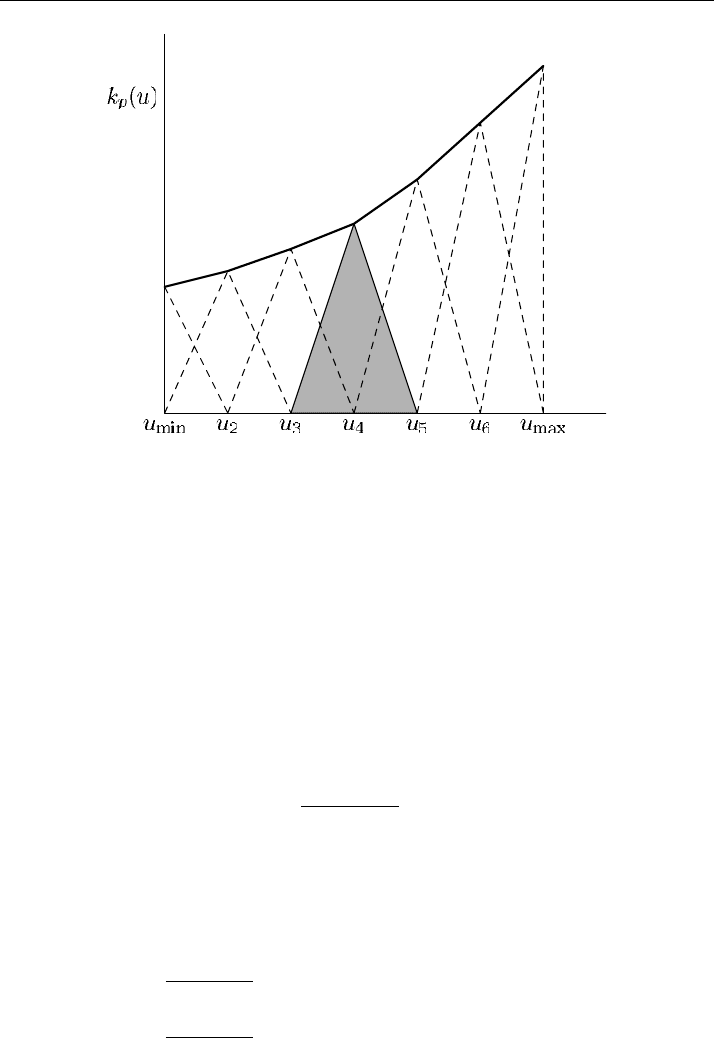
Figure 8.20 Piecewise-linear approximation
provided that the value of the regularization parameter α is properly matched with the
input-data inaccuracy (i.e., with the value of δ in (8.149)). An alternative here is an
iteration method for determining the vector a.
In the second variant of the parametric identification algorithm, specific features of
parametric identification are taken into account more fully. Here, the dimensionality
of K
p
, or the number of elements in the expansion (8.147), is used as the regulariza-
tion parameter. Here, we can speak of self-regularizing properties exhibited by the
discretization algorithm (8.147).
As a typical example of (8.147), consider piecewise linear approximation. We as-
sume that a grid
u
β
= u
min
+ (β − 1)
u
max
− u
min
p − 1
,β= 1, 2,...,p.
is introduced, uniform over the variable u. In this case (see Figure 8.20), the piecewise
linear finite functions η
β
(u), β = 1, 2,..., p are given in the form
η
β
(u) =
⎧
⎪
⎪
⎪
⎪
⎪
⎪
⎪
⎨
⎪
⎪
⎪
⎪
⎪
⎪
⎪
⎩
0, u < u
β−1
,
u − u
β−1
u
β
− u
β−1
, u
β−1
< u < u
β
,
u
β+1
− u
u
β+1
− u
β
, u
β−1
< u < u
β
,
0, u > u
β+1
,
β = 2, 3,...,p − 1,
and the coefficients are a
β
= k
p
(u
β
), β = 1, 2,...,p. In this representation of the

Section 8.4 Coefficient inverse problem for the nonlinear parabolic equation 401
approximate solution, the mesh size over u or the total number p of nodes can be used
as a regularization parameter.
In the use of the regularization method (8.150), the computational algorithms for
parametric identification (8.147) are related with the minimization problem for the
function p of the variable J
α
(a). Let us formulate a necessary condition for a
minimum that can be used to construct numerical algorithms for the parameters a
β
,
β = 1, 2,...,p. Immediately from (8.150), we have:
∂ J
α
∂a
β
= 2
M
m=1
T
0
(u(z
m
, t;a) − ϕ
m
(t))
∂u
∂a
β
dt + 2αa
β
. (8.151)
Relations (8.132)–(8.134) and representation (8.147) for ∂u/∂a
β
yield the following
boundary value problem:
∂v
∂t
−
∂
∂x
k(u)
∂v
∂x
=
∂
∂x
η
β
(u)
∂u
∂x
, 0 < x < l, 0 < t ≤ T , (8.152)
v(0, t) = 0,v(l, t) = 0, 0 < t ≤ T, (8.153)
v(x, 0) = 0, 0 ≤ x ≤ l. (8.154)
To obtain a more convenient representation for the first term in the right-hand side
of (8.151), we formulate a boundary value problem for the conjugate state. Let the
function ψ(x, t) with some known u(x, t) be the solution of the boundary value prob-
lem (8.142), (8.143), (8.145). We multiply equation (8.152) through by ψ(x, t); then,
integrating the resulting equation over x and t, by direct calculations we obtain the
desired system of equations:
T
0
l
0
η
β
(u)
∂u
∂x
∂ψ
∂x
dx dt + 2αa
β
= 0,β= 1, 2,..., p. (8.155)
Around (8.155), we can construct the computational algorithms. In particular, we can
use iteration methods for determining the parameters a
β
, β = 1, 2,...,p. Here, the
complication owing to the nonlinear dependence of the ground state u(x, t) on the
sought coefficient k(u) = k
p
(u) must be taken into account.
Under monotonic conditions for the boundary conditions of type (8.136), successive
identification algorithms can be constructed. A similar local regularization procedure
was discussed above, in the consideration of evolutionary inverse problems in which
it was required to reconstruct the initial condition and the boundary conditions. In
the case of (8.132)–(8.136), at each time in the interval t ≤ t
∗
< T we can find
the relation k(u) for u ≤ g(t
∗
). Such specific features of the coefficient problem
under consideration can most easily be taken into account in the case of parametric
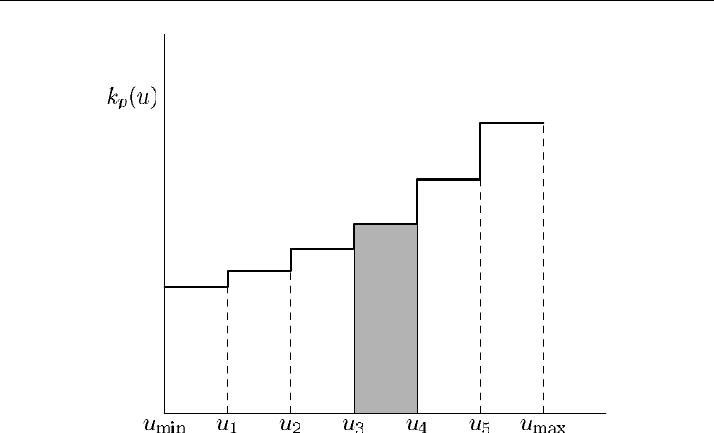
optimization of (8.147) in the class of piecewise constant functions. In the latter case
(see also Figure 8.21), with the use of the uniform grid
u
β
= u
min
+ β
u
max
− u
min
p
,β= 0, 1,...,p
402 Chapter 8 Other problems
Figure 8.21 Piecewise-constant approximation
the trial functions are given in the form
η
β
(u) =
⎧
⎨
⎩
0, u < u
β−1
,
1, u
β−1
≤ u ≤ u
β
,
0, u > u
β
,
β = 1, 2,...,p. (8.156)
In the case of the latter parameterization, with u
β−1
≤ u ≤ u
β
it is required to find just
one numerical parameter a
β
since the parameters a
ν
, ν = 1, 2,...,β − 1 were found
previously. Such a procedure is possible not only with piecewise constant completion
of the unknown coefficient, but also in using other approximations of (8.147), for
instance, with the piecewise linear approximation (see Figure 8.20).
8.4.4 Difference problem
Consider problems that arise when the parametric optimization algorithm in the vari-
ant of local regularization is used in the approximate solution of the coefficient inverse
problem (8.132)–(8.135). Under the assumptions of (8.136), we solve the identifica-
tion problem for the coefficient k(u) in the class (8.147), (8.156).
We begin with constructing the difference analogue to the direct problem (8.132)–
(8.134). Over time, we introduce the simplest uniform grid
¯ω
τ
= ω
τ
∪{T }={t
n
= nτ, n = 0, 1,...,N
0
,τN
0
= T }
with some step size τ>0. To find the approximate solution by the time t = t
n
,we
use the notations y
n
(x) = y(x, t
n
).

Section 8.4 Coefficient inverse problem for the nonlinear parabolic equation 403
We complement the time-uniform grid with a grid non-uniform over u. With
(8.133), (8.136), we define
g
n
= g(t
n
), n = 0, 1,...,N
0
,
u
min
= g
0
< g
1
< ···< g
n−1
< g
n
< ···< g
N
0
= u
max
.
Using these data, one can construct a cruder grid over u:
u
β
= u
β−1
+ N
(β)
0
τ,
u
0
= u
min
, u
p
= u
max
,β= 1, 2,...,p.
(8.157)
In this way, between the nodes u
β−1
and u
β
we make N
(β)
0
time steps.
We denote as ¯ω a uniform grid with a step size h over the interval
¯
= [0, l]:
¯ω ={x | x = x
i
= ih, i = 0, 1,...,N, Nh = l}
Here, ω is the set of internal nodes, and ∂ω is the set of boundary nodes. We define
the difference operator
A(v)y =−(d(v)y
¯x
)
x
, x ∈ ω.
Then, we set the coefficient d(v) in the form
d(v) = k(0.5(v(x) + v(x − h))), d(v) = 0.5(k(v(x − h)) + k(v(x))).
At the internal grid nodes over space, we put in correspondence to equation (8.132)
the purely implicit difference scheme
y
n+1
− y
n
τ
+ A(y
n+1
)y
n+1
= 0,
x ∈ ω, n = 0, 1,...,N
0
− 1.
(8.158)
The approximation of the boundary conditions (8.133) yields
y
n+1
(0) = 0, y
n+1
(l) = g
n+1
, n = 0, 1,...,N
0
− 1. (8.159)
To the initial condition (8.134), the following condition corresponds:
y
0
= 0, x ∈ ω. (8.160)
The matter of construction and computational realization of difference schemes for
the approximate solution of direct initially boundary problems of type (8.132)–(8.134)
was considered in more detail in Chapter 4. Of our primary concern here is the fol-
lowing question: how, based on the difference scheme (8.158)–(8.160), computational
algorithms for numerical solution of the coefficient inverse problem (8.132)–(8.134)
can be constructed.

404 Chapter 8 Other problems
In using the piecewise constant approximation (8.147), (8.156), (8.157) of the un-
known coefficient k(u), we can use the step-by-step identification method. We assume
that some approximation for the nonlinear coefficient is available for 0 ≤ u < u
β−1
.
The difference solution at the corresponding time, and at preceding times, is also
found. We seek the solution of the inverse problem for u
β−1
≤ u < u
β
.
We denote as L
(β)
the number of the time layer at which the solution u
β
is achieved.
With (8.157), we obtain:
L
(β)
=
β
γ =1
N
(γ )
0
, L
(0)
= 0,β= 1, 2,...,p.
In solving the inverse problem, the solution y
l
,0≤ l ≤ L
(β−1)
is known; according to
(8.147), (8.156), (8.157)), also known is the sought coefficient k
u
in the same interval
(0 < u < u
β−1
).
Next, we solve the difference problem
y
n+1
− y
n
τ
+ A(y
n+1
)y
n+1
= 0, x ∈ ω,
n = L
(β−1)
+ 1, L
(β−1)
+ 2,...,L
(β)
(8.161)
y
n+1
(0) = 0, y
n+1
(l) = g
n+1
,
n = L
(β−1)
+ 1, L
(β−1)
+ 2,...,L
(β)
.
(8.162)
Here, only the coefficient a
β
is unknown. To determine this coefficient, we invoke
additional available information (see (8.148), (8.149)).
We assume that the observation points z
m
, m = 1, 2,...,M are some internal
nodes of the calculation grid over space. As the criterion for closeness of the ap-
proximate solution at these points to measured values, in solution of problem (8.161),
(8.162), in line with (8.148), it seems reasonable to use the criterion
J
(β)
=
M
m=1
L
(β)
n=L
(β−1)
+1
(y
n
(z
m
) − ϕ
δ
m
(t
n
))
2
τ. (8.163)
In view of J
(β)
= J
(β)
(a
β
), the parameter a
β
can be found from the minimum of the
function J
(β)
(a
β
). In computational realization, to find the minimum of (8.163), we
can use standard minimization methods for a function of one variable (the golden-
section method, the method of parabolas, etc.).
In the local regularization under consideration, matching with the input-data inac-
curacy can be achieved through a proper choice of the interval [u
β−1
, u
β
] (choice of
N
(β)
0
= L
(β)
−L
(β−1)
in (8.161), (8.162). Using the discrepancy principle and inequal-
ity (8.149), we choose a maximum N
(β)
0
for which
J
(β)
≤ MN
(β)
0
δ
2
. (8.164)

Section 8.4 Coefficient inverse problem for the nonlinear parabolic equation 405
In some critical cases, relation (8.164) can be violated at all N
(β)
0
; then, we have to
choose N
(β)
0
= 1.
8.4.5 Program
The computational algorithm for the successive determination of the nonlinear coeffi-
cient k(u) is realized in the program PROBLEM18. Consider some specific features of
this program.
The time interval is divided into equal subintervals; the total number of these subin-
tervals is p = 2
ν
, ν = 0, 1,...,ν
max
(in the case of N
0
= 2
ν
max
). The refinement is
terminated on achievement of a certain level of discrepancy or on the condition that
subsequent densening of the grid does not decrease the discrepancy. To approximately
solve the nonlinear equation for the constant, we use the golden-section method.
Program PROBLEM18
C
C PROBLEM18 - COEFFICIENT INVERSE PROBLEM
C QUASI-LINEAR 1D PARABOLIC EQUATION
C
IMPLICIT REAL
*
8 ( A-H, O-Z )
PARAMETER ( DELTA = 0.02D0, N = 100, M = 128 )
DIMENSION X(N+1), Y(N+1), Y1(N+1), YT(N+1)
+ ,U(N+1,M+1), AKS(M+1), PHI(M+1), PHID(M+1)
+ ,BR(M+1), UL(M+1)
+ ,A(N+1), B(N+1), C(N+1), F(N+1)
+ ,ALPHA(N+2), BETA(N+2)
C
C PARAMETERS:
C
C XL, XR - LEFT AND RIGHT END POINTS OF THE GEGMENT;
C N + 1 - NUMBER OF NODAL POINTS OVER SPACE;
C M + 1 - NUMBER OF NODAL POINTS OVER TIME;
C XD - OBSERVATION POINT;
C PHI(M+1) - EXACT SOLUTION AT THE OBSERVATION POINT;
C PHID(M+1) - DISTURBED SOLUTION AT THE OBSERVATION POINT;
C
XL = 0.D0
XR = 1.D0
TMAX = 1.D0
XD = 0.6D0
EPSA = 1.D-4
EPSH = 1.D-4
C
OPEN (01, FILE=’RESULT.DAT’) ! FILE TO STORE THE CALCULATED DATA
C
C GRID
C
H =(XR-XL)/N
TAU = TMAX / M
DOI=1,N+1
X(I) = XL + (I-1)
*
H
END DO
C