
Samarskii A.A., Vabishchevich P.N. Numerical Methods for Solving Inverse Problems of Mathematical Physics
Подождите немного. Документ загружается.


366 Chapter 8 Other problems
At the internal nodes, in using the purely implicit scheme we approximate equation
(8.54) with the difference equation
y
n+1
− y
n
τ
− (ay
n+1
¯x
)
x
= 0, x ∈ ω, n = 0, 1,...,N
0
− 1, (8.79)
with, for instance, a(x) = k(x − 0.5h). The initial condition (8.56) yields:
y
0
(x) = 0, x ∈ ω. (8.80)
The second-kind boundary condition (8.55) is approximated on the solutions of
(8.54):
y
n+1
0
− y
n
0
τ
−
2
h
a
1
y
n+1
1
− y
n+1
0
h
= 0, n = 0, 1,...,N
0
− 1. (8.81)
To the non-local boundary condition (8.57), we put in correspondence the non-local
difference condition
y
n+1
0
+ αy
n+1
N
= ϕ
n+1
, n = 0, 1,...,N
0
− 1. (8.82)
Realization of the difference scheme (8.79)–(8.82) implies solution of the three-
point difference problem at each time step with the non-local boundary conditions
(8.82). To this end, we can use some modification of the standard sweep algorithm.
A second possibility was considered previously, in the discussion of non-local regu-
larization; this possibility is related with the use of some special representation of the
solution (see (8.63) and (8.72)).
We seek the solution of the difference problem (8.79)–(8.82) in the form
y
n+1
(x) = z
n+1
(x) + q(x)v
n+1
, x ∈¯ω. (8.83)
Here, similarly to (8.64)–(8.67), the mesh function z
n
(x) is defined as the solution
of the following direct problem:
z
n+1
− y
n
τ
− (az
n+1
¯x
)
x
= 0, x ∈ ω, n = 0, 1,...,N
0
− 1, (8.84)
z
0
(x) = 0, x ∈ ω, (8.85)
z
n+1
0
− y
n
0
τ
−
2
h
a
1
z
n+1
1
− z
n+1
0
h
= 0, n = 0, 1,...,N
0
− 1, (8.86)
z
n+1
N
= 0, n = 0, 1,...,N
0
− 1. (8.87)
The mesh function q(x) (see (8.73), (8.74)) is defined as the solution of the boundary
value problem
q
τ
− (aq
¯x
)
x
= 0, x ∈ ω, (8.88)

Section 8.2 Non-local distribution of boundary conditions 367
q
0
τ
−
2
h
q
1
− q
0
h
= 0, q
N
= 1. (8.89)
Substitution of (8.83) into (8.82) yields:
v
n+1
=
ϕ
n+1
− z
n+1
0
α + q
0
, n = 0, 1,...,N
0
− 1. (8.90)
For the solution of the difference problem (8.79)–(8.82) to be found, we have to solve
two standard problems, problems (8.84)–(8.87) and (8.88), (8.89) and, then, find the
function v
n
, n = 1, 2,...,N by formula (8.90); subsequently, the sought solution is
to be represented in the form (8.83).
8.2.5 Program
The above solution algorithm for the boundary value inverse problem (8.49), (8.50),
(8.52), (8.53) based on a non-local perturbation of the boundary condition is realized
in the program PROBLEM16.
Program PROBLEM16
C
C PROBLEM16 - IDENTIFICATION OF THE BOUNDARY CONDITION
C ONE-DIMENSIONAL NON-STATIONARY PROBLEM
C NON-LOCAL DISTURBANCE OF THE BOUNDARY CONDITION
C
IMPLICIT REAL
*
8 ( A-H, O-Z )
PARAMETER ( DELTA = 0.01D0,N=101,M=21)
DIMENSION X(N), Y(N), Z(N), Q(N)
+ ,FI(M), FID(M), FIY(M), U(M), UA(M)
+ ,A(N), B(N), C(N), F(N)
C
C PARAMETERS:
C
C XL, XR - LEFT AND RIGHT ENDS OF THE GEGMENT;
C N - NUMBER OF GRID NODES OVER SPACE;
C TMAX - MAXIMAL TIME;
C M - NUMBER OF GRID NODES OVER TIME;
C DELTA - INPUT-DATA INACCURACY LEVEL;
C FI(M) - EXACT DIFFERENCE BOUNDARY CONDITION;
C FID(M) - DISTURBED DIFFERENCE BOUNDARY CONDITION;
C U(M) - EXACT SOLUTION OF THE INVERSE PROBLEM
C (BOUNDARY CONDITION);
C UA(M) - APPROXIMATE SOLUTION OF THE INVERSE PROBLEM;
C
XL = 0.D0
XR = 1.D0
TMAX = 1.D0
C
OPEN ( 01, FILE=’RESULT.DAT’) ! FILE TO STORE THE CALCULATED DATA
C
C GRID
C
H=(XR-XL)/(N-1)

368 Chapter 8 Other problems
DOI=1,N
X(I) = XL + (I-1)
*
H
END DO
TAU = TMAX / (M-1)
C
C DIRECT PROBLEM
C
C BOUNDARY REGIME
C
DOK=1,M
T = (K-1)
*
TAU
U(K) = AF(T, TMAX)
END DO
C
C INITIAL CONDITION
C
T = 0.D0
DOI=1,N
Y(I) = 0.D0
END DO
C
C NEXT TIME LAYER
C
DOK=2,M
T=T+TAU
C
C DIFFERENCE-SCHEME COEFFICIENTS
C PURELY IMPLICIT SCHEME
C
DOI=2,N-1
A(I) = 1.D0 / (H
*
H)
B(I) = 1.D0 / (H
*
H)
C(I) = A(I) + B(I) + 1.D0 / TAU
F(I) = Y(I) / TAU
END DO
C
C BOUNDARY CONDITION AT THE LEFT AND RIGHT ENDS
C
B(1) = 2.D0 / (H
*
H)
C(1) = B(1) + 1.D0 / TAU
F(1) = Y(1) / TAU
A(N) = 0.D0
C(N) = 1.D0
F(N) = U(K)
C
C SOLUTION OF THE PROBLEM ON THE NEXT TIME LAYER
C
ITASK = 1
CALL PROG3 ( N, A, C, B, F, Y, ITASK )
C
C SOLUTION AT THE LEFT BOUNDARY
C
FI(K) = Y(1)
FID(K) = FI(K)
END DO
C
C NOISE ADDITION TO THE SOLUTION OF THE BOUNDARY-VALUE PROBLEM
C
DOK=2,M

Section 8.2 Non-local distribution of boundary conditions 369
FID(K) = FI(K) + 2.D0
*
DELTA
*
(RAND(0)-0.5D0)
END DO
C
C INVERSE PROBLEM
C
C NON-LOCAL DISTURBANCE OF THE BOUNDARY CONDITION
C
C AUXILIARY MESH FUNCTION
C
C DIFFERENCE-SCHEME COEFFICIENTS
C
DOI=2,N-1
A(I) = 1.D0 / (H
*
H)
B(I) = 1.D0 / (H
*
H)
C(I) = A(I) + B(I) + 1.D0 / TAU
F(I) = 0.D0
END DO
C
C BOUNDARY CONDITION AT THE LEFT AND RIGHT END POINTS
C
B(1) = 2.D0 / (H
*
H)
C(1) = B(1) + 1.D0 / TAU
F(1) = 0.D0
A(N) = 0.D0
C(N) = 1.D0
F(N) = 1.D0
C
C SOLUTION OF THE PROBLEM
C
ITASK = 1
CALL PROG3 ( N, A, C, B, F, Q, ITASK )
C
C ITERATIVE PROCESS FOR THE REGULARIZATION PARAMETER
C
IT=0
ITMAX = 100
ALPHA = 0.001D0
QQ = 0.75D0
100IT=IT+1
C
C INITIAL CONDITION
C
T = 0.D0
DOI=1,N
Y(I) = 0.D0
END DO
UA(1) = Y(N)
C
C NEXT TIME LAYER
C
DOK=2,M
T=T+TAU
C
C DIFFERENCE-SCHEME COEFFICIENTS
C PURELY IMPLICIT SCHEME
C
DOI=2,N-1
A(I) = 1.D0 / (H
*
H)
B(I) = 1.D0 / (H
*
H)
C(I) = A(I) + B(I) + 1.D0 / TAU

370 Chapter 8 Other problems
F(I) = Y(I) / TAU
END DO
C
C BOUNDARY CONDITION AT THE LEFT AND RIGHT END POINTS
C
B(1) = 2.D0 / (H
*
H)
C(1) = B(1) + 1.D0 / TAU
F(1) = Y(1) / TAU
A(N) = 0.D0
C(N) = 1.D0
F(N) = 0.D0
C
C SOLUTION OF THE AUXILIARY PROBLEM ON THE NEXT TIME LAYER
C
ITASK = 1
CALL PROG3 ( N, A, C, B, F, Z, ITASK )
C
C SOLUTION AT THE RIGHT BOUNDARY
C
UA(K) = (FID(K) - Z(1)) / (ALPHA + Q(1))
C
C SOLUTION AT ALL NODES
C
DOI=1,N
Y(I) = Z(I) + Q(I)
*
UA(K)
END DO
END DO
C
C SOLUTION OF THE DIRECT PROBLEM WITH THE FOUND BOUNDARY CONDITION
C
C INITIAL CONDITION
C
T = 0.D0
DOI=1,N
Y(I) = 0.D0
END DO
FIY(1) = Y(1)
C
C NEXT TIME LAYER
C
DOK=2,M
T=T+TAU
C
C DIFFERENCE-SCHEME COEFFICIENTS
DOI=2,N-1
A(I) = 1.D0 / (H
*
H)
B(I) = 1.D0 / (H
*
H)
C(I) = A(I) + B(I) + 1.D0 / TAU
F(I) = Y(I) / TAU
END DO
C
C BOUNDARY CONDITION AT THE LEFT AND RIGHT END POINTS
C
B(1) = 2.D0 / (H
*
H)
C(1) = B(1) + 1.D0 / TAU
F(1) = Y(1) / TAU
A(N) = 0.D0
C(N) = 1.D0
F(N) = UA(K)
C

Section 8.2 Non-local distribution of boundary conditions 371
C SOLUTION OF THE PROBLEM ON THE NEXT TIME LAYER
C
ITASK = 1
CALL PROG3 ( N, A, C, B, F, Y, ITASK )
FIY(K) = Y(1)
END DO
C
C CRITERION FOR THE EXIT FROM THE ITERATIVE PROCESS
C
SUM = 0.D0
DOK=1,M
SUM = SUM + (FIY(K) - FID(K))
**
2
*
TAU
END DO
SL2 = DSQRT(SUM)
C
IF (IT.GT.ITMAX) STOP
IF ( IT.EQ.1 ) THEN
IND=0
IF ( SL2.LT.DELTA ) THEN
IND=1
QQ = 1.D0/QQ
END IF
ALPHA = ALPHA
*
QQ
GO TO 100
ELSE
ALPHA = ALPHA
*
QQ
IF ( IND.EQ.0 .AND. SL2.GT.DELTA ) GO TO 100
IF ( IND.EQ.1 .AND. SL2.LT.DELTA ) GO TO 100
END IF
C
C RECORDING OF CALCULATED DATA
C
WRITE ( 01,
*
) (U(K), K = 1,M)
WRITE ( 01,
*
) (FID(K), K = 1,M)
WRITE ( 01,
*
) (UA(K), K = 1,M)
WRITE ( 01,
*
) (FIY(K), K = 1,M)
CLOSE ( 01 )
STOP
END
C
DOUBLE PRECISION FUNCTION AF ( T, TMAX )
IMPLICIT REAL
*
8 ( A-H, O-Z )
C
C BOUNDARY CONDITION AT THE RIGHT BOUNDARY
C
AF = 2.D0
*
T/TMAX
IF (T.GT.(0.5D0
*
TMAX)) AF = 2.D0
*
(TMAX-T)/TMAX
C
RETURN
END
The program implements the algorithm with non-locally perturbed boundary condi-
tions for problem (8.49), (8.50), (8.52), (8.53) with the coefficient k(x) = const = 1
and with the non-local perturbation parameter chosen from the discrepancy.
372 Chapter 8 Other problems
8.2.6 Computational experiments
The problem was solved using a uniform grid with h = 0.01 and τ = 0.05 in the
calculation domain with l = 1 and T = 1. The input data in the inverse problem were
taken from the solution of the direct problem with the right-end boundary condition
ψ(t) =
2t/T , 0 < t < T/2,
2(T − t)/T, T/2 < t < T.
The same model problem was considered above, when we discussed the algorithm
with continuation over the spatial variable.
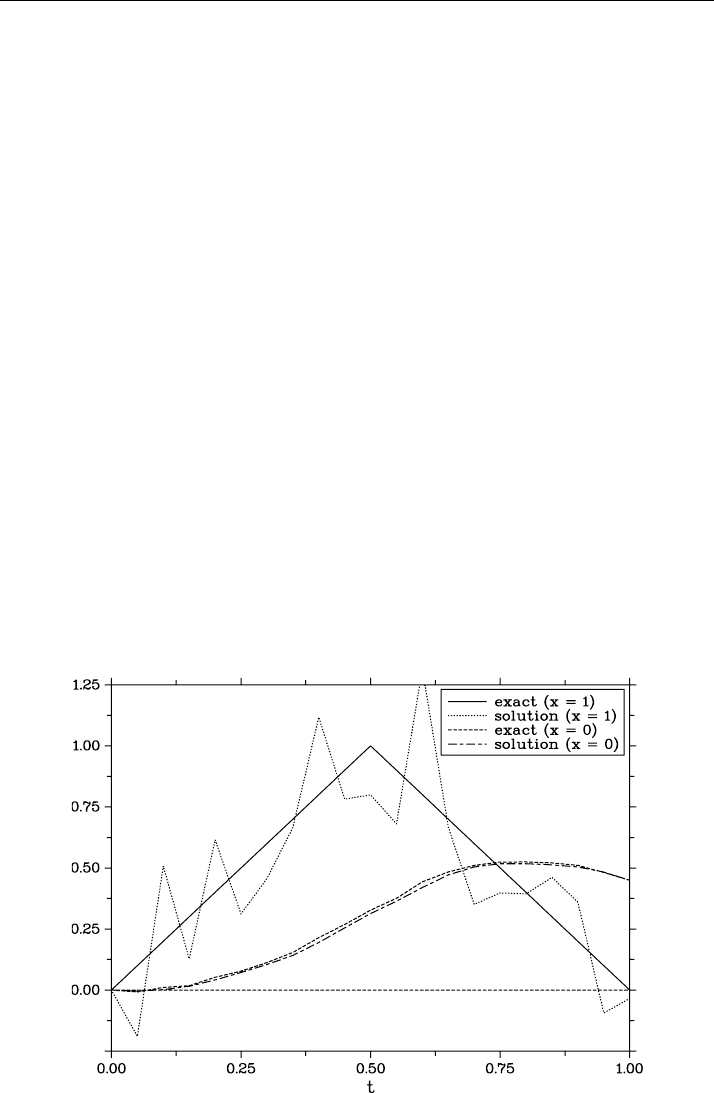
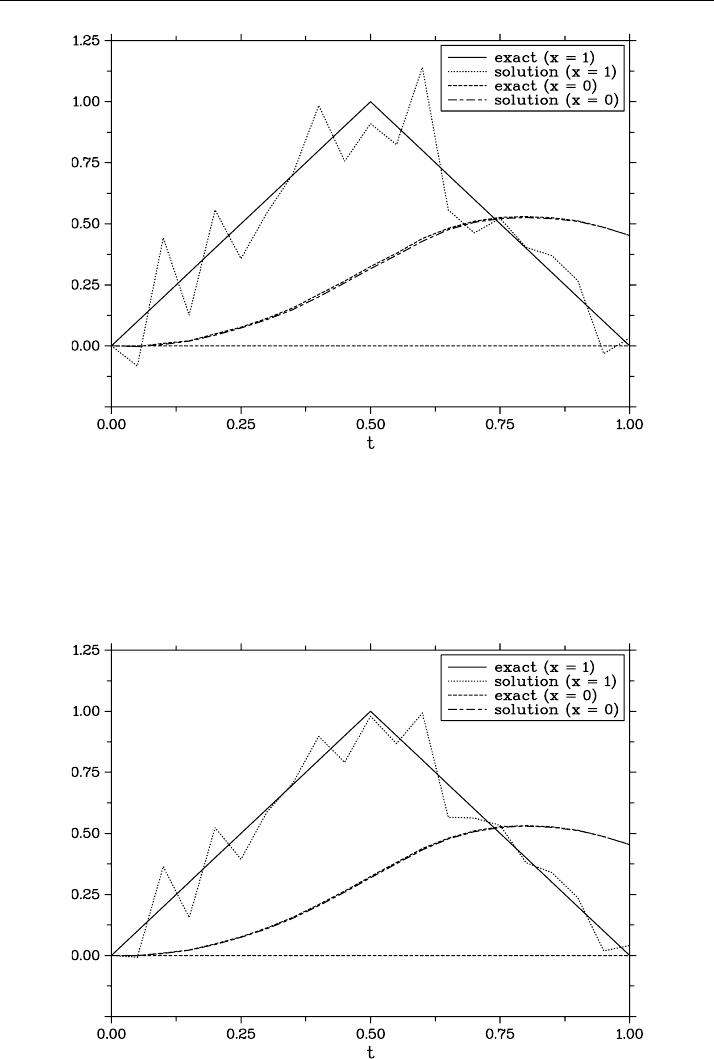
The data calculated with the various input-data inaccuracy levels are shown in Fig-
ures 8.6–8.8. A comparison with the data obtained using the algorithm with contin-
uation over the spatial variable (see Figures 8.2, 8.4, 8.5) shows that the algorithm
with non-locally perturbed boundary condition is inferior in terms of data accuracy
because it poorly takes into account the specific features of the boundary value inverse
problems of interest. With this approach, we hardly can count on time filtration of
high-frequency inaccuracies because here, in fact, we have regularization with respect
to the spatial variable.
In many respects, the effect due to the regularization is provided at the expense of
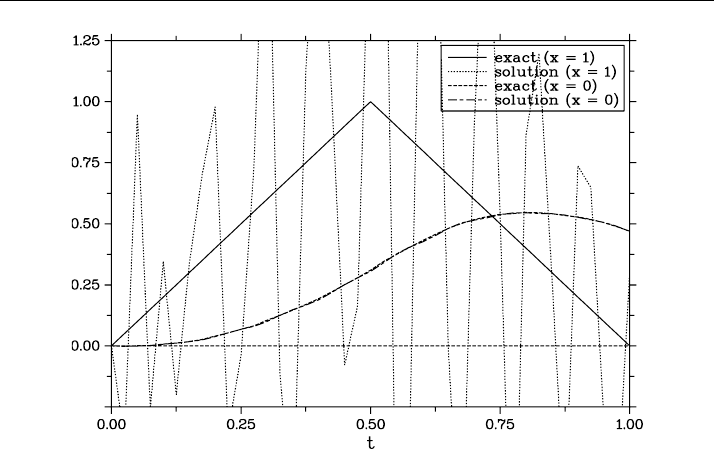
cruder calculation grids along time (self-regularization effect). An illustration here
are the data calculated with a finer grid along time (see Figure 8.9). The input-data
inaccuracies can be most distinctly identified by reducing the time step size. The latter
can be explicitly traced considering the formula for the solution at the right boundary,
since q
0
→ 0asτ → 0.
Figure 8.6 Inverse-problem solution obtained with δ = 0.01
Section 8.2 Non-local distribution of boundary conditions 373
Figure 8.7 Inverse-problem solution obtained with δ = 0.005
Figure 8.8 Inverse-problem solution obtained with δ = 0.0025
374 Chapter 8 Other problems
Figure 8.9 Solutions obtained with δ = 0.0025 and τ = 0.025
8.3 Identification of the boundary condition
in the two-dimensional problem
In this section, we consider the boundary-layer inverse problem for the two-
dimensional parabolic equation of second order. From data on some portion of the
boundary, it is required to reconstruct the boundary data on the other portion of the
boundary. To approximately solve the problem, we use the iteration method. Primary
attention is given to accurate formulation of the symmetrized operator equation of the
first order at the differential and mesh levels.
8.3.1 Statement of the problem
To most powerful methods intended for the approximate solution of inverse problems
for mathematical physics equations, iteration methods belong. These methods rather
adequately take into account the general specific features of the problems. Very often,
the correct use of such methods is hampered by the necessity to perform certain analyt-
ical work primarily related with the fact that symmetrization of the corresponding op-
erator equation of the first order is necessary. Similar problems are encountered in the
formulation of necessary minimum conditions in the Tikhonov regularization method
as applied to related optimum control problems for systems governed by mathematical
physics equations. Here, the matter of obtaining the symmetrized operator equation is
considered both on the differential level and on the mesh level.
Section 8.3 Identification of the boundary condition in two-dimensional problems 375
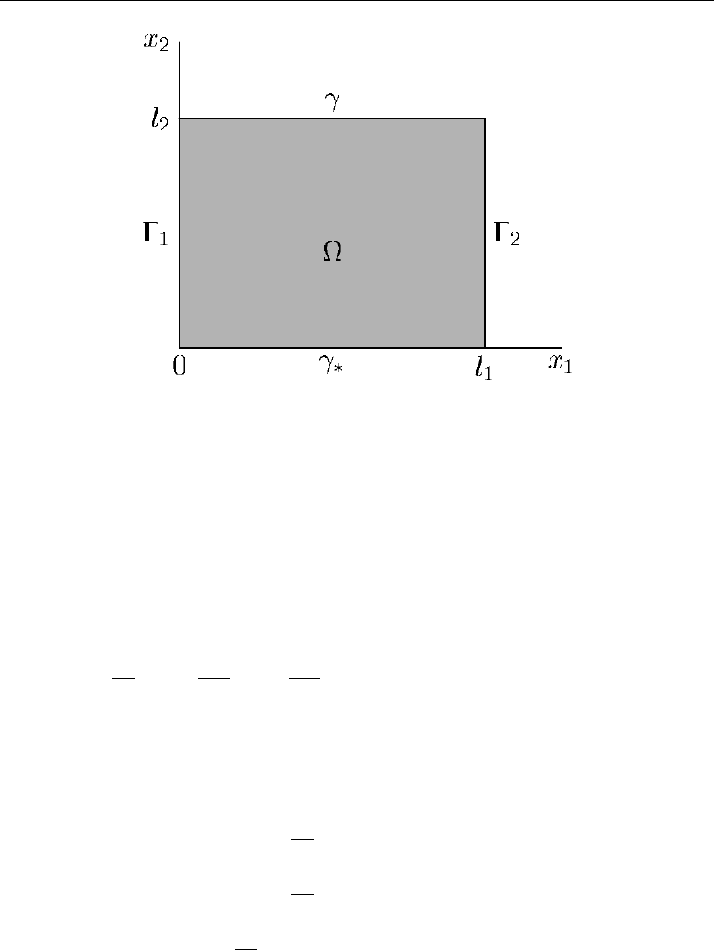
Figure 8.10 Calculation domain
As a model one, consider the two-dimensional problem in the rectangle
={x | x = (x
1
, x
2
), 0 < x
β
< l
β
,β= 1, 2}.
For the sides of , we use the following notations (see Figure 8.10):
∂ = γ
∗
∪
1
∪ γ ∪
2
,=
1
∪
2
.
In , we seek the solution of the parabolic equation
∂u
∂t
−
2
β=1
∂
∂x
β
k(x)
∂u
∂x
β
= 0, x ∈ , 0 < t < T . (8.91)
We assume that k(x) ≥ κ, κ>0, x ∈ .
The starting point in the present consideration is the direct initial-boundary value
problem for equation (8.91), in which the boundary and initial conditions look as
k(x)
∂u
∂n
(x, t) = 0, x ∈ ∂γ
∗
, (8.92)
k(x)
∂u
∂n
(x, t) = 0, x ∈ , (8.93)
k(x)
∂u
∂n
(x, t) = μ(x
1
, t), x ∈ γ, (8.94)
u(x, 0) = 0, x ∈ . (8.95)
Consider an inverse problem in which it is required to identify the boundary condi-
tion on some portion of the boundary (on γ ). In the latter case, instead of (8.94) the
following condition is given:
u(x, t) = ϕ(x
1
, t), x ∈ γ
∗
. (8.96)