
Samarskii A.A., Vabishchevich P.N. Numerical Methods for Solving Inverse Problems of Mathematical Physics
Подождите немного. Документ загружается.


356 Chapter 8 Other problems
B(I) = 1.D0 / (H
*
H)
C(I) = A(I) + B(I) + 1.D0 / TAU
FF(I) = Y(I,K-1) / TAU
END DO
C
C BOUNDARY CONDITION AT THE LEFT AND RIGHT END POINTS
C
B(1) = 2.D0 / (H
*
H)
C(1) = B(1) + 1.D0 / TAU
FF(1) = Y(1,K-1) / TAU
A(N) = 0.D0
C(N) = 1.D0
FF(N) = Q(K)
C
C SOLUTION OF THE PROBLEM ON THE NEXT TIME LAYER
C
ITASK = 1
CALL PROG3 ( N, A, C, B, FF, YY, ITASK )
DOI=1,N
Y(I,K) = YY(I)
END DO
END DO
C
C SOLUTION ON THE LEFT BOUNDARY
C
DOK=1,M
FI(K) = Y(1,K)
FID(K) = FI(K)
END DO
C
C NOISE ADDITION TO THE SOLUTION OF THE BOUNDARY-VALUE PROBLEM
C
DOK=2,M
FID(K) = FI(K) + 2.D0
*
DELTA
*
(RAND(0)-0.5D0)
END DO
C
C INVERSE PROBLEM
C
C GENERALIZED INVERSE METHOD
C CONTINUATION OVER THE SPATIAL VARIABLE
C
IT=0
ITMAX = 100
ALPHA = 0.001D0
QQ = 0.75D0
100IT=IT+1
C
C INITIAL CONDITIONS
C (LEFT BOUNDARY)
C
DOK=2,M
Y(1,K) = FID(K)
Y(2,K) = FID(K) + 0.5D0
*
H
**
2
*
(FID(K)-FID(K-1))/TAU
END DO
C
C NEXT LAYER
C
DOI=3,N
C
C DIFFERENCE-SCHEME COEFFICIENTS

Section 8.1 Continuation over spatial variable in boundary value inverse problems 357
C
DOK=2,M-1
A(K) = ALPHA / (H
*
TAU
**
2)
B(K) = ALPHA / (H
*
TAU
**
2)
C(K) = A(K) + B(K) + 1.D0 / (H
*
H)
FF(K) = (Y(I-1,K)-Y(I-1,K-1))/TAU
+ + (2.D0
*
Y(I-1,K) - Y(I-2,K))/(H
*
H)
+ - A(K)
*
(Y(I-2,K+1)-2.D0
*
Y(I-2,K)+Y(I-2,K-1))
END DO
C
C BOUNDARY CONDITION ON THE BOTTOM AND ON THE TOP
C
B(1) = 0.D0
C(1) = 1.D0
FF(1) = 0.D0
A(M) = ALPHA / (H
*
TAU
**
2)
C(M) = A(M) + 1.D0 / (H
*
H)
FF(M) = (Y(I-1,M)-Y(I-1,M-1))/TAU
+ + (2.D0
*
Y(I-1,M) - Y(I-2,M))/(H
*
H)
+ - A(M)
*
(-Y(I-2,M)+Y(I-2,M-1))
C
C SOLUTION OF THE PROBLEM ON THE NEXT LAYER
C
ITASK = 1
CALL PROG3 ( M, A, C, B, FF, YY, ITASK )
DOK=1,M
Y(I,K) = YY(K)
END DO
END DO
C
C SOLUTION
C
DOK=1,M
QA(K) = Y(N,K)
END DO
C
C SOLUTION OF THE DIRECT PROBLEM WITH THE FOUND BOUNDARY CONDITION
C
C INITIAL CONDITION
C
T = 0.D0
DOI=1,N
Y(I,1) = 0.D0
END DO
C
C NEXT TIME LAYER
C
DOK=2,M
T=T+TAU
C
C DIFFERENCE-SCHEME COEFFICIENTS
DOI=2,N-1
A(I) = 1.D0 / (H
*
H)
B(I) = 1.D0 / (H
*
H)
C(I) = A(I) + B(I) + 1.D0 / TAU
FF(I) = Y(I,K-1) / TAU
END DO
C
C BOUNDARY CONDITION AT THE LEFT AND RIGHT END POINTS
C

358 Chapter 8 Other problems
B(1) = 2.D0 / (H
*
H)
C(1) = B(1) + 1.D0 / TAU
FF(1) = Y(1,K-1) / TAU
A(N) = 0.D0
C(N) = 1.D0
FF(N) = QA(K)
C
C SOLUTION OF THE PROBLEM ON THE NEXT TIME LAYER
C
ITASK = 1
CALL PROG3 ( N, A, C, B, FF, YY, ITASK )
DOI=1,N
Y(I,K) = YY(I)
END DO
END DO
C
C CRITERION FOR THE EXIT FROM THE ITERATIVE PROCESS
C
SUM = 0.D0
DOK=1,M
FIY(K) = Y(1,K)
SUM = SUM + (FIY(K) - FID(K))
**
2
*
TAU
END DO
SL2 = DSQRT(SUM)
C
IF (IT.GT.ITMAX) STOP
IF ( IT.EQ.1 ) THEN
IND=0
IF ( SL2.LT.DELTA ) THEN
IND=1
QQ = 1.D0/QQ
END IF
ALPHA = ALPHA
*
QQ
GO TO 100
ELSE
ALPHA = ALPHA
*
QQ
IF ( IND.EQ.0 .AND. SL2.GT.DELTA ) GO TO 100
IF ( IND.EQ.1 .AND. SL2.LT.DELTA ) GO TO 100
END IF
C
C RECORDING OF CALCULATED DATA
C
WRITE ( 01,
*
) (Q(K), K = 1,M)
WRITE ( 01,
*
) (FID(K), K = 1,M)
WRITE ( 01,
*
) (QA(K), K = 1,M)
WRITE ( 01,
*
) (FIY(K), K = 1,M)
CLOSE ( 01 )
STOP
END
C
DOUBLE PRECISION FUNCTION AF ( T, TMAX )
IMPLICIT REAL
*
8 ( A-H, O-Z )
C
C BOUNDARY CONDITION ON THE RIGHT BOUNDARY
C
AF = 2.D0
*
T/TMAX
IF (T.GT.(0.5D0
*
TMAX)) AF = 2.D0
*
(TMAX-T)/TMAX
C
RETURN
Section 8.1 Continuation over spatial variable in boundary value inverse problems 359
END
8.1.5 Examples
As the basic one, a uniform grid with h = 0.01 and τ = 0.01 for the problem with
l = 1 and T = 1 was used. In the realization of the quasi-real experiment for the direct
problem, the boundary condition at the right end point was set as follows:
ψ(t) =
2t/T , 0 < t < T/2,
2(T − t)/T, T/2 < t < T.
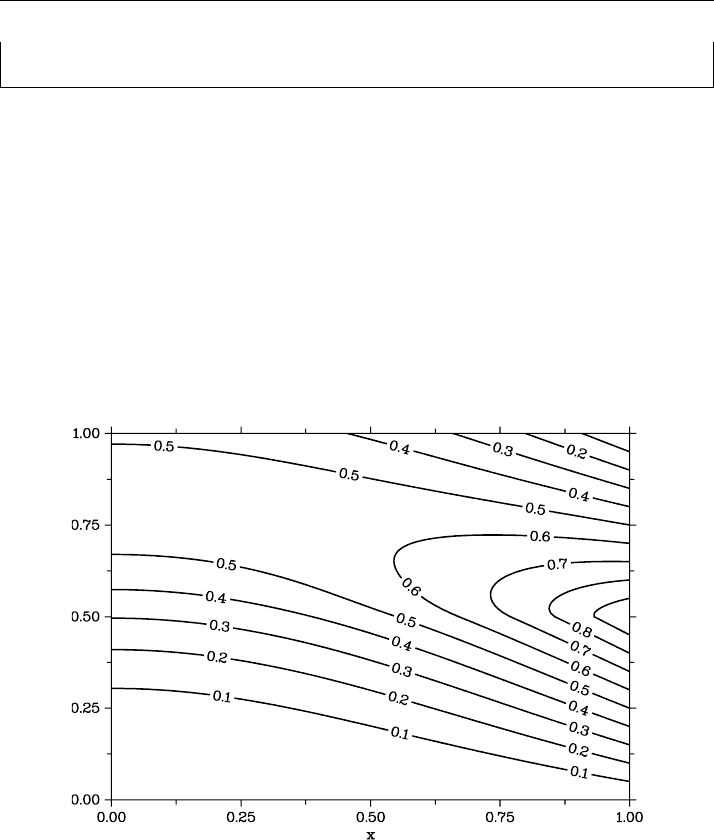
Figure 8.1 shows the contour lines for the direct-problem solution obtained with the
chosen boundary conditions.
Figure 8.1 Direct-problem solution
First of all, we would like to know how the inaccuracy in setting the boundary
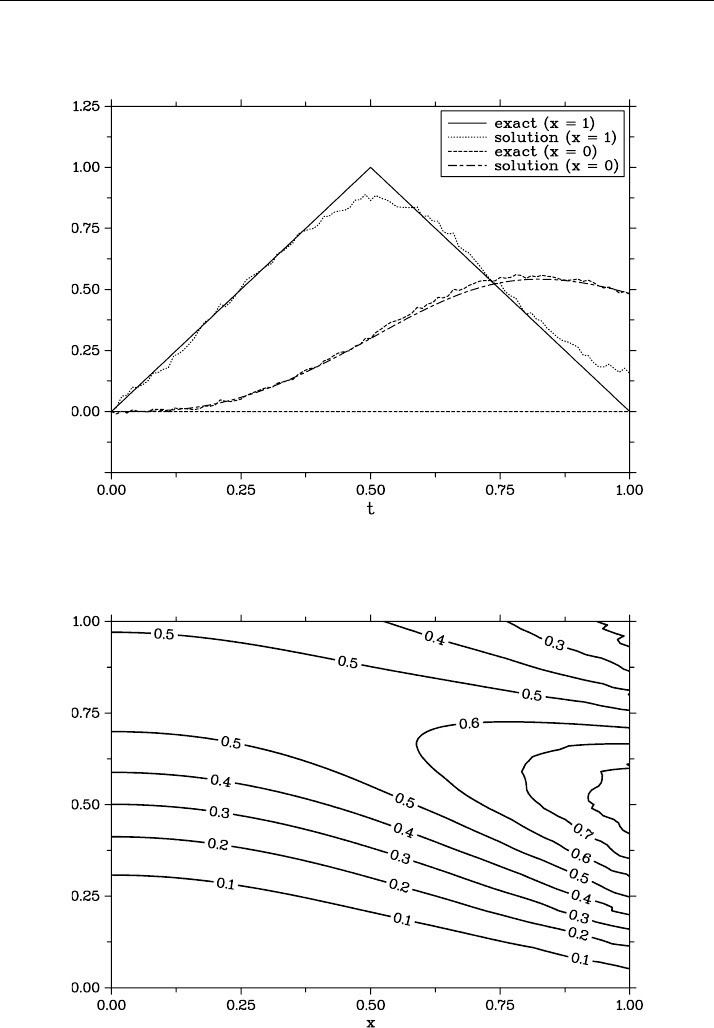
conditions affects the solution accuracy in the inverse problem. Figure 8.2 shows the
solution of the inverse problem obtained with the inaccuracy level defined by δ = 0.01.
Here, plotted are the exact and perturbed solutions at the left boundary (at x = 0),
serving the input data in solving the inverse problem. From these conditions, the
solution in the interval 0 < x ≤ l is to be reconstructed. Plotted in the figure are the
exact solution and the found solution at x = 1. The direct-problem solution at x = 1
for the found boundary condition is shown in Figure 8.3 (compare with Figure 8.1).
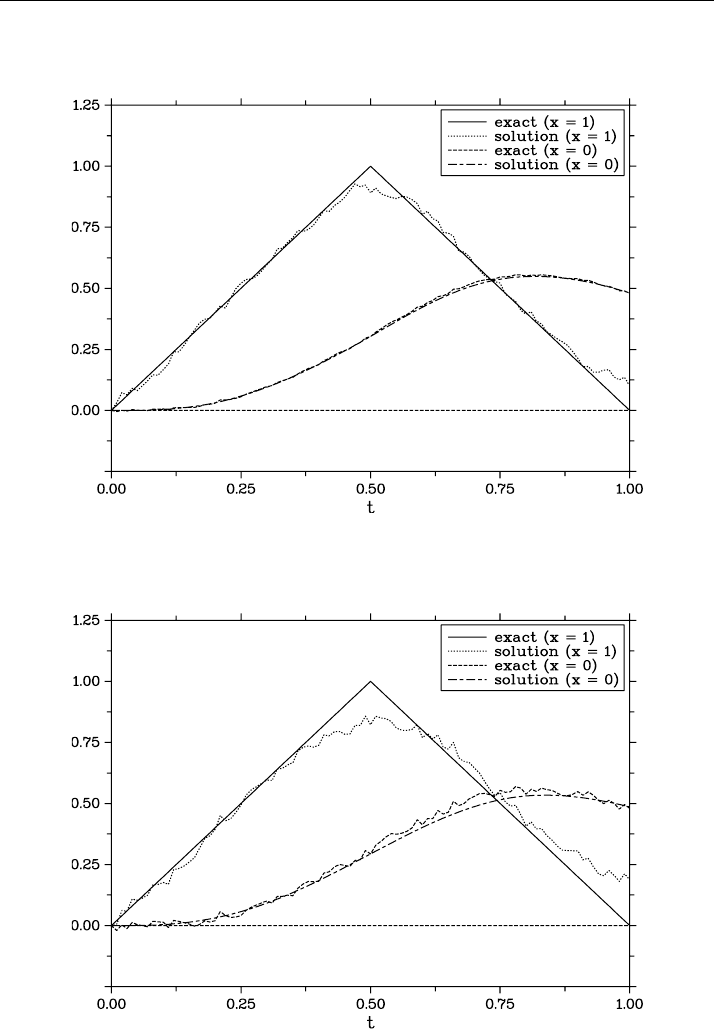
The effect due to the inaccuracy level is illustrated by Figures 8.4 and 8.5.
360 Chapter 8 Other problems
Figure 8.2 Inverse-problem solution obtained with δ = 0.01
Figure 8.3 Direct-problem solution obtained with the found boundary conditions
Section 8.1 Continuation over spatial variable in boundary value inverse problems 361
Figure 8.4 Inverse-problem solution obtained with δ = 0.005
Figure 8.5 Inverse-problem solution obtained with δ = 0.02

362 Chapter 8 Other problems
8.2 Non-local distribution of boundary conditions
For the approximate solution of the boundary value inverse problem for the one-
dimensional parabolic equation, a computational algorithm is often used based on
non-local perturbation of the boundary condition. This approach can be related to
the local Tikhonov regularization.
8.2.1 Model problem
We assume that the process of interest obeys the one-dimensional parabolic equation
of the second order. The related direct problem can be formulated as follows:
The solution u(x, t) is to be determined in the rectangle
Q
T
= × [0, T ], ={x | 0 ≤ x ≤ l}, 0 ≤ t ≤ T.
The function u(x, t) satisfies the equation
∂u
∂t
=
∂
∂x
k(x)
∂u
∂x
, 0 < x < l, 0 < t ≤ T, (8.49)
with the usual constraints k(x) ≥ κ>0. The adopted boundary and initial conditions
are as follows:
k(x)
∂u
∂x
(0, t) = 0, 0 < t ≤ T, (8.50)
u(l, t) = ψ(t), 0 < t ≤ T, (8.51)
u(x, 0) = 0, 0 ≤ x ≤ l. (8.52)
We consider the boundary value inverse problem in which the boundary condition at
the right boundary is not given (the function ψ(t) in (8.51) is unknown). Instead, given
is the additional condition at the left boundary:
u(0, t) = ϕ(t), 0 < t ≤ T. (8.53)
Additionally, we assume that, as it is often the case in practice, the latter boundary
condition is given with some inaccuracy.
8.2.2 Non-local boundary value problem
Among the various possible approaches to the approximate solution of inverse prob-
lems for evolutionary equations, we choose to treat methods with perturbed initial
equation and methods with perturbed initial (boundary) conditions. The variant of the
generalized inverse method with the passage to a well-posed problem for a perturbed
equation was realized above by considering the spatial variable as the evolutionary
variable. It is of interest here to use the variant of this method with perturbed boundary
(initial, with the interpretation of the variable x as the evolutionary variable) condition.

Section 8.2 Non-local distribution of boundary conditions 363
We denote the approximate solution of the boundary value inverse problem (8.49),
(8.50), (8.52), (8.53) as u
α
(x, t) and determine it from the equation
∂u
α
∂t
=
∂
∂x
k(x)
∂u
α
∂x
, 0 < x < l, 0 < t ≤ T. (8.54)
We leave the boundary condition (8.50) and the initial condition (8.52) unchanged:
k(x)
∂u
α
∂x
(0, t) = 0, 0 < t ≤ T, (8.55)
u
α
(x, 0) = 0, 0 ≤ x ≤ l. (8.56)
We replace the boundary condition (8.53), which makes the inverse problem (8.49),
(8.50), (8.52), (8.53) an ill-posed problem, with the following non-local condition:
u
α
(0, t) + αu
α
(l, t) = ϕ(t), 0 < t ≤ T. (8.57)
In (8.54)–(8.57), the passage to a non-local boundary value problem can be made
immediately. A second possibility in formulating such a non-classical problem is
based on the consideration of the Tikhonov regularization method for problem (8.54)–
(8.57) interpreted as a boundary control problem (the boundary condition at the right
end point is (8.51)) with boundary observation (at the left end point, the condition
(8.53) is adopted). Next, we can try to formulate a related Euler equation, which, as
we saw, leads to non-classical boundary value problems. What is necessary is to only
take the fact into account that in the case of interest both for the ground and conjugate
states we have evolutionary problems with non-selfadjoint operators.
8.2.3 Local regularization
As it was repeated over and over again, in the application of regularization methods to
evolutionary problems we have two possibilities. In global regularization methods the
solution is to be determined at all times simultaneously, whereas in local regularization
methods the solution depends only on the pre-history, and can be determined sequen-
tially at separate times. Local regularization methods take into account the specific
feature of inverse problems for evolutionary problems in maximal possible measure.
Over time, we introduce the uniform grid
¯ω
τ
={t
n
= nτ, n = 0, 1,...,N
0
,τN
0
= T },
and let u
n
(x) = u(x, t
n
). In the approximate solution of the inverse problem (8.54)–
(8.57), we perform the transition to the next time layer using the purely implicit scheme

364 Chapter 8 Other problems
for the direct problem:
u
n+1
− u
n
τ
−
∂
∂x
k(x)
∂u
n+1
∂x
= 0, 0 < x < l, n = 0, 1,...,N
0
− 1, (8.58)
k(x)
∂u
n+1
∂x
(0) = 0, n = 0, 1,...,N
0
− 1, (8.59)
u
n+1
(l) = v
n+1
, n = 0, 1,...,N
0
− 1, (8.60)
u
0
(x) = 0, 0 ≤ x ≤ l. (8.61)
Using, on each time layer, the Tikhonov regularization for determining the boundary
condition at the right boundary (see (8.60)) implies minimization of the smoothing
functional
J
α
(v
n+1
) = (u
n+1
(0) − ϕ
n+1
)
2
+ α(v
n+1
)
2
. (8.62)
Let us show that the minimization problem for the functional (8.62) under constraints
(8.58)–(8.61) is in fact equivalent to solving the difference problem with non-local
boundary conditions of type (8.57) on each time layer.
We represent the solution of problem (8.58)–(8.60) in the form
u
n+1
(x) = z
n+1
(x) + w
n+1
(x). (8.63)
In the latter representation, z
n+1
(x) is the solution of the difference problem
z
n+1
− u
n
τ
−
∂
∂x
k(x)
∂z
n+1
∂x
= 0, 0 < x < l, n = 0, 1,...,N
0
− 1, (8.64)
k(x)
∂z
n+1
∂x
(0) = 0, n = 0, 1,...,N
0
− 1, (8.65)
z
n+1
(l) = 0, n = 0, 1,...,N
0
− 1, (8.66)
z
0
(x) = 0, 0 ≤ x ≤ l. (8.67)
Thereby, z
n+1
(x) is the solution of the direct problem with homogeneous condition of
the first kind at the right boundary.
From (8.63) and (8.64)–(8.67), for w
n+1
(x) we obtain:
w
n+1
τ
−
∂
∂x
k(x)
∂w
n+1
∂x
= 0, 0 < x < l, n = 0, 1,...,N
0
− 1, (8.68)
k(x)
∂w
n+1
∂x
(0, t) = 0, n = 0, 1,...,N
0
− 1, (8.69)
w
n+1
(l) = v
n+1
, n = 0, 1,...,N
0
− 1, (8.70)
w
0
(x) = 0, 0 ≤ x ≤ l. (8.71)
Taking into account the linearity of the coefficient k(x) and its independence of time,
for the solution of the difference problem (8.68)–(8.71) we obtain the representation
w
n+1
(x) = q(x)v
n+1
, (8.72)

Section 8.2 Non-local distribution of boundary conditions 365
in which q(x) is the solution of the difference problem
q
τ
−
d
dx
k(x)
dq
dx
= 0, 0 < x < l, (8.73)
k(x)
dq
dx
(0) = 0, q(l) = 1. (8.74)
Substitution of (8.63) and (8.72) into (8.62) yields:
J
α
(v
n+1
) = (z
n+1
(0) + q(0)v
n+1
− ϕ
n+1
)
2
+ α(v
n+1
)
2
. (8.75)
The minimum of (8.75) is attained at
(z
n+1
(0) + q(0)v
n+1
− ϕ
n+1
))q(0) + αv
n+1
= 0. (8.76)
Thereby, for the boundary condition at the right boundary we have:
v
n+1
= q(0)
ϕ
n+1
− z
n+1
(0)
α + q
2
(0)
. (8.77)
In the local regularization algorithm as applied to the solution of the inverse prob-
lem (8.54)–(8.57), the transition to the next time layer implies the solution of the direct
problems (8.64)–(8.67) and (8.73), (8.74), the calculation of the constant v
n+1
by for-
mula (8.76), and the use of representation (8.63), (8.72) for the solution of the inverse
problem.
Using the maximum principle for problem (8.64)–(8.67), we have q(0)>0; hence,
the condition (8.76) can be brought (see (8.70)) to the form
u
n+1
(0) +
α
q(0)
u
n+1
(l) = ϕ
n+1
. (8.78)
Thus, the minimization problem for the functional (8.62) under constraints (8.58)–
(8.61) is equivalent to the solution of the problem with the non-local boundary con-
ditions (8.58), (8.59), (8.61), and (8.77). With all these taken into account, we can
say that the local regularization algorithm is a discrete variant of the method with non-
locally perturbed boundary conditions (8.54)–(8.57) for the approximate solution of
the boundary value inverse problem (8.49), (8.50), (8.52), (8.53).
8.2.4 Difference non-local problem
To the differential problem with the non-local boundary condition (8.54)–(8.57), we
put in correspondence a difference problem. Along the spatial variable, we introduce
a uniform grid ¯ω with a grid size h over the interval
¯
= [0, l]:
¯ω ={x | x = x
i
= ih, i = 0, 1,...,N, Nh = l}.
In this grid, ω is the set of internal nodes, and ∂ω is the set of boundary nodes.