
Smith R., Minton R. Calculus
Подождите немного. Документ загружается.

P1: OSO/OVY P2: OSO/OVY QC: OSO/OVY T1: OSO
MHDQ256-Ch11 MHDQ256-Smith-v1.cls December 22, 2010 20:10
LT (Late Transcendental)
CONFIRMING PAGES
11-17 SECTION 11.2
..
Vectors in Space 703
In exercises 7–10, compute a b, a − 3b and 4a 2b.
7. a =2, 1, −2, b =1, 3, 0
8. a =−1, 0, 2, b =4, 3, 2
9. a = 3i −j +4k, b = 5i + j
10. a = i −4j −2k, b = i − 3j + 4k
............................................................
In exercises 11–16, (a) find two unit vectors parallel to the given
vector and (b) write the given vector as the product of its mag-
nitude and a unit vector.
11. 3, 1, 2 12. 2, −4, 6
13. 2i −j +2k 14. 4i −2j +4k
15. From (1, 2, 3) to (3, 2, 1) 16. From (1, 4, 1) to (3, 2, 2)
............................................................
In exercises 17–20, find a vector with the given magnitude and
in the same direction as the given vector.
17. Magnitude 6, v =2, 2, −1
18. Magnitude 10, v =3, 0, −4
19. Magnitude 4, v = 2i −j +3k
20. Magnitude 3, v = 3i +3j −k
............................................................
In exercises 21–24, find an equation of the sphere with radius r
and center (a, b, c).
21. r = 2, (a, b, c) = (3, 1, 4)
22. r = 3, (a, b, c) = (2, 0, 1)
23. r =
√
5, (a, b, c) = (π, 1, −3)
24. r =
√
7, (a, b, c) = (1, 3, 4)
............................................................
In exercises 25–30, identify the geometric shape described by
the given equation.
25. (x − 1)
2
+ y
2
+ (z + 2)
2
= 4
26. x
2
+ (y − 1)
2
+ (z − 4)
2
= 2
27. x
2
− 2x + y
2
+ z
2
− 4z = 0
28. x
2
+ x + y
2
− y + z
2
=
7
2
29. (x + 1)
2
+ (y − 2)
2
+ z
2
= 0
30. x
2
− 2x + y
2
+ z
2
+ 4z + 4 = 0
............................................................
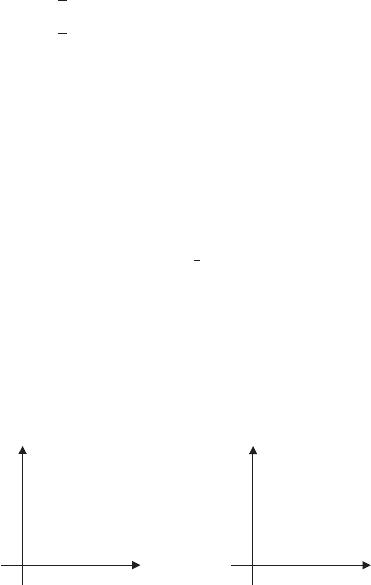
In exercises 31 and 32, sketch the third axis to make xyz a
right-handed system.
31.
y
x
32.
z
x
............................................................
In exercises 33–36, sketch a graph in xyz-space and identify the
plane as parallel to the xy-plane, xz-plane or yz-plane and sketch
a graph.
33. y = 4 34. x =−2
35. z =−1 36. z = 3
............................................................
In exercises 37–40, give an xyz equation (e.g., z 0) for the
indicated figure.
37. xz-plane 38. xy-plane
39. yz-plane 40. x-axis
............................................................
41. (a) Prove the commutative property of Theorem 2.1.
(b) Prove the associative property of Theorem 2.1.
42. (a) Prove the distributive properties of Theorem 2.1.
(b) Prove the multiplicative properties of Theorem 2.1.
43. Find the displacement vectors
−→
PQ and
−→
QR and deter-
mine whether the points P = (2, 3, 1), Q = (4, 2, 2) and
R = (8, 0, 4) are colinear (on the same line).
44. Find the displacement vectors
−→
PQ and
−→
QR and deter-
mine whether the points P = (2, 3, 1), Q = (0, 4, 2) and
R = (4, 1, 4) are colinear (on the same line).
45. Use vectors to determine whether the points (0, 1, 1), (2, 4, 2)
and (3, 1, 4) form an equilateral triangle.
46. Use vectors to determine whether the points (2, 1, 0), (4, 1, 2)
and (4, 3, 0) form an equilateral triangle.
47. Use vectors and the Pythagorean Theorem to determine
whether the points (3, 1, −2), (1, 0, 1) and (4, 2, −1) form
a right triangle.
48. Use vectors and the Pythagorean Theorem to determine
whether the points (1, −2, 1), (4, 3, 2) and (7, 1, 3) form a
right triangle.
49. Use vectors to determine whether the points (2, 1, 0),
(5, −1, 2), (0, 3, 3) and (3, 1, 5) form a square.
50. Use vectors to determine whether the points (1, −2, 1),
(−2, −1, 2), (2, 0, 2) and (−1, 1, 3) form a square.
In exercises 51–58, you are asked to work with vectors of dimen-
sion higher than three. Use rules analogous to those introduced
for two and three dimensions.
51. 2, 3, 1, 5+21, −2, 3, 1
52. 23, −2, 1, 0−2, 1, −2, 1
53. 3, −2, 4, 1, 0, 2−31, 2, −2, 0, 3, 1
54. 2, 1, 3, −2, 4, 1, 0, 2+23, 1, 1, 2, −2, 0, 3, 1
55. a for a =3, 1, −2, 4, 1
56. a for a =1, 0, −3, −2, 4, 1
57. a +b for a =1, −2, 4, 1 and b =−1, 4, 2, −4
58. a − 2b for a =2, 1, −2, 4, 1 and b =3, −1, 4, 2, −4
............................................................
P1: OSO/OVY P2: OSO/OVY QC: OSO/OVY T1: OSO
MHDQ256-Ch11 MHDQ256-Smith-v1.cls December 22, 2010 20:10
LT (Late Transcendental)
CONFIRMING PAGES
704 CHAPTER 11
..
Vectors and the Geometry of Space 11-18
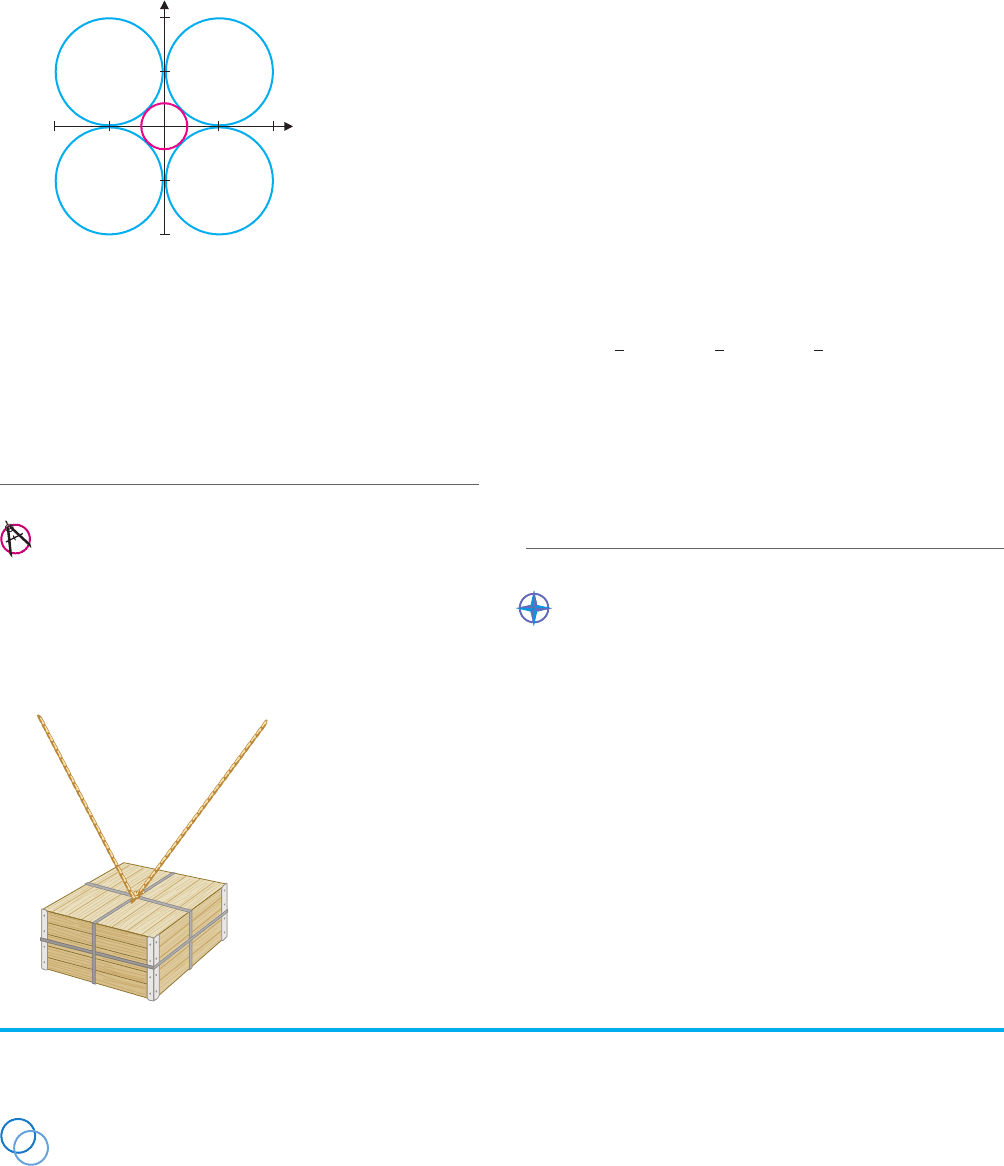
59. (a) Take four unit circles and place them tangent to the x- and
y-axes as shown. Find the radius of the inscribed circle
(shown in the accompanying figure in red).
y
x
210
0
12
2
1
1
2
(b) Extend to three dimensions by finding the radius of the
sphere inscribed by eight unit spheres that are tangent to
the coordinate planes.
(c) Generalize the results to n dimensions. Show that for
n ≥ 10, the inscribedhypersphere is actually not contained
in the “box” −2 ≤ x ≤ 2, −2 ≤ y ≤ 2 andso on, thatcon-
tains all of the individual hyperspheres.
60. Letr =x, y, zandr
0
=x
0
, y
0
, z
0
be such that||r −r
0
|| = 2.
Describe the set of points (x, y, z).
APPLICATIONS
61. In the accompanying figure, two ropes are attached to a
500-pound crate. Rope A exerts a force of 10, −130, 200
pounds on the crate, and rope B exerts a force of
−20, 180, 160 pounds on the crate. If no further ropes are
added, find the net force on the crate and the direction it will
move. If a third rope C isadded to balance the crate, what force
A
B
must this rope exert on the crate? Find the tension (magnitude
of force) in each rope.
62. For the crate in exercise 61, suppose that the crate weighs only
300 pounds and the goal is to movethe crate up and to the right
with a constant force of 0, 30, 20 pounds. If a third rope is
added to accomplish this, what force must the rope exert on
the crate? Find the tension in each rope.
63. The thrust of an airplane’s engine produces a speed of 600
mph in still air. The plane is aimed in the direction of 2, 2, 1
and the wind velocity is 10, −20, 0 mph. Find the velocity
vector of the plane with respect to the ground and find the
speed.
64. The thrust of an airplane’s engine produces a speed of 700 mph
in still air. The plane is aimed in the direction of 6, −3, 2 but
itsvelocitywithrespecttothegroundis580, −330, 160mph.
Find the wind velocity.
65. Given O = (0, 0), A = (2, 1) and B = (4, 5), graph
−→
OA,
−→
OA+
1
4
−→
AB,
−→
OA+
1
2
−→
AB,
−→
OA+
3
4
−→
AB and
−→
OA+
−→
AB and
explain how these vectors could be used to animate the move-
ment of a virtual object.
66. A unit cube has vertex (0, 0, 0) and sides parallel to 1, 1, 0,
1, −1, 0 and 0, 0, 1 such that if (x, y, z) is inside the cube
then x ≥ 0 and z ≥ 0. Explain why the process of exercise
65 (applied to each vertex) would not be used to animate the
rotation of the cube 45
◦
about the z-axis.
EXPLORATORY EXERCISES
1. Find an equation describing all points equidistant from
A = (0, 1, 0) and B = (2, 4, 4) and sketch a graph. Based on
yourgraph,describetherelationship between the displacement
vector
−→
AB =2, 3, 4 and your graph. Simplify your equation
for the three-dimensional surface until 2, 3 and 4 appear as co-
efficients of x, y and z. Use what you have learned to quickly
writedownan equationfor the set ofall points equidistant from
A = (0, 1, 0) and C = (5, 2, 3).
2. In this exercise, you will try to identify the three-
dimensional surface defined by the equation a(x − 1) +
b(y − 2) +c(z − 3) = 0fornonzeroconstantsa, b andc.First,
show that (1, 2, 3) is one point on the surface. Then, show that
any point that is equidistant from the points (1 + a, 2 +b, 3 +
c) and (1 −a, 2 − b, 3 −c) is on the surface. Use this geo-
metric fact to identify the surface. Determine the relationship
between a, b, c and the surface.
11.3 THE DOT PRODUCT
In sections 11.1 and 11.2, we defined vectors in R
2
and R
3
and examined many of the
properties of vectors, including how to add and subtract two vectors. It turns out that two
different kinds of products involving vectors have proved to be useful: the dot product
P1: OSO/OVY P2: OSO/OVY QC: OSO/OVY T1: OSO
MHDQ256-Ch11 MHDQ256-Smith-v1.cls December 22, 2010 20:10
LT (Late Transcendental)
CONFIRMING PAGES
11-19 SECTION 11.3
..
The Dot Product 705
(or scalar product) and the cross product (or vector product). We introduce the first of these
two products in this section.
DEFINITION 3.1
Thedot product of twovectorsa =a
1
, a
2
, a
3
andb =b
1
, b
2
, b
3
in V
3
isdefinedby
a · b =a
1
, a
2
, a
3
·b
1
, b
2
, b
3
=a
1
b
1
+ a
2
b
2
+ a
3
b
3
. (3.1)
Likewise, the dot product of two vectors in V
2
is defined by
a · b =a
1
, a
2
·b
1
, b
2
=a
1
b
1
+ a
2
b
2
.
Be sure to notice that the dot product of two vectors is a scalar (i.e., a number, not a
vector). For this reason, the dot product is also called the scalar product.
EXAMPLE 3.1 Computing a Dot Product in R
3
Compute the dot product a · b for a =1, 2, 3 and b =5, −3, 4.
Solution We have
a · b =1, 2, 3·5, −3, 4=(1)(5) +(2)(−3) +(3)(4) = 11.
Certainly, dot products are very simple to compute, whether a vector is written in
component form or written in terms of the standard basis vectors, as in example 3.2.
EXAMPLE 3.2 Computing a Dot Product in R
2
Find the dot product of the two vectors a = 2i − 5j and b = 3i +6j.
Solution We have
a · b = (2)(3) +(−5)(6) = 6 −30 =−24.
The dot product in V
2
or V
3
satisfies the following simple properties.
REMARK 3.1
Since vectors in V
2
can be
thought of as special cases
of vectors in V
3
(where the third
component is zero), all of the
resultswe provefor vectorsin V
3
hold equally for vectors in V
2
.
THEOREM 3.1
For vectors a, b and c and any scalar d, the following hold:
(i) a ·b = b ·a (commutativity)
(ii) a ·(b +c) = a · b + a · c (distributive law)
(iii) (da) · b = d(a ·b) = a ·(db)
(iv) 0 ·a = 0 and
(v) a ·a =a
2
.
PROOF
We prove (i) and (v) for a, b ∈ V
3
. The remaining parts are left as exercises.
(i) For a =a
1
, a
2
, a
3
and b =b
1
, b
2
, b
3
, we have from (3.1) that
a · b =a
1
, a
2
, a
3
·b
1
, b
2
, b
3
=a
1
b
1
+ a
2
b
2
+ a
3
b
3
= b
1
a
1
+ b
2
a
2
+ b
3
a
3
= b · a,
since multiplication of real numbers is commutative.
(v) For a =a
1
, a
2
, a
3
, we have
a · a =a
1
, a
2
, a
3
·a
1
, a
2
, a
3
=a
2
1
+ a
2
2
+ a
2
3
=a
2
.
Notice that properties (i)–(iv) of Theorem 3.1 are also properties of multiplication of
real numbers. This is why we use the word product in dot product. However, there are some
P1: OSO/OVY P2: OSO/OVY QC: OSO/OVY T1: OSO
MHDQ256-Ch11 MHDQ256-Smith-v1.cls December 22, 2010 20:10
LT (Late Transcendental)
CONFIRMING PAGES
706 CHAPTER 11
..
Vectors and the Geometry of Space 11-20
properties of multiplication of real numbers not shared by the dot product. For instance, we
will see that a · b = 0 does not imply that either a = 0 or b = 0.
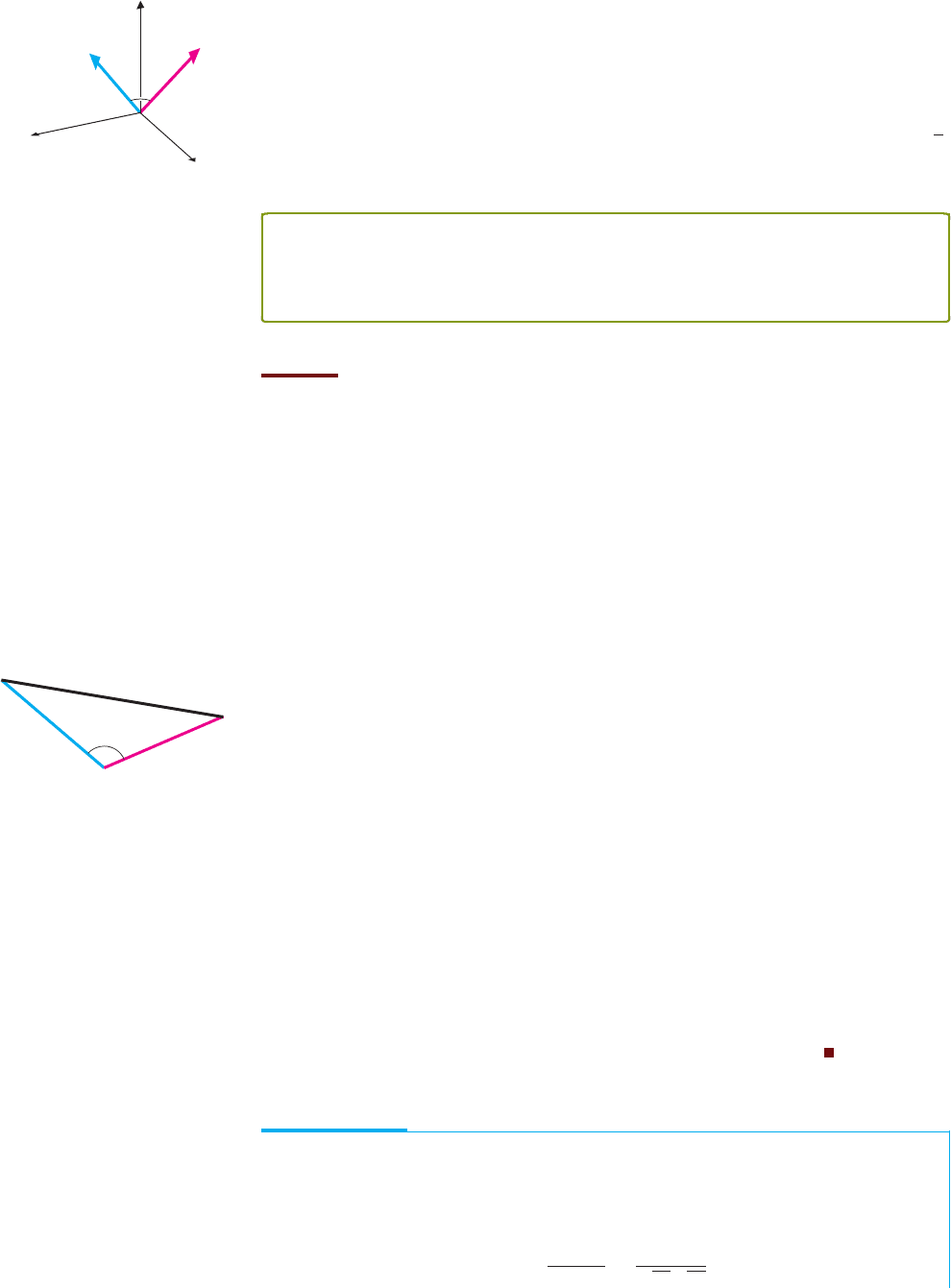
For two nonzero vectors a and b in V
3
, we define the angle θ (0 ≤ θ ≤ π) between
the vectors to be the smaller angle between a and b, formed by placing their initial points
at the same point, as illustrated in Figure 11.23a.
y
z
x
ab
u
FIGURE 11.23a
The angle between two vectors
Notice that if a and b have the same direction, then θ = 0. If a and b have opposite
directions, then θ = π. We say that a and b are orthogonal (or perpendicular)ifθ =
π
2
.
We consider the zero vector 0 to be orthogonal to every vector. The general case is stated
in Theorem 3.2.
THEOREM 3.2
Let θ be the angle between nonzero vectors a and b. Then,
a · b =abcos θ. (3.2)
PROOF
We must prove the theorem for three separate cases.
(i) If a and b have the same direction, then b = ca, for some scalar c > 0 and the angle
between a and b is θ = 0. This says that
a · b = a ·(ca) = ca ·a = ca
2
.
Further,
abcos θ =a|c|acos 0 = ca
2
= a · b,
since for c > 0, we have |c|=c.
(ii) If a and b have the opposite direction, the proof is nearly identical to case (i) above
and we leave the details as an exercise.
(iii) If a and b are not parallel, then we have that 0 <θ<π, as shown in Figure 11.23b.
Recall that the Law of Cosines allows us to relate the lengths of the sides of triangles
like the one in Figure 11.23b. We have
a − b
2
=a
2
+b
2
− 2abcosθ. (3.3)
Now, observe that
a − b
2
=a
1
− b
1
, a
2
− b
2
, a
3
− b
3
2
= (a
1
− b
1
)
2
+ (a
2
− b
2
)
2
+ (a
3
− b
3
)
2
=
a
2
1
− 2a
1
b
1
+ b
2
1
+
a
2
2
− 2a
2
b
2
+ b
2
2
+
a
2
3
− 2a
3
b
3
+ b
2
3
=
a
2
1
+ a
2
2
+ a
2
3
+
b
2
1
+ b
2
2
+ b
2
3
− 2(a
1
b
1
+ a
2
b
2
+ a
3
b
3
)
=a
2
+b
2
− 2a ·b (3.4)
Equating the right-hand sides of (3.3) and (3.4), we get (3.2), as desired.
a
a b
b
u
FIGURE 11.23b
The angle between two vectors
We can use (3.2) to find the angle between two vectors, as in example 3.3.
EXAMPLE 3.3 Finding the Angle Between Two Vectors
Find the angle between the vectors a =2, 1, −3 and b =1, 5, 6.
Solution From (3.2), we have
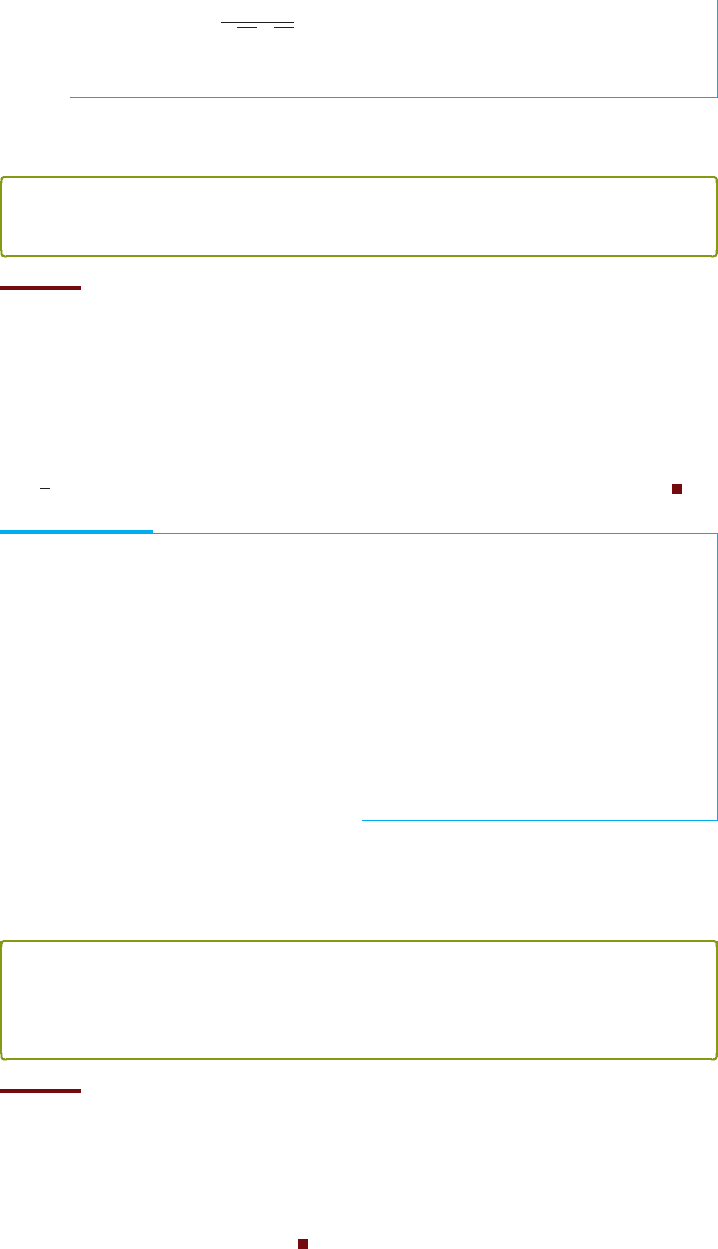
cosθ =
a · b
ab
=
−11
√
14
√
62
.
P1: OSO/OVY P2: OSO/OVY QC: OSO/OVY T1: OSO
MHDQ256-Ch11 MHDQ256-Smith-v1.cls December 22, 2010 20:10
LT (Late Transcendental)
CONFIRMING PAGES
11-21 SECTION 11.3
..
The Dot Product 707
It follows that
θ = cos
−1
−11
√
14
√
62
≈ 1.953(radians)
(or about 112
◦
), since 0 ≤ θ ≤ π and the inverse cosine function returns an angle in this
range.
The following result is an immediate and important consequence of Theorem 3.2.
COROLLARY 3.1
Two vectors a and b are orthogonal if and only if a ·b = 0.
PROOF
First,observethat ifeithera or b isthe zerovector, then a ·b = 0anda and b areorthogonal,
as the zero vector is considered orthogonal to every vector. If a and b are nonzero vectors
and if θ is the angle between a and b, we have from Theorem 3.2 that
abcos θ = a ·b = 0
if and only if cos θ = 0 (since neither a nor b is the zero vector). This occurs if and only if
θ =
π
2
, which is equivalent to having a and b orthogonal and so, the result follows.
EXAMPLE 3.4 Determining Whether Two Vectors Are Orthogonal
Determine whether the following pairs of vectors are orthogonal: (a) a =1, 3, −5 and
b =2, 3, 10 and (b) a =4, 2, −1 and b =2, 3, 14.
Solution For (a), we have:
a · b = 2 +9 −50 =−39 = 0,
so that a and b are not orthogonal.
For (b), we have
a · b = 8 +6 −14 = 0,
so that a and b are orthogonal, in this case.
The following two results provide us with some powerful tools for comparing the
magnitudes of vectors.
THEOREM 3.3 (Cauchy-Schwartz Inequality)
For any vectors a and b,
|a · b|≤ab. (3.5)
PROOF
If either a or b is the zero vector, notice that (3.5) simply says that 0 ≤ 0, which is certainly
true. On the other hand, if neither a nor b is the zero vector, we have from (3.2) that
|a · b|=ab|cos θ|≤ab,
since |cosθ|≤1 for all values of θ.
Onebenefitofthe Cauchy-SchwartzInequality isthatitallowsustoprovethefollowing
very useful result. If you were going to learn only one inequality in your lifetime, this is
probably the one you would want to learn.
P1: OSO/OVY P2: OSO/OVY QC: OSO/OVY T1: OSO
MHDQ256-Ch11 MHDQ256-Smith-v1.cls December 28, 2010 17:20
LT (Late Transcendental)
CONFIRMING PAGES
708 CHAPTER 11
..
Vectors and the Geometry of Space 11-22
THEOREM 3.4 (The Triangle Inequality)
For any vectors a and b,
a + b≤a+b. (3.6)
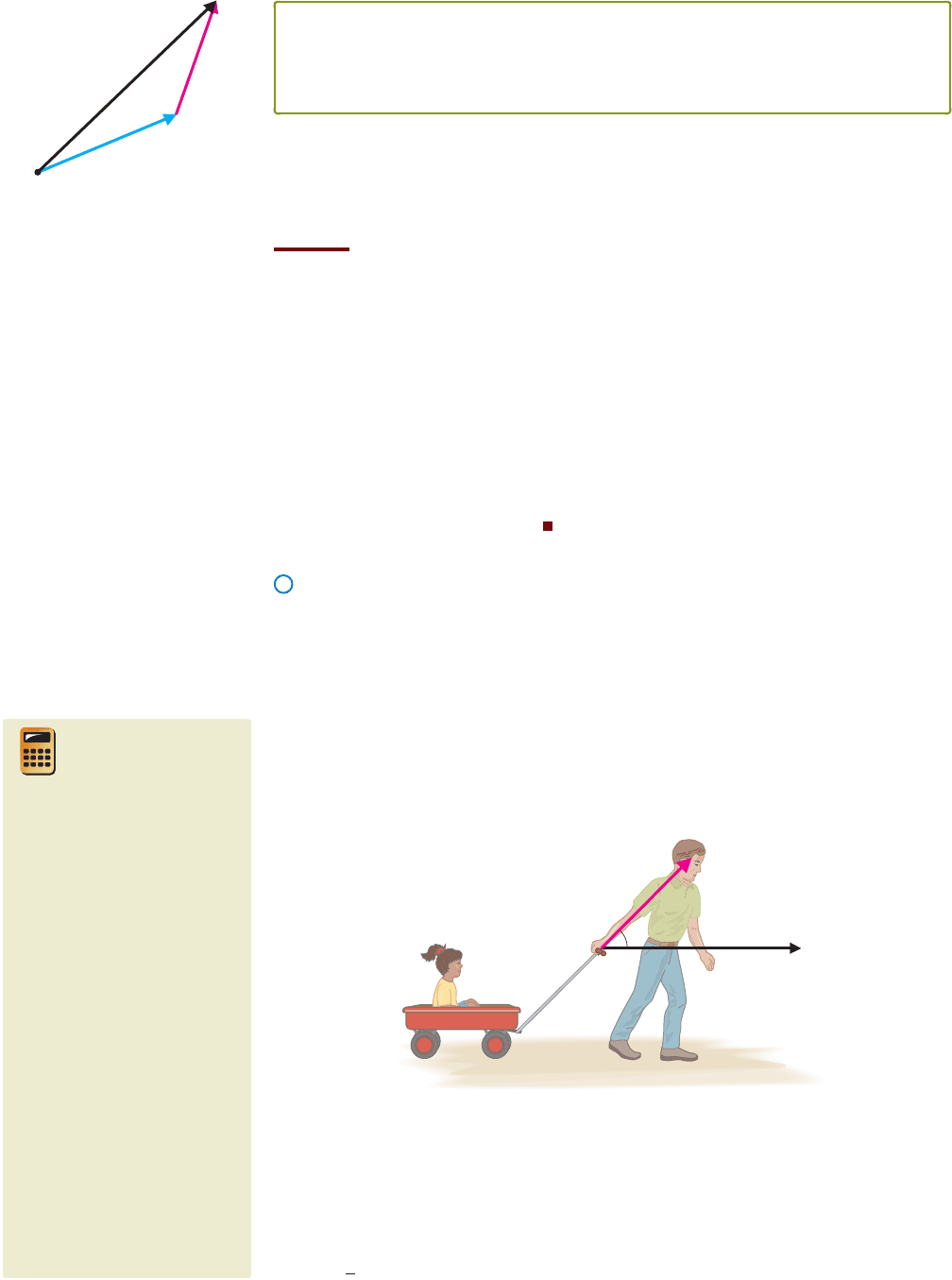
a
b
a ⫹ b
FIGURE 11.24
The Triangle Inequality
Before we prove the theorem, consider the triangle formed by the vectors a, b and
a + b, shown in Figure 11.24. Notice that the Triangle Inequality says that the length of the
vector a + b never exceeds the sum of the individual lengths of a and b.
PROOF
From Theorem 3.1 (i), (ii) and (v), we have
a + b
2
= (a +b) ·(a +b) = a ·a +a · b + b · a + b · b
=a
2
+ 2a ·b +b
2
.
From the Cauchy-Schwartz Inequality (3.5), we have a · b ≤|a · b|≤ab and so, we
have
a + b
2
=a
2
+ 2a ·b +b
2
≤a
2
+ 2ab+b
2
= (a+b)
2
.
Taking square roots gives us (3.6).
TODAY IN
MATHEMATICS
Lene Hau (1959– )
A Danish mathematician and
physicist known for her
experiments to slow down and
stop light. Although neither of her
parents had a background in
science or mathematics, she says
that as a student, “I loved
mathematics. I would rather do
mathematics than go to the
movies in those days. But after
awhile, I discovered quantum
mechanics and I’ve been hooked
ever since.” Hau credits a culture
of scientific achievement with her
success. “I was lucky to be a
Dane. Denmark has a long
scientific tradition that included
the great Niels Bohr. . . . In
Denmark, physics is widely
respected by laymen as well as
scientists and laymen contribute
to physics.”
Components and Projections
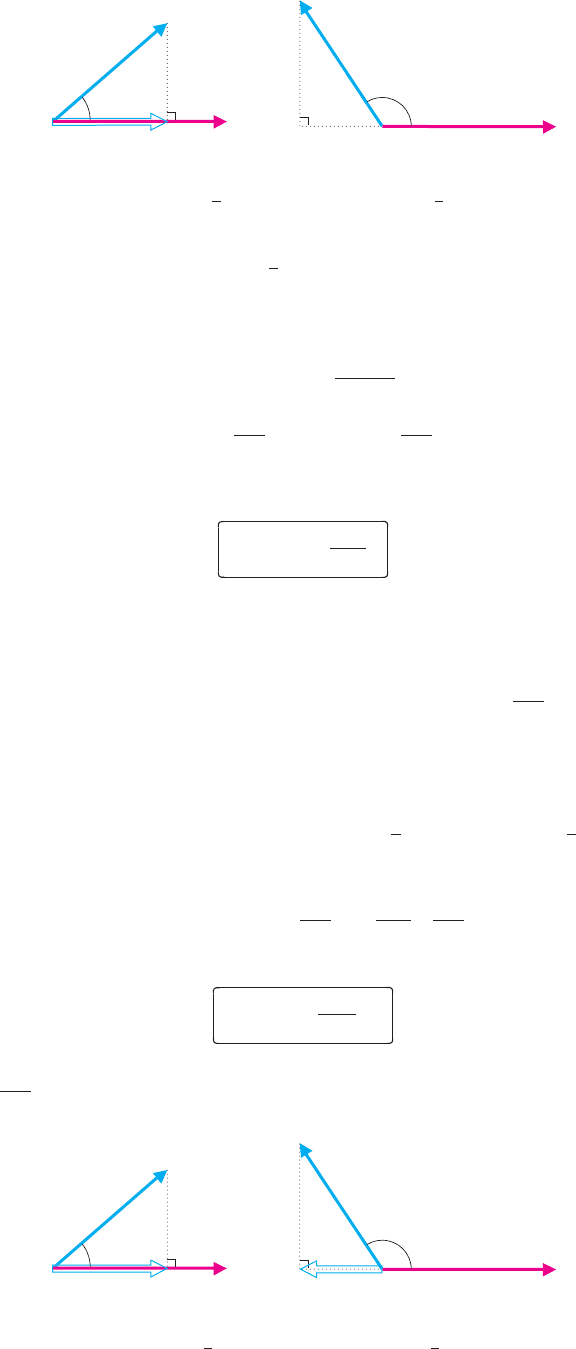
Think about the case where a vector represents a force. Often, it’s impractical to exert a
force in the direction you’d like. For instance, inpulling a child’s wagon, we exerta force in
the direction determined by the position of the handle, instead of in the direction of motion.
(See Figure 11.25.) An important question is whether there is a force of smaller magnitude
that can be exerted in a different direction and still produce the same effect on the wagon.
Notice that it is the horizontal portion of the force that most directly contributes to the
motion of the wagon. (The vertical portion of the force only acts to reduce friction.) We
now consider how to compute such a component of a force.
Force
Direction
of motion
u
FIGURE 11.25
Pulling a wagon
For any two nonzero position vectors a and b, let θ be the angle between the vectors.
If we drop a perpendicular line segment from the terminal point of a to the line containing
the vector b, then from elementary trigonometry, the base of the triangle (in the case where
0 <θ<
π
2
) has length given by acos θ. (See Figure 11.26a.)
P1: OSO/OVY P2: OSO/OVY QC: OSO/OVY T1: OSO
MHDQ256-Ch11 MHDQ256-Smith-v1.cls December 22, 2010 20:10
LT (Late Transcendental)
CONFIRMING PAGES
11-23 SECTION 11.3
..
The Dot Product 709
a
b
a cos u
u
a
b
a cos u
u
FIGURE 11.26a
comp
b
a, for 0 <θ<
π
2
FIGURE 11.26b
comp
b
a, for
π
2
<θ<π
On the other hand, notice that if
π
2
<θ<π, the length of the base is given by
−acos θ. (See Figure 11.26b.) In either case, we refer to acosθ as the component of
a along b, denoted comp
b
a. Using (3.2), observe that we can rewrite this as
comp
b
a =acos θ =
ab
b
cosθ
=
1
b
abcos θ =
1
b
a · b
or
Component of a along b
comp
b
a =
a · b
b
. (3.7)
Noticethatcomp
b
a isascalarandthatwe dividethe dot product in (3.7) by bandnot
by a. One way to keep this straight is to recognize that the components in Figures 11.26a
and 11.26b depend on how long a is but not on how long b is. We can view (3.7) as the dot
product of the vector a and a unit vector in the direction of b, given by
b
b
.
Once again, consider the case where the vector a represents a force. Rather than the
component of a along b, we are often interested in finding a force vector parallel to b having
the same component along b as a. We call this vector the projection of a onto b, denoted
proj
b
a, as indicated in Figures 11.27a and 11.27b. Since the projection has magnitude
|comp
b
a| and points in the direction of b, for 0 <θ<
π
2
and opposite b, for
π
2
<θ<π,
we have from (3.7) that
proj
b
a = (comp
b
a)
b
b
=
a · b
b
b
b
,
or
Projection of a onto b
proj
b
a =
a · b
b
2
b, (3.8)
where
b
b
represents a unit vector in the direction of b.
a
b
u
proj
b
a
a
b
proj
b
a
u
FIGURE 11.27a
proj
b
a, for 0 <θ<
π
2
FIGURE 11.27b
proj
b
a, for
π
2
<θ<π
P1: OSO/OVY P2: OSO/OVY QC: OSO/OVY T1: OSO
MHDQ256-Ch11 MHDQ256-Smith-v1.cls December 22, 2010 20:10
LT (Late Transcendental)
CONFIRMING PAGES
710 CHAPTER 11
..
Vectors and the Geometry of Space 11-24
In example 3.5, we illustrate the process of finding components and projections.
EXAMPLE 3.5 Finding Components and Projections
For a =2, 3 and b =−1, 5, find the component of a along b and the projection of a
onto b.
Solution From (3.7), we have
comp
b
a =
a · b
b
=
2, 3·−1, 5
−1, 5
=
−2 + 15
√
1 + 5
2
=
13
√
26
.
Similarly, from (3.8), we have
proj
b
a =
a · b
b
b
b
=
13
√
26
−1, 5
√
26
=
13
26
−1, 5=
1
2
−1, 5=
−
1
2
,
5
2
.
We leave it as an exercise to show that, in general, comp
b
a = comp
a
b and
proj
b
a = proj
a
b. One reason for needing to consider components of a vector in a given
direction is to compute work, as we see in example 3.6.
CAUTION
Be careful to distinguish
between the projection of a
onto b (a vector) and the
component of a along b (a
scalar). It is very common to
confuse the two.
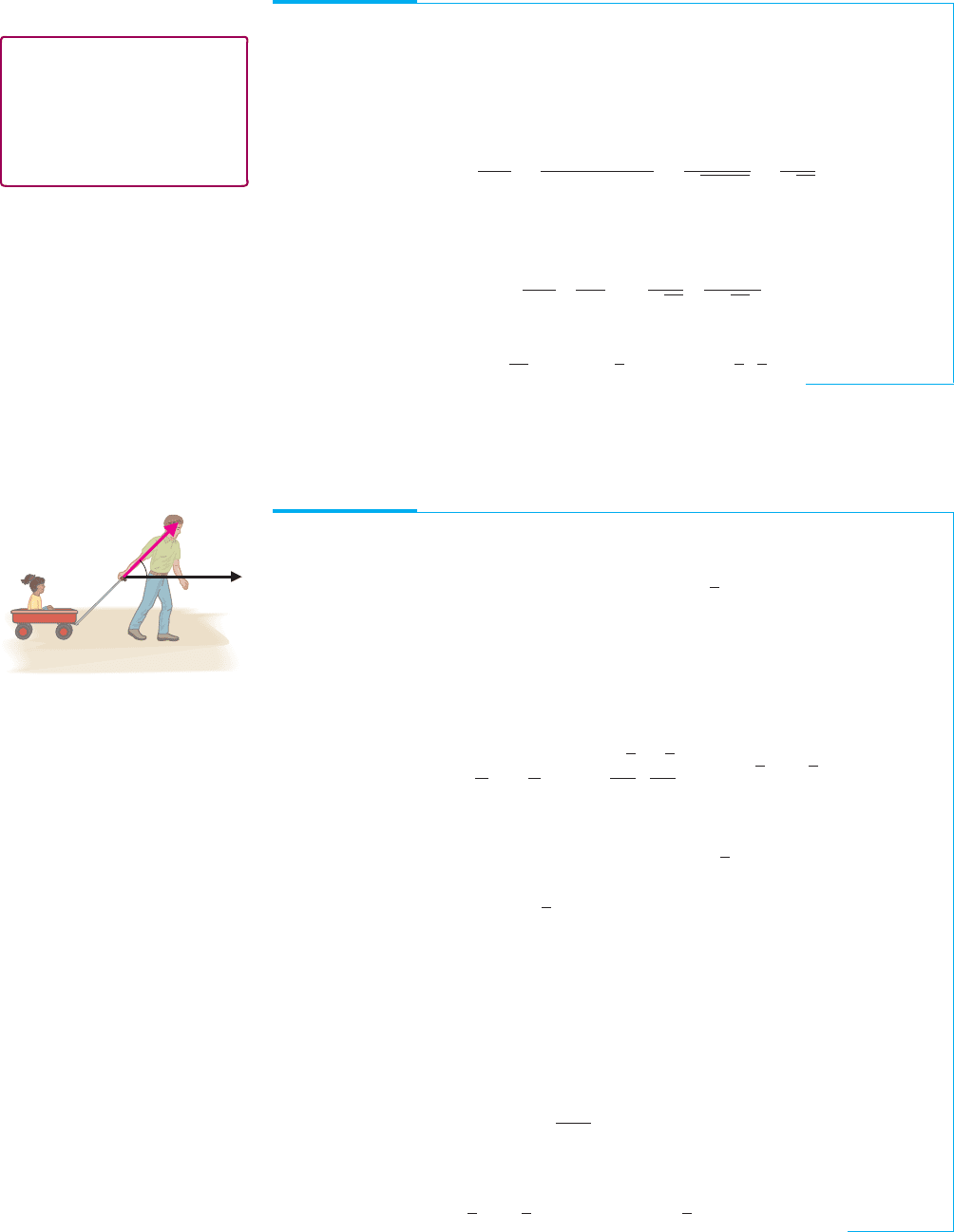
40 pounds
Direction
of motion
d
FIGURE 11.28
Pulling a wagon
EXAMPLE 3.6 Calculating Work
You exert a constant force of 40 pounds in the direction of the handle of the wagon
pictured in Figure 11.28. If the handle makes an angle of
π
4
with the horizontal and you
pull the wagon along a flat surface for 1 mile (5280 feet), find the work done.
Solution First, recall from our discussion in Chapter 5 that if we apply a constant
force F for a distance d, the work done is given by W = Fd. In this case, the force
exerted in the direction of motion is not given. However, since the magnitude of the
force is 40, the force vector must be
F = 40
cos
π
4
, sin
π
4
= 40
√
2
2
,
√
2
2
=20
√
2, 20
√
2.
The force exerted in the direction of motion is simply the component of the force along
the vector i (that is, the horizontal component of F)or20
√
2. The work done is then
W = Fd = 20
√
2(5280) ≈ 149,341 foot-pounds.
More generally, if a constant force F moves an object from point P to point Q, we refer
to the vector d =
−→
PQ as the displacement vector. The work done is the product of the
component of F along d and the distance:
W = comp
d
Fd
=
F · d
d
·d=F · d.
Here, this gives us
W =20
√
2, 20
√
2·5280, 0=20
√
2(5280), as before.
P1: OSO/OVY P2: OSO/OVY QC: OSO/OVY T1: OSO
MHDQ256-Ch11 MHDQ256-Smith-v1.cls December 22, 2010 20:10
LT (Late Transcendental)
CONFIRMING PAGES
11-25 SECTION 11.3
..
The Dot Product 711
BEYOND FORMULAS
The dot product gives us a shortcut for computing components and projections. The
dot product test for perpendicular vectors follows directly from this interpretation. In
general, components and projections are used to isolate a particular portion of a larger
problem for detailed analysis. This sort of reductionism is central to much of modern
science.
EXERCISES 11.3
WRITING EXERCISES
1. Explain in words why the Triangle Inequality is true.
2. The dot product is called a “product” because the properties
listed in Theorem 3.1 are true for multiplication of real num-
bers. Two other properties of multiplication of real numbers
involve factoring: (1) if ab = ac(a = 0) then b = c and (2) if
ab = 0 then a = 0orb = 0. Discuss the extent to which these
properties are true for the dot product.
3. To understand the importance of unit vectors, identify the sim-
plification in formulas for finding the angle between vectors
andforfinding the componentof a vector,ifthe vectorsare unit
vectors.There is also a theoretical benefit to using unit vectors.
Compare the number of vectors in a particular direction to the
number of unit vectors in that direction. (For this reason, unit
vectors are sometimes called direction vectors.)
4. It is important to understand whywork is computed using only
the component of force in the direction of motion. Suppose
you push on a door to close it. If you are pushing on the edge
of the door straight at the door hinges, are you accomplishing
anything useful? In this case, the work done would be zero.
If you change the angle at which you push very slightly, what
happens? As the angle increases, discuss how the component
of force in the direction of motion changes and how the work
done changes.
In exercises 1–6, compute a ·b.
1. a =3, 1, b =2, 4
2. a = 3i +j, b =−2i +3j
3. a =2, −1, 3, b =0, 2, −4
4. a =3, 2, 0, b =−2, 4, 3
5. a = 2i −k, b = 4j − k
6. a = 3i +3k, b =−2i +j
............................................................
In exercises 7–10, compute the angle between the vectors.
7. a = 3i −2j, b = i + j
8. a =2, 0, −2, b =0, −2, 4
9. a = 3i +j −4k, b =−2i +2j +k
10. a = i +3j −2k, b = 2i − 3k
............................................................
In exercises 11–14, determine whether the vectors are
orthogonal.
11. a =2, −1, b =2, 4
12. a = 6i +2j, b =−i +3j
13. a = 3i, b = 6j −2k
14. a =4, −1, 1, b =2, 4, 4
............................................................
In exercises 15–18, (a) find a 3-dimensional vector perpendicu-
lar to the givenvector and (b) find a vector of the form a, 2, −3
that is perpendicular to the given vector.
15. 2, −1, 0 16. 4, −1, 1
17. 6i +2j −k 18. 2i − 3k
............................................................
In exercises 19–24, find comp
b
a and proj
b
a.
19. a =2, 1, b =3, 4
20. a = 3i +j, b = 4i − 3j
21. a =2, −1, 3, b =1, 2, 2
22. a =1, 4, 5, b =−2, 1, 2
23. a =2, 0, −2, b =0, −3, 4
24. a =3, 2, 0, b =−2, 2, 1
............................................................
25. Repeat example 3.6 with an angle of
π
3
with the horizontal.
26. Repeat example 3.6 with an angle of
π
6
with the horizontal.
27. Explain why the answers to exercises 25 and 26 aren’t the
same, even though the force exerted is the same. In this
setting, explain why a larger amount of work corresponds to a
more efficient use of the force.
28. Find the force needed in exercise 25 to produce the same
amount of work as in example 3.6.
P1: OSO/OVY P2: OSO/OVY QC: OSO/OVY T1: OSO
MHDQ256-Ch11 MHDQ256-Smith-v1.cls December 22, 2010 20:10
LT (Late Transcendental)
CONFIRMING PAGES
712 CHAPTER 11
..
Vectors and the Geometry of Space 11-26
29. A constant force of 30, 20 pounds moves an object in a
straightline from the point (0,0) to the point (24,10). Compute
the work done.
30. A constant force of 60, −30 pounds moves an object in
a straight line from the point (0, 0) to the point (10, −10).
Compute the work done.
31. Labeleach statement as true orfalse. If itis true, briefly explain
why; if it is false, give a counterexample.
(a) If a ·b = a · c, then b = c.
(b) If b = c, then a · b = a · c.
(c) a ·a =a
2
.
(d) If a > b then a ·c > b · c.
(e) If a=b then a = b.
32. To compute a · b, where a =2, 5 and b =
4, 1
√
17
, you can
first compute 2, 5·4, 1 and then divide the result (13) by
√
17. Which property stated in Theorem 3.1 is being used?
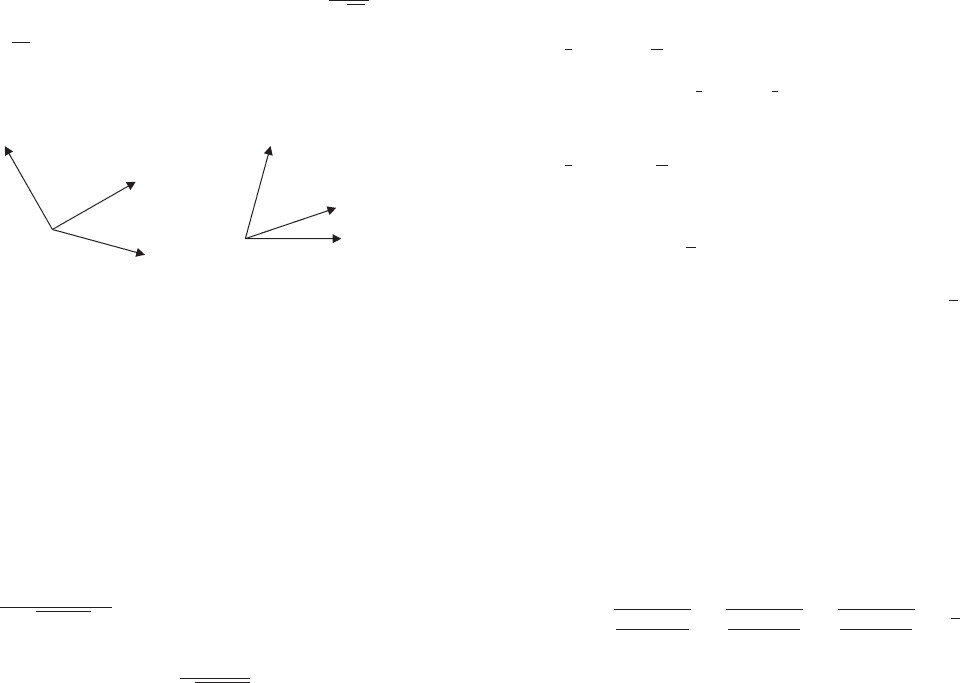
In exercises 33 and 34, use the figure to sequence a ·b, a ·c and
b ·c in increasing order.
33.
a
b
c
34.
a
b
c
............................................................
35. If a =2, 1, find a vector b such that (a) comp
b
a = 1;
(b) comp
a
b =−1.
36. If a =4, −2, find a vector b such that (a) proj
b
a =4, 0;
(b) proj
a
b =4, −2.
37. Find the angles in the triangle with vertices (1, 2, 0), (3, 0, −1)
and (1, 1, 1).
38. Find the angles in the quadrilateral ABCD with vertices
A =(2, 0, 1), B =(2, 1, 4), C =(4, −2, 5) and D =(4, 0, 2).
39. The distance from a point P to a line L is the length of the
line segment connecting P to L at a right angle. Show that
the distance from (x
1
, y
1
) to the line ax + by + c = 0 equals
|ax
1
+ by
1
+ c|
√
a
2
+ b
2
.
40. Prove that the distance between lines ax +by + c = 0 and
ax +by + d = 0 equals
|d − c|
√
a
2
+ b
2
.
41. (a) Find the angle between the diagonal of a square and an
adjacent side. (b) Find the angle between the diagonal of a
cube and an adjacent side. (c) Extend the results of parts (a)
and (b) to a hypercube of dimension n ≥ 4.
42. Prove that ||a +b||
2
+||a −b||
2
= 2||a||
2
+ 2||b||
2
. State this
result in terms of properties of the parallelogram formed by
vectors a and b.
Exercises 43–54 involve the Cauchy-Schwartz and Triangle
Inequalities.
43. By the Cauchy-Schwartz Inequality, |a ·b|≤ab. What
relationship must exist between a and b to have
|a · b|=ab?
44. By the Triangle Inequality, a + b≤a+b. What
relationship must exist between a and b to have
a + b=a+b?
45. Use the Triangle Inequality to prove that
a − b≥a−b.
46. Prove parts (ii) and (iii) of Theorem 3.1.
47. For vectors a and b, use the Cauchy-Schwartz Inequality to
find the maximum value of a · b if a=3 and b=5.
48. Find a formula for a in terms of b if a=3, b=5 and
a · b is maximum.
49. Use the Cauchy-Schwartz Inequality in n dimensions to show
that
n
k=1
|a
k
b
k
|
2
≤
n
k=1
a
2
k
n
k=1
b
2
k
. If both
∞
k=1
a
2
k
and
∞
k=1
b
2
k
converge, what can be concluded? Apply the result to
a
k
=
1
k
and b
k
=
1
k
2
.
50. Show that
n
k=1
|a
k
b
k
|≤
1
2
n
k=1
a
2
k
+
1
2
n
k=1
b
2
k
. If both
∞
k=1
a
2
k
and
∞
k=1
b
2
k
converge, what can be concluded? Apply the result to
a
k
=
1
k
and b
k
=
1
k
2
. Is this bound better or worse than the
bound found in exercise 49?
51. (a) Use the Cauchy-Schwartz Inequality in n dimensions to
show that
n
k=1
|a
k
|≤
√
n
n
k=1
a
2
k
1/2
. (b) If p
1
, p
2
,...,p
n
are
nonnegative numbers that sum to 1, show that
n
k=1
p
2
k
≥
1
n
.
(c) Among all sets of nonnegative numbers p
1
, p
2
,...,p
n
that
sum to 1, find the choice of p
1
, p
2
,...,p
n
that minimizes
n
k=1
p
2
k
.
52. Use the Cauchy-Schwartz Inequality in n dimensions to show
that
n
k=1
|a
k
|≤
n
k=1
|a
k
|
2/3
1/2
n
k=1
|a
k
|
4/3
1/2
.
53. Show that
n
k=1
a
2
k
b
2
k
≤
n
k=1
a
2
k
n
k=1
b
2
k
and then
n
k=1
a
k
b
k
c
k
2
≤
n
k=1
a
2
k
n
k=1
b
2
k
n
k=1
c
2
k
.
54. Show that
x + y
x + y + z
+
y + z
x + y + z
+
x + z
x + y + z
≤
√
6.
............................................................
55. Prove that comp
c
(a + b) = comp
c
a + comp
c
b for any
nonzero vectors a, b and c.
56. The orthogonal projection of vector a along vector b is de-
fined as orth
b
a = a −proj
b
a. Sketch a picture showing vec-
tors a, b, proj
b
a and orth
b
a, and explain what is orthogonal
about orth
b
a.
57. Write the given vector as a + b, where a is parallel to 1, 2, 3
and b is perpendicular to 1, 2, 3, for (a) 3, −1, 2 and
(b) 0, 4, 2.
58. (a) For the Mandelbrot set and associated Julia sets, functions
oftheform f (x) = x
2
− c areanalyzedforvariousconstantsc.
The iterates of the function increase if |x
2
− c| > |x|.