
Smith R., Minton R. Calculus
Подождите немного. Документ загружается.

P1: OSO/OVY P2: OSO/OVY QC: OSO/OVY T1: OSO
MHDQ256-Ch11 MHDQ256-Smith-v1.cls December 22, 2010 20:10
LT (Late Transcendental)
CONFIRMING PAGES
11-37 SECTION 11.4
..
The Cross Product 723
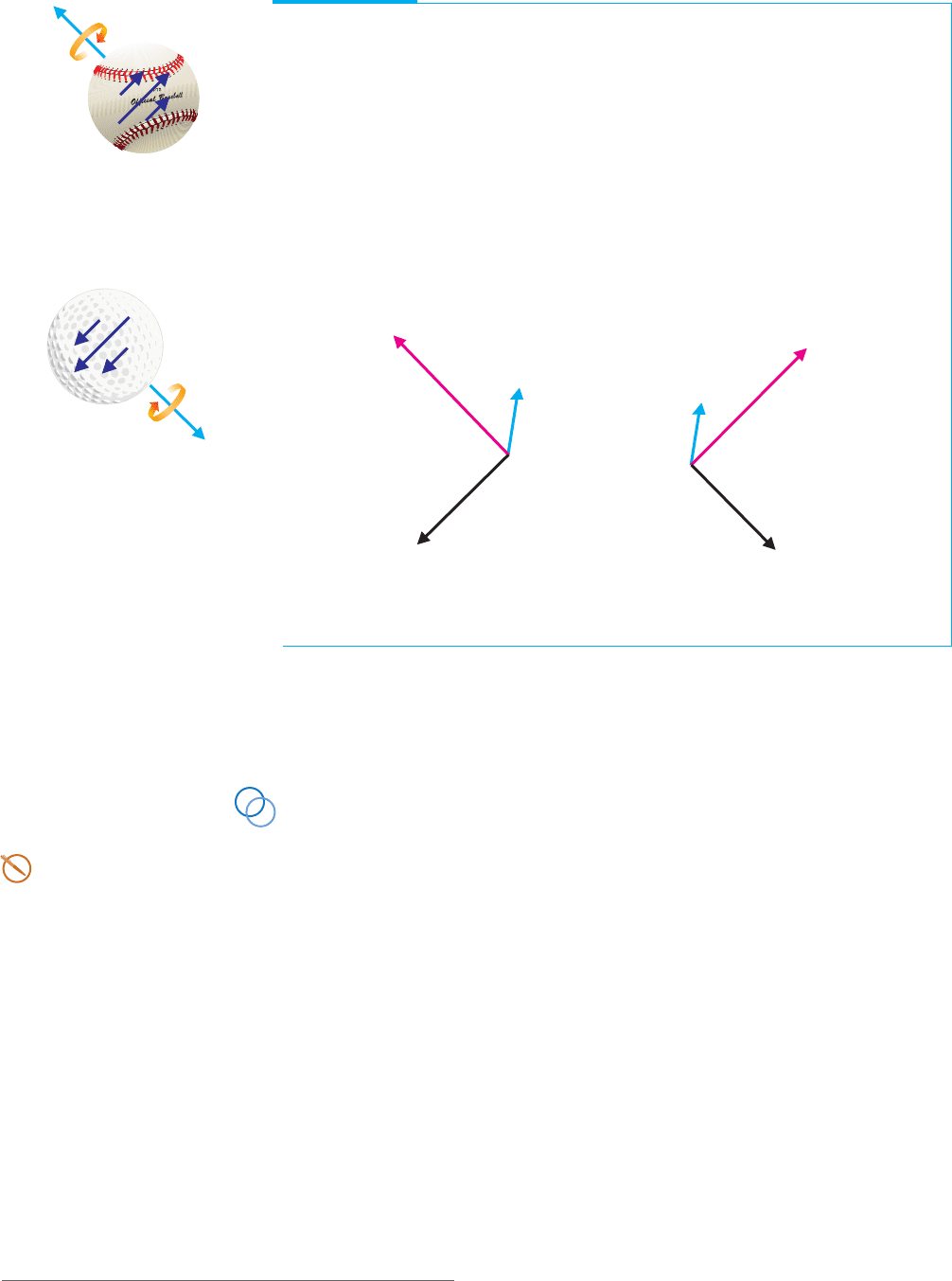
EXAMPLE 4.8 Finding the Direction of a Magnus Force
The balls shown in Figures 11.37a and 11.37b are moving into the page and away from
you with spin as indicated. The first ball represents a right-handed baseball pitcher’s
curveball, while the second ball represents a right-handed golfer’s shot. Determine the
direction of the Magnus force and discuss the effects on the ball.
Solution For the first ball, notice that the spin vector points up and to the left, so that
s × v points down and to the left as shown in Figure 11.38a. Such a ball will curve to
the left and drop faster than a ball that is not spinning, making it more difficult to hit.
For the second ball, the spin vector points down and to the right, so s × v points up and
to the right. Such a ball will move to the right (a “slice”) and stay in the air longer than a
ball that is not spinning. (See Figure 11.38b.)
v
F
m
s
v
s
F
m
FIGURE 11.38a
Magnus force for a right-handed
curveball
FIGURE 11.38b
Magnus force for a right-handed
golf shot
s
FIGURE 11.37a
Right-hand curveball
s
FIGURE 11.37b
Right-hand golf shot
EXERCISES 11.4
WRITING EXERCISES
1. In this chapter, we have developed several tests for geometric
relationships. Briefly describe how to test whether two vec-
tors are (a) parallel; (b) perpendicular. Briefly describe how to
test whether (c) three points are colinear; (d) four points are
coplanar.
2. The flip side of the problems in exercise 1 is to con-
struct vectors with desired properties. Briefly describe how to
construct a vector (a) parallel to a given vector; (b) perpendic-
ular to a given vector. (c) Given a vector, describe how to con-
structtwo other vectorssuch that the three vectorsare mutually
perpendicular.
3. In example 4.7, how would the torque change if the force F
werereplacedwiththeforce−F?Answerbothinmathematical
terms and in physical terms.
4. Sketch a picture and explain in geometric terms why k × i = j
and k × j =−i.
In exercises 1–4, compute the given determinant.
1.
20−1
110
−2 −11
2.
02−1
1 −12
112
3.
23−1
010
−2 −13
4.
−22−1
03−2
01 2
............................................................
In exercises 5–10, compute the cross product a × b.
5. a =1, 2, −1, b =1, 0, 2
6. a =3, 0, −1, b =1, 2, 2
7. a =0, 1, 4, b =−1, 2, −1
8. a =2, −2, 0, b =3, 0, 1
P1: OSO/OVY P2: OSO/OVY QC: OSO/OVY T1: OSO
MHDQ256-Ch11 MHDQ256-Smith-v1.cls December 28, 2010 17:20
LT (Late Transcendental)
CONFIRMING PAGES
724 CHAPTER 11
..
Vectors and the Geometry of Space 11-38
9. a = 2i −k, b = 4j + k
10. a =−2i +j −3k, b = 2j −k
............................................................
In exercises 11–16, find two unit vectors orthogonal to the two
given vectors.
11. a =1, 0, 4, b =1, −4, 2
12. a =2, −2, 1, b =0, 0, −2
13. a =2, −1, 0, b =1, 0, 3
14. a =0, 2, 1, b =1, 0, −1
15. a = 3i −j, b = 4j + k
16. a =−2i +3j −3k, b = 2i −k
............................................................
In exercises 17–20, find the distance from the point Q to the
given line.
17. Q = (1, 2, 0), line through (0, 1, 2) and (3, 1, 1)
18. Q = (2, 0, 1), line through (1, −2, 2) and (3, 0, 2)
19. Q = (3, −2, 1), line through (2, 1, −1) and (1, 1, 1)
20. Q = (1, 3, 1), line through (1, 3, −2) and (1, 0, −2)
............................................................
In exercises 21–26, find the indicated area or volume.
21. Area of the parallelogram with two adjacent sides formed by
2, 3 and 1, 4
22. Area of the parallelogram with two adjacent sides formed by
−2, 1 and 1, 3
23. Area of the triangle with vertices (0, 0, 0), (2, 3, −1) and
(3, −1, 4)
24. Area of the triangle with vertices (1, 1, 0), (0, −2, 1) and
(1, −3, 0)
25. Volume of the parallelepiped with threeadjacent edges formed
by 2, 1, 0, −1, 2, 0 and 1, 1, 2
26. Volume of the parallelepiped with threeadjacent edges formed
by 0, −1, 0, 0, 2, −1 and 1, 0, 2
............................................................
27. If you apply a force of magnitude 20 pounds at the end of an
8-inch-long wrench at an angle of
π
4
to the wrench, find the
magnitude of the torque applied to the bolt.
28. If you apply a force of magnitude 40 pounds at the end of an
18-inch-long wrench at an angle of
π
3
to the wrench, find the
magnitude of the torque applied to the bolt.
29. Use the torque formula τ = r ×F to explain the positioning
of doorknobs. In particular, explain why the knob is placed as
far as possible from the hinges and at a height that makes it
possible for most people to push or pull on the door at a right
angle to the door.
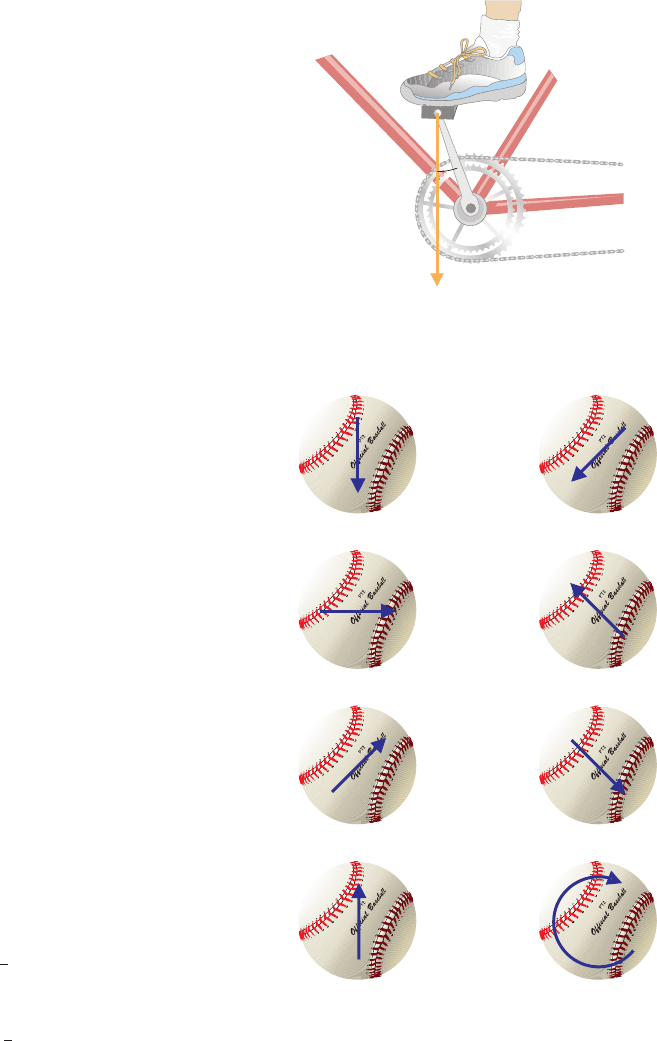
30. In the diagram, a foot applies a force F vertically to a bicycle
pedal. Compute the torque on the sprocket in terms of θ and
F. Determine the angle θ at which the torque is maximized.
When helping a young person to learn to ride a bicycle, most
people rotate the sprocket so that the pedal sticks straight out
to the front. Explain why this is helpful.
u
F
In exercises 31–34, assume that the balls are moving into the
page (and away from you) with the indicated spin. Determine
the direction of the spin vector and of the Magnus force.
31. (a)
(b)
32. (a) (b)
33. (a) (b)
34. (a) (b)
............................................................
In exercises 35–40, label each statement as true or false. If it is
true, briefly explain why. If it is false, give a counterexample.
35. If a ×b = a ×c, then b = c.
36. a ×b =−b ×a
37. a ×a =a
2
38. a ·(b ×c) = (a ·b) ×c
39. If the force is doubled, the torque doubles.
40. If the spin rate is doubled, the Magnus force is doubled.
............................................................
P1: OSO/OVY P2: OSO/OVY QC: OSO/OVY T1: OSO
MHDQ256-Ch11 MHDQ256-Smith-v1.cls December 22, 2010 20:10
LT (Late Transcendental)
CONFIRMING PAGES
11-39 SECTION 11.4
..
The Cross Product 725
In exercises 41–44, use the cross product to determine the angle
θ between the vectors, assuming that 0 ≤ θ ≤
π
2
.
41. a =1, 0, 4, b =2, 0, 1
42. a =2, 2, 1, b =0, 0, 2
43. a = 3i +k, b = 4j + k
44. a = i +3j +3k, b = 2i + j
............................................................
In exercises 45–50, draw pictures to identify the cross product
(do not compute!).
45. i × (3k) 46. k × (2i)
47. i × (j × k) 48. j × ( j × k)
49. j × (j × i) 50. (j × i) × k
............................................................
In exercises 51–54, use the parallelepiped volume formula to
determine whether the vectors are coplanar.
51. 2, 3, 1, 1, 0, 2 and 0, 3, −3
52. 1, −3, 1, 2, −1, 0 and 0, −5, 2
53. 1, 0, −2, 3, 0, 1 and 2, 1, 0
54. 1, 1, 2, 0, −1, 0 and 3, 2, 4
............................................................
55. Show that a × b
2
=a
2
b
2
− (a · b)
2
.
56. Show that (a − b) ×(a +b) = 2(a ×b).
57. Show that (a × b) ·(c ×d) =
a · cb· c
a · db·d
.
58. Prove parts (ii), (iv), (v) and (vi) of Theorem 4.3.
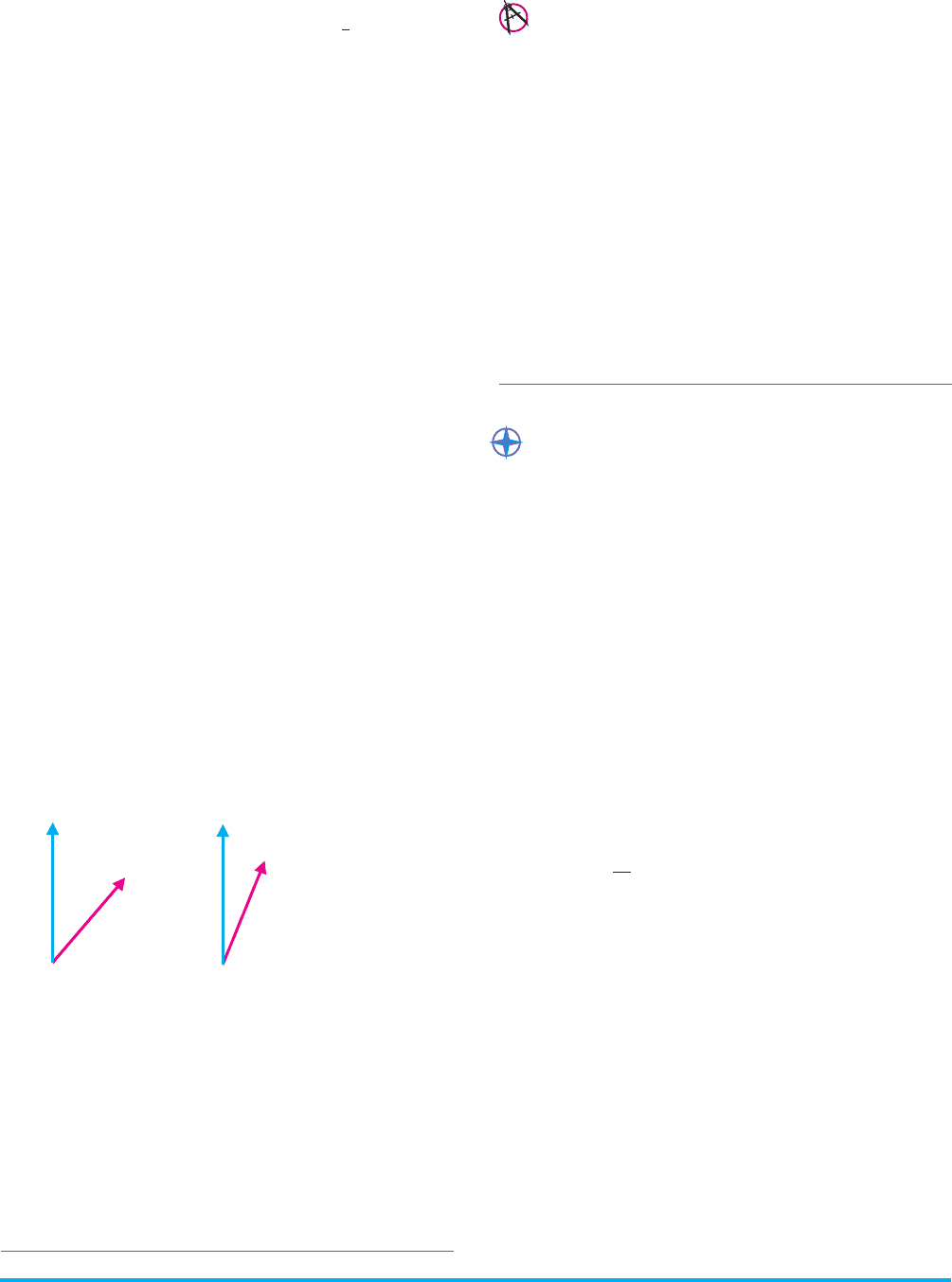
59. In each of the situations shown here, a=3 and b=4. In
which case is a ×b larger? What is the maximum possible
value for a × b?
b
a
b
a
FIGURE A FIGURE B
60. In Figures A and B, if the angles between a and b are 50
◦
and
20
◦
, respectively, find the exact values for a × b. Also, state
whether a × b points into or out of the page.
61. Identify the expressions that are undefined.
(a) a ·(b ×c) (b) a ×(b ·c)
(c) a ·(b ·c) (d) a ×(b ×c)
62. Explain why each equation is true.
(a) a ·(a ×b) = 0 (b) b · (a × a) = 0
APPLICATIONS
In exercises 63–70, a sports situation is described, with the typ-
ical ball spin shown in the indicated exercise. Discuss the effects
on the ball and how the game is affected.
63. Baseball overhand fastball, spin in exercise 31(a)
64. Baseball right-handed curveball, spin in exercise 33(a)
65. Tennis topspin groundstroke, spin in exercise 34(a)
66. Tennis left-handed slice serve, spin in exercise 32(b)
67. Football spiral pass, spin in exercise 34(b)
68. Soccer left-footed “curl” kick, spin in exercise 31(b)
69. Golf “pure” hit, spin in exercise 31(a)
70. Golf right-handed “hook” shot, spin in exercise 33(b)
EXPLORATORY EXERCISES
1. Devise a test that quickly determines whether
a × b < |a · b|, a ×b > |a ·b| or a ×b=|a ·b|.
Apply your test to the following vectors: (a) 2, 1, 1 and
3, 1, 2, (b) 2, 1, −1 and −1, −2, 1 and (c) 2, 1, 1 and
−1, 2, 2. For randomly chosen vectors, which of the three
cases is the most likely?
2. In this exercise, we explore the equation of motion for a gen-
eral projectile in three dimensions. Newton’s second law is
F = ma. Three forces that could affect the motion of the pro-
jectile are gravity, air drag and the Magnus force. Orient the
axes such that positive z is up, positive x is right and positive y
is straight ahead. The force due to gravity is weight, given by
F
g
=0, 0, −mg. Air drag has magnitude proportional to the
square of speed and direction opposite that of velocity. Show
that if v is the velocity vector, then F
d
=−vv satisfies both
properties. The Magnus force is proportional to s ×v, where s
is the spin vector. The full model is then
dv
dt
=0, 0, −g−c
d
vv + c
m
(s × v),
for positive constants c
d
and c
m
. With v =v
x
,v
y
,v
z
and
s =s
x
, s
y
, s
z
, expand this equation into separate differential
equations for v
x
,v
y
and v
z
. We can’t solve these equations,but
we can get some information by considering signs. For a golf
drive, the spin produced could be pure backspin, in which case
the spin vector is s =ω, 0, 0 for some large ω>0. (A golf
shot can havespins of 4000 rpm.) The initial velocity of a good
shot would be straight ahead with some loft, v(0) =0, b, c
for positive constants b and c. At the beginning of the flight,
show that v
y
< 0 and thus, v
y
decreases. If the ball spends
approximately the same amount of time going up as coming
down,concludethattheballwilltravelfartherdownrangewhile
going up than coming down. Next, consider the case of a ball
with some sidespin, so that s
x
> 0 and s
y
> 0. By examining
the sign of v
x
, determine whether this ball will curve to the
right or left. Examine the other equations and determine what
other effects this sidespin may have.
P1: OSO/OVY P2: OSO/OVY QC: OSO/OVY T1: OSO
MHDQ256-Ch11 MHDQ256-Smith-v1.cls December 28, 2010 17:20
LT (Late Transcendental)
CONFIRMING PAGES
726 CHAPTER 11
..
Vectors and the Geometry of Space 11-40
11.5 LINES AND PLANES IN SPACE
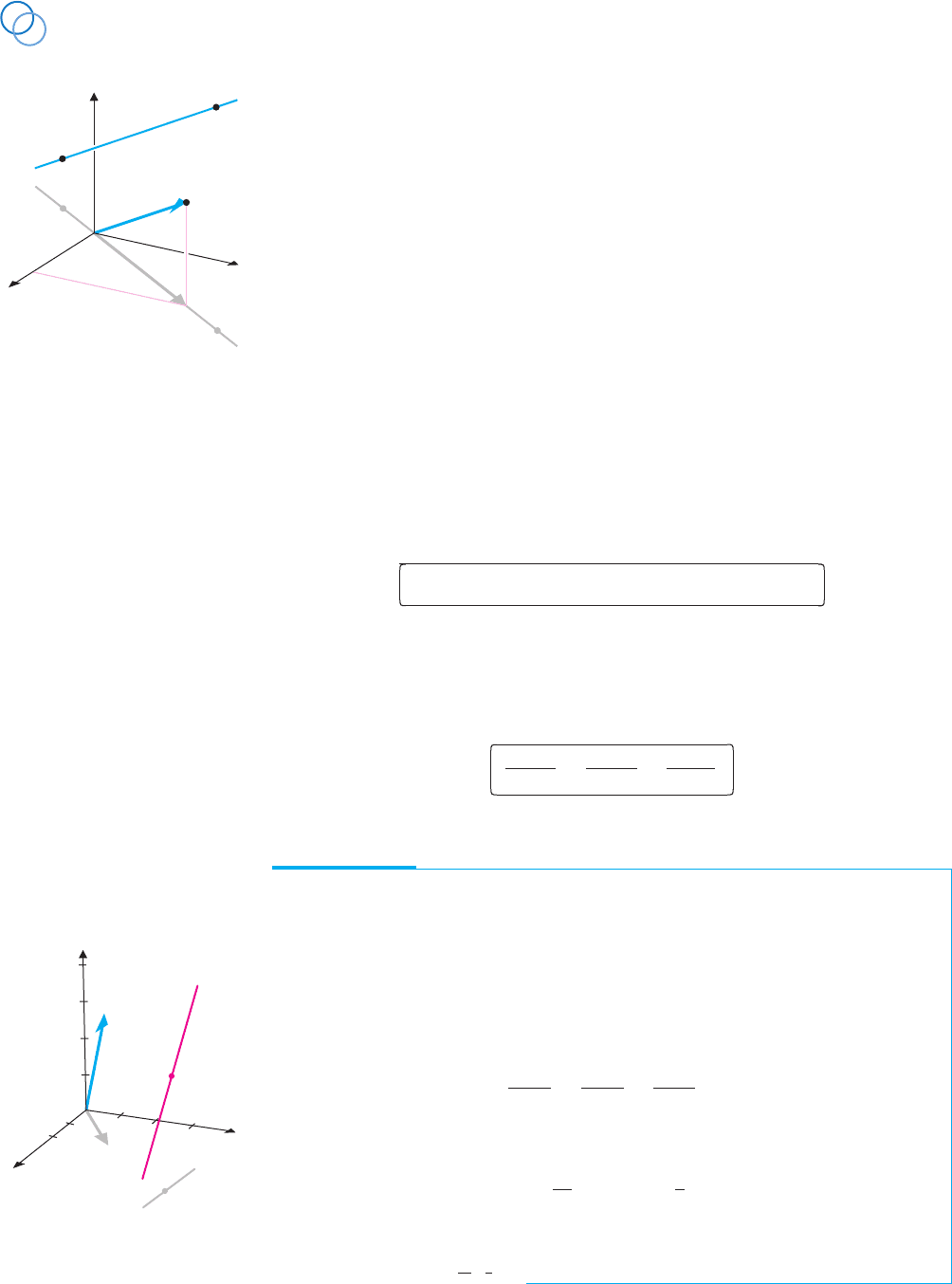
In the xy-plane, we specify a line by selecting either two points on the line or a single
point on the line and its direction, as indicated by the slope of the line. In three dimensions,
specifying two points on a line will still determine the line. An alternative is to specify
a single point on the line and its direction, which is determined by a vector parallel to
the line.
y
x
z
P(x, y, z)
P
1
(x
1
, y
1
, z
1
)
A(a
1
, a
2
, a
3
)
O
a
l
FIGURE 11.39
Line in space
Let’s look for the line that passes through the point P
1
(x
1
, y
1
, z
1
) and that is parallel to
the position vector a =a
1
, a
2
, a
3
. (See Figure 11.39.) For any other point P(x, y, z)on
the line, observe that the vector
−−→
P
1
P will be parallel to a, so that
−−→
P
1
P = ta, (5.1)
for some scalar t. The line then consists of all points P(x, y, z) for which (5.1) holds. Since
−−→
P
1
P =
x − x
1
, y − y
1
, z − z
1
,
we have from (5.1) that
x − x
1
, y − y
1
, z − z
1
=ta = ta
1
, a
2
, a
3
.
Finally, since two vectors are equal if and only if all of their components are equal, we have
x − x
1
= a
1
t, y − y
1
= a
2
t and z − z
1
= a
3
t. (5.2)
Parametric equations of a line
We call (5.2) parametric equations for the line, where t is the parameter. As in the two-
dimensional case, a line in space can be represented by many different sets of parametric
equations. Provided none of a
1
, a
2
or a
3
are zero, we can solve for the parameter in each of
the three equations, to obtain
x − x
1
a
1
=
y − y
1
a
2
=
z − z
1
a
3
. (5.3)
Symmetric equations of a line
We refer to (5.3) as symmetric equations of the line.
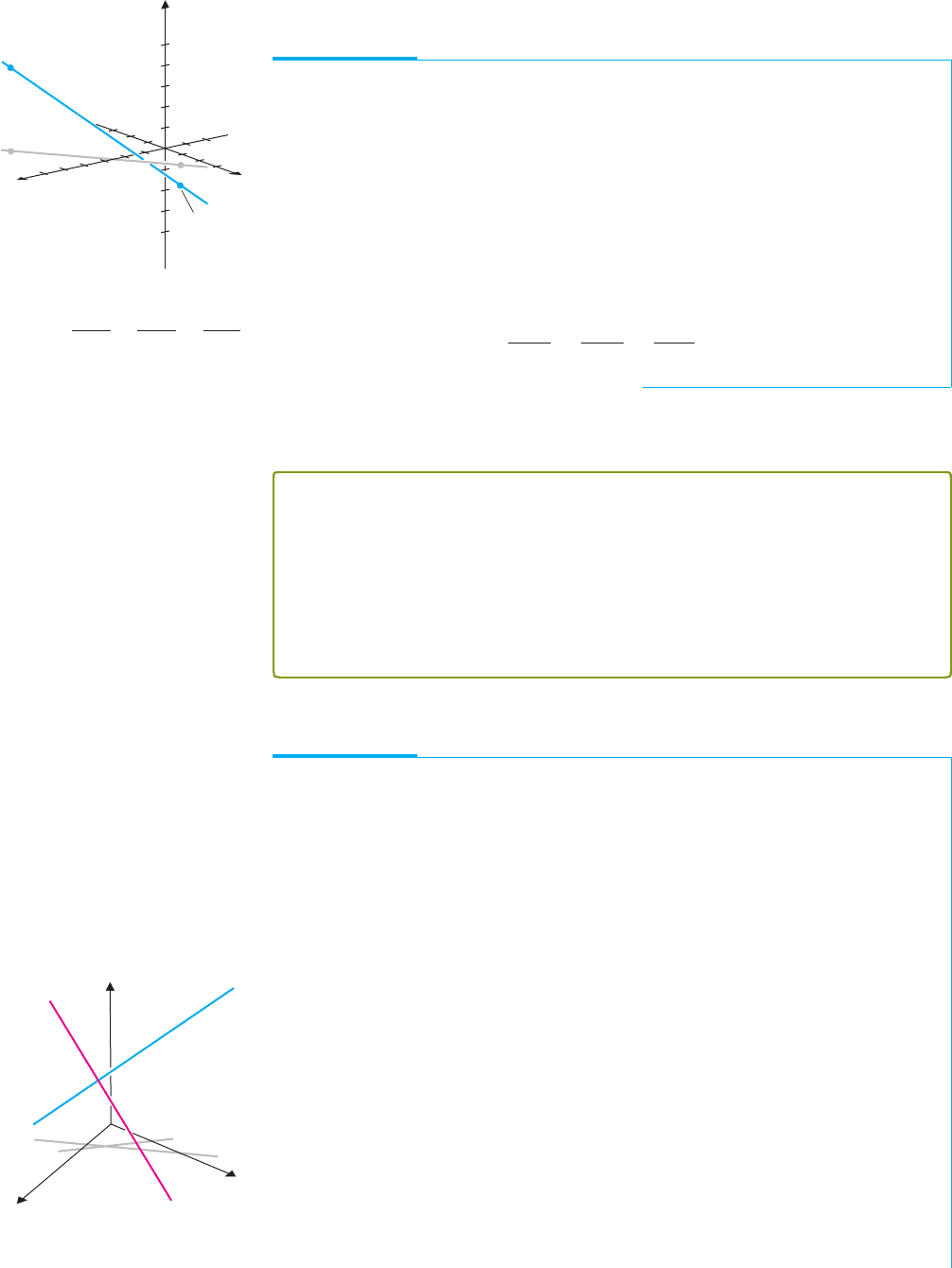
EXAMPLE 5.1 Finding Equations of a Line Given a Point and a Vector
Find equations for the line through the point (1, 5, 2) and parallel to the vector 4, 3, 7.
Also, determine where the line intersects the yz-plane.
Solution From (5.2), parametric equations for the line are
x −1 = 4t, y − 5 = 3t and z − 2 = 7t.
From (5.3), symmetric equations of the line are
x −1
4
=
y − 5
3
=
z − 2
7
. (5.4)
We show the graph of the line in Figure 11.40. Note that the line intersects the yz-plane
where x = 0. Setting x = 0 in (5.4), we solve for y and z to obtain
y =
17
4
and z =
1
4
.
Alternatively, observe that we could solve x −1 = 4t for t (again where x = 0) and
substitute this into the parametric equations for y and z. So, the line intersects the
yz-plane at the point
0,
17
4
,
1
4
.
y
x
z
(1, 5, 2)
具4, 3, 7典
O
2
2
2
FIGURE 11.40
The line x = 1 +4t, y = 5 +3t,
z = 2 +7t
P1: OSO/OVY P2: OSO/OVY QC: OSO/OVY T1: OSO
MHDQ256-Ch11 MHDQ256-Smith-v1.cls December 22, 2010 20:10
LT (Late Transcendental)
CONFIRMING PAGES
11-41 SECTION 11.5
..
Lines and Planes in Space 727
Given two points, we can easily find the equations of the line passing through them, as
in example 5.2.
4
3
y
x
4
O
(1, 2, 1)
(5, 3, 4)
z
FIGURE 11.41
The line
x − 1
4
=
y − 2
−5
=
z + 1
5
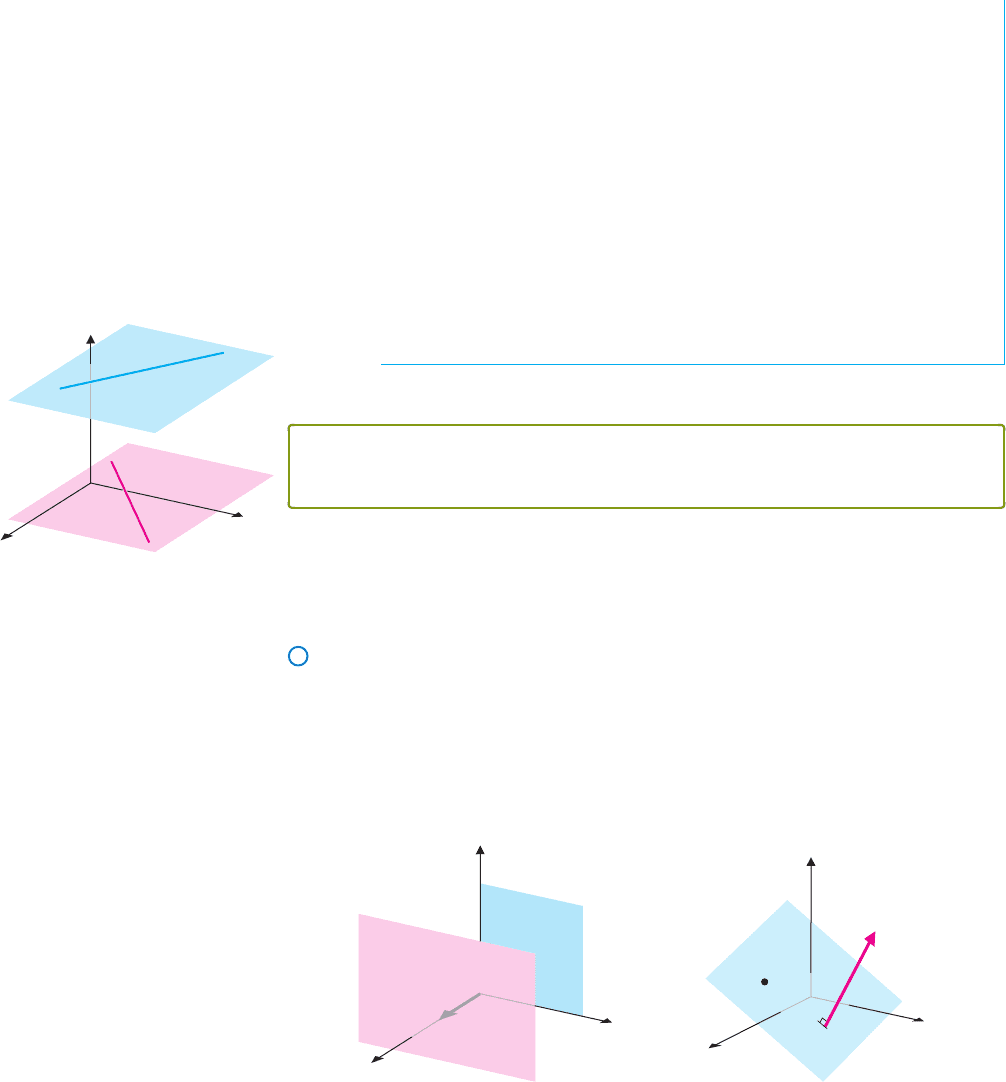
EXAMPLE 5.2 Finding Equations of a Line Given Two Points
Find equations for the line passing through the points P(1, 2, −1) and Q(5, −3, 4).
Solution First, a vector that is parallel to the line is
−→
PQ =5 − 1, −3 −2, 4 − (−1)=4, −5, 5.
Picking either point will give us equations for the line. Here, we use P, so that parametric
equations for the line are
x −1 = 4t, y − 2 =−5t and z + 1 = 5t.
Similarly, symmetric equations of the line are
x −1
4
=
y − 2
−5
=
z + 1
5
.
We show the graph of the line in Figure 11.41.
Since we have specified a line by choosing a point on the line and a vector with the
same direction, Definition 5.1 should be no surprise.
DEFINITION 5.1
Let l
1
and l
2
be two lines in R
3
, with parallel vectors a and b, respectively, and let θ
be the angle between a and b.
(i) The lines l
1
and l
2
are parallel whenever a and b are parallel.
(ii) If l
1
and l
2
intersect, then
(a) the angle between l
1
and l
2
is θ and
(b) the lines l
1
and l
2
are orthogonal whenever a and b are orthogonal.
In two dimensions, two lines are either parallel or they intersect. This is not true in
three dimensions, as we see in example 5.3.
z
O
l
1
l
2
y
x
FIGURE 11.42
Skew lines
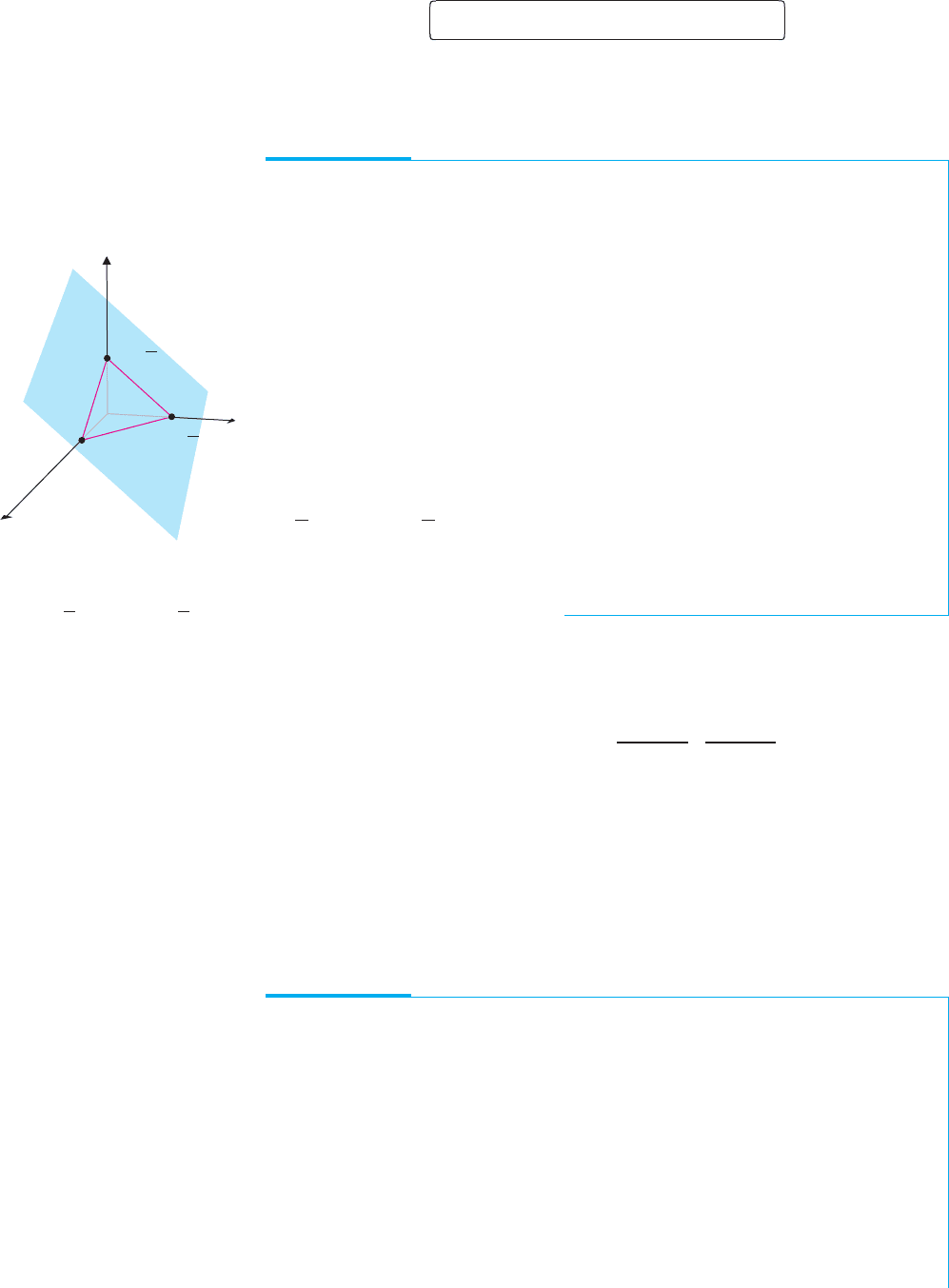
EXAMPLE 5.3 Showing Two Lines Are Not Parallel
but Do Not Intersect
Show that the lines
l
1
: x − 2 =−t, y − 1 = 2t and z − 5 = 2t
and
l
2
: x − 1 = s, y − 2 =−s and z − 1 = 3s
are not parallel, yet do not intersect.
Solution Notice immediately that we have used different letters (t and s)as
parameters for the two lines. In this setting, the parameter is a dummy variable, so the
letter used is not significant. However, solving the first parametric equation of each line
for the parameter in terms of x,weget
t = 2 − x and s = x − 1,
respectively. This says that the parameter represents something different in each line; so
we must use different letters. Notice from the graph in Figure 11.42 that the lines are
most certainly not parallel, but it is unclear whether or not they intersect. (Remember,
the graph is a two-dimensional rendering of lines in three dimensions and so, while the
two-dimensional lines drawn do intersect, it’s unclear whether or not the
three-dimensional lines that they represent intersect.)
You can read from the parametric equations that a vector parallel to l
1
is
a
1
=−1, 2, 2, while a vector parallel to l
2
is a
2
=1, −1, 3. Since a
1
is not a scalar
P1: OSO/OVY P2: OSO/OVY QC: OSO/OVY T1: OSO
MHDQ256-Ch11 MHDQ256-Smith-v1.cls December 22, 2010 20:10
LT (Late Transcendental)
CONFIRMING PAGES
728 CHAPTER 11
..
Vectors and the Geometry of Space 11-42
multiple of a
2
, the vectors are not parallel, confirming that the lines l
1
and l
2
are not
parallel. The lines intersect if there’s a choice of the parameters s and t that produces the
same point, that is, that produces the same values for all of x, y and z. Setting the
x-values equal, we get
2 − t = 1 +s,
so that s = 1 −t. Setting the y-values equal and setting s = 1 −t,weget
1 + 2t = 2 −s = 2 −(1 −t) = 1 +t.
Solving this for t yields t = 0, which further implies that s = 1. Setting the
z-components equal gives
5 + 2t = 3s + 1,
but this is not satisfied when t = 0 and s = 1. So, l
1
and l
2
are not parallel, yet do not
intersect.
y
x
z
l
1
l
2
O
FIGURE 11.43
Skew lines
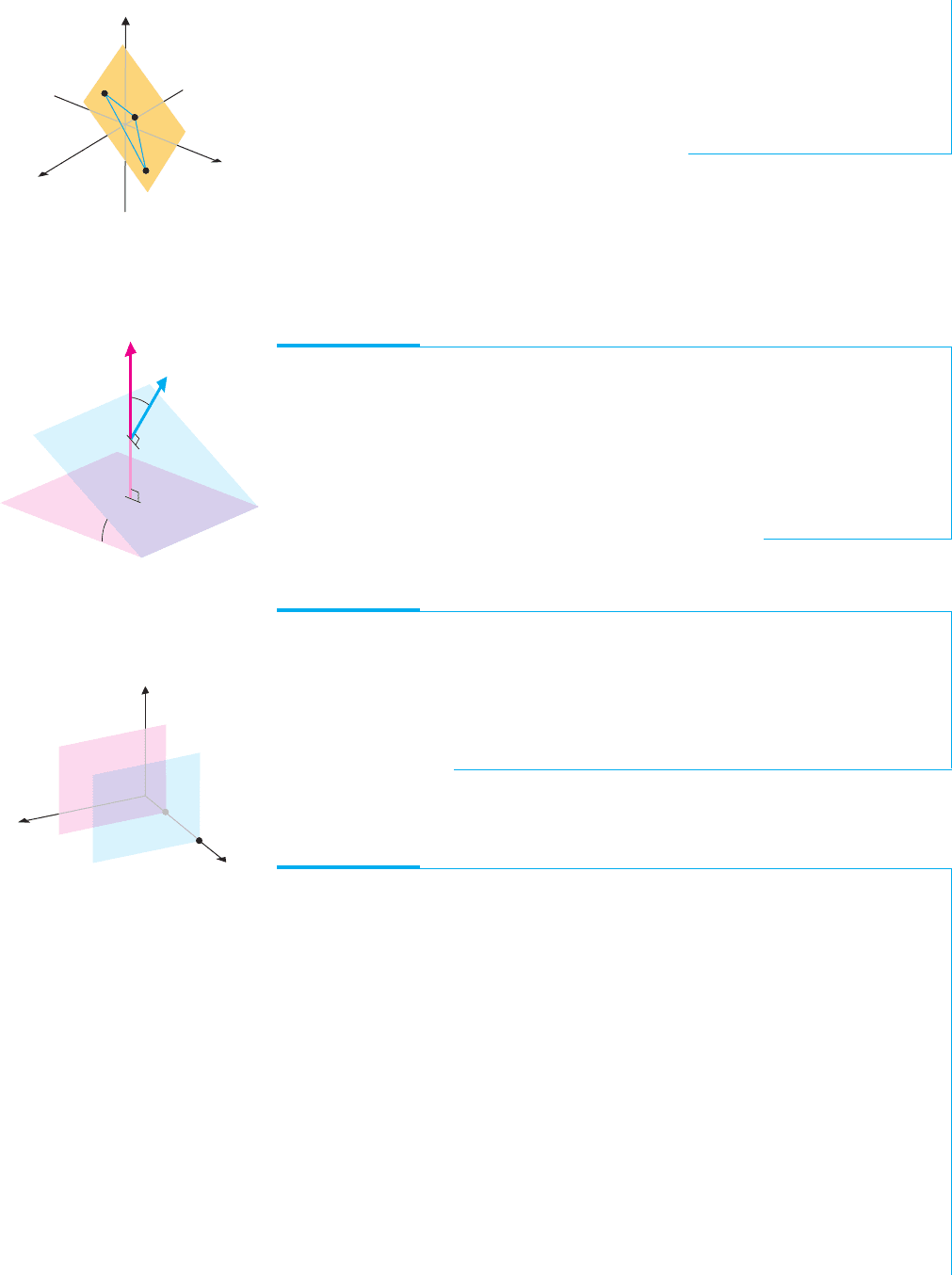
DEFINITION 5.2
Nonparallel, nonintersecting lines are called skew lines.
Note that it’s fairly easy to visualize skew lines. Draw two planes that are parallel and
draw a line in each plane (so that it lies completely in the plane). As long as the two lines
are not parallel, these are skew lines. (See Figure 11.43.)
Planes in R
3
Think about what information you might need to specify a plane in space. As a simple
example,observethattheyz-planeisasetofpointsinspacesuchthateveryvectorconnecting
twopoints in the set is orthogonal to i. However, every plane parallel to the yz-plane satisfies
this criterion. (See Figure 11.44.) In order to select the one that corresponds to the yz-plane,
you also need to specify a point through which it passes (any one will do).
y
yz-plane
x
z
i
a
z
x
y
P
1
FIGURE 11.44
Parallel planes
FIGURE 11.45
Plane in R
3
Ingeneral,aplaneinspaceisdeterminedbyspecifyinganonzerovectora =a
1
, a
2
, a
3
that is normal to the plane (i.e., orthogonal to every vector lying in the plane) and a point
P
1
(x
1
, y
1
, z
1
) lying in the plane. (See Figure 11.45.) In order to find an equation of the
plane, let P(x, y, z) represent any point in the plane. Then, since P and P
1
are both points
in the plane, the vector
−−→
P
1
P =x − x
1
, y − y
1
, z − z
1
lies in the plane and so, must be
orthogonal to a. By Corollary 3.1, we have that
0 = a ·
−−→
P
1
P =a
1
, a
2
, a
3
·x − x
1
, y − y
1
, z − z
1
P1: OSO/OVY P2: OSO/OVY QC: OSO/OVY T1: OSO
MHDQ256-Ch11 MHDQ256-Smith-v1.cls December 28, 2010 17:20
LT (Late Transcendental)
CONFIRMING PAGES
11-43 SECTION 11.5
..
Lines and Planes in Space 729
or
0 = a
1
(x − x
1
) + a
2
(y − y
1
) + a
3
(z − z
1
). (5.5)
Equation of a plane
Equation (5.5) is anequation for theplane passing through the point (x
1
, y
1
, z
1
) with normal
vectora
1
, a
2
, a
3
.It’s asimplematterto use this to find theequationofanyparticular plane.
We illustrate this in example 5.4.
EXAMPLE 5.4 The Equation and Graph of a Plane Given a Point
and a Normal Vector
Find an equation of the plane containing the point (1, 2, 3) with normal vector 4, 5, 6,
and sketch the plane.
Solution From (5.5), we have the equation
0 = 4(x − 1) + 5(y − 2) +6(z − 3). (5.6)
To draw the plane, we locate three points lying in the plane. In this case, the simplest
way to do this is to look at the intersections of the plane with each of the coordinate
axes. When y = z = 0, we get from (5.6) that
0 = 4(x − 1) + 5(0 − 2) +6(0 −3) = 4x − 4 − 10 − 18,
so that 4x = 32 or x = 8. The intersection of the plane with the x-axis is then the point
(8, 0, 0). Similarly, you can find the intersections of the plane with the y- and z-axes:
0,
32
5
, 0
and
0, 0,
16
3
, respectively. Using these three points, we can draw the plane
seen in Figure 11.46. We start by drawing the triangle with vertices at the three points;
the plane we want is the one containing this triangle. Notice that since the plane
intersects all three of the coordinate axes, the portion of the plane in the first octant is
the indicated triangle and its interior.
(8, 0, 0)
(
0, , 0
)
(
0, 0,
)
32
5
z
x
y
16
3
FIGURE 11.46
The plane through (8, 0, 0),
0,
32
5
, 0
and
0, 0,
16
3
Note that if we expand out the expression in (5.5), we get
0 = a
1
(x − x
1
) + a
2
(y − y
1
) + a
3
(z − z
1
)
= a
1
x +a
2
y + a
3
z + (−a
1
x
1
− a
2
y
1
− a
3
z
1
)
constant
.
We refer to this last equation as a linear equation in the three variables x, y and z.In
particular, this says that every linear equation of the form
0 = ax + by + cz + d,
where a, b, c and d are constants, is the equation of a plane with normal vector a, b, c.
We observed earlier that three points determine a plane. But, how can you find an
equation of a plane given only three points? If you are to use (5.5), you’ll first need to find
a normal vector. We can easily resolve this, as in example 5.5.
EXAMPLE 5.5 Finding the Equation of a Plane Given Three Points
Find the plane containing the three points P(1, 2, 2), Q(2, −1, 4) and R(3, 5, −2).
Solution First, we’ll need to find a vector normal to the plane. Notice that two vectors
lying in the plane are
−→
PQ =1, −3, 2 and
−→
QR =1, 6, −6.
Consequently, a vector orthogonal to both of
−→
PQ and
−→
QR is the cross product
−→
PQ ×
−→
QR =
ijk
1 −32
16−6
=6, 8, 9.
P1: OSO/OVY P2: OSO/OVY QC: OSO/OVY T1: OSO
MHDQ256-Ch11 MHDQ256-Smith-v1.cls December 28, 2010 17:20
LT (Late Transcendental)
CONFIRMING PAGES
730 CHAPTER 11
..
Vectors and the Geometry of Space 11-44
Since
−→
PQ and
−→
QR are not parallel,
−→
PQ ×
−→
QR must be orthogonal to the plane, as well.
(Why is that?) From (5.5), an equation for the plane is then
0 = 6(x − 1) + 8(y − 2) +9(z − 2).
In Figure 11.47, we show the triangle with vertices at the three points. The plane in
question is the one containing the indicated triangle.
Q
P
R
z
x
y
FIGURE 11.47
Plane containing three points
In three dimensions, two planes are either parallel or they intersect in a straight line.
(Think about this some.) Suppose that two planes having normal vectors a and b,
respectively, intersect. Then the angle between the planes is the same as the angle between
a and b. (See Figure 11.48.) With this in mind, we say that the two planes are parallel
whenever their normal vectors are parallel and the planes are orthogonal whenever their
normal vectors are orthogonal.
a
b
u
u
FIGURE 11.48
Angle between planes
EXAMPLE 5.6 The Equation of a Plane Given a Point and a Parallel Plane
Find an equation for the plane through the point (1, 4, −5) and parallel to the plane
defined by 2x − 5y + 7z = 12.
Solution First, notice that a normal vector to the given plane is 2, −5, 7. Since the
two planes are to be parallel, this vector is also normal to the new plane. From (5.5), we
can write down the equation of the plane:
0 = 2(x − 1) − 5(y − 4) +7(z + 5).
It’s particularly easy to see that some planes are parallel to the coordinate planes.
y
x
z
(0, 8, 0)
(0, 3, 0)
FIGURE 11.49
The planes y = 3 and y = 8
EXAMPLE 5.7 Drawing Some Simple Planes
Draw the planes y = 3 and y = 8.
Solution First, notice that both equations represent planes with the same normal
vector, 0, 1, 0=j. This says that the planes are both parallel to the xz-plane, the first
one passing through the point (0, 3, 0) and the second one passing through (0, 8, 0), as
seen in Figure 11.49.
In example 5.8, we see how to find an equation of the line of intersection of two
nonparallel planes.
EXAMPLE 5.8 Finding the Intersection of Two Planes
Find the line of intersection of the planes x + 2y + z = 3 and x − 4y + 3z = 5.
Solution Solving both equations for x,weget
x = 3 −2y − z and x = 5 +4y − 3z. (5.7)
Setting these expressions for x equal gives us
3 − 2y − z = 5 +4y − 3z.
Solving this for z gives us
2z = 6y + 2orz = 3y + 1.
Returning to either equation in (5.7), we can solve for x (also in terms of y). We have
x = 3 −2y − z = 3 − 2y − (3y + 1) =−5y + 2.
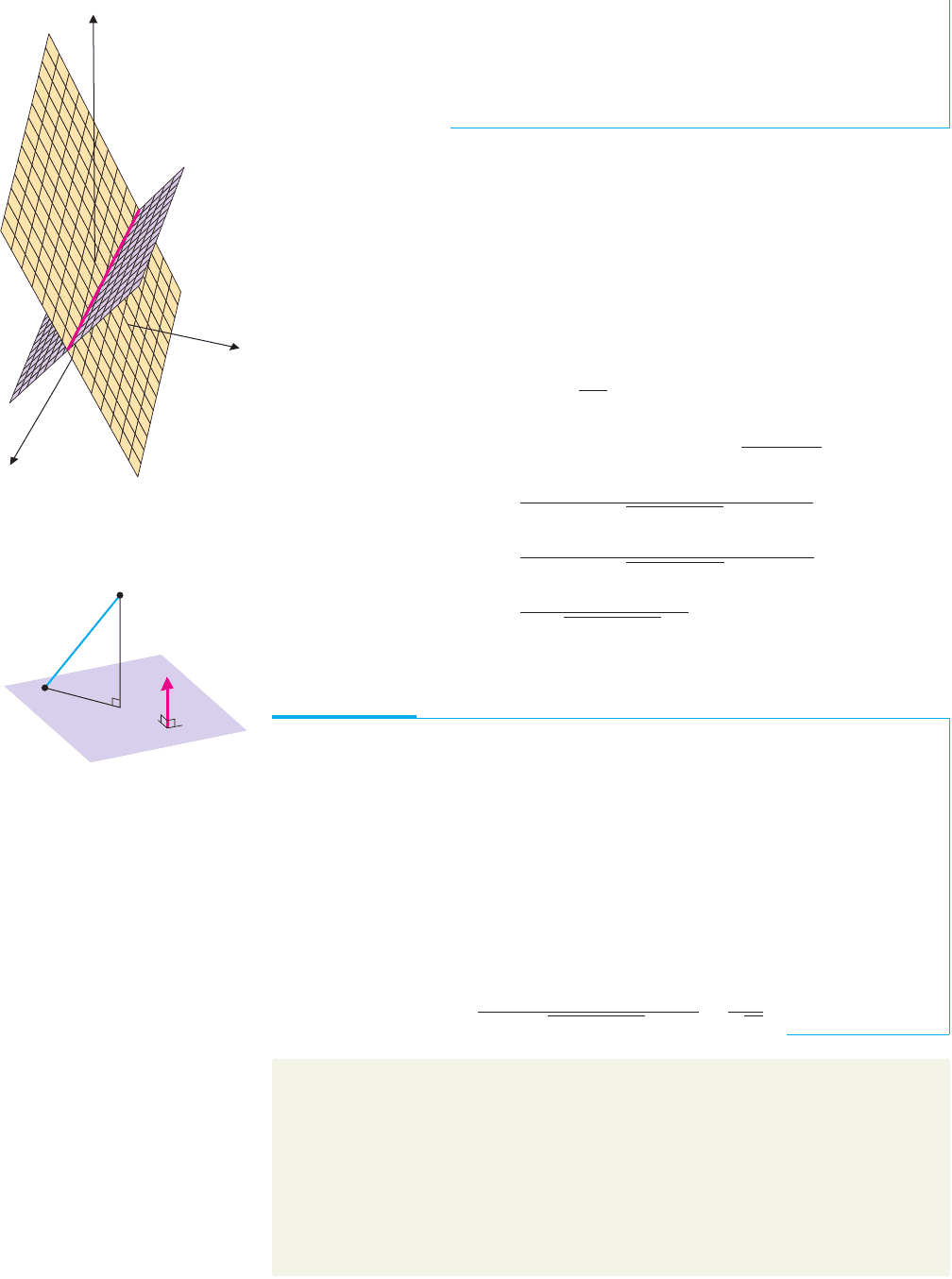
P1: OSO/OVY P2: OSO/OVY QC: OSO/OVY T1: OSO
MHDQ256-Ch11 MHDQ256-Smith-v1.cls December 22, 2010 20:10
LT (Late Transcendental)
CONFIRMING PAGES
11-45 SECTION 11.5
..
Lines and Planes in Space 731
Taking y as the parameter (i.e., letting y = t), we obtain parametric equations for the line
of intersection:
x =−5t + 2, y = t and z = 3t + 1.
You can see the line of intersection in the computer-generated graph of the two planes
seen in Figure 11.50.
z
y
x
FIGURE 11.50
Intersection of planes
P
1
P
0
→
comp
a
P
1
P
0
a
P
1
FIGURE 11.51
Distance from a point to a plane
Observethatthedistancefrom theplaneax +by + cz + d = 0to apoint P
0
(x
0
, y
0
, z
0
)
not on the plane is measured along a line segment connecting the point to the plane that
is orthogonal to the plane. (See Figure 11.51.) To compute this distance, pick any point
P
1
(x
1
, y
1
, z
1
) lying in the plane and let a =a, b, c denote a vector normal to the plane.
From Figure 11.51, notice that the distance from P
0
to the plane is simply |comp
a
−−→
P
1
P
0
|,
where
−−→
P
1
P
0
=x
0
− x
1
, y
0
− y
1
, z
0
− z
1
.
From (3.7), the distance is
comp
a
−−→
P
1
P
0
=
−−→
P
1
P
0
·
a
a
=
x
0
− x
1
, y
0
− y
1
, z
0
− z
1
·
a, b, c
a, b, c
=
|a(x
0
− x
1
) + b(y
0
− y
1
) + c(z
0
− z
1
)|
√
a
2
+ b
2
+ c
2
=
|ax
0
+ by
0
+ cz
0
− (ax
1
+ by
1
+ cz
1
)|
√
a
2
+ b
2
+ c
2
=
|ax
0
+ by
0
+ cz
0
+ d|
√
a
2
+ b
2
+ c
2
, (5.8)
since (x
1
, y
1
, z
1
) lies in the plane and ax + by +cz =−d, for every point (x, y, z)inthe
plane.
EXAMPLE 5.9 Finding the Distance Between Parallel Planes
Find the distance between the parallel planes:
P
1
:2x −3y + z = 6
and P
2
:4x −6y + 2z = 8.
Solution First, observe that the planes are parallel, since their normal vectors
2, −3, 1 and 4, −6, 2 are parallel. Further, since the planes are parallel, the distance
from the plane P
1
to every point in the plane P
2
is the same. So, pick any point in P
2
,
say (0, 0, 4). (This is certainly convenient.) The distance D from the point (0, 0, 4) to the
plane P
1
is then given by (5.8) to be
D =
|(2)(0) − (3)(0) + (1)(4) − 6|
√
2
2
+ 3
2
+ 1
2
=
2
√
14
.
BEYOND FORMULAS
Bothlines and planesaredefined in thissectioninterms of apointand a vector. Toavoid
confusing the equations of lines and planes, focus on understanding the derivations of
these equations. Parametric equations of a line simply express the line in terms of a
starting point and a direction. The equation of a plane is simply an expanded version
of the dot product equation for the normal vector being perpendicular to the plane.
Hopefully, you have discovered that a formula is easier to memorize if you understand
the logic behind the result.

P1: OSO/OVY P2: OSO/OVY QC: OSO/OVY T1: OSO
MHDQ256-Ch11 MHDQ256-Smith-v1.cls December 22, 2010 20:10
LT (Late Transcendental)
CONFIRMING PAGES
732 CHAPTER 11
..
Vectors and the Geometry of Space 11-46
EXERCISES 11.5
WRITING EXERCISES
1. Explain how to shift back and forth between the parametric
and symmetric equations of a line. Describe one situation in
which you would prefer to have parametric equations to work
with and one situation inwhich symmetric equationswould be
more convenient.
2. Lines and planes can both be specified with a point and
a vector. Discuss the differences in the vectors used, and
explain why the normal vector of the plane specifies an entire
plane, while the direction vector of the line merely specifies
a line.
3. If c = 0 in the equation ax +by + cz + d = 0 of a plane, you
have an equation that could describe a line in the xy-plane.
Describe how this line relates to the plane.
4. Our hint about visualizing skew lines was to place the lines in
parallel planes. Discuss whether every pair of skew lines must
necessarily lie in parallel planes. (Hint: Discuss how the cross
product of the direction vectors of the lines would relate to the
parallel planes.)
In exercises 1–10, find (a) parametric equations and (b) sym-
metric equations of the line.
1. The line through (1, 2, −3) and parallel to 2, −1, 4
2. The line through (3, −2, 4) and parallel to 3, 2, −1
3. The line through (2, 1, 3) and (4, 0, 4)
4. The line through (0, 2, 1) and (2, 0, 2)
5. The line through (1, 2, 1) and parallel to the line x = 2 −3t,
y = 4, z = 6 + t
6. The line through (−1, 0, 0) and parallel to the line
x + 1
−2
=
y
3
= z − 2
7. The line through (2, 0, 1) and perpendicular to both 1, 0, 2
and 0, 2, 1
8. The line through (−3, 1, 0) and perpendicular to both
0, −3, 1 and 4, 2, −1
9. The line through (1, 2, −1) and normal to the plane
2x − y + 3z = 12
10. The line through (0, −2, 1) and normal to the plane y + 3z = 4
............................................................
In exercises 11–14, determine whether the lines are paral-
lel, skew or intersect. If they intersect, find the point of
intersection.
11.
⎧
⎨
⎩
x = 4 +t
y = 2
z = 3 +2t
and
⎧
⎨
⎩
x = 2 +2s
y = 2s
z =−1 +4s
12.
⎧
⎨
⎩
x = 3 +t
y = 3 +3t
z = 4 −t
and
⎧
⎨
⎩
x = 2 −s
y = 1 −2s
z = 6 +2s
13.
⎧
⎨
⎩
x = 1 +2t
y = 3
z =−1 −4t
and
⎧
⎨
⎩
x = 2 −s
y = 2
z = 3 +2s
14.
⎧
⎨
⎩
x = 1 −2t
y = 2t
z = 5 −t
and
⎧
⎨
⎩
x = 3 +2s
y =−2
z = 3 +2s
............................................................
In exercises 15–24, find an equation of the given plane.
15. The plane containing the point (1, 3, 2) with normal vector
2, −1, 5
16. The plane containing the point (−2, 1, 0) with normal vector
−3, 0, 2
17. The plane containing the points (2, 0, 3), (1, 1, 0) and
(3, 2, −1)
18. The plane containing the points (1, −2, 1), (2, −1, 0) and
(3, −2, 2)
19. The plane containing the points (a, 0, 0), (0, b, 0) and (0, 0, c),
where a, b and c are nonzero constants.
20. The plane containing the points (x
1
, y
1
, 0), (x
2
, 0, z
2
) and
(0, y
3
, z
3
).
21. The plane containing the point (0, −2, −1) and parallel to the
plane −2x + 4y = 3
22. Theplane containingthe point(3, 1,0) and parallel to the plane
−3x − 3y + 2z = 4
23. The plane containing the point (1, 2, 1) and perpendicular to
the planes x + y = 2 and 2x + y − z = 1
24. The plane containing the point (3, 0, −1) and perpendicular to
the planes x + 2y − z = 2 and 2x − z = 1
............................................................
In exercises 25–34, find all intercepts and sketch the given plane.
25. x + y + z = 4 26. 2x − y + 4z = 4
27. 3x +6y − z = 6 28. 2x + y + 3z = 6
29. x = 4 30. y = 3
31. z = 2 32. x + y = 1
33. 2x − z = 2 34. y = x +2
............................................................
In exercises 35–38, find the intersection of the planes.
35. 2x − y − z = 4 and 3x −2y + z = 0
36. 3x + y − z = 2 and 2x −3y + z =−1