
Smith R., Minton R. Calculus
Подождите немного. Документ загружается.


P1: OSO/OVY P2: OSO/OVY QC: OSO/OVY T1: OSO
MHDQ256-Ch11 MHDQ256-Smith-v1.cls December 22, 2010 20:10
LT (Late Transcendental)
CONFIRMING PAGES
11-47 SECTION 11.5
..
Lines and Planes in Space 733
37. 3x +4y = 1 and x + y − z = 3
38. x − 2y + z = 2 and x + 3y −2z = 0
............................................................
In exercises 39–44, find the distance between the given objects.
39. The point (2, 0, 1) and the plane 2x − y + 2z = 4
40. The point (1, 3, 0) and the plane 3x + y − 5z = 2
41. The point (2, −1, −1) and the plane x − y + z = 4
42. The point (0, −1, 1) and the plane 2x −3y = 2
43. The planes 2x − y − z = 1 and 2x − y − z = 4
44. The planes x + 3y − 2z = 3 and x + 3y − 2z = 1
............................................................
In exercises 45–50, state whether the lines are parallel or
perpendicular and find the angle between the lines.
45.
⎧
⎨
⎩
x = 1 −3t
y = 2 +4t
z =−6 +t
and
⎧
⎨
⎩
x = 1 +2s
y = 2 −2s
z =−6 +s
46.
⎧
⎨
⎩
x = 4 −2t
y = 3t
z =−1 +2t
and
⎧
⎨
⎩
x = 4 +s
y =−2s
z =−1 +3s
47.
⎧
⎨
⎩
x = 1 +2t
y = 3
z =−1 +t
and
⎧
⎨
⎩
x = 2 −s
y = 8 +5s
z = 2 +2s
48.
⎧
⎨
⎩
x = 1 −2t
y = 2t
z = 5 −t
and
⎧
⎨
⎩
x = 3 +2s
y =−2 −2s
z = 6 +s
49.
⎧
⎨
⎩
x =−1 +2t
y = 3 +4t
z =−6t
and
⎧
⎨
⎩
x =−1 −s
y = 3 −2s
z = 3s
50.
⎧
⎨
⎩
x = 3 −t
y = 4
z =−2 +2t
and
⎧
⎨
⎩
x = 1 +2s
y = 7 −3s
z =−3 +s
............................................................
51. Showthat the distance between planes ax +by + cz = d
1
and
ax +by + cz = d
2
is given by
|d
2
− d
1
|
√
a
2
+ b
2
+ c
2
.
52. Find an equation of the plane containing the lines
⎧
⎨
⎩
x = 4 +t
y = 2
z = 3 +2t
and
⎧
⎨
⎩
x = 2 +2s
y = 2s
z =−1 +4s
.
53. Find an equation for the intersection of
⎧
⎨
⎩
x = 2 +t
y = 3 −t
z = 2t
and
x − y + 2z = 3
.
54. Find numbers a, b and c such that
⎧
⎨
⎩
x = 1 +at
y = 2 +bt
z = 3 +ct
is perpendicular to
2x + y − 3z = 1
.
In exercises 55–62, state whether the statement is true or false
(not always true). If itis false, modify it to makea true statement.
55. Two planes either are parallel or intersect.
56. The set of points common to two planes is a line.
57. The set of points common to three planes is a point.
58. Lines that lie in different parallel planes are skew.
59. The set of all lines perpendicular to a given line forms a plane.
60. There is exactly one line perpendicular to a given plane.
61. The set of allpoints equidistant fromtwo different fixed points
forms a plane.
62. The set of all points equidistant from two given planes forms
a plane.
............................................................
In exercises 63–66, determine whether the given lines or planes
are the same.
63. x = 3 −2t, y = 3t, z = t − 2 and x = 1 +4t, y = 3 − 6t,
z =−1 −2t
64. x = 1 +4t, y = 2 −2t, z = 2 +6t and x = 9 −2t,
y =−2 +t, z = 8 − 3t
65. 2(x − 1) −(y + 2) +(z − 3) = 0 and 4x − 2y + 2z = 2
66. 3(x + 1) +2(y − 2) −3(z + 1) = 0 and
6(x − 2) +4(y + 1) −6z = 0
............................................................
67. Describe the family of planes and the role of the parameter c.
(a) x + y + cz = 2 (b) x + y + 2z = c
(c) 2(x −c) + y − z = 4 (d) x + 2y − 3z = 1 + 3c
68. Suppose two airplanes fly paths described by the parametric
equations P
1
:
⎧
⎨
⎩
x = 3
y = 6 −2t
z = 3t + 1
and P
2
:
⎧
⎨
⎩
x = 1 +2s
y = 3 +s
z = 2 +2s
.
Describe the shape of the flight paths. If t = s represents
time, determine whether the paths intersect. Determine if the
planes collide.
EXPLORATORY EXERCISES
1. Compare the equations that we have developed for the dis-
tance between a (two-dimensional) point and a line and for a
(three-dimensional) point and a plane. Based on these equa-
tions, hypothesize a formula for the distance between the
(four-dimensional) point (x
1
, y
1
, z
1
,w
1
) and the hyperplane
ax +by + cz + dw + e = 0.
2. In this exercise, we will explore the geometrical object deter-
minedby theparametricequations
⎧
⎨
⎩
x = 2s + 3t
y = 3s +2t .
z = s + t
Giventhat
there are two parameters, what dimension do you expect the
object to have? Given that the individual parametric equations
P1: OSO/OVY P2: OSO/OVY QC: OSO/OVY T1: OSO
MHDQ256-Ch11 MHDQ256-Smith-v1.cls December 22, 2010 20:10
LT (Late Transcendental)
CONFIRMING PAGES
734 CHAPTER 11
..
Vectors and the Geometry of Space 11-48
are linear, what do you expect the object to be? Show that the
points (0, 0, 0), (2, 3, 1) and (3, 2, 1) are on the object. Find an
equation of the plane containing these three points. Substitute
in the equations for x, y and z and show that the object
lies in the plane. Argue that the object is, in fact, the entire
plane.
11.6 SURFACES IN SPACE
Now that we have discussed lines and planes in R
3
, we explore more complicated objects
in three dimensions. Don’t expect a general theory like we developed for two-dimensional
graphs. Drawing a two-dimensional image that represents an object in three dimensions or
even correctly interpreting computer-generated graphics is something of an art. Our goal
here is not to produce artists, but rather to leave you with the ability to deal with a small
group of surfaces in three dimensions. In countless problems, taking a few extra minutes to
draw a better graph will result in a huge savings of time and effort.
Cylindrical Surfaces
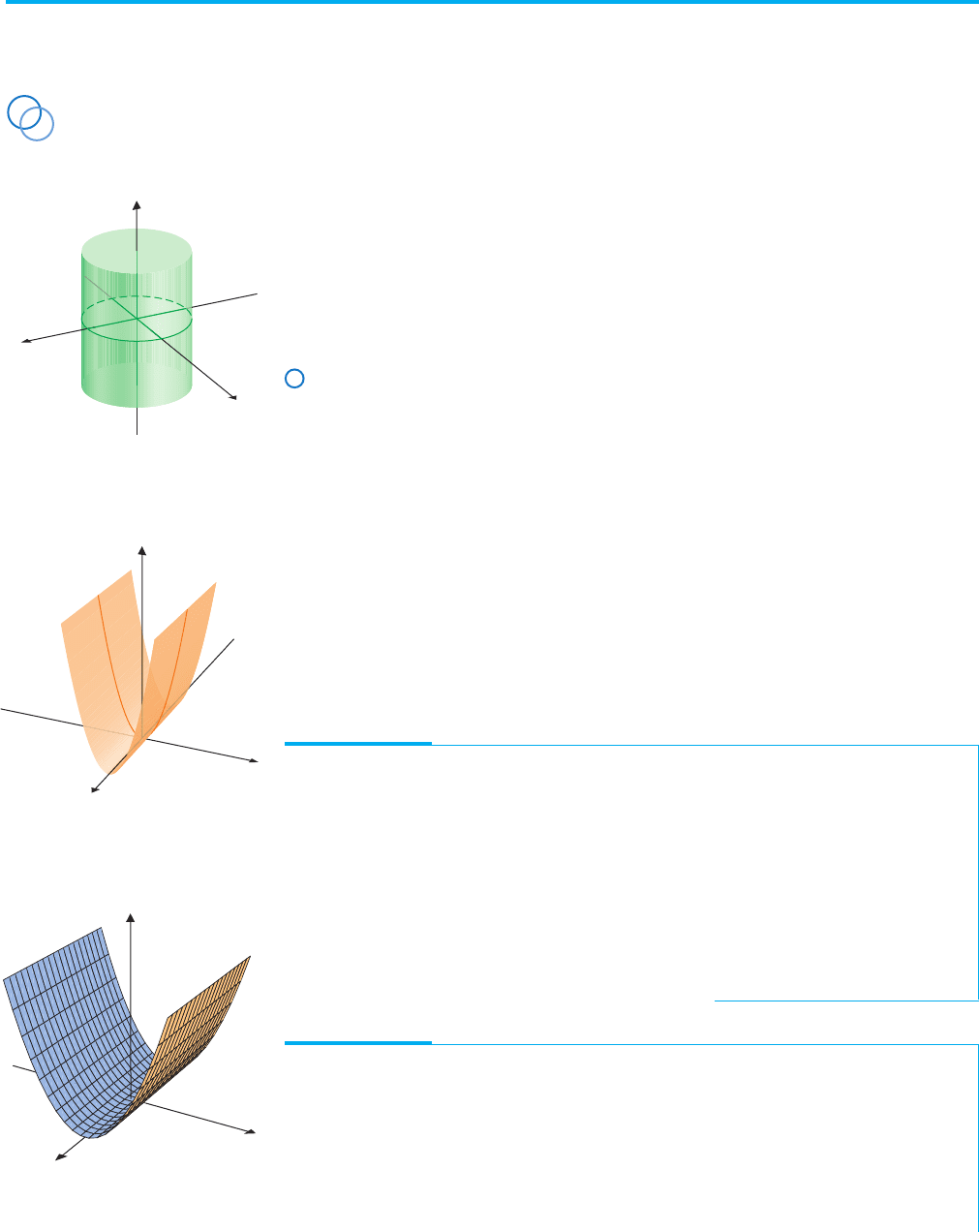
We begin with a simple type of three-dimensional surface. When you see the word
cylinder, you probably think of a right circular cylinder. For instance, consider the graph
of the equation x
2
+ y
2
= 9inthree dimensions. While the graph of x
2
+ y
2
= 9intwo
dimensions is the circle of radius 3, centered at the origin, what is its graph in three dimen-
sions? Consider the intersection of the surface with the plane z = k, for some constant k.
Since the equation has no z’s in it, the intersection with every such plane (called the trace
of the surface in the plane z = k) is the same: a circle of radius 3, centered at the origin.
Think about it: the intersection of this surface with every plane parallel to the xy-plane is a
circle of radius 3, centered at the origin. This describes a right circular cylinder, in this case
one of radius 3, whose axis is the z-axis. (See Figure 11.52.)
More generally, the term cylinder is used to refer to any surface whose traces in every
plane parallel to a given plane are the same. With this definition, many surfaces qualify as
cylinders.
O
y
x
z
O
FIGURE 11.52
Right circular cylinder
y
z
x
FIGURE 11.53a
z = y
2
y
x
z
FIGURE 11.53b
Wireframe of z = y
2
EXAMPLE 6.1 Sketching a Surface
Draw a graph of the surface z = y
2
in R
3
.
Solution Since there are no x’s in the equation, the trace of the graph in the plane
x = k is the same for every k. This is then a cylinder whose trace in every plane parallel
to the yz-plane is the parabola z = y
2
. To draw this, we first draw the trace in the
yz-plane and then make several copies of the trace, locating the vertices at various
points along the x-axis. Finally, we connect the traces with lines parallel to the x-axis to
give the drawing its three-dimensional look. (See Figure 11.53a.) A computer-generated
wireframe graph of the same surface is seen in Figure 11.53b. Notice that the wireframe
consists of numerous traces for fixed values of x or y.
EXAMPLE 6.2 Sketching an Unusual Cylinder
Draw a graph of the surface z = sin x in R
3
.
Solution In this case, there are no y’s in the equation. Consequently, traces of the
surface in any plane parallel to the xz-plane are the same; they all look like the
two-dimensional graph of z = sin x. We draw one of these in the xz-plane and then
make copies in planes parallel to the xz-plane, finally connecting the traces with
lines parallel to the y-axis. (See Figure 11.54a.) In Figure 11.54b, we show a
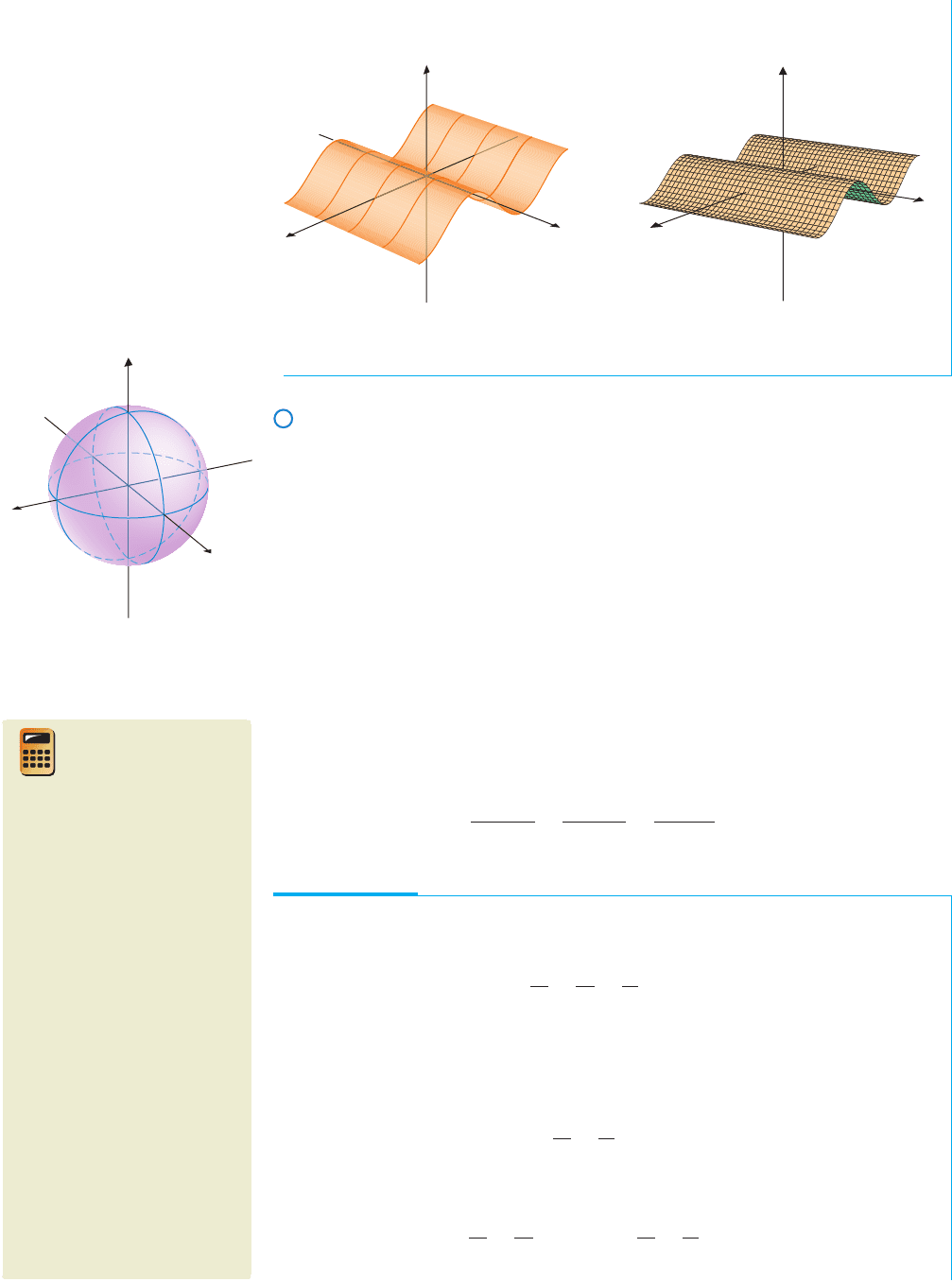
P1: OSO/OVY P2: OSO/OVY QC: OSO/OVY T1: OSO
MHDQ256-Ch11 MHDQ256-Smith-v1.cls December 22, 2010 20:10
LT (Late Transcendental)
CONFIRMING PAGES
11-49 SECTION 11.6
..
Surfaces in Space 735
computer-generated wireframe plot of the same surface. In this case, the cylinder looks
like a plane with ripples in it.
y
z
x
z
y
x
FIGURE 11.54a
The surface z = sin x
FIGURE 11.54b
Wireframe: z = sin x
y
x
z
FIGURE 11.55
Sphere
Quadric Surfaces
The graph of the equation
ax
2
+ by
2
+ cz
2
+ dxy + eyz + fxz+ gx + hy + jz + k = 0
in three-dimensional space (where a, b, c, d, e, f, g, h, j and k are all constants and at least
one of a, b, c, d, e or f is nonzero) is referred to as a quadric surface.
The most familiar quadric surface is the sphere
(x − a)
2
+ (y − b)
2
+ (z − c)
2
= r
2
of radius r centered at the point (a, b, c). To draw the sphere centered at (0, 0, 0), first
draw a circle of radius r, centered at the origin in the yz-plane. Then, to give the surface its
three-dimensional look, draw circles of radius r centered at the origin, in both the xz- and
xy-planes, as in Figure 11.55. Note that due to the perspective, these circles will look like
ellipses and will be only partially visible. (We indicate the hidden parts of the circles with
dashed lines.)
TODAY IN
MATHEMATICS
Grigori Perelman (1966– )
A Russian mathematician whose
work on a famous problem
known as Poincar
´
e’s conjecture is
described in Masha Gessen’s book
Perfect Rigor. Perelman showed
his mathematical prowess as a
high school student, winning a
gold medal at the 1982
International Mathematical
Olympiad. Eight years of isolated
work produced a proof of a deep
result known as Thurston’s
Geometrization Conjecture,
which is more general than the
100-year-old Poincar
´
e conjecture.
Perelman’s techniques have
already enabled other researchers
to make breakthroughs on less
famous problems and are
important advances in our
understanding of the geometry of
three-dimensional space.
A generalization of the sphere is the ellipsoid:
(x − a)
2
d
2
+
(y − b)
2
e
2
+
(z − c)
2
f
2
= 1.
(Notice that when d = e = f , the surface is a sphere.)
EXAMPLE 6.3 Sketching an Ellipsoid
Graph the ellipsoid
x
2
1
+
y
2
4
+
z
2
9
= 1.
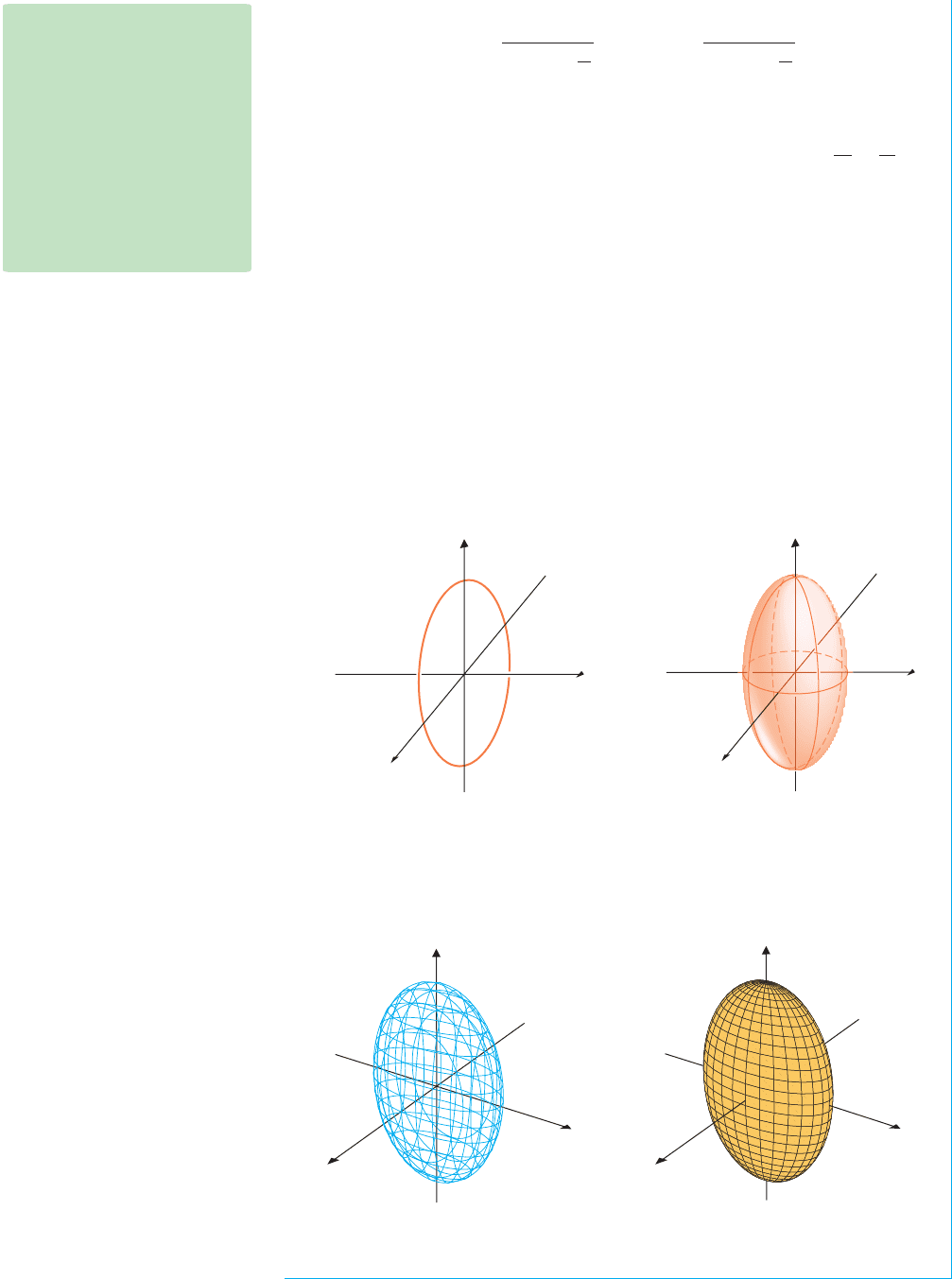
Solution First draw the traces in the three coordinate planes. (In general, you may
need to look at the traces in planes parallel to the three coordinate planes, but the traces
in the three coordinate planes will suffice, here.) In the yz-plane, x = 0, which gives us
the ellipse
y
2
4
+
z
2
9
= 1,
shown in Figure 11.56a (on the following page). Next, add to Figure 11.56a the traces in
the xy- and xz-planes. These are
x
2
1
+
y
2
4
= 1 and
x
2
1
+
z
2
9
= 1,
respectively, which are also ellipses. (See Figure 11.56b.)
P1: OSO/OVY P2: OSO/OVY QC: OSO/OVY T1: OSO
MHDQ256-Ch11 MHDQ256-Smith-v1.cls December 22, 2010 20:10
LT (Late Transcendental)
CONFIRMING PAGES
736 CHAPTER 11
..
Vectors and the Geometry of Space 11-50
CASs and many graphing calculators produce three-dimensional plots when given
z as a function of x and y. For the problem at hand, notice that we can solve for z and
plot the two functions z = 3
1 − x
2
−
y
2
4
and z =−3
1 − x
2
−
y
2
4
. Such graphs
often fail to connect the two halves of the ellipsoid. To correctly interpret such a graph,
you must mentally fill in the gaps. This requires an understanding of how the graph
should look, which we obtained drawing Figure 11.56b.
NOTES
We normally start by drawing a
trace in the plane x = 0. With
axes oriented as in Figure 11.56a,
this trace is viewed ‘head-on’,
with little distortion. The trace in
the plane z = 0 often adds enough
depth to a drawing to make the
surface recognizable. The trace in
the plane y = 0 further clarifies
the drawing.
As an alternative, many CASs enable you to graph the equation x
2
+
y
2
4
+
z
2
9
= 1
using implicit plot mode. In this mode, the CAS numerically solves the equation for
the value of z corresponding to each one of a large number of sample values of x and y
and plots the resulting points. The graph obtained in Figure 11.56c shows some details
not present in Figure 11.56b, but doesn’t show the elliptical traces that we used to
construct Figure 11.56b.
The best option, when available, is often a parametric plot. In three dimensions,
this involves writing each of the three variables x, y and z in terms of two parameters,
with the resulting surface produced by plotting points corresponding to a sample of
values of the two parameters. (A more extensive discussion of the mathematics of
parametric surfaces is given in section 12.6.) As we develop in the exercises, parametric
equations for the ellipsoid are x = sins cost, y = 2sin s sint and z = 3 coss, with the
parameters taken to be in the intervals 0 ≤ s ≤ 2π and 0 ≤ t ≤ 2π . Notice how
Figure 11.56d shows a nice smooth plot and clearly shows the elliptical traces.
z
y
x
z
y
x
FIGURE 11.56a
Ellipse in yz-plane
FIGURE 11.56b
Ellipsoid
y
x
z
y
x
z
FIGURE 11.56c
Wireframe ellipsoid
FIGURE 11.56d
Parametric plot
P1: OSO/OVY P2: OSO/OVY QC: OSO/OVY T1: OSO
MHDQ256-Ch11 MHDQ256-Smith-v1.cls December 22, 2010 20:10
LT (Late Transcendental)
CONFIRMING PAGES
11-51 SECTION 11.6
..
Surfaces in Space 737
EXAMPLE 6.4 Sketching a Paraboloid
Draw a graph of the quadric surface
x
2
+ y
2
= z.
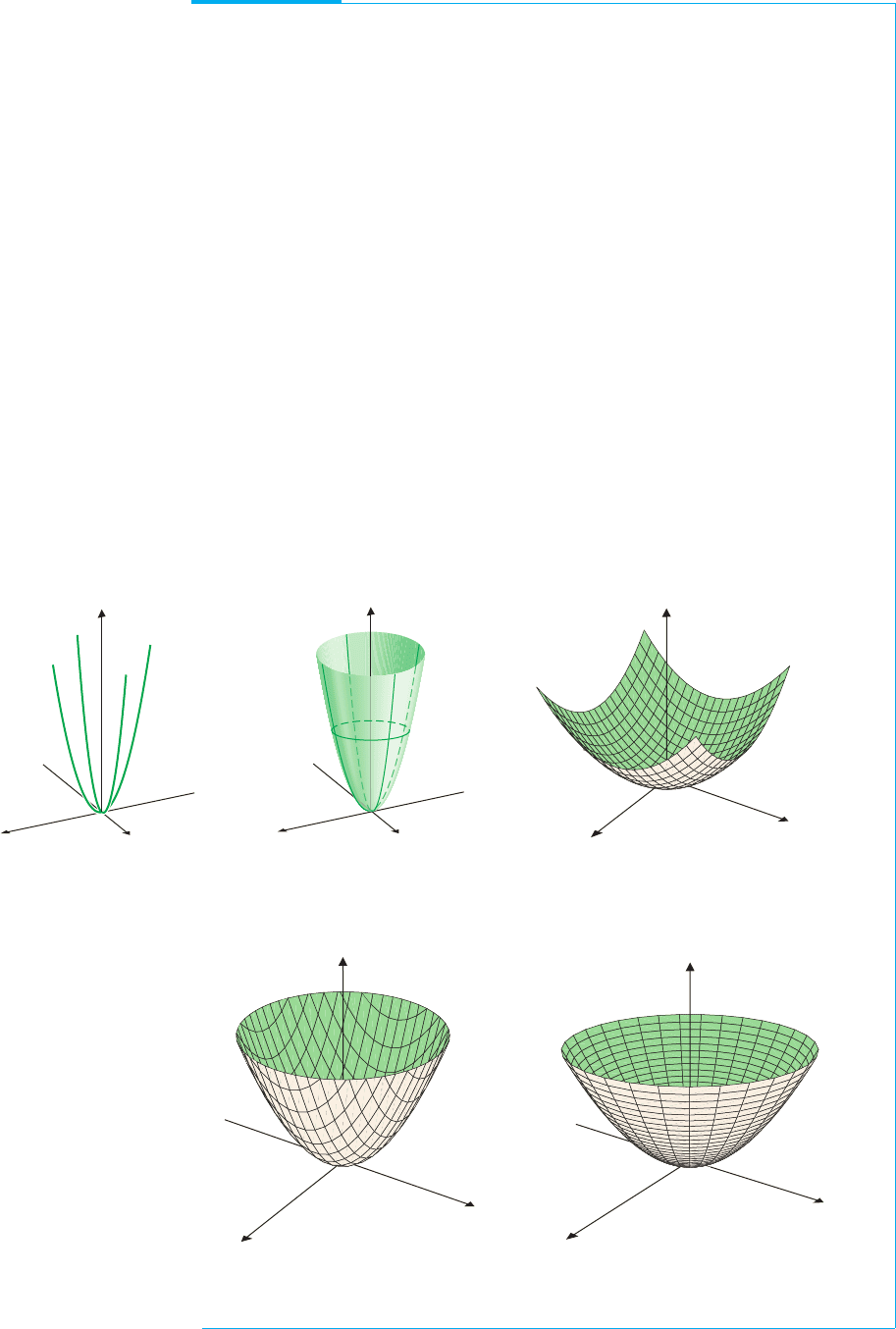
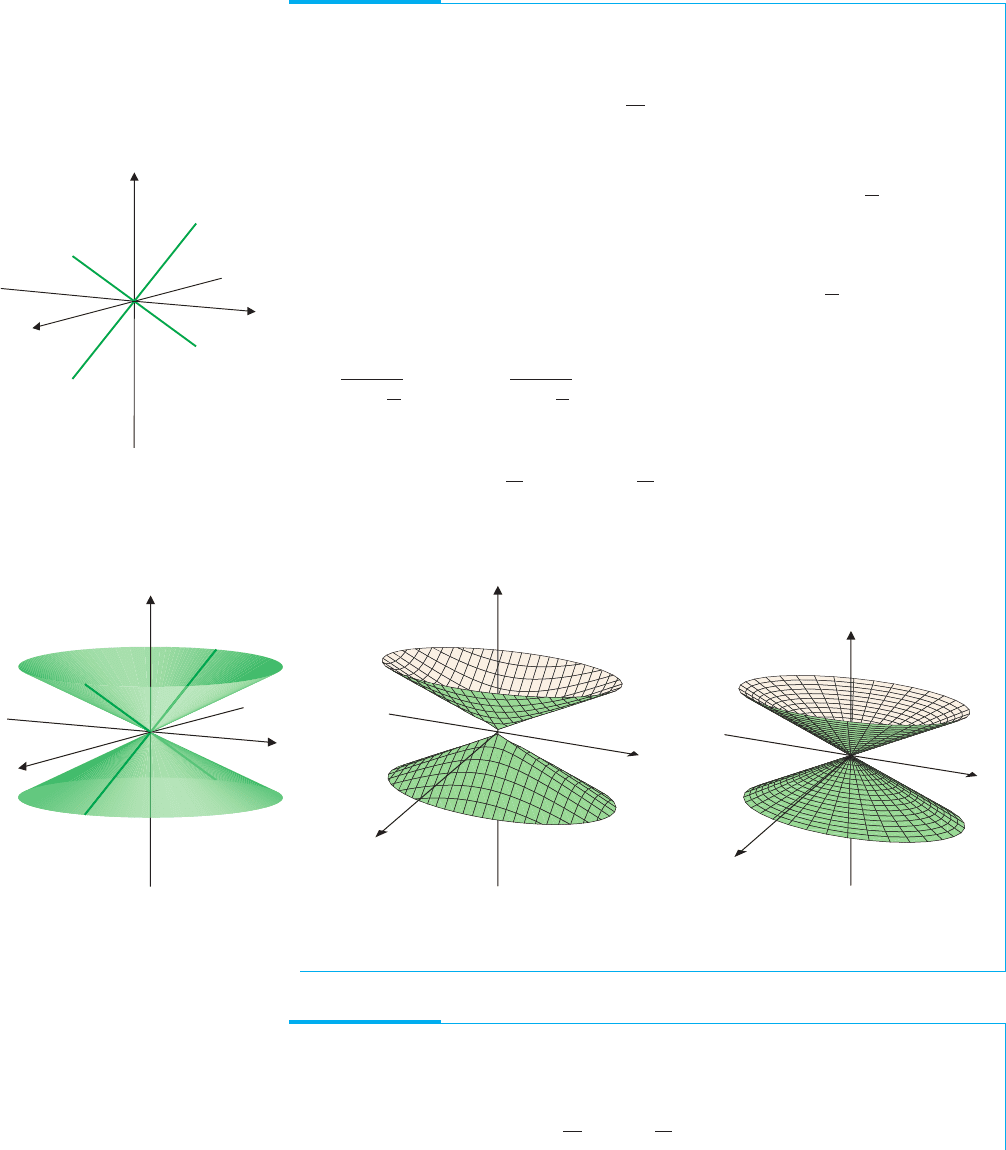
Solution To get an idea of what the graph looks like, first draw its traces in the three
coordinate planes. In the yz-plane, we have x = 0 and so, y
2
= z (a parabola). In the
xz-plane, we have y = 0 and so, x
2
= z (a parabola). In the xy-plane, we have z = 0 and
so, x
2
+ y
2
= 0 (a point—the origin). We sketch the traces in Figure 11.57a. Finally,
since the trace in the xy-plane is just a point, we consider the traces in the planes z = k
(for k > 0). Notice that these are the circles x
2
+ y
2
= k, where for larger values of z
(i.e., larger values of k), we get circles of larger radius. We sketch the surface in Figure
11.57b. Such surfaces are called paraboloids and since the traces in planes parallel to
the xy-plane are circles, this is called a circular paraboloid.
Graphing utilities with three-dimensional capabilities generally produce a graph
like Figure 11.57c for z = x
2
+ y
2
. Notice that the parabolic traces are visible, but not
the circular cross sections we drew in Figure 11.57b. The four peaks visible in Figure
11.57c are due to the rectangular domain used for the plot (in this case, −5 ≤ x ≤ 5 and
−5 ≤ y ≤ 5).
We can improve this by restricting the range of the z-values. With 0 ≤ z ≤ 15,
you can clearly see the circular cross section in the plane z = 15 in Figure 11.57d.
As in example 6.3, a parametric surface plot is even better. Here, we have
x = s cost, y = s sint and z = s
2
, with 0 ≤ s ≤ 5 and 0 ≤ t ≤ 2π. Figure 11.57e
clearly shows the circular cross sections in the planes z = k, for k > 0.
x
y
z
y
x
z
z
y
x
FIGURE 11.57a
Traces
FIGURE 11.57b
Paraboloid
FIGURE 11.57c
Wireframe paraboloid
z
y
x
z
y
x
FIGURE 11.57d
Wireframe paraboloid for 0 ≤ z ≤ 15
FIGURE 11.57e
Parametric plot paraboloid
P1: OSO/OVY P2: OSO/OVY QC: OSO/OVY T1: OSO
MHDQ256-Ch11 MHDQ256-Smith-v1.cls December 22, 2010 20:10
LT (Late Transcendental)
CONFIRMING PAGES
738 CHAPTER 11
..
Vectors and the Geometry of Space 11-52
Notice that in each of the last several examples, we have had to use some thought
to produce computer-generated graphs that adequately show the important features of
the given quadric surface. We want to encourage you to use your graphing calculator or
CAS for drawing three-dimensional plots, because computer graphics are powerful tools
for visualization and problem solving. However, be aware that you will need a basic
understanding of the geometry of quadric surfaces to effectively produce and interpret
computer-generated graphs.
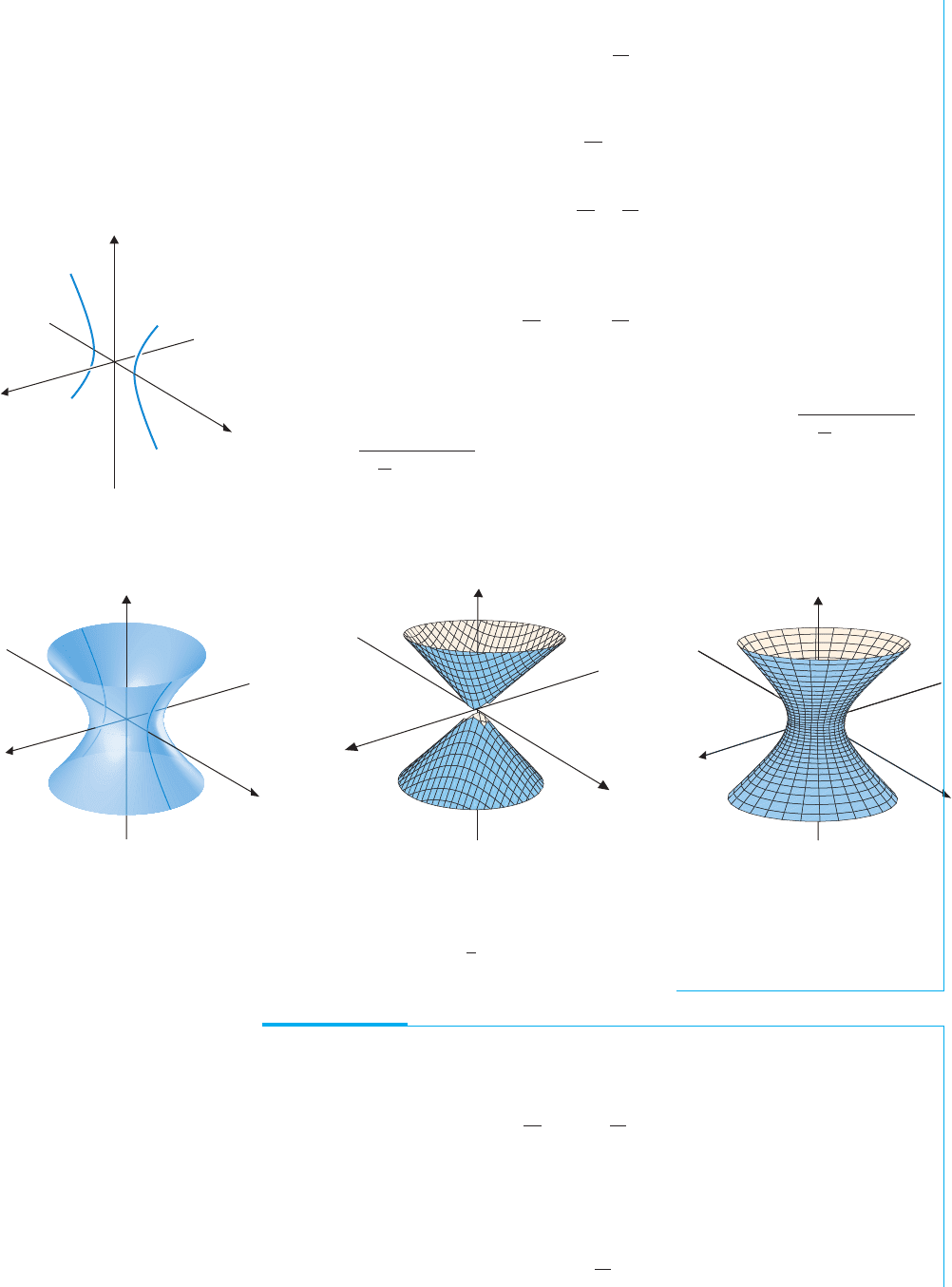
EXAMPLE 6.5 Sketching an Elliptic Cone
Draw a graph of the quadric surface
x
2
+
y
2
4
= z
2
.
Solution While this equation may look a lot like that of an ellipsoid, there is a
significant difference. (Look where the z
2
term is!) Again, we start by looking at the
traces in the coordinate planes. For the yz-plane, we have x = 0 and so,
y
2
4
= z
2
or
y
2
= 4z
2
, so that y =±2z. That is, the trace is a pair of lines: y = 2z and y =−2z.We
show these in Figure 11.58a. Likewise, the trace in the xz-plane is a pair of lines:
x =±z. The trace in the xy-plane is simply the origin. (Why?) Finally, the traces in the
planes z = k (k = 0), parallel to the xy-plane, are the ellipses x
2
+
y
2
4
= k
2
. Adding
these to the drawing gives us the double-cone seen in Figure 11.58b.
z
x
y
FIGURE 11.58a
Trace in yz-plane
Since the traces in planes parallel to the xy-plane are ellipses, we refer to this as an
elliptic cone. One way to plot this with a CAS is to graph the two functions
z =
x
2
+
y
2
4
and z =−
x
2
+
y
2
4
. In Figure 11.58c, we restrict the z-range to
−10 ≤ z ≤ 10 to show the elliptical cross sections. Notice that this plot shows a gap
between the two halves of the cone. If you have drawn Figure 11.58b yourself, this
plotting deficiency won’t fool you. Alternatively, the parametric plot shown in
Figure 11.58d, with x =
√
s
2
cost, y = 2
√
s
2
sint and z = s, with −5 ≤ s ≤ 5 and
0 ≤ t ≤ 2π, shows the full cone with its elliptical and linear traces.
z
y
x
z
y
x
z
y
x
FIGURE 11.58b
Elliptic cone
FIGURE 11.58c
Wireframe cone
FIGURE 11.58d
Parametric plot
EXAMPLE 6.6 Sketching a Hyperboloid of One Sheet
Draw a graph of the quadric surface
x
2
4
+ y
2
−
z
2
2
= 1.
P1: OSO/OVY P2: OSO/OVY QC: OSO/OVY T1: OSO
MHDQ256-Ch11 MHDQ256-Smith-v1.cls December 22, 2010 20:10
LT (Late Transcendental)
CONFIRMING PAGES
11-53 SECTION 11.6
..
Surfaces in Space 739
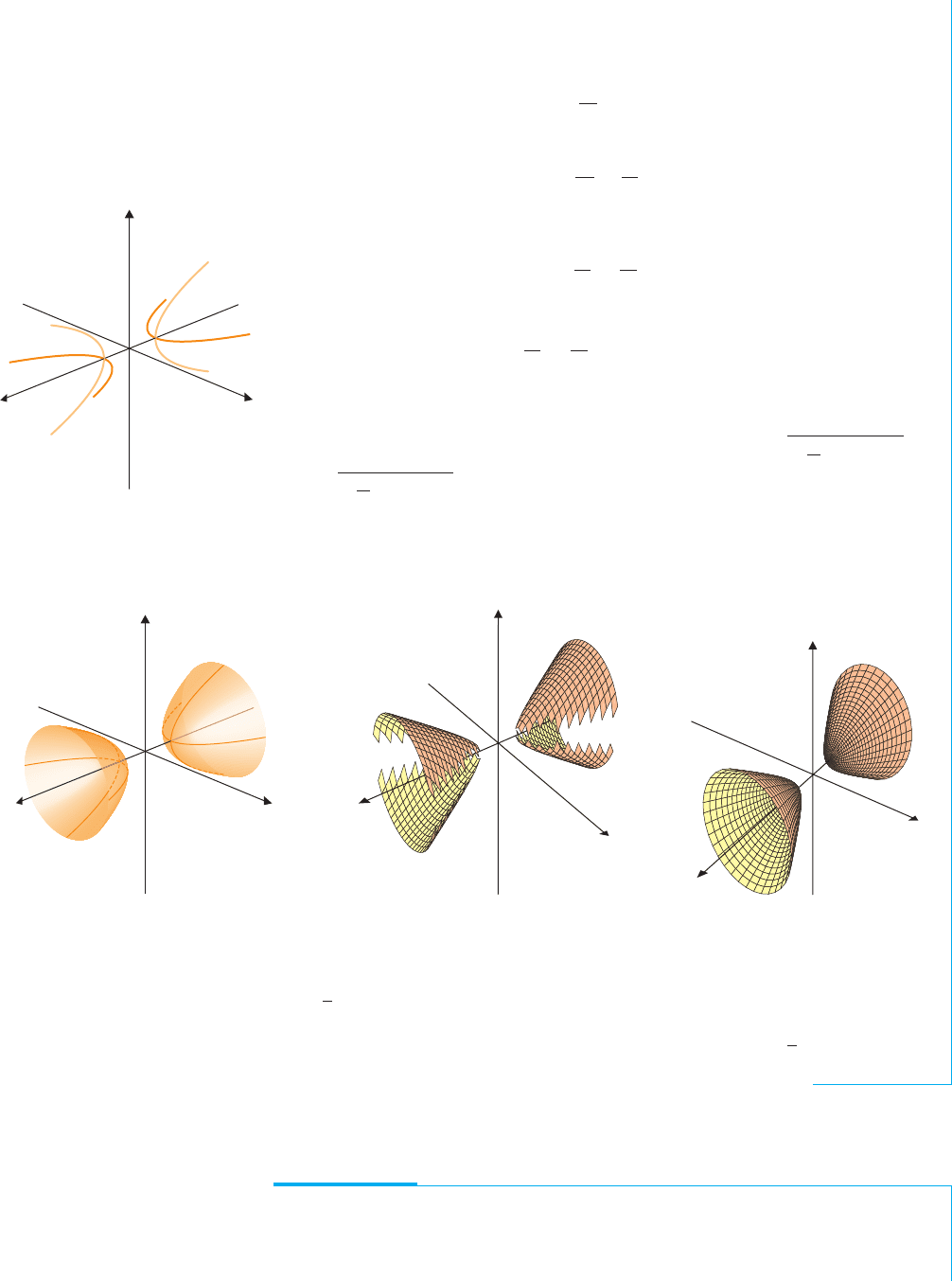
Solution The traces in the coordinate plane are as follows:
yz-plane(x = 0): y
2
−
z
2
2
= 1 (hyperbola)
(see Figure 11.59a),
xy-plane (z = 0):
x
2
4
+ y
2
= 1 (ellipse)
and xz-plane (y = 0):
x
2
4
−
z
2
2
= 1 (hyperbola).
Further, notice that the trace of the surface in each plane z = k (parallel to the xy-plane)
is also an ellipse:
x
2
4
+ y
2
=
k
2
2
+ 1.
Finally, observe that the larger k is, the larger the axes of the ellipses are. Adding this
information to Figure 11.59a, we draw the surface seen in Figure 11.59b. We call this
surface a hyperboloid of one sheet.
y
z
x
FIGURE 11.59a
Trace in yz-plane
To plot this with a CAS, you could graph the two functions z =
2
x
2
4
+ y
2
− 1
and z =−
2
x
2
4
+ y
2
− 1
. (See Figure 11.59c, where we have restricted the z-range
to −10 ≤ z ≤ 10, to show the elliptical cross sections.) Notice that this plot looks more
like a cone than the hyperboloid in Figure 11.59b. However, if you have drawn Figure
11.59b yourself, this plotting deficiency won’t fool you.
y
z
x
y
z
x
y
x
z
FIGURE 11.59b
Hyperboloid of one sheet
FIGURE 11.59c
Wireframe hyperboloid
FIGURE 11.59d
Parametric plot
Alternatively, the parametric plot seen in Figure 11.59d, with x = 2 coss cosht,
y = sins cosht and z =
√
2sinh t, with 0 ≤ s ≤ 2π and −5 ≤ t ≤ 5, shows the full
hyperboloid with its elliptical and hyperbolic traces.
EXAMPLE 6.7 Sketching a Hyperboloid of Two Sheets
Draw a graph of the quadric surface
x
2
4
− y
2
−
z
2
2
= 1.
Solution Notice that this is the same equation as in example 6.6, except for the sign
of the y-term. As we have done before, we first look at the traces in the three coordinate
planes. The trace in the yz-plane (x = 0) is defined by
−y
2
−
z
2
2
= 1.
P1: OSO/OVY P2: OSO/OVY QC: OSO/OVY T1: OSO
MHDQ256-Ch11 MHDQ256-Smith-v1.cls December 22, 2010 20:10
LT (Late Transcendental)
CONFIRMING PAGES
740 CHAPTER 11
..
Vectors and the Geometry of Space 11-54
Since it is clearly impossible for two negative numbers to add up to something positive,
this is a contradiction and there is no trace in the yz-plane. That is, the surface does not
intersect the yz-plane. The traces in the other two coordinate planes are as follows:
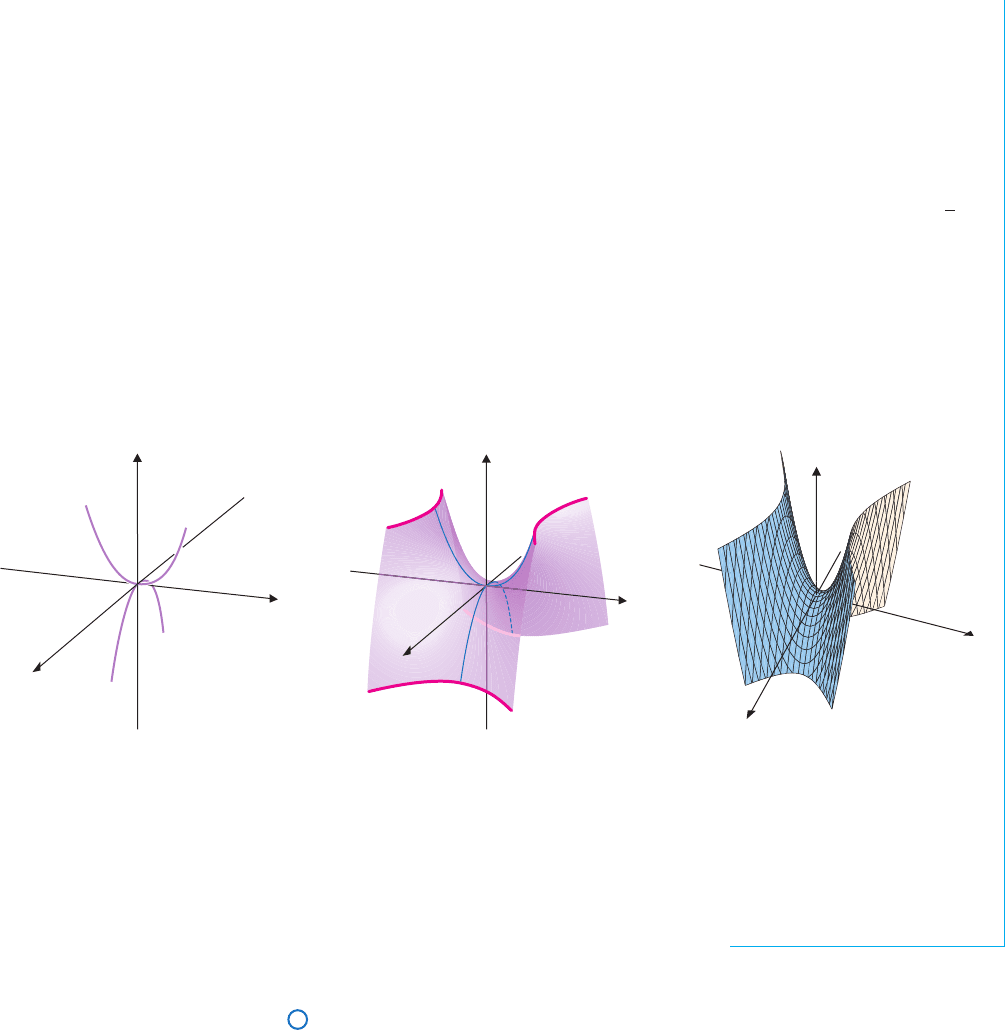
xy-plane(z = 0):
x
2
4
− y
2
= 1(hyperbola)
and xz-plane (y = 0):
x
2
4
−
z
2
2
= 1(hyperbola).
We show these traces in Figure 11.60a. Finally, notice that for x = k, we have that
y
2
+
z
2
2
=
k
2
4
− 1,
so that the traces in the plane x = k are ellipses for k
2
> 4. It is important to notice here
that if k
2
< 4, the equation y
2
+
z
2
9
=
k
2
4
− 1 has no solution. (Why is that?) So, for
−2 < k < 2, the surface has no trace at all in the plane x = k, leaving a gap that
separates the hyperbola into two sheets. Putting this all together, we have the surface
seen in Figure 11.60b. We call this surface a hyperboloid of two sheets.
y
z
x
FIGURE 11.60a
Traces in xy- and xz-planes
We can plot this on a CAS by graphing the two functions z =
2
x
2
4
− y
2
− 1
and
z =−
2
x
2
4
− y
2
− 1
. (See Figure 11.60c, where we have restricted the z-range to
−10 ≤ z ≤ 10, to show the elliptical cross sections.) Notice that this plot shows large
gaps between the two halves of the hyperboloid. However, if you have drawn Figure
11.60b yourself, this plotting deficiency won’t fool you.
y
x
z
z
y
x
z
y
x
FIGURE 11.60b
Hyperboloid of two sheets
FIGURE 11.60c
Wireframe hyperboloid
FIGURE 11.60d
Parametric plot
Alternatively, the parametric plot with x = 2 coshs, y = sinhs cost and
z =
√
2sinh s sint, for −4 ≤ s ≤ 4 and 0 ≤ t ≤ 2π, produces the left half of the
hyperboloid with its elliptical and hyperbolic traces. The right half of the hyperboloid
has parametric equations x =−2 coshs, y = sinhs cost and z =
√
2sinh s sint, with
−4 ≤ s ≤ 4 and 0 ≤ t ≤ 2π. We show both halves in Figure 11.60d.
As our final example, we offer one of the more interesting quadric surfaces. It is also
one of the more difficult surfaces to sketch.
EXAMPLE 6.8 Sketching a Hyperbolic Paraboloid
Sketch the graph of the quadric surface defined by the equation
z = 2y
2
− x
2
.
P1: OSO/OVY P2: OSO/OVY QC: OSO/OVY T1: OSO
MHDQ256-Ch11 MHDQ256-Smith-v1.cls December 22, 2010 20:10
LT (Late Transcendental)
CONFIRMING PAGES
11-55 SECTION 11.6
..
Surfaces in Space 741
Solution We first consider the traces in planes parallel to each of the coordinate
planes:
parallel to xy-plane (z = k): 2y
2
− x
2
= k (hyperbola, for k = 0),
parallel to xz-plane (y = k): z =−x
2
+ 2k
2
(parabola opening down)
and parallel to yz-plane (x = k): z = 2y
2
− k
2
(parabola opening up).
We begin by drawing the traces in the xz- and yz-planes, as seen in Figure 11.61a. Since
the trace in the xy-plane is the degenerate hyperbola 2y
2
= x
2
(two lines: x =±
√
2y),
we instead draw the trace in several of the planes z = k. Notice that for k > 0, these are
hyperbolas opening toward the positive and negative y-direction and for k < 0, these are
hyperbolas opening toward the positive and negative x-direction. We indicate one of
these for k > 0 and one for k < 0 in Figure 11.61b, where we show a sketch of the
surface. We refer to this surface as a hyperbolic paraboloid. More than anything else,
the surface resembles a saddle. In fact, we refer to the origin as a saddle point for this
graph. (We’ll discuss the significance of saddle points in Chapter 13.)
y
z
x
y
x
z
z
y
x
FIGURE 11.61a
Traces in the xz- and yz-planes
FIGURE 11.61b
The surface z = 2y
2
− x
2
FIGURE 11.61c
Wireframe plot of z = 2y
2
− x
2
A wireframe graph of z = 2y
2
− x
2
is shown in Figure 11.61c (with −5 ≤ x ≤ 5
and −5 ≤ y ≤ 5 and where we limited the z-range to −8 ≤ z ≤ 12). Note that only the
parabolic cross sections are drawn, but the graph shows all the features of Figure 11.61b.
Plotting this surface parametrically is fairly tedious (requiring four different sets of
equations) and doesn’t improve the graph noticeably.
An Application
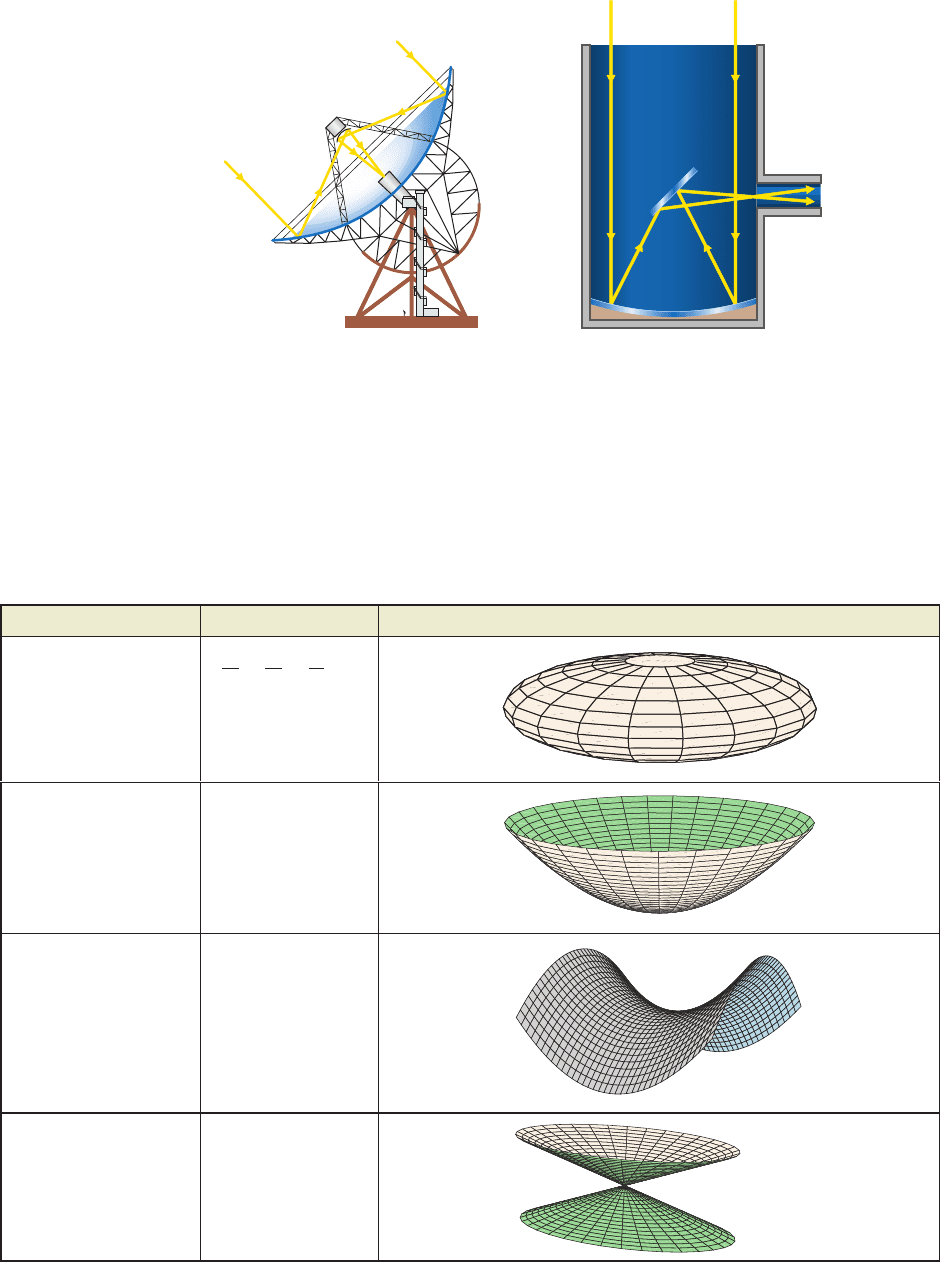
You may have noticed the large number of paraboloids around you. For instance, radio-
telescopes and even home television satellite dishes have the shape of a portion of a para-
boloid.Reflecting telescopes haveparabolicmirrorsthat again, areaportionof a paraboloid.
There is a very good reason for this. It turns out that in all of these cases, light waves or radio
waves striking any point on the parabolic dish or mirror are reflected toward one point, the
focus of each parabolic cross section through the vertex of the paraboloid. This remarkable
fact means that all light waves or radio waves end up being concentrated at just one point.
In the case of a radiotelescope, placing a small receiver just in front of the focus can take
a very faint signal and increase its effective strength immensely. (See Figure 11.62 on the
following page.) The same principle is used in optical telescopes to concentrate the light
from a faint source (e.g., a distant star). In this case, a small mirror is mounted in a line
from the parabolic mirror to the focus. The small mirror then reflects the concentrated light
to an eyepiece for viewing. (See Figure 11.63.)
P1: OSO/OVY P2: OSO/OVY QC: OSO/OVY T1: OSO
MHDQ256-Ch11 MHDQ256-Smith-v1.cls December 22, 2010 20:10
LT (Late Transcendental)
CONFIRMING PAGES
742 CHAPTER 11
..
Vectors and the Geometry of Space 11-56
Mirror
Eyepiece
Parabolic
mirror
FIGURE 11.62
Radiotelescope
FIGURE 11.63
Reflecting telescope
The following table summarizes the graphs of quadric surfaces.
Name Generic Equation Graph
Ellipsoid
x
2
a
2
+
y
2
b
2
+
z
2
c
2
= 1
Elliptic paraboloid z = ax
2
+ by
2
+ c
(a, b > 0)
Hyperbolic paraboloid z = ax
2
− by
2
+ c
(a, b > 0)
Cone z
2
= ax
2
+ by
2
(a, b > 0)
Continued