
Thomas M. Cover, Joy A. Thomas. Elements of information theory
Подождите немного. Документ загружается.


PROBLEMS 155
(c) Show that
C(T ) ≥ log
2
i
2
T
i
(5.157)
for any tree T .
(d) Show that there exists a tree such that
C(T ) ≤ log
2
i
2
T
i
+ 1. (5.158)
Thus, log
2
i
2
T
i
is the analog of entropy for this problem.
5.35 Generating random variables. One wishes to generate a random
variable X
X =
1 with probability p
0 with probability 1 − p.
(5.159)
You are given fair coin flips Z
1
,Z
2
,... .LetN be the (random)
number of flips needed to generate X. Find a good way to use
Z
1
,Z
2
,... to generate X. Show that EN ≤ 2.
5.36 Optimal word lengths.
(a) Can l = (1, 2, 2) be the word lengths of a binary Huffman
code. What about (2,2,3,3)?
(b) What word lengths l = (l
1
,l
2
,...) can arise from binary Huff-
man codes?
5.37 Codes. Which of the following codes are
(a) Uniquely decodable?
(b) Instantaneous?
C
1
={00, 01, 0}
C
2
={00, 01, 100, 101, 11}
C
3
={0, 10, 110, 1110,...}
C
4
={0, 00, 000, 0000}
5.38 Huffman.FindtheHuffmanD-ary code for (p
1
,p
2
,p
3
,p
4
,p
5
,
p
6
) = (
6
25
,
6
25
,
4
25
,
4
25
,
3
25
,
2
25
) and the expected word length
(a) For D = 2.
(b) For D = 4.

156 DATA COMPRESSION
5.39 Entropy of encoded bits.LetC : X −→ { 0, 1}
∗
be a nonsingular
but nonuniquely decodable code. Let X have entropy H(X).
(a) Compare H(C(X)) to H(X).
(b) Compare H(C(X
n
)) to H(X
n
).
5.40 Code rate.LetX be a random variable with alphabet {1, 2, 3}
and distribution
X =
1 with probability
1
2
2 with probability
1
4
3 with probability
1
4
.
The data compression code for X assigns codewords
C(x) =
0ifx = 1
10 if x = 2
11 if x = 3.
Let X
1
,X
2
,... be independent, identically distributed according
to this distribution and let Z
1
Z
2
Z
3
···=C(X
1
)C(X
2
) ··· be the
string of binary symbols resulting from concatenating the corre-
sponding codewords. For example, 122 becomes 01010.
(a) Find the entropy rate H(
X) and the entropy rate H(Z) in bits
per symbol. Note that Z is not compressible further.
(b) Now let the code be
C(x) =
00 if x = 1
10 if x = 2
01 if x = 3
and find the entropy rate H(
Z).
(c) Finally, let the code be
C(x) =
00 if x = 1
1ifx = 2
01 if x = 3
and find the entropy rate H(
Z).
5.41 Optimal codes.Letl
1
,l
2
,...,l
10
be the binary Huffman code-
word lengths for the probabilities p
1
≥ p
2
≥···≥p
10
. Suppose
that we get a new distribution by splitting the last probability
HISTORICAL NOTES 157
mass. What can you say about the optimal binary codeword lengths
˜
l
1
,
˜
l
2
,...,
˜
l
11
for the probabilities p
1
,p
2
,...,p
9
,αp
10
,(1 − α)p
10
,
where 0 ≤ α ≤ 1.
5.42 Ternary codes. Which of the following codeword lengths can be
the word lengths of a 3-ary Huffman code, and which cannot?
(a) (1, 2, 2, 2, 2)
(b) (2, 2, 2, 2, 2, 2, 2, 2, 3, 3, 3)
5.43 Piecewise Huffman. Suppose the codeword that we use to
describe a random variable X ∼ p(x) always starts with a symbol
chosen from the set {A, B, C}, followed by binary digits {0, 1}.
Thus, we have a ternary code for the first symbol and binary
thereafter. Give the optimal uniquely decodable code (minimum
expected number of symbols) for the probability distribution
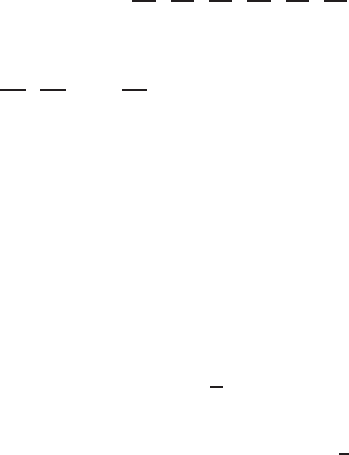
p =
16
69
,
15
69
,
12
69
,
10
69
,
8
69
,
8
69
. (5.160)
5.44 Huffman. Find the word lengths of the optimal binary encoding
of p =
1
100
,
1
100
,...,
1
100
.
5.45 Random 20 questions.LetX be uniformly distributed over {1, 2,
...,m}. Assume that m = 2
n
. We ask random questions: Is X ∈ S
1
?
Is X ∈ S
2
?... until only one integer remains. All 2
m
subsets S of
{1, 2,...,m} are equally likely to be asked.
(a) Without loss of generality, suppose that X = 1 is the random
object. What is the probability that object 2 yields the same
answers for k questions as does object 1?
(b) What is the expected number of objects in {2, 3,...,m} that
have the same answers to the questions as does the correct
object 1?
(c) Suppose that we ask n +
√
n random questions. What is the
expected number of wrong objects agreeing with the answers?
(d) Use Markov’s inequality Pr{X ≥ tµ}≤
1
t
, to show that the
probability of error (one or more wrong object remaining) goes
to zero as n −→ ∞ .
HISTORICAL NOTES
The foundations for the material in this chapter can be found in Shan-
non’s original paper [469], in which Shannon stated the source coding
158 DATA COMPRESSION
theorem and gave simple examples of codes. He described a simple code
construction procedure (described in Problem 5.5.28), which he attributed
to Fano. This method is now called the Shannon–Fano code construction
procedure.
The Kraft inequality for uniquely decodable codes was first proved
by McMillan [385]; the proof given here is due to Karush [306]. The
Huffman coding procedure was first exhibited and proved to be optimal
by Huffman [283].
In recent years, there has been considerable interest in designing source
codes that are matched to particular applications, such as magnetic record-
ing. In these cases, the objective is to design codes so that the output
sequences satisfy certain properties. Some of the results for this problem
are described by Franaszek [219], Adler et al. [5] and Marcus [370].
The arithmetic coding procedure has its roots in the Shannon–Fano
code developed by Elias (unpublished), which was analyzed by Jelinek
[297]. The procedure for the construction of a prefix-free code described
in the text is due to Gilbert and Moore [249]. The extension of the
Shannon–Fano–Elias method to sequences is based on the enumerative
methods in Cover [120] and was described with finite-precision arithmetic
by Pasco [414] and Rissanen [441]. The competitive optimality of Shan-
non codes was proved in Cover [125] and extended to Huffman codes by
Feder [203]. Section 5.11 on the generation of discrete distributions from
fair coin flips follows the work of Knuth and Yao[317].
CHAPTER 6
GAMBLING AND DATA
COMPRESSION
At first sight, information theory and gambling seem to be unrelated.
But as we shall see, there is strong duality between the growth rate of
investment in a horse race and the entropy rate of the horse race. Indeed,
the sum of the growth rate and the entropy rate is a constant. In the process
of proving this, we shall argue that the financial value of side information
is equal to the mutual information between the horse race and the side
information. The horse race is a special case of investment in the stock
market, studied in Chapter 16.
We also show how to use a pair of identical gamblers to compress a
sequence of random variables by an amount equal to the growth rate of
wealth on that sequence. Finally, we use these gambling techniques to
estimate the entropy rate of English.
6.1 THE HORSE RACE
Assume that m horses run in a race. Let the ith horse win with probability
p
i
. If horse i wins, the payoff is o
i
for 1 (i.e., an investment of 1 dollar
on horse i results in o
i
dollars if horse i wins and 0 dollars if horse i
loses).
There are two ways of describing odds: a-for-1 and b-to-1. The first
refers to an exchange that takes place before the race—the gambler puts
down 1 dollar before the race and at a-for-1 odds will receive a dollars
after the race if his horse wins, and will receive nothing otherwise. The
second refers to an exchange after the race—at b-to-1 odds, the gambler
will pay 1 dollar after the race if his horse loses and will pick up b dollars
after the race if his horse wins. Thus, a bet at b-to-1 odds is equivalent to
a bet at a-for-1 odds if b = a − 1. For example, fair odds on a coin flip
would be 2-for-1 or 1-to-1, otherwise known as even odds.
Elements of Information Theory, Second Edition, By Thomas M. Cover and Joy A. Thomas
Copyright 2006 John Wiley & Sons, Inc.
159
160 GAMBLING AND DATA COMPRESSION
We assume that the gambler distributes all of his wealth across the
horses. Let b
i
be the fraction of the gambler’s wealth invested in horse i,
where b
i
≥ 0and
b
i
= 1. Then if horse i wins the race, the gambler
will receive o
i
times the amount of wealth bet on horse i. All the other
bets are lost. Thus, at the end of the race, the gambler will have multiplied
his wealth by a factor b
i
o
i
if horse i wins, and this will happen with prob-
ability p
i
. For notational convenience, we use b(i) and b
i
interchangeably
throughout this chapter.
The wealth at the end of the race is a random variable, and the gambler
wishes to “maximize” the value of this random variable. It is tempting to
bet everything on the horse that has the maximum expected return (i.e.,
the one with the maximum p
i
o
i
). But this is clearly risky, since all the
money could be lost.
Some clarity results from considering repeated gambles on this race.
Now since the gambler can reinvest his money, his wealth is the product
of the gains for each race. Let S
n
be the gambler’s wealth after n races.
Then
S
n
=
n
i=1
S(X
i
), (6.1)
where S(X) = b(X)o(X) is the factor by which the gambler’s wealth is
multiplied when horse X wins.
Definition The wealth relative S(X) = b(X)o(X) is the factor by which
the gambler’s wealth grows if horse X wins the race.
Definition The doubling rate of a horse race is
W(b, p) = E(log S(X)) =
m
k=1
p
k
log b
k
o
k
. (6.2)
The definition of doubling rate is justified by the following theorem.
Theorem 6.1.1 Let the race outcomes X
1
,X
2
,... be i.i.d. ∼ p(x).
Then the wealth of the gambler using betting strategy b grows exponen-
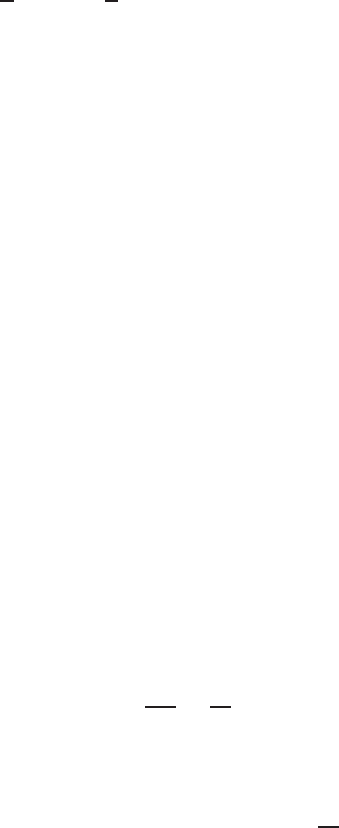
tially at rate W(b, p); that is,
S
n
.
= 2
nW (b,p)
. (6.3)
6.1 THE HORSE RACE 161
Proof: Functions of independent random variables are also independent,
and hence log S(X
1
), log S(X
2
), . . . are i.i.d. Then, by the weak law of
large numbers,
1
n
log S
n
=
1
n
n
i=1
log S(X
i
) → E(log S(X)) in probability. (6.4)
Thus,
S
n
.
= 2
nW (b,p)
. (6.5)
Now since the gambler’s wealth grows as 2
nW (b,p)
, we seek to maximize
the exponent W(b, p) over all choices of the portfolio b.
Definition The optimum doubling rate W
∗
(p) is the maximum doubling
rate over all choices of the portfolio b:
W
∗
(p) = max
b
W(b, p) = max
b:b
i
≥0,
i
b
i
=1
m
i=1
p
i
log b
i
o
i
. (6.6)
We maximize W(b, p) as a function of b subject to the constraint
b
i
= 1. Writing the functional with a Lagrange multiplier and changing
the base of the logarithm (which does not affect the maximizing b), we
have
J(b) =
p
i
ln b
i
o
i
+ λ
b
i
. (6.7)
Differentiating this with respect to b
i
yields
∂J
∂b
i
=
p
i
b
i
+ λ, i = 1, 2,...,m. (6.8)
Setting the partial derivative equal to 0 for a maximum, we have
b
i
=−
p
i
λ
. (6.9)
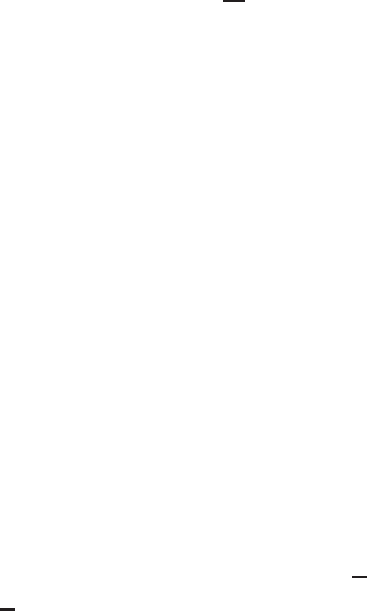
Substituting this in the constraint
b
i
= 1 yields λ =−1andb
i
= p
i
.
Hence, we can conclude that b = p is a stationary point of the function
J(b). To prove that this is actually a maximum is tedious if we take
162 GAMBLING AND DATA COMPRESSION
second derivatives. Instead, we use a method that works for many such
problems: Guess and verify. We verify that proportional gambling b = p
is optimal in the following theorem. Proportional gambling is known as
Kelly gambling [308].
Theorem 6.1.2 (Proportional gambling is log-optimal) The optimum
doubling rate is given by
W
∗
(p) =
p
i
log o
i
− H(p) (6.10)
and is achieved by the proportional gambling scheme b
∗
= p.
Proof: We rewrite the function W(b, p) in a form in which the maximum
is obvious:
W(b, p) =
p
i
log b
i
o
i
(6.11)
=
p
i
log
b
i
p
i
p
i
o
i
(6.12)
=
p
i
log o
i
− H(p) − D(p||b) (6.13)
≤
p
i
log o
i
− H(p), (6.14)
with equality iff p = b (i.e., the gambler bets on each horse in proportion
to its probability of winning).
Example 6.1.1 Consider a case with two horses, where horse 1 wins
with probability p
1
and horse 2 wins with probability p
2
. Assume even
odds (2-for-1 on both horses). Then the optimal bet is proportional bet-
ting (i.e., b
1
= p
1
, b
2
= p
2
). The optimal doubling rate is W
∗
(p) =
p
i
log o
i
− H(p) = 1 − H(p), and the resulting wealth grows to infin-
ity at this rate:
S
n
.
= 2
n(1−H(p))
. (6.15)
Thus, we have shown that proportional betting is growth rate optimal
for a sequence of i.i.d. horse races if the gambler can reinvest his wealth
and if there is no alternative of keeping some of the wealth in cash.
We now consider a special case when the odds are fair with respect to
some distribution (i.e., there is no track take and
1
o
i
= 1). In this case,
we write r
i
=
1
o
i
,wherer
i
can be interpreted as a probability mass function

6.1 THE HORSE RACE 163
over the horses. (This is the bookie’s estimate of the win probabilities.)
With this definition, we can write the doubling rate as
W(b, p) =
p
i
log b
i
o
i
(6.16)
=
p
i
log
b
i
p
i
p
i
r
i
(6.17)
= D(p||r) − D(p||b). (6.18)
This equation gives another interpretation for the relative entropy dis-
tance: The doubling rate is the difference between the distance of the
bookie’s estimate from the true distribution and the distance of the gam-
bler’s estimate from the true distribution. Hence, the gambler can make
money only if his estimate (as expressed by b) is better than the bookie’s.
An even more special case is when the odds are m-for-1 on each horse.
In this case, the odds are fair with respect to the uniform distribution and
the optimum doubling rate is
W
∗
(p) = D
p||
1
m
= log m − H(p). (6.19)
In this case we can clearly see the duality between data compression and
the doubling rate.
Theorem 6.1.3 (Conservation theorem) For uniform fair odds,
W
∗
(p) + H(p) = log m. (6.20)
Thus, the sum of the doubling rate and the entropy rate is a constant.
Every bit of entropy decrease doubles the gambler’s wealth. Low entropy
races are the most profitable.
In the analysis above, we assumed that the gambler was fully invested.
In general, we should allow the gambler the option of retaining some of
his wealth as cash. Let b(0) be the proportion of wealth held out as cash,
and b(1), b(2),...,b(m) be the proportions bet on the various horses.
Then at the end of a race, the ratio of final wealth to initial wealth (the
wealth relative)is
S(X) = b(0) + b(X)o(X). (6.21)
Now the optimum strategy may depend on the odds and will not necessar-
ily have the simple form of proportional gambling. We distinguish three
subcases:

164 GAMBLING AND DATA COMPRESSION
1. Fair odds with respect to some distribution:
1
o
i
= 1. For fair odds,
the option of withholding cash does not change the analysis. This is
because we can get the effect of withholding cash by betting b
i
=
1
o
i
on the ith horse, i = 1, 2,...,m.ThenS(X) = 1 irrespective of
which horse wins. Thus, whatever money the gambler keeps aside
as cash can equally well be distributed over the horses, and the
assumption that the gambler must invest all his money does not
change the analysis. Proportional betting is optimal.
2. Superfair odds:
1
o
i
< 1. In this case, the odds are even better than
fair odds, so one would always want to put all one’s wealth into the
race rather than leave it as cash. In this race, too, the optimum
strategy is proportional betting. However, it is possible to choose
b so as to form a Dutch book by choosing b
i
= c
1
o
i
,wherec =
1/
1
c
i
,togeto
i
b
i
= c, irrespective of which horse wins. With
this allotment, one has wealth S(X) = 1/
1
o
i
> 1 with probability
1 (i.e., no risk). Needless to say, one seldom finds such odds in
real life. Incidentally, a Dutch book, although risk-free, does not
optimize the doubling rate.
3. Subfair odds:
1
o
i
> 1. This is more representative of real life. The
organizers of the race track take a cut of all the bets. In this case it
is optimal to bet only some of the money and leave the rest aside
as cash. Proportional gambling is no longer log-optimal. A paramet-
ric form for the optimal strategy can be found using Kuhn–Tucker
conditions (Problem 6.6.2); it has a simple “water-filling” interpre-
tation.
6.2 GAMBLING AND SIDE INFORMATION
Suppose the gambler has some information that is relevant to the outcome
of the gamble. For example, the gambler may have some information
about the performance of the horses in previous races. What is the value
of this side information?
One definition of the financial value of such information is the increase
in wealth that results from that information. In the setting described in
Section 6.1 the measure of the value of information is the increase in the
doubling rate due to that information. We will now derive a connection
between mutual information and the increase in the doubling rate.
To formalize the notion, let horse X ∈{1, 2,...,m} win the race with
probability p(x) and pay odds of o(x) for 1. Let (X, Y ) have joint
probability mass function p(x,y).Letb(x|y) ≥ 0,
x
b(x|y) = 1bean
arbitrary conditional betting strategy depending on the side information