
Thomas M. Cover, Joy A. Thomas. Elements of information theory
Подождите немного. Документ загружается.

5.11 GENERATION OF DISCRETE DISTRIBUTIONS FROM FAIR COINS 135
a
b
c
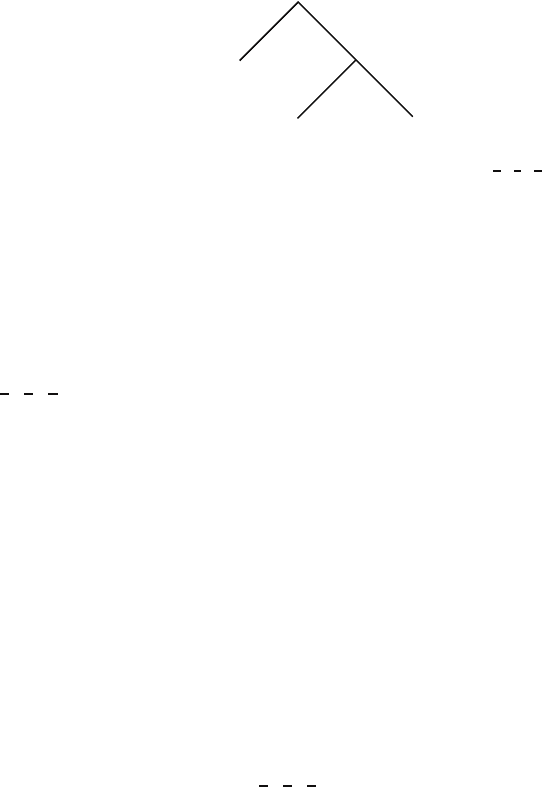
FIGURE 5.7. Tree for generation of the distribution (
1
2
,
1
4
,
1
4
).
p = (p
1
,p
2
,...,p
m
). Let the random variable T denote the number of
coin flips used in the algorithm.
We can describe the algorithm mapping strings of bits Z
1
,Z
2
,..., to
possible outcomes X by a binary tree. The leaves of the tree are marked
by output symbols X, and the path to the leaves is given by the sequence
of bits produced by the fair coin. For example, the tree for the distribution
(
1
2
,
1
4
,
1
4
) is shown in Figure 5.7.
The tree representing the algorithm must satisfy certain properties:
1. The tree should be complete (i.e., every node is either a leaf or has
two descendants in the tree). The tree may be infinite, as we will
see in some examples.
2. The probability of a leaf at depth k is 2
−k
. Many leaves may be
labeled with the same output symbol—the total probability of all
these leaves should equal the desired probability of the output sym-
bol.
3. The expected number of fair bits ET required to generate X is equal
to the expected depth of this tree.
There are many possible algorithms that generate the same output dis-
tribution. For example, the mapping 00 → a, 01 → b, 10 → c, 11 → a
also yields the distribution (
1
2
,
1
4
,
1
4
). However, this algorithm uses two
fair bits to generate each sample and is therefore not as efficient as the
mapping given earlier, which used only 1.5 bits per sample. This brings
up the question: What is the most efficient algorithm to generate a given
distribution, and how is this related to the entropy of the distribution?
We expect that we need at least as much randomness in the fair bits as
we produce in the output samples. Since entropy is a measure of random-
ness, and each fair bit has an entropy of 1 bit, we expect that the number
of fair bits used will be at least equal to the entropy of the output. This
is proved in the following theorem. We will need a simple lemma about
trees in the proof of the theorem. Let Y denote the set of leaves of a com-
plete tree. Consider a distribution on the leaves such that the probability

136 DATA COMPRESSION
of a leaf at depth k onthetreeis2
−k
.LetY be a random variable with
this distribution. Then we have the following lemma.
Lemma 5.11.1 For any complete tree, consider a probability distribu-
tion on the leaves such that the probability of a leaf at depth k is 2
−k
.Then
the expected depth of the tree is equal to the entropy of this distribution.
Proof: The expected depth of the tree
ET =
y∈Y
k(y)2
−k(y)
(5.99)
and the entropy of the distribution of Y is
H(Y) =−
y∈Y
1
2
k(y)
log
1
2
k(y)
(5.100)
=
y∈Y
k(y)2
−k(y)
, (5.101)
where k(y) denotes the depth of leaf y. Thus,
H(Y) = ET.
(5.102)
Theorem 5.11.1 For any algorithm generating X, the expected number
of fair bits used is greater than the entropy H(X), that is,
ET ≥ H(X). (5.103)
Proof: Any algorithm generating X from fair bits can be represented by
a complete binary tree. Label all the leaves of this tree by distinct symbols
y ∈
Y ={1, 2,...}. If the tree is infinite, the alphabet Y is also infinite.
Now consider the random variable Y defined on the leaves of the tree,
such that for any leaf y at depth k, the probability that Y = y is 2
−k
.
By Lemma 5.11.1, the expected depth of this tree is equal to the entropy
of Y :
ET = H(Y). (5.104)
Now the random variable X is a function of Y (one or more leaves
map onto an output symbol), and hence by the result of Problem 2.4, we
have
H(X) ≤ H(Y). (5.105)

5.11 GENERATION OF DISCRETE DISTRIBUTIONS FROM FAIR COINS 137
Thus, for any algorithm generating the random variable X,wehave
H(X) ≤ ET.
(5.106)
The same argument answers the question of optimality for a dyadic dis-
tribution.
Theorem 5.11.2 Let the random variable X have a dyadic distribu-
tion. The optimal algorithm to generate X from fair coin flips requires an
expected number of coin tosses precisely equal to the entropy:
ET = H(X). (5.107)
Proof: Theorem 5.11.1 shows that we need at least H(X) bits to generate
X. For the constructive part, we use the Huffman code tree for X as
the tree to generate the random variable. For a dyadic distribution, the
Huffman code is the same as the Shannon code and achieves the entropy
bound. For any x ∈
X, the depth of the leaf in the code tree corresponding
to x is the length of the corresponding codeword, which is log
1
p(x)
. Hence,
when this code tree is used to generate X, the leaf will have a probability
2
−log
1
p(x)
= p(x). The expected number of coin flips is the expected depth
of the tree, which is equal to the entropy (because the distribution is
dyadic). Hence, for a dyadic distribution, the optimal generating algorithm
achieves
ET = H(X).
(5.108)
What if the distribution is not dyadic? In this case we cannot use the
same idea, since the code tree for the Huffman code will generate a dyadic
distribution on the leaves, not the distribution with which we started. Since
all the leaves of the tree have probabilities of the form 2
−k
, it follows that
we should split any probability p
i
that is not of this form into atoms of this
form. We can then allot these atoms to leaves on the tree. For example, if
one of the outcomes x has probability p(x) =
1
4
, we need only one atom
(leaf of the tree at level 2), but if p(x) =
7
8
=
1
2
+
1
4
+
1
8
, we need three
atoms, one each at levels 1, 2, and 3 of the tree.
To minimize the expected depth of the tree, we should use atoms with
as large a probability as possible. So given a probability p
i
,wefindthe
largest atom of the form 2
−k
that is less than p
i
, and allot this atom to
the tree. Then we calculate the remainder and find that largest atom that
will fit in the remainder. Continuing this process, we can split all the
138 DATA COMPRESSION
probabilities into dyadic atoms. This process is equivalent to finding the
binary expansions of the probabilities. Let the binary expansion of the
probability p
i
be
p
i
=
j≥1
p
(j)
i
, (5.109)
where p
(j)
i
= 2
−j
or 0. Then the atoms of the expansion are the {p
(j)
i
:
i = 1, 2,...,m, j ≥ 1}.
Since
i
p
i
= 1, the sum of the probabilities of these atoms is 1.
We will allot an atom of probability 2
−j
to a leaf at depth j on the
tree. The depths of the atoms satisfy the Kraft inequality, and hence by
Theorem 5.2.1, we can always construct such a tree with all the atoms at
the right depths. We illustrate this procedure with an example.
Example 5.11.2 Let X have the distribution
X =
a with probability
2
3
,
b with probability
1
3
.
(5.110)
We find the binary expansions of these probabilities:
2
3
= 0.10101010 ...
2
(5.111)
1
3
= 0.01010101 ...
2
. (5.112)
Hence, the atoms for the expansion are
2
3
→
1
2
,
1
8
,
1
32
,...
(5.113)
1
3
→
1
4
,
1
16
,
1
64
,...
. (5.114)
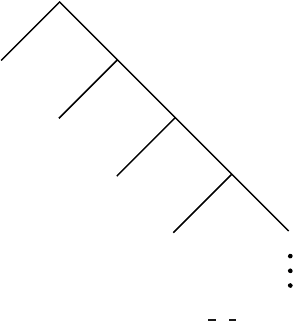
These can be allotted to a tree as shown in Figure 5.8.
This procedure yields a tree that generates the random variable X.
We have argued that this procedure is optimal (gives a tree of minimum
expected depth), but we will not give a formal proof. Instead, we bound
the expected depth of the tree generated by this procedure.
5.11 GENERATION OF DISCRETE DISTRIBUTIONS FROM FAIR COINS 139
a
b
a
b
FIGURE 5.8. Tree to generate a (
2
3
,
1
3
) distribution.
Theorem 5.11.3 The expected number of fair bits required by the opti-
mal algorithm to generate a random variable X lies between H(X) and
H(X)+ 2:
H(X) ≤ ET < H(X) + 2. (5.115)
Proof: The lower bound on the expected number of coin tosses is proved
in Theorem 5.11.1. For the upper bound, we write down an explicit
expression for the expected number of coin tosses required for the proce-
dure described above. We split all the probabilities (p
1
,p
2
,...,p
m
) into
dyadic atoms, for example,
p
1
→
p
(1)
1
,p
(2)
1
,...
, (5.116)
and so on. Using these atoms (which form a dyadic distribution), we
construct a tree with leaves corresponding to each of these atoms. The
number of coin tosses required to generate each atom is its depth in the
tree, and therefore the expected number of coin tosses is the expected
depth of the tree, which is equal to the entropy of the dyadic distribution
of the atoms. Hence,
ET = H(Y), (5.117)
where Y has the distribution, (p
(1)
1
,p
(2)
1
,...,p
(1)
2
,p
(2)
2
,...,p
(1)
m
,p
(2)
m
,...).
Now since X is a function of Y ,wehave
H(Y) = H(Y,X) = H(X)+ H(Y|X), (5.118)
140 DATA COMPRESSION
and our objective is to show that H(Y|X) < 2. We now give an algebraic
proof of this result. Expanding the entropy of Y ,wehave
H(Y) =−
m
i=1
j≥1
p
(j)
i
log p
(j)
i
(5.119)
=
m
i=1
j:p
(j)
i
>0
j2
−j
, (5.120)
since each of the atoms is either 0 or 2
−k
for some k. Now consider the
term in the expansion corresponding to each i, which we shall call T
i
:
T
i
=
j:p
(j)
i
>0
j2
−j
. (5.121)
We can find an n such that 2
−(n−1)
>p
i
≥ 2
−n
,or
n − 1 < −log p
i
≤ n. (5.122)
Then it follows that p
(j)
i
> 0 only if j ≥ n, so that we can rewrite (5.121)
as
T
i
=
j:j ≥n,p
(j)
i
>0
j2
−j
. (5.123)
We use the definition of the atom to write p
i
as
p
i
=
j:j ≥n,p
(j)
i
>0
2
−j
. (5.124)
To prove the upper bound, we first show that T
i
< −p
i
log p
i
+ 2p
i
.
Consider the difference
T
i
+ p
i
log p
i
− 2p
i
(
a)
<T
i
− p
i
(n − 1) − 2p
i
(5.125)
= T
i
− (n − 1 + 2)p
i
(5.126)
=
j:j ≥n,p
(j)
i
>0
j2
−j
− (n + 1)
j:j ≥n,p
(j)
i
>0
2
−j
(5.127)
=
j:j ≥n,p
(j)
i
>0
(j − n − 1)2
−j
(5.128)

SUMMARY 141
=−2
−n
+ 0 +
j:j ≥n+2,p
(j)
i
>0
(j − n − 1)2
−j
(5.129)
(b)
=−2
−n
+
k:k≥1,p
(k+n+1)
i
>0
k2
−(k+n+1)
(5.130)
(c)
≤−2
−n
+
k:k≥1
k2
−(k+n+1)
(5.131)
=−2
−n
+ 2
−(n+1)
2 (5.132)
= 0, (5.133)
where (a) follows from (5.122), (b) follows from a change of variables
for the summation, and (c) follows from increasing the range of the sum-
mation. Hence, we have shown that
T
i
< −p
i
log p
i
+ 2p
i
. (5.134)
Since ET =
i
T
i
, it follows immediately that
ET < −
i
p
i
log p
i
+ 2
i
p
i
= H(X)+ 2, (5.135)
completing the proof of the theorem.
Thus, an average of H(X)+ 2 coin flips suffice to simulate a random
variable X.
SUMMARY
Kraft inequality. Instantaneous codes ⇔
D
−l
i
≤ 1.
McMillan inequality. Uniquely decodable codes ⇔
D
−l
i
≤ 1.
Entropy bound on data compression
L
=
p
i
l
i
≥ H
D
(X). (5.136)

142 DATA COMPRESSION
Shannon code
l
i
=
log
D
1
p
i
(5.137)
H
D
(X) ≤ L<H
D
(X) + 1. (5.138)
Huffman code
L
∗
= min
D
−l
i
≤1
p
i
l
i
(5.139)
H
D
(X) ≤ L
∗
<H
D
(X) + 1. (5.140)
Wrong code. X ∼ p(x), l(x) =
log
1
q(x)
, L =
p(x)l(x):
H(p) + D(p||q) ≤ L<H(p)+ D(p||q) + 1. (5.141)
Stochastic processes
H(X
1
,X
2
,...,X
n
)
n
≤ L
n
<
H(X
1
,X
2
,...,X
n
)
n
+
1
n
. (5.142)
Stationary processes
L
n
→ H(X). (5.143)
Competitive optimality. Shannon code l(x) =
log
1
p(x)
versus any
other code l
(x):
Pr
l(X) ≥ l
(X) + c
≤
1
2
c−1
. (5.144)
PROBLEMS
5.1 Uniquely decodable and instantaneous codes.Let
L =
m
i=1
p
i
l
100
i
be the expected value of the 100th power
of the word lengths associated with an encoding of the random
variable X. Let L
1
= min L over all instantaneous codes; and let
L
2
= min L over all uniquely decodable codes. What inequality
relationship exists between L
1
and L
2
?
PROBLEMS 143
5.2 How many fingers has a Martian? Let
S =
S
1
,...,S
m
p
1
,...,p
m
.
The S
i
’s are encoded into strings from a D-symbol output alphabet
in a uniquely decodable manner. If m = 6 and the codeword lengths
are (l
1
,l
2
,...,l
6
) = (1, 1, 2, 3, 2, 3), find a good lower bound on
D. You may wish to explain the title of the problem.
5.3 Slackness in the Kraft inequality. An instantaneous code has word
lengths l
1
,l
2
,...,l
m
, which satisfy the strict inequality
m
i=1
D
−l
i
< 1.
The code alphabet is
D ={0, 1, 2,...,D − 1}. Show that there
exist arbitrarily long sequences of code symbols in
D
∗
which cannot
be decoded into sequences of codewords.
5.4 Huffman coding. Consider the random variable
X =
x
1
x
2
x
3
x
4
x
5
x
6
x
7
0.49 0.26 0.12 0.04 0.04 0.03 0.02
.
(a) Find a binary Huffman code for X.
(b) Find the expected code length for this encoding.
(c) Find a ternary Huffman code for X.
5.5 More Huffman codes. Find the binary Huffman code for the
source with probabilities (
1
3
,
1
5
,
1
5
,
2
15
,
2
15
). Argue that this code is
also optimal for the source with probabilities (
1
5
,
1
5
,
1
5
,
1
5
,
1
5
).
5.6 Bad codes. Which of these codes cannot be Huffman codes for
any probability assignment?
(a) {0, 10, 11}
(b) {00, 01, 10, 110}
(c) {01, 10}
5.7 Huffman 20 questions. Consider a set of n objects. Let X
i
=
1 or 0 accordingly as the ith object is good or defective. Let
X
1
,X
2
,...,X
n
be independent with Pr{X
i
= 1}=p
i
; and p
1
>
p
2
> ···>p
n
>
1
2
. We are asked to determine the set of all defec-
tive objects. Any yes–no question you can think of is admissible.
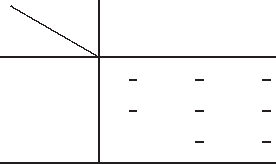
144 DATA COMPRESSION
(a) Give a good lower bound on the minimum average number of
questions required.
(b) If the longest sequence of questions is required by nature’s
answers to our questions, what (in words) is the last ques-
tion we should ask? What two sets are we distinguishing with
this question? Assume a compact (minimum average length)
sequence of questions.
(c) Give an upper bound (within one question) on the minimum
average number of questions required.
5.8 Simple optimum compression of a Markov source. Consider the
three-state Markov process U
1
,U
2
,... having transition matrix
U
n
U
n−1
S
1
S
2
S
3
S
1
1
2
1
4
1
4
S
2
1
4
1
2
1
4
S
3
0
1
2
1
2
Thus, the probability that S
1
follows S
3
is equal to zero. Design
three codes C
1
,C
2
,C
3
(one for each state 1, 2 and 3, each code
mapping elements of the set of S
i
’s into sequences of 0’s and 1’s,
such that this Markov process can be sent with maximal compres-
sion by the following scheme:
(a) Note the present symbol X
n
= i.
(b) Select code C
i
.
(c) Note the next symbol X
n+1
= j and send the codeword in C
i
corresponding to j .
(d) Repeat for the next symbol. What is the average message length
of the next symbol conditioned on the previous state X
n
= i
using this coding scheme? What is the unconditional average
number of bits per source symbol? Relate this to the entropy
rate H(
U) of the Markov chain.
5.9 Optimal code lengths that require one bit above entropy .The
source coding theorem shows that the optimal code for a random
variable X has an expected length less than H(X)+ 1. Give an
example of a random variable for which the expected length of the
optimal code is close to H(X)+ 1 [i.e., for any >0, construct a
distribution for which the optimal code has L>H(X)+ 1 − ].