
Thomas M. Cover, Joy A. Thomas. Elements of information theory
Подождите немного. Документ загружается.


HISTORICAL NOTES 655
ˆ
b
2
(x
1
) =
1
0
bS
1
(b)db
1
0
S
1
(b)db
.
(f) Which of S
2
(b), S
∗
2
,
ˆ
S
2
,
ˆ
b
2
are unchanged if we permute the
order of appearance of the stock vector outcomes [i.e., if the
sequence is now (1, 2), (1,
1
2
)]?
16.10 Growth optimal.LetX
1
,X
2
≥ 0, be price relatives of two inde-
pendent stocks. Suppose that EX
1
>EX
2
. Do you always want
some of X
1
in a growth rate optimal portfolio S(b) = bX
1
+ bX
2
?
Prove or provide a counterexample.
16.11 Cost of universality. In the discussion of finite-horizon universal
portfolios, it was shown that the loss factor due to universality is
1
V
n
=
n
k=0
n
k
k
n
k
n − k
n
n−k
. (16.233)
Evaluate V
n
for n = 1, 2, 3.
16.12 Convex families. This problem generalizes Theorem 16.2.2. We
say that
S is a convex family of random variables if S
1
,S
2
∈ S
implies that λS
1
+ (1 − λ)S
2
∈ S.LetS be a closed convex family
of random variables. Show that there is a random variable S
∗
∈ S
such that
E ln
S
S
∗
≤ 0 (16.234)
for all S ∈
S if and only if
E
S
S
∗
≤ 1 (16.235)
for all S ∈
S.
HISTORICAL NOTES
There is an extensive literature on the mean–variance approach to invest-
ment in the stock market. A good introduction is the book by Sharpe
[491]. Log-optimal portfolios were introduced by Kelly [308] and Latan
´
e
[346], and generalized by Breiman [75]. The bound on the increase in the
656 INFORMATION THEORY AND PORTFOLIO THEORY
growth rate in terms of the mutual information is due to Barron and Cover
[31]. See Samuelson [453, 454] for a criticism of log-optimal investment.
The proof of the competitive optimality of the log-optimal portfolio
is due to Bell and Cover [39, 40]. Breiman [75] investigated asymptotic
optimality for random market processes.
The AEP was introduced by Shannon. The AEP for the stock mar-
ket and the asymptotic optimality of log-optimal investment are given
in Algoet and Cover [21]. The relatively simple sandwich proof for the
AEP is due to Algoet and Cover [20]. The AEP for real-valued ergodic
processes was proved in full generality by Barron [34] and Orey [402].
The universal portfolio was defined in Cover [110] and the proof of
universality was given in Cover [110] and more exactly in Cover and
Ordentlich [135]. The fixed-horizon exact calculation of the cost of uni-
versality V
n
is given in Ordentlich and Cover [401]. The quantity V
n
also
appears in data compression in the work of Shtarkov [496].

CHAPTER 17
INEQUALITIES IN
INFORMATION THEORY
This chapter summarizes and reorganizes the inequalities found throughout
this book. A number of new inequalities on the entropy rates of subsets
and the relationship of entropy and
L
p
norms are also developed. The
intimate relationship between Fisher information and entropy is explored,
culminating in a common proof of the entropy power inequality and the
Brunn–Minkowski inequality. We also explore the parallels between the
inequalities in information theory and inequalities in other branches of
mathematics, such as matrix theory and probability theory.
17.1 BASIC INEQUALITIES OF INFORMATION THEORY
Many of the basic inequalities of information theory follow directly from
convexity.
Definition A function f is said to be convex if
f(λx
1
+ (1 − λ)x
2
) ≤ λf (x
1
) + (1 −λ)f (x
2
) (17.1)
for all 0 ≤ λ ≤ 1andallx
1
and x
2
.
Theorem 17.1.1 (Theorem 2.6.2: Jensen’s inequality) If f is convex,
then
f
(
EX
)
≤ Ef (X). (17.2)
Lemma 17.1.1 The function log x is concave and x log x is convex, for
0 <x<∞.
Elements of Information Theory, Second Edition, By Thomas M. Cover and Joy A. Thomas
Copyright 2006 John Wiley & Sons, Inc.
657

658 INEQUALITIES IN INFORMATION THEORY
Theorem 17.1.2 (Theorem 2.7.1: Log sum inequality) For positive
numbers a
1
,a
2
,...,a
n
and b
1
,b
2
,...,b
n
,
n
i=1
a
i
log
a
i
b
i
≥
n
i=1
a
i
log
n
i=1
a
i
n
i=1
b
i
(17.3)
with equality iff
a
i
b
i
= constant.
We recall the following properties of entropy from Section 2.1.
Definition The entropy H(X) of a discrete random variable X is de-
fined by
H(X) =−
x∈X
p(x) log p(x). (17.4)
Theorem 17.1.3 (Lemma 2.1.1, Theorem 2.6.4: Entropy bound)
0 ≤ H(X) ≤ log |
X|. (17.5)
Theorem 17.1.4 (Theorem 2.6.5: Conditioning reduces entropy) For
any two random variables X and Y ,
H(X|Y) ≤ H(X), (17.6)
with equality iff X and Y are independent.
Theorem 17.1.5 (Theorem 2.5.1 with Theorem 2.6.6: Chain rule)
H(X
1
,X
2
,...,X
n
) =
n
i=1
H(X
i
|X
i−1
,...,X
1
) ≤
n
i=1
H(X
i
), (17.7)
with equality iff X
1
,X
2
,...,X
n
are independent.
Theorem 17.1.6 (Theorem 2.7.3) H(p) is a concave function of p.
We now state some properties of relative entropy and mutual informa-
tion (Section 2.3).
Definition The relative entropy or Kullback–Leibler distance between
two probability mass functions p(x) and q(x) is defined by
D(p||q) =
x∈X
p(x) log
p(x)
q(x)
. (17.8)

17.1 BASIC INEQUALITIES OF INFORMATION THEORY 659
Definition The mutual information between two random variables X
and Y is defined by
I(X;Y) =
x∈X
y∈Y
p(x, y) log
p(x, y)
p(x)p(y)
= D(p(x, y)||p(x)p(y)).
(17.9)
The following basic information inequality can be used to prove many
of the other inequalities in this chapter.
Theorem 17.1.7 (Theorem 2.6.3: Information inequality) For any
two probability mass functions p and q,
D(p||q) ≥ 0 (17.10)
with equality iff p(x) = q(x) for all x ∈
X.
Corollary For any two random variables X and Y ,
I(X;Y) = D(p(x, y)||p(x)p(y)) ≥ 0 (17.11)
with equality iff p(x, y) = p(x)p(y) (i.e., X and Y are independent).
Theorem 17.1.8 (Theorem 2.7.2: Convexity of relative entropy)
D(p||q) is convex in the pair (p, q).
Theorem 17.1.9 (Theorem 2.4.1 )
I(X;Y) = H(X)− H(X|Y). (17.12)
I(X;Y) = H(Y) − H(Y|X). (17.13)
I(X;Y) = H(X)+ H(Y)− H(X,Y). (17.14)
I(X;X) = H(X). (17.15)
Theorem 17.1.10 (Section 4.4) For a Markov chain:
1. Relative entropy D(µ
n
||µ
n
) decreases with time.
2. Relative entropy D(µ
n
||µ) between a distribution and the stationary
distribution decreases with time.
3. Entropy H(X
n
) increases if the stationary distribution is uniform.
4. The conditional entropy H(X
n
|X
1
) increases with time for a station-
ary Markov chain.
660 INEQUALITIES IN INFORMATION THEORY
Theorem 17.1.11 Let X
1
,X
2
,...,X
n
be i.i.d. ∼ p(x).Let ˆp
n
be the
empirical probability mass function of X
1
,X
2
,...,X
n
.Then
ED( ˆp
n
||p) ≤ ED( ˆp
n−1
||p). (17.16)
17.2 DIFFERENTIAL ENTROPY
We now review some of the basic properties of differential entropy
(Section 8.1).
Definition The differential entropy h(X
1
,X
2
,...,X
n
), sometimes writ-
ten h(f ),isdefinedby
h(X
1
,X
2
,...,X
n
) =−
f(x) log f(x)dx. (17.17)
The differential entropy for many common densities is given in
Table 17.1.
Definition The relative entropy between probability densities f and
g is
D(f ||g) =
f(x) log
(
f(x)/g(x)
)
dx. (17.18)
The properties of the continuous version of relative entropy are iden-
tical to the discrete version. Differential entropy, on the other hand, has
some properties that differ from those of discrete entropy. For example,
differential entropy may be negative.
We now restate some of the theorems that continue to hold for differ-
ential entropy.
Theorem 17.2.1 (Theorem 8.6.1: Conditioning reduces entropy)
h(X|Y) ≤ h(X), with equality iff X and Y are independent.
Theorem 17.2.2 (Theorem 8.6.2: Chain rule)
h(X
1
,X
2
,...,X
n
) =
n
i=1
h(X
i
|X
i−1
,X
i−2
,...,X
1
) ≤
n
i=1
h(X
i
)
(17.19)
with equality iff X
1
,X
2
,...,X
n
are independent.
Lemma 17.2.1 If X and Y are independent, then h(X + Y) ≥ h(X).
Proof: h(X + Y) ≥ h(X + Y |Y) = h(X|Y) = h(X).

17.2 DIFFERENTIAL ENTROPY 661
TABLE 17.1 Differential Entropies
a
Distribution
Name Density Entropy (nats)
f(x) =
x
p−1
(1 −x)
q−1
B(p, q)
,
ln B(p, q) − (p − 1)
Beta ×[ψ(p) − ψ(p + q)]
0 ≤ x ≤ 1,p,q>0 −(q − 1)[ψ(q) − ψ(p + q)]
f(x) =
λ
π
1
λ
2
+ x
2
,
Cauchy ln(4πλ)
−∞ <x<∞,λ>0
f(x) =
2
2
n/2
σ
n
(n/2)
x
n−1
e
−
x
2
2σ
2
,
Chi ln
σ(n/2)
√
2
−
n − 1
2
ψ
n
2
+
n
2
x>0,n > 0
f(x) =
1
2
n/2
σ
n
(n/2)
x
n
2
− 1
e
−
x
2σ
2
,
ln 2σ
2
n
2
Chi-squared
x>0,n> 0
−
1 −
n
2
ψ
n
2
+
n
2
f(x) =
β
n
(n − 1)!
x
n−1
e
−βx
,
Erlang (1 − n)ψ(n) + ln
(n)
β
+ n
x,β > 0,n >0
Exponential f(x)=
1
λ
e
−
x
λ
,x,λ>0 1 + ln λ
f(x) =
n
n
1
2
1
n
n
2
2
2
B(
n
1
2
,
n
2
2
)
×
x
(
n
1
2
) − 1
(n
2
+ n
1
x)
n
1
+n
2
2
,
ln
n
1
n
2
B
n
1
2
,
n
2
2
x>0,n
1
,n
2
> 0
F +
1 −
n
1
2
ψ
n
1
2
−
1 −
n
2
2
ψ
n
2
2
+
n
1
+ n
2
2
ψ
n
1
+ n
2
2
Gamma f(x)=
x
α−1
e
−
x
β
β
α
(α)
,x,α,β>0
ln(β(α)) + (1 −α)ψ(α) + α
f(x) =
1
2λ
e
−
|x−θ |
λ
,
Laplace 1 + ln 2λ
−∞ <x,θ <∞,λ >0
f(x) =
e
−x
(1+e
−x
)
2
,
Logistic 2
−∞ <x<∞

662 INEQUALITIES IN INFORMATION THEORY
TABLE 17.1 (continued)
Distribution
Name Density Entropy (nats)
f(x) =
1
σx
√
2π
e
−
ln(x−m)
2
2σ
2
,
Lognormal m +
1
2
ln(2πeσ
2
)
x>0, −∞ <m<∞,σ > 0
Maxwell– f(x) = 4π
−
1
2
β
3
2
x
2
e
−βx
2
,
Boltzmann
1
2
ln
π
β
+ γ −
1
2
x,β > 0
f(x) =
1
√
2πσ
2
e
−
(x−µ)
2
2σ
2
,
Normal
1
2
ln(2πeσ
2
)
−∞ <x,µ<∞,σ > 0
Generalized f(x)=
2β
α
2
(
α
2
)
x
α−1
e
−βx
2
,
normal ln
(
α
2
)
2β
1
2
−
α − 1
2
ψ
α
2
+
α
2
x,α,β > 0
Pareto f(x)=
ak
a
x
a+1
,x≥ k>0,a > 0 ln
k
a
+ 1 +
1
a
Rayleigh f(x) =
x
b
2
e
−
x
2
2b
2
,x,b>0 1 + ln
β
√
2
+
γ
2
f(x) =
(1 + x
2
/n)
−(n+1)/2
√
nB(
1
2
,
n
2
)
,
n + 1
2
ψ
n + 1
2
− ψ
n
2
Student’s t
−∞ <x<∞,n > 0 + ln
√
nB
1
2
,
n
2
Triangular f(x)=
2x
a
, 0 ≤ x ≤ a
2(1 − x)
1 −a
,a≤ x ≤ 1
1
2
− ln 2
Uniform f(x) =
1
β − α
,α≤ x ≤ β
ln(β − α)
Weibull f(x)=
c
α
x
c−1
e
−
x
c
α
,x,c,α>0
(c − 1)γ
c
+ ln
α
1
c
c
+ 1
a
All entropies are in nats; (z) =
∞
0
e
−t
t
z−1
dt; ψ(z) =
d
dz
ln (z); γ = Euler’s constant =
0.57721566 ....
Source:
Lazo and Rathie [543].

17.3 BOUNDS ON ENTROPY AND RELATIVE ENTROPY 663
Theorem 17.2.3 (Theorem 8.6.5) Let the random vector X ∈ R
n
have
zero mean and covariance K = EXX
t
(i.e., K
ij
= EX
i
X
j
, 1 ≤ i, j ≤ n).
Then
h(X) ≤
1
2
log(2πe)
n
|K| (17.20)
with equality iff X ∼
N(0,K).
17.3 BOUNDS ON ENTROPY AND RELATIVE ENTROPY
In this section we revisit some of the bounds on the entropy function. The
most useful is Fano’s inequality, which is used to bound away from zero
the probability of error of the best decoder for a communication channel
at rates above capacity.
Theorem 17.3.1 (Theorem 2.10.1: Fano’s inequality) Given two ran-
dom variables X and Y ,let
ˆ
X = g(Y) be any estimator of X given Y and
let P
e
= Pr(X =
ˆ
X) be the probability of error. Then
H(P
e
) + P
e
log |X|≥H(X|
ˆ
X) ≥ H(X|Y). (17.21)
Consequently, if H(X|Y) > 0,thenP
e
> 0.
A similar result is given in the following lemma.
Lemma 17.3.1 (Lemma 2.10.1) If X and X
are i.i.d. with entropy
H(X)
Pr(X = X
) ≥ 2
−H(X)
(17.22)
with equality if and only if X has a uniform distribution.
The continuous analog of Fano’s inequality bounds the mean-squared
errorofanestimator.
Theorem 17.3.2 (Theorem 8.6.6 ) Let X be a random variable with
differential entropy h(X).Let
ˆ
X be an estimate of X, and let E(X −
ˆ
X)
2
be the expected prediction error. Then
E(X −
ˆ
X)
2
≥
1
2πe
e
2h(X)
. (17.23)
Given side information Y and estimator
ˆ
X(Y ),
E(X −
ˆ
X(Y ))
2
≥
1
2πe
e
2h(X|Y)
. (17.24)
664 INEQUALITIES IN INFORMATION THEORY
Theorem 17.3.3 (L
1
bound on entropy) Let p and q be two proba-
bility mass functions on
X such that
||p − q||
1
=
x∈X
|
p(x) − q(x)
|
≤
1
2
. (17.25)
Then
|
H(p)− H(q)
|
≤−||p − q||
1
log
||p − q||
1
|X|
. (17.26)
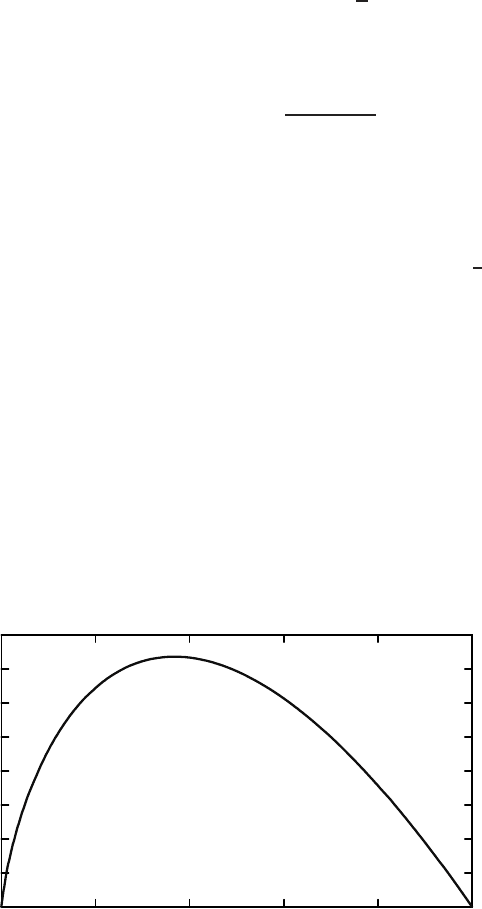
Proof: Consider the function f(t) =−t log t shown in Figure 17.1. It
can be verified by differentiation that the function f(·) is concave. Also,
f(0) = f(1) = 0. Hence the function is positive between 0 and 1. Con-
sider the chord of the function from t to t +ν (where ν ≤
1
2
). The
maximum absolute slope of the chord is at either end (when t = 0or
1 − ν). Hence for 0 ≤ t ≤ 1 − ν,wehave
|
f(t)− f(t + ν)
|
≤ max{f(ν),f(1 − ν)}=−ν log ν. (17.27)
Let r(x) =|p(x) − q(x)|.Then
|H(p) − H(q)|=
x∈X
(−p(x) log p(x) + q(x)log q(x))
(17.28)
≤
x∈X
|
(−p(x) log p(x) + q(x)log q(x))
|
(17.29)
0.4
0.35
0.3
0.25
0.2
0.15
0.1
0.05
0
0 0.2 0.4
t
f
(
t
) = −
t
In
t
−
t
In
t
0.6 0.8 1
FIGURE 17.1. Function f(t) =−t ln t.