
Thomas M. Cover, Joy A. Thomas. Elements of information theory
Подождите немного. Документ загружается.


16.7 UNIVERSAL PORTFOLIOS 635
find by differentiating with respect to b that the maximum value
w
∗
(j
n
) = max
0≤b≤1
b
k
(1 − b)
n−k
(16.111)
=
k
n
k
n − k
n
n−k
, (16.112)
which is achieved by
b
∗
=
k
n
,
n − k
n
. (16.113)
Note that
w
∗
(j
n
)>1, reflecting the fact that the amount “bet” on
j
n
is chosen in hindsight, thus relieving the hindsight investor of the
responsibility of allocating his investments w
∗
(j
n
) to sum to 1. The causal
investor has no such luxury. How can the causal investor choose initial
investments ˆw(j
n
),
ˆw(j
n
) = 1, to protect himself from all possible j
n
and hindsight-determined w
∗
(j
n
)? The answer will be to choose ˆw(j
n
)
proportional to w
∗
(j
n
). Then the worst-case ratio of ˆw(j
n
)/w
∗
(j
n
) will
be maximized. To proceed, we define V
n
by
1
V
n
=
j
n
k(j
n
)
n
k(j
n
)
n − k(j
n
)
n
n−k(j
n
)
(16.114)
=
n
k=0
n
k
k
n
k
n − k
n
n−k
(16.115)
and let
ˆw(j
n
) = V
n
k(j
n
)
n
k(j
n
)
n − k(j
n
)
n
n−k(j
n
)
. (16.116)
It is clear that ˆw(j
n
) is a legitimate distribution of wealth over the 2
n
stock sequences (i.e., ˆw(j
n
) ≥ 0and
j
n
ˆw(j
n
) = 1). Here V
n
is the
normalization factor that makes ˆw(j
n
) a probability mass function. Also,
from (16.109) and (16.113), for all sequences x
n
,
ˆ
S
n
(x
n
)
S
∗
n
(x
n
)
≥ min
j
n
ˆw(j
n
)
w
∗
(j
n
)
(16.117)
= min
k
V
n
(
k
n
)
k
(
n−k
n
)
n−k
b
∗k
(1 − b
∗
)
n−k
(16.118)
≥ V
n
, (16.119)

636 INFORMATION THEORY AND PORTFOLIO THEORY
where (16.117) follows from (16.109) and (16.119) follows from (16.112).
Consequently, we have
max
ˆ
b
min
x
n
ˆ
S
n
(x
n
)
S
∗
n
(x
n
)
≥ V
n
. (16.120)
We have thus demonstrated a portfolio on the 2
n
possible sequences of
length n that achieves wealth
ˆ
S
n
(x
n
) within a factor V
n
of the wealth
S
∗
n
(x
n
) achieved by the best constant rebalanced portfolio in hindsight. To
complete the proof of the theorem, we show that this is the best possible,
that is, that any nonanticipating portfolio b
i
(x
i−1
) cannot do better than
a factor V
n
in the worst case (i.e., for the worst choice of x
n
). To prove
this, we construct a set of extremal stock market sequences and show that
the performance of any nonanticipating portfolio strategy is bounded by
V
n
for at least one of these sequences, proving the worst-case bound.
For each j
n
∈{1, 2}
n
, we define the corresponding extremal stock mar-
ket vector x
n
(j
n
) as
x
i
(j
i
) =
(1, 0)
t
if j
i
= 1,
(0, 1)
t
if j
i
= 2,
(16.121)
Let e
1
= (1, 0)
t
, e
2
= (0, 1)
t
be standard basis vectors. Let
K ={x(j
n
) : j
n
∈{1, 2}
n
, x
ij
i
= e
j
i
} (16.122)
be the set of extremal sequences. There are 2
n
such extremal sequences,
and for each sequence at each time, there is only one stock that yields
a nonzero return. The wealth invested in the other stock is lost. There-
fore, the wealth at the end of n periods for extremal sequence x
n
(j
n
)
is the product of the amounts invested in the stocks j
1
,j
2
,...,j
n
,[i.e.,
S
n
(x
n
(j
n
)) =
i
b
j
i
= w(j
n
)]. Again, we can view this as an investment
on sequences of length n, and given the 0–1 nature of the return, it is
easy to see for x
n
∈ K that
j
n
S
n
(x
n
(j
n
)) = 1. (16.123)
For any extremal sequence x
n
(j
n
) ∈ K, the best constant rebalanced port-
folio is
b
∗
(x
n
(j
n
)) =
n
1
(j
n
)
n
,
n
2
(j
n
)
n
t
, (16.124)

16.7 UNIVERSAL PORTFOLIOS 637
where n
1
(j
n
) is the number of occurrences of 1 in the sequence j
n
.The
corresponding wealth at the end of n periods is
S
∗
n
(x
n
(j
n
)) =
n
1
(j
n
)
n
n
1
(j
n
)
n
2
(j
n
)
n
n
2
(j
n
)
=
ˆw(j
n
)
V
n
, (16.125)
from (16.116) and it therefore follows that
x
n
∈K
S
∗
n
(x
n
) =
1
V
n
j
n
ˆw(j
n
) =
1
V
n
. (16.126)
We then have the following inequality for any portfolio sequence {b
i
}
n
i=1
,
with S
n
(x
n
) defined as in (16.104):
min
x
n
∈K
S
n
(x
n
)
S
∗
n
(x
n
)
≤
˜
x
n
∈K
S
∗
n
(
˜
x
n
)
x
n
∈K
S
∗
n
(x
n
)
S
n
(
˜
x
n
)
S
∗
n
(
˜
x
n
)
(16.127)
=
˜
x
n
∈K
S
n
(
˜
x
n
)
x
n
∈K
S
∗
n
(x
n
)
(16.128)
=
1
x
n
∈K
S
∗
n
(x
n
)
(16.129)
= V
n
, (16.130)
where the inequality follows from the fact that the minimum is less than
the average. Thus,
max
b
min
x
n
∈K
S
n
(x
n
)
S
∗
n
(x
n
)
≤ V
n
. (16.131)
The strategy described in the theorem puts mass on all sequences of
length n and is clearly dependent on n. We can recast the strategy in
incremental terms (i.e., in terms of the amount bet on stock 1 and stock
2 at time 1), then, conditional on the outcome at time 1, the amount bet
on each of the two stocks at time 2, and so on. Consider the weight
ˆ
b
i,1
assigned by the algorithm to stock 1 at time i given the previous
sequence of stock vectors x
i−1
. We can calculate this by summing over
all sequences j
n
that have a 1 in position i, giving
ˆ
b
i,1
(x
i−1
) =
j
i−1
∈M
i−1
ˆw(j
i−1
1)x(j
i−1
)
j
i
∈M
i
ˆw(j
i
)x(j
i−1
)
, (16.132)

638 INFORMATION THEORY AND PORTFOLIO THEORY
where
ˆw(j
i
) =
j
n
:j
i
⊆j
n
w(j
n
) (16.133)
is the weight put on all sequences j
n
that start with j
i
,and
x(j
i−1
) =
i−1
k=1
x
kj
k
(16.134)
is the return on those sequences as defined in (16.106).
Investigation of the asymptotics of V
n
reveals [401, 496] that
V
n
∼
2
n
m−1
(m/2)/
√
π (16.135)
for m assets. In particular, for m = 2 assets,
V
n
∼
2
πn
(16.136)
and
1
2
√
n + 1
≤ V
n
≤
2
√
n + 1
(16.137)
for all n [400]. Consequently, for m = 2stocks, the causal portfolio strat-
egy
ˆ
b
i
(x
i−1
) given in (16.132) achieves wealth
ˆ
S
n
(x
n
) such that
ˆ
S
n
(x
n
)
S
∗
n
(x
n
)
≥ V
n
≥
1
2
√
n + 1
(16.138)
for all market sequences x
n
.
16.7.2 Horizon-Free Universal Portfolios
We describe the horizon-free strategy in terms of a weighting of different
portfolio strategies. As described earlier, each constantly rebalanced port-
folio b can be viewed as corresponding to a mutual fund that rebalances
the m assets according to b. Initially, we distribute the wealth among
these funds according to a distribution µ(b), where dµ(b) is the amount
of wealth invested in portfolios in the neighborhood db of the constantly
rebalanced portfolio b.

16.7 UNIVERSAL PORTFOLIOS 639
Let
S
n
(b, x
n
) =
n
i=1
b
t
x
i
(16.139)
be the wealth generated by a constant rebalanced portfolio b on the stock
sequence x
n
. Recall that
S
∗
n
(x
n
) = max
b∈B
S
n
(b, x
n
) (16.140)
is the wealth of the best constant rebalanced portfolio in hindsight.
We investigate the causal portfolio defined by
ˆ
b
i+1
(x
i
) =
B
bS
i
(b, x
i
)dµ(b)
B
S
i
(b, x
i
)dµ(b )
. (16.141)
We note that
ˆ
b
t
i+1
(x
i
)x
i+1
=
B
b
t
x
i+1
S
i
(b, x
i
)dµ(b )
B
S
i
(b, x
i
)dµ(b )
(16.142)
=
B
S
i+1
(b, x
i+1
)dµ(b )
B
S
i
(b, x
i
)dµ(b)
. (16.143)
Thus, the product
ˆ
b
t
i
x
i
telescopes and we see that the wealth
ˆ
S
n
(x
n
)
resulting from this portfolio is given by
ˆ
S
n
(x
n
) =
n
i=1
ˆ
b
t
i
(x
i−1
)x
i
(16.144)
=
b∈B
S
n
(b, x
n
)dµ(b ). (16.145)
There is another way to interpret (16.145). The amount given to port-
folio manager b is dµ(b), the resulting growth factor for the manager
rebalancing to b is S(b, x
n
), and the total wealth of this batch of invest-
ments is
ˆ
S
n
(x
n
) =
B
S
n
(b, x
n
)dµ(b). (16.146)
Then
ˆ
b
i+1
, defined in (16.141), is the performance-weighted total “buy
order” of the individual portfolio manager b.

640 INFORMATION THEORY AND PORTFOLIO THEORY
So far, we have not specified what distribution µ(b) we use to apportion
the initial wealth. We now use a distribution µ that puts mass on all
possible portfolios, so that we approximate the performance of the best
portfolio for the actual distribution of stock price vectors.
In the next lemma, we bound
ˆ
S
n
/S
∗
n
as a function of the initial wealth
distribution µ(b).
Lemma 16.7.2 Let S
∗
n
(x
n
) in 16.140 be the wealth achieved by the best
constant rebalanced portfolio and let
ˆ
S
n
(x
n
) in (16.144) be the wealth
achieved by the universal mixed portfolio
ˆ
b(·), given by
ˆ
b
i+1
(x
i
) =
bS
i
(b, x
i
)dµ(b)
S
i
(b, x
i
)dµ(b)
. (16.147)
Then
ˆ
S
n
(x
n
)
S
∗
n
(x
n
)
≥ min
j
n
B
n
i=1
b
j
i
dµ(b)
n
i=1
b
∗
j
i
. (16.148)
Proof: As before, we can write
S
∗
n
(x
n
) =
j
n
w
∗
(j
n
)x(j
n
), (16.149)
where w
∗
(j
n
) =
n
i=1
b
∗
j
i
is the amount invested on the sequence j
n
and
x(j
n
) =
n
i=1
x
ij
i
is the corresponding return. Similarly, we can write
ˆ
S
n
(x
n
) =
n
i=1
b
t
x
i
dµ(b) (16.150)
=
j
n
n
i=1
b
j
i
x
ij
i
dµ(b) (16.151)
=
j
n
ˆw(j
n
)x(j
n
), (16.152)
where ˆw(j
n
) =
n
i=1
b
j
i
dµ(b). Now applying Lemma 16.7.1, we have
ˆ
S
n
(x
n
)
S
∗
n
(x
n
)
=
j
n
ˆw(j
n
)x(j
n
)
j
n
w
∗
(j
n
)x(j
n
)
(16.153)
≥ min
j
n
ˆw(j
n
)x(j
n
)
w
∗
(j
n
)x(j
n
)
(16.154)
= min
j
n
B
n
i=1
b
j
i
dµ(b)
n
i=1
b
∗
j
i
. (16.155)

16.7 UNIVERSAL PORTFOLIOS 641
We now apply this lemma when µ(b) is the Dirichlet(
1
2
) distribution.
Theorem 16.7.2 For the causal universal portfolio
ˆ
b
i
(), i = 1, 2,...,
given in (16.141), with m = 2 stocks and dµ(b) the Dirichlet(
1
2
,
1
2
) distri-
bution, we have
ˆ
S
n
(x
n
)
S
∗
n
(x
n
)
≥
1
2
√
n + 1
,
for all n and all stock sequences x
n
.
Proof: As in the discussion preceding (16.112), we can show that the
weight put by the best constant portfolio b
∗
on the sequence j
n
is
n
i=1
b
∗
j
i
=
k
n
k
n − k
n
n−k
= 2
−nH (k/n)
, (16.156)
where k is the number of indices where j
i
= 1. We can also explicitly
calculate the integral in the numerator of (16.148) in Lemma 16.7.2 for
the Dirichlet(
1
2
) density, defined for m variables as
dµ(b) =
(
m
2
)
1
2
m
m
j=1
b
−
1
2
j
db, (16.157)
where (x) =
∞
0
e
−t
t
x−1
dt denotes the gamma function. For simplicity,
we consider the case of two stocks, in which case
dµ(b) =
1
π
1
√
b(1 − b)
db, 0 ≤ b ≤ 1, (16.158)
where b is the fraction of wealth invested in stock 1. Now consider any
sequence j
n
∈{1, 2}
n
, and consider the amount invested in that sequence,
b(j
n
) =
n
i=1
b
j
i
= b
l
(1 − b)
n−l
, (16.159)
where l is the number of indices where j
i
= 1. Then
b(j
n
)dµ(b) =
b
l
(1 − b)
n−l
1
π
1
√
b(1 − b)
db (16.160)

642 INFORMATION THEORY AND PORTFOLIO THEORY
=
1
π
b
l−
1
2
(1 − b)
n−l−
1
2
db (16.161)
=
1
π
B
l +
1
2
,n− l +
1
2
, (16.162)
where B(λ
1
,λ
2
) is the beta function, defined as
B(λ
1
,λ
2
) =
1
0
x
λ
1
−1
(1 − x)
λ
2
−1
dx (16.163)
=
(λ
1
)(λ
2
)
(λ
1
+ λ
2
)
(16.164)
and
(λ) =
∞
0
x
λ−1
e
−x
dx. (16.165)
Note that for any integer n, (n + 1) = n!and(n +
1
2
) =
1·3·5···(2n−1)
2
n
√
π.
We can calculate B(l +
1
2
,n− l +
1
2
) by means of simple recursion
using integration by parts. Alternatively, using (16.164), we obtain
B
l +
1
2
,n− l +
1
2
=
π
2
2n
2n
n
n
l
2n
2l
. (16.166)
Combining all the results with Lemma 16.7.2, we have
ˆ
S
n
(x
n
)
S
∗
n
(x
n
)
≥ min
j
n
B
n
i=1
b
j
i
dµ(b)
n
i=1
b
∗
j
i
(16.167)
≥ min
l
1
π
B(l +
1
2
,n− l +
1
2
)
2
−nH (l/n)
(16.168)
≥
1
2
√
n + 1
, (16.169)
using the results in [135, Theorem 2].
It follows for m = 2stocksthat
ˆ
S
n
S
∗
n
≥
1
√
2π
V
n
(16.170)
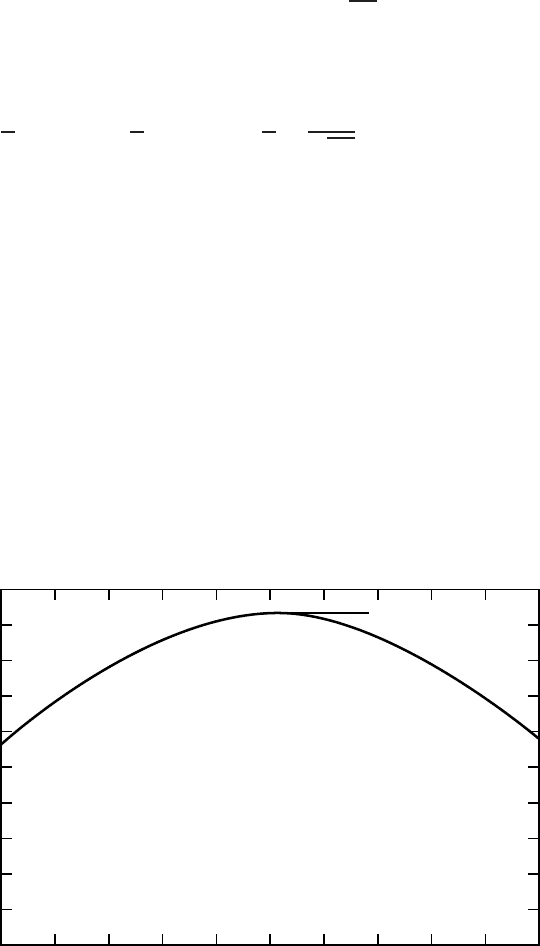
16.7 UNIVERSAL PORTFOLIOS 643
for all n and all market sequences x
1
,x
2
,...,x
n
. Thus, good minimax per-
formance for all n costs at most an extra factor
√
2π over the fixed horizon
minimax portfolio. The cost of universality is V
n
, which is asymptotically
negligible in the growth rate in the sense that
1
n
ln
ˆ
S
n
(x
n
) −
1
n
ln S
∗
n
(x
n
) ≥
1
n
ln
V
n
√
2π
→ 0. (16.171)
Thus, the universal causal portfolio achieves the same asymptotic growth
rate of wealth as the best hindsight portfolio.
Let’s now consider how this portfolio algorithm performs on two real
stocks. We consider a 14-year period (ending in 2004) and two stocks,
Hewlett-Packard and Altria (formerly, Phillip Morris), which are both
components of the Dow Jones Index. Over these 14 years, HP went up by
a factor of 11.8, while Altria went up by a factor of 11.5. The performance
of the different constantly rebalanced portfolios that contain HP and Altria
are shown in Figure 16.2. The best constantly rebalanced portfolio (which
can be computed only in hindsight) achieves a growth of a factor of 18.7
using a mixture of about 51% HP and 49% Altria. The universal portfolio
strategy described in this section achieves a growth factor of 15.7 without
foreknowledge.
20
18
16
14
12
10
8
6
4
2
0
0 0.1 0.2 0.3 0.4 0.5 0.6 0.7 0.8 0.9 1
Proportion b of wealth in HPQ
Value
S
n
(
b
) of initial investment
S
n
*
FIGURE 16.2. Performance of different constant rebalanced portfolios b for HP and Altria.

644 INFORMATION THEORY AND PORTFOLIO THEORY
16.8 SHANNON–MCMILLAN–BREIMAN THEOREM
(GENERAL AEP)
The AEP for ergodic processes has come to be known as the Shan-
non –McMillan –Breiman theorem. In Chapter 3 we proved the AEP for
i.i.d. processes. In this section we offer a proof of the theorem for a
general ergodic process. We prove the convergence of
1
n
log p(X
n
) by
sandwiching it between two ergodic sequences.
In a sense, an ergodic process is the most general dependent process for
which the strong law of large numbers holds. For finite alphabet processes,
ergodicity is equivalent to the convergence of the kth-order empirical
distributions to their marginals for all k.
The technical definition requires some ideas from probability theory. To
be precise, an ergodic source is defined on a probability space (,
B,P),
where
B is a σ -algebra of subsets of and P is a probability measure.
A random variable X is defined as a function X(ω),ω ∈ , on the prob-
ability space. We also have a transformation T : → , which plays
the role of a time shift. We will say that the transformation is stationary
if P(TA) = P(A) for all A ∈
B. The transformation is called ergodic if
every set A such that TA= A, a.e., satisfies P(A) = 0or1.IfT is station-
ary and ergodic, we say that the process defined by X
n
(ω) = X(T
n
ω) is
stationary and ergodic. For a stationary ergodic source, Birkhoff’s ergodic
theorem states that
1
n
n
i=1
X
i
(ω) → EX =
XdP with probability 1. (16.172)
Thus, the law of large numbers holds for ergodic processes.
We wish to use the ergodic theorem to conclude that
−
1
n
log p(X
0
,X
1
,...,X
n−1
) =−
1
n
n−1
i=0
log p(X
i
|X
i−1
0
)
→ lim
n→∞
E[−log p(X
n
|X
n−1
0
)]. (16.173)
But the stochastic sequence p(X
i
|X
i−1
0
) is not ergodic. However, the
closely related quantities p(X
i
|X
i−1
i−k
) and p(X
i
|X
i−1
−∞
) are ergodic and
have expectations easily identified as entropy rates. We plan to sandwich
p(X
i
|X
i−1
0
) between these two more tractable processes.