
Thomas M. Cover, Joy A. Thomas. Elements of information theory
Подождите немного. Документ загружается.

16.5 INVESTMENT IN STATIONARY MARKETS 625
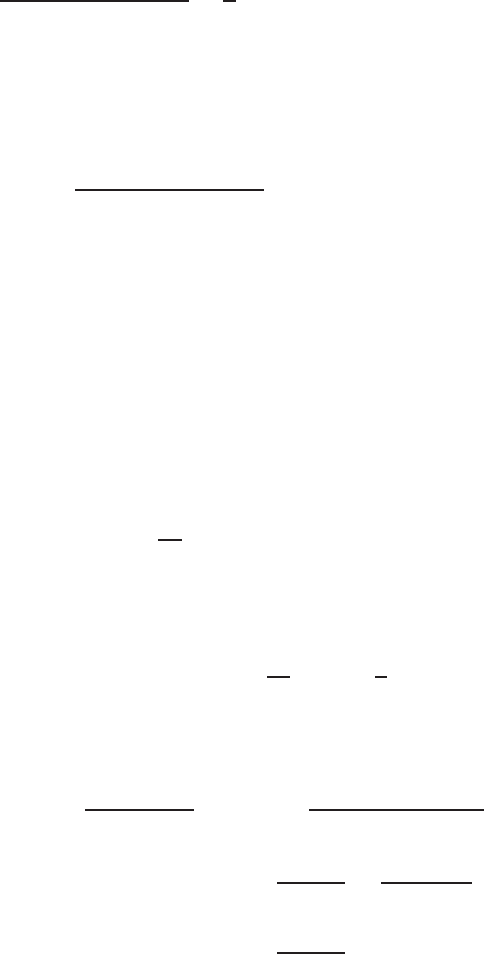
Proof: By stationarity, W
∗
(X
n
|X
1
, X
2
,...,X
n−1
) is nondecreasing in n.
Hence, it must have a limit, possibly infinity. Since
W
∗
(X
1
, X
2
,...,X
n
)
n
=
1
n
n
i=1
W
∗
(X
i
|X
1
, X
2
,...,X
i−1
), (16.63)
it follows by the theorem of the Ces
´
aro mean (Theorem 4.2.3) that the
left-hand side has the same limit as the limit of the terms on the right-hand
side. Hence, W
∗
∞
exists and
W
∗
∞
= lim
n→∞
W
∗
(X
1
, X
2
,...,X
n
)
n
= lim
n→∞
W
∗
(X
n
|X
1
, X
2
,...,X
n−1
).
(16.64)
We can now extend the asymptotic optimality property to stationary
markets. We have the following theorem.
Theorem 16.5.2 Consider an arbitrary stochastic process {X
i
}, X
i
∈
R
m
+
, conditionally log-optimal portfolios, b
∗
i
(X
i−1
) and wealth S
∗
n
.LetS
n
be the wealth generated by any other causal portfolio strategy b
i
(X
i−1
).
Then S
n
/S
∗
n
is a positive supermartingale with respect to the sequence of
σ -fields generated by the past X
1
,X
2
,...,X
n
. Consequently, there exists
a random variable V such that
S
n
S
∗
n
→ V with probability 1 (16.65)
EV ≤ 1 (16.66)
and
Pr
sup
n
S
n
S
∗
n
≥ t
≤
1
t
. (16.67)
Proof: S
n
/S
∗
n
is a positive supermartingale because
E
S
n+1
(X
n+1
)
S
∗
n+1
(X
n+1
)
X
n
= E
(b
t
n+1
X
n+1
)S
n
(X
n
)
(b
∗t
n+1
X
n+1
)S
∗
n
(X
n
)
X
n
(16.68)
=
S
n
(X
n
)
S
∗
n
(X
n
)
E
b
t
n+1
X
n+1
b
∗t
n+1
X
n+1
X
n
(16.69)
≤
S
n
(X
n
)
S
∗
n
(X
n
)
, (16.70)

626 INFORMATION THEORY AND PORTFOLIO THEORY
by the Kuhn–Tucker condition on the conditionally log-optimal portfolio.
Thus, by the martingale convergence theorem, S
n
/S
∗
n
has a limit, call it
V ,andEV ≤ E(S
0
/S
∗
0
) = 1. Finally, the result for sup(S
n
/S
∗
n
) follows
from Kolmogorov’s inequality for positive martingales.
We remark that (16.70) shows how strong the competitive optimality
of S
∗
n
is. Apparently, the probability is less than 1/10 that S
n
(X
n
) will
ever be 10 times as large as S
∗
n
(X
n
). For a stationary ergodic market, we
can extend the asymptotic equipartition property to prove the following
theorem.
Theorem 16.5.3 (AEP for the stock market) Let X
1
, X
2
,...,X
n
be a
stationary ergodic vector-valued stochastic process. Let S
∗
n
be the wealth
at time n for the conditionally log-optimal strategy, where
S
∗
n
=
n
i=1
b
∗t
i
(X
1
, X
2
,...,X
i−1
)X
i
. (16.71)
Then
1
n
log S
∗
n
→ W
∗
∞
with probability 1. (16.72)
Proof: The proof involves a generalization of the sandwich argument
[20] used to prove the AEP in Section 16.8. The details of the proof (in
Algoet and Cover [21]) are omitted.
Finally, we consider the example of the horse race once again. The
horse race is a special case of the stock market in which there are m
stocks corresponding to the m horses in the race. At the end of the race,
the value of the stock for horse i is either 0 or o
i
, the value of the odds
for horse i. Thus, X is nonzero only in the component corresponding to
the winning horse.
In this case, the log-optimal portfolio is proportional betting, known as
Kelly gambling (i.e., b
∗
i
= p
i
), and in the case of uniform fair odds (i.e.,
o
i
= m,foralli),
W
∗
= log m − H(X). (16.73)
When we have a sequence of correlated horse races, the optimal portfolio
is conditional proportional betting and the asymptotic growth rate is
W
∗
∞
= log m − H(X), (16.74)

16.6 COMPETITIVE OPTIMALITY OF THE LOG-OPTIMAL PORTFOLIO 627
where H(X) = lim
1
n
H(X
1
,X
2
,...,X
n
) if the limit exists. Then Theo-
rem 16.5.3 asserts that
S
∗
n
.
= 2
nW
∗
, (16.75)
in agreement with the results in chapter 6.
16.6 COMPETITIVE OPTIMALITY OF THE LOG-OPTIMAL
PORTFOLIO
We now ask whether the log-optimal portfolio outperforms alternative
portfolios at a given finite time n. As a direct consequence of the
Kuhn–Tucker conditions, we have
E
S
n
S
∗
n
≤ 1, (16.76)
and hence by Markov’s inequality,
Pr(S
n
>tS
∗
n
) ≤
1
t
. (16.77)
This result is similar to the result derived in Chapter 5 for the competitive
optimality of Shannon codes.
By considering examples, it can be seen that it is not possible to get
a better bound on the probability that S
n
>S
∗
n
. Consider a stock market
with two stocks and two possible outcomes,
(X
1
,X
2
) =
1,
1
1 −
with probability 1 −,
(1, 0) with probability .
(16.78)
In this market the log-optimal portfolio invests all the wealth in the first
stock. [It is easy to verify that b = (1, 0) satisfies the Kuhn–Tucker con-
ditions.] However, an investor who puts all his wealth in the second stock
earns more money with probability 1 − . Hence, it is not true that with
high probability the log-optimal investor will do better than any other
investor.
The problem with trying to prove that the log-optimal investor does
best with a probability of at least
1
2
is that there exist examples like the
one above, where it is possible to beat the log-optimal investor by a
small amount most of the time. We can get around this by allowing each
investor an additional fair randomization, which has the effect of reducing
the effect of small differences in the wealth.
628 INFORMATION THEORY AND PORTFOLIO THEORY
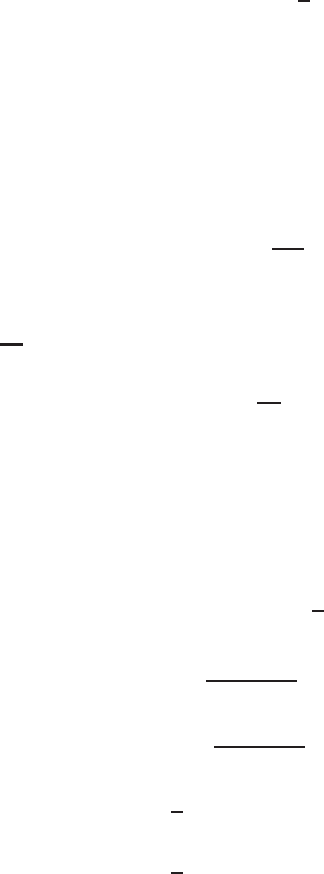
Theorem 16.6.1 (Competitive optimality) Let S
∗
be the wealth at the
end of one period of investment in a stock market X with the log-optimal
portfolio, and let S be the wealth induced by any other portfolio. Let U
∗
be
a random variable independent of X uniformly distributed on [0, 2], and
let V be any other random variable independent of X and U
∗
with V ≥ 0
and EV = 1.Then
Pr(V S ≥ U
∗
S
∗
) ≤
1
2
. (16.79)
Remark Here U
∗
and V correspond to initial “fair” randomizations of
the initial wealth. This exchange of initial wealth S
0
= 1 for “fair” wealth
U
∗
can be achieved in practice by placing a fair bet. The effect of the
fair randomization is to randomize small differences, so that only the
significant deviations of the ratio S/S
∗
affect the probability of winning.
Proof: We have
Pr(V S ≥ U
∗
S
∗
) = Pr
VS
S
∗
≥ U
∗
(16.80)
= Pr(W ≥ U
∗
), (16.81)
where W =
VS
S
∗
is a non-negative-valued random variable with mean
EW = E(V )E
S
n
S
∗
n
≤ 1 (16.82)
by the independence of V from X and the Kuhn–Tucker conditions. Let
F be the distribution function of W .ThensinceU
∗
is uniform on [0, 2],
Pr(W ≥ U
∗
) =
2
0
Pr(W > w)f
U
∗
(w) dw (16.83)
=
2
0
Pr(W > w)
1
2
dw (16.84)
=
2
0
1 − F(w)
2
dw (16.85)
≤
∞
0
1 − F(w)
2
dw (16.86)
=
1
2
EW (16.87)
≤
1
2
, (16.88)

16.7 UNIVERSAL PORTFOLIOS 629
using the easily proved fact (by integrating by parts) that
EW =
∞
0
(1 − F(w))dw (16.89)
for a positive random variable W . Hence, we have
Pr(V S ≥ U
∗
S
∗
) = Pr(W ≥ U
∗
) ≤
1
2
.
(16.90)
Theorem 16.6.1 provides a short-term justification for the use of the
log-optimal portfolio. If the investor’s only objective is to be ahead of his
opponent at the end of the day in the stock market, and if fair randomiza-
tion is allowed, Theorem 16.6.1 says that the investor should exchange his
wealth for a uniform [0, 2] wealth and then invest using the log-optimal
portfolio. This is the game-theoretic solution to the problem of gambling
competitively in the stock market.
16.7 UNIVERSAL PORTFOLIOS
The development of the log-optimal portfolio strategy in Section 16.1
relies on the assumption that we know the distribution of the stock vectors
and can therefore calculate the optimal portfolio b
∗
. In practice, though,
we often do not know the distribution. In this section we describe a causal
portfolio that performs well on individual sequences. Thus, we make no
statistical assumptions about the market sequence. We assume that the
stock market can be represented by a sequence of vectors x
1
, x
2
,...∈ R
m
+
,
where x
ij
is the price relative for stock j on day i and x
i
is the vector
of price relatives for all stocks on day i. We begin with a finite-horizon
problem, where we have n vectors x
1
,...,x
n
. We later extend the results
to the infinite-horizon case.
Given this sequence of stock market outcomes, what is the best we
can do? A realistic target is the growth achieved by the best constant
rebalanced portfolio strategy in hindsight (i.e., the best constant rebal-
anced portfolio on the known sequence of stock market vectors). Note
that constant rebalanced portfolios are optimal against i.i.d. stock mar-
ket sequences with known distribution, so that this set of portfolios is
reasonably natural.
Let us assume that we have a number of mutual funds, each of which
follows a constant rebalanced portfolio strategy chosen in advance. Our
objective is to perform as well as the best of these funds. In this section
we show that we can do almost as well as the best constant rebalanced

630 INFORMATION THEORY AND PORTFOLIO THEORY
portfolio without advance knowledge of the distribution of the stock
market vectors.
One approach is to distribute the wealth among a continuum of fund
managers, each of which follows a different constantly rebalanced portfo-
lio strategy. Since one of the managers will do exponentially better than
the others, the total wealth after n days will be dominated by the largest
term. We will show that we can achieve a performance of the best fund
manager within a factor of n
m−1
2
. This is the essence of the argument for
the infinite-horizon universal portfolio strategy.
A second approach to this problem is as a game against a malicious
opponent or nature who is allowed to choose the sequence of stock
market vectors. We define a causal (nonanticipating) portfolio strategy
ˆ
b
i
(x
i−1
,...,x
1
) that depends only on the past values of the stock market
sequence. Then nature, with knowledge of the strategy
ˆ
b
i
(x
i−1
), chooses a
sequence of vectors x
i
to make the strategy perform as poorly as possible
relative to the best constantly rebalanced portfolio for that stock sequence.
Let b
∗
(x
n
) be the best constantly rebalanced portfolio for a stock market
sequence x
n
. Note that b
∗
(x
n
) depends only on the empirical distribution
of the sequence, not on the order in which the vectors occur. At the end
of n days, a constantly rebalanced portfolio b achieves wealth:
S
n
(b, x
n
) =
n
i=1
b
t
x
i
, (16.91)
and the best constant portfolio b
∗
(x
n
) achieves a wealth
S
∗
n
(x
n
) = max
b
n
i=1
b
t
x
i
, (16.92)
whereas the nonanticipating portfolio
ˆ
b
i
(x
i−1
) strategy achieves
ˆ
S
n
(x
n
) =
n
i=1
ˆ
b
t
i
(x
i−1
)x
i
. (16.93)
Our objective is to find a nonanticipating portfolio strategy
ˆ
b(·) = (
ˆ
b
1
,
ˆ
b
2
(x
1
),...,
ˆ
b
i
(x
i−1
)) that does well in the worst case in terms of the ratio
of
ˆ
S
n
to S
∗
n
. We will find the optimal universal strategy and show that this
strategy for each stock sequence achieves wealth
ˆ
S
n
that is within a factor
V
n
≈ n
−
m−1
2
of the wealth S
∗
n
achieved by the best constantly rebalanced
portfolio on that sequence. This strategy depends on n, the horizon of
16.7 UNIVERSAL PORTFOLIOS 631
the game. Later we describe some horizon-free results that have the same
worst-case asymptotic performance as that of the finite-horizon game.
16.7.1 Finite-Horizon Universal Portfolios
We begin by analyzing a stock market of n periods, where n is known
in advance, and attempt to find a portfolio strategy that does well against
all possible sequences of n stock market vectors. The main result can be
stated in the following theorem.
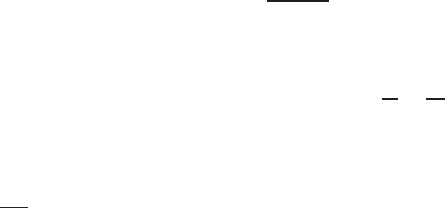
Theorem 16.7.1 For a stock market sequence x
n
= x
1
,...,x
n
, x
i
∈
R
m
+
of length n with m assets, let S
∗
n
(x
n
) be the wealth achieved by the
optimal constantly rebalanced portfolio on x
n
, and let
ˆ
S
n
(x
n
) be the wealth
achieved by any causal portfolio strategy
ˆ
b
i
(·) on x
n
;then
max
ˆ
b
i
(·)
min
x
1
,...,x
n
ˆ
S
n
(x
n
)
S
∗
n
(x
n
)
= V
n
, (16.94)
where
V
n
=
n
1
+···+n
m
=n
n
n
1
,n
2
,...,n
m
2
−nH (
n
1
n
,...,
n
m
n
)
−1
. (16.95)
Using Stirling’s approximation, we can show that V
n
is on the order
of n
−
m−1
2
, and therefore the growth rate for the universal portfolio on
the worst sequence differs from the growth rate of the best constantly
rebalanced portfolio on that sequence by at most a polynomial factor.
The logarithm of the ratio of growth of wealth of the universal portfolio
ˆ
b to the growth of wealth of the best constant portfolio behaves like
the redundancy of a universal source code. (See Shtarkov [496], where
log V
n
appears as the minimax individual sequence redundancy in data
compression.)
We first illustrate the main results by means of an example for n = 1.
Consider the case of two stocks and a single day. Let the stock vector for
the day be x = (x
1
,x
2
).Ifx
1
>x
2
, the best portfolio is one that puts all
its money on stock 1, and if x
2
>x
1
, the best portfolio puts all its money
on stock 2. (If x
1
= x
2
, all portfolios are equivalent.)
Now assume that we must choose a portfolio in advance and our oppo-
nent can choose the stock market sequence after we have chosen our
portfolio to make us do as badly as possible relative to the best portfolio.
Given our portfolio, the opponent can ensure that we do as badly as pos-
sible by making the stock on which we have put more weight equal to 0
and the other stock equal to 1. Our best strategy is therefore to put equal
632 INFORMATION THEORY AND PORTFOLIO THEORY
weight on both stocks, and with this, we will achieve a growth factor at
least equal to half the growth factor of the best stock, and hence we will
achieve at least half the gain of the best constantly rebalanced portfolio.
It is not hard to calculate that V
n
= 2whenn = 1andm = 2inequation
(16.94).
However, this result seems misleading, since it appears to suggest that
for n days, we would use a constant uniform portfolio, putting half our
money on each stock every day. If our opponent then chose the stock
sequence so that only the first stock was 1 (and the other was 0) every
day, this uniform strategy would achieve a wealth of 1/2
n
, and we would
achieve a wealth only within a factor of 2
n
of the best constant portfolio,
which puts all the money on the first stock for all time.
The result of the theorem shows that we can do significantly better.
The main part of the argument is to reduce a sequence of stock vectors to
the extreme cases where only one of the stocks is nonzero for each day.
If we can ensure that we do well on such sequences, we can guarantee
that we do well on any sequence of stock vectors, and achieve the bounds
of the theorem.
Before we prove the theorem, we need the following lemma.
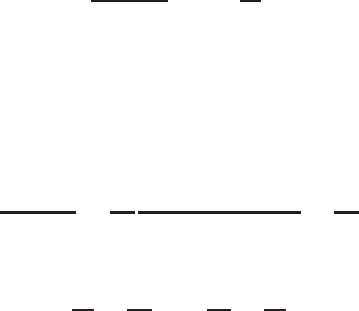
Lemma 16.7.1 For p
1
,p
2
,...,p
m
≥ 0 and q
1
,q
2
,...,q
m
≥ 0,
m
i=1
p
i
m
i=1
q
i
≥ min
i
p
i
q
i
. (16.96)
Proof: Let I denote the index i that minimizes the right-hand side in
(16.96). Assume that p
I
> 0(ifp
I
= 0, the lemma is trivially true). Also,
if q
I
= 0, both sides of (16.96) are infinite (all the other q
i
’s must also
be zero), and again the inequality holds. Therefore, we can also assume
that q
I
> 0. Then
m
i=1
p
i
m
i=1
q
i
=
p
I
q
I
1 +
i=I
(p
i
/p
I
)
1 +
i=I
(q
i
/q
I
)
≥
p
I
q
I
(16.97)
because
p
i
q
i
≥
p
I
q
I
−→
p
i
p
I
≥
q
i
q
I
(16.98)
for all i.
First consider the case when n = 1. The wealth at the end of the first
day is
ˆ
S
1
(x) =
ˆ
b
t
x, (16.99)
S
1
(x) = b
t
x (16.100)
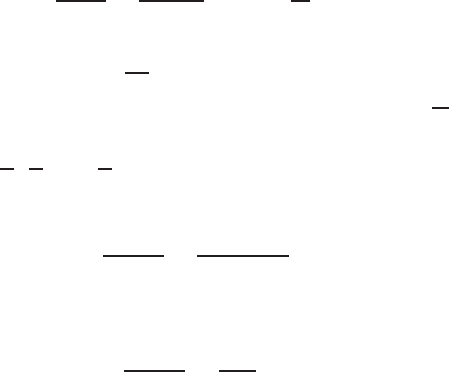
16.7 UNIVERSAL PORTFOLIOS 633
and
ˆ
S
1
(x)
S
1
(x)
=
ˆ
b
i
x
i
b
i
x
i
≥ min
ˆ
b
i
b
i
. (16.101)
We wish to find max
ˆ
b
min
b,x
ˆ
b
t
x
b
t
x
. Nature should choose x = e
i
,wheree
i
is
the ith basis vector with 1 in the component i that minimizes
ˆ
b
i
b
∗
i
,andthe
investor should choose
ˆ
b to maximize this minimum. This is achieved by
choosing
ˆ
b = (
1
m
,
1
m
,...,
1
m
).
The important point to realize is that
ˆ
S
n
(x
n
)
S
n
(x
n
)
=
n
i=1
ˆ
b
t
i
x
i
n
i=1
b
t
i
x
i
(16.102)
can also be rewritten in the form of a ratio of terms
ˆ
S
n
(x
n
)
S
n
(x
n
)
=
ˆ
b
t
x
b
t
x
, (16.103)
where
ˆ
b, b, x
∈ R
m
n
+
.Herethem
n
components of the constantly rebal-
anced portfolios b are all of the product form b
n
1
1
b
n
2
2
···b
n
m
m
.Onewishes
to find a universal
ˆ
b that is uniformly close to the b’s corresponding to
constantly rebalanced portfolios.
We can now prove the main theorem (Theorem 16.7.1).
Proof of Theorem 16.7.1: We will prove the theorem for m = 2. The
proof extends in a straightforward fashion to the case m>2. Denote the
stocks by 1 and 2. The key idea is to express the wealth at time n,
S
n
(x
n
) =
n
i=1
b
t
i
x
i
, (16.104)
which is a product of sums, into a sum of products. Each term in the sum
corresponds to a sequence of stock price relatives for stock 1 or stock
2 times the proportion b
i1
or b
i2
that the strategy places on stock 1 or
stock2attimei. We can therefore view the wealth S
n
as a sum over
all 2
n
possible n-sequences of 1’s and 2’s of the product of the portfolio
proportions times the stock price relatives:
S
n
(x
n
) =
j
n
∈{1,2}
n
n
i=1
b
ij
i
x
ij
i
=
j
n
∈{1,2}
n
n
i=1
b
ij
i
n
i=1
x
ij
i
. (16.105)

634 INFORMATION THEORY AND PORTFOLIO THEORY
If we let w(j
n
) denote the product
n
i=1
b
ij
i
, the total fraction of wealth
invested in the sequence j
n
,andlet
x(j
n
) =
n
i=1
x
ij
i
(16.106)
be the corresponding return for this sequence, we can write
S
n
(x
n
) =
j
n
∈{1,2}
n
w(j
n
)x(j
n
). (16.107)
Similar expressions apply to both the best constantly rebalanced portfolio
and the universal portfolio strategy. Thus, we have
ˆ
S
n
(x
n
)
S
∗
n
(x
n
)
=
j
n
∈{1,2}
n
ˆw(j
n
)x(j
n
)
j
n
∈{1,2}
n
w
∗
(j
n
)x(j
n
)
, (16.108)
where ˆw
n
is the amount of wealth placed on the sequence j
n
by the
universal nonanticipating strategy, and w
∗
(j
n
) is the amount placed by the
best constant rebalanced portfolio strategy. Now applying Lemma 16.7.1,
we have
ˆ
S
n
(x
n
)
S
∗
n
(x
n
)
≥ min
j
n
ˆw(j
n
)x(j
n
)
w
∗
(j
n
)x(j
n
)
= min
j
n
ˆw(j
n
)
w
∗
(j
n
)
. (16.109)
Thus, the problem of maximizing the performance ratio
ˆ
S
n
/S
∗
n
is reduced
to ensuring that the proportion of money bet on a sequence of stocks by
the universal portfolio is uniformly close to the proportion bet by b
∗
.As
might be obvious by now, this formulation of S
n
reduces the n-period
stock market to a special case of a single-period stock market—there are
2
n
stocks, one invests w(j
n
) in stock j
n
and receives a return x(j
n
) for
stock j
n
, and the total wealth S
n
is
j
n
w(j
n
)x(j
n
).
We first calculate the weight w
∗
(j
n
) associated with the best constant
rebalanced portfolio b
∗
. We observe that a constantly rebalanced portfolio
b results in
w(j
n
) =
n
i=1
b
ij
i
= b
k
(1 − b)
n−k
, (16.110)
where k is the number of times 1 appears in the sequence j
n
. Thus, w(j
n
)
depends only on k, the number of 1’s in j
n
. Fixing attention on j
n
,we