
Velten K. Mathematical Modeling and Simulation: Introduction for Scientists and Engineers
Подождите немного. Документ загружается.


3.6 Solution of ODE’s: Overview 155
The integral in this formula cannot be obtained in closed form. But since this
expression is needed so often in probability and statistics, it received its own name
andisreferredtoastheerror function erf (x) [105]. Using this function as a part
of the ‘‘well-known functions’’, many formulas can be written in closed form in
probability and statistics, which would not have been possible based on the usual
set of ‘‘well-known functions’’.
From a modeling point of view, it is desirable to have closed form solutions since
they tell us more about the system compared to numerical solutions. To see this,
consider Equation 3.25 again, the closed form solution of the body temperature
model, Equations 3.29 and 3.30:
T(t) = T
b
− (T
b
− T
0
) · e
−r · t
(3.106)
In this expression, the effects of the various model parameters on the resulting
temperature curve can be seen directly. In particular, it can be seen that the ambient
temperature, T
b
, as well as the initial temperature, T
0
, affect the temperature
essentially linear, while the rate parameter r has a strong nonlinear (exponential)
effect on the temperature pattern. To make this precise, Equation 3.106 could also
be used for a so-called sensitivity analysis, computing the derivatives of the solution
with respect to its parameters. The expression of T(t) in Equation 3.106 allows T to
be viewed as a multidimensional function
T(T
0
, T
b
, r, t) = T
b
− (T
b
− T
0
) ·e
−r · t
(3.107)
where we can take, for example, the derivative with respect to r as follows:
∂T(T
0
, T
b
, r, t)
∂r
= r · (T
b
− T
0
) ·e
−r · t
(3.108)
This is called the sensitivity of T with respect to r.OnthebasisofaTaylor
expansion, it can be used to estimate the effect of a change from r to r + r (r
being small) as
T(T
0
, T
b
, r + r, t) ≈ T(T
0
, T
b
, r, t) +
∂T(T
0
, T
b
, r, t)
∂r
· r (3.109)
A numerical solution of Equations 3.29 and 3.30, on the other hand, would give
us the temperature curve for any given set of parameters T
0
, T
b
, r similar to an
experimental data set, that is, it would provide us with a list of values (t
1
, T
1
),
(t
2
, T
2
), ...,(t
n
, T
n
) which we could then visualize, for example, using the plotting
capabilities of Maxima (Section 3.8.1). Obviously, we would not be able to see any
parameter effects based on such a list of data, or to compute sensitivities analytically
as above. The only way to analyze parameter effects using numerical solutions is to
compute this list of values (t
1
, T
1
), (t
2
, T
2
), ...,(t
n
, T
n
) for several different values of
a parameter, and then to see how it changes. Alternatively, parameter sensitivities
could also be computed using appropriate numerical procedures. However, you

156 3 Mechanistic Models I: ODEs
would have these numerically computed sensitivities only at some particular points,
and it is of course better and gives you more information on the system if you have
a general formula like Equation 3.108. In situations where you cannot get a closed
form solution for a mathematical model, it may, thus, be worthwhile to consider
a simplified version of the model that can be solved in terms of a closed form
solution. You will then have to trade off the advantages of the closed form solution
against the disadvantages of considering simplified versions of your model only.
3.7
Closed Form Solutions
Although mathematical models expressed as closed form solutions are very useful
as discussed above, an exhaustive survey of the methods that can be used to obtain
closed form solutions of ODEs would be beyond the scope of a first introduction
to mathematical modeling techniques. This section is intended to give the reader a
first idea of the topic based on a discussion of a few elementary methods that can
be applied to first-order ODEs. For anything beyond this, the reader is referred to
the literature such as [100].
3.7.1
Right-hand Side Independent of the Independent Variable
Let us start our consideration of closed form solutions with the simplest ODE
discussed above (Equation 3.71 in Section 3.5.5):
T
= 0 (3.110)
3.7.1.1 General and Particular Solutions
Basically, we solved this equation ‘‘by observation’’, namely by the observation
that straight lines parallel to the x-axis have the property that the slope vanishes
everywhere as required by Equation 3.110. Here, ‘‘everywhere’’ of course refers
to the fact that we are talking about solutions of Equation 3.110 over the entire
set of real numbers. A more precise formulation of the problem imposed by
Equation 3.110 would be
(P1): Find a function T : R → R such that T
(x) = 0holdsforallx ∈ R.
In this formulation, it is implicitly assumed that the function T is differentiable
such that T
(t) can be computed everywhere in R. We could be more explicit (and
more precise) in this point using a specification of the space of functions in which
we are looking for the solution:
(P2) Find a function T ∈ C
1
(R)suchthatT
(x) = 0holdsforallx ∈ R.

3.7 Closed Form Solutions 157
Here, C
1
(R) is the set of all functions having a continuous first derivative on
R. In the theory of differential equations, particularly in the theory of PDEs, a
precise consideration of the function spaces where the solutions of differential
equations are sought for is of great importance. These functions spaces are used as
a subtle measure of the differentiability or smoothness of functions. For example,
the theory of PDEs leads to the so-called Sobolev spaces that involve functions that
are not differentiable in the classical sense, but are, nevertheless, used to solve
differential equations involving derivatives (see Section 4.7.1 for more details). All
this, however, is beyond the scope of this first introduction into mathematical
modeling techniques.
Note 3.7.1 (Notation convention) If we write down an equation such as
Equation 3.110 with no further comments and restrictions, it will be under-
stood that we are looking for a sufficiently differentiable function on all of R.If
there can be no misunderstanding, a formulation like Equation 3.110 will always
be preferred to alternative formulations such as (P1) or (P2) above.
Now let us go back to the problem of solving Equation 3.110. As discussed in
Section 3.5.5, the observation ‘‘straight lines parallel to the x axis solve Equation
3.110’’ leads to the following expression for the solution of Equation 3.110:
T(x) = c, c ∈ R (3.111)
This is called the general solution of Equation 3.110 since it was derived from that
equation without any extra (initial or boundary) conditions. Note that Equation 3.111
describes an entire family of solutions parameterized by c,thatis,foreveryc ∈ R
we get a particular solution of Equation 3.110 from the general solution (Equation
3.111). General solutions of differential equations are typically described by such
families of solutions that are parameterized by certain parameters. We will see
several more examples of general solutions below. As explained before, initial or
boundary conditions are the appropriate means to pick out one particular solution
from the general solution, that is, to fix one particular value of c inthecaseof
Equation 3.111.
3.7.1.2 Solution by Integration
To say that we solved Equation 3.110 ‘‘by observation’’ is of course a very un-
satisfactory statement, which cannot be generalized to more complex equations
We obviously need computational procedures to obtain the solution. Regarding
Equation 3.110, we can simply integrate the equation (corresponding to using the
fundamental theorem calculus) which then leads directly to the general solution
(Equation 3.111). The same technique can be applied to all ODEs having the
simple form
T
(x) = f (x) (3.112)

158 3 Mechanistic Models I: ODEs
Assuming that f (x) is defined and continuous on some interval [a, b], the
fundamental theorem calculus states [17] that
T(x) =
x
a
f (s) ds + c, c ∈ R, x ∈ [a, b] (3.113)
solves Equation 3.112. Since f is assumed to be continuous (Definition 3.5.1), we
know that the integral on the right-hand side of Equation 3.113 can be evaluated. Of
course, continuity of the right-hand side of an ODE was required in Definition 3.5.1
exactly for this reason, that is, to make sure that solution formulas such as Equation
3.113 make good sense. In the sense explained above, Equation 3.113 is the general
solution of Equation 3.112, and it is again a family of solutions parameterized by
c ∈ R. As before, particular solutions of Equation 3.112 are obtained by imposing
an initial condition. From Equation 3.113, you see that T(0) = c, which shows that
c is the initial value of T at x = 0, so you see that the value of c (and hence a
particular case of Equation 3.113) is indeed fixed if you impose an initial condition.
3.7.1.3 Using Computer Algebra Software
You will agree that what we did so far did not really involve a great deal of deep
mathematics. Anyone with that basic mathematical education assumed in this
book will do all this easily by hand. Nevertheless, we have a good starting point
here to see how a computer algebra software such as Maxima can be used to solve
ODEs (Appendix C). As explained before, the Maxima procedures used in this
book translate easily into very similar corresponding procedures in other computer
algebra software that you might prefer. Let us begin with Equation 3.110. In terms
of Maxima, this equation is written as
´diff(T,x)=0;
(3.114)
Comparing this with Equation 3.110, you see that the operator ‘diff(.,x)
designates differentiation with respect to x. To work with this equation in Maxima,
it should be stored in a variable like this:
eq: ´diff(T,x)=0;
(3.115)
Now you can solve the ODE using the ode2 command as follows:
ode2(eq,T,x);
(3.116)
This command instructs Maxima to solve the equation eq for the function
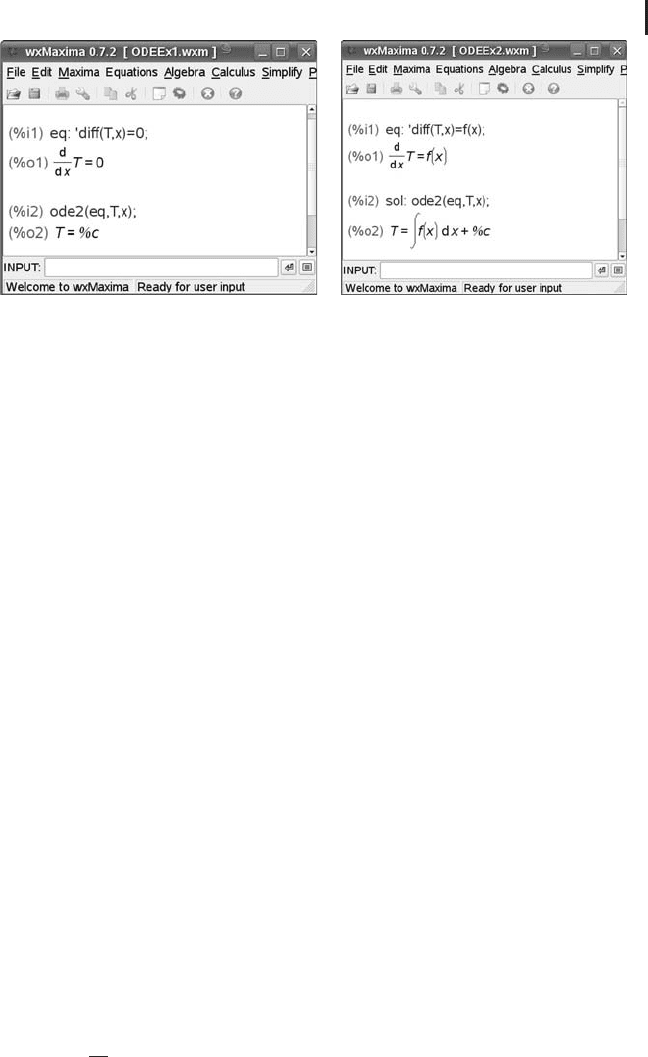
T which depends on the independent variable x. Figure 3.6a shows how this
procedure is realized in a wxMaxima session. As can be seen, Maxima writes the
result in the form
T=%c;
(3.117)
3.7 Closed Form Solutions 159
(
a
)(
b
)
Fig. 3.6 wxMaxima sessions solving (a) Equation 3.110 and (b) Equation 3.112.
which is Maxima’s way to express our general solution in Equation 3.111. As you
see, an expression such as
%c in a Maxima output denotes a constant that may
take on any value in R. This example is a part of the book software (see the file
ODEEx1.mac).
Figure 3.6b shows an analogous wxMaxima session for the solution of Equation
3.112. As the figure shows, Maxima writes the solution as
T =
f (x) dx + %c (3.118)
This corresponds to the general solution derived above in Equation 3.113. Again,
%c is an arbitrary real constant. Maxima expresses the integral in its indefinite
form, which means that appropriate integration limits should be inserted by the
‘‘user’’ of this solution formula similar to those used in Equation 3.113. Note that
the x in Equation 3.118 is just an integration variable, but it is not the independent
variable on which the solution function T depends. Equation 3.113 clarifies this
point. Maxima’s notation may be considered a little bit awkward here, but this is
the usual notation for indefinite integrals, and it is not really a problem when you
read it carefully.
Of course, Maxima can easily evaluate the integral in Equation 3.118 when you
provide a concrete (integrable) expression for f (x). For example, solving
T
(x) = x
2
(3.119)
instead of Equation 3.112 and using the same procedure as above, Maxima produces
the correct general solution
T =
x
3
3
+ %c (3.120)

160 3 Mechanistic Models I: ODEs
which corresponds to
T(x) =
x
3
3
+ c, c ∈ R (3.121)
in the usual mathematical notation (see ODEEx3.mac in the book software).
Note 3.7.2 (Computer algebra software solves ODEs) Computer algebra soft-
ware such as Maxima can be used to solve ODEs either in closed form or
numerically. Closed form solutions are obtained in Maxima using the
ode2 com-
mand (and/or the
ic1, ic2,anddesolve commands, see below) and numerical
solutions using the
rk command (see below).
3.7.1.4 Imposing Initial Conditions
So far we have seen how general solutions of ODEs can be computed using
Maxima. The next step is to pick out particular solutions using initial or boundary
conditions. Maxima provides the command
ic1 to impose initial conditions
in first-order equations and a corresponding command
ic2 for second-order
equations. Let us look at the following initial value problem for Equation 3.119:
T
(x) = x
2
(3.122)
T(0) = 1 (3.123)
Using the general solution, Equation 3.113, it is easily seen that the initial
condition, Equation 3.123, leads us to c = 1 such that the solution of Equations
3.122 and 3.123 is
T(x) =
x
3
3
+ 1 (3.124)
In Maxima, this is obtained using the following lines of code (see ODEEx4.mac
in the book software):
1: eq: ´diff(T,x)=xˆ2;
2: sol: ode2(eq,T,x);
3: ic1(sol,x=0,T=1);
(3.125)
As before, the ‘‘1:’’, ‘‘2:’’, ‘‘3:’’ at the beginning of each line are not a part of
the code, but just line numbers which we will use for reference. The first two lines
of this code produce the general solution (3.120) following the same procedure as
above, the only difference being that the general solution is stored in the variable
sol in line 2 for further usage. Line 3 instructs Maxima to take the general solution
stored in
sol, and then to set T = 1atx = 0, that is, to impose the initial condition
(3.123). Maxima writes the results of these lines as
T =
x
3
+ 3
3
(3.126)
which is the same as Equation 3.124 as required. If you want Maxima to produce
this result exactly in the better readable form of Equation 3.124, you can use the

3.7 Closed Form Solutions 161
expand command as follows:
1: eq: ´diff(T,x)=xˆ2;
2: sol: ode2(eq,T,x);
3: ic1(sol,x=0,T=1);
4: expand(%);
(3.127)
The expand command in line 4 is applied to ‘‘%’’. Here, ‘‘%’’ refers to the last
output produced by Maxima, which is the result of the
ic1 command in line 3.
This means that the
expand command in line 4 is applied to the solution of the
initial value problem (Equation 3.126). Another way to achieve the same result
would have been to store the result of line 3 in a variable, and then to apply the
expand command to that variable, as it was done in the previous lines of the code.
As you can read in the Maxima manual, the
expand command splits numerators
of rational expressions that are sums into their respective terms. In this case, this
leads us exactly from Equation 3.126 to 3.124 as required.
As it was discussed above, the general form of Equation 3.122 is this:
T
(x) = f (x) (3.128)
We have seen that Equation 3.118 is the general solution of this equation. This
means that solving this kind of ODEs amounts to the problem of integrating f (x).
This can be done using the procedure described above, that is, by treating Equation
3.128 as before. On the other hand, we could also have used a direct integration
of f (x)basedonMaxima’s command for the integration of functions:
integrate.
For example, to solve Equation 3.119, we could have used the simple command
integrate(xˆ2,x);
(3.129)
See ODEEx5.mac in the book software. Maxima writes the result in the form
x
3
3
(3.130)
Except for the fact that Maxima skips the integration constant here, we are back
at the general solution (Equation 3.113) of Equation 3.119. In cases where the
integral of the right-hand side of Equation 3.128 cannot be obtained in closed form,
the numerical integration procedures of Maxima can be used (see e.g. Maxima’s
QUADPACK package).
3.7.2
Separation of Variables
The simple differential equations considered so far provided us with a nice
playground for testing Maxima procedures, but differential equations of this kind
would of course hardly justify the use of computer algebra software. So let us go on

162 3 Mechanistic Models I: ODEs
now toward more sophisticated ODEs. Solving ODEs becomes interesting when
the right-hand side depends on y. The simplest ODE of this kind is this:
y
= y (3.131)
You remember that this was the first ODE considered above in Section 3.3.
Again, we solved it ‘‘by observation’’, observing that Equation 3.131 requires
the unknown function to coincide with its derivative, which is satisfied by the
exponential function:
y(x) = c · e
x
, c ∈ R (3.132)
Equation 3.132 is the general solution of Equation 3.131. Of course, it is again
quite unsatisfactory that we got this only ‘‘by observation’’. We saw above that
the fundamental theorem of calculus can be used to solve ODEs having the form
Equation 3.112. Obviously, this cannot be applied to Equation 3.131. Are there any
computational procedures that can be applied to this equation? Let us hear what
Maxima says to this question. First of all, let us note that Maxima solves Equation
3.131 using the above procedure (see
ODEEx7.mac in the book software):
1: eq: ´diff(y,x)=y;
2: ode2(eq,y,x);
(3.133)
If you execute this code, Maxima expresses the solution as
y = %c%e
x
(3.134)
As before, %c designates an arbitrary constant. You may be puzzled by the second
percentsign,butthisisjustapartoftheEulernumberwhichMaxima writes as
%e.
So we see that Maxima correctly reproduces Equation 3.132, the general solution of
Equation 3.131. But remember that we were looking for a computational procedure
to solve Equation 3.131. So far we have just seen that Maxima can do it somehow.
To understand the computational rule used by Maxima, consider the following
generalization of Equation 3.131:
y
= f (x) · g(y) (3.135)
Obviously, Equation 3.131 is obtained from this by setting g(y) = y and f (x) = 1.
Equation 3.128 is also obtained as a special case from Equation 3.135 if we set
g(y) = 1. Now confronting Maxima with Equation 3.135, it must tell us the rule
which it uses since it will of course be unable to compute a detailed solution like
Equation 3.134 without a specification of f (x)andg(y). To solve Equation 3.135,
the following code can be used (see
ODEEx8.mac in the book software):
1: eq: ´diff(y,x)=f(x)*g(y);
2: ode2(eq,y,x);
(3.136)

3.7 Closed Form Solutions 163
Maxima writes the result as follows:
1
g(y)
dy =
f (x) dx + %c (3.137)
This leads to the following note:
Note 3.7.3 (Separation of variables method) The solution y(x)ofEquation
3.135 satisfies
1
g(y)
dy =
f (x) dx + c, c ∈ R (3.138)
In the literature, this method is often formally justified by writing Equation
3.135 as
dy
dx
= f (x) · g(y) (3.139)
that is, by using Leibniz’s notation of the derivative, and then by ‘‘separating the
variables’’ on different sides of the equation as
dy
g(y)
= f (x) dx (3.140)
assuming g(y) = 0, of course. Then, a formal integration of the last equation yields
the separation of variables method (Equation 3.138).
Note that if g(y) = 1, that is, in the case of Equation 3.128, we get
y =
1 dy =
f (x) dx + c, c ∈ R (3.141)
which means that we correctly get the general solution (3.113), which turns out
to be a special case of Equation 3.138. Now let us look at Equation 3.131, which
is obtained by setting g(y) = y and f (x) = 1 in Equation 3.135 as observed above.
Using this in Equation 3.138 and assuming y = 0, we get
1
y
dy =
1 dx + c, c ∈ R (3.142)
or
ln|y|=x + c, c ∈ R (3.143)
which leads by exponentiation to
|y|=e
x+c
, c ∈ R (3.144)

164 3 Mechanistic Models I: ODEs
or, resolving the absolute value and denoting sgn(y) · e
c
as a new constant c,
y = c · e
x
, c ∈ R\{0} (3.145)
Since y = 0 is another obvious solution of Equation 3.131, the general solution
canbewrittenas
y = c · e
x
, c ∈ R (3.146)
3.7.2.1 Application to the Body Temperature Model
As another example application of Equation 3.138, let us derive the solution of the
body temperature model (Equation 3.29 in Section 3.4.1):
T
(t) = r · (T
b
− T(t)) (3.147)
To apply Equation 3.138, we first need to write the right-hand side of the last
equation in the form of Equation 3.135, that is,
T
= f (t) · g(T) (3.148)
Since Equation 3.147 is an autonomous equation, we can set
f (t) = 1 (3.149)
g(T) = r · (T
b
− T) (3.150)
Equation 3.138 now tells us that the solution is obtained from
1
r · (T
b
− T)
dT =
1 dx + c, c ∈ R (3.151)
Using the substitution z = T
b
− T(t) in this integral and an analogous argu-
mentation as above in Equations 3.142–3.146 the general solution is obtained as
T(t) = T
b
+ c · e
−rt
, c ∈ R (3.152)
Applying the initial condition
T(0) = T
0
(3.153)
one obtains
c = T
0
− T
b
(3.154)
and hence
T(t) = T
b
+ (T
0
− T
b
) ·e
−r · t
(3.155)
which is the solution obtained ‘‘by observation’’ in Section 3.4.1 (Equation 3.25).