
Velten K. Mathematical Modeling and Simulation: Introduction for Scientists and Engineers
Подождите немного. Документ загружается.


3.7 Closed Form Solutions 165
3.7.2.2 Solution Using Maxima and Mathematica
Let us now see how Equation 3.147 is solved using Maxima, and let us first try to
use the same code as it was used, for example, in Equation 3.136 (see
ODEEx9.mac
in the book software):
1: eq: ´diff(T,t)=r*(T[b]-T);
2: ode2(eq,T,t);
(3.156)
Maxima’s result is as follows:
−
log(T − T
b
)
r
= t + %c (3.157)
This result is unsatisfactory for two reasons. First, it is an implicit solution of
Equation 3.147 since it expresses the solution in an equation not solved for the
unknown T. More seriously, note that the expression log(T − T
b
)inEquation3.157
is defined only for T > T
b
, which means that this solution is valid only in the
case T > T
b
. When we introduced the body temperature model in Section 3.2.2,
we were interested exactly in the reverse case, T < T
b
.InthecaseofT > T
b
,it
is easy to derive Equation 3.152 from Equation 3.157 by exponentiation as before.
Nevertheless, we are definitely at a point here where we encounter Maxima’s limits
for the first time. Using the commercial Mathematica , Equation 3.147 is solved
without problems using a code very similar to program 3.156:
1: eq=T´[t]==r*(Tb-T[t]);
2: DSolve[eq,T[t],t]
(3.158)
Mathematica’s result is
{{T[t] → Tb + e
−rt
C[1]}} (3.159)
which is exactly the general solution (Equation 3.152). Note that without going into
details of Mathematica notation, the ‘‘→’’ in Equation 3.159 can be understood as
an equality sign ‘‘=’’ here, and note also that Mathematica writes the arbitrary real
constant as C[1] (instead of %c in Maxima).
Does this mean we should recommend using the commercial Mathematica
instead of Maxima? The answer is a definite ‘‘no and yes’’. You will see in
a minute that although Maxima’s
ode2 command fails here, there is a way to
solve Equation 3.147 in Maxima using a different command. This is the ‘‘no’’.
On the other hand, undoubtedly, Mathematica is more comfortable here since
it solves all ODEs considered so far with one single command (
DSolve). Also,
comparing Mathematica’s and Maxima’s capabilities to solve ODE, you will see
that Mathematica solves a lot more ODEs. This is the ‘‘yes’’. The true answer lies
in between. It depends on your needs. If you constantly need to solve computer
algebra problems beyond Maxima’s scope in your professional work, then it can
be economically advantageous to pay for Mathematica, at least until your problems

166 3 Mechanistic Models I: ODEs
will be covered by improved versions of Maxima or other open-source computer
algebra software.
At least within the scope of this book where we want to learn about the principles
and ideas of computer algebra software, Maxima’s capabilities are absolutely
satisfactory. This is nicely illustrated by a comparison of the Maxima code 3.156
with the Mathematica code 3.158. Except for different names of the ODE solving
commands and different ways to write derivatives and equations, the structure
of these two codes is very similar, and we can safely say that after you have
learned about Maxima in this book, you will not have any big problems in using
Mathematica or other computer algebra software.
Now it is time to say how to solve Equation 3.147 in Maxima. Maxima provides
a second command solving ODEs called
desolve. This command is restricted to
linear ODEs (including systems of linear ODEs), and it can be applied here since
Equation 3.147 is indeed linear (see the discussion of linearity in Section 3.5.8
above). The following code can be used (see
ODEEx10.mac in the book software):
1: eq: ´diff(T(x),x)=r*(T[b]-T(x));
2: desolve(eq,T(x));
(3.160)
This is again very similar to the two codes above (programs 3.156 and 3.158).
Note that in contrast to the
ode2 command used in Equation 3.156, desolve wants
you to write down the dependence of the unknown on the independent variable in
the form T(x). Equation 3.160 produces the following result:
T(x) = (T(0) −T
b
)%e
−rx
+ T
b
(3.161)
which is equivalent with Equation 3.155.
3.7.3
Variation of Constants
As was discussed above in Section 3.5, Equation 3.147 is no longer solved by
Equation 3.152 if we assume that the room temperature T
b
is time dependent. In
that case, we can write Equation 3.147 as
T
(t) = r · (T
b
(t) − T(t)) (3.162)
The separation of variables method (Note 3.7.3) is not applicable to this equation
since we simply cannot separate the variables here. This method would require the
right-hand side of Equation 3.162 to be written in the form
T
(t) = f (t) · g(T) (3.163)
but there is no way how this could be done since the right-hand side of Equation
3.162 expresses a sum, not a product. The general form of Equation 3.162 is that

3.7 Closed Form Solutions 167
of a linear ODE in the sense of Equation 3.93 (see the discussion of linear ODEs in
Section 3.5.8):
y
(x) = a(x) · y(x) + b(x) (3.164)
As before, we ask Maxima to tell us how this kind of equation is solved. Analogous
to Equation 3.156, the following Maxima code can be used (see
ODEEx11.mac in
the book software):
1: eq: ´diff(y,x)=a(x)*y+b(x);
2: ode2(eq,y,x);
(3.165)
In Maxima,thisyields
y = %e
a(x) dx
b(x) · %e
−
a(x) dx
dx + %c
(3.166)
which is known as the
Note 3.7.4 (Variation of constants method) The solution y(x) of Equation 3.164
satisfies
y = e
a(x) dx
b(x) · e
−
a(x) dx
dx + c
, c ∈ R (3.167)
This method – which is also known as the variation of parameters method – applies
to an inhomogeneous ODE such as Equation 3.164, and it can be generalized to
inhomogeneous systems of ODEs such as Equation 3.96. Remember from your lin-
ear algebra courses that the term ‘‘inhomogeneous’’ refers to a situation where we
have b(x) = 0 in Equation 3.164. The case b(x) = 0 can be treated by the separation
of variables method as described above. As in the case of the separation of variables
method (Note 3.7.3), the variation of constants method does not necessarily lead
us to a closed form solution of the ODE. Closed form solutions are obtained
only when the integrals in Equation 3.167 (or Equation 3.138 in the case of the
separation of variables method) can be solved in closed form, that is, if the result
canbeexpressedintermsofwell-knownfunctions.Inouraboveapplicationsofthe
separation of variables method, we got everything in closed form (e.g. the solution
Equation 3.155 of Equation 3.147).
3.7.3.1 Application to the Body Temperature Model
Now let us see whether we get a closed form solution if we apply the variation of
constants method to Equation 3.162. Comparing Equations 3.162 and 3.164, you
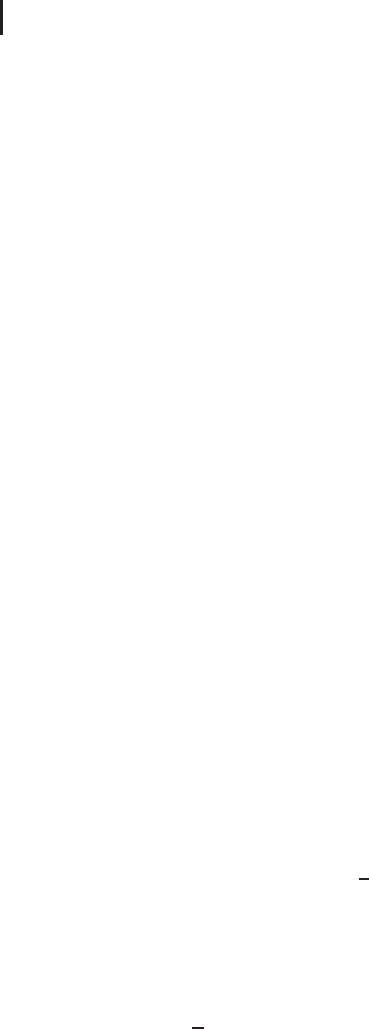
seethatwehave
a(t) =−r
b(t) = r · T
b
(t)
(3.168)
168 3 Mechanistic Models I: ODEs
and hence
a(t) dt =
−rdt=−rt (3.169)
Note that we do not need to consider an integration constant here since the
a(t) dt in the variation of constant method refers to one particular integral of a(t)
that we are free to choose. Using the last three equations, we get the following
general solution of Equation 3.162:
T(t) = e
−rt
r · T
b
(t) ·e
rt
dt + c
, c ∈ R (3.170)
If this formula is correct, it should give us the general solution that we derived
above in the case T
b
= const, Equation 3.152. In this case, the last equation
turns into
T(t) = e
−rt
T
b
·
r · e
rt
dt + c
, c ∈ R (3.171)
or
T(t) = e
−rt
T
b
· e
rt
+ c
, c ∈ R (3.172)
which leads us back to Equation 3.152 as required. In the case where T
b
depends
on time, we get a closed form solution from Equation 3.170 only when the integral
in that formula can be expressed in closed form. For example, let us assume a
linearly varying room temperature:
T
b
(t) = α · t + β (3.173)
such that Equation 3.170 becomes
T(t) = e
−rt
r ·
(
α · t + β
)
· e
rt
dt + c
, c ∈ R (3.174)
Theintegralinthisformulacanbeexpressedinclosedform:
r ·
(
α · t + β
)
· e
rt
dt = e
rt
αt + β −
a
r
(3.175)
This can be obtained by hand calculation, for example, using an integration
of parts, or by using Maxima’s
integrate command (Section 3.7.1.4). Using
Equations 3.174 and 3.175, we get
T(t) = αt +β −
α
r
+ c · e
−rt
, c ∈ R (3.176)
as the general solution of Equation 3.162. If you like, insert T(t)fromEquation
3.176 and its derivative T
(t) into Equation 3.162 to verify that this equation is really

3.7 Closed Form Solutions 169
solved by Equation 3.176. Note that the case T
b
= const corresponds to α = 0and
T
b
= β in Equation 3.173. If this is used in Equation 3.176, we get
T(t) = T
b
+ c · e
−rt
, c ∈ R (3.177)
that is, we get Equation 3.152 as a special case of Equation 3.176 again. Using
Equation 3.173, Equation 3.176 can be brought in a form very similar to Equation
3.177:
T(t) = T
b
t −
1
r
+ c · e
−rt
, c ∈ R (3.178)
ThismeansthatwealmostgetthesamesolutionasinthecaseT
b
= const, except
for the fact that the solution T(t) ‘‘uses’’ an ‘‘old’’ body temperature T
b
(t − 1/r)
instead of the actual body temperature T
b
(t). This is related to the fact that the
system needs some time until it adapts itself to a changing temperature. The time
needed for this adaption is controlled by the parameter r. In Section 3.4.1.2, we
saw that r is the percent decrease of the temperature difference T
b
− T(t)perunit
of time. As a consequence, large (small) values of r refer to a system that adapts
quickly (slowly) to temperature changes. This corresponds with the fact that the
solution formula (3.178) uses almost the actual temperature for a quickly adapting
system, that is, when r is large, since we have T
b
(t − 1/r) ≈ T
b
(t)inthatcase.
Note 3.7.5 (Advantage of closed form solutions) A discussion of this kind
is what makes closed form solutions attractive, since it leads us to a deeper
understanding of the effects that the model parameters (r in this case) have
on the solution. No similar discussion would have been possible based on a
numerical solution of Equation 3.162.
Note that there is still a constant c in all solutions of Equation 3.162 derived above.
As before, this constant is determined from an initial condition (Section 3.7.1.4).
3.7.3.2 Using Computer Algebra Software
Equation 3.170, the general solution of Equation 3.162, could also have been
obtained using Maxima’s
ode2 command similar to above (see ODEEx12.mac in
the book software):
1: eq: ´diff(T,t)=r*(Tb(t)-T);
2: ode2(eq,T,t);
(3.179)
The result is as follows:
T = %e
−rt
r
%e
rt
T
b
(t) dt + %c
(3.180)

170 3 Mechanistic Models I: ODEs
which is – in Maxima notation – the same as Equation 3.170. Likewise, Equation
3.176 can be obtained directly as the solution of Equation 3.162 in the case of
T
b
(t) = αt + β using the following code (see ODEEx13.mac in the book software):
1: eq: ´diff(T,t)=r*(a*t+b-T);
2: ode2(eq,T,t);
(3.181)
which leads to the following result in Maxima:
T = %e
−rt
a(rt − 1)%e
rt
r
+ b%e
rt
+ %c
(3.182)
which coincides with Equation 3.176 if we identify a = α and b = β.
3.7.3.3 Application to the Alarm Clock Model
Now let us try to get a closed form solution for the alarm clock model (Section 3.4.2):
T
s
(t) = r
si
· (T
i
(t) −T
s
(t)) (3.183)
T
i
(t) = r
ia
· (T
a
− T
i
(t)) (3.184)
T
s
(0) = T
s0
(3.185)
T
i
(0) = T
i0
(3.186)
In general, it is, of course, much harder to derive analytical solutions for systems
of ODEs. With the last examples in mind, however, it is easy to see that something
can be done here. First of all, note that Equations 3.184 and 3.186 can be solved
independently from the other two equations since they do not involve T
s
.Equations
3.183 and 3.184 are partially decoupled in the sense that the solution T
i
of Equation
3.184 affects Equation 3.183, but not vice versa. We will come back to this point
in our next example below (Section 3.7.4). To solve Equations 3.184 and 3.186, it
suffices to say that we have already done this before. Except for different notation,
Equation 3.184 is equivalent with Equation 3.147. Equation 3.155 was derived as
the solution of Equation 3.147, which is
T
i
(t) = T
a
+ (T
i0
− T
a
) · e
−r
ia
· t
(3.187)
in this case if Equation 3.186 is used. Inserting this into Equations 3.183–3.186,
we come up with a single ODE as follows:
T
s
(t) = r
si
· (T
a
+ (T
i0
− T
a
) ·e
−r
ia
· t
− T
s
(t)) (3.188)
T
s
(0) = T
s0
(3.189)
Except for different notation, again, Equation 3.188 is of the form expressed by
Equation 3.162, which has been generally solved using the variation of constants
method above, as expressed by Equation 3.170. Using this solution, we find that

3.7 Closed Form Solutions 171
the general solution of Equation 3.188 is
T
s
(t) = e
−r
si
t
r
si
· (T
a
+ (T
i0
− T
a
) ·e
−r
ia
· t
) · e
r
si
t
dt + c
, c ∈ R (3.190)
Everything that remains to be done is the evaluation of the integral in Equation
3.190, and the determination of the constant in that equation using the initial
condition, Equation 3.189. Similar to above, you can do this by hand calculation, by
using Maxima’s
integrate command, or you could also go back to Equations 3.188
and 3.189 and solve these using Maxima’s
ode2 or desolve commands as shown
in our previous examples. Instead of proceeding with Equation 3.190, let us go
back to the original system (Equations 3.183–3.186), which can be solved directly
using Maxima’s
desolve command as follows (see ODEEx14.mac in the book
software):
1: eq1: ´diff(Ts(t),t)=rsi*(Ti(t)-Ts(t));
2: eq2: ´diff(Ti(t),t)=ria*(Ta-Ti(t));
3: desolve([eq1,eq2],[Ts(t),Ti(t)]);
(3.191)
Note that we cannot use Maxima’s ode2 command here since it is restricted to
single ODEs, that is, it cannot be applied to ODE systems.
desolve is applicable
here since Equations 3.183 and 3.184 are linear ODEs in the sense explained in
Section 3.5. The code (3.191) produces a result which (after a little simplification
by hand) reads as follows:
T
s
(t) = T
a
+ (T
s0
− T
a
)e
−r
si
t
+
(
T
i0
− T
a
)
· r
si
e
−r
si
t
− e
−r
ia
t
r
ia
− r
si
(3.192)
T
i
(t) = T
a
+ (T
i0
− T
a
)e
−r
ia
t
(3.193)
3.7.3.4 Interpretation of the Result
A number of things can be seen in these formulas. First of all, note that the initial
conditions, Equations 3.185 and 3.186, are satisfied since all the exponential terms
in Equations 3.192 and 3.193 equal 1 for t = 0. Moreover, the formulas show that
we have T
s
= T
i
= T
a
in the limit t →∞, since all exponential terms vanish as t
reaches infinity. This reflects the fact that both the sensor and the effective internal
temperature will of course equal the ambient temperature after a long time. You
can also see that the solution behaves as expected in the case T
i0
= T
a
,thatis,inthe
case when we start with no difference between internal and ambient temperatures.
In this case, we would expect a constant T
i
(t) = T
a
, which is obviously true due to
T
i0
− T
a
= 0 in Equation 3.193. In Equation 3.192, T
i0
= T
a
implies
T
s
(t) = T
a
+ (T
s0
− T
a
)e
−r
si
t
(3.194)
which is (except for different notation) equivalent with Equation 3.155, the solution
of the body temperature model with constant body temperature, Equation 3.147.

172 3 Mechanistic Models I: ODEs
This is correct since Equation 3.147 expresses the form of Equation 3.183 in the
case of T
i0
= T
a
,sinceT
i
is time independent in that case. So you see again that
a lot can be seen from a closed form solution such as Equations 3.192 and 3.193.
Without graphical plots of T
s
and T
i
, Equations 3.192 and 3.193 already tell us
about the behavior of the solution in special cases such as those discussed above,
and we can see from this that the behavior of T
s
and T
i
in these special cases is
reasonable. No a priori discussion of this kind would have been possible based on
a numerical solution of Equations 3.183 and 3.184.
Note that Equation 3.192 also shows that we have a problem in the case of
r
si
= r
ia
when the denominator in the fraction becomes zero. To understand this
point, we can ask Maxima for the result in the case r = r
si
= r
ia
.Aftersomehand
simplification, again, we get (compare
ODEEx15.mac in the book software)
T
s
(t) = T
a
+ (T
s0
− T
a
)e
−rt
+ (T
i0
− T
a
)rte
−rt
(3.195)
T
i
(t) = T
a
+ (T
i0
− T
a
)e
−rt
(3.196)
Now it is just a matter of simple calculus to see that these two solutions are
compatible. Denoting r = r
si
, compatibility of Equation 3.192 with 3.195 requires
lim
r
ia
→r
e
−rt
− e
−r
ia
t
r
ia
− r
= te
−rt
(3.197)
which is indeed true. Based on the usual definition of the derivative, Equation
3.197 just expresses the fact that te
−rt
is the derivative of e
−rt
with respect to r.
If you like, you can show this by hand calculation based on any of the methods
used to compute limits in calculus [17]. Alternatively, you can use Maxima’s
limit
function to obtain Equation 3.197 as follows [106]:
limit((%eˆ(-r*t)-%eˆ(-(r+h)*t))/h,h,0);
(3.198)
Note that the argument of limit in program 3.198 corresponds to the left-hand
side of Equation 3.197 if we identify h = r
ia
− r. The closed form solution of
Equations 3.183–3.186 can now be summarized as follows:
T
s
(t) =
T
a
+ (T
s0
− T
a
)e
−r
si
t
+ (T
i0
− T
a
) · r
si
e
−r
si
t
−e
−r
ia
t
r
ia
−r
si
, r
si
= r
ia
T
a
+ (T
s0
− T
a
)e
−rt
+ (T
i0
− T
a
)rte
−rt
, r = r
si
= r
ia
(3.199)
T
i
(t) =
T
a
+ (T
i0
− T
a
)e
−r
ia
t
, r
si
= r
ia
T
a
+ (T
i0
− T
a
)e
−rt
, r = r
si
= r
ia
(3.200)
An example application of this closed form solution has been discussed in
Section 3.4.2.3 (Figure 3.5).

3.7 Closed Form Solutions 173
3.7.4
Dust Particles in the ODE Universe
Sofarwehaveintroducedtheseparation of variables method and the variation of
constants method as methods to obtain closed form solutions of ODEs by hand
calculation. You should know that there is a great number of other methods that
could be used to solve ODEs by hand, and that cannot be discussed in a book like
this which focuses on mathematical modeling. There is a lot of good literature
you can refer to if you like to know more [98–100]. Beyond hand calculation, we
have seen that closed form solutions of ODEs can also be obtained efficiently using
computer algebra software such as Maxima.
It was already mentioned above that ODEs having closed form solutions are rather
the exception than the rule. More precisely, those ODEs are something like dust
particles in the ‘‘ODE universe’’. Usually, small changes of an analytically solvable
ODE suffice to make it analytically unsolvable (corresponding to the fact that you do
not have to travel a long way if you want to leave a dust particle toward space). For
example, one may find it impressive that Equations 3.199 and 3.200 can be derived
as a closed form solution of Equations 3.183–3.186. But consider the following
equations, which have a structure similar to Equations 3.183–3.186, and which do
not really look more complicated compared to these equations at a first glance:
x
= x(a − by) (3.201)
y
=−y(c − dx) (3.202)
This is the so-called Lotka–Volterra model, which is discussed in Section 3.10.1.
x(t)andy(t) are the unknowns in these equations, t is time, and a, b, c are real
constants. Note that we have used a notation here that is frequently used in practice,
with no explicit indication of the fact that x and y are unknown functions. This is
implicitly expressed by the fact that x and y appear with their derivatives in the
equations. Also, in the absence of any further comments, the usual interpretation
of Equation 3.202 automatically implies that a, b, c, d are real constants.
In a first, naive attempt we could follow a similar procedure as above, trying to
solve this ODE system using a code similar to Equation 3.191 (see
ODEEx16.mac
in the book software):
1: eq1: ´diff(x(t),t)=x(t)*(a-b*y(t));
2: eq2: ´diff(y(t),t)=-y(t)*(c-d*x(t));
3: desolve([eq1,eq2],[x(t),y(t)]);
(3.203)
However, this code produces no result in Maxima. Trying to understand why this
is so, you may remember that it was said above that
desolve applies only to linear
ODEs. As it was explained in Section 3.5, a linear ODE system has the form of
Equation 3.94 or 3.96, that is, the unknowns may be added, subtracted, or multiplied

174 3 Mechanistic Models I: ODEs
by known quantities. In Equations 3.201 and 3.202, however, the unknowns x(t)
and y(t) are multiplied, which means that these equations are nonlinear and hence
Maxima’s
desolve command is not applicable. We also discussed Maxima’s ode2
command above, which is indeed applicable to nonlinear ODEs, but unfortunately
not to ODE systems like Equations 3.201 and 3.202. Fortunately, on the other hand,
this is no problem since
ode2 could not solve these equations even if it would be
applicable, since the solution of Equations 3.201-and 3.202 cannot be expressed in
closed form.
Comparing the structure of Equations 3.201 and 3.202 with the analytically
solvable system (3.183)–(3.186), one can say that there are two main differences:
Equations 3.201 and 3.202 are nonlinear, and they involve a stronger coupling of the
ODEs. As it was already noted above, Equation 3.184 can be solved independently
of Equation 3.183, while in the system of Equations 3.201 and 3.202 each of the
two equations depends on the other equation.
Note 3.7.6 (Why most ODEs do not have closed form solutions) Nonlinearity
and a strong coupling and interdependence of ODEs are the main reasons why
closed form solutions cannot be achieved in many cases.
3.8
Numerical Solutions
If there is no closed form solution of an ODE, you know from our discussion in
Section 3.6 that the way out is to compute approximate numerical solutions of the
ODE using appropriate numerical algorithms on the computer. Since our emphasis
is on modeling aspects, we will not go into a detailed explanation of numerical
algorithms here, just as we did not provide an exhaustive discussion of analytical
methods in the previous section. This section is intended to make you familiar
with some general ideas that are applied in the numerical solution of ODEs, and
with appropriate software that can be used to solve ODEs.
Some people have a general preference for what might be called closed form
mathematics in the sense of Section 3.7, that is, for a kind of mathematics where
everything can be written down using ‘‘well-known expressions’’ as explained in
Section 3.6.2. These people tend to believe that in what might be called the house
of mathematics, numerical mathematics has its place at some lower level, several
floors below closed form mathematics. When they write down quantities such as
√
2orπ in their formulas, they do not spend too much thoughts on it, and they
believe that numerical mathematics is far away. If they would spend a few thoughts
on their formulas, they would realize that numerical mathematics is everywhere,
and that it gazes at us through most of the closed form formulas that we may
write down. It is easy to write down transcendental numbers such as π or
√
2,
but from a practical point of view, these symbols are just a wrapping around the
numerical algorithms that must be used to obtain numerical approximations of