
Velten K. Mathematical Modeling and Simulation: Introduction for Scientists and Engineers
Подождите немного. Документ загружается.


Contents IX
3.9.1.1 Coupling lsoda with nls 195
3.9.1.2 Estimating One Parameter 197
3.9.1.3 Estimating Two Parameters 198
3.9.1.4 Estimating Initial Values 199
3.9.1.5 Sensitivity of the Parameter Estimates 200
3.9.2 The General Parameter Estimation Problem 201
3.9.2.1 One State Variable Characterized by Data 202
3.9.2.2 Several State Variables Characterized by Data 203
3.9.3 Indirect Measurements Using Parameter Estimation 204
3.10 More Examples 205
3.10.1 Predator–Prey Interaction 205
3.10.1.1 Lotka–Volterra Model 205
3.10.1.2 General Dynamical Behavior 207
3.10.1.3 Nondimensionalization 208
3.10.1.4 Phase Plane Plots 209
3.10.2 Wine Fermentation 211
3.10.2.1 Setting Up a Mathematical Model 212
3.10.2.2 Yeast 213
3.10.2.3 Ethanol and Sugar 215
3.10.2.4 Nitrogen 216
3.10.2.5 Using a Hand-fit to Estimate N
0
217
3.10.2.6 Parameter Estimation 219
3.10.2.7 Problems with Nonautonomous Models 220
3.10.2.8 Converting Data into a Function 222
3.10.2.9 Using Weighting Factors 222
3.10.3 Pharmacokinetics 223
3.10.4 Plant Growth 226
4 Mechanistic Models II: PDEs 229
4.1 Introduction 229
4.1.1 Limitations of ODE Models 229
4.1.2 Overview: Strange Animals, Sounds, and Smells 230
4.1.3 Two Problems You Should Be Able to Solve 231
4.2 The Heat Equation 233
4.2.1 Fourier’s Law 234
4.2.2 Conservation of Energy 235
4.2.3 Heat Equation = Fourier’s Law + Energy Conservation 236
4.2.4 Heat Equation in Multidimensions 238
4.2.5 Anisotropic Case 238
4.2.6 Understanding Off-diagonal Conductivities 239
4.3 Some Theory You Should Know 241
4.3.1 Partial Differential Equations 241
4.3.1.1 First-order PDEs 242
4.3.1.2 Second-order PDEs 243
4.3.1.3 Linear versus Nonlinear 243

X Contents
4.3.1.4 Elliptic, Parabolic, and Hyperbolic Equations 244
4.3.2 Initial and Boundary Conditions 245
4.3.2.1 Well Posedness 246
4.3.2.2 A Rule of Thumb 246
4.3.2.3 Dirichlet and Neumann Conditions 247
4.3.3 Symmetry and Dimensionality 248
4.3.3.1 1D Example 249
4.3.3.2 2D Example 251
4.3.3.3 3D Example 252
4.3.3.4 Rotational Symmetry 252
4.3.3.5 Mirror Symmetry 253
4.3.3.6 Symmetry and Periodic Boundary Conditions 253
4.4 Closed Form Solutions 254
4.4.1 Problem 1 255
4.4.2 Separation of Variables 255
4.4.3 A Particular Solution for Validation 257
4.5 Numerical Solution of PDE’s 257
4.6 The Finite Difference Method 258
4.6.1 Replacing Derivatives with Finite Differences 258
4.6.2 Formulating an Algorithm 259
4.6.3 Implementation in R 260
4.6.4 Error and Stability Issues 262
4.6.5 Explicit and Implicit Schemes 263
4.6.6 Computing Electrostatic Potentials 264
4.6.7 Iterative Methods for the Linear Equations 264
4.6.8 Billions of Unknowns 265
4.7 The Finite-Element Method 266
4.7.1 Weak Formulation of PDEs 267
4.7.2 Approximation of the Weak Formulation 269
4.7.3 Appropriate Choice of the Basis Functions 270
4.7.4 Generalization to Multidimensions 271
4.7.5 Summary of the Main Steps 272
4.8 Finite-element Software 274
4.9 A Sample Session Using Salome-Meca 276
4.9.1 Geometry Definition Step 277
4.9.1.1 Organization of the GUI 277
4.9.1.2 Constructing the Geometrical Primitives 278
4.9.1.3 Excising the Sphere 279
4.9.1.4 Defining the Boundaries 281
4.9.2 Mesh Generation Step 281
4.9.3 Problem Definition and Solution Step 283
4.9.4 Postprocessing Step 285
4.10 A Look Beyond the Heat Equation 286
4.10.1 Diffusion and Convection 288
4.10.2 Flow in Porous Media 290

Contents XI
4.10.2.1 Impregnation Processes 291
4.10.2.2 Two-phase Flow 293
4.10.2.3 Water Retention and Relative Permeability 293
4.10.2.4 Asparagus Drip Irrigation 295
4.10.2.5 Multiphase Flow and Poroelasticity 296
4.10.3 Computational Fluid Dynamics (CFD) 296
4.10.3.1 Navier–Stokes Equations 296
4.10.3.2 Backward Facing Step Problem 298
4.10.3.3 Solution Using Code-Saturne 299
4.10.3.4 Postprocessing Using Salome-Meca 301
4.10.3.5 Coupled Problems 302
4.10.4 Structural Mechanics 303
4.10.4.1 Linear Static Elasticity 303
4.10.4.2 Example: Eye Tonometry 306
4.11 Other Mechanistic Modeling Approaches 309
4.11.1 Difference Equations 309
4.11.2 Cellular Automata 310
4.11.3 Optimal Control Problems 312
4.11.4 Differential-algebraic Problems 314
4.11.5 Inverse Problems 314
A CAELinux and the Book Software 317
B R (Programming Language and Software Environment) 321
B.1 Using R in a Konsole Window 321
B.1.1 Batch Mode 321
B.1.2 Command Mode 322
B.2 R Commander 322
CMaxima323
C.1 Using Maxima in a Konsole Window 323
C.1.1 Batch Mode 323
C.1.2 Command Mode 323
C.2 wxMaxima 324
References 325
Index 335

XIII
The purpose of computing is insight, not numbers.
R.W. Hamming [242]
Preface
‘‘Everyone is an artist’’ was a central message of the famous twentieth century artist
Joseph Beuys. ‘‘Everyone models and simulates’’ is a central message of this book.
Mathematical modeling and simulation is a fundamental method in engineering
and science, and it is absolutely valid to say that everybody uses it (even those of us
who are not aware of doing so). The question is not whether to use this method or
not, but rather how to use it effectively.
Today we are in a situation where powerful desktop PCs are readily available
to everyone. These computers can be used for any kind of professional data
analysis. Even complex structural mechanical or fluid dynamical simulations
which would have required supercomputers just a few years ago can be performed
on desktop PCs. Considering the huge potential of modeling and simulation to
solve complex problems and to save money, one should thus expect a widespread
and professional use of this method. Particularly in the field of engineering,
however, complex problems are often still treated largely based on experimental
data. The amount of money spent on experimental equipment sometimes seems
proportional to the complexity and urgency of the problems that are solved, and
simple spreadsheet calculations are used to explore the information content of
such expensive data. As this book will show, mathematical models and simulations
help to reduce experimental costs not only by a partial replacement of experiments
by computations, but also by a better exploration of the information content of
experimental data.
This book is based on the author’s modeling and simulation experience in the
fields of science and engineering and as a consultant. It is intended as a first
introduction to the subject, which may be easily read by scientists, engineers and
students at the undergraduate level. The only mathematical prerequisites are some
calculus and linear algebra – all other concepts and ideas will be developed in
the course of the book. The reader will find answers to basic questions such as:
What is a mathematical model? What types of models do exist? Which model
is appropriate for a particular problem? How does one set up a mathematical
model? What is simulation, parameter estimation, validation? The book aims to
be a practical guide, enabling the reader to setup simple mathematical models on
his own and to interpret his own and other people’s results critically. To achieve

XIV Preface
this, many examples from various fields such as biology, ecology, economics,
medicine, agricultural, chemical, electrical, mechanical and process engineering
are discussed in detail.
The book relies exclusively upon open-source software, which is available to ev-
erybody free of charge. The reader is introduced into CAELinux, Calc, Code-Saturne,
Maxima, R,andSalome-Meca, and the entire book software – including 3D CFD
and structural mechanics simulation software – can be used based on a (free)
CAELinux-Live-DVD that is available in the Internet (works on most machines and
operating systems, see Appendix A).
While software is used to solve most of the mathematical problems, it is
nevertheless attempted to put the reader mathematically on firm ground as much
as possible. Trap-doors and problems that may arise in the modeling process, in
the numerical treatment of the models or in their interpretation are indicated, and
the reader is referred to the literature whenever necessary.
The book is organized as follows. Chapter 1 explains the principles of mathemati-
cal modeling and simulation. It provides definitions and illustrative examples of the
important concepts as well as an overview of the main types of mathematical models.
After a treatment of phenomenological (data-based) models in Chapter 2, the rest of
the book introduces the most important classes of mechanistic (process-oriented)
models (ordinary and partial differential equation models in Chapters 3 and 4,
respectively).
Although it is possible to write a book like this on your own, it is also true that it is
impossible to write a book like this on your own ... I am indebted to a great number
of people. I wish to thank Otto Richter (TU Braunschweig), my first teacher in
mathematical modeling; Peter Knabner (U Erlangen), for an instructive excursion
into the field of numerical analysis; Helmut Neunzert and Franz-Josef Pfreundt
(TU and Fraunhofer-ITWM Kaiserslautern), who taught me to apply mathematical
models in the industry; Helmut Kern (FH Wiesbaden), for blazing a trail to
Geisenheim; Jo
¨
el Cugnoni (EPFL Lausanne), for our cooperation and an adapted
version of CAELinux (great idea, excellent software); Anja Tsch
¨
ortner, Cornelia
Wanka, Alexander Grossmann, H.-J. Schmitt and Uwe Krieg from Wiley-VCH;
and my colleagues and friends Marco G
¨
unther, Stefan Rief, Karlheinz Spindler,
and Aivars Zemitis for proofreading.
I dedicate this book to Birgid, Benedikt, Julia, and Theresa for the many weekends
and evenings they patiently allowed me to work on this book, to the Sisters of the
Ursuline Order in Geisenheim and Straubing, and, last but not least, to my parents
and to my brothers Axel and Ulf, to Bettina and Brigi and, of course, to Felix, for
their support and encouragment through so many years.
Geisenheim, May 2008 Kai Velten

1
1
Principles of Mathematical Modeling
We begin this introduction to mathematical modeling and simulation with an
explanation of basic concepts and ideas, which includes definitions of terms such
as system, model, simulation, mathematical model, reflections on the objectives of
mathematical modeling and simulation, on characteristics of ‘‘good’’ mathematical
models, and a classification of mathematical models. You may skip this chapter at
first reading if you are just interested in a hands-on application of specific methods
explained in the later chapters of the book, such as regression or neural network
methods (Chapter 2) or differential equations (DEs) (in Chapters 3 and 4). Any
professional in this field, however, should of course know about the principles
of mathematical modeling and simulation. It was emphasized in the preface that
everybody uses mathematical models – ‘‘even those of us who are not aware of
doing so’’. You will agree that it is a good idea to have an idea of what one is doing...
Our starting point is the complexity of the problems treated in science and
engineering. As will be explained in Section 1.1, the difficulty of problems treated
in science and engineering typically originates from the complexity of the systems
under consideration, and models provide an adequate tool to break up this
complexity and make a problem tractable. After giving general definitions of
the terms system, model,andsimulation in Section 1.2, we move on toward
mathematical models in Section 1.3, where it is explained that mathematics is
the natural modeling language in science and engineering. Mathematical models
themselves are defined in Section 1.4, followed by a number of example applications
and definitions in Sections 1.5 and 1.6. This includes the important distinction
between phenomenological and mechanistic models,which has been used as the
main organization principle of this book (see Section 1.6.1 and Chapters 2–4). The
chapter ends with a classification of mathematical models and Golomb’s famous
‘‘Don’ts of mathematical modeling’’ in Sections 1.7 and 1.8.
1.1
A Complex World Needs Models
Generally speaking, engineers and scientists try to understand, develop, or optimize
‘‘systems’’. Here, ‘‘system’’ refers to the object of interest, which can be a part of

2 1 Principles of Mathematical Modeling
nature (such as a plant cell, an atom, a galaxy etc.) or an artificial technological
system (see Definition 1.2.3 below). Principally, everybody deals with systems in
his or her everyday life in a way similar to the approach of engineers or scientists.
For example, consider the problem of a table which is unstable due to an uneven
floor. This is a technical system and everybody knows what must be done to
solve the problem: we just have to put suitable pieces of cardboard under the
table legs. Each of us solves an abundant number of problems relating to simple
technological systems of this kind during our lifetime. Beyond this, there is a great
number of really difficult technical problems that can only be solved by engineers.
Characteristic of these more demanding problems is a high complexity of the
technical system. We would simply need no engineers if we did not have to deal
with complex technical systems such as computer processors, engines, and so on.
Similarly, we would not need scientists if processes such as the photosynthesis of
plants could be understood as simply as an unstable table. The reason why we have
scientists and engineers, virtually their right to exist, is the complexity of nature
and the complexity of technological systems.
Note 1.1.1 (The complexity challenge) It is the genuine task of scientists and
engineers to deal with complex systems, and to be effective in their work, they
most notably need specific methods to deal with complexity.
The general strategy used by engineers or scientists to break up the complexity of
their systems is the same strategy that we all use in our everyday life when we are
dealing with complex systems: simplification. The idea is just this: if something is
complex, make it simpler. Consider an everyday life problem related to a complex
system: A car that refuses to start. In this situation, everyone knows that a look at
the battery and fuel levels will solve the problem in most cases. Everyone will do
this automatically, but to understand the problem solving strategy behind this, let
us think of an alternative scenario. Assume someone is in this situation for the
first time. Assume that ‘‘someone’’ was told how to drive a car, that he has used the
car for some time, and now he is for the first time in a situation in which the car
does not start. Of course, we also assume that there is no help for miles around!
Then, looking under the hood for the first time, our ‘‘someone’’ will realize that
the car, which seems simple as long as it works well, is quite a complex system.
He will spend a lot of time until he will eventually solve the problem, even if we
admit that our ‘‘someone’’ is an engineer. The reason why each of us will solve this
problem much faster than this ‘‘someone’’ is of course the simple fact that this
situation is not new to us. We have experienced this situation before, and from our
previous experience we know what is to be done. Conceptually, one can say that
we have a simplified picture of the car in our mind similar to Figure 1.1. In the
moment when we realize that our car does not start, we do not think of the car as
the complex system that it really is, that is, we do not think of this conglomerate of
valves, pistons, and all the kind of stuff that can be found under the hood; rather,
we have this simplified picture of the car in our mind. We know that this simplified
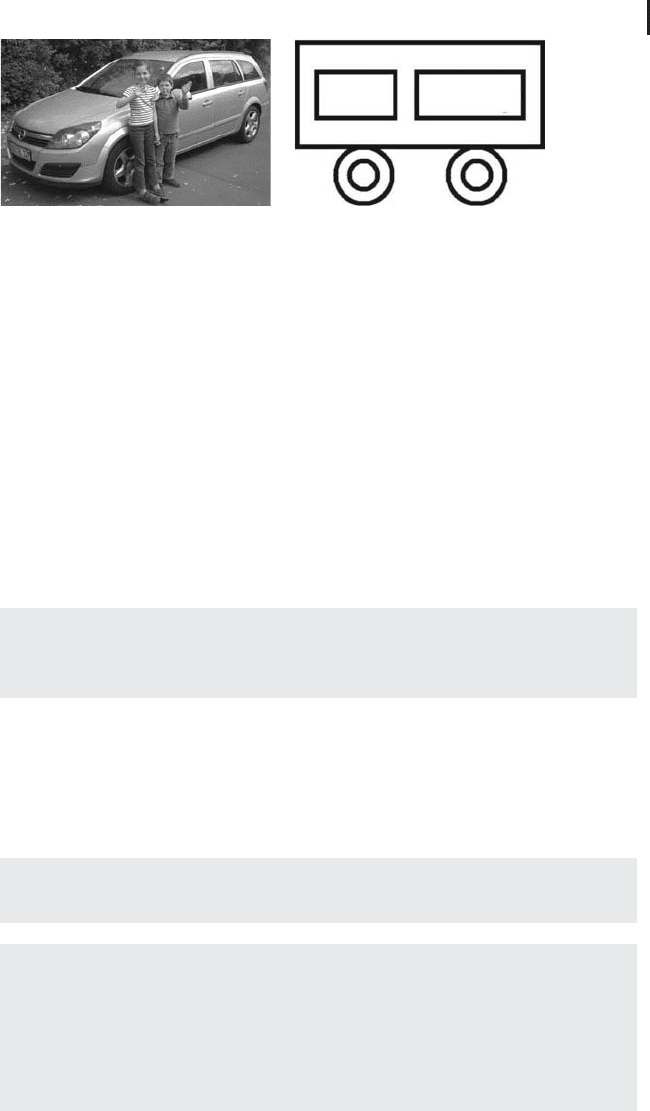
1.2 Systems, Models, Simulations 3
Tank
Battery
Fig. 1.1 Car as a real system and as a model.
picture is appropriate in this given situation, and it guides us to look at the battery
and fuel levels and then to solve the problem within a short time.
This is exactly the strategy used by engineers or scientists when they deal
with complex systems. When an engineer, for example, wants to reduce the fuel
consumption of an engine, then he will not consider that engine in its entire
complexity. Rather, he will use simplified descriptions of that engine, focusing on
the machine parts that affect fuel consumption. Similarly, a scientist who wants
to understand the process of photosynthesis will use simplified descriptions of
a plant focusing on very specific processes within a single plant cell. Anyone
who wants to understand complex systems or solve problems related to complex
systems needs to apply appropriate simplified descriptions of the system under
consideration. This means that anyone who is concerned with complex systems
needs models, since simplified descriptions of a system are models of that system
by definition.
Note 1.1.2 (Role of models) To break up the complexity of a system under
consideration, engineers and scientists use simplified descriptions of that system
(i.e. models).
1.2
Systems, Models, Simulations
In 1965, Minsky gave the following general definition of a model [1, 2]:
Definition 1.2.1 (Model) To an observer B, an object A
∗
is a model of an object
A to the extent that B can use A
∗
to answer questions that interest him about A.
Note 1.2.1 (Formal definitions) Note that Definition 1.2.1 is a formal definition
in the sense that it operates with terms such as object or observer that are not
defined in a strict axiomatic sense similar to the terms used in the definitions
of standard mathematical theory. The same remark applies to several other
definitions in this book, including the definition of the term mathematical model
in Section 1.4. Definitions of this kind are justified for practical reasons, since

4 1 Principles of Mathematical Modeling
they allow us to talk about the formally defined terms in a concise way. An
example is Definition 2.5.2 in Section 2.5.5, a concise formal definition of the
term overfitting, which uses several of the previous formal definitions.
The application of Definition 1.2.1 to the car example is obvious – we just have
to identify B with the car driver, A with the car itself, and A* with the simplified
tank/battery description of the car in Figure 1.1.
1.2.1
Teleological Nature of Modeling and Simulation
Animportantaspectoftheabovedefinitionisthefactthatitincludesthe
purpose of a model, namely, that the model helps us to answer questions and
to solve problems. This is important because particularly beginners in the field
of modeling tend to believe that a good model is one that mimics the part of
reality that it pertains to as closely as possible. But as was explained in the
previous section, modeling and simulation aims at simplification, rather than at a
useless production of complex copies of a complex reality, and hence, the contrary
is true:
Note 1.2.2 (The best model) The best model is the simplest model that still
serves its purpose, that is, which is still complex enough to help us understand a
system and to solve problems. Seen in terms of a simple model, the complexity
of a complex system will no longer obstruct our view, and we will virtually be
able to look through the complexity of the system at the heart of things.
The entire procedure of modeling and simulation is governed by its purpose
of problem solving – otherwise it would be a mere l’art pour l’art. As [3] puts
it, ‘‘modeling and simulation is always goal-driven, that is, we should know the
purpose of our potential model before we sit down to create it’’. It is hence natural
to define fundamental concepts such as the term model with a special emphasis
on the purpose-oriented or teleological nature of modeling and simulation. (Note that
teleology is a philosophical discipline dealing with aims and purposes, and the
term teleology itself originates from the Greek word telos, which means end or
purpose [4].) Similar teleological definitions of other fundamental terms, such as
system, simulation,andmathematical model are given below.
1.2.2
Modeling and Simulation Scheme
Conceptually, the investigation of complex systems using models can be divided
into the following steps: