
Walbank F.W., Astin A.E., Frederiksen M.W., Ogilvie R.M. The Cambridge Ancient History, Volume 7, Part 1: The Hellenistic World
Подождите немного. Документ загружается.

BLACK
SEA
THRACE
o Heraclea
Pontica
dia
^•JoX^AEOUS
Aezani
L .
n T
, y
°Elae»
o G A L
0
A T I A —-
'2Hi-_^
V
*
,A
Pessmus
^
Mazaca
T
«<«oiS'JnrS?
ard
" ^-f
H
**a,
A
^S^r~Z_, "
ZaC
' ARMENIA
Miletus^ CARIA OApollonia Salbace
* • ™~
COM(Ulft«£NE
i
^oi^Labraunda
. n I A /_ ^Si
jfP'\,
J| S I
D
" ,
i0»
cl
*
0
H.erapol*Castabala
%
-Sfc V^^eleucaia-cf^J^lUutB-LlMBa
^
. ,
LYCIA
A
"a/^
Tarsus^
^Zaugr^r"^,,^^
> "nPieria WjgAniioch
. ' A \ \\
"
^Afc*
Icnnae" oNicephorium
\ *
[b]
LaodiceaHjaAApamea
X. ^ \ ^
CYPRUS Aradusdf
Ba
)
Berytus^__A.,_^^*Palmyra
SidonSEpUGfS
Tv re,^ .^^yPamascus
Ptolemais-rf OPanlum
/
o&iwtMipolis
(Bet
She'an)
Joppa/
J
MDMA
Gaza^
°n I
Alexandria
Memphis
0
EGYPT
Ptolemais
o
of
the
Elephants
ARABIA
Icarus
0
(Fa.laka)
Orchoi
(Uruk)
SeleuceiaNlti
the-Tigns
Ctesiphon
(Kermanshah)
Echelon.*
0
•
Laoaicea
(Nehavend)
Seleuceia
~TXSusa)
—^US^AN
A
Alexandria
in
Car mania
DASHT
E
KAVIR
MEDIA
P
A R T H I A
A
R E I A
'
ec atompyl u s
Alexandria
O (Merv)
S
O G D I A N A
o Alexandria
Eschate
o
Ai
Khanum
G
AND
H A R A
Ibl
o Alexandria
(Ghazni)
Alexandria^©
of the-Caucasus
Alexandria.
-
(Kandahar)
G
E D R O S I A
Roads
Land over
1000
metres
SCALE
0
200 400 600
800km
|
1 , 1 •_, 1
0
200 400
miles
•
\
Cambridge Histories Online © Cambridge University Press, 2008
jy8 6 SYRIA AND THE EAST
founder, Seleucus
I, and so
appears
to
some extent
as its
re-founder,
although he lived (till 187) to experience the first heavy blow dealt
it
by
Rome
in the war of
192-189 B.C.
The second period (187—63
B.C.)
can,
however, also
be
subdivided
into
two
periods:
(a) That during which the state was still
a
solid political and economic
entity, with
a
sense
of
its fundamental unity and legitimate power. This
lasted from the reigns
of
Seleucus IV and Antiochus
IV
Epiphanes (the
sons
of
Antiochus
the
Great)
to
those
of
Demetrius
I,
Antiochus
V
Eupator, Alexander Balas and Antiochus VI, and largely corresponds
to
the period during which Roman policy
in the
eastern Mediterranean
appears simply
as one of
hegemony (196—146 B.C.).
(b)
A
second period
in
which
the
seeds
of
discord, sown
by the
accession to the throne of the two sons of Antiochus the Great (Seleucus
IV and Antiochus IV) successively, and the appearance
in
consequence
of
two
dynastic branches increasingly
in
conflict with each other,
resulted
in
violent and bloody conflicts, usurpations, secessions (such as
that
of
the Jews), reductions
in
the territory subject
to the
king
(at the
hands
of
the Parthians),
the
loss
or
eclipse
of
legitimacy
and
even
the
appropriation
by
foreign dynasties from Armenia
and
Commagene
of
dynastic traditions
and
legitimate rights over
the
kingdom.
After this short historical sketch,
it
will
be
convenient
to
examine
various aspects of the Seleucid kingdom
in
its classic form, that is
to
say
at the time of
its
greatest extent. However we shall also note some of the
divergences caused
by the
complex incidents
and
disturbances which
have been briefly described.
The kingdom founded
by
Seleucus
was a
personal, rather than
a
national, monarchy.
2
It
consisted in the rule of a king
{basileus)
belonging
to
the
dynasty founded
by
Seleucus.
The
territory over which
the
authority
of the
king extended
was
inhabited
by
various peoples,
without ethnic unity. Unlike
the
documents mentioning
the
king
of
Macedonia, in which in addition to the
basileus,
and subordinated to him,
we have
the
Macedones,
the
official Seleucid documents mention
the
king
but no
people
(ethnos).
Had a
people been mentioned, given
the
dynastic origin of the Seleucid dynasty and the ethnic composition of the
army,
at
least
in
the early decades,
it
could only have been the
Aiacedones
2
For
this difference, sometimes denied without reason, see Aymard 1967, 100—22: (1 9); Musti
1966,
111—38:
(E
44); and other works indicated
in
the Bibliography- For a different viewpoint see
Errington 1978: (D 17).
The
character
of
personal monarchy
is
perhaps also inherent
in the
term
ZcAeuKis,
especially if this means (at least in
the
early period of Seleucid history) 'land or dominion of
Seleucus'.
(Cf.
Musti 1966,
61—81:
(E
44)).
For
a broader notion
of
iTcAcuKir
(in the
third century
B.C.) with respects to Zvpia
EtXevKis (as
also including Cilicia) see also Ihnken 1978,41
n.
2:
(B
93).
On Xupta ZVAeuKiV
in
Strabo
see
below,
p.
189
n. 21.
Cambridge Histories Online © Cambridge University Press, 2008
ORGANIZATION, THE MONARCHY, THE COURT 179
again, here too in Syria. The absence of
any
indication of a people beside
the title
(and
name)
of
the king
is a
matter
of
greater positive than
negative significance. This positive significance was as an expression of
the dynasty's resolve
not to
represent
the
basikia
simply
as the
rule
of
Macedonian
(or
Graeco-Macedonian) conquerors over
the
various
subject peoples, who were, in order of their conquest, the populations of
Mesopotamia
and
Syria, Iran, Asia Minor
and
Palestine
—
in
short,
Semitic peoples together with Iranian and Anatolian elements. After an
early period during which
the
capital was
in
Mesopotamia (Seleuceia-
on-the-Tigris:
c.
311—301),
it was transferred, perhaps for
a
short time,
to
the new foundation
of
Seleuceia-in-Pieria and then, finally,
to
Antioch-
on-the-Orontes.
At
this point the geographical, political and (partly,
at
least) the economic centre
of
gravity moved
to
Syria. The burden,
but
also the advantage
of
a more direct rule, now fell most heavily
on the
Semitic populations
of
Syria (and as before,
of
Babylonia).
But this did
not mean that
the
Seleucid kings became formally
'
kings
of the
Syrians'.
3
The inscriptions found
in the
Seleucid kingdom
use
terms which
taken together provide some indication of
its
personal structure. Besides
the king appear the friends
(philoi)
and the military forces of land and sea
(aynameis).
1
The former term
(philoi)
stresses the personal structure of the
kingdom:
it
indicates
a
characteristic aspect
of the
monarchical
institution as such. But
it is
also
of
interest
to
seek
its
antecedents;
the
institution.appears
in an
eastern context
(in
the Achaemenid kingdom
and its Mesopotamian predecessors) as well as in that of
Macedonia.
The
' king's friends' form
his
council. Participation
in
this body does
not
depend on the local origin of
its
members. Precisely because the council
is formed with absolute autonomy
by a
king endowed with absolute
power, persons who
are
strictly speaking foreigners, since they come
from outside
the
kingdom, can become members
of
it. The court was
thus
a
prop
for
the king and
at
the same time
a
vehicle
of
international
relations, open
to
politicians, soldiers
and
scholars, drawn (usually)
from the Graeco-Macedonian
elements.
Among the 'Friends' there were
various categories, arranged according to a more or less rigid hierarchy:
timomenoi,
protoi
kaiprotimomenoi,
'honoured men', 'first and especially
honoured men'.
The Seleucid monarchy (like
the
Ptolemaic
and
other Hellenistic
monarchies) was also acquainted with the category of'relations'
of
the
3
On the argument for the Macedonian presence cf. Edson
I958:(E
19),
and also some remarks in
Musti 1966, 111-38:
(E
44).
On the
different capitals
of
the kingdom
in
the different periods,
cf.
Downey 1961: (E 157); Will 1979, 1.60: (A 67); Marinoni 1972: (E 39).
4
Cf. e.g. OGIS 219, 20-9; Habicht 1958, 3-4:
(H
85); Orth 1977, 44, 55-8, 67, 170-1,passim:
(A
46).
Cambridge Histories Online © Cambridge University Press, 2008
l8o 6 SYRIA AND THE EAST
king
(syngeneis).
Often (and especially
in
the early days
of
the kingdom)
these people were
in
fact blood relations
of
the sovereign;
but
later
on
the title became purely honorific.
5
The true basis
of
the Seleucid monarchy was, however,
the
armed
forces
{dynameis).
Its
power was based
on
these and this fact determines
the whole structure and history of the kingdom. The Seleucid monarchy
had
the
typical characteristics
of a
military monarchy: this basic fact
explains
the
colonization,
the
type
of
relations with
the
natives,
the
limited success of attempts at hellenization, and the sense of precarious-
ness pervading
the
whole history
of the
kingdom
—
to
mention
an
external factor which
of
course does
not
embrace the whole reality
of
Seleucid history,
but is
nonetheless
an
aspect that cannot
be
ignored.
Balancing, and sometimes contrasted with, all these features stands
the
policy of
the
sovereign, resting specifically on the ideology of
a
personal
and multiracial monarchy,
a
privileged relationship for the cities
{poleis),
a much-trumpeted respect
for
their freedom
and
democracy
{eleutheria
kai
demokratia),
and, all in all, a
claim
to
principles inspired
by the
policies
of
Alexander the Great and Antigonus Monophthalmus, who
served
as
models
for the
Seleucid kings.
Power, then, was exercised by the king, his 'Friends' and the armed
forces,
and the
object
of
their rule
was the
territory
{chord)
and the
subject population. More specifically cultivators
of the
royal lands
{basilike chord)
were called royal peasants
{basilikoi
laoi):
they were
not
slaves
but
their status was akin
to
that
of
rural serfs. However their
position cannot be described precisely without reference
to
the villages
in which they lived.
6
The distinction between cities, peoples
and
dynasts
{poleis,
ethne,
djnastai)
is sometimes considered peculiar to the Seleucid kingdom. But
in fact, although these terms
are
sometimes
to be
found
in
Seleucid
inscriptions, they also occur, all
or
some, and
in
various combinations,
in other texts, literary and epigraphical. These are not,
in
the writer's
view, distinctions valid only within
the
kingdom. They
are
rather
complex designations
of
the complex reality
of
the Hellenistic world
considered as a whole
—
which is how
it
is considered in the texts of the
chancelleries
of
Hellenistic sovereigns. For throughout the Hellenistic
world there were basikis, that
is
true
and
proper kings, djnastai,
princelings
or
local lords,
ethne,
populations with little
or no
civic
5
Cf.
Momigliano
I9J3:(E4Z);
Mooren 1968:^285). For the Ptolemaic ambience there are surer
indications of the meaning, function and hierarchy of titles such as
6
ovyyevrjs,
TUIV
npwrwv
tf>iAajv,
apxioujiuiTO<j>vXa£,
TUIV
<f>iXwv, TWV auifxaTO(j>vXa.Ku>v,Tu)v SiaSo^oiK.
Cf.
Trindl 1942:
(F
333)
and
especially Mooren 1977: (F 287). Mooren does not think that the council of'Friends' had lost
its
political role by the beginning
of
the second century B.C., particularly in Egypt (as against Habicht
1958:
(H
85)).
6
On the
condition
of
the laoi see below,
p.
205
n. 45.
Cambridge Histories Online © Cambridge University Press, 2008
GEOGRAPHICAL DESCRIPTION
OF THE
KINGDOM 18
I
structure
and
often dominated
by
the
dynastai
or
even
the
basileis,
and
poleis,
the
cities which enjoyed
at
least
a
certain level
of
autonomy.
7
II.
GEOGRAPHICAL DESCRIPTION OF THE SELEUCID
KINGDOM
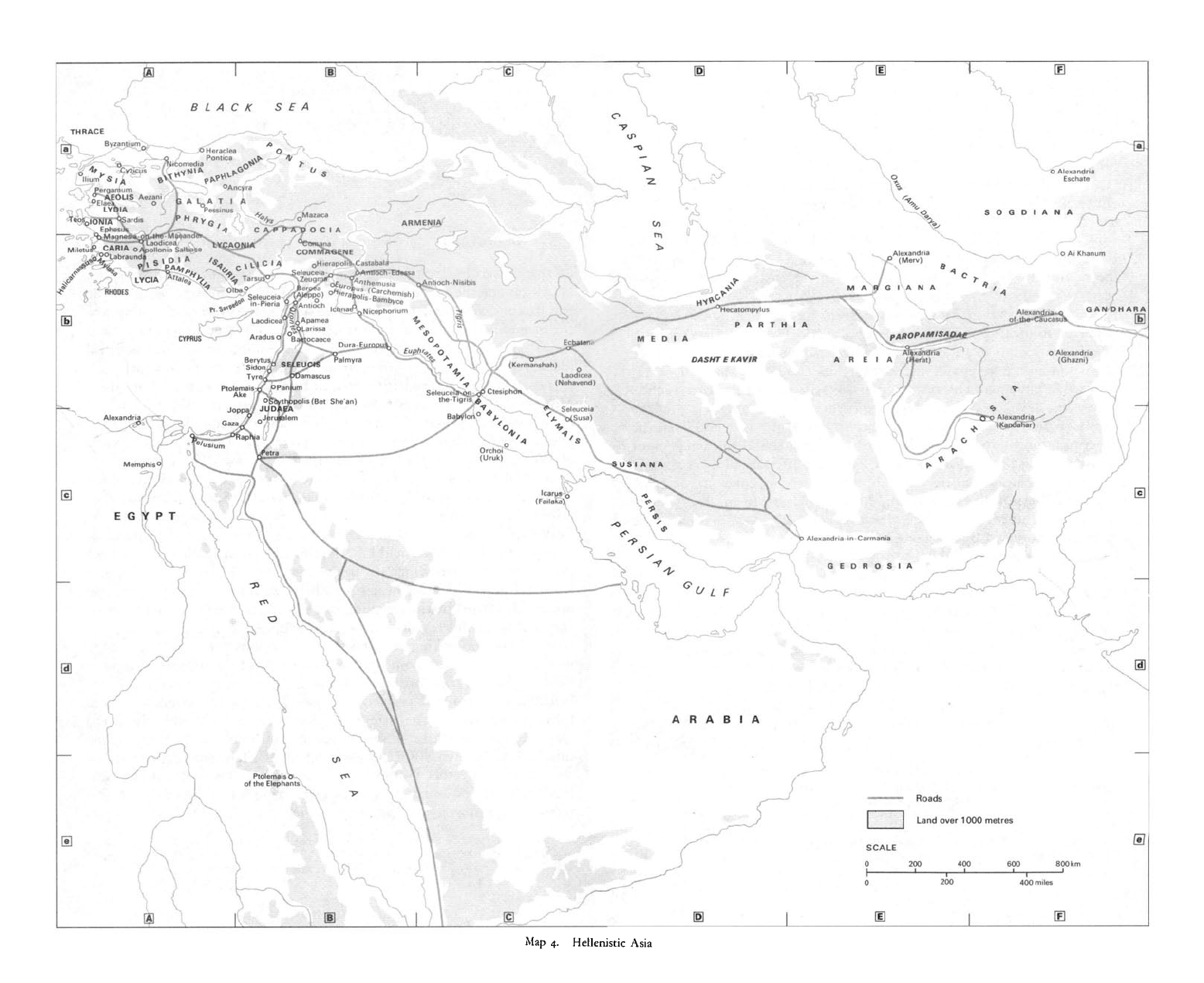
The nucleus of the state was in the arc spanning the area from the Persian
Gulf,
across the Plain of Babylonia and Giazirah (literally 'the island')
to
the broad valley
of
Aleppo,
the
coast
of
Hatay (Myriandrus) with
its
many ports, Seleuceia-in-Pieria, the plains of Apamea and Laodicea, and
on to the plain
of
Cilicia.
This was the compact economic, strategic and
political nucleus: Mesopotamia, Syria
and
Cilicia.
Immediately behind this nucleus
lie
other areas:
(1) First there
is
the high desert plain of modern southern Syria (probably
ancient Coele-Syria), crossed by a few hills and valleys. On the edges of
this region there were cities, most of which developed late, especially
in
the Roman period
but
also
in
late Hellenistic times: Palmyra
and
Damascus, both important stops on caravan routes and both destined
to
play
a
special role in the following period, when their economic function
became more important during the political and economic crisis
of
the
Seleucid state.
(2) Iran: this is a region mainly composed of mountains and desert, but
also including fertile zones such
as
Gilan, Mazandaran with Gurgan,
immediately
to
the
south
of
the Caspian Sea. The general function
of
Iran
in
the structure
of
the Seleucid kingdom and its relations with
the
sovereign will be discussed
in
the next paragraph. Here we simply note
the interest, from the military point of
view,
of
the road that connected
the nucleus of the Seleucid kingdom (with Mesopotamia as the principal
departure point, and in particular the ancient capital of Seleuceia-on-the-
Tigris with its royal residence) with northern Iran, that is the region of
Media. This road was wedged between the Caspian Mountains (south of
the Caspian Sea)
and the
Salt Desert (Dasht-e Kavir).
It is no accident that one piece of evidence for the cult of the Seleucid
rulers,
Antiochus III and his 'sister-wife'
(adelphef
Laodice, comes from
Nehavend, the Seleucid Laodicea, and another from Kermanshah, both
probably stops
on a
main mountain-road from Mesopotamia
to
Media.
Similarly,
the
parallel evidence from Durdurkar
in
Phrygia
was
also
found along another 'umbilical cord', this time connecting the heart of
the kingdom with one
of
its various offshoots, western Asia Minor.
9
7
It
is
in
this fuller sense that the formula is employed,
for
example,
in
Diod. xix.57.3.
Cf.
also
OGIS 228, 1. 11;
and
Herzog-Klaffenbach 1952, no. 2, 11.8ft".:
(B
89).
8
The title
is
formal: Laodice was
not
in
fact Antiochus' sister.
9
Cf.
Robert,
HelUnica
vn
(1949)
5—29;
vm
(1950) 33-75;
CR
Acad.
Inscr.
1967, 281—97:
(B
146)
(for the copies of the letter of Antiochus III on the institution of the cult of Laodice side by side with
his own).
Cambridge Histories Online © Cambridge University Press, 2008
l82 6 SYRIA AND THE EAST
(5) Outside
the
borders
of
Iran
itself,
but
still within
the
Iranian
(or
Iranian-Scythian) orbit, there were outposts
set
up by
Alexander, some
of which were preserved, at least
for
a
time,
by
Seleucus
I
and
Antiochus
I.
To the
north-east
of
modern Mashhad,
on
the
plain
of
what
is
today
Turkmenistan, exposed to the attacks
of
tribes (whom
we now
know
to
have been much more sedentary than was previously imagined
and to be
distinguished from
the
surrounding nomads) there
was
Antioch-in-
Margiana (Mary, till 1937 called Merv).
A
little further
to
the east,
in the
region
of
Ferghana (beyond Maracanda-Samarkand), there was Alexan-
dria Eschate
('
the last'). The domain
of
Seleucus
I
also extended behind
the mountains
of
Band-i-Baba, Hararajat
and the
Chain
of Par-
opamisadae (Hindu-Kush) into modern Afghanistan,
to
where
the
high
plain allows
the
possibility of settlement
and
cultivation
and
where there
arose some
of
the many Alexandrias founded
by the
great Macedonian:
Alexandria-Herat, Alexandria-Kandahar, Alexandria-Ghazni (below
Kabul), Alexandria-of-the-Caucasus
and
Alexandria-on-the-Oxus,
probably
to
be identified with
AT
Khanum,
at
the confluence of the Amu
Darya
and the
Kowkcheh.
10
Here
in
ancient Bactria, Seleucid rule
survived
for a few
decades, continuing that
of
Alexander
the
Great.
However, while Seleucus
I was
still
on the
throne, control
was
relinquished over
the
level region
of
the Indus
(now
Pakistan)
and the
Punjab (North-West India).
A notable feature of the two regions described above was the presence
of transit routes furthering communication
and
trade. Besides
the
great
road joining Mesopotamia
via the
passes
of
the
Zagrus into northern
Iran (which, besides its fundamental military role and its function
as a
link
with
the
outposts
of
Graeco-Macedonian rule,
may
have also been used
as
a
trade route with
the
regions
of
Central Asia), there were
the
roads
which followed
the
course
of
the Tigris
or
the
Euphrates
to
the
Persian
Gulf. The
Seleucid presence is also documented
by
inscriptions from
the
third century
B.C.
in an
island opposite
the
mouth
of
the
Tigris
in the
northernmost corner
of
the
Persian
Gulf;
this
is
Failaka,
the
ancient
Icarus.
The
roads following the course of the two great rivers crossed the
Syrian heartland
and
went towards
the
ports either
of
northern Syria
or
(after
the
acquisition
of
Phoenicia, Palestine
and
southern Syria)
of
Phoenicia.
The history
of
roads
in the
Seleucid kingdom,
and in
particular those
connecting
the
regions east
of
the
Tigris
and the
Euphrates with
the
10
On the
seventy Alexandrias attributed
by
tradition (Plut.
de
Alex. fort.
1.5) to the
great
Macedonian,
and on the
difficulty of giving them a precise location,
cf.
Tcherikower 1927,
145—6:
(A
60);
Tarn 1948, 11.171-80, 232-59:
(A
58).
Specifically
on
Alexander's foundations
in
Bactria
and
Sogdiana:Diod.xvii.24;Straboxi.n.4.c.
;
17;
on
the cities founded
in
Margiana: Curt. vi. 10.15 —
16.
On
the
cities
in the
Indus delta:
ibid,
ix.10.2.
For
AY
Khanum,
cf. n. 67.
Cambridge Histories Online © Cambridge University Press, 2008
GEOGRAPHICAL DESCRIPTION OF THE KINGDOM 183
shores of the Mediterranean, can be divided, according to Rostovtzeff,
into two distinct periods. The first was before the Seleucid victory of
Panium (200), which gave the kingdom of Syria control over Phoenicia
and Palestine, and the second after this victory and especially after the
peace
of
Apamea between Syria and Rome (188 B.C.).
In
the third
century B.C. and in the second till the peace of Apamea, the roads most
frequently used
for
trade were the northernmost ones (Rostovtzeff
singles out two between Antioch and Mesopotamia: one ran from
Antioch-on-the-Orontes
in
the direction
of
the Euphrates, which
it
crossed at Zeugma, and then continued through Edessa and Antioch-
Nisibis to join the Persian road leading to the upper satrapies; the second
followed the same route
to
Zeugma but then, having crossed
the
Euphrates, descended to the Plain of Mesopotamia and followed the
Anthemusia—Ichnae—Nicephorium route to join the road dating from
the Persian period which led to Babylon and Seleuceia-on-the-Tigris). In
the second century
B.C.
another trade route became important, the desert
road, connecting Seleuceia-on-the-Tigris by
a
more southerly route,
which ran either through Damascus,
or
even further
to
the south
through Petra, with the ports of Phoenicia and Palestine respectively.
11
(4) Asia Minor was a land of great variety, which expressed itself in its
landscape,
its
geographical and economic characteristics, and
in its
political history. Consequently Seleucid rule, which in Cilicia was solid
and produced typical and long-lasting results, proved to be less stable
elsewhere.
12
In particular Asia Minor possessed certain characteristic
empty spaces, which
to
some extent reflected the dimensions and
directions
of
the conquests and rule
of
Alexander the Great. The
Seleucids seem, for example, not to have gained a firm foothold in the
mountainous regions of Armenia and in their outliers in Asia Minor.
The sources speak
of a
'Seleucid Cappadocia' (and also
of
military
operations by Seleucus
I
near a River Lycus in Armenia), but in these
regions Seleucid rule was strictly limited.
13
The chain of mountains in
Pontus, which follows,
at
some distance, the coast line
of
eastern
Anatolia and enters the Asiatic hinterland,
put
Pontic Cappadocia
beyond Seleucid control. But neither did internal Cappadocia
—
the
region whose centre was the royal temple-city of Comana
-
become truly
subject to Seleucid rule; and this was also, and even more decidedly, the
11
See especially chs. 4-6
in
Rostovtzeff 1953: (A 52).
12
On
forms
of
'democratic' life
in
Seleucid Cilicia,
in
particular
at
Tarsus and Magarsus
(Antioch-on-the-Cydnus and Antioch-on-the-Pyramus respectively), cf. Musti 1966, 187-90:
(E
44)
(differing from Welles 1962: (E 101)), on the basis of the inscription from Karatas (SEG xn.jit;
Robert,
CR
Acad.
Inscr. 1951, 256-9).
13
On Kamra&OKia EtXcvKis: Appian, Syr.
5
5.281;
on Seleucus' operations on the Lycus: Plut.
Demetr. 46.7-47.3; Musti 1966, 71-3: (E 44).
Cambridge Histories Online © Cambridge University Press, 2008
184
6
SYRIA
AND THE
EAST
case with Bithynia.
14
In
short, vast inland regions of eastern Asia Minor,
behind
the
mountains
of
Armenia,
the
Antitaurus
and the
Taurus,
escaped conquest
and
rule
at the
hands
of
both Alexander
and
the
Seleucids, and
on
the whole the Graeco-Macedonian presence was also
episodic during
the
period
of
the Diadochi.
The Graeco-Macedonians thus
did not
control
the
whole length
of
the ancient royal Persian road, which
ran
from Ephesus
to
Sardis,
entered Phrygia, and after leaving that region passed over
to
the east of
the River Halys (Kizil Irmak) into those parts of eastern Anatolia which,
as we have seen, were outside Seleucid rule. Persian rule seems
to
have
penetrated more deeply into these regions inhabited
by
peoples
of
Anatolian and Iranian origin. The expansion organized by the Seleucids
into Asia Minor did not therefore follow the route of the ancient Persian
royal road
but
rather
the one
followed
by the Ten
Thousand
in
Xenophon's Anabasis
or
by the army
of
Alexander the Great: from
the
Troad
to
the high plains of Phrygia in western Asia Minor
-
these were
not without their fertile areas
-
and then, turning sharply towards
the
coast, across the Taurus (and the pass
of
the Cilician Gates) into Cilicia
and the modest coastal plains of the Gulf of Alexandretta. This route was
followed
in
reverse (in an effort to retain connexions with western Asia
Minor
and
the
Aegean)
in the
course
of
Seleucid expansion under
Seleucus
I,
then under Antiochus
I
and especially under Antiochus III.
Cyprus remained outside Seleucid control.
Its
possession would
indeed have required (and also stimulated)
a
proper naval policy.
But
that was something which remained embryonic
in
Seleucid history;
the
Seleucid navy was only consistently developed
in
the last decade, more
or less, of Antiochus III, that is during the brief period from the victory
of Panium
to
the
peace
of
Apamea (200—188 B.C.) during which
the
Seleucids controlled the ports of Phoenicia (and also,
it
should be noted,
the forests
of
Lebanon, which were
an
excellent source
of
timber
for
ship-building).
III.
ADMINISTRATIVE DIVISIONS AND PERSONNEL
Because
of
the
large expanse
of
territory ruled over
by
the
Seleucid
kings,
not
only was
it
divided from the outset into districts, which
we
shall examine later,
but
above that there
was
a
division into large
territorial areas, which meant, alongside
the
central nucleus
of the
kingdom under
the
direct administration
of
the king
and
his generals,
the creation
of
true viceroyalties. This need
for
some breaking
up
and
territorial distribution
of
power arose primarily from
the
size
of
the
14
On
the sanctuary
of
Ma
at
Comana
in
Cappadocia, Straboxn.2.3.
c.
535-6;
on
the sanctuary
duplicating
it at
Pontic Comana see also Strabo xn.3.32.
c.
557.
Cambridge Histories Online © Cambridge University Press, 2008
ADMINISTRATIVE DIVISIONS AND PERSONNEL 185
kingdom and,
in
consequence
of
this,
the
existence
of
vast peripheral
areas subject
to
less rigorous control,
in
which the work
of
unification
and transformation went on less intensively. These areas were strategi-
cally more exposed and they already possessed less responsive political
and economic systems. Relations between them and the central power
were more difficult, and
it
was therefore necessary
for
these
to
be more
indirect than those existing between the central power and the nucleus of
the kingdom. However, the creation
of
these ' viceroyalties'
or
'special
commands', as they were called, solved
a
problem arising from the fact
that the monarchy was hereditary,
in
short a dynasty. Especially during
the early decades
of
Seleucid history, these 'special commands' were
usually reserved for members of the royal dynasty; in particular, the heir
to
the
throne
was
given command over
the
'upper satrapies' (ano
satrapeiai),
comprising
the
Iranian regions (sometimes
the
term also
included Mesopotamia).
15
The other special command was the gover-
norship
of
Sardis, that is,
the
territories
of
western Asia Minor lying
west of the line running from the River Halys to the Taurus mountains.
The existence of
a
governorship of Sardis is clearly attested
as
early
as
the
Persian period, during which
we
find
the
title
and
function
of the
karanos,
the viceroy of the Achaemenid king, who resided
at
Sardis and
exercised jurisdiction over
the
lands
of
western Asia Minor. Many
modern scholars (beginning with H. Bengtson, who is best acquainted
with the post of general
(strategos)
in the Hellenistic period) hold that this
governorship was re-established
in
the Seleucid kingdom immediately
after
the
conquest
of
western Asia Minor, that
is
after Seleucus
I's
victory over Lysimachus
at
Corupedium
in 281
B.C. Although this
possibility is not to be excluded,
it
should be pointed out that there is
no
positive evidence
for the
unification
of
these regions under
a
single
command before the middle
of
the third century B.C. (The first certain
governor
is
Antiochus Hierax,
the
brother and later
the
opponent
of
King Seleucus
II.
His successors, Achaeus, who also belonged
to the
dynasty
and
rebelled against Antiochus
III, and
Zeuxis,
are
also well
known.)
16
Moreover, it does not seem necessary nor even likely that the
conditions
of
considerable confusion which characterized Seleucid rule
in Asia Minor would have recommended the too rapid creation in these
15
For the
problems
of
the special commands
of
the East and
the
West,
cf.
Bengtson 1964-7,
11.
iff.:
(A
6);Orth 1977, 124-6:
(A
46);
different views in Musti J957,
275-8:
(B
I
13); 1965, 153-60:
(E
87);
1966,
107-11:
(E 44).
16
On
the position
of
Zeuxis see Musti 1966,
109-11:
(E
44); Olshausen 1972:
(E
89); Walbank
1
979> I". '09
("d
Polyb.
xn. 16.4) and
78
5:
(B
3
7).
Zeuxis is the most interesting and (with some gaps)
the best documented example of the career of
a
Seleucid official (222-190
B.C.).
The brothers Molon
and Alexander were invested at the accession of Antiochus III (so
I
interpret Polyb. v.40.7) with the
command
of
the ovto aajpaniXat (one Media, the other Persia). However, on these two see
(for a
partly different interpretation) Schmitt 1964, 116-50: (E
51).
Cambridge Histories Online © Cambridge University Press, 2008
^6 6 SYRIA AND THE EAST
regions of an extraordinary power, whose holder could at once have
strengthened himself
by
alliance with individual cities, thus constituting
a serious threat to the central authority. In the writer's opinion the
unification of power in these territories was caused by dynastic
pressures: but these then had the foreseeable consequences of encourag-
ing rivalry within the family and secession from the central and
legitimate power of the king of Antioch.
It has been said that in the Seleucid state there was no proper council
of ministers, no 'cabinet'. At any rate the functions of'prime minister'
were apparently performed by persons with the title 'charged with
affairs'
{epi
(on pragma
ton);
17
and both at central and regional level we can
distinguish the functions of the
dioiketes
who, in accordance with the
principal meaning of the word
dioikesis,
appears to have been responsible
for financial administration. At local level there
is
the
oikonomos,
who was
probably the administrator of the district governed by a general
{strategos)
or more specifically of the royal property (beneath him was the
hyparchos
with executive functions); but the
oikonomos
can also mean the
administrator of individual properties (e.g. that of the queen Laodice II).
It is also difficult to define the exact position of the official known as ' in
charge of revenues'
{epi
ton
prosodon)
in the Seleucid kingdom. Once this
position was thought to be a very high one, comparable in some degree
to the
dioiketes;
but now it is held to be more equivalent in rank to the
oikonomos.
The relevant sources would suggest that there was a
development in the function of the
epi ton prosodon
in the later stages of
Seleucid history to the detriment of the
oikonomos,
whom he replaced. It
is,
however, very difficult to assign a single rigid value to designations
which are of their nature generic, or to establish a rigorous hierarchy
between the various functions, outside particular contexts in which the
different functions are defined and co-ordinated in relation to each other.
Also to be noted are the offices of the
eklogistes
(accountant), the
epistolographos
(secretary) and the
chreophylax
(the keeper of the register of
debts) (the latter at Uruk).
18
If we are certain of the existence of a special command of the ' upper
satrapies' from the time of the reign of the founder of the Seleucid
empire, and of a special command of western Asia Minor from the
middle of the third century B.C., we can then go on to enquire how the
17
On the «ri
TUIV
irpa.yna.Twv
(which was the position of Hermias and Zeuxis under Antiochus
III) cf. Walbank 1957,1.571 (orfPolyb. v.41.1),
idem
1967,11.452 («/Polyb. xv.31.6):
(B
37);Schmitt
1964,
1
;o—8:
(E 51).
18
On the vnapxos cf. RC 18-20 and p. 371. We should also mention the yafjcx^uAa/aov
(treasury): RC
18,11.
20-1. On the relations between
fiaaiXevs,
OTparrfyos,
vnapxos, |3uj3Aio^uAa£,
ibid.;
Musti 1957, 267-7;:
(B
113); 1965: (E 87). On the
kmoToXoypatfros
(Dionysius at the time of
Antiochus IV) and on the xp«u<£uAaf (keeper of the register of debts, attested at Uruk), cf.
Rostovtzeffi92 8, 165, 167,
181:
(E
48).
On the
SIOKOJTTJS,
J. and L. Roberts,
Bull.
epig.
in
Rev.
Et.Cr.
83 (1970)
469—71;
84 (1971) 502-9. On the cm
TWV
npoaoSujv
and the
hyAayiOTTjs,
ibid.
1954, 292-5.
Cambridge Histories Online © Cambridge University Press, 2008