
Westermeier R., Naven T., H?pker H.-R. Proteomics in Practice: A Guide to Successful Experimental Design
Подождите немного. Документ загружается.


Step 4: SDS Polyacrylamide Gel Electrophoresis352
Fast runs:
Step 1 5 mA per gel »0.2 W 2 hours
Step 2 40 mA per gel 15 W 4–6 hours
In a warm laboratory the buffer temperature can rise to 30 C. This
does not create a problem. When the temperature gets higher, the
power setting should be reduced.
& Note: The running time is also dependent on the
water quality. Water with more ions causes
slower runs.
After the run
.
Switch off the electric field.
.
Open the safety lid.
.
Remove the cassettes.
For DIGE DIGE gels are scanned while they are in the low fluores-
cent glass cassettes. If they cannot be scanned within the next couple
of hours, place the cassettes into a refrigerator or into a cold room.
.
Do not fix the gels, because acidic fixation would
reduce the fluorescent signal considerably.
For staining the gels
.
Open the cassettes only with a piece of plastic,
like a Wonderwedge.
.
Remove the gels from the cassette; be very care-
ful, when gels are not attached to a glass plate or
a support film. Place the gels immediately into
fixing solution or the hot Coomassie blue solu-
tion (see next chapter).
.
Rinse the cassettes with mild detergent, tap
water and deionized water and let them dry in
the air.
.
Pump the used buffer out by opening the valve:
Be sure that the end of the tubing is placed into
a bucket or a sink. Switch the pump off immedi-
ately when the tank is empty.
When the anodal buffer should be re-used (only possible for Tris-Cl
gels), pump only 2.5 L out. When the PPA-Cl gels are run, the buffer
cannot be re-used. The Tris ions have to be completely removed from
the lower buffer tank by filling several times a few liters of water in
and pumping it out.
If you use metal spatulas or
knives, you can damage the
glass plates.
Or dry them with lint-free
tissue paper.
Do not walk away during this
procedure!

4.5 The SDS Electrophoresis Run 353
.
Rinse the cathode panels on the hinged safety
lid with deionized water.
.
Wash the lower buffer tank several times with
tap water and then with deionized water to
remove any disturbing ions.
4.5.2
The Six-gel Instrument with Standard Power Supply
& Note: Never plug the pump cable in without
liquid in the tank.
.
Check whether the instrument has been pre-
pared as described above in Section 4.3.3.
.
Wet the buffer seal of the upper buffer chamber
with 0.1% SDS water.
.
Insert the cassettes into the cassette carrier and
place it into the tank.
.
When fewer than six gels are run, insert blank
cassettes into the free positions. In the front,
however, a gel cassette should be inserted: this
makes it easier to watch the migration of the
Bromophenol blue front during the run.
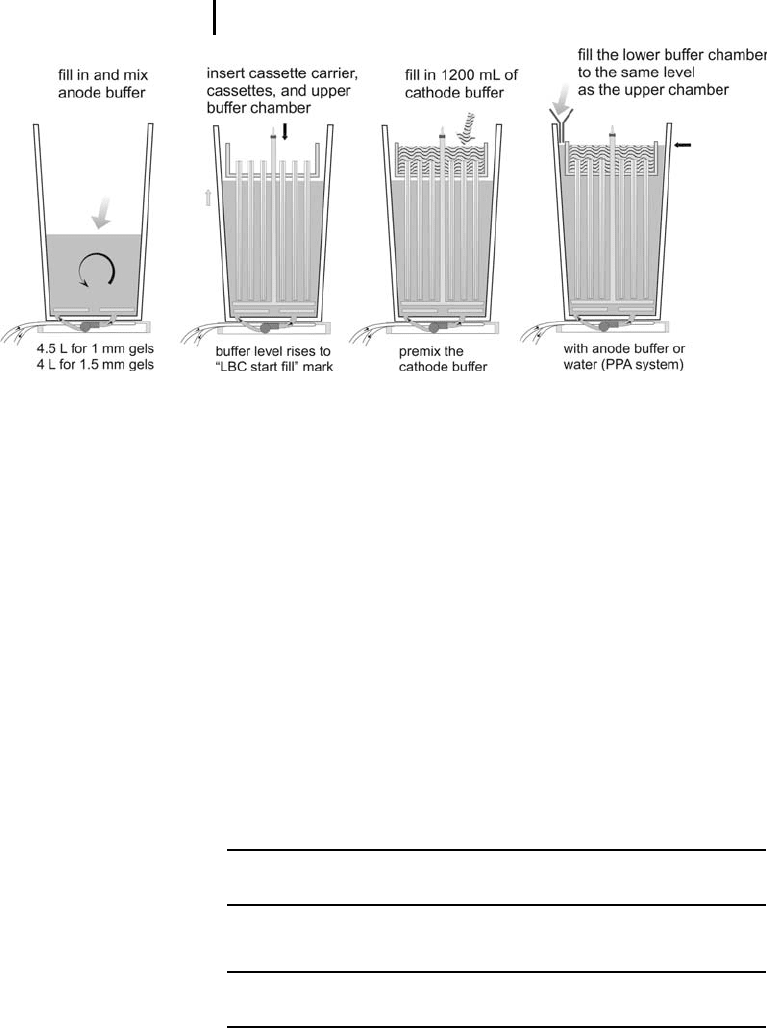
When all cassettes are in place, the level of the anodal buffer should
have reached the mark “LBC start fill”. If necessary, add anodal buffer
or deionized water (for PPA buffer system for ready-made gels) to
reach the mark. The filling procedure is shown in detail in Figure
4.13.
.
Make up 1.2 L cathodal buffer by diluting and
mixing the concentrate:
– 1 cathodal buffer for running 1–3 gels (120
mL concentrate plus 1,080 mL deionized
water).
– 2 cathodal buffer for more than 3 gels, to pre-
vent buffer depletion (240 mL concentrate
plus 960 mL deionized water).
When a pump runs dry, it gets
destroyed.
Spray with the plant sprayer
used for overlaying the gel
edges.
Turn ready-made gel cassettes
with the glass plates to the
front, because the plastic
frames are not transparent.
Step 4: SDS Polyacrylamide Gel Electrophoresis354
Fig. 4.13: Schematic drawing of the filling steps for the six-gel
chamber. It is important to have a hydrostatic balance between
upper and lower buffer.
.
Pour 1.2 L cathodal buffer into the upper tank.
.
Immediately fill more water or buffer into the
lower buffer chamber to adjust the liquid level to
the level in the upper buffer. The hydrostatic bal-
ance is necessary to prevent leakage of the upper
buffer tank and mixing of the buffers (see Figure
4.13).
.
Put the safety lid containing the cathodal electro-
des in place and connect the cables to the power
supply.
The running conditions are the same for both ready-made gels and
laboratory-made SDS gels:
Overnight runs:
Step 1 5 mA per gel »0.2 W 2 hours
Step 2 25 mA per gel 1 W Overnight
Fast runs:
Step 1 5 mA per gel »0.2 W 2 hours
Step 2 40 mA per gel 15 W 4–6 hours
Water is for ready-made gels /
buffer, for other gels buffer is
poured in.
External thermostat is set to
25 C.

4.6 The SDS Electrophoresis Run 355
& Note: The running time is also dependent on the
water quality. Water with more ions causes
slower runs.
After the run
.
Switch off the power supply and unplug the con-
necting cables.
.
Unplug the pump cable.
.
Remove the safety lid.
.
Remove the entire cassette carrier and carry it to
a sink. Then remove the upper buffer tank and
the cassettes from the carrier.
When the anodal buffer is required for re-use (only possible for Tris-
Cl gels), the upper buffer must be collected and poured into the ano-
dal buffer in order to bring the Tris ions back.
For DIGE DIGE gels are scanned while they are in the low fluores-
cent glass cassettes. If they cannot be scanned within the next couple
of hours, place the cassettes into a refrigerator or into a cold room.
.
Do not fix the gels, because acidic fixation would
reduce the fluorescent signal considerably.
For staining the gels
.
Open the cassettes only with a piece of plastic,
like a Wonderwedge.
.
Remove the gels from the cassette; be very care-
ful, when gels are not attached to a glass plate or
a support film. Place the gels immediately into
fixing solution or the hot Coomassie blue solu-
tion (see next Chapter).
.
Clean the glass plates as soon as possible (see
below)!
.
Pour the buffer out and wash the lower buffer
tank several times with tap water and then with
deionized water to remove any disturbing ions.
When the PPA-Cl gels are run, the buffer cannot be re-used. The Tris
ions have to be completely removed from the lower buffer tank by fill-
ing several times a few liters of water in and pumping it out.
.
Rinse the cathode panels on the safety lid with
deionized water.
Fixing of gels causes quantita-
tively and qualitatively modi-
fied results.
If you use metal spatulas or
knives, you can damage the
glass plates.

Step 4: SDS Polyacrylamide Gel Electrophoresis356
4.6
Cleaning the Glass Plates
Normal cleaning
.
Rinse the cassettes with 0.5% (w/v) SDS solu-
tion.
.
Wash them with tap water.
.
Rinse them with deionized water.
.
Let them dry in the air.
Removal of Bind-Silane bound gels from glass plates
.
Soak the glass plates overnight in a 5% (v/v)
Decon 90 solution.
.
Remove any gel fragments attached to the plate
from previous gels.
If Decon is not available
.
Pour a few mL of 0.5 mol/L KOH on the glass
plate, distribute the solution evenly over the sur-
face.
.
Wait for a few minutes, wipe the gel off with a
paper.
.
Wash with tap water.
.
Rinse with deionized water.
.
Store the glass plates and cassettes in a dust-free
cabinet.
Or dry them with lint-free
tissue paper.
Longer time can cause etching
of the surface.

357
Step 5: Scanning of Gels Containing Pre-labeled
Proteins
Gels containing fluorescence pre-labeled proteins can be scanned
while they are inside the cassette. It is important, that cassettes are made
from low-fluorescent glass plates. Two types of imagers can be used:
.
Laser scanners with photomultiplier tubes;
.
White light sources with excitation filters and a
scanning CCD camera.
The key point is the prevention of crosstalk between the different dye
channels. Therefore the quality of the narrow band pass emission fil-
ters is of high importance.
For correct positioning the cassettes and avoiding the development
of Newton’s rings, the way of cassettes placement is very important.
In the Typhoon laser scanner the cassettes are placed on an assembly
of alignment guides, which provide an opening of 200 mm between
the platen and the cassette glass plate to prevent the formation of
Newton rings. The position of the cassettes is easily recognized by
the software as a pre-defined tray area. For the scanning CCD camera
special carrier cassettes are provided, which have an open bottom for
this application.
2-D gels are always scanned in a defined – and the same – orienta-
tion, in order to evaluate and display the image with the low isoelec-
tric points on the left hand side and the low molecular weights pro-
teins at the bottom. The print on the IPG strips is very useful to find
the correct orientation.
The standard resolution for adequate evaluation with DeCyder soft-
ware is a pixel size of 100 mm. The scanner computer should contain
a software package ImageQuant to overlay the different images for
visual control of the separation results and cropping the images.
.
Wipe off fluorescent contaminations on the
scanner glass platen and glass plates with lint-
free tissue paper soaked in 10 % (v/v) H
2
O
2
and
rinse with double-distilled water.
Proteomics in Practice. A Guide to Successful Experimental Design 2
nd
Ed.
Reiner Westermeier, Tom Naven, and Hans-Rudolf Hçpker
Copyright 2008 WILEY-VCH Verlag GmbH & Co. KGaA, Weinheim
ISBN: 978-3-527-31941-1
According to a Cartesian coor-
dinate system.
Step 5: Scanning of Gels Containing Pre-labeled Proteins358
5.1
Selection of Imager Settings
5.1.1
Laser Scanner
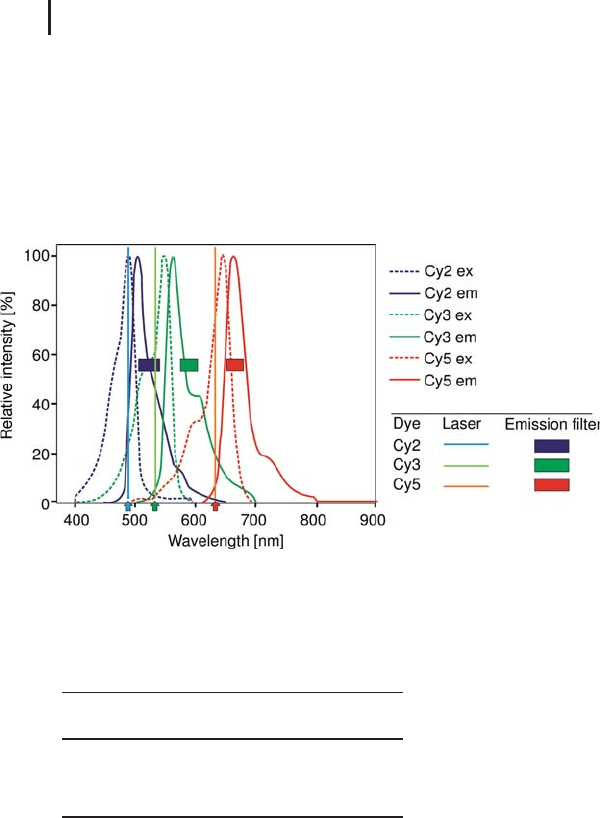
For excitation the appropriate laser is selected together with the
related emission filter as shown in Figure 5.1 and Table 5.1.
Fig. 5.1: Graph of CyDyes, excitation, and emission filter
wavelengths for scanning CyDyes with Typhoon.
Tab. 5.1: Laser and emission filter selection for scanning DIGE gels
with Typhoon.
Dye Laser Emission filter (nm)
Cy2 Blue 488 nm 520/40
Cy3 Green 532 nm 580/30
Cy5 Red 633 nm 670/30
.
Adjust the photomultiplier (PMT) voltage for
each wavelength after pre-scanning the entire
gel with a low resolution of 1,000 mm. The lowest
pixel should have at least ten counts. Saturation
must be avoided. The values are usually between
470 V and 550 V.
.
Select focal plane (+3 mm) for scanning in
between the glass plates.
Saturated spots (>100,000
counts) are indicated in red
color.
This is a specialty of confocal
optics.
5.2 After Scanning 359
5.1.2
Scanning CCD Camera
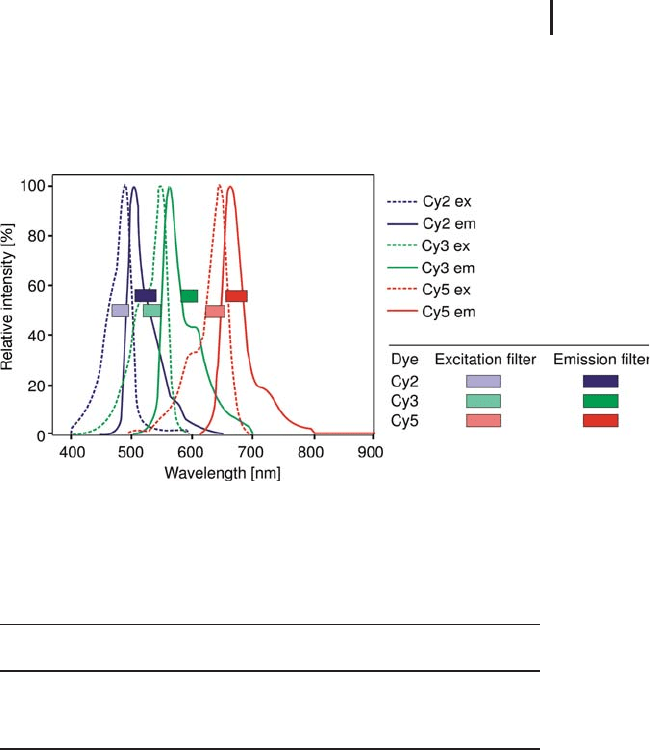
For the white light source imager the excitation and emission filters
have to be selected as shown in Figure 5.2 and Table 5.2.
Fig. 5.2: Graph of CyDyes, excitation, and emission filter wavelengths
for scanning CyDyes with EDI scanning CCD camera imager.
Tab. 5.2: Excitation and emission filter selection for scanning DIGE
gels with EDI scanning CCD camera imager.
Dye Excitation filter (nm) Emission filter (nm)
Cy2 480/30 530/40
Cy3 540/25 595/25
Cy5 635/30 680/30
.
For the CCD camera adjust the exposure time
settings for each wavelength (between 0.15 sec-
onds and 4.0 seconds) after a pre-scan of a small
scanning area.
5.2
After Scanning
The files are saved as 16 bit TIFF files. The software saves the differ-
ent channels in two formats: *.ds and *.gel, to which it adds automa-
tically the suffix Cy2, Cy3, or Cy5, and for the selected internal stan-
dard channel it also adds the suffix STANDARD. The *.ds files allow
the scanned images to be overlaid in ImageQuant.
Usually settings are 0.9 seconds
or below to keep scanning time
down. Weaker signals need
longer exposure.

Step 5: Scanning of Gels Containing Pre-labeled Proteins360
If the cassettes have been scanned in the wrong orientation, this
can be corrected with the scanner software, which includes tools for
rotating and flipping images.

361
Step 6: Staining of Gels
Only a selection of staining techniques will be described, those which
are most useful for fast results, good sensitivity, image analysis, quan-
tification, and mass spectrometry compatibility.
6.1
Visible Stains
6.1.1
Sensitive Stepwise Coomassie Brilliant Blue Colloidal Staining
According to Neuhoff et al. (1988).
6.1.1.1 Solutions
Stock staining solution A:
.
10% (w/v) ammonium sulfate, 2% (w/v) phos-
phoric acid in 100 mL deionized water.
Stock staining solution B:
.
5% (w/v) Coomassie brilliant blue G-250 in de-
ionized water.
Staining solution:
.
Mix 2 mL of stock solution B with 80 ml of stock
solution A. Add 20 mL of methanol into the AB
mix.
& Note: The staining solution should never be
filtered because the colloidal dye particles
formed are retained on the filter.
Proteomics in Practice. A Guide to Successful Experimental Design 2
nd
Ed.
Reiner Westermeier, Tom Naven, and Hans-Rudolf Hçpker
Copyright 2008 WILEY-VCH Verlag GmbH & Co. KGaA, Weinheim
ISBN: 978-3-527-31941-1
Neuhoff V, Arold N, Taube D
and Ehrhardt W. Electrophor-
esis 9 (1988) 255-262.