
Westermeier R., Naven T., H?pker H.-R. Proteomics in Practice: A Guide to Successful Experimental Design
Подождите немного. Документ загружается.

Step 4: SDS Polyacrylamide Gel Electrophoresis342
.
Store the usable gels in an airtight container
with about 100 mL gel storage solution. When
the gels are not used during the next day, place
the container with the gels into a cold room or a
refrigerator.
.
Take the foam gasket out of the front plate and
rinse it with deionized water.
.
Rinse the gel caster and the separator sheet with
mild detergent and then with deionized water.
.
Let them dry in the air.
4.2
Inserting Ready-made Gels into Cassettes
Ready-made gels on a film support are supplied in airtight aluminum
bags and need to be inserted into specially designed reusable cas-
settes. They are run in a vertical mode in the vertical systems for large
gels.
.
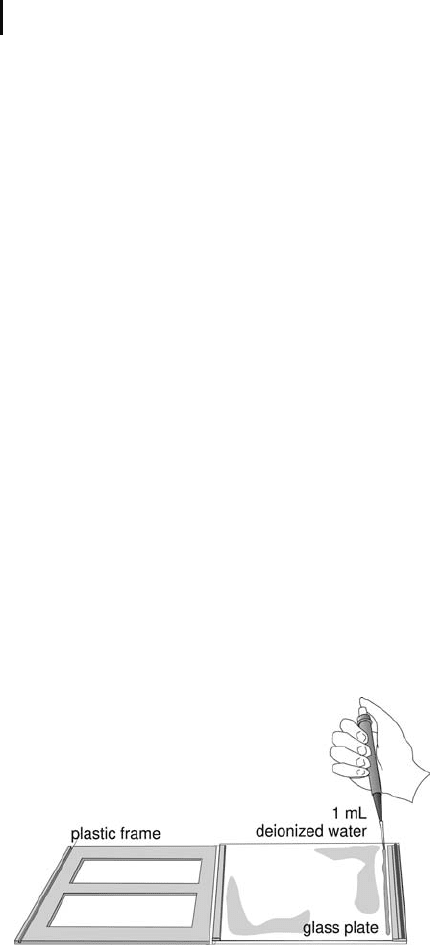
Place the cassette for ready-made gels on the
bench top with the hinge down, plastic frame to
the left. Clean the inner side of the glass plate
thoroughly with a 2% (w/v) SDS water solution,
rinse it with water and dry it completely with a
lint-free tissue paper. Pipette 1 ml deionized
water onto the glass plate as a streak along the
spacer of the closing side (see Figure 4.7).
Fig. 4.7: Application of 1 mL deionized water on the glass
plate along the spacer of the closing side.
.
Open the gel package by cutting around the gel
on three sides at about 1 cm from the edge to
avoid cutting the gel or the support film.
Remove the gel from the package.
Do not leave it in the groove,
because it would lose its sealing
property.
Do not use more than 1 mL,
because excess liquid between
gel surface and glass plate has
to be removed completely with
a roller.
4.2 Inserting Ready-made Gels into Cassettes 343
The gel is cast onto a plastic support film and does not cover the film
entirely. The support film protrudes approximately 15 mm beyond
the top (cathodal) edge of the gel and approximately 5 mm at the lat-
eral sides.
.
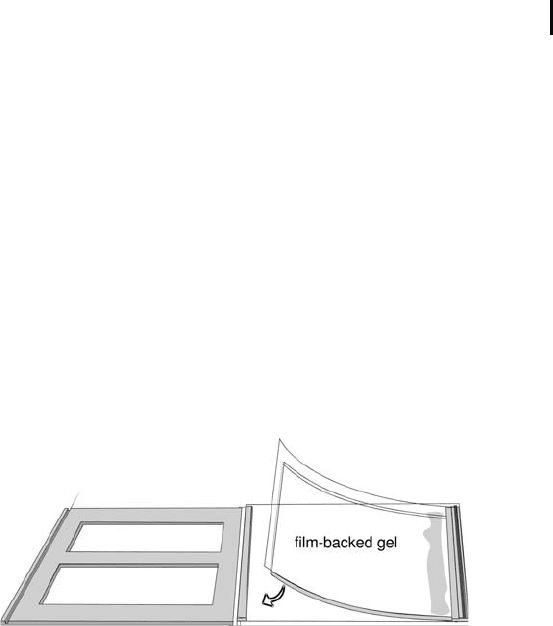
Remove the protective plastic sheet from the gel.
Handling the gel only by the side support film
margins, hold it, gel-side down, over the glass
plate. Align the right edge of the gel with the
inner edge of the side spacer next to the opening
side, flex the gel downward slightly and lower it
slowly toward the glass plate from right to left
(see Figure 4.8). Take care that the bottom edge
of the gel is flush of the bottom edge of the glass
plate. The protruding side support film margins
(not the gel) should rest on top of the side
spacers.
Fig. 4.8: Placing the film-backed gel into the cassette.
With this procedure almost no air bubbles are caught between glass
plate and gel surface. The gel edge near to the opening side will take
up a few microliters of gel buffer; this prevents eventual current leak-
age at the closing side, when gel edge should be slightly thinner than
the cassette spacer.
.
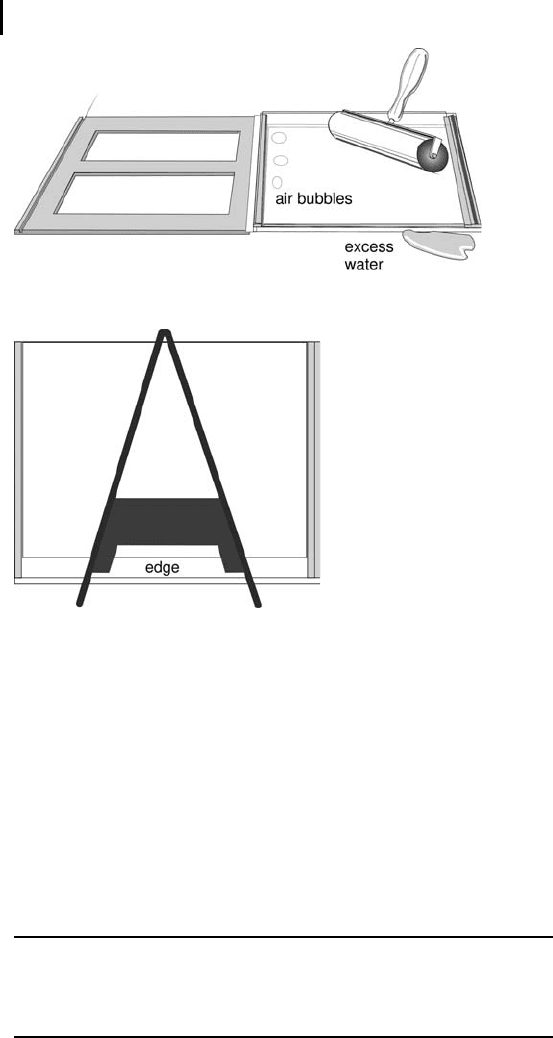
Press out any bubbles or liquid from between
the gel and the glass with a roller (Figure 4.9).
Press firmly against the plastic support film with
the roller and roll over the entire gel.
.
Snap the plastic frame to the glass plate and
press the edges tightly together. Ensure that the
cassette is closed completely: an incompletely
closed cassette causes a strongly curved front
because of current leakage.
.
Keep them in the cassette rack upside down to
prevent drying of the upper edge, to which the
IPG strip will be applied.
Step 4: SDS Polyacrylamide Gel Electrophoresis344
Fig. 4.9: Removing excess water and air bubbles with a roller.
Fig. 4.10: The cassettes are placed into the rack upside
down to prevent drying of the surface.
4.3
Preparation of SDS Electrophoresis Equipment
4.3.1
Stock Solutions for Running Buffers
The cathodal buffer is identical for laboratory-made gels containing
Tris-Cl pH 8.8 and ready-made gels containing PPA-Cl pH 7.0.
Cathodal buffer (5 to 10 concentration) = “Laemmli buffer”:
Tris base 0.25 mol/L 30.4 g
Glycine 1.92 mol/L 144.0 g
SDS 1% (w/v) 10 g
Water, deionized Make up to 1L
Store at room temperature.Do not titrate the Tris-glycine
buffer!

4.3 Preparation of SDS Electrophoresis Equipment 345
& Note: When the instruments are loaded with
more than half of the possible gel number, use
2 cathodal buffer instead of 1 buffer to
prevent buffer depletion.
1 cathodal buffer is usually used as anodal buffer for Tris-Cl pH 8.8
gels. When care is taken that anodal and cathodal buffers do not mix
during electrophoresis, the anodal buffer concentrate can be com-
posed as follows.
Anodal buffer (10 concentration) for Tris-Cl buffered gels:
Tris base 0.25 mol/L 30.4 g
SDS 1% (w/v) 10 g
Water, deionized Make up to 800 mL
4 mol/L HCl Titrate to pH 8.4
Water, deionized Make up to 1 L
Store at room temperature.
When the anodal buffer is mixed with the used cathodal buffer
after the run, there will be enough Tris in the buffer for repeated use
as anodal buffer. This saves work and reagent costs. Of course, the
cathodal buffer must be new for each electrophoretic run.
The ready-made gels contain PPA-Cl. For this buffer system, the
anodal buffer must be completely free of Tris ions. In a buffer kit 75
mL of the 100 concentrated buffer are supplied, which is enough for
one run in the high-throughput instrument and two runs in the
instrument for up to six gels.
Anodal buffer (100 concentration) for PPA-Cl buffered gels:
Diethanolamine 5 mol/L 167 mL
Acetic acid 5 mol/L 100 mL
Water, deionized Make up to 300 mL
Store at room temperature.
4.3.2
Setting up the Integrated High-throughput Instrument
.
Place the separation unit on a leveled bench.
Check with a spirit level. If necessary, adjust the
level with inserting plastic sheets below some
feet of the separation unit.
In the standard procedure the
same running buffer for the
anode and cathode tank is
used.
This saves costs, particularly
when large volumes of anodal
buffer are used.
Also in this case, care must be
taken that anodal and cathodal
buffers do not mix during the
run.
Note, this is a highly viscous
fluid.

Step 4: SDS Polyacrylamide Gel Electrophoresis346
.
Turn the pump valve at the back of the separa-
tion unit to “circulate”.
.
Pour 750 mL Tris-containing anodal buffer or –
when running ready-made gels is intended –
75 mL DEA-containing buffer concentrate into
the lower buffer tank.
.
Fill the tank up to the mark 7.5 L with deionized
water; in this way you rinse the buffer concen-
trate off the buffer seal tubing.
When identical buffers are used for the anode and the cathode, you
can pour 950 mL buffer concentrate into the tank and fill up to the
mark 9.5 L with deionized water.
.
Switch the control unit on, set the temperature
to 25 C, and set the pump to “ON”. The pump
starts to circulate the liquid, mixes the concen-
trate with the water and the buffer temperature
will be adjusted to 25 C.
4.3.3
Setting up the Six-gel Instrument
.
Take the cassette carrier and the upper buffer
chamber out of the instrument.
.
Connect the tubing to a circulating thermostat,
which has been set to 25 C.
.
Pour 450 mL Tris-containing anodal buffer or –
when running ready-made gels is intended –
45 mL DEA-containing buffer concentrate into
the lower buffer tank.
.
Fill 4 L deionized water into the tank.
.
Plug the cable for the pump in. The pump starts
to circulate the liquid, mixes the concentrate
with the water.

4.4 Equilibration of IPG Strips and transfer to SDS Gels 347
4.4
Equilibration of IPG Strips and transfer to SDS Gels
4.4.1
Equilibration
Equilibration stock solution:
6 mol/L urea 180 g
30% glycerol (v/v) 85% solution 176 mL
50 mmol/L Tris-Cl pH 8.8 1.5 mol/L stock solution 17 mL
0.01% Bromophenol blue 50 mg
Water, deionized Make up to 500 mL
Dissolve completely
Then add
2% (w/v) SDS 10.0 g
Store in 50 mL aliquots in a freezer at –20 C or below.
.
Equilibrate all strips together in the manifold
with 100 mL equilibration buffer for each step.
Or, when the IEF is run in individual strip holders:
.
Place each IPG strip into an individual equilibra-
tion tube and equilibrate with 10 mL buffer.
Equilibration:
15 min 10 mL equilibration stock solution Plus 100 mg DTT
15 min 10 mL equilibration stock solution Plus 250 mg iodoacetamide
& Note: When samples have been pre-labeled at
the cysteines with saturation dyes for a DIGE
experiment, the second equilibration step with
iodoacetamide is omitted.
4.4.2
Application of IPG Strips onto SDS Gels
Agarose sealing solution:
0.5% agarose NA 0.5 g
0.01% Bromophenol blue 10 mg
SDS cathode buffer (1 concentration) 100 mL
Do not add the SDS from the
beginning; urea and SDS
together would need a long
time to become dissolved.
Step 4: SDS Polyacrylamide Gel Electrophoresis348
.
Heat on a heating stirrer or in a microwave oven
until agarose is completely dissolved. Prepare ali-
quots for storage; store them at room tempera-
ture. Do not melt the agarose repeatedly. For
ready-made gels aliquoted sealing solutions are
supplied with the buffer kit.
Both types of cassettes (those for lab-cast and for pre-cast gels) have
one “longer” glass plate.
.
Pour a few milliliters of deionized water on the
upper gel edge using a squeeze bottle.
.
Lay the cassette on the bench with the longer
glass plate down, the protruding edge oriented
towards the operator.
.
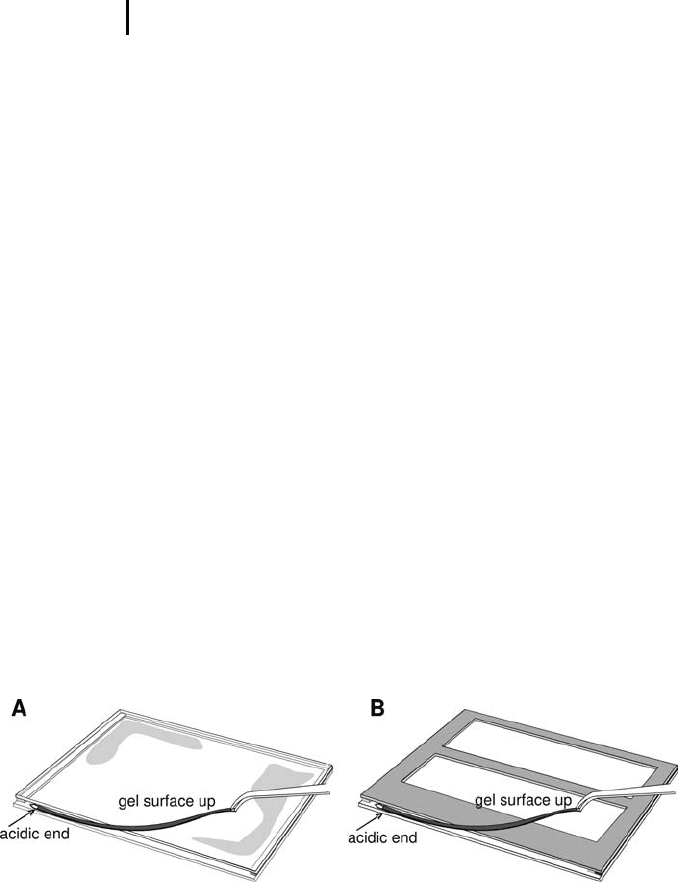
Place the strip with the acidic end to the left, gel
surface up onto the protruding edge of the
longer glass plate as shown in Figure 4.11.
When the strip is applied gel surface up, with
the acidic end to the left side, the gels are
assembled correctly in the standard orientation
as indicated on page 115.
For film-backed gels it is important to slide the IPG strip into the cas-
sette with its film-side towards the glass and its gel surface towards
the film backing. This does not matter for the laboratory-made gel
cassettes; however, a standardized orientation should always be
applied.
Fig. 4.11: Application of the equilibrated IPG strip into the SDS gel cassette for:
A. laboratory-made gels and B. ready-made gels on film support.
.
With the forceps move the strip into the cassette
slot.
.
Place the cassette into the rack, now with the
IPG strip-supporting edge upside.
.
With a thin plastic ruler, gently push the IPG
strip down so that the entire lower edge of the
This greatly facilitates insertion
of the IPG strip into the
cassette.
4.4 Equilibration of IPG Strips and transfer to SDS Gels 349
IPG strip is in contact with the top surface of the
SDS gel (see Figure 4.12). Do not push the IPG
strip down too hard, it would force a gap
between gel surface and glass plate and damage
the gel.
.
Tilt the cassette by 90 degrees to get rid of the
water.
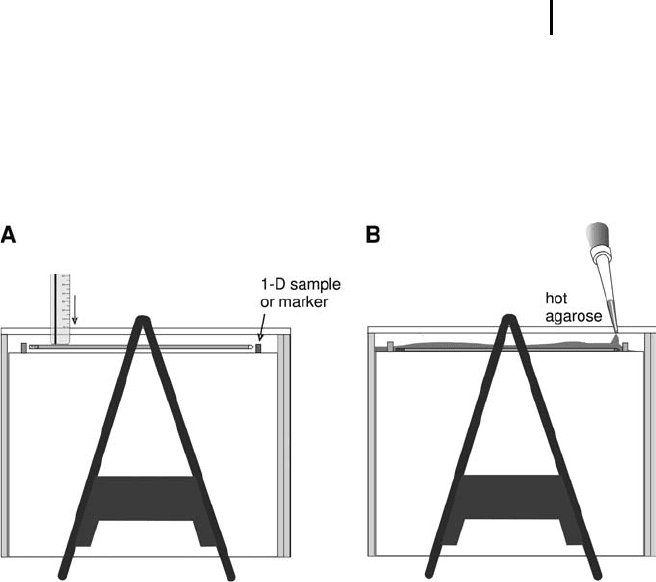
Fig. 4.12: IPG strip application on a two-dimensional gel.
A. Pushing the IPG strip onto the SDS gel with a ruler.
B. Sealing the strip and the 1-D sample pads in place with
hot agarose.
4.4.3
Application of Molecular Weight Marker Proteins and 1-D Samples
If molecular weight markers and 1-D samples should be applied,
choose 18 cm IPG strips instead of 24 cm strips. They should be
placed at least 1.5 cm apart from the spacers to achieve straight
bands. The markers should contain 200 ng to 1000 ng of each compo-
nent for Coomassie staining and about 10 ng to 50 ng of each compo-
nent for silver or sensitive fluorescent staining.
.
Rehydrate an IPG strip with molecular weight
marker protein solution.
.
Cut it into small pieces, which are stored in a
deep freezer.
Close to the spacers there are
always some edge effects,
which cause bent zones.

Step 4: SDS Polyacrylamide Gel Electrophoresis350
Alternatively:
.
Apply 15 mL molecular weight marker protein
solution on a IEF sample application piece and
let it dry.
.
For less volume, cut the sample application piece
proportionally.
.
Pick up the application piece with forceps and
apply to the top surface of the gel next to one
end of the IPG strip.
4.4.4
Seal the IPG Strip and the SDS Gel
.
Melt each aliquot as needed in a 100 C heating
block (each gel will require about 2 mL). Allow
the agarose to cool until the beaker or tube can
be hold by fingers (60 C) and then slowly pip-
ette the amount required to seal the IPG strip in
place. Pipetting slowly avoids introducing bub-
bles.
For ready-made gels the agarose will also seal the narrow gap between
the spacer near the hinge and the gel edge. The agarose must not be
too hot, otherwise it will run down through the gap before it gels.
Also, in general, carbamylation of proteins must be avoided.
4.5
The SDS Electrophoresis Run
4.5.1
The Integrated High-throughput Instrument
& Note: Never switch the pump on without liquid
in the tank.
.
Check whether the instrument has been pre-
pared as described above in Section 4.3.2.
.
Wet the tubing of the buffer seal with 0.1% SDS
water.
.
Insert the cassettes between the tubing of the
buffer seal, starting at the back. Slide them
down to the bottom.
Carbamylated peptides would
cause problems for protein
identification in mass spectro-
metry.
Spray with the plant sprayer
used for overlaying the gel
edges.

4.5 The SDS Electrophoresis Run 351
Do not force the cassettes down; this could damage the buffer seal.
Take care that the silicone tubing are not bent and stretched down;
this would cause current leakage and buffer mixing. If you detected
bent tubing, move the upper edges of the two neighboring cassettes
slightly back and forward, to release the tubing.
.
When fewer than 12 gels are run, insert blank
cassettes into the free positions. In the front,
however, a gel cassette should be inserted: this
makes it easier to watch the migration of the
Bromophenol blue front during the run.
When all cassettes are in place, the level of the anodal buffer should
be 3 mm to 5 mm below the lower buffer seal edge. If the level is
lower, remove one cassette, add some anodal buffer or deionized
water (for PPA buffer system for ready-made gels), and slide the cas-
sette in again.
If the level is higher, and you use the identical running buffer, it
does not matter. If you use an anodal buffer different from the catho-
dal buffer: open the draining valve for a very short time and close it
again immediately to pump the excess liquid out.
.
Make up 2.5 L cathodal buffer by diluting and
mixing the concentrate:
– 1 cathodal buffer for 1–6 gels (250 mL con-
centrate plus 2.25 L deionized water);
– 2 cathodal buffer for more than 6 gels, to pre-
vent buffer depletion (500 mL concentrate
plus 2 L deionized water).
.
Pour the 2.5 L cathodal buffer into the upper
tank.
.
Close the safety lid, which contains the cathodal
electrodes.
The running conditions are the same for both ready-made and labora-
tory-made SDS gels.
Setting of the programmable power supply (set temperature to
25 C):
Overnight runs:
Step 1 5 mA per gel »0.2 W 2 hours
Step 2 25 mA per gel 1 W Overnight
Turn ready-made gel cassettes
with the glass plates to the
front, because the plastic
frames are not transparent.