
Yam, Kit L. (ed.). The Wiley encyclopedia of packaging technology
Подождите немного. Документ загружается.

Products in Polyethylene Packaging for g-Irradiation,’’ Food
Addit. Contam. 18, 581–591, (2001).
46. M. E. Krzymien, D. J. Carlsson, L. Desche
ˆ
nes, and M.
Mercier, ‘‘Analyses of Volatile Transformation Products from
Additives in g-Irradiated Polyethylene Packaging,’’ Food Ad-
dit. Contam. 18, 739–749, (2001).
47. Y. Kawamura, M. Miura, Y. Miura, and T. Yamada, ‘‘Effects of
Gamma Irradiation on Antioxidants and Ultraviolet Stabili-
zers,’’ Food Irradiation Japan 33, 1–9, (1998).
48. Y. Kawamura, K. Sayama, and T. Yamada, ‘‘Effects of Gamma
Irradiation on Food Contact Polyethylene, Polypropylene and
Polystyrene: Additives and Other Chemicals,’’ Food Irradia-
tion Japan 35, 7–14, (2000).
49. D. Marque, A. Feigenbaum, D. Dainelli, and A. M. Riquet,
‘‘Safety Evaluation of an Ionized Multiplayer Plastic Film
Used for Vacuum Cooking and Meat Preservation,’’ Food
Addit. Contam. 15, 831–841, (1998).
50. F. Bourges, G. Bureau, and B. Pascat, ‘‘Effects of Electron
Beam Irradiation on Commercial Polypropylene: Kinetic
Study of Antioxidant Degradation,’’ Packag. Technol. Sci. 5,
197–204, (1992).
51. J. A. Garde, R. Catala, R. Gavara, and R. J. Hernandez,
‘‘Characterizing the Migration of Antioxidants from Polypro-
pylene into Fatty Food Simulants,’’ Food Addit. Contam. 18,
750–762, (2001).
52. D. H. Jeon, G. Y. Park, I. S. Kwak, K. H. Lee, and H. J. Park,
‘‘Antioxidants and Their Migration into Food Simulants on
Irradiated LLDPE Film,’’ LWT 40, 151–156, (2007).
53. G. Y. Park, S. Y. Cho, D. H. Jeon, I. S. Kwak, K. H. Lee, and H.
J. Park, ‘‘Formation of Monomer Residues in PS, PC, PA-6 and
PVC upon g-Irradiation,’’ Radiat. Phys. Chem. 75, 1055–1059,
(2006).
RADIO FREQUENCY IDENTIFICATION (RFID)
WILLIAM MCCOMBIE
BRUCE A. WELT
Packaging Science Program,
Agricultural and Biological
Engineering Department,
University of Florida/IFAS,
Gainesville, Florida
INTRODUCTION
Radio-frequency identification (RFID) is a method for
automatic identification that relies on storing and retriev-
ing data from transponder ‘‘tags.’’ RFID systems require
readers equipped with one or more antennas connected to
back-end computer systems. Tags are equipped with
power generation and regulation, control circuitry, data
memory, and communications capability. Readers activate
tags to initiate data transfer via radio signals. Proponents
expect RFID technology to replace conventional barcode
technologies. To date, RFID has been evaluated and im-
plemented in a number of applications including supply
chain tracking, animal identification, and toll collection.
Opponents to RFID suggest that the technology does,
however, have some drawbacks, including cost of imple-
mentation, reliability, performance, and potential for priv-
acy misuse issues.
HISTORY
RFID has roots in several technologies. One such technol-
ogy dates back to World War II, when Great Britain
implemented a system known as ‘‘Identity Friend or
Foe’’ to identify incoming planes as either friendly or
enemy. A ground transmitter would send a signal to a
plane, and a transponder on the plane would respond with
an encrypted message indicating whether the plane was
friendly. Modern RFID works on the same basic principle.
The first patent for a passive RFID-type system was
filed in 1970 (U.S. Patent 3,713,148). The term RFID was
first used in U.S. Patent 4,384,288 entitled, ‘‘Portable radio
frequency emitting identifier.’’ Since then and particularly
within the last decade, many RFID-related patents have
been issued. Significant patent holding companies include
Internic, Motorola, Alien Technology, and IBM. Modern
technology has been able to produce microchips with RFID
capability, allowing RFID to be used in many applications
at relatively low cost. However, the question remains as to
whether the costs are or will be low enough to replace
barcodes.
Proponents of RFID technology envision a future in
which any object can be wirelessly tracked. One vision
involves the smart, automated supermarket. This vision
has customers exiting supermarkets without stopping at
the cashier. Instead, embedded RFID tags in merchandise
packaging would automatically interface with readers
located on the shelves and at the exit of the store.
Payments would be processed with RFID-enabled pay-
ment cards. Simultaneously, ‘‘smart shelves’’ would detect
those items removed for purchase to provide real-time
inventory reporting allowing optimal logistics and supply,
merchandizing, and therefore optimizing sales while and
minimizing out-of-stock items.
This vision continues into the home. Purchased gro-
ceries would interface with smart appliances. A smart
refrigerator would alert consumers to expired or finished
merchandise and order new products as required in
accordance with consumer defined rules. Smart ovens
would properly cook foods by retrieving detailed cooking
instructions tags embedded in packaging. Such devices
have already been developed in numerous academic and
corporate laboratories. One such device, already devel-
oped by Samsung, uses 2D barcodes printed on product
packaging rather than RFID tags (1). Finally, when
packages are disposed of or recycled, tags might be used
to facilitate automated sorting in order to route materials
for optimal recycling, energy conversion, or disposal.
Such technologies are in developmental stages today.
The Metro Extra Future Store in Rheinberg, Germany
performed an experiment with RFID in which certain
items in the store were individually tagged. Several items
were placed on ‘‘smart shelves,’’ which detect removed
items and signal back-end systems to request more stock.
Some items had tags attached to the packaging, while
1058 RADIO FREQUENCY IDENTIFICATION (RFID)

other items, such as Gillette razors, had tags embedded at
the factory.
Digital video disks (DVDs) stocked by the store also
contained RFID tags and were used in conjunction with
interactive kiosks, allowing shoppers to watch movie pre-
views. The store also embedded RFID tags in its customer
loyalty cards, but this was later discontinued after privacy
advocates protested the practice (2).
Currently, RFID tags cost as low as about 7b per tag
when purchased in multimillion unit quantities. Manu-
facturing costs continue to be relatively high as manufac-
turing processes are improved and scaled. However,
failure rates of RFID tags continue to be unsustainably
high. Defective tag rates, postapplication tag failure rates,
and overall tag longevity are not well known as manufac-
turers are reluctant to share such data. However, experi-
ence with various tag types suggest defective rates in the
range of 30% and postapplication failure rates in the
5–20% range within one year of application. Rigorous,
third-party studies are needed to more fully understand
RFID tag failure modes and rates.
Alien Technology and Symbol Technologies (now Moto-
rola) are both attempting to reduce this cost with Fluidic
Self-Assembly (FSA) and Parallel Integrated Chip Assem-
bly (PICA), respectively (3, 4). Table 1 summarizes these
technologies.
INDUSTRY STANDARDS FOR AUTOMATIC
IDENTIFICATION
Barcodes
Barcodes have been around for many years, and there are
many standards. One of the most common in the United
States is the Universal Product Code, which retailers use
to identify merchandise. Other standards exist, many of
them proprietary. Most barcodes, however, do not un-
iquely identify an item, but rather an item type (e.g.
‘‘case of super-widgets’’ versus ‘‘this case is the 82nd case
of widgets.’’)
UID
Universal Identification is a method used by the United
States Department of Defense (DOD) to identify assets
(5). DOD describes its needs for unique identification
capabilities as follows (6):
The Department must, of necessity, uniquely identify the
items to which it takes title to provide for better asset
accountability, valuation and life cycle management. Unique
identification provides the Department the opportunity to
differentiate an individual item from all others. Unique iden-
tification of items provides the Department with the source
data to facilitate accomplishment of the following:
. Improve the acquisition of equipment- and performance-
based logistics services for the warfighter,
. Capture timely, accurate, and reliable data on items (i.e.,
equipment, reparables, materials, and consumables),
. Improve life-cycle asset management.
. Track items in the department and industry systems for
operational, logistic, and financial accountability purposes.
While DoD’s UID mandate requires physical marking
of all items with a unique code, RFID is being used as a
means to transfer UID information. UID is primarily
implemented using two-dimensional ‘‘DataMatrix’’ style
barcodes.
EPC Global
The Electronic Product Code (EPC) is a set of standards
initiated by the Massachusetts Institute of Technology
(MIT) Auto ID Labs and eventually overseen by EPC
Global Inc. The EPC protocols intend to ensure that all
tags, RFID or otherwise, are coded with unique values.
EPC Global defines a set of standards for hardware,
software, and the codes themselves. An EPC can contain
a preexisting standard, such as Global Trade Identifica-
tion Number (GTIN), Serial Shipping Container Code
(SSCC), Global Location Number (GLN), Global Return-
able Asset Identifier (GRAI), or Global Individual Asset
Identifier (GIAI), and provides specifications for imple-
menting such codes within an EPC (7).
The EPC standard dictates how data should be stored
on tags, in addition to translating codes from one format to
another. An example of how UPC/GTIN is implemented as
a unique and serialized EPC SGTIN code follows.
Global Trade Identification Number (GTIN) is one
method of identifying objects with an automated data
capture system. GTIN, like UPC, does not, however,
uniquely identify items. The EPC system includes a
serialized GTIN, known as Serialized Global Trade
Table 1. Summary of RFID Technologies
Method Company Description Progress
Fluidic self-assembly Alien Technology Chips are attached by flowing in a
special fluid over holes shaped
to catch the chips.
Alien claims that prices will
continue to drop as FSA
production increases.
PICA (parallel integrated chip
assembly)
Symbol Technologies Attaches RFID chips to inlays
(antennas) in parallel.
Expected to be online in 2006;
however, this is not the case.
Conventional methods Various companies Tags are manufactured by
attaching each chip to each
antenna individually.
RADIO FREQUENCY IDENTIFICATION (RFID) 1059

Identification Number. The code includes a header (used
to identify the encoding to the reader, whether it is SGTIN
or another standard, and the size of the tag in bits); a filter
to separate loads by pallet, case, or item; a company
identification number; a product identification number,
and a serial number. This information can be used to
query a database to find out more information about
tagged items. The 64- and 96-bit EPC compliant tags are
currently available; however, 64-bit tags are being phased
out. Table 2 shows an example of SGTIN-96 encoding.
It is worth noting that although EPC was developed to
be used with RIFD, industry is realizing that serialized
codes can also be implemented with other identification
methods, including barcodes.
Hardware. EPC Global standards define operational
characteristics for hardware, including frequency and wire-
less communication protocols. These standards provide for
common communications methods and interfaces that al-
low components from different companies to work together.
Software. RFID middleware is software used to inter-
face between RFID readers and other components, includ-
ing user interfaces, databases, and other applications. The
main purpose of middleware is to simplify interfacing back
end systems with new RFID hardware. As RFID gains
acceptance, RFID software and backend systems are being
developed to more easily integrate, thus putting into
question the long-term need for middleware applications.
There are several commercial and open source packages
available on the market, including solutions from Micro-
soft, Inc., ConnecTerra, Inc. (now BEA Systems, Inc.),
GlobeRanger, Inc., IBM, Inc., and Sun Microsystems, Inc.
Middleware packages are capable of interfacing di-
rectly with RFID devices and can translate information
from the reader(s) into formats that can be used by other
applications. An EPC Global encoded tag, for example, can
be broken down into specific values for company, item, and
serial number, while the middleware performs one action
for carton tags and another for pallet tags. Another
advantage of using middleware is compatibility with
different brands and models of RFID readers.
It is worth noting that middleware is not necessarily
limited to RFID technology. Most packages are compatible
with conventional barcode systems and other systems as
well.
RFID devices are being offered with increasing levels of
middleware functionality built in. These are capable of
doing basic middleware operations without the need for
additional software. Alternatively, for some applications,
such as those where only a single reader is used, custom
software can be written to interpret tag information.
APPLICATIONS
One of the largest applications of RFID is supply chain
management. This industry has used conventional bar-
codes for years with great success. RFID initiated serial-
ization offers potential to greatly enhance supply chain
visibility and enables suppliers and retailers to track
goods from the point of manufacture to the store shelf
and beyond.
The lowest level of RFID tracking is known as ‘‘item
level’’ tagging and consists of placing RFID tags on
individual items, in a manner similar to UPC labels on
most grocery products. Item level tagging has been tested
and implemented in several retail environments, such as
at Wal-Mart stores and Metro Group’s Extra Future Store
initiative in Germany. Most modern implementations,
however, have been limited to case and pallet levels.
Wal-Mart is one of the largest backers of the technology
and has put it to use to in an effort to improve supply
chain efficiency, reduce labor costs, and reduce shelf out-
of-stocks, apparently resulting in increased sales (8, 9).
Electronics retailer Best Buy Co. Inc. (Richfield, Minne-
sota) also experimented with item level RFID on DVDs
and video games. The initial trial was linked to increased
DVD sales due to reductions in out-of-stock merchandise
(10).
The supply chain is not the only place where RFID has
been implemented. Toll booths have used RFID to auto-
matically collect tolls using transponders carried by mo-
torists. Examples include SunPass (a toll collection system
used in Florida) and EZ-Pass (a toll collection system used
in the northeastern United States).
A primitive form of RFID is Electronic Article Surveil-
lance (EAS). A major supplier of EAS systems is Tyco,
Inc.’s (Pembroke, Bermuda) ADT Division (formerly Sen-
sormatic of Boca Raton, FL). Instead of using a chip to
store information, EAS tags use simple tuned circuits that
respond to particular radio frequencies. Such systems are
commonly used in retail stores to deter shoplifting, and
they are also used in libraries to prevent removal of
articles that have not been checked out. Such tags are
either removed or deactivated at check-out to prevent
Table 2. Example of SGTIN-96 Encoding
Field Header Filter Partition Company Item Serial
Number of
bits
8 3 3 20-40 (dependant
on partition size)
24-4 (dependant
on partition size)
38
Description Set to 0 30
to indicate
SGTIN-96
encoding
Determines
the type of
item, such as
a pallet,
carton, or
item
Determines
the size of the
company and
Item fields
Identifies the
company that
produced the
item
Identifies the
item the tag is
attached to, such
as a box of
detergent
Serial number to
uniquely identify
a product (i.e.,
which box of
detergent)
1060 RADIO FREQUENCY IDENTIFICATION (RFID)

them from triggering alarms when removed from
the premises. Figure 1 shows Checkpoint Systems Inc.
(Thorofare, NJ) EAS antennas at the entrance to the
University of Florida bookstore. Upon removing an unpaid
item (or an item that has not been deactivated properly),
such as a textbook, an alarm will sound, alerting store
staff. Checkpoint also manufacturers EPCGlobal compa-
tible RFID products and produces a line of EAS devices
that may be upgraded for use with RFID systems. Other
applications of RFID include ExxonMobil’s (Irving, Texas)
SpeedPass, first used in 1997. It was a system that allowed
cashless payments at Mobil/Exxon fueling stations, and
also at McDonald’s fast food restaurants with a simple
keychain attachment (11).
Credit card manufacturers have also recently started
embedding RFID chips within credit cards for cashless
payments, and many cities have used RFID for transport
payments. Examples include Visa’s payWave, Master-
Card’s PayPass, and American Express’s ExpressPay.
Animal tracking is another application of RFID. Do-
mesticated pets and livestock can be injected with a
subdermal RFID chip, improving herd management and
allowing lost animals to be identified.
TYPES OF RFID
Passive RFID
Passive RFID is a type of RFID tagging in which tags are
not self-powered. Passive tags are designed to harvest
power from radio signals transmitted by an RFID reader
at a particular frequency. When within the electromag-
netic field emitted by the reader, passive tags activate and
respond as required to interrogation. The two most com-
mon passive technologies involve high-frequency (HF) and
ultra-high-frequency (UHF) energy. The HF mode uses
the magnetic component of the field and has a very short
read range. HF tags typically need to be within a few
centimeters of a reader. UHF tags offer greater read
ranges that are typically on the order of a 2–10 ft. UHF
tags are more common for supply chain applications,
whereas HF tags are finding greater use in asset manage-
ment and other applications that require more intimate
proximity between reader and tag (e.g., hospital patient
bracelets for drug distribution). UHF tags communicate
using the principle of backscatter radiation. Essentially,
the tag reflects a portion of reader’s energy back to the
reader with a superimposed modulated signal (12). Tag
performance depends upon antenna size and geometry.
Tag size is mainly due to the antenna. Larger antennas
tend to provide longer read ranges. Current technology
has enabled tags to be embedded in paper or under the
skin. Hitachi’s mChip, for example, is 7.5 mm thick (13).
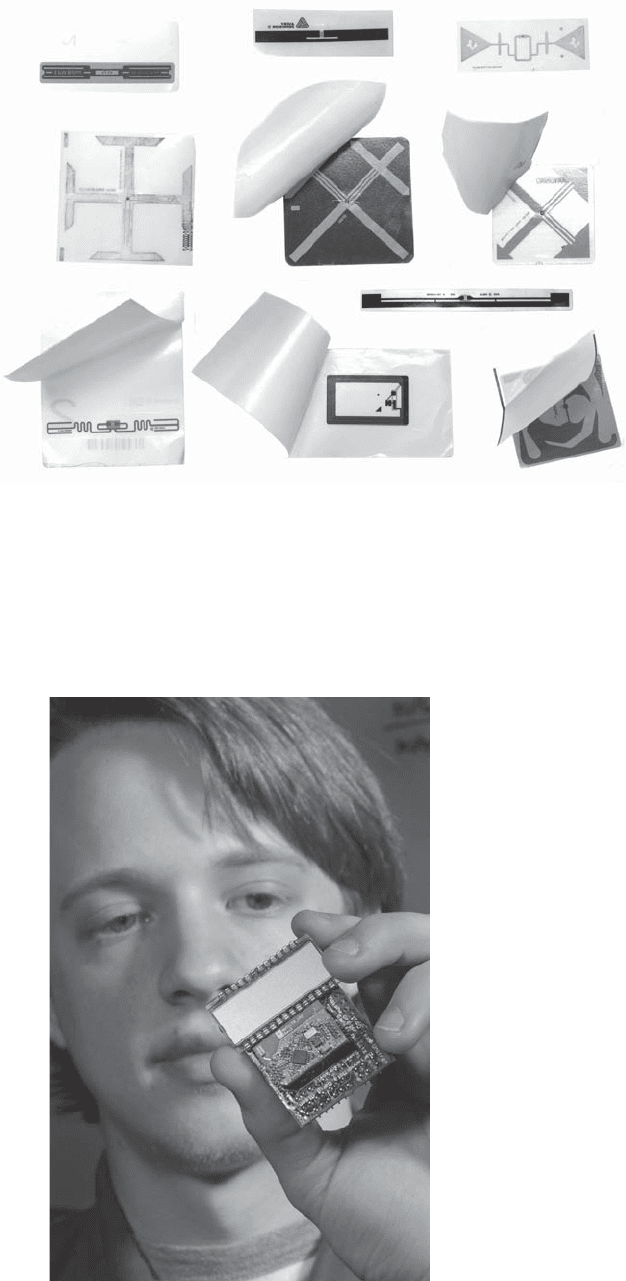
Passive RFID tags have been used for tracking pallets of
goods, contactless ‘‘smart cards,’’ and machine readable
passports. Figure 2 shows some passive RFID tags.
Active RFID
Active RFID involves tags with an internal power source,
such as a battery. One common application of active RFID
technology is electronic toll collection. Active RFID tags
may also be paired with one or more different types of
sensors, such as temperature sensors. Toll collection de-
vices may include some form of feedback, alerting the user
when a toll is collected. Active RFID tags are much more
expensive than passive RFID tags and are typically in the
$5to$100 range. Figure 3 shows an active RFID sensor
developed at the University of Florida to assist in mon-
itoring food freshness (14).
Semiactive/Semipassive
Semiactive/semipassive RFID tags, like active tags, also
contain a power supply, but this power supply is only used
to power the circuitry. The radio signal is transmitted
using power from the incoming radio signal. Semiactive/
semipassive RFID technology is being developed primarily
for ‘‘smart’’ reusable containers and pallets.
Frequencies
Many RFID systems can interface with tags from other
systems if the frequencies and protocols are the same.
There are some standards to frequencies, and lower-
frequency tags are generally less expensive but have a
shorter range (Table 3) (15).
ADVANTAGES AND DISADVANTAGES OF RFID
Advantages
Unlike barcodes, which require a line of sight between
reader and barcode, RFID tags interface with readers using
radio signals. RFID chips are tiny while storing hundreds
or thousands of bits of information, which allows tags
to be hidden from view. By comparison, barcodes require
clearly visible area on items or packaging, and this area
requirement generally increases with the amount of data
stored.
Figure 1. Checkpoint EAS antennas use special one-bit tags to
detect unauthorized removal of products from premises.
RADIO FREQUENCY IDENTIFICATION (RFID) 1061
Data collection rate is the primary advantage of RFID.
Since barcodes require line-of-sight for data collection,
barcode read rates depend upon rates at which barcodes
can be presented to readers. RFID tags communicate
without line of sight and at high frequency allowing tens
or hundreds of tags to be read each second. However, this
inherent advantage of RFID is mitigated by the rates at
which items such as containers, pallets, cases and items
can be physically moved through the supply chain. Since
barcode readers are capable of reading data on items at
the highest speeds attainable within the supply chain, this
RFID advantage may not be fully exploitable.
Another advantage of RFID is that it helped to intro-
duced standards and serialization to industry. With con-
ventional UPC/EAN barcodes, each package of an item
contains an identical product code. They identify only the
manufacturer and the product type. A serialized RFID
tag, on the other hand, contains a serial number, allowing
a reader to determine which package of a product is being
scanned. This information can be queried into a database
to determine the source, expiration date, and other useful
information about a particular item.
Disadvantages
Data Transmission. In theory, radio signals can be read
without direct line of sight between tags and readers. In
practice, however, something close to line of sight is often
necessary due to dielectric properties of tagged items.
Many products are good absorbers of electromagnetic
energy used for RFID, which interferes with low power
RFID transmissions. Additionally, many products contain
metals or metal packaging. Metals shield, scatter, and
reflect radio signals, resulting in unpredictable RFID
performance. Therefore, maximum, or at least predictable,
RFID performance is often obtained when the least mate-
rial is placed between tag and reader, practically negating
the purported ‘‘no line of sight’’ benefit.
Reliability. As with any electronic device, RFID tags
have a tendency to fail. Most passive RFID tags consist of
an integrated circuit connected to an antenna. Should the
chip, antenna, or the connection between the chip and
Figure 2. Assorted passive UHF RFID tags.
Figure 3. Active RFID freshness monitoring tag developed at
the University of Florida.
1062 RADIO FREQUENCY IDENTIFICATION (RFID)

antenna become damaged, the tag will no longer function
properly. Unlike barcodes, RFID tags are more dependent
on the environment. One problem facing RFID implemen-
tation is difficulty reading tags attached to metals or
liquid containers.
Additionally, some consumers have devised methods to
detect and ‘kill’ RFID tags. One such example is the RFID
Zapper, created using an off-the-shelf single-use camera
and a coil of wire. The device uses the capacitor in the
camera (normally used to power the flash) to pass a high
voltage through the coil, overpowering the RFID tag and
causing the circuit to overload (16). RFID tags can also be
disabled by placing them in a microwave oven; however,
this can be dangerous and can cause damage to the tagged
item and the microwave oven as well as the RFID tag (17).
In either case, the impact of disabled tags on supply chain
peformance remains unmeasured.
Cost. RFID tags are extremely costly in comparison to
barcodes, even at the industry’s current target rate of 5
cents per RFID tag. In addition to direct costs, RFID
tags cannot be produced in the field. Therefore, commit-
ment to RFID technology requires a related commitment
to actively managed RFID tag inventory. Unexpected
shortages of tags could seriously disrupt operations. Alter-
natively, barcodes may be printed as required on virtually
any substrate using a variety of well-established printing
or marking techniques. By comparison, barcodes are 100
to 1000 times less expensive than RFID tags that contain
similar data.
Disposable tags are not the only investment in imple-
mentation. RFID implementation requires RFID-enabled
label printers, readers, and antennas, software, middle-
ware, computers, and network infrastructure that are
compatible with a particular generation of RFID tags.
Currently, the switch to ‘‘Generation 2’’ tags quickly
rendered first generation technology obsolete. It is likely
that improvements in RFID technologies will result in
required costly hardware upgrades that were similar to
other computer networking products. Recall networking
technology migrating from 1200 bps telephone modems to
56k modems to ISDN, T1, ADSL, and so on. While costly
upgrades in networking technologies were quickly offset
by productivity increases and new revenue generating
opportunities, such immediate and apparent rewards are
probably not awaiting capital expenditures for upgraded
RFID hardware for basic supply chain management
functionality.
Consumers
Privacy and Security. One obstacle in deploying RFID is
consumer privacy. Advocacy organizations, such as Con-
sumers Against Supermarket Privacy Invasion and Num-
bering (CASPIAN) and FoeBud, a German group of RFID
and privacy activists, strongly oppose item level tracking,
since these technologies may allow for undisclosed wire-
less customer tracking. One controversial example in-
volves a system that collects photos of customers as
products are removed from shelves (18). While the system
was promoted as a means to reduce shoplifting, consumer
advocacy groups fear that such technologies violate con-
sumer rights.
While some retailers, including the Metro Extra Future
Store, claim that RFID tags are useless once they leave
the store, privacy advocates claim that the tags are still
‘‘live’’ and can be tracked by other readers beyond the
store of purchase.
Opponents envision a ‘‘1984’’-type society in which all
people and objects are tracked using microchips embedded
under the skin. In fact, such systems are now widely used
for pets (19). The VeriChip or VeriPay (20) is a type of
RFID chip that is designed to be implanted under the skin.
While it may only contain a 16-digit serial number, this
information is linked to a database and can also be picked
up by any compatible reader. One such use of the VeriChip
is at the Baja Beach Club, in Barcelona, Spain, which
experimented with implanting chips in people to allow
them to pay for drinks and obtain VIP benefits without the
need to carry a wallet. Human-implantable chips have
also been used in medical settings for patient identifica-
tion, though they are not without health and privacy risks
of their own (21). Religious groups have even linked such
Table 3.
Technology Frequencies
Read Range
(Approximate) Characteristics Applications
Low frequency o135 KHz o1 ft Coiled antennas Can
work around fluids
and metals
Animal identification
Automation Access control
High frequency 13.56 MHz W3 ft Common around the
world Poor
performance around
metals
Payment and loyalty cards
Access control Item level
tracking People
identification
Ultra-high frequency 433 MHz W10 ft Interference from
liquids and metals
Supply chain
860 MHz-930 MHz
(depending on region)
100’s of feet for some
active systems
Microwave 2.45 GHz, 5.8 GHz Similar to UHF Fast data transfer
rates.
Access control
May be active or
passive
Toll collection Industrial
automation
RADIO FREQUENCY IDENTIFICATION (RFID) 1063
chips to the book of Revelation, which apparently de-
scribes a time in which people are required to take a
mark in order to buy or sell (17).
Disposal. A significant, yet little publicized, challenge
facing RFID is the issue of disposal. Passive RFID tags
have been designed to be discarded, and electronic waste
is a growing problem in the United States (21). RFID
tagging may contribute to the problem because RFID tags
are fabricated in ways that make them difficult to recycle;
and because they are designed to be attached to or part of
other items, RFID tags interfere with established recy-
cling technologies. One study on the impact of RFID tags
on corrugated recycling found that (1) laminated copper
antennas do not readily break down and are removed
early in the pulping process as a nonrecyclable solid waste
and (2) conductive silver inks used as an alternative to
copper on nonlaminated labels remain with paper sub-
strates and are not easily extractable from finished paper
(22).
Interference and Spurious Reads. As with any radio-fre-
quency device, RFID systems are susceptible to electromag-
netic interference. Interference may interrupt, obstruct, or
degrade performance of RFID systems. There are many
sources of interference, particularly in industrial settings.
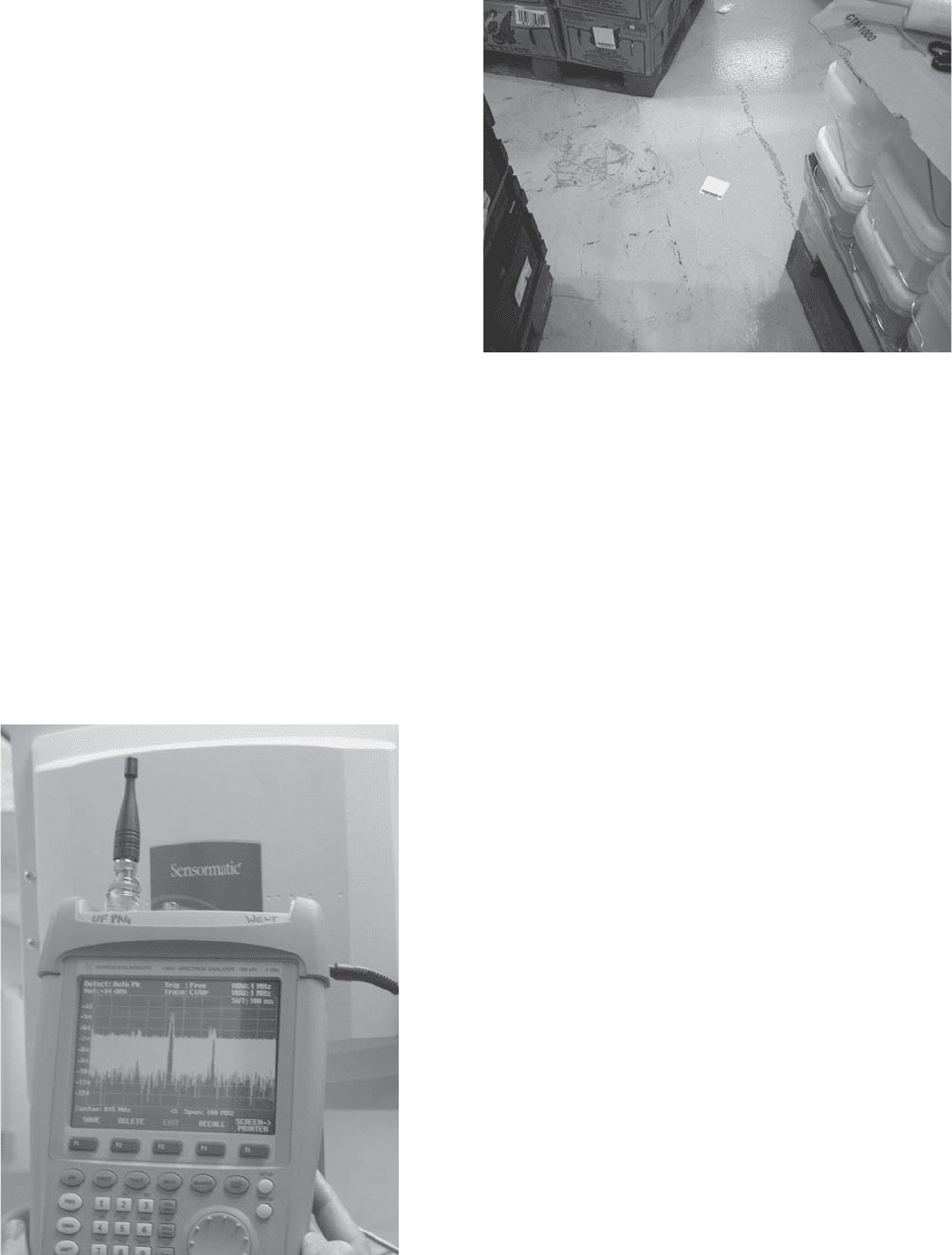
The Packaging Science Laboratory at the University of
Florida has relied upon a hand-held spectrum analyzer to
identify and mitigate potential sources of interference
(Figure 4).
The EPC Global RFID air operating protocol requires
that complying RFID reader manufacturers use frequency
hopping spread spectrum (FHSS) to mitigate electromag-
netic interference issues (23).
RFID systems are also quite susceptible to spurious
reads. Spurious reads involve reading tags that are not
intended to be read. Spurious read may occur for many
reasons including tags that become separated from packa-
ging. Figure 5 shows an example of a tag that may
interfere with normal RFID operation.
Spurious reads are a particular problem in multireader
environments. Also, manual handling of tagged items in
reader environments can also be problematic because
items might be carried through read zones in directions
opposite to expected flow. Spurious reads could also be a
serious problem in automatic checkout and payment
applications in retail outlets, where items from one cus-
tomer’s cart are charged to another customer.
IMPLEMENTATION OF RFID IN THE INDUSTRY
Mandates by Companies
Wal-Mart. Wal-Mart, Inc. made a big push into RFID
primarily as a way to reduce labor costs and occurrences of
out-of-stock merchandise. In 2003, Wal-Mart announced
that it would require its top 100 suppliers to use ultra-
high-frequency RFID tags conforming to EPC Global
standards on pallets and cases destined to specific dis-
tribution test centers by January 2005. Additionally, Wal-
Mart insisted that no price increases to cover RFID
investments would be tolerated. This requirement was
later eased to 65% of pallets and cartons due to issues with
reading tags on metal and liquid (15). Wal-Mart then
extended the requirement to other suppliers, expecting
all suppliers to use RFID by December 2006.
Wal-Mart RFID specifications stated an expectation to
be able to read 100% of pallet tags in the pallet/portal
configuration and 100% of case tags for cases in any
Figure 4. Handheld spectrum analyzer at the University of
Florida Packaging Lab.
Figure 5. RFID tag that fell from palletized product. (Photo by
Bruce Welt, University of Florida.)
1064 RADIO FREQUENCY IDENTIFICATION (RFID)

orientation moving at up to 600 ft/min on conveyor equip-
ment (24). These specifications led to considerable anxiety,
confusion, and capital expenditure as companies scram-
bled to acquire limited quantities of first-generation RFID
hardware. Additionally, RFID testing laboratories began
to sprout all over the United States where work focused on
equipment performance comparisons, tag read rates, tag
placement on cases and pallets, read ranges, product
interference issues, and so on (12). Of particular note is
the amount of work devoted to improving read rates of
palletized cases moving through RFID portals even
though Wal-Mart’s specifications did not require case
tags to be read in this configuration (25, 26). The practical
result of this work, however, was the realization that line-
of-site was practically necessary in order to be sure that
the pallet tags and case tags could be read as required.
Wal-Mart and RFID proponents generally supported
use of nonproprietary, EPC Global standards in order to
allow the industry to quickly grow to a necessary critical
mass to ensure survival. Several years of effort went into
development of ‘‘Generation 2’’ technology, which elimi-
nated issues related to incompatible tags and equipment.
Ultimately, Generation 2 technology was to be freely
available to all participants. However, once these stan-
dards were ratified, Intermec, Inc. (Everett, Washington)
caused a stir by indicating that its intention to make its
patents available did not mean that they would be avail-
able without cost. Intermec’s RFID patent portfolio cur-
rently covers critical aspects of RFID as ratified in the
Generation 2 standard. To avoid prolonged legal wran-
gling, Intermec devised an apparently effective plan to
properly reward its shareholders while allowing the RFID
industry to move forward. Its plan involved offering access
to its complete patent portfolio under a preferred royalty
plan, but only for a limited time of 90 days. Companies
that did not sign up within the 90-day period would be
required to negotiate terms on a patent-by-patent basis as
well as face patent infringement actions. Intermec’s plan
was apparently successful; and even archrival and sole
holdout, Symbol Technologies, Inc. (now part of Motorola),
ultimately acquiesced and arrived at an agreement with
Intermec, albeit after the 90-day window closed.
US DoD. The United States Department of Defense
(DoD) has a large number of assets; and at any time, many
of these assets are in transit. The DoD needed a way to
track these assets. It assigned each asset with a Unique
Identifier (UID), and uses RFID to read UID values from
objects. It mandated all shipments to be equipped with
RFID tags (5, 7). The DoD uses standard EPCglobal
compliant tags. As with other RFID applications, adoption
has been slow, but the DoD attributes this to its necessary
focus on current intensive military operations (27).
ALTERNATIVES TO RFID
RFID has provided industry with two potentially valuable
advances. First, RFID made code serialization feasible
and accessible. By serializing identification codes, each
tagged item can be independently tracked through the
supply chain. This realization has helped to create new
opportunities for improving supply chain logistics. Second,
RFID brought people and companies together to create
standards and operating procedures that provide for more
efficient data transfer and collaboration.
While RFID might be credited for helping to bring
these advances, the cruel irony is that many are starting
to realize that all of the benefits from these advances may
be realized without RFID. Ultimately, RFID is simply a
means to collect data via radio waves. Other well-estab-
lished technologies are also available that are useful for
collecting data, and these may be simpler and cheaper to
implement than RFID. Barcodes and image processing are
two promising alternative methods for collecting data.
Technological advances in electronics have been increas-
ing the power, speed, and capabilities of barcode and
image processing systems while reducing costs.
Chipless RFID
Chipless RFID is a recent innovation that combines RFID
and barcodes. Unlike conventional RFID tags, chipless
RFID does not rely on a central integrated circuit to
transmit and receive information and instead uses a series
of chemicals, each tuned to resonate at a certain frequency
when excited by incoming radio waves. Each chemical
represents a bit, with a chemical’s presence representing a
1 and its absence representing a 0. Such a system can be
printed relatively inexpensively onto an item, similar to
how barcodes are printed. The developers of such a
technology intend for chipless RFID to assist in anti-
counterfeiting and anti-copying measures (28). Unlike
conventional RFID, however, chipless RFID does not
provide features commonly found on RFID chips, such as
error and interference detection and avoidance.
1D Barcodes
Barcodes were invented shortly after World War II in
response to a need to manage grocery inventory. In
September 1969 the Grocery Manufacturers of America
(GMA) and the National Association of Food Chains met to
express a need for an ‘‘inter-industry product code.’’ The
effort of an ad hoc committee resulted in an 11-digit code
now commonly known as the Universal Product Code
(UPC) (Figure 6). After considerable time and develop-
ment, on June 6, 1974 a pack of Wrigley’s gum was
checked out of Marsh’s Supermarket in Troy, OH using a
barcode scanner developed by NCR, formerly National
Cash Register Company (29, 30).
Figure 6. UPC barcode example for (123456789012).
RADIO FREQUENCY IDENTIFICATION (RFID) 1065
While UPC barcodes served the grocery industry well,
other code standards were developed for other industries.
Today there are barcode standards that can include
numbers, letters, and the special characters that make
up the complete ASCII character set. Table 4 summarizes
these barcode standards. The UPC code standard has been
widely adopted throughout the world as a slightly mod-
ified barcode known as European Article Numbering
(EAN). The 11-digit UPC code actually presents 12 digits
because the last digit serves as a checksum digit to ensure
reading accuracy. The EAN-13 symbology is a superset of
the UPC symbology and contains 13 digits in order to
accommodate country identification codes, which are re-
quired in Europe and other parts of the world. The UPC
and EAN contain a string of numbers indicating the
source or company associated with the item as well as a
code identifying the item type. The UPC, however, does
not store a serial number, which means that each choco-
late bar has an identical UPC.
UPC/EAN codes can also be represented as Global
Trade Identification (GTIN) numbers, which is the current
basis for identifying goods in transit throughout the
world. RFID added unique serial numbers to GTIN, which
are now known as serialized global identification numbers
(S-GTIN). The EPC Global, Inc. electronic product code
(EPC) is a superset of S-GTIN and contains additional
information about the nature of the particular type of
RFID tag that is used, which are not needed for non-radio-
based systems. The important question at this time is
whether RFID is the appropriate technology to carry
serialization forward.
The main problem with adding serial numbers to linear
barcodes is that they require significant amounts of print-
ing area, which most companies would rather devote to
informational or promotional content. One promising tech-
nology that is squeezing more data into smaller areas was
originally known as reduced space symbology (RSS). RSS is
actually a family of symbologies, each developed for some
marketplace efficiency such as speed, size, or readability.
The name ‘‘RSS’’ created confusion due to another unre-
lated technology for syndicating web content (‘‘really sim-
ple syndication’’), which was also known as RSS. Therefore,
the term RSS is being rebranded as GS1 Databart (31).
Currently, a GS1 Databar version of the UPC code requires
about 1/3 of the area currently consumed by the UPC/EAN
barcode (32). This provides ample opportunity to include
serialization and/or other useful data in the future. GS1
Databar will likely prove to be a serious challenger to RFID
technology in the near future as GS1 Databar technology is
scheduled to sunrise in 2010 (Figure 7).
OCR
Optical Character Recognition (OCR) is a technology in
which a computer or machine is used to read standard
text. Such technology is in use by postal services, for
example, to read address labels and direct mail to correct
destinations. A variation, Magnetic Ink Character Recog-
nition (MICR), is commonly used by banks and retailers to
process checks. Figure 8 shows human readable version of
EPC data being captured by a Cognex, Inc. vision system.
Figure 9 shows both the 2D barcode and human-readable
text being interpreted by the camera software.
OCR algorithms are not currently as robust as barcode
readers at this time; however, technological improvements
in hardware and software along with cost reductions will
likely open opportunities for human-readable data in the
future.
2D Barcodes
Two-dimensional barcodes are a relatively new technology
that store more data than conventional linear barcodes.
While they carry the same advantages and disadvantages
of linear barcodes, the ability to store more data makes it
more practical to store information such as a serial
number. 2D barcodes have been used by UPS for package
tracking, by state governments for Driver Licenses/ID
cards, and by NASA for part identification.
One of the most common 2D barcode standards is
DataMatrix (Figure 10). It is designed such that it can
be printed or engraved on objects as small as the head of a
pin (5) or as large as several feet across. The symbols
themselves can hold up to 2335 alphanumeric characters,
and they include error detection and correction algorithms
that produce a valid read even if a significant portion of
the symbol is damaged or absent. DataMatrix codes, like
RFID, can be used to store serialized EPC and UID codes.
Figure 11 shows a 2D barcode with some damage. Even
though some data are missing, some or all of the data can
still be read.
Figure 12 shows 2D barcode information used to store
digital sound data on a roll of movie film in two different
formats.
Another advantage of tracking using 2D barcodes is
backward compatibility. 2D barcode equipment can print
and read linear barcodes without the need for additional
hardware.
PRACTICAL TESTING AND IMPLEMENTATION
Universal tracking of items in rapidly moving supply
chains requires robust systems. To successfully implement
such systems, testing is required to understand basic
performance characteristics, weaknesses, and limitations.
Such evaluations can be extensive, complex, and tedious.
RFID Hardware
A simple RFID system consists of a tag, a reader, and an
antenna. The reader transmits and receives signals to and
from the tag through the antenna.
RFID Printer. While RFID tags can be programmed
at the factory or by readers, it may be desirable to
program RFID tags using a specially designed label
printer
. Such printers
print onto labels with em-
bedded RFID tags. The printer contains an RFID
device that programs tags as labels are printed. This
method allows easy mass encoding of RFID tags.
Currently, however, encoding RFID tags while print-
ing tags significantly slows the printing process.
1066 RADIO FREQUENCY IDENTIFICATION (RFID)
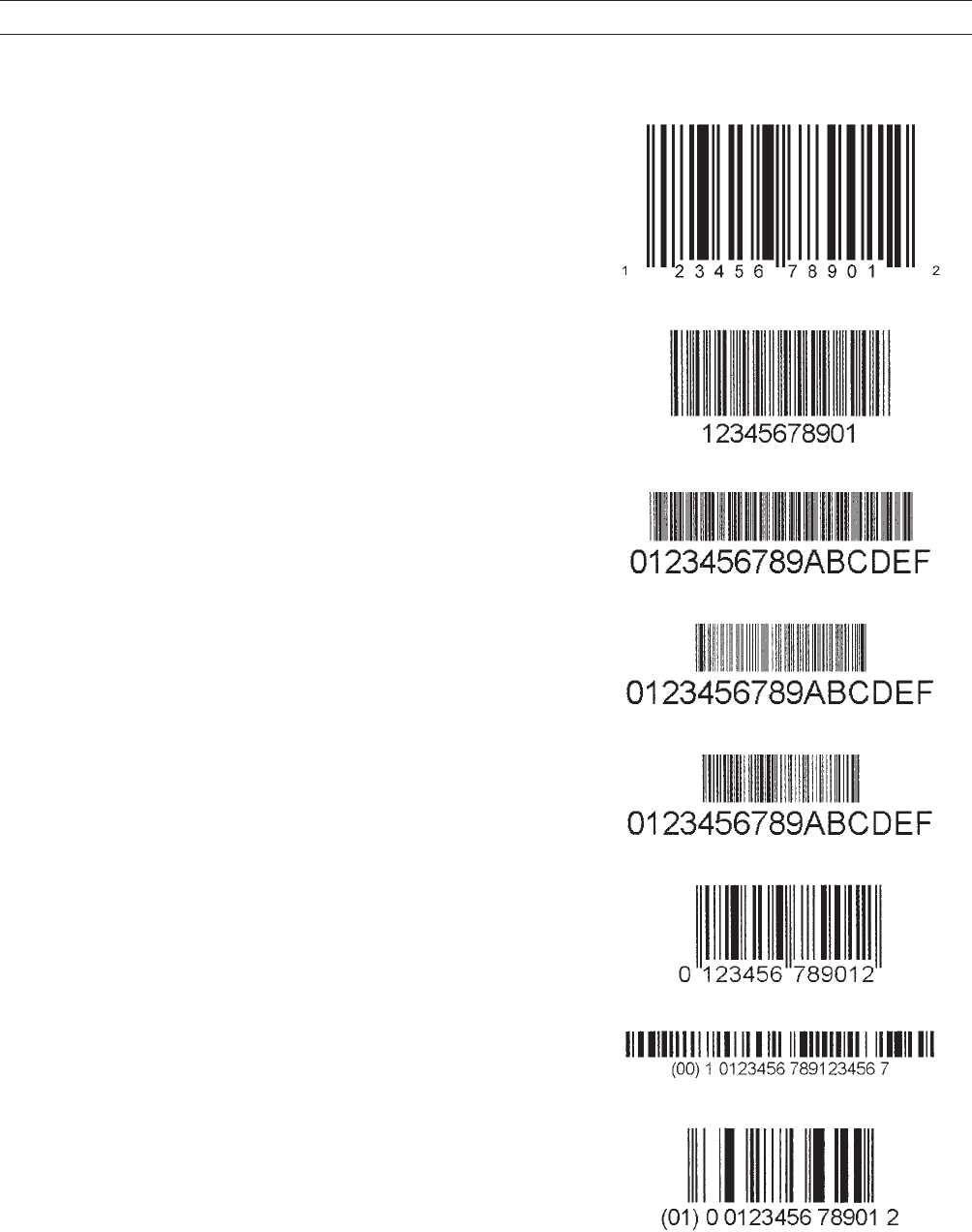
Table 4. Summary of Barcode Standards
Standard Description Applications Sample
Plessey Two bar widths with white space,
easy to print using dot-matrix
printers. Does not include built-in
error checking.
Libraries, some
retailers
UPC Robust barcode algorithm for retail
use. Stores numbers only with
manufacturer and product. Last
digit is used as a check digit.
Retail in the
United States
Codabar Capable of being printed with dot-
matrix printers. Self checking.
Stores numbers and can store
some letters.
Libraries, air-
bills, blood
banks.
Code 39 Compatible with many readers;
however, data density is low.
Contains alphanumeric
characters and some symbols.
Code 93 Higher density and more robust
than Code 39. Two check
characters.
Canadian Post
Office
Code 128 High density, can store any
character.
Shipping and
packaging
industries
EAN-13 Superset of UPC symbology with
additional country code.
Worldwide retail
GS1-128 (UCC/
EAN-128)
Implementation of Code 128 used
for storing various types of data
such as a Global Trade Item
Numbers or an Expiration Date.
GS1 DataBar
(RSS)
Can encode 14-digit GTIN values.
Smaller than conventional UPC/
EAN barcodes.
Healthcare
industry,
intended for
retail
(Continued)
RADIO FREQUENCY IDENTIFICATION (RFID) 1067