
Yam, Kit L. (ed.). The Wiley encyclopedia of packaging technology
Подождите немного. Документ загружается.


often inefficient. Stickies in pulp cause paper-mill operat-
ing problems by reducing pulp drainage rates on paper
machines (20). They do this by forming deposits on paper-
machine wires, dryer fabrics, press rolls, and drying
cylinders. Reduced drainage rates force operators to run
paper machines at slower speeds or shut them down to
clean the fabrics. Both result in lower mill production
rates and reduced profitability. Stickies also prevent good
fiber–fiber bonding, reducing paper strength, an impor-
tant consideration for corrugated containers. Both hot-
melt adhesives and pressure-sensitive adhesives can form
stickies.
Fractionation separates fine particles and short, weak
cellulose fibers from longer, stronger fibers (21). Refining
is used to develop the desired pulp drainage properties on
the paper machine and control paper bulk and density,
strength, surface smoothness, and porosity (22, 23).
Caustic soaking is also used to improve OCC fiber pro-
perties (24).
Extensive bleaching of OCC can produce a high-bright-
ness pulp suitable for use in manufacturing office paper
(25). Economics compare favorably to those obtained for
manufacturing office paper from de-inked recovered office
paper (26).
A considerable fraction of corrugated containers are
coated with wax to increase water resistance. Waxes and
hot-melt adhesives can form a thin film when making
linerboard from OCC and result in a slippery surface (27).
This can cause ‘‘telescoping’’ when the linerboard is wound
on a roll. When recycling OCC, removal of this wax is
difficult. Flotation has been found to remove the wax
efficiently (27). However, high paper fiber losses make
this process uneconomical.
PLASTICS
Plastics recycling has several advantages (28):
. Conservation of nonrenewable fossil fuels: Plastic
production uses 8% of the world oil production, 4%
as feedstock and 4% for manufacture.
. Reduced consumption of energy.
. Reduced emissions of carbon dioxide, nitrogen oxide
and sulfur dioxide (SO
2
).
. Reduced amounts of solid waste going to landfills.
The economic attractiveness of plastics recycling is
dependent upon the cost of the plastics feedstocks, crude
oil, and natural gas. For example, the price of recycled
polyethylene can vary from 85% to 105% of the virgin
polyethylene price, depending upon feedstock prices. If the
crude oil price doubles, as occurred in 2004–2005, and the
energy cost is 25% of the total cost of the virgin or the
recycled polymer, virgin polymer cost increases 75% while
recycled polymer cost increases 25%.
Primary recycling is the recycling of plastics that are
plant scrap and have not been sold for consumer use.
Secondary recycling is the physical cleaning and proces-
sing of postconsumer plastic products. Tertiary recycling
is the chemical treatment of polymers. This treatment is
usually depolymerization to produce monomers that are
purified and then polymerized to produce new polymer.
Using tertiary recycling, materials such as fillers and
fibers can be physically removed from the monomer. The
monomers can also be purified by distillation and other
processes prior to polymerization. The leading example of
tertiary recycling is poly(ethylene terephthalate) (PET).
Residential collection programs indicate high collection
rates for easily recognized types of containers (Table 2).
Sorted plastic packaging materials are shipped, usually
in bales, to processing plants to be converted to polymer
resins. The bales are broken and the bottles sorted to
ensure that only one type of polymer is further processed.
Processing consists of chopping and grinding the bottles
into flakes. These flakes are washed. Processing steps
such as flotation are used to remove polymeric contami-
nants from the flakes. The flakes are melted and converted
into pellets. Process costs are summarized in Table 3.
For high-value food-packaging applications, minimal
migration of contaminants into food products is critical.
Currently the FDA requirement is a maximum 0.5 part
per billion (ppb) of noncarcinogenic compounds by dietary
exposure (29).
Poly(ethylene Terephthalate) (PET)
Originally, PET was used virtually exclusively to package
soft drinks. As a result the recyling stream was quite
homogeneous, consisting of unpigmented one- and two-
liter bottles with a small percentage of green bottles.
However, PET is now used to package a wide variety of
beverages besides soft drinks including water, fruit juice,
tea, and beer, plus other products such as peanut butter,
ketchup, and edible oils. These products are often pack-
aged in bottles with a wide range of pigments in many
sizes and shapes. In addition, various adhesives and
barrier resins are combined with PET (30).
Table 2. Residential Recovery Rate by Package Type
Package Type Percent Recovery
Beverage bottles 65
Liquid detergent bottles 50
Other rigid containers 10
Packaging film 5
Average of all plastics 30
Source: Reference 6.
Table 3. Approximate Polymer Recycling Costs
Costs
Process Step $ per Pound Percent
Collection 0.10 27
Sorting 0.12 32
(Subtotal cost) (0.22) (59)
Grinding and cleaning
0.15 41
Total 0.37 100
Source: Reference 6.
1078 RECYCLING
In 2006, 30.9% of plastic soft drink bottles were recycled.
Initial polyethylene terephthalate (PET) processing is si-
milar to that outlined in Table 3. Cleaning comprises
washing, rinsing, and drying. Poly(vinyl chloride) (PVC)
and PET have very similar density values; both will sink to
the bottom of the waterbath during rinsing. Therefore it is
difficult to separate the two polymers after the bottles have
been ground into small particles (31). Melting PET contain-
ing PVC will produce black spots due to charring of the
PVC during processing to produce new bottles (32, 33).
For food applications, improved cleaning of PET pro-
duced by secondary recycling is needed. Supercritical fluid
extraction using carbon dioxide (34) and solvents such as
propylene glycol (35) have been proposed. High tempera-
ture and the use of vacuum to remove volatile impurities
has also been suggested (35). Stripping of volatile compo-
nents at temperatures above 160 1C for 3 min has been
reported (36). Application of a multilayer approach, the
manufacture of a bottle with an inner layer of recycled
PET sandwiched between surface layers of virgin PET, is
used commercially for soft drink applications (37).
Two PET tertiary recycling technologies are used com-
mercially: methanolysis (38) and glycolysis (39). Both
cleave the ester linkages in the polymer to form mono-
mers. In methanolysis, methanol is used to cleave the
polymer ester linkages, producing stoichiometric amounts
of dimethyl terephthalate and ethylene glycol (38, 40). The
ethylene glycol is separated and purified by distillation.
The dimethyl terephthalate is purified by crystallization
and distillation. Both bis-hydroxyethylterephthalate and
oligomers are formed in glycolysis (37, 40). These are
recovered and purified by vacuum distillation and then
polymerized in the presence of ethylene glycol to form
PET. Glycolysis is claimed to be somewhat less costly than
methanolysis (38).
Hydrolysis yielding terephthalic acid and ethylene
glycol is a third process. High temperatures and pressures
are required for this currently noncommercial process.
The purification of the terephthalic acid is costly and is the
reason the hydrolysis process is no longer commercial.
High-Density Polyethylene
Process steps in recycling high-density polyethylene
(HDPE) are similar to those outlined in Table 3. Cleaning
comprises washing, rinsing, and drying (32). Removing
labels is the worst problem in washing and drying stages.
Detergents are often used to improve the efficiency of label
removal. Metal foil labels can introduce metals into the
polymer. When metal foil labels are heat-sealed onto plas-
tic, the only way to remove them is using an extrusion melt
filter. This leads to plugging of the filter screens causing
more frequent changes and increasing production costs.
During the rinse cycle, polyethylene particles float to
the surface of the waterbath. The higher-density PET and
PVC particles sink to the bottom of the bath and can be
separated from the polyethylene.
Blends of PET and HDPE have been suggested to
exploit the availability of these clean recycled polymers.
The blends could combine the inherent chemical resis-
tance of PET with the processing characteristics of HDPE.
Since the two polymers are mutually immiscible, about 5%
compatibilizer must be added to the molten mixture (38).
The properties of polymer blends containing 80–90% PET/
20–10% HDPE have been reported (41). Use of 5–15%
compatibilizer produces polymers more suitable for extru-
sion blow molding than pure PET.
Polypropylene
In 2005, polypropylene recycling was 10.1 million pounds
recovered. Polypropylene (PP) is used in packaging appli-
cations as films and in rigid containers. Battery cases
could be considered another packaging application. Dead
batteries are often collected at the point of sale of new
batteries. In the United States, some states have laws
mandating this. Lead, acid, and plastics, particularly PP
from battery casings, are recovered and recycled (6). PP is
also recovered from bale wrap and other PP fabrics used
for wrapping in the textile industry and from other
containers (42).
Steps in polypropylene recycling include size reduction
by grinding, washing, rinsing, and drying to remove
contaminants and produce PP flakes (42). After extrusion,
molten polymer is filtered through screen packs. The
polymer may be separated into different melt flow ranges
to produce more uniform product grades.
Polystyrene
Polystyrene (PS) packaging applications include injection-
molded products such as beverage containers, dairy pro-
duct containers, and packaging for personal-care products
(43). Extruded solid-sheet PS packaging products include
salad boxes, dairy-product containers, baked-goods con-
tainers, and vending cups and lids. Extruded foam sheet
PS packaging products include poultry and meat trays,
produce trays, hinged-lid containers, egg cartons, and
foam cups. One formerly large-volume PS use, fast-food
clamshell containers, has greatly diminished because of
concerns over slow biodegradation of discarded polystyr-
ene containers. Blow- and foam-molded PS packaging
products include vitamin bottles, loose-fill packaging,
and cushion packaging.
Polystyrene recycling processing steps include densifi-
cation (for foams), granulation to reduce particle size,
washing, drying, extrusion, and pelletizing. High-density
baling is used to increase the bulk density of polystyrene,
often by a factor of 2. Contaminants are more easily
removed before this densification step than after. A de-
monstration plant chemically decomposes polystyrene to
produce monomer (43).
Consumers readily recognize polystyrene foam pro-
ducts and turn these products in for recycling. However,
recovery rates for other PS packaging products is signifi-
cantly less (43).
Commingled Plastic Wastes
A
relatively small amount
of PVC goes into packaging
applications and appears in municipal solid waste (33).
The greatest concern with PVC is as a contaminant in
other polymers being recycled, particularly PET.
RECYCLING 1079

The composition of nonmetal residues produced in
shredding automobiles is summarized in Table 4. Each
vehicle generates 500–800 lb of residue. The annual U.S.
total is about 3.5 million tons or about 1.3% of the
municipal solid waste generated annually (3). The mix-
ture is too complex to separate and recycle. Depending on
the amount of glass, water, metal, and dirt present, the
residue has a heating value of 4800–6800 Btu/lb (6, 44).
Incineration reduces residue weight by 50% and volume
by 80%.
Advanced waste recycling is the high-temperature/
high-pressure conversion of commingled plastic wastes
to form petrochemical process streams (45). Research is
in progress to determine the conditions that will favor
formation of certain types of chemical feedstocks, includ-
ing synthesis gas (hydrogen + carbon monoxide), hydro-
gen, crude pyrolysis oil (containing benzene, toluene, and
xylene), olefins, and oxygenates (methanol, esters, methyl
formate, etc). This technology has also been evaluated for
producing fuels: (a) medium-Btu gas for boilers and (b)
liquid fuels such as diesel oil. None of these processes is
currently economic.
ECONOMICS AND STATISTICS
In the United States the number of beverage containers
sold increased approximately 25% between 1996 and 2006.
However, the number recycled remained essentially flat at
approximately 75 billion weighing approximately 4 million
short tons (46). Between 1990 and 2006, the recycling rate
for all beverage containers declined from 49% to 39% after
reaching a high of 53% in 1992 (Anonymous, Container
Recycling Institute, http://www.container-recycling.org/
images/allrates/recrate-90-06.gif).
The materials used in beverage containers has changed
substantially between 1993 and 2004. The fraction of
aluminum containers has declined from 67% to 50% in
this period, while the fraction of class containers has
declined from 32% to 18% (47). In contrast, the fraction
of PET bottles has increased from 9% to 25%.
Overall, 2005 recycling for all packaging is over 25% in
a number of old EU Member States (Austria, Belgium,
Germany, Italy, the Netherlands, Norway, Sweden, and
Switzerland). In addition, new Member States like the
Czech Republic and Slovenia exceed 25% (48). In 2005,
35% of all PET bottles were recycled in the EI , equivalent
to 0.8 million metric tons.
Paper
Paper recovery now averages 346 pounds for each man,
woman, and child in the United States. Exports of paper to
be recycled have doubled since the late 1990s, according to
the American Forestry & Paper Association (49).
Eighty-one percent of the paper recovered is recycled
by U.S. mills. Sixteen percent is exported to foreign
markets. The rest is used domestically to manufacture
products such as molded packaging, compost, and kity
litter. Mills buy recycled paper loose or in bales. Grades of
paper include mixed paper, mixed office paper, sorted
white ledger, sorted colored ledger, computer printout,
newspaper, corrugated containers, and magazines (50).
More than 228 U.S. mills and industrial facilities
convert corrugated containers and other paper packaging
to new paper products and construction materials (51).
More than 60 of these produce linerboard and corrugated
medium with a recycle content of 100% (52). In North
America, minimills designed to process old corrugated
containers are becoming increasingly common. Located
in or near major cities, minimills are 25–50% the size of
conventional paper mills.
Metals
The U.S. aluminum industry recycled 51.9 billion alumi-
num cans in 2006, half a billion more than in 2005 (53). It
has the highest recycling rate of any beverage container at
51.6%. However, the recycling rate has declined from its
1997 high of over 65% (54).
An estimated five billion aluminium cans were used in
the UK in 2001, 42% of which were recycled (55).
In the United States, the recycling rate for steel
packaging was 63% in 1999 (56). In the United Kingdom,
the recycling rate for steel packaging, including transport
packaging, such as steel drums and bale wire, was 42% in
2002 (57). In 2005, over 2.3 million metric tons of steel
packaging were recycled in the 25 countries of the Eur-
opean Union (58). This represents an increase of 6%
compared to 2004 and a recycling rate of 63%.
Glass
In 2005, 25.3% of all glass containers were recycled (59).
The recycling rate of glass beverage containers declined
from 30% to 20% between 1996 and 2006 (60). Glass
makes up about 6% by weight of the material in municipal
waste streams recycled (59). Cullet from recycled glass
costs 80–95% of the virgin raw materials used in glass
production. In addition, the use of cullet saves 15% of the
energy costs associated with glass production from virgin
raw materials. This energy savings arises from the lower
melting temperature of cullet compared to virgin raw
materials and lower operating costs for pollution-abate-
ment equipment.
Seven billion glass containers were produced in the
United Kingdom in 2003 and the recycling rate has
remained relatively constant at approximately 33% since
2000 (61). This contrasts with much higher recycling rates
of 80–90% in European countries with more extensive
waste collection systems.
Table 4. Representative Composition of Automobile
Shredder Residue
Material Percent by Weight
Plastics 27
Rubber 7
Glass 16
Textiles 12
Fluids 17
Other 21
Source: Reference 6.
1080 RECYCLING
Plastics
The total pounds of plastic bottles recycled in 2005 in the
United States reached a new record high of 2.102 billion
pounds (62). PET and HDPE together comprise over 95%
of the plastic bottle market and 99.6% of the recycled
pounds (63).
In 2005, the recovery rate for plastics in the European
Union was 47% (64).
In 2005, 5.075 billion pounds of PET bottles and jars
were available for recycling in the United States (65). Of
this, 1.170 billion pounds was collected and sold. Of this,
58% were used by U.S. processors and 42% exported. The
favorable economics of PET recycling have been attributed
in part to forward integrated PET recyclers consuming
their own product to make bottle resin (32).
In 2005, the HDPE bottle recycling rate increased 1.2%
to 27.1%. Exports of collected HDPE bottles for recycling
overseas were 162.4 million pounds, nearly 18% of the
HDPE collected (63).
The largest used for recycled PET and HDPE resins is
fabrication of new bottles (63).
In 2005, 10.1 million pounds of polypropylene was
recycled in the United States (63). Most of this is derived
from the recovery of polypropylene bottle closures during
PET recycling. In addition, polypropylene bottles are com-
monly recycled with high-density polyethylene (HDPE). At
levels up to 5% by weight, polypropylene has a negligible
impact on the properties of recycled HDPE resins.
The costs of recycling commingled plastics has been
estimated at $1700 per ton (66). This is 10 times more
expensive than recycling easily separated homogeneous
products such as PET and HDPE.
BIBLIOGRAPHY
J. K. Borchardt, ‘‘Recycling’’ in A. J. Brody and K. S. Marsh, eds.,
The Wiley Encyclopedia of Packaging Technology, 2nd edition,
Wiley, New York, 1997, pp. 799–805.
Cited Publications
1. Anonymous, Aluminum Now, 6, 1 (2004).
2. Anonymous, http://www.wasteonline.org.uk/resources/
InformationSheets/Packaging.htm.
3. Anonymous, ‘‘Municipal Solid Waste in the United States:
2006 Facts and Figures,’’ U.S. Environmental Protection
Agency, www.epa.gov/msw/pubs/mswchar06.pdf.
4. S. K. Das, Materials Science Forum, Vols. 519–521, 2006.
pp. 1239–1244.
5. R. G. Saba and W. E. Pearson, ‘‘Curbside Recycling Infra-
structure: A Pragmatic Approach’’ in C. P. Rader, S. D.
Baldwin, D. D. Cornell, G. B. Sadler, and R. F. Stockel, eds.,
Plastics, Rubber, and Paper Recycling: A Pragmatic Ap-
proach, American Chemical Society, Washington, DC, 1995,
Chapter 2, pp. 11–26.
6. R. A. Pett, A. Golovny, and S. S. Labana, ‘‘Automotive
Recycling’’ in Ref. 5, pp. 47–61.
7. E. Schloeman and D. B. Spencer, Resource Recovery Conserv.
1, 151 (1975).
8. R. E. Snaders, Jr., ‘‘Aluminum and its Alloys’’ in the Kirk–
Othmer Encyclopedia of Chemical Technology, Vol. 2, 5th
edition, Wiley, Hoboken, 2004.
9. K. W. Das Subodh, J. Long III, H. W. Hayden, J. A. S. Green,
and W. H. Hunt, Jr., ‘‘Energy implications of the changing
world of aluminum metal supply,’’ J. Miner. Met. Mater. Soc.
56(8), 1047–4838 (2004).
10. W. T. Choate and J. A. S. Green, Modeling the Impact of
Secondary Recovery (Recycling) on the U.S. Aluminum Supply
and Nominal Energy Requirements, The Minerals, Metals
and Materials Society, Warrendale, PA, 2004.
11. Aluminum Industry Technology Roadmap, The Aluminum
Association Inc., Washington, DC, 2003.
12. K. Grjotheim, H. Kvande, K. Hotzfeldt, and B. J. Welch, Can.
Metall. Q. 11(4), 585 (1972).
13. Anonymous, Ceramic Ind. 141(6), 14 (1993).
14. J. Cattaneo, ‘‘Commodities Update: Glass Container Recy-
cling’’ in Virginia Recycling Association 2007 Annual Con-
ference, http://www.vrarecycles.org/downloads/conf2007/VRA
percent20Glass percent20Markets percent20Presentation. ppt
(May 1, 2007).
15. Anonymous, ‘‘Glass,’’ http://www.epa.gov/jtr/comm/glass.htm,
(2007).
16. Anonymous, ‘‘AF&PA Sheds Light on Recycling,’’ http://
www.packaging-online.com/paperboardpackaging/article/
articleDetail.jsp?id = 415756 (March 31, 2007).
17. K. Merriman, in R. J. Spandenberg, ed., Secondary Fiber
Recycling, TAPPI Press, Atlanta, 1993, p. 101.
18. T. Bliss, in Ref. 11, p. 125.
19. C. M. Vitori, Pulp Pap. Can. 94(12), 109 (1993).
20. M. Doshi, Prog. Paper Recycl. 4(2), 103 (1995).
21. C.F.Yu,R.F.DeFoe,andB.R.Crossley,inProceedings of the
TAPPI Pulping Conference, TAPPI Press, Atlanta, 1994, p. 451.
22. M. Doshi, Prog. Paper Recycl. 1(2), 61 (1992).
23. R. DeFoe, TAPPI J. 76(2), 157 (1993).
24. T. Pekkarinen, ‘‘Fractionation of OCC Waste Paper with a
Pressure Screen’’ in Proceedings of the TAPPI Pulping Con-
ference,
TAPPI Press
, Atlanta, 1985, p. 37.
25. T. Nguyen, A. Shariff, P. F. Earl, and R. J. Eamer, Prog. Paper
Recycl. 2(3), 25–32 (1993).
26. M. Bisner, R. Campbell, and W. T. McKean, ‘‘Bleached Kraft
Pulp from OCC’’ in Recycled Paper Technology: An Anthology
of Published Papers, TAPPI Press, Atlanta, 1994, pp. 48–56.
27. G. Galland, Y. Vernac, and J. Brun, ‘‘Recycling of Waxed
Papers and Boxes’’ in Ref. 26, pp. 81–89.
28. Anonymous, ‘‘Plastics Recycling I: General Overview,’’ http://
www.specialchem4polymers.com/resources/articles/article.
aspx?id = 2369 (February 7, 2006).
29. Anonymous, Fed. Reg. 58, 52719–52729 (October 12, 1993).
30. Anonymous, ‘‘2005 Report on Post Consumer PET Container
Recycling Activity, Final Report,’’ National Association for
PET Container Resources, www.napcor.com.
31. Anonymous, Modern Plast. 71, 73–94 (1994).
32. W. K. Atkins, ‘‘A Resin Producer’s Perspective and Experi-
ences in Polyethylene Recycling’’ in Ref. 5, pp. 104–112.
33. R. A. Burnett, ‘‘Progress in Poly(vinyl chloride) Recycling’’ in
Ref. 5, pp. 97–104.
34. A. S. Gupta and J. T. Camp, U.S. Patent 4,680,060. (to The
Coca-Cola Company), (July 14, 1987).
35. Points to Consider for the Use of Recycled Plastics in Food
Packaging: Chemistry Considerations, U.S. Food and Drug
RECYCLING 1081
Administration, Center for Food Safety and Applied
Nutrition, Publication HFS-245, Washington, DC, April
1992.
36. D. E. Pierce, D. B. King, and G. D. Sadler, ‘‘Analysis of
Contaminants in Recycled Poly(ethylene terephthalate) by
Thermal-Extraction Gas Chromatography–Mass Spectro-
scopy’’ in Ref. 5, pp. 458–471.
37. T. H. Begley and H. C. Hollifield, Food Technol. 47, 109–112
(1993).
38. D. Gisstis, Makromol. Chem. Makromol. Symp. 57, 185 (1992).
39. G. Bauer, in K. J. Thome-Kozmensky, ed., Recycling of Wastes,
EF-Press, Berlin, 1989, p. 293.
40. F. L. Bayer, D. V. Myers, and M. J. Gage, ‘‘Consideration of
Poly(ethylene terephthalate) Recycling for Food Use’’ in Ref.
5, pp. 152–160.
41. S. A. Jabarin and V. V. Bhakkad, ‘‘Morphology and Properties
of Poly(ethylene terephthalate)—High-Density Polyethylene
Blends’’ in Ref. 5, pp. 113–138.
42. R. M. Prioleau, ‘‘Recycling of Polypropylene’’ in Ref. 5, pp.
80–88.
43. D. A. Thomson, ‘‘Polystyrene Recycling: An Overview of the
Industry in North America’’ in Ref. 5, pp. 89–96.
44. W. S. Hubble, I. G. Most, and M. R. Wolman, Investigation of
the Energy Value of Automobile Shredder Residue, Publica-
tion DOE/ID/12551-1, U.S. Department of Energy, Washing-
ton, D.C., August 1987.
45. S. J. Pearson, G. D. Kryder, R. R. Kopang, and W. R. Seeker, in
Ref. 44, pp. 183–193.
46. Anonymous, Container Recycling Institute (http://www.contai-
ner-recycling.org/images/allrates/recsale-units-96-06.gif).
47. Anonymous, Container Recycling Institute, http://www.
container-recycling.org/assets/html/plastic/2006-11-PETStra-
tegies_files/frame.htm).
48. Anonymous, ‘‘The Compelling Facts About Plastics: An ana-
lysis of plastics production, demand and recovery for 2005 in
Europe,’’ www.endseuropedaily.com/docs/70514a.pdf (spring
2007).
49. Anonymous, ‘‘AF&PA Sheds Light on Recycling,’’ http://
www.packaging-online.com/paperboardpackaging/article/
articleDetail.jsp?id = 415756 (March 31, 2007).
50. ‘‘Paper and Paperboard Products, United States Environmen-
tal Protection Agency, hhtp://www.epa.gov/epaoswer/non-hw/
muncpl/paper.htm, accessed September 2008. G. B. Stanley,
TAPPI J. 79(1), 37 (1996).
51. Doshi & Associates, ‘‘1996–1997 Directory of Recycled Pulp &
Paper Mills,’’ supplement to Progress in Paper Recycling 5(3)
(1996).
52. W. E. Franklin, Old Corrugated Containers Recovery Fore-
cast’’ in V. Stefan, ed., Recovery and Use of OCC,’’ Miller
Freeman, San Francisco, 1993, pp. 12–14.
53. Aluminum Association, Inc., ‘‘U.S. Aluminum Can Re-
cycling Steady in 2006,’’ Business Wire Press Release (June
27, 2007).
54. Subodh K Das, ‘‘Emerging Trends in Aluminum Recycling:
Reasons and Responses,’’ Light Metals 2006 Edited by Travis
J. Galloway, The Minerals, Metals & Materials Society,
Warrendale, PA, 2006.
55. Anonymous, ‘‘e-Digest of Environmental Statistics,’’ http://
www.wasteonline.org.uk/resources/InformationSheets/
Packaging.htm (2004).
56. Anonymous, ‘‘Municipal Waste,’’ U.S. Environmental Protec-
tion Agency, http://www.epa.gov/garbage/recycle.htm.
57. Anonymous, ‘‘e-Digest of Environmental Statistics,’’ http://
www.wasteonline.org.uk/resources/InformationSheets/
Packaging.htm (2004).
58. M. Beck, ‘‘More Growth in Europe’s Steel Packaging Recy-
cling,’’ Recyclers World, http://www.recycle.net/cgi-bin/
exview.cgi?rw = 60&w = 01&item = LA762934&st = LA&g = 04
(December 6, 2001).
59. J. Cattaneo, Glass Packaging Institute, ‘‘Commodities Up-
date: Glass Container Recycling,’’ http://www.vrarecycles.org/
downloads/conf2007/VRA percent20Glass percent20Markets
percent20Presentation.ppt (May 1, 2007).
60. Anonymous, Container Recycling Institute, http://www.
container-recycling.org/images/glass/graphs/recrate-percent-
96-06.gif).
61. Anonymous, ‘‘e-Digest of Environmental Statistics,’’ http://
www.wasteonline.org.uk/resources/InformationSheets/
Packaging.htm (2004).
62. ‘‘Plastics Recycling Reaches a Record High of More Than 2
Billion Pounds Annually http://www.americanchemistry.com/
s_acc/sec_news_article.asp?SID = 1&DID = 4766&CID = 206&
VID = 142&RTID = 0&CIDQS = &Taxonomy = &special-
Search = (February 5, 2007).
63. Anonymous, ‘‘2005 National Post-Consumer Plastics Bottle
Recycling Report,’’ www.americanchemistry.com).
64.
Anony
mous, ‘‘The Compelling Facts About Plastics: An analy-
sis of plastics production, demand and recovery for 2005 in
Europe,’’ www.endseuropedaily.com/docs/70514a.pdf (spring
2007).
65. ‘‘2005 Report on Post Consumer PET Container Recycling
Activity, Final Report,’’ National Association for PET Con-
tainer Resources, www.napcor.com).
66. J. R. Ellis, ‘‘Polymer Recycling: Economic Realities’’ in Ref. 5,
pp. 62–69.
ROLL HANDLING
In web processes, such as slitting and rewinding, coating
and laminating, printing, as well as other applications,
rolls must be loaded from the rewind station after the
process. Because of weight and size, handling of rolls is
done by general-purpose equipment, such as cranes and
forklifts. For greater productivity, roll-handling equip-
ment is engineered to suit the characteristics of the
web-process equipment. An important fringe benefit of
engineered handling systems is the reduction of safety
hazards associated with general-purpose equipment.
Slitter/Rewinder Overview. A slitter/rewinder (see Slit-
ting-rewinding machinery) converts master rolls into high-
quality, narrow-width, rewound rolls that may or may not
be the final product. Variables in the web characteristics
and in the final form of the product determine which of the
several types of slitting and rewinding techniques is used.
The slitter/rewinder machine is typically composed of un-
wind, slitting, and rewind stations. A turret used for
unwinding allows the loading of new master rolls while
the machine is slitting and rewinding. Continuous unwind-
ing can be attained by automatic splicing equipment.
1082 ROLL HANDLING
The slitting methods used depend on the material
characteristics and quality of the slit edge desired. Razor
slitting is used primarily on films and score slitting on
many types of fabrics, nonwovens, and textiles. Shear
slitting is excellent for most materials but requires a
relatively high initial investment and operator expertise.
Locked-core rewinding is successful on good caliper webs
and pressure-sensitive tapes with relatively small roll
diameters. Differential rewinding is required for off-cali-
per materials and large-diameter rolls.
An effective method of rewinding is to alternate the slit
webs on two rewinding shafts. This method, termed
‘‘duplex rewinding’’, is particularly suited for narrow-
width slit material. Winding on a single shaft, called
simplex winding, is generally effective for slit and unslit
paper, nonwovens, and textiles.
Shaft Extraction/Insertion System. On duplex and sim-
plex slitter/rewinders, webs are slit and rewound on cores
supported by rewind mandrels. Rewind mandrels may be
extremely heavy, i.e., several thousand pounds (kilo-
grams), or cumbersome to handle manually. Each machine
cycle requires that a rewind mandrel be loaded up with
cores, put into the rewind station, removed from the
rewind station, and then extracted from the rewound
rolls. This process might take place many times a day,
and an operator might have to lift and maneuver many
tons of rewind mandrels per shift. Apart from the burden
on the operator, manual shaft handling hinders produc-
tion, because the cycle time for loading and unloading is
relatively long.
The use of a shaft extraction/insertion system mini-
mizes cycle time as well as operator fatigue. With this
concept, the finished rolls and rewind mandrels are trans-
ferred to a lift table where shaft extrators pull the rewind
mandrel from the rolls. The shaft is supported in the
extracted position until the rolls are removed from the
extractor table. Fixtures called core boxes are sometimes
engineered into the extractor table to locate cores in their
proper positions. The extractor inserts the shaft back into
the cores. The cored shafts then are brought back into the
rewind stations.
Shaft extractors are easily interfaced in close proximity
to turret winders, unwinders, and other simplex winders,
which often require the handling of steel shafts 6–10 in.
(15–25 cm) in diameter by several hundred inches (several
meters) long.
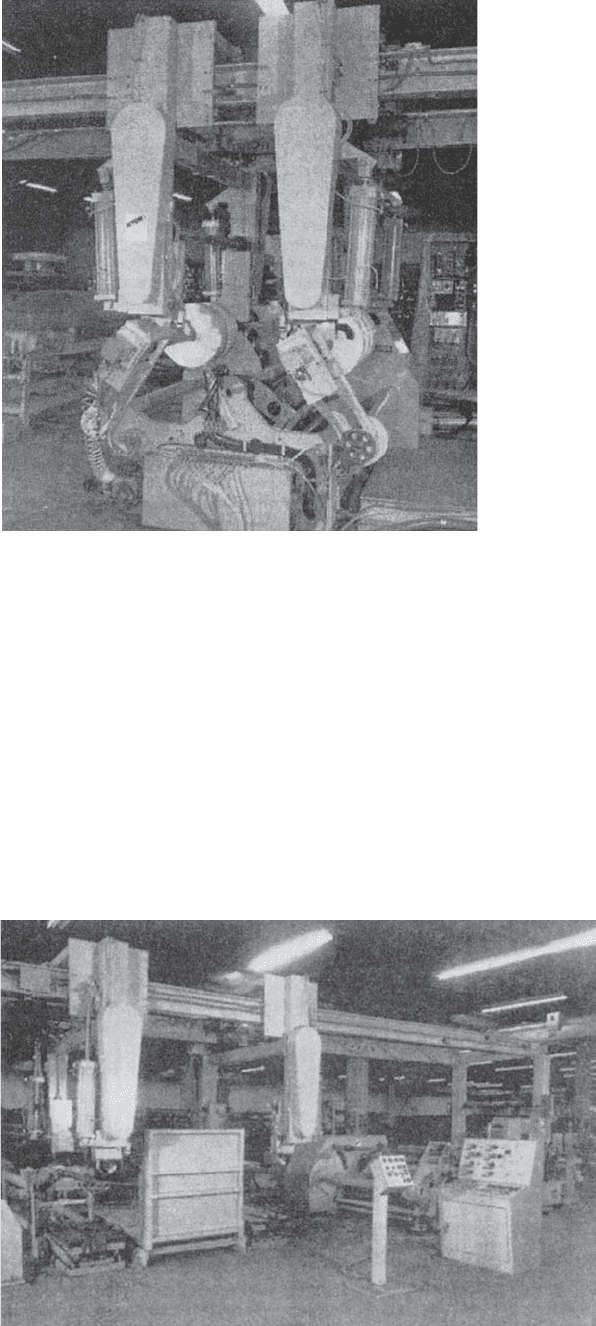
Handling Systems for Duplex Rewinders. A duplex slit-
ter/rewinder (see Figure 1), with the rewind stations
Figure 1. A duplex slitter/rewinder with roll-handling system.
Turret carriages are in full-roll downward position at slitter/
rewind station. New mandrels are in an upward position awaiting
turret index.
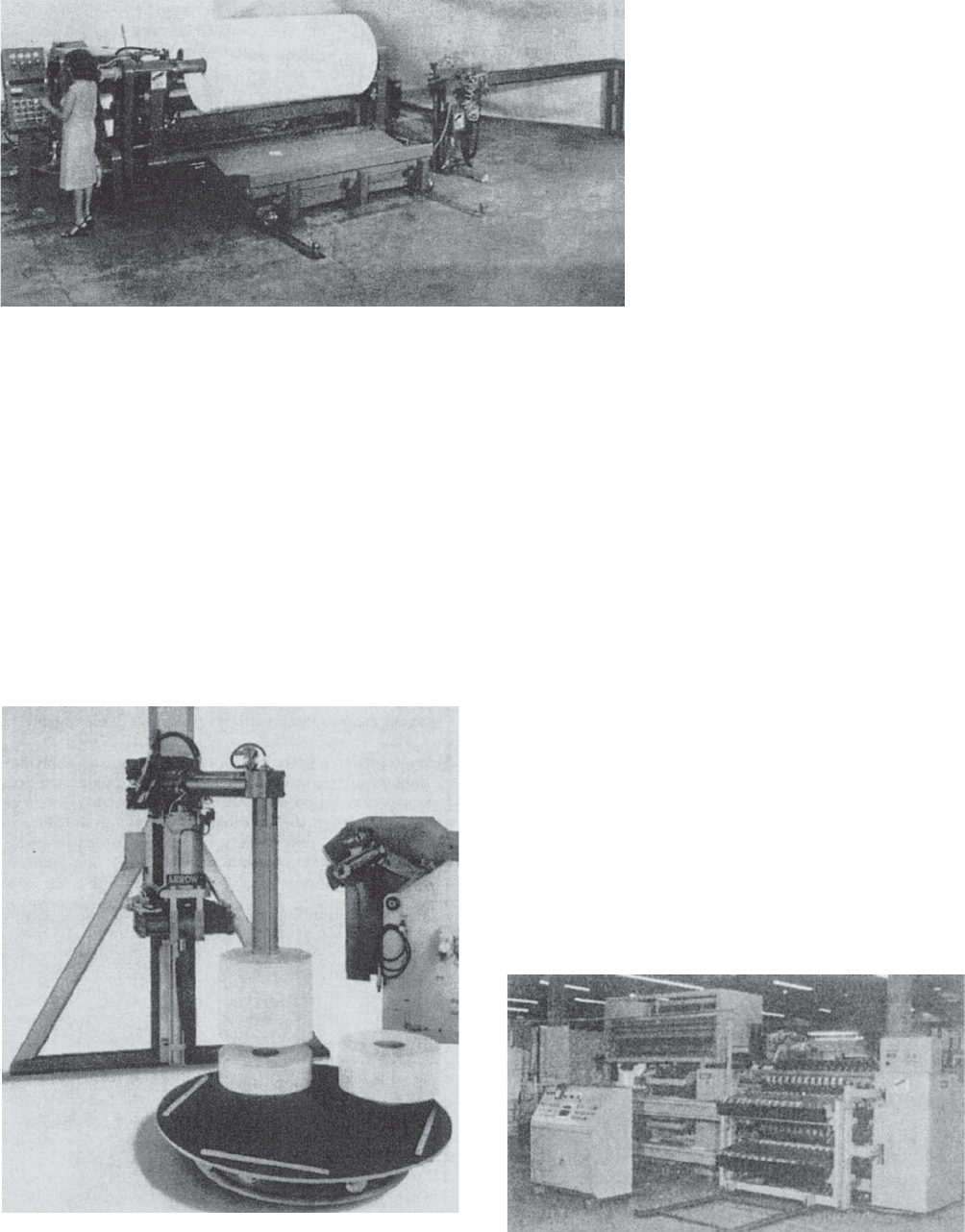
Figure 2. A slitter/rewinder roll-handling system
with a shaft-type unwind stand. This two-motor
drive system has an adjustable vacuum winding
capability and an overhead mandrel lift/transfer
mechanism.
ROLL HANDLING 1083
located above the main machine, interfaces well with an
overhead roll-handling system. After the rewind cycle, the
shafts with the rewound rolls are lifted out and the new
shafts with cores must be inserted into the machine.
A typical system (see Figure 2) may have an overhead-
powered carriage that supports dual vertically adjustable
shaft-clamp assemblies. With two clamps for each vertical
lifting mechanism, new shafts with cores can be loaded
into the machine immediately after the shafts with the
finished rolls are removed. In other words, a machine with
two rewind stations has four shafts circulating through
the system simultaneously. As the new rewind cycle
begins, the shafts with rolls are conveyed overhead to
the shaft extractors where the slit and rewound rolls
become free of the shafts and may be upended on pallets
for conveyor or forklift removal into storage.
Floor Loading and Unloading. Floor loading and unload-
ing features are available as an integral part of many
unwinds and simplex rewinds. These units use hydrauli-
cally pivoting arms to raise and lower rolls to the floor. The
need for auxiliary equipment is eliminated. Lift tables,
shaft extractors, and upenders are designed to work with
simplex (single-position) rewinders that produce large-
diameter rolls of paper, laminates, and nonwovens (see
Figure 3). Driven ‘‘V’’-trough conveyors can then move the
rolls from the rewinders to weighing stations, stretch
wrapping, and storage conveyors.
Robotic Roll Handling. An example of robotics in spe-
cial-purpose roll handling is shown in Figure 4. A simplex
slitter/rewinder with an automatic roll pusher pushes the
slit and wound rolls onto the robot shaft. The robot shaft
then expands to lock the cores to the shaft. The robot is
programmed to shift the axes of the rolls 901 and to
automatically position them over a pallet. A rotary table
supports the pallet and will index every 901 to allow
unloading of finished stacks of rolls in the four quadrants
of the pallet.
Total Automation. The ultimate in roll handling is
shown in Figure 5. This slitter/rewinder for duct tape
automatically cuts cores, loads cores at their proper loca-
tion on dual rewind shafts, feeds the loaded shafts into
rewind stations, winds the slit tapes, unloads the rewound
Figure 3. A surface center slitter/rewinder
with hydraulically pivoting rewind arms,
preset constant surfacing pressing in the
center surface rewinding mode, and an auto-
matic minimum gap for center winding.
Figure 4. A roll unloading and stacking robot with hydraulically
controlled cantilever mounted boom with 901 rotational capability
on vertical and horizontal axes for pallet offload.
Figure 5. A fully automatic, pressure-sensitive tape turret slit-
ter/rewinder with automatic core cutter and loader.
1084 ROLL HANDLING
rolls from the machine, and feeds the empty shafts back in
for core loading. This completely ‘‘hands-off’’ machine is
microprocessor-controlled. Cycle times are better than 30 s.
REFERENCES
‘‘Roll Handling’’ in R. E. Mastriani, ed. Wiley Encyclopedia of
Packaging Technology, 1st edition, Arrow Converting Equip-
ment, Inc., pp 571–573.
ROTATIONAL MOLDING
PHIL DODGE
Quantum Chemical Company
Cincinnati, Ohio
Reusable, large industrial containers can be made by
rotational molding. Rotational molding generally is not
thought of as a technique for making packaging. However,
some manufacturers use this process, which can make
complex, hollow, and seamless products of all sizes and
shapes to produce large bulk containers for shipment of
powders and liquids, 5–55–gal drums, trash and recycling
containers, insulated food-product containers, and double-
wall shipping trays for equipment components.
ADVANTAGES
Compared with blow molding or thermoforming, rota-
tional molding offers significant advantages:
. Mold costs are low and comparable with those for
blow molding and thermoforming.
. The process is economical for short production runs.
. Secondary tooling is minimal or not needed.
. There can be little or no scrap.
Numerous design features are possible; for example,
double-walled parts, good surface detail, intricate con-
tours and undercuts, stress-free parts, minimal cross-
sectional deformation and warping, and molded-in inserts
can be used.
POLYETHYLENES MOST WIDELY USED
Generally, powdered resins are used in rotational molding.
However, a few liquid resins are available and some high-
flow resins, such as nylons, have been used in small pellet
form.
Although many thermoplastics can be rotationally
molded, only a few actually are used to make commercial
products. Polyethylenes—low-density (LDPE), linear low-
density (LLDPE), high-density (HDPE), and copolymers—
are the most widely used materials (see also Thermoset-
ting polymers).
LLDPE rotational molding grades typically have den-
sities ranging from 0.935 to 0.940 g/mL and a melt index
(MI) of 3–10 g/10 min. LLDPE rotational molding resins
offer good stiffness and low-temperature impact strength,
excellent environmental stress-crack resistance (ESCR),
and warp resistance.
LDPE rotational molding grades generally have den-
sities of 0.915–0.920 g/mL and an MI of 10–25 g/10 min.
LDPE rotational molding resins offer good impact
strength, low shrink-age, good warp resistance, and
flexibility.
HDPE rotational molding grades have densities of
0.942–0.950 g/mL and an MI of 2–8 g/10 min. HDPE rota-
tional molding resins offer high stiffness, high impact
strength, and excellent chemical resistance.
Ethylene-vinyl acetate (EVA) copolymers for rotational
molding have densities of 0.925–0.945 and an MI of 10–25
g/10 min. EVAs offer good low-temperature impact strength
and flexibility.
Postconsumer polyethylene resins (PCR) are made
from HDPE blow-molded containers. HDPE PCRs have
much lower melt indices than the MI of typical rotational
molding resins. Therefore, for rotational molding, a HDPE
PCR is blended with a virgin resin. HDPE PCR content in
blends can range between 10–25%. The blends can be
made by either melt compounding or dry blending PCR/
virgin blends.
How the PCR/virgin resin blend is prepared affects the
inner surfaces of rotationally molded parts. Parts rota-
tionally molded from dry blends can have very rough inner
surfaces. Parts made from HDPE PCR/virgin resin extru-
sion blends exhibit smooth inner surfaces.
The color of parts rotationally molded from HDPE PCR/
virgin resin blends will be influenced by the type of HDPE
PCR in the blend. Because some HDPE PCR are green
(e.g., PCR based on HDPE copolymers), rotational molding
resins made with these resins have a green tint. Other
HDPE PCR are gray and have black specks. Thus, parts
rotationally molded from blends made with these HDPE
PCR have a dirty white color.
Compared to the virgin LLDPE resin, the toughness of
HDPE PCR/virgin resin blends is much less, and it
decreases as HDPE PCR content increases.
The environmental stress-crack resistance (ESCR) of
HDPE PCR/virgin resin blends is considerably lower than
that of the virgin polyolefin resins.
Crosslinked polyethylene rotational moldings can be
made by using materials that contain a chemical cross-
linking agent. Crosslinking improves physical properties,
in particular impact strength, dimensional stability, creep
resistance, and environmental stress crack resistance
(ESCR).
Polyethylene rotational moldings also can be crosslinked
using electron-beam treatment. Electron-beam processing
allows the degree of crosslinking to be controlled; therefore,
the level of property improvements can be controlled. Also,
parts can be recycled before they are subjected to the EB
treatment. Thus, scrap losses are reduced.
Polypropylene rotational molding resins provide higher
heat resistance (containers can be autoclaved) and have
higher stiffness than polyethylenes. Reactor-produced poly
ROTATIONAL MOLDING 1085
propylene copolymers (TPOs), i.e., copolymers produced in
a reactor, have not been subjected to the mechanical and
thermal degradation associated with melt blending of
rubber compounds into a polypropylene base. Other ad-
vantages of the reactor-produced TPOs include their in-
herent temperature and chemical resistance, low specific
gravity, and high flexibility. Also, unlike rubber blends—
which can degrade or crosslink—the reactor-produced
TPOs are readily rotationally molded.
Nylon rotational molding resins, both liquid and pellet,
offer good heat resistance, toughness, good wear and
abrasion resistance, high strength and stiffness, and
good chemical resistance.
Polycarbonate rotational molding resins offer high heat
resistance, good impact strength, and clarity.
Vinyl rotational molding resins, both powder and li-
quid, are available. Vinyl plastisols are liquid rotational
molding resins that offer a wide range of stiffness, from
very soft (low-durometer) to very rigid (high durometer).
A SIMPLE, BUT VERSATILE PROCESS
Six basic steps exist to the rotational molding process and
are as follows:
1. A predetermined amount of resin is placed in the
bottom half of a two-piece mold.
2. The mold halves are closed.
3. The mold is placed in a heated oven and rotated
biaxially.
4. The resin melts against the inside surface of the
mold, fuses, and then densifies into the shape of the
mold cavity.
5. The mold is removed from the oven and placed in a
cooling chamber. A combination of air and water is
used to slowly cool the mold.
6. The mold is transferred from the cooling chamber
and opened, and then the finished part is removed.
Many variations exist of the basic rotational molding
process.
Generally, the walls of rotational moldings are made of
one material. However, multilayer rotational moldings
can be made. For example, there can be a foam layer, a
solid layer, a layer of recycled material, a crosslinked
layer, and different-colored layers.
The standard technique for making multilayer rota-
tional moldings is to use a ‘‘dump box.’’ After the first layer
is molded, the dump box—which is attached to the mold—
is opened to allow the material for the second layer to
enter. The dump-box cover is closed, and the second layer
is molded.
Foam filling, which uses rigid polyurethane foam,
injected into the hollow space between the walls of rota-
tional moldings adds stiffness and structural strength.
Integral skin foam moldings also are possible with
resins that contain foaming agents. These one-step foam-
ing resins expand inside the mold, and the material
directly against the mold surface forms a dense skin.
This approach to multilayer foam molding is faster than
other techniques, and tooling costs are less.
Molded-in decoration also is possible with rotational
molding. By embedding a graphic into the surface of a
rotational molding, the graphic becomes permanent and
will not peel and cannot be scratched or rubbed off.
Molded-in graphics eliminate surface pretreating required
with other decorating methods. Also, no paints or painting
equipment are required.
Precolored polyethylene powders save rotational
molders from the hassle of dry-blending pigments with
natural-colored resin powder.
Rotolining is a process that chemically bonds a reactive
polymer to the inner surface of hollow metal products. The
metal product is mounted on the rotational molding arm
as opposed to a mold.
SEVERAL TYPES OF EQUIPMENT
Many different types of rotational molding equipment
exist.
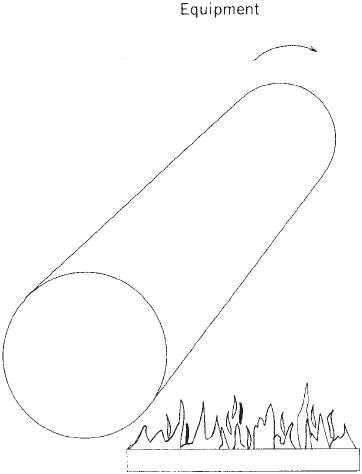
Open-Flame and Slush Molding Machines. These ma-
chines (Figure 1), which are the oldest type of equipment,
usually rotate on only one axis. This equipment is used
mostly to produce open containers.
Carousel Machines. These machines (Figure 2) are the
most common type. Carousels consist of a heating station
or oven, a cooling station or enclosed chamber, and a
loading and unloading station. The carousel can have
three to six spindles or arms for mounting molds. Most
carousels have the freedom to rotate in a complete circle.
Figure 1. Rotational-molding equipment.
1086 ROTATIONAL MOLDING

Clamshell Machines. These machines (Figure 3) have
only one arm, and the heating, cooling, and loading/
unloading stations are all in the same location.
Rock-and-Roll Machines. These machines (Figure 4),
which rotate on one axis and tilt on another, are used for
long items.
Shuttle Machines. These machines (Figure 5) generally
are used to make large parts. A frame for holding one mold
is mounted on a movable bed. The bed is on a track that
allows the mold and the bed to move into and out of the
oven. After the heating cycle is complete, the mold is
moved into an open cooling station. A duplicate bed with
a mold is then sent into the oven from the opposite end.
RECENT TRENDS
Considerable progress has been made in recent years to
improve processing controls. Microprocessors, which in-
dicate processing set points and conditions, greatly im-
prove precision. Mold-cycle data for the oven and cooling
chambers can be stored for future production of parts.
Cycle time, oven temperature, major and minor axis
speeds, as well as fan and water-spray times are other
functions under computer control. New temperature-mon-
itoring systems also are available.
A key benefit of rotational molding is the low relative
cost of its tooling. Cast aluminum molds are most fre-
quently used, especially for small-to-medium-sized parts.
Cast aluminum has good heat transfer and is cost-
effective when several molds for the same part are
required.
Sheet-metal molds are normally used for larger parts.
These molds are easy to make because sections can be
welded together. Other molds, such as electroformed and
vapor-formed nickel molds, yield an end product with fine
detail. Cost for these is typically higher.
To assist in part removal, most rotational molds require
a mold-release agent, which is either baked or wiped on.
Many molds now use a fluoropolymer coating to eliminate
the use of mold release. Also, waterborne release agents,
Figure 2. Carousel/turret machines have a center pivot with
three, four, or five arms that hold molds. The arms index
simultaneously from station to station, i.e., load/unload station,
to oven and to cooler.
Figure 3. Single-station machines, also called clamshell ma-
chines, have an oven that has a hinged cover and a hinged front
panel. The mold rotation arm can swing into and out of the oven.
The cover and front panel are closed during heating and are
opened for part cooling, removal, and reloading of the mold.
Figure 4. Rotational moldings with long length:diameter (L/D)
ratios can be made on equipment called ‘‘rock-and-roll machines.’’
The mold is rocked back and forth on a stationary, horizontal axis
while it is rotated about a moving axis that is perpendicular to the
rotating axis.
Figure 5. Shuttle machines either move the mold, along an oval
or straight track, from the load/unload station, to the oven, and to
the cooling station.
ROTATIONAL MOLDING 1087