
Yam, Kit L. (ed.). The Wiley encyclopedia of packaging technology
Подождите немного. Документ загружается.

Gerald A. Young, Sonoco Products Company, Industrial Container
Division, Drums, Fiber
R. W. Young, John Dusenberry Co., Slitting And Rewinding Machine
Paul J. Zepf, Zarpac, Inc.—Engineering, Conveying; Packaging Line
Performance
Keith A. Zullow, Goodwin Procter LLP, Patent Law Primer for the
Packaging Industry
David A. Zumbrunnen, Laboratory for Advanced Plastic Materials and
Technology, Clemson University, Smart Blending Technology
viii CONTRIBUTORS

PREFACE
Welcome to the third edition of the Wiley Encyclopedia of
Packaging Technology. For over two decades, this has been
the most authoritative packaging encyclopedia around the
world, providing useful and comprehensive information to
serve the packaging community. In this new edition, we
have done our best to continue the tradition.
Since the last edition of this encyclopedia published
12 years ago, what have been the major changes in
packaging technologies? To answer this question, it is
useful to understand that the packaging industry is
largely driven by the needs of the consumers, the society,
and the manufacturers. The consumers need higher qual-
ity products that are more convenient to meet their ever-
changing lifestyle. The society needs products that are
safer to respond to events such as September 11 and
outbreaks of food pathogens, as well as products that are
more environmentally friendly to meet the demands of the
public and the activists. The manufacturers need better
and more cost-effective packaging technologies to satisfy
the market and make profits.
During the past decade, several new or improved
packaging technologies have emerged to satisfy the needs
of the market, specifically those relating to active packa-
ging, sustainable packaging, and intelligent packaging.
Active packaging involves advanced technologies that
actively change the internal conditions of the package to
extend product shelf life; for example, oxygen-scavenging
films are an active packaging technology that is used to
absorb oxygen inside the package and extend the shelf life
of the product. Sustainable packaging involves technolo-
gies that are environmentally friendly, socially acceptable,
and economically viable; for example, a sustainable pack-
age may be made of biobased materials that are biodegrad-
able and inexpensive but yet possessing properties
required for the application. Intelligent packaging involves
the use of smart package devices (such as RFID tags, time-
temperature indicators, and biosensors) to track product,
sense the environment inside or outside the package,
monitor product quality, and improve efficiency.
In this third edition, new articles are added to provide
the reader with a basic understanding of active packag-
ing, sustainable packaging, and intelligent packaging.
Other new articles include important packaging topics
such as nanotechnology, smart blending technology,
packaging for space missions, military packaging, bio-
based materials, high-voltage leak detection technique,
analytical methods for food packaging, application of
predictive microbiology, and patent law primer for the
packaging industry.
Although the packaging industry will adopt new tech-
nologies slowly, its operations continue to rely heavily on
traditional technologies. In this edition, a balance is struck
to allocate spaces for new and traditional technologies.
The scope of packaging is broad. It encompasses technical
activities such as machinery design, graphic design, package
development, package manufacture, shelf-life testing , distri-
bution, and marketing. It deals with various types of pack-
ages, including metal cans, glass containers , paper cartons,
plastic containers , and pouches. It involves the participation
of packaging scientists and engineers, packaging material
suppliers, packaging converters, manufacturers , retailers,
and regulatory agencies. This encyclopedia endeavors to
cover all relevant and contemporary aspects of packaging,
although inevitably some aspe cts may be omitted o r deem-
phasized. The A to Z format and the cross-in dex permit the
readers to find everything in the encyclopedia easily.
This third edition is blessed by the dedication and
contributions of the authors, the editorial advisory board,
and the experts from the packaging industry. The editors
of previous editions deserve credit for building a strong
foundation for the encyclopedia. As the editor of this new
edition, I am grateful to the assistance and hard work of
the editorial staff from Wiley, particularly Arza Seidel,
Mary Mann, Mickey Bickford, and Kris Parrish, along
with the staff at MPS. The encyclopedia is also blessed by
the support of the readers who make it the most recog-
nized packaging encyclopedia ever published.
Finally, acknowledgments would not be complete with-
out thanking my wife, Aileen, who as a research enthu-
siast, has acted as sounding board and support during
countless hours of working.
It is my fervent hope that this new edition will continue
to serve as a useful reference for the seasoned profes-
sionals, novices, students, and casual readers.
Kit L. Yam
New Brunswick, New Jersey
ix

A
ACRYLIC PLASTICS
J. T. SULLIVAN
Rohm and Haas Company
Updated by Staff
Acrylic plastics is defined as a family of synthetic or man-
made plastic materials containing one or more derivatives
of acrylic acid. The most commonly used derivative is
poly(methyl methacrylate). Polymers based on acrylic
monomers are useful in packaging as a basis for printing
inks and adhesives and as modifiers for rigid PVC products.
ACRYLIC-BASED INKS
Paste Inks
Acrylic solution resins are used in lithographic inks as
dispersing or modifying letdown vehicles (see Inks; Print-
ing). A typical resin (60% in oil) offers excellent dot forma-
tion, high color fidelity, exceptional print definition,
nonskinning, and good press-open time. Set times are fast
(B60–90 s), and a minimal level of starch spray (75% of
normal) is effective. Coatings on cartons, fabrication stocks,
and paper are glossy and exhibit good dry resistance.
Solvent Inks
Because of their resistance to heat and discoloration, good
adhesion, toughness, and rub resistance, acrylics are
widely used in flexographic inks on paper, paperboard,
metals, and a variety of plastics (1). These inks also give
block resistance, resistance to grease, alcohol, and water,
and good heat-sealing performance (see Sealing, heat).
With some grades, adding nitrocellulose improves heat
sealability, heat resistance, and compatibility with lami-
nating adhesives. This family of methacrylate polymers
(methyl to isobutyl) has broad latitude in formulating and
performance. Solid grades afford low odor, resist sintering,
and dissolve rapidly in alcohol–ester mixtures or in esters
alone (gravure inks). Solution grades (40–50% solids) are
available, as well as nonaqueous dispersions (40% solids)
in solvents such as VMP naphtha, which exhibit fast
solvent release and promote superior leveling and hiding.
They are excellent vehicles for fluorescent inks.
Water-Based Inks
The development of waterborne resins has been a major
achievement. Their outstanding performance allows them
to replace solvent systems in flexographic and gravure
inks and overprint varnishes on corrugated and kraft
stocks, cartons, and labels. Approximately 50% of all the
flexographic inks used are based on water as their pri-
mary solvent. Typical inks are water-based with acrylic
emulsion resins as the main binder (1). Press inks are very
fluid and of low viscosity. Inks contain a variety of
additives for the elimination of foaming dipersion of
pigments, rheological modifiers, slip agents, and so on.
The paramount advantage of aqueous systems is a sub-
stantial decrease in environmental pollution by volatile
organics. Aqueous acrylic colloidal dispersions (30% so-
lids) and a series of analogous ammonium salts (46–49%
solids) are effective dispersants for carbon blacks, tita-
nium dioxide, and organic pigments. Derived inks give
crisp, glossy impressions at high pigment loading, good
coverage and hiding, and water resistance. The relatively
flat pH–viscosity relationship assures formulation stabi-
lity on presses despite minor loss of volatiles. Adjusting
the alcohol–water ratio controls drying rate, and quick-
drying inks can be made for high-speed printing. The
resins are compatible with styrene–acrylic or maleic dis-
persants and acrylic or styrene–acrylic letdown vehicles.
Blends of self-curing polymer emulsions are excellent
overprint varnishes for labels and exhibit a good balance
of gloss, holdout, slip, and wet-rub resistance.
Some aqueous acrylic solutions (37% solids) combine the
functions of pigment dispersant and letdown resin and
serve as ready-to-use vehicles for inks on porous substrates
like kraft and corrugated stocks and cartons. They afford
excellent color development, excellent heat-aging resis-
tance in formulations, and fast drying. The flat pH–viscos-
ity relationship gives the same benefit as the dispersants.
ACRYLIC ADHESIVES
Pressure-Sensitive Adhesives
Solution copolymers of alkyl acrylates and minor amounts
of acrylic acid, acrylonitrile, or acrylamide adhere well to
paper, plastics, metals, and glass and have gained wide
use in pressure-sensitive tapes (2). Environmental regula-
tions, however, have raised objections to pollution by
solvent vapors and are requiring costly recovery systems.
This opportunity has encouraged the development of
waterborne substitutes, such as emulsion polymers, which
eliminate these difficulties, offer excellent adhesion, show
resistance to wet delamination, aging, and yellowing, and,
like the solvent inks, need no tackifier. In packaging
applications, the emulsion polymers provide high tack, a
good balance of peel adhesion and shear resistance, ex-
cellent cling to hard-to-bond substrates, and clearance for
food packaging applications under FDA Regulations 21
CFR 175.105, 21 CFR 176.170, and 21 CFR 176.180. Their
low viscosity makes formulation easy, and the properties
of the adhesives can be adjusted by adding surfactants,
acrylic thickeners, and defoamers. The main advantages
of pressure-sensitive adhesives compared to other tapes is
convenience of use. There are no storage problems, and
mixing or activation is not necessary. No waiting is
involved. Often the bond is reversible. Disadvantages
are that the adhesive strengths are low, they are
1
unsuitable for rough surfaces, and they are expensive in
terms of cost per bond area (3).
Resins are available that are designed specifically for
use on polypropylene carton tapes (4). They are ready-to-
use noncorrosive liquids applicable to the corona-treated
side of oriented polypropylene film using knife-to-roll,
Mayer rod, or reverse-roll coaters (see Coating equipment;
Film, oriented polypropylene; Surface modification). A
release coating is unnecessary because the adhesive does
not stick to the untreated side and parts cleanly from
the roll. The tapes are used to seal paperboard cartons
with high-speed taping machines or handheld dispensers.
Adhesion to the cartons is instantaneous and enduring.
The colorless tape is well-suited for label protection. The
material adheres well to other plastics and metals.
An acrylate–vinyl acetate copolymer-based tape is gen-
erally used in high-quality tapes for their better technical
properties. They are paler in color, exhibit much better
aging, and, if crosslinked after coating, can give a very
good shear strength (3).
Hot-Melt Adhesives
The most recent development in pressure-sensitive tape
manufacture is the the hot-melt coating process. These
adhesives offer obvious advantages over solvent or water-
borne materials if equivalent performance is obtainable.
Acrylic prototypes gave better color and oxidative stability
than rubber-based products, but exhibit poor adhesion
quality. New improved grades are providing an impressive
array of adhesive properties and superior cohesive
strength at elevated temperatures in addition to stability
and low color. The action of the adhesives involves a
thermally reversible crosslinking mechanism that gives
ready flow at 3501F (1771C), rapid increase in viscosity on
cooling, and a stiff crosslinked rubber at ambient tem-
perature. The resins give durable peel adhesion, good
shear resistance, resistance to cold flow, and excellent
photostability in accelerated weathering. On commercial
machinery these resins have displayed excellent coatabil-
ity on polyester film at high line speeds (see Film, oriented
polyester). These adhesives form bonds without supple-
mentary processing and are considered environmentally
friendly. A drawback is the possibility of damage to a
substrate that cannot withstand application temperatures
(3). There is a wide variety of possible applications for
these materials, including packaging tapes.
PVC MODIFIERS
Acrylics have played a major role in the emergence of clear
rigid PVC films and bottles (5, 6). Acrylic processing aids
provide smooth processing behavior in vinyl compounds
when passed through calenders, extruders, blow-molding
machinery, and thermoforming equipment (see Additives,
plastics). One member of this group is a lubricant-proces-
sing aid that prevents sticking to hot metal surfaces and
permits reduction in the level of other lubricants, thereby
improving clarity. Other benefits of acrylics are low
tendency to plateout and a homogenizing effect on melts
to give sparkling clarity and improved mechanical
properties. The usual level in vinyl compounds for packa-
ging is about 1.5–2.5 phr.
In a second group are the impact modifiers, which are
graft polymers of methyl methacrylate–styrene–butadiene
used in the production of clear films and bottles. The
principal function of impact modifiers is to increase tough-
ness at ambient and low temperature. Levels of 10–15 phr,
depending on modifier efficiency, are normal.
Many acrylics are cleared for use in food-contact pro-
ducts under FDA Regulations 21 CFR 178.3790 and 21
CFR 175.210 (7). These regulations stipulate limits in the
permissible level of modifiers relative to their composition.
Processors should seek advice from suppliers on the ma-
keup of formulations. Many modifiers are fine powders that
may produce airborne dust if handled carelessly. Above
0.03 oz/ft
3
(0.03 mg/cm
3
), dust is a potential explosion ha-
zard and its accumulation on hot surfaces is a fire hazard.
The recommended exposure limit to dust over an 8-h period
is 2 mg/m
3
. Eliminate ignition sources, ground equipment
electrically, and provide local exhaust ventilation where
dusting may occur (8). Workers may wear suitable MSHA-
NIOSH respiratory devices as protection against dust.
BIBLIOGRAPHY
1. R. W. Bassemeir and A. Bean, Kirk–Othmer Encyclopedia of
Chemical Technology, Vol. 14, John Wiley & Sons, Hoboken,
NJ, 2005, pp. 320, 326.
2. D. Satas, ed., Handbook of Pressure-Sensitive Adhesives, Satas
& Associates, 1999.
3. D. W. Aubrey, in D. E. Packham, ed., Handbook of Adhesives,
John Wiley & Sons, Chichester, UK, 2005.
4. W. J. Sparks, Adhes. Age 26(2), 38 (1982).
5. Bulletin MR-112b, Rohm and Haas Company, Philadelphia,
1983.
6. J. T. Lutz, Jr., in D. L. Dunkelberger, ed., Impact Modifiers:
History and Practice for PVC, John Wiley & Sons, New York,
1991, p. 34.
7. ‘‘Acrylate Ester Copolymer Coating,’’ 21CFR175.210, U.S. Food
and Drug Administration, revised April 2003, accessed Janu-
ary 2008.
8. American Conference of Governmental Hygienists, Cincinnati,
A Manual of Recommended Practice, 1982; American National
Standards Institute, New York, Fundamentals Governing the
Design and Operation of Local Exhaust Systems, ANSI Z-9.2,
1979.
ACTIVE PACKAGING
ANDREW SCULLY
CSIRO Materials Science and
Engineering, Melbourne,
Victoria 3169, Australia
This is a revised and updated
version of the article written by
Michael Rooney
Packaging is described as active when it performs some
desired role other than to provide an inert barrier between
2 ACTIVE PACKAGING
the product and the outside environment, although nu-
merous other definitions also exist (1). Therefore, active
packaging differs from conventional passive packaging in
that one or more forms of interaction are planned, usually
to offset a deficiency in an otherwise suitable package. The
active component may be part of the packaging material
or may be an insert or attachment to the inside of the
pack. Active packaging is largely an innovation dating
from the 1980s, although there are examples that have
been in use for over a century. The tinplate can, for
instance, provides a sacrificial layer of tin that protects
the food from accumulation of catalytically active iron
salts. Antioxidant release from waxed-paper packs for
breakfast cereals has been used, as has been the impreg-
nation of cheese wraps with sorbic acid.
It was in 1987 that the term ‘‘active packaging’’ was
introduced by Labuza (2). Prior to that time, terms such as
‘‘smart,’’ ‘‘freshness preservative,’’ and ‘‘functional’’ were
used to describe active-packaging materials. Sachets of
iron powder have been described as ‘‘deoxidizers,’’ ‘‘free
oxygen absorbers,’’ and ‘‘oxygen scavengers’’ (see Oxygen
scavengers). Active packaging can enable the properties of
the package to more adequately meet the requirements of
the product. Therefore, the forms and applications of
active packaging are diverse, addressing specific situa-
tions in the protection and presentation of foods and other
products.
PROBLEMS ADDRESSED BY ACTIVE PACKAGING
Active packaging can be used to minimize the deteriora-
tion of the packaged product, which can occur through
biological or physicochemical reaction mechanisms.
Biological deterioration may result from insect attack
as occurs, for instance, in foods, furs, fabrics, and museum
specimens. Elevated temperatures and humidities en-
hance the rate of activity at various stages in the life cycles
of insects. Chemical fumigation is possible in some cases
but is becoming more tightly controlled with foods such as
grains and dried fruits. Accordingly, modified-atmosphere
packaging (MAP) is now commonly used in many markets,
including Europe and North America. Since low levels of
oxygen and/or high carbon dioxide levels are required to
suppress growth, packaging systems or adjuncts that
assist in achieving such atmospheres can contribute to
quality maintenance. Such adjuncts are oxygen scaven-
gers, desiccants, and carbon dioxide emitters.
The other generically common cause of biological dete-
rioration is microbial growth. This is usually enhanced by
the same variables, but there is also danger from anaero-
bic pathogenic bacteria, such as clostridia, that grow at
very low oxygen levels or in the absence of oxygen. Hence,
the removal of oxygen is not necessarily a solution to
all microbial growth problems. Antimicrobial treatments
such as the release of carbon dioxide, ethanol, other
preservatives, or fungicides can play a role in reducing
microbial growth. Similarly, desiccants can assist in pro-
viding the ‘‘hurdle’’ of reduced water activity, especially in
foods. Where liquid water is formed by condensation on
the packages of fresh produce, the use of humidity buffers
or condensation control films can be useful. Where tissue
fluids from fish or white and red meats is unsightly, the
use of drip absorbent pads is commonplace.
Biological deterioration of fresh produce also occurs
naturally as part of the process of senescence. Reduction
in the rate of senescence can be achieved in many cases by
reduction of the respiration rate by reducing equilibrium
oxygen concentrations to B2%. Ethylene synthesis that
accelerates ripening and senescence can be suppressed by
elevated carbon dioxide concentrations. Existing plastic
packaging films seldom allow beneficial equilibrium-mod-
ified atmospheres to be developed, so some form of active
packaging is needed. Transpiration of water by produce
leads to condensation when temperatures fluctuate
slightly. Furthermore, ethylene release by one or more
damaged or ripe fruit can cause rapid ripening of others.
This is akin to the ‘‘one rotten apple in the barrel’’
situation. Ethylene removal is therefore a highly desirable
property of produce packaging.
Chemical deterioration vectors act on the widest range
of packaged products. These include especially foods and
beverages (lipid and nutrient loss, off-flavor generation),
but also pharmaceuticals. The protection offered by active
packaging is, in many cases, essential to achieving a
satisfactory shelf life for pharmacologically active com-
pounds, many of which can lose potency through hydro-
lysis and, therefore, require the use of a desiccant. With
the intense search for new drug candidates, attention is
now being directed to compounds that are subject to
oxidation, in which case protection from oxygen becomes
essential to maintaining efficacy. Similarly, active packa-
ging can be useful for optimizing the shelf life of in vitro
diagnostic preparations, which often include chemically
and biochemically active compounds that may be subject
to hydrolytic or oxidative degradation. The active protec-
tion in this case can either be incorporated within the
package or be designed into the device itself. Some diag-
nostic formulas are enzyme-based, with the enzymes
in the dry form or a fully hydrated form. The moisture
content of dry enzyme preparations must be controlled at
an appropriate low level, with sufficient residual moisture
to ensure that the protein does not become denatured,
thereby inhibiting its activity. Conversely, the moisture
content of hydrated enzyme preparations must be main-
tained at a level that prevents the localized dilution or
leaching of formula components caused by moisture eva-
poration and recondensation as a result of temperature
fluctuations
during storage and
distribution. In this case,
active moisture regulation within the package can be
useful for maintaining functionality over the required
shelf life.
Industrial chemicals such as amines, and particularly
some printing inks, are oxidized on storage. Microelectro-
nic components, some metals, and a variety of unrelated
items can be subject to attack by oxygen. Often the rate of
loss can be reduced adequately by inert-gas flushing and
barrier packaging. However, these treatments are not
always effective, convenient, or economical, particularly
when oxygen levels below 0.5% are desired (3). Nitrogen
flushed packs of dry foods often have residual oxygen
levels of 0.5–2%. Chemical forms of in-pack oxygen
ACTIVE PACKAGING 3
scavenging have been introduced both to reduce these
residual levels further and to deoxygenate air headspaces
without the use of inert-gas flushing or evacuation.
Fried snacks are particularly susceptible to oxidation,
depending on their moisture content. Although sliced,
processed meats are packaged commercially under va-
cuum, improved presentation using MAP can be achieved
when an oxygen scavenger is present. The pink nitroso-
myoglobin is damaged by even low quantities of oxygen in
the package. The flavor of alcoholic beverages such as beer
and white wines is particularly sensitive to oxygen, so the
relatively high oxygen permeability of poly(ethylene ter-
ephthalate) (PET) bottles makes them unsuitable for
packaging most wines and beers. The presence of oxygen
in glass bottles is usually offset by addition of sulfur
dioxide to the beverage. However, oxidative loss of this
antioxidant still limits the shelf life of beer and white wines
and limits their packaging options. A similar sulfur dioxide
loss occurs in dried apricots. In these cases the presence of
an oxygen scavenger that does not react with this acidic
gas is required. Porous adsorbents in current oxygen
scavengers may also remove some of the sulfur dioxide.
The flavor of some foods changes on storage because of
effects other than oxidation. Tainting is a recurrent
problem. Moldy taints can result from long voyages in
shipping containers. Methods of odor interception without
the use of expensive barrier packaging are needed for the
transportation of low-valued primary products. Besides
interception of external taints, there is also a need for
removal of food breakdown products that can be formed
during storage. These include amines or thiols formed
rapidly in fish or rancid odors in oil-containing foods. Such
compounds can be present in trace amounts that are
significant organoleptically but may not constitute a
health hazard. The bitter principle in some orange juices,
limonin, is formed on standing, and a method for its
removal from juice has been reported (4).
Two physical properties of a product that can poten-
tially be affected by active packaging are heating and
cooling. Thus the microwave heating of packaged multi-
component entrees offers a challenge for uniform heating
in spite of varying layer thicknesses and water contents
(see Microwave pasteurization and sterilization). Canned
drinks, such as sake and coffee, supplied via vending
machines in Japan are frequently consumed warm. Other
drinks may need to be cooled, and so dispensing from the
one machine may necessitate building the temperature-
changing capacity into the can itself.
GOALS OF ACTIVE PACKAGING
Active packaging is chosen to enhance the ability of
conventional packaging to help deliver the product to
the user in a desired state. The decision to use some
form of active packaging will often be based on one or
more of the following considerations (see also Shelf life).
1. Extension of Shelf Life. This extension may exceed
the presently accepted limits as with sea shipment
of some fresh produce.
2. Less Expensive Packaging Materials. Packaging of
limited-shelf-life products may require enhance-
ment of only one property for a fixed period. This
can include bakery products, metal components
shipped by sea, or chilled meats.
3. Simpler Processing. Introduction of additional mi-
crobiological ‘‘hurdles’’ can allow MAP to be achieved
without use of expensive equipment.
4. Reduction or Removal of Preservatives from Food
Formulations. This is done to meet consumer de-
mands for ‘‘fresher’’ foods containing fewer additives
by transferring preservatives from the food to the
packaging.
5. Difficult-to-Handle Products. Oxygen can be re-
moved from tightly packaged products such as
cheeses that are subject to mold growth.
6. Allowing Particular Types of Packages to be Used.
This could include (a) retortable plastic packages for
products with multiyear shelf lives or (b) PET wine
bottles.
7. Presentation. Heating by microwave susceptors and
other adjuncts has allowed packaging innovation for
convenience foods.
Other goals are developing as the potential is being
realized. Indicators of time–temperature and temperature
abuse are presently available. The composition of the
package headspace can potentially indicate chemical,
physiological, or microbiological state or the potency of
the packaged product.
FORMS OF ACTIVE PACKAGING
The active components in packaging can exist either as
part of an otherwise unmodified package or as an elabo-
rate adjunct or design modification. The major form in use
at present is the insertion of sachets of various scavengers
or emitters. These have been followed more recently by
plastics blends or compounds and, to a lesser extent, by
composite packages of various forms.
Sachets and Other Inserts
Desiccants. Silica
gel has been
supplied for protection
of packaged goods from water for many years. A range of
sachets and porous canisters as well as saddles are
manufactured in sizes from grams to kilograms by com-
panies such as Multisorb Technologies, Inc. (Buffalo, NY)
and Su
¨
d-Chemie. Silica gel has a capacity when dried for
taking up 40% of its own weight of water vapor. An
alternative is lime (calcium oxide), which takes up 28%.
Both are used largely in the shipment of goods through
humid atmospheres to protect against corrosion (steel,
aluminum computers), caking (pharmaceuticals), or
mold growth (foods). In Japan these are used with some
snacks such as rice crackers to give a high level of
crunchiness, as well as a sticky, dehydrating sensation
on the tongue. Many variants in form have facilitated new
uses for these well-known materials. Sachets are marked
4 ACTIVE PACKAGING
‘‘Do not eat’’ and are often between the primary and
secondary package. Less severe desiccants can be also
used for condensation control in the wholesale distribu-
tion of produce, particularly where the carton liner bag is
heat-sealed to generate a modified atmosphere. A few
products such as tomatoes are packed with large micro-
porous sachets of salts, like sodium chloride, which absorb
excess water at the high relative humidities experienced
in such closed packages. The relative humidity can be
lowered from B95% to 80%. This was a first-generation
approach to humidity buffering.
Oxygen Scavengers. Oxygen scavenging sachets were
introduced in Japan in 1969 initially containing sodium
dithionite and lime. This followed early work by Tallgren
in Finland in 1938 using iron and other metals (5).
Mitsubishi Gas Chemical Co. introduced Ageless
s
sachets
in 1977 containing reduced iron powder, salt, and trace
ingredients. This technology has developed with a wide
variety of formulations being provided by Mitsubishi and
other companies in Japan. Multisorb Technologies, Inc.
manufactures the FreshPaxt series of iron-based oxygen
absorbers, which are also marketed in the United King-
dom, and Standa Industrie of Caen manufactures a range
of sachets under the name ATCO in France. It was
estimated that around 12 billion such sachets were man-
ufactured in Japan in 2001, and it is predicted that sales
for 2007 will be on the order of 14.4 billion in Japan, 4.5
billion in the United States, and 5.7 billion in Europe (6).
The global value of this market is predicted to grow from
$588 million in 2005 to around $924 million in 2010 (7).
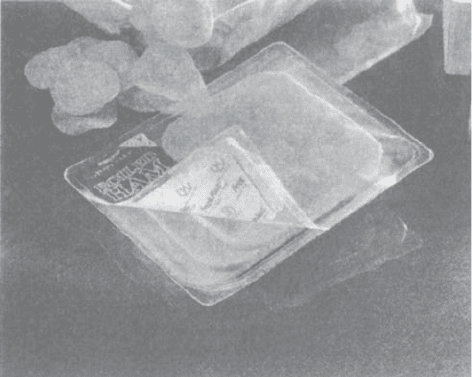
The oxygen scavenging materials can also be bonded to
the inside of the package, resulting in even less chance of
accidental ingestion or incorporation into food prepara-
tions. Mitsubishi Gas Chemical Co. introduced a hot-melt
adhesive system for sachets, and Multisorb Technologies,
Inc. market an adhesive label (FreshMax
s
), which is
sufficiently thin that it can be applied with conventional
labeling machinery (see Figure 1). The contents of oxygen-
scavenging sachets differ, depending on the relative hu-
midity of the product, usually food. Some are designed to
operate at refrigerator or even freezer temperatures.
Characteristics of some commonly used sachets are shown
in Table 1. The form of triggering is one of the key aspects
of oxygen scavengers of any type. It is preferable that the
scavenging composition can be activated when required,
because premature reaction with atmospheric air leads to
loss of scavenging capacity and potential failure in the
sealed package.
Combination sachets are also available from Mitsubishi
Gas Chemical Co. and EMCO Packaging Systems (UK).
Some of these release carbon dioxide while taking up
oxygen. These are normally based on ascorbic acid and
sodium bicarbonate. Ageless
s
E sachets contain lime as
well as iron to absorb CO
2
and oxygen and are used in
roasted-coffee packs.
Ethanol and Sulfur Dioxide Emitters. Low concentrations
of ethanol, 1–2% in bakery products, have been shown to
suppress the growth of a range of common molds. Higher
levels are necessary to suppress bacteria and yeasts, and
the effectiveness is dependent on the water activity of the
product. Freund Corp. (Japan) has developed two ethanol-
emitting sachets which release ethanol vapor in response
to the absorption of water vapor from the food headspace.
Antimold-mild
s
(also known as Ethicap) sachets contain
food-grade ethanol (55%) adsorbed in silica powder (35%).
The sachets consist of films of varying permeabilities to
provide some control of the rate of ethanol release. Sachets
are available from Freund in sizes of 0.6–6G containing
0.33–3.3 g of ethanol. The size of the sachet required can
be calculated from knowledge of the water activity and
weight of the product and the shelf life desired.
Food packages containing ethanol-releasing sachets
should have an ethanol vapor permeability of o2 g/m
2
per day at 301C (Freund Corp.). Packaging films used with
ethanol generators can be as simple as oriented polypro-
pylene/polypropylene, but polyethylenes are too perme-
able for use. Ethicap has been investigated with pita
bread, apple turnovers, strawberry layer cakes, and ma-
deira and cherry cream cake. It is used widely in Japan
with semimoist or dry fish products.
The second type of ethanol emitting sachet marketed
by Freund Corp., under the name Negamold
s
, is a com-
bined oxygen scavenger and ethanol emitter. This type of
sachet is not widely used. Ethanol-emitting sachets are
manufactured by other companies in Japan, including
Ohe Chemicals Inc. (Oytech L). Pira International Ltd.
estimated that the total global market (predominantly in
Japan) in 2005 for these types of sachets was $37 million,
and it forecasts growth to $65 million by 2010 (8).
Sulfur-dioxide-releasing pads are available for use in
the transportation of cartons of table grapes. Grapes are
readily separated from their stalks by the action of fungi
in the moist atmosphere of polyethylene-lined cartons.
Microporous pads containing sodium metalbisulfite
(B7 g) placed on top of the fruit release sulfur dioxide as
water vapor is absorbed. If the uptake of water vapor is too
rapid, as is often the case, the rapid premature hydrolysis
results in excessive levels of sulfur dioxide, resulting
Figure 1. FreshMax
s
oxygen-absorbing label attached to the
inside of processed meat package. (Courtesy of Multisorb Tech-
nologies, Inc.)
ACTIVE PACKAGING 5

further in bleaching of the grapes, commencing at the
bottom of the berries. Such pads are largely manufactured
in Chile by companies such as Productions Quimicos &
Alimenticos Osku SA, of Santiago (e.g., OSKU-VID
s
Grape Guard), and are widely distributed internationally.
Ethylene Absorbers. Ethylene-absorbing sachets, some-
times made of steel mesh, are available and follow from
the variety of porous slabs and blankets developed for
ethylene removal in cool stores and shipping containers.
Several minerals are used to contain potassium perman-
ganate in the form of purple beads or in other shapes.
Typical inert substrates include perlite, alumina, silica
gel, and vermiculite containing 4–6% potassium perman-
ganate. The manner in which these might be used should
be checked because potassium permanganate is toxic.
There are many manufacturers such as Ethylene Control,
Inc. of Salinas, CA and Purafil Co. of Chalamblee, GA. The
efficiency of such absorbers will depend on the product,
the surface area of the substrate, and possibly any water
condensation.
Ethylene-absorbing sachets based on other principles
for destruction of the ethylene, such as the use of carbon
activated with a palladium catalyst, have also been re-
ported (8). Nonspecific absorbents have also been mar-
keted in sachet form in Japan for removal of gases such as
ethylene, carbon dioxide, and unwanted odors from food
packs. A product based on activated carbon is marketed by
Mitsubishi Gas Chemical Co. (Ageless
s
C-P, which in-
cludes slaked lime). The capacity of such absorbents for
ethylene at physiological concentrations (e.g., o1 ppm,
95% RH) and at the typically low temeprartures used for
storage needs to be defined.
Plastic-Based Active Packaging Materials
Moisture Control. Moisture in packages may be in the
form of liquid (condensate or drip/weep) or as the vapor.
Desiccants remove both forms of water, although they are
designed to remove the vapor. The simple form of liquid
moisture sorption has been provided by drip-absorbent
sheets consisting of two layers of nonwoven polyolefin,
divided by heat seals into pouches containing polyacrylate
superabsorbent polymers. These sheets are used under
chicken or turkey pieces and sometimes under red meats
to absorb drip during display. Other uses are to absorb
drip from seafood, especially when air-freighted to avoid
corrosion of airframes caused by spilling. These sheets are
widely available from companies such as Maxwell Chase
Inc. (Douglasville, USA) (Fresh-R-Paxt).
Although superabsorbent polymers can absorb up to
500 times their own weight of water, they do not function
as such rapid absorbents for water vapor. Condensation
can be prevented by use of multilayer plastic sheets
containing a humectant or moisture absorbent material
between the layers, such as those developed by Showa
Denko K.K. (Japan) (9) and CSIRO (Australia) (10). At
least one water vapor absorbent sheet has been produced
for domestic use, known as Pichit. This consisted of an
envelope of polyvinyl alcohol film sandwiching a glycol
and carbohydrate in a strong water vapor absorber (see
Figure 2). It is manufactured by Shoko Co. Ltd. (a
subsidiary of Showa Denko K.K) and sold as a perforated
role and as packs of single sheets for wrapping food
portions in domestic refrigerators. Su
¨
d Chemie produce
a desiccant polymer (2AP
s
) for use in a wide range of
package formats including tubes and caps, and have
patented approaches for producing such materials by
inclusion of microchannels and humectants or desiccants.
Oxygen Scavenging. Oxygen scavenger films have been
a goal of packaging industry researchers since the work of
the American Can Co. in 1976 with the palladium-cata-
lyzed reaction of oxygen with hydrogen. That package,
Figure 2. Pichit bilayer sheet for absorbing water from food
portions. (Courtesy of Showa Denko K. K.)
Table 1. Properties of Some Oxygen Scavenging Sachets
a
Type Trigger A
w
Time Days at 251C (other) Substrate Base Additional Effect
FreshPaxt
B Water >0.65 0.5–2 Fe
D Self >0.7 0.5–4 (2-20) Fe
R Self All 0.5–1 Fe
M Self >0.65 0.5–2 Fe +CO
2
Ageless
s
Z Self >0.65 1–3 Fe
S Self >0.65 0.5–2 Fe
SS Self >0.85 2–3 (0-4) Fe
10 (–25) Fe
FX Water >0.85 0.5–1 Fe
G Self 0.3–0.5 — Ascorbic acid +CO
2
E Self o0.3 3–8 Fe/lime CO
2
Negamold
s
Water >0.85 — Fe/ethanol Ethanol
a
Data from technical information from manufacturers and references 5 and 22.
6 ACTIVE PACKAGING
marketed by American Can Co. as Maraflex, was not
widely used commercially because of its complexity and
its requirement for flushing with a nitrogen/hydrogen
mixture. Oxygen-scavenging films or other plastic materi-
als offer the opportunity to prevent oxygen ingress to the
package by permeation as well as removing that originally
present inside the package. They also offer the potential
for package fabrication, filling, and sealing without the
need for insertion or attachment of a sachet. Despite the
substantial international R&D effort over the last two
decades (11), only a few oxygen-scavenging film technolo-
gies have been commercialized, such as Sealed Air’s light-
activated Cryovac
s
OS System, which is based on the
transition metal-catalyzed oxidation of rubber-like unsa-
turated polymeric components.
Oxygen-scavenging closure products are marketed by a
number of companies, including Silgan White Cap (Stam-
ford, Connecticut) (Plasti-Twist
s
), Grace Darex
s
Packa-
ging Technologies (a business unit of W. R. Grace
Company), and Bericap (O2S
s
). The Grace Darex
s
com-
positions, exemplified by Daraform
s
6490, include up to
7% sodium sulfite and 4% sodium ascorbate in a polyolefin
base (12), and they have been used by Heineken and
Anheuser-Busch beer produced under license in the Uni-
ted Kingdom. More recently, Grace Darex
s
launched
Celoxt, a closure liner that is claimed by the manufacturer
to provide a substantially faster scavenging rate. Toyo
Seikan Kaisha Ltd. (Yokohama, Japan) has taken a differ-
ent approach using a reduced iron base for reaction with
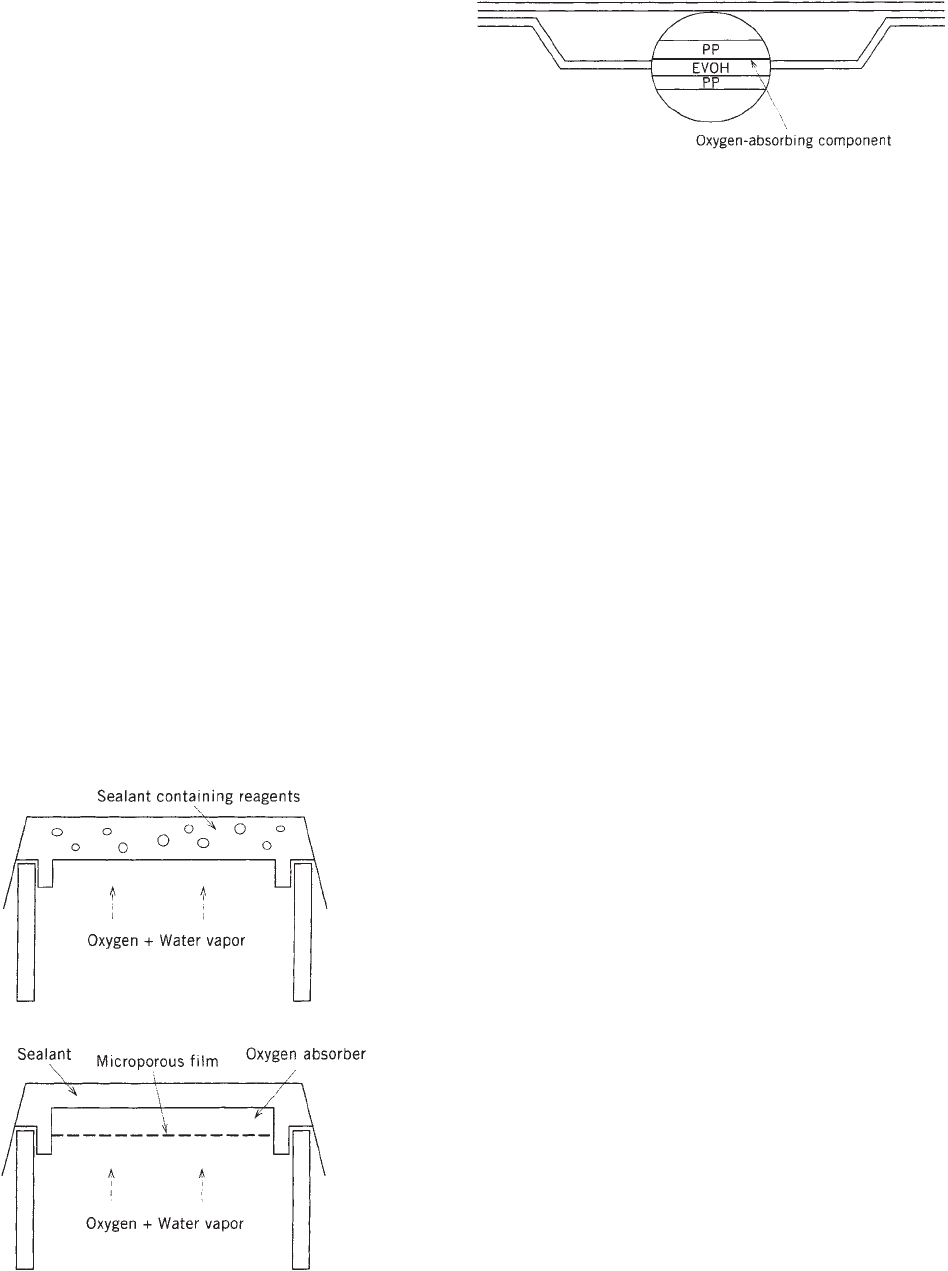
oxygen. The crown closure consists of three layers with the
middle, reactive layer separated from the beer by a micro-
porous polymer layer. The scavenging reaction involves
water vapor from the beer, especially during pasteuriza-
tion, and premature reaction is presented by keeping the
composition dry prior to use. The closure sealant designs
can be compared by reference to Figure 3, which repre-
sents the Grace approach (top) and the Toyo Seikan Kaisha
approach (bottom).
The first thermoformable oxygen-scavenging sheet
(Oxyguardt) was commercialized in 1994 by Toyo Seikan
Kaisha Ltd. for use in retortable plastics trays. The
oxygen scavenging layer is between the EVOH (ethylene
vinyl alcohol) oxygen-barrier layer and the inner, perme-
able polypropylene layer. Figure 4 shows this structure
diagramatically. The scavenging process involves moist-
ure-activated reaction of oxygen with iron particles em-
beded in the polypropylene layer. Similar thermoformable
oxygen-scavenging polymeric materials are also produced
by Ciba Speciality Chemicals (SHELFPLUS
s
O2).
Active Oxygen Barriers. More recently, oxygen-scaven-
ging has been used to improve the barrier performance of
PET containers. The Oxbart technology involves the tran-
sition-metal-catalyzed oxidation of polymeric materials
such as MXD6 Nylon, and it was originally developed by
CMB Technologies plc UK for making PET bottles oxygen-
impermeable while scavenging oxygen from the packaged
beverage. This technology is now the basis of PET bottles
manufactured by Constar International Inc. (Philadelphia,
Penn.), as well as by other packaging companies, such as
Amcor Ltd. (Melbourne, Australia), under license. Other
approaches based on the use of transition-metal-catalyzed
oxidation to produce PET bottles having enhanced oxygen-
barrier properties include those of BP Amoco (Amosorb
s
),
Valspar (ValORt), and Toyo Seikan Kaisha Ltd. (Oxyblock,
also referred to as SIRIUS101). M&G has developed a
technology involving incorporation of iron particles into
the PET, and it produces actively enhanced oxygen barrier
PET bottles (ActiTUF
s
).
Antimicrobial Films. Antimicrobial agents, fungicides,
and natural antagonists are applied to harvested produce
in the form of aqueous dips or as waxes or other edible
coatings. Their roles and their U.S. regulatory status have
been tabulated (13). Besides produce, foods with cut
surfaces are subject to largely superficial microbial attack
and some cheeses are packaged with wrappings or separ-
ating films (sliced cheese) containing sorbic acid. Although
many foods are subject to rapid attack at the cut surfaces,
potentially useful antimicrobial packaging films are still
largely a subject of research (14–16).
Sinanen Zeomic Co. Ltd. in Japan produces a synthetic
zeolite, Zeomic, which has silver ions bonded into the
Figure 3. Oxygen absorbing closure liners for bottles. Top: W. R.
Grace type. Bottom: Toyo Seikan Kaisha Ltd. type.
Figure 4. Oxygen-absorbing thermoformed multilayer tray for
semiaseptic rice (PP, polypropylene; EVOH, ethylene vinyl alcohol
copolymer). (Courtesy of Toyo Seikan Kaisha Ltd.)
ACTIVE PACKAGING 7