
Alkauskas A., Deak P., Neugebauer J., Pasquarello A., Van de Walle Ch.G. (Eds.) Advanced Calculations for Defects in Materials: Electronic Structure Methods
Подождите немного. Документ загружается.

further and demonstrated in Section 16.4.2. Since the large majority of computer
time is spent in structural relaxations (and other quantities where derivatives of the
energy are of paramount importance) a significant amount of computer time can be
saved by correctly assessing the relevant impact of BSSE on a calculation. Although, at
present, much of this must be done by the user, in principle, it can be automated.
We will discuss work in this direction in Section 16.5.
16.2.2
The Matrix Build
The building of the Hamiltonian is achieved using standard techniques. The overlap
matrix, and the matrix elements of kinetic energy and the non-local pseudopotential
may be found analytically using recurrence relations reported in Ref. [10]. The matrix
elements of the Kohn–Sham potential are found as described in Refs. [6] and [11].
An important difference between our approach and standard methods of
quantum chemistry is our avoidance of four centre integrals. Our approach of
quadrature using a set of equally spaced grids [6] has linear scaling with an
acceptable prefactor. In doing this the charge density and the potential are expressed
on an equally spaced grid in real space which, in plane wave parlance would have an
exceptionally high cutoff—typical values would be 80 Rydbergs (silicon) and 300
Rydbergs (carbon). This is feasible as this expansion is done only for the charge
density, and not for each individual Kohn–Sham level. A consequence is that the
Hamiltonian matrix is determined essentially free of integration error, with
arbitrarily high accuracy being achievable at modest cost. Timings for this are
presented in passing in Section 16.4.1 when it is noted that this is a negligible
contribution to run-times for large systems, being only 3 min when run in serial on
a single core even for a system of 4096 atoms.
16.2.3
The Energy Kernel: Parallel Diagonalisation and Iterative Methods
Once the primitive Hamiltonian and overlap matrices—H and S respectively—have
been evaluated these are then converted from sparse storage to a dense block-cyclic
parallel distribution. The N N GEP
Hc ¼ ScL; ð16:4Þ
is then solved (ScaLAPACK diagonalisation) to calculate the output density
nðrÞ¼
X
ij
b
ij
w
i
ðrÞw
j
ðrÞ; ð16:5Þ
where
b
ij
¼
X
m
l
f ðL
ll
Þc
il
c
jl
; ð16:6Þ
288
j
16 Accurate Kohn–Sham DFT With the Speed of Tight Binding
and m is the number of occupied states. A charge density mixing scheme [12] is used
to iterate (the SCF cycle) towards the self-consistent density.
As well as diagonalisation, especially when the N/m ratio is high and good parallel
scaling is important, an iterative algorithm—based on the direct inversion of the
iterative subspace (DIIS)—is also used [5].
16.2.4
Forces and Structural Relaxation
It is occasionally argued that the determination of forces is more complex and time
consuming with Gaussian orbitals as a consequence of the Pulay forces associated
with atom centred basis functions. This, in fact, is not the case in reality. In fact,
viewing Pulay forces as an approximation to incompleteness forces (see Section II C
of Ref. [6] for a detailed discussion) it is more accurate to say that rather than being a
burden, the ability to calculate Pulay forces (rather than their presence) is a distinct
advantage as significant efficiencies can be obtained (see Section 16.4 for a more
detailed discussion).
Forces are determined from the Hellmann–Feynman theorem as adapted for
localised basis functions [3]:
qE
qR
a
¼
X
ij
qH
ij
qR
a
b
ij
X
ij
qS
ij
qR
a
w
ij
;
where w
ij
is the energy weighted density matrix
w
ij
¼
X
m
l
f ðL
ll
ÞL
ll
c
il
c
jl
: ð16:7Þ
The first term,
qH
ij
qR
a
b
ij
, is trivially evaluated in time scaling linearly with system size.
Indeed the time for this is only marginally greater than the construction of the
Hamiltonian itself, only 45 s for a 1000 atom cell (see discussion of timings in
Section 16.4.1). The construction of w
ij
is likewise straightforward. Evaluating
Eq. (16.7) directly using OðN
3
Þ dense matrix operations imposes a negligible
overhead—and, in principle, since only elements of w
ij
that have corresponding
non-zero elements in the Hamiltonian are required this step can be performed in
OðN
2
Þ. In conclusion then, force determination is possible in a small fraction of the
time for a single SCF step.
Movement of the atoms to attain equilibrium is then achieved using any standard
scheme. We commonly use the conjugate gradient method [13], BFGS [13] and
G-DIIS methods [14].
16.2.5
Parallelism
AIMPRO is parallelised using the message passing interface library (MPI). A library
to handle the creation and destruction of multiple worlds—and levels of worlds—is
16.2 The AIMPRO Kohn–Sham Kernel: Methods and Implementation
j
289
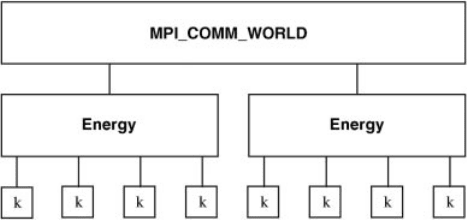
also implemented. A typical arrangement of these worlds for the calculation of the
dynamical matrix is given in Figure 16.1. Each Energy world could, for example,
calculate a row of the dynamical matrix, furthermore within each energy calculation
the calculation can further be split into separate k-point worlds. Such flexible
infrastructure such as this enables extra embarrassingly parallel functionality to be
included in the main algorithm itself.
16.3
Functionality
Although in this chapter, the emphasis is on the kernel of the calculation, and how
this may be improved both in terms of speed and accuracy, the great utility of ab initio
calculations over the last two decades has been their ability to link to an increasingly
broad range of experiments, producing quantitatively accurate values for measurable
quantities. In this section, we illustrate this by outlining some of the functionality
incorporated into the AIMPRO code and the problems tackled.
16.3.1
Energetics: Equilibrium and Kinetics
The fundamental property given by these calculations is, of course, the total energy.
In terms of defect physics, this is of outstanding importance with the formation
energy controlling the equilibrium concentrations of defects. The energy barrier to
motion of a defect through a material, gives information about kinetic motion and is
as important as the formation energy in understanding the behaviour of defects in a
material. For example, the result that the diffusion barrier of hydrogen in ZnO is
under 0.5 eV has demonstrated that isolated H cannot be responsible for the residual
n-type conductivity of this material [15] as had previously been thought. On the other
hand, the fact we can show that H binds strongly to other impurities to produce
thermally stable complexes can provide alternative explanations for this phenome-
na [16] and can also have important technological implications for other doping
issues [17].
Figure 16.1 Schematic of parallel worlds (see text for details).
290
j
16 Accurate Kohn–Sham DFT With the Speed of Tight Binding
It is frequently the energetics of defects at the high temperatures at which material
processing occurs that can determine the defects seen in materials. As such a free
energy of formation should be calculated at the temperature at which the material
is processed. Calculations of this requires treatment of vibrational modes for all
atoms in a unit cell, once demanding but now becoming a more common calculation.
It can often happen that a binding energy changes sign at high temperature leading to
some defect complexes being absent in samples [18].
16.3.2
Hyperfine Couplings and Dynamic Reorientation
An accurate knowledge of the electron spin density enables the coupling with the
magnetic moment of certain nuclei to be calculated, enabling a comparison with
experimentally measured hyperfine coupling tensors. In the simplest case a com-
parison with experiment can be a powerful tool enabling the characterisation of
defect centres [19]; in more complex cases low symmetry defects can re-orient
dynamically at room temperature appearing experimentally as having a higher
symmetry. In this case the ability to calculate both the energy barrier and the averaged
hyperfine tensor is key [19]. The physics here is quite rich in variety with quantum
tunnelling of hydrogen also being demonstrated [20].
16.3.3
D-Tensors
Defects with electron spin, S > 1 exhibit a zero field splitting, measured experi-
mentally as the D-tensor. A method to calculate the first order contribution to the
zero-field splitting tensor was presented in Ref. [9]. Again comparison of calculated
tensors [21–25] with experiment aids in the characterisation of defect centres.
The ability to perform a quantitative calculation has also shown that conclusions
drawn from the phenomenological point dipole model frequently used to interpret
the size of the D-tensor are not always reliable [21].
16.3.4
Vibrational Modes and Infrared Absorption
The vibrational modes associated with def ects are readily measured experimen-
tally, and may be calculated from the second derivatives of the energy surface.
These modes have been some of the most fruitful methods of characterising
defects [26, 27].
16.3.5
Piezospectroscopic and Uniaxial Stress Experiments
Calculation of piezospectroscopic (energy–stress) tensors of defects also provides a
direct link with experiment [28]. The response of vibrational frequencies to uniaxial
16.3 Functionality
j
291
stress is also a valuable tool in the experimental determination of defect symmetry
and these shifts can be calculated accurately from total energy calculations, providing
a further aid in characterisation studies [29].
16.3.6
Electron Energy Loss Spectroscopy (EELS)
The simplest treatment of energy loss spectroscopies is based on the dipole matrix
elements between Kohn–Sham states. This is an approximate model, but in many
instances is sufficiently accurate for features in experimental spectra to be correlated
with electronic states associated with regions of defects, particularly extended defects.
Both low-loss [30, 31] and core–electron energy loss spectroscopy (EELS) experiments
(or the theoretically similar XPS experiment [32]) can be modelled.
16.4
Filter Diagonalisation with Localisation Constraints
We now turn to the main topic of this chapter, namely, recent advances in the
KSDFT kernel that enable such calculations to be performed in a time comparable
to a tight binding calculation. The conventional AIMPRO kernel described in
Section 16.2 has been dramatically improved upon recently [6]. The filter diag-
onalisation method with localisation constraints promises to allow calculations with
larger primitive sets, thereby approaching the basis set limit, while the fundamental
density matrix is only the size of a minimal (or tight binding like) basis density
matrix. For a detailed account of the method and algorithmic details the interested
reader is referred to Refs. [6, 7]. Here, we summarise the method to elucidate later
discussions, however, it is the broader impact of the filtration algorithm we wish to
concentrate upon.
Rather than a direct diagonalisation in the full primitive basis a subspace
eigenproblem is constructed in a small basis of filtered functions, defined in terms
of the primitive basis set {w
i
}as
W
I
ðrÞ¼
X
i
k
iI
w
i
ðrÞ: ð16:8Þ
For silicon, for example, using the pseudopotential approximation this reduces
the size of the kernel eigenproblem from, say, 28 (if using the ddpp basis
described in Ref. [6]) functions per atom to only four functions per atom—a
significant saving. The step that performs this reduction in basis size will be
referred to as the filtration algorithm. A filtration radius (r
cut
)isdefi ned and the
filteredbasisonanatomatR
a
constructed using basis f unctions that lie on atoms
at R
b
where jR
a
R
b
j < r
cut
. Henceforth, filtered basis sets will be referred to
using the notation fW
ðr
cut
Þ
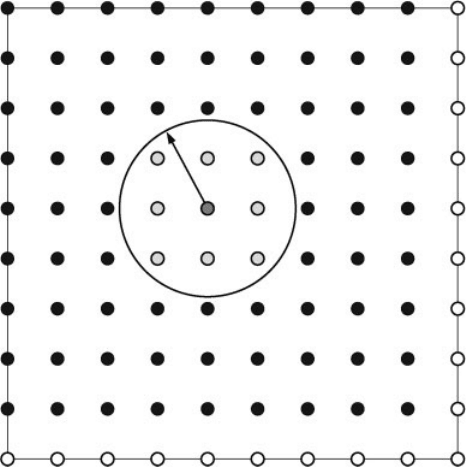
g. A schematic of the filtration region for an atom if
shown in Figure 16.2.
292
j
16 Accurate Kohn–Sham DFT With the Speed of Tight Binding
The filtration step, as outlined in Ref. [6], consists of the following operations on a
trial function jt
~
i
jk
~
i¼cf ðLÞc
T
Sjt
~
i; ð16:9Þ
to obtain the vector of contraction coefficients jk
~
i. The remaining quantities are
defined by the GEP
Hc ¼ ScL; ð16:10Þ
where, here, H and S matrices only consisting of a subset of the rows and columns
of the Hamiltonian and overlap matrix formed in the large primitive basis (see
Ref. [6]). In other words they are the H and S matrices associated with the primitive
functions within the filtration region (Figure 16.2). The filtration function f used in
Ref. [6] and throughout this work is a high temperature (kT 3 eV) Fermi-Dirac
function, which has the desired effect of removing the unnecessary high eigenspace
of the Hamiltonian. The GEP [Eq. (16.10)] can be transformed to an ordinary
eigenproblem
Hd ¼ L
1
HL
T
d ¼ dL; ð16:11Þ
Figure 16.2 (online colour at: www.pss-b
.com/) Schematic of the filtration region. Filled
circles represent atoms and unfilled their
periodic images. The green circle represents an
atom for which filtered functions are to be
calculated and the yellow circles represent
atoms whose primitive functions will contribute
to these filtered functions.
16.4 Filter Diagonalisation with Localisation Constraints
j
293
where L is a lower triangular matrix and
S ¼ LL
T
and d ¼ L
T
c: ð16:12Þ
From this we can express Eq. (16.9) as
jk
~
i¼L
T
df ðLÞd
T
L
T
jt
~
i¼L
T
f ð
H
ÞL
T
jt
~
i: ð16:13Þ
The primitive space ! subspace transformation is performed using the following
sparse matrix multiplications;
H
~
¼ k
T
Hk and S
~
¼ k
T
Sk: ð16:14Þ
From this one obtains the subspace GEP
H
~
c
~
¼ S
~
c
~
L
~
: ð16:15Þ
Since the dimension of this eigenproblem is small—essentially the size of a tight
binding Hamiltonian—it is, at present, solved with standard direct diagonalisation.
However, it must be stressed that due to the fi ltered functions being localised this
matrix will be sparse for large systems, and therefore alternatives to diagonalisation
may be considered. After the solution of this eigenproblem is obtained the subspace
density matrix is constructed
b
~
IJ
¼
X
l
f ðL
ll
Þ
c
I
l
c
Jl
; ð16: 16Þ
after which the subspace ! primitive space transformation is performed
b ¼ kb~k
T
; ð16:17Þ
and the calculation proceeds as normal. For calculations in silicon and similar
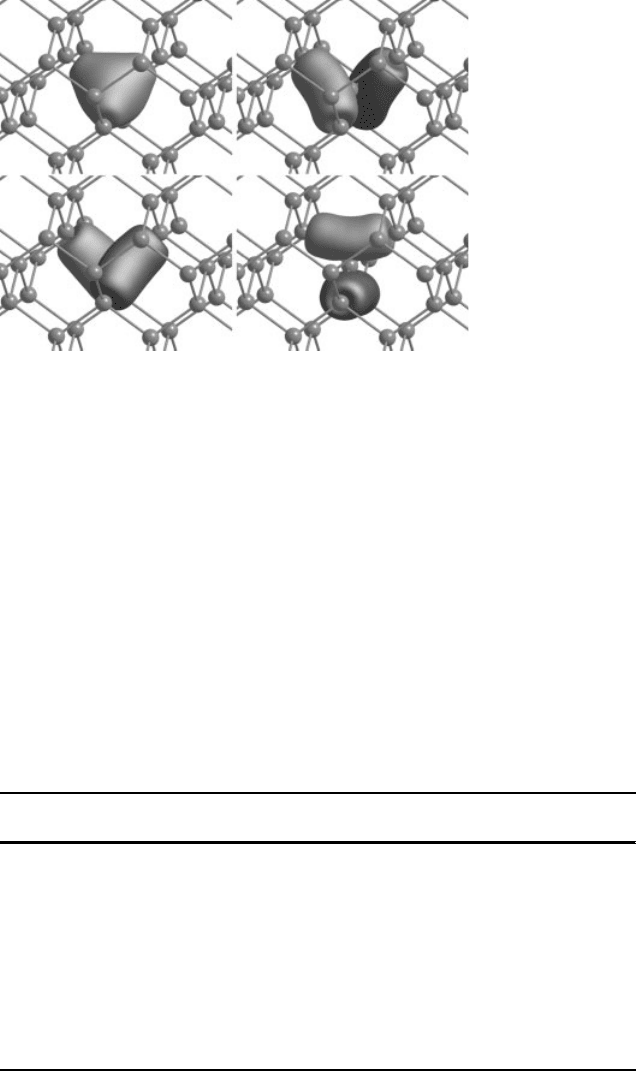
materials we have used four functions produced using trial functions of s, and p type
symmetry. The resulting functions jk
~
i are plotted in Figure 16.3.
We should note that, although the number of functions we are using (four) has an
obvious chemical significance for silicon, this is in no way a restriction of the
algorithm. Indeed, we may choose to use more or less functions, with full conver-
gence to the primitive basis being obvious as more functions are added. Using fewer
than four functions can also give good results, but only if the filtration is performed at
a low-enough temperature to permit this. Indeed, zero temperature filtration can
produce an exact result with only two filtered functions per silicon atom, although
this would not be practical as the functions would lose their localisation (in general),
thereby removing any advantage of this method.
16.4.1
Performance
We now detail the performance of the current algorithm including latest devel-
opments [7] and also some very encouraging preliminary results from further
294
j
16 Accurate Kohn–Sham DFT With the Speed of Tight Binding
optimisations of the algorithm. As a model system we look at unit cells of silicon
created by forming n n n ar rays of the eight atom conventional unit cell, w here
2 n 8. It must be stressed, however, that the algorithm is not limited to wide-
gap systems and is equally applicable to metals [6, 33]. The calculations use
gamma point sampling and are performed on a single core of a 2.8G Hz Intel
Xeon CPU.
Table 16.1 gives timings using an approximate filtration strategy—still good
enough to give only a 10
4
A
error in relaxed final structures (se e Section 16.4.2).
Times are given for a single self-consistent iteration. For this system, SCF cycles
Table 16.1 Timings (s) of components of a self-consistent iteration for n
3
(simple cubic) cells of
silicon (n ¼ 2; ...; 8) on a single 2.8 GHz Intel Xeon core. The first row gives the number of atoms in
each cell. See Sections 16.2 and 16.4 for a description of the algorithmic components. These
calculations correspond to the approximate filtration scheme (see Table 16.2).
64 216 512 1000 1728 2744 4096
matrix build 2.79 9.38 22.99 45.05 76.48 133.99 185.11
potential calculation 0.07 0.22 0.58 1.15 2.11 3.44 4.84
filtration kernel 2.00 6.74 16.00 31.19 53.94 85.97 128.12
primitive ! subspace 0.48 3.82 12.41 27.61 48.76 77.71 116.10
subspace diagonalisation 0.03 0.47 7.73 52.58 270.63 1057.98 3740.67
density matrix build 0.00 0.07 0.86 6.11 31.88 124.13 414.33
subspace ! primitive space 0.11 0.96 5.35 24.88 72.30 138.89 213.17
calculation of real space density 0.43 1.53 3.75 7.42 12.75 21.97 30.51
overhead 0.11 0.70 1.85 3.20 7.56 11.59 19.14
total 6.02 23.89 71.52 199.19 576.41 1655.67 4851.99
Figure 16.3 (online colour at: www.pss-b.com) Filter functions from trial functions of s, p
x
, p
y
and p
z
(clockwise from top-left) symmetry.
16.4 Filter Diagonalisation with Localisation Constraints
j
295
require f ewer than ten iterations to converge the Hartree energy associated with
the difference of input and output densities to less than 10
5
Ha. The most notable
detail in the table is the bottom line. This shows that on a single core a self-
consistency step for a 1000 atom system takes just 200 s and a 1728 atom system
less than 10 min. Therefore initial total energies of these systems can b e found in
30 min and 1.6 h respectively. Clearly, even modest parallelism over the 8
cores, which may typically be in a commodity dual processor PC, reduces these to
remarkably small values, and enable even complex structural relaxations on
inexpensive hardware.
Clearly for small systems (e.g. 216 atoms) the dominant time is that of the matrix
build [Eq. (16.3)] together with the filtration kernel [Eq. (16.9)]. These have O(N)
complexity and are clearly unimportant for larger systems where the O(N
3
) subspace
diagonalisation begins to dominate. One somewhat surprising feature of the timings
is that the primitive to subspace transformation [Eq. (16.14)] and its inverse
[Eq. (16.17)] are not significant at any system size, occupying at most 20% of the
total time (in 216 atoms) and gradually reducing for larger systems. This is a
consequence of the sparsity of k, H and S being well exploited together with
reasonably efficient code (which achieves 25% of peak performance) to perform
the block-multiplications.
As a final comment, it is seen that for the 1728 atom system, approximately half of
the total time is spent solving the subspace matrix eigenvalue problem. As the size of
this matrix is the same as in a tight binding calculation it may be supposed that an
accurate full DFTcalculation on this system size may be performed in twice the time
of a tight binding calculation. The difference however diminishes to just 20% for the
4096 atom system and asymptotically will vanish entirely, if direct diagonalisation is
used in both.
16.4.2
Accuracy
We now analyse the accuracy of the filtration method by comparing formation
energies and relaxed structures to the parent primitive basis. The filtration algorithm
has been previously shown to produce energies and forces which are in close
agreement with those produced by the conventional algorithm [6]. We have subse-
quently looked at a variety of different systems including metals and wide band gap
materials [33]. In this section some further results are given focusing particularly
on the accuracy of equilibrium structures and the impact of filtration on the atomic
co-ordinates.
We first present a comparison of the structures of single interstitial atoms in
silicon. Three structures are presented: the 110 defect in which a pair of Si atoms
straddle a lattice site, displaced from it in h110i directions; an atom placed at a
tetrahedral interstitial site (T
d
in the table below), and a hexagonal interstitial site,
labelled H in the tables. The calculations were performed in unit cells containing 217
silicon atoms, using a ddpp primitive basis, the pseudopotentials of Hartwigsen
et al. [34] and k-point sampling corresponding to 2 2 2 Monkhorst–Pack grid [35].
296
j
16 Accurate Kohn–Sham DFT With the Speed of Tight Binding
Structures were optimised until all components of forces on atoms were less than
5 10
5
a.u.
Two filtration conditions were chosen. The first uses a cutoff radius of 12 a.u., our
standard converged value for silicon as used in previous work [6]. For this, Table 16.2
illustrates the minimal impact filtration has on equilibrium structure, with maxi-
mum deviations from the unfiltered results of order 10
4
A
or less. To further
illustrate the insensitivity of the structures produced by filtration, a second filtration
strategy was adopted which used a smaller localisation radius (10 a.u.) together with
an more approximate filtration kernel. This more approximate approach shifts the
total energy of the system by 0.3 Ha, an immense change but the corresponding
changes to equilibrium structure are still seen from Table 16.2 to be much less
than 10
3
A
. The relative energies of the defects are also changed by only 20 meV by
this. This is a clear demonstration of the arguments regarding BSSE given in
Section 16.2.1. We find this result to be a general feature of our procedure.
Also shown in Table 16.2 are the relative energies of the different structures. It is
seen that the error associated with filtration is <10 meV and even the approximate
filtration invokes errors of only 20 meV. These results are typical of a number of
systems we have looked at. Although in an application of this in materials science, we
would not consider publishing the relative energy from the approximate filtration but
include it here to illustrate an important behaviour of the filtration (indeed, atom
centred localised basis set calculations in general)—even if an approximation is used
which produces gross (of order 10 eV) shifts in the absolute energy of structures, the
relative energies remain converged and the structure is almost unchanged, indeed if
bond lengths are published to three decimal places, they would appear unchanged.
This can be exploited if desired as a means of accelerating structural optimisation,
which typically consumes the majority of computing time in a research project.
As a second example, we have considered the binding of an interstitial oxygen atom
O
i
to a vacancy oxygen VO centre in silicon:
VO þO
i
!VO
2
;
Table 16.2 Relative energies (DE) and errors in relaxed structures (D
r
)—both mean (avg) and
maximum (max) errors—of various defects in silicon (see text for details).
DE (eV) D
r
max
(mA
) D
r
avg
(mA
)
110 structure unfiltered 0.000 ——
standard filtration 0.000 0.16 0.01
approx. filtration 0.000 0.68 0.06
T
d
structure unfiltered 0.149 ——
standard filtration 0.143 0.06 0.006
approx. filtration 0.162 0.41 0.05
H structure unfiltered 0.107 ——
standard filtration 0.104 0.06 0.009
approx. filtration 0.125 0.28 0.046
16.4 Filter Diagonalisation with Localisation Constraints
j
297