
Alkauskas A., Deak P., Neugebauer J., Pasquarello A., Van de Walle Ch.G. (Eds.) Advanced Calculations for Defects in Materials: Electronic Structure Methods
Подождите немного. Документ загружается.

Then, the reducible polarizability operator is obtained from the irreducible
polarizability operator P through the following Dysons equation:
P ¼ð1P uÞ
1
P: ð4:5Þ
Finally, the irreducible polarizability is given from the product in time of one-
electron propagators:
Pðr; r
0
; tÞ¼iGðr; r
0
; tÞGðr
0
; r; tÞ: ð4:6Þ
The GWA alone does not permit to solve the QPEq, unless G and W are known,
possibly depending on the solution of the QPEq itself.
One of the most popular further approximations is the so-called G
W
approx-
imation, where the one-electron propagator G is obtained from the eigenfunctions
y
n
(r) and eigenenergies e
n
of a one-electron (usually a Kohn–Sham) Hamiltonian:
G
ðr; r
0
; tÞ¼i
X
u
y
u
ðrÞy
*
u
ðr
0
Þe
ie
u
t
qðtÞ
i
X
c
y
c
ðrÞy
*
c
ðr
0
Þe
ie
c
t
qðtÞ;
ð4:7Þ
where, referred to the Fermi energy, u and c suffixes indicate valence states below and
conduction states above the Fermi energy, respectively, and q is the Heaviside step
function. Now, using the definition of G
in Eq. (4.6) is equivalent to calculating the
irreducible polarizability within the random-phase approximation (RPA) which we
indicate with P
. Then, from Eqs. (4.5) and (4.4), we obtain the approximate reducible
polarizability operator P
and dynamically screened Coulomb operator W
. Finally,
the approximate self-energy operator in the G
W
scheme is calculated through:
S
G
W
ðr; r
0
; tÞ¼iG
ðr; r
0
; t þgÞW
ðr; r
0
; tÞ: ð4:8Þ
A further approximation, usually referred to as the diagonal approximation, is
introduced for solving the QPEq: the QPAs are approximated directly with the non-
interacting eigenfunctions:
j
n
ðrÞy
n
ðrÞ: ð4:9Þ
This permits to find the QPEs by solving the following self-consistent one-variable
equation:
E
n
e
n
þhS
~
G
W
ðE
n
Þi
n
hV
XC
i
n
; ð4:10Þ
where hAi
n
¼hy
n
jAjy
n
i.
The apparently simple G
W
approximation still involves severe difficulties,
mainly related to the calculation and manipulation of the polarizability that enters
the definition of W
.Thesedifficulties are often addressed using the so-called
plasmon-pole approximation [6], which however introduces noticeable ambiguities
and inaccuracies when applied to inhomogeneous systems [16]. A well-established
technique to address QP spectra in real materials without any crude approxima-
tions on response functions is the space–time method (STM) by Godby and cow-
orkers [17]. In the STM the time/energy dependence of the G
W
operators is
4.2 The GW Approximation
j
63

represented on the imaginary axis, thus making t hem smooth (in the imaginary
frequency domain) or exponentially decaying (in the imaginary time domain). The
various operators are represented on a real-space grid, a choice which is straight-
forward, but impractical for systems large r than a few handfuls of inequivalent
atoms. In the STM, the self-energy expectation value in Eq. (4.10) is obtained by
analytically continuing to the real frequency axis the Fourier transform of the
expression:
hS
G
W
ðitÞi
n
¼
X
l
e
e
l
t
ð
y
n
ðrÞy
l
ðrÞy
l
ðr
0
Þy
n
ðr
0
ÞW
ðr; r
0
; itÞ dr dr
0
;
ð4:11Þ
where the upper (lower) sign holds for positive (negative) times, the sum extends
below (above) the Fermi energy, and QPAs are assumed to be real. For simplicit y, in
the rest of the paper, one-particle wavefunctions will be always considered to be real,
which is always possible for time-symmetric systems. By substituting u for W,
Eq. (4.11) yields the exchange self-energy, where as u P u yie lds the correlation
contribution, S
C
, w hose evaluation is the main size-limiting step of GW
calculations.
4.3
The Method: Optimal Polarizability Basis
Let us suppose that a small, time-independent, orthonormal basis set {W
m
(r)} exists
for representing polarizability operators:
Pðr; r
0
; itÞ
X
mn
P
mn
ðitÞW
m
ðrÞW
n
ðr
0
Þ: ð4:12Þ
Then, the correlation contribution S
C
to the self-energy is given by Eq. (4.11):
hS
C
ðitÞi
n
X
lmn
e
e
l
t
P
mn
ðitÞS
nl;m
S
nl;n
qðE
1
C
e
l
Þ; ð4:13Þ
where E
1
C
is an energy cutoff that limits the number of conduction states to be used in
the calculation of the self-energy and:
S
nl;n
¼
ð
y
n
ðrÞy
l
ðrÞ
e
2
jrr
0
j
W
n
ðr
0
Þdr dr
0
: ð4:14Þ
Then a convenient representation of the polarizability would thus allow QPEs to be
calculated from Eq. (4.10), by analytically continuing to the real axis the Fourier
transform of Eq. (4.13). Our goal is to shrink the dimension of the polarizability basis
set {W
m
(r)} without loss of accuracy. Therefore, an optimal polarizability basis would
allow fast and accurate GW calculations.
We construct an optimal representation in three steps:
i) we first express the Kohn–Sham orbitals, whose products enter the definition of
P
, in terms of localized, Wannier-like, orbitals,
64
j
4 Accelerating GW Calculations with Optimal Polarizability Basis

ii) we then construct a basis set of localized functions for the manifold spanned by
products of Wannier orbitals,
iii) finally, this basis is further restricted to a set of approximate eigenvectors of P
,
corresponding to eigenvalues larger than a given threshold.
Let us start from the RPA irreducible polarizability:
~
P
ðr; r
0
; ivÞ¼
X
cu
W
cu
ðrÞW
cu
ðr
0
Þx
cu
ðivÞ; ð4:15Þ
where
x
cu
ðivÞ¼2Re
1
ive
c
þe
u
; ð4:16Þ
and
W
cu
ðrÞ¼y
c
ðrÞy
u
ðrÞ: ð4:17Þ
We express valence and conduction QPAs in terms of localized, orthonormal
maximally localized Wannier functions [12, 14]:
u
s
ðrÞ¼
X
u
U
us
y
u
ðrÞqðe
u
Þ
u
s
ðrÞ¼
X
c
V
cs
y
c
ðrÞqðe
c
ÞqðE
2
C
e
c
Þ;
ð4:18Þ
where E
2
C
E
1
C
is a second energy cutoff that limits a lower conduction manifold (LCM)
to be used only in the construction of the polarizability basis and the U and V matrices
are unitary.
We then reduce the number of product functions from the product, which scales
quadratically with the system size, between the number of valence and the number of
conduction states, to a number that scales linearly. Indeed, we have transformed the
problem of calculating products in real space of delocalized (usually Kohn–Sham)
orbitals in that of calculating products in real space of localized Wannier functions.
We express the
Ws as approximate linear combinations of products of the us us:
W
cu
ðrÞ
X
rs
O
cu;rs
W
rs
ðrÞqðjW
rs
j
2
s
1
Þ; ð4:19Þ
where:
O
cu;c
0
u
0
¼U
uu
0
V
cc
0
; ð4:20Þ
and the products in real space are given by:
W
rs
ðrÞ¼u
r
ðrÞu
s
ðrÞ; ð4:21Þ
and jW
cu
jis the L
2
norm of W
rs
(r), which is arbitrarily small when the centers of the u
r
and u
s
functions are sufficiently distant, and s
1
is an appropriate threshold.
The number of basis functions can be further reduced on account of the non-
orthogonality of the Ws. Indeed it is possible to obtain an orthonormal basis for
representing the Ws whose dimension can be significantly smaller that the number
4.3 The Method: Optimal Polarizability Basis
j
65

of retained Ws. This is done through a procedure analogous to a singular value
decomposition. We first define the overlap matrix:
Q
rs
¼
ð
W
r
ðrÞW
s
ðrÞdr; ð4:22Þ
where the r and s indices stand for pairs of rs indices. Then, we calculate the
eigenvalues {q
v
} and eigenvectors fU
n
g of the matrix Q. It should be noted that the
matrix Qis always positive definite. The magnitude of the eigenvalues is a measure of
the relevance of their corresponding eigenvectors. Indeed an orthonormal basis set
which spans the space of the {W
r
} is given by the states W:
W
n
ðrÞ¼
1
ffiffiffiffiffi
q
n
p
X
r
U
nr
W
r
ðrÞ: ð4:23Þ
An optimal polarizability basis can be obtained by retaining those Ws for which q
v
is larger than a given threshold, s
2
. We can now write:
W
cu
ðrÞ
X
r
0
n
0
O
cu;r
0
ffiffiffiffiffiffi
q
n
0
p
U
n
0
r
0
W
n
0
ðrÞ; ð4:24Þ
where the indices r
0
and n
0
run only over the elements which have been retained
according to the thresholds s
1
and s
2
, respectively.
It is worth noting that the optimal polarizability basis vectors {W
v
} are the
(approximate) eigenvectors of the polarizability operator P
0
at zero time constructed
with empty states only from the LCM:
P
0
ðr; r
0
Þ¼
X
uc
0
W
uc
0
ðrÞW
uc
0
ðr
0
Þ; ð4:25Þ
where c
0
indicates the empty states belonging to the LCM. As the U and V matrices
are unitary, it holds:
P
0
ðr; r
0
Þ
X
r
0
W
r
0
ðrÞW
r
0
ðr
0
Þ: ð4:26Þ
From this equation and from Eq. (4.24), it is easy to show that:
ð
dr
0
P
0
ðr; r
0
ÞW
n
ðr
0
Þq
n
W
n
ðrÞ: ð4:27Þ
This means that the construction of the polarizability basis selects the most
important eigenvectors of the polarizability at least at zero time. We have verified,
however, that the manifold spanned by the most important eigenvectors of P
in the
(imaginary) time domain depends very little on time, which permits the use of a same
basis at different frequencies. We have also verified that although the polarizability
basis has been constructed only with empty states from the LCM, it behaves very well
also for representing polarizability operators constructed with much more complete
sets of empty states.
66
j
4 Accelerating GW Calculations with Optimal Polarizability Basis
It should be noted that equivalent optimal polarizability basis sets could be
constructed by choosing s
1
¼0 and by considering directly products of Kohn–Sham
orbitals without trasforming them into localized Wannier functions. Going through
Wannier functions and discarding small overlaps permits only to speed up the
construction of the polarizability basis set. Indeed, this results into a O(N
3
) process
instead of a O(N
4
) process. This means that also for systems presenting delocalized
orbitals it will always be possible to obtain optimal polarizabilty basis sets. However,
in the limit case in which Kohn–Sham orbitals are simply plane waves, the optimal
polarizability basis will be simply a basis of plane-waves. Hence, we expect to find
larger benefits from the use of optimal polarizability basis sets in the case of isolated
materials and in that of extended insulators, while in the limit of small gap extended
systems we do not expect to find significant improvements with respect to the use of
plane-waves basis sets.
Once an optimal basis set has been identified, an explicit representation for the
irreducible polarizability,
~
P
ðr; r
0
; ivÞ¼
X
mn
~
P
mn
ðivÞW
m
ðrÞW
n
ðr
0
Þ; ð4:28Þ
is obtained. By equating Eq. (4.15) to Eq. (4.28) and taking into account the
orthonormality of the Ws, one obtains:
~
P
nm
ðivÞ¼
X
cu
T
cu;m
T
cu;n
~
x
cu
ðivÞqðE
1
C
e
c
Þ; ð4:29Þ
with
T
cu;m
¼
ð
W
cu
ðrÞW
m
ðrÞdr; ð4:30Þ
where the index c runs over all the empty states defined by the cutoff E
1
C
. Finally, a
representation for P is obtained by simple matrix manipulations.
While isolated system can be easily treated by applying in Eq. (4.14) a truncated
form of the Coulomb potential [18], extended ones require some additional steps
which we briefly introduce here. Note that in the present work the Brillouin zone is
generally sampled at the C-point only. First, it is convenient to introduce the
frequency dependent symmetric dielectric matrix [19]:
~
e
sym
ðivÞ¼1u
1=2
~
P
ðivÞu
1=2
; ð4:31Þ
where u is the Coulomb interaction. From e
sym
the screened Coulomb interaction W
is given by:
~
W
ðivÞ¼u
1=2
~
e
sym;1
ðivÞu
1=2
: ð4:32Þ
Because of the long-range character of the Coulomb interaction, the long-wave-
length components, the head (G ¼ G
0
¼ 0) and wings (G ¼0, G
0
6¼ 0), of
~
e
sym
ðivÞ cannot be neglected. As the optimal polarizability basis is orthogonal to
the G ¼0 component, we calculate e
sym
(iv) on the representation of the optimal
4.3 The Method: Optimal Polarizability Basis
j
67

polarizability basis plus the G ¼0 vector. This is done by calculating the head and
wings terms at frequency iv using a linear response approach [20], where optionally
the Brillouin zone can be sampled with denser meshes of k-points [21], and by
projecting the wings over the polarizability basis functions. Then, we extract from W
~
the long-range part behaving as u:
~
W
ðivÞ¼
~
e
sym;1
G¼0 G
0
¼0
ðivÞu
þ
X
mn
u
1=2
jW
m
ið
~
e
sym;1
mn
ðivÞd
m;n
~
e
sym;1
G¼0G
0
¼0
ðivÞÞhW
n
ju
1=2
:
ð4:33Þ
The contribution to S
C
due to the long-range part of W is then given by:
hS
lr
C
ðitÞi
n
X
l
ð
drdr
0
e
2
y
n
ðrÞy
l
ðrÞy
l
ðr
0
Þy
n
ðr
0
Þ
jrr
0
j
ðe
sym;1
G¼0G
0
¼0
ðitÞ1Þe
e
l
t
qðE
1
C
e
l
Þ:
ð4:34Þ
As the calculation of such terms closely resembles the evaluation of exchange
terms, we calculate them using the scheme introduced in Ref. [22], optionally using a
denser sampling of the BZ. Finally, the contribution to S
C
due to the short-range part
of W is given by:
hS
sr
C
ðitÞi
n
X
lmn
0
mn
0
e
e
l
t
S
nl;m
S
nl;n
qðE
1
C
e
l
Þ
u
1=2
mm
0
ðe
sym;1
m
0
n
0
ðitÞd
m
0
;n
0
e
sym;1
G¼0G
0
¼0
ðitÞÞu
1=2
n
0
n
;
ð4:35Þ
where the operator u is calculated first on the polarizability basis:
u
mn
¼hW
m
jujW
n
i: ð4:36Þ
The evaluation of Eq. (4.36) does not present any difficulty as the polarizability
basis functions Ws are orthogonal to the G ¼0 vector.
4.4
Implementation and Validation
Our scheme has been implemented in the QUANTUM-ESPRESSO density functional
package [23], for norm-conserving as well as ultra-soft [24] pseudopotentials, result-
ing in a new module called gww.x which uses a Gauss–Legendre discretization of the
imaginary time/frequencies half-axes, and that is parallelized accordingly. In the
following examples, DFT calculations were performed using the energy functional
from Ref. [25] and pseudo-potentials have been taken from the Quantum-Espresso
tables [23]. We used an imaginary time cutoff of 10 a. u., an imaginary frequency
cutoff of 20 Ry, and grids of 80 steps in both cases. The self-energy was analytically
continued using a two poles formula [17].
68
j
4 Accelerating GW Calculations with Optimal Polarizability Basis
4.4.1
Benzene
We first illustrate our scheme by considering an isolated benzene molecule in a
periodically repeated cubic cell with an edge of 20 a.u. using a first conduction
energy cutoff E
1
C
¼ 56:7 eV, corresponding to 1000 conduction states, and a
threshold on the norm of Wannier products s
1
¼0.1 a.u. We used the norm-
conserving pseudopotentials: C.pz-vbc and H.pz-vbc. The wavefunctions and the
charge density were expanded on plane waves, defined by kinetic energy cutoffs
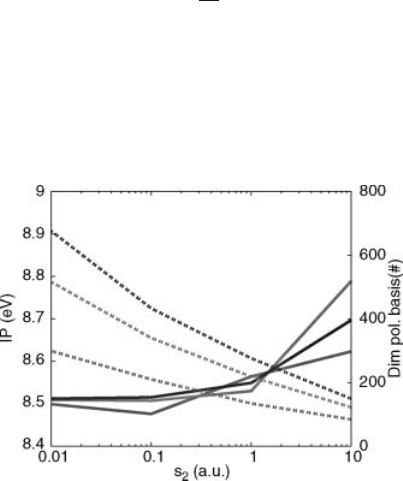
of 40 and 160 Ry, respectively. In Figure 4.1 we display the dependence of the
calculated ionization potential (IP) on the second conduction energy cutoff used
to define the polarization basis, E
2
C
, and on the threshold on the eigenvalues of
the overlap matrix between Wannier products, s
2
. Convergence within 0.01 eV is
achieved with a conduction energy cutoff E
2
C
smaller than 30 eV (less than 300
states) and a polarizability basis set of only 400 elements. The convergence of
other QPEs is similar.
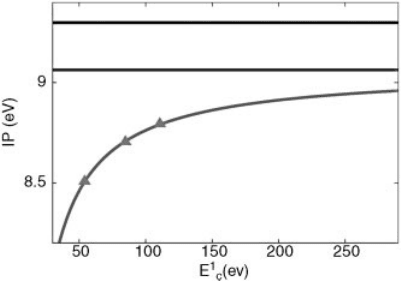
In Figure 4.2, we display the convergence of the IP with respect to E
1
C
, which turns
out to be quite slow. These data can be accurately fitted by the simple formula:
IPðE
1
C
Þ¼IPð1Þþ
A
E
1
C
; ð4:37Þ
resulting in a predicted ionization potential IP(1) ¼9.1 eV, in good agreement with
the experimental value of 9.3 eV [26].
Figure 4.1 (online color at: www.pss-b.com)
Calculated ionization potential of the benzene
molecule (solid lines, left scale) and dimension
of the polarization basis (dashed lines, right
scale) versus the s
2
threshold. The polarization
basis has been constructed with a conduction
energy cutoff E
2
C
¼ 16:7 eV (red-grey, 100
states), E
2
C
¼ 28 :6 eV (green-light grey, 300
states), and E
2
C
¼ 38:3 eV (blue-black, 500
states).
4.4 Implementation and Validation
j
69
4.4.2
Bulk Si
In order to demonstrate our scheme for extended systems, we consider crystalline
silicon treated using a 64-atom simple cubic cell at the experimental lattice constant
and sampling the corresponding Brillouin zone (BZ) using the C-point only. This
gives the same sampling of the electronic states as would result from six points in the
irreducible wedge of the BZ of the elementary 2-atom unit cell. We used an norm-
conserving pseudopotential: Si.pz-rrkj. The wavefunctions and the charge density
were expanded on plane waves, defined by kinetic energy cutoffs of 18 and 72 Ry,
respectively. Then, the GW calculations were performed using E
1
C
¼ 94:6 eV (corre-
sponding to 3200 conduction states) and E
2
C
¼ 33:8 eV (corresponding to 800 states
in the LCM), s
1
¼1.0 a.u. and two distinct values for s
2
(0.01 and 0.001). For
calculating the head and wing terms of the symmetric dielectric matrix we used a
4 4 4 grid for sampling the BZ of the 64-atom cubic cell. Then, for calculating the
long-range contribution to the self-energy given in Eq. (4.34), we used a 2 2 2
grid. In Table 4.1 we summarize our results and compare them with previous
theoretical results, as well as with experiments. An overall convergence within a few
tens meV is achieved with a s
2
cutoff of 0.001 a.u., corresponding to a polarizability
basis of 6500 elements. The residual small discrepancy with respect to previous
results [17] is likely due to our use of a supercell, rather than the more accurate k-point
sampling used in previous works.
4.4.3
Vitreous Silica
Our ability to treat large supercells give us the possibility to deal with disordered
systems that could hardly be addressed using conventional approaches. In Figure 4.3
Figure 4.2 (online color at: www.pss-b.com) Calculated ionization potential as a function of the
overall conduction energy cutoff, E
1
C
. Black line: experimental value; red line: fit to the calculated
values (green triangles); blue line extrapolated value. See text for more details.
70
j
4 Accelerating GW Calculations with Optimal Polarizability Basis
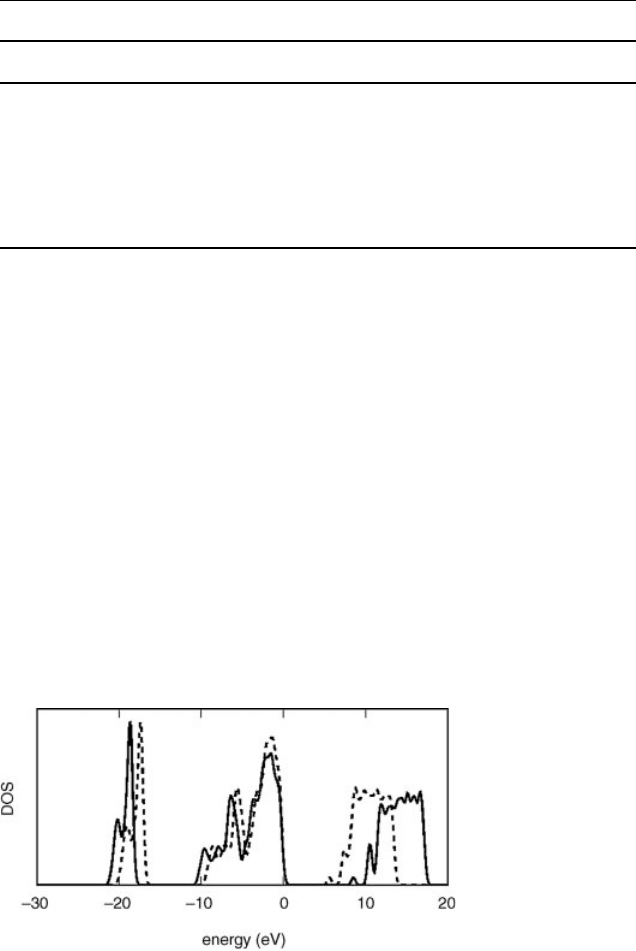
we show the QPE density of states (DOS) as calculated for a 72-atom model of vitreous
silica [27].We used a norm-conserving pseudopotential for Si (Si.pz-vbc) and an
ultrasoft [24] one (O.pz-rrkjus) for O. The wavefunctions and the charge density were
expanded on plane waves, defined by kinetic energy cutoffs of 24 and 200 Ry,
respectively. We used E
1
C
¼ 48:8 eV (corresponding to 1000 conduction states),
E
2
C
¼ 30:2 eV (corresponding to 500 states in the LCM), s
1
¼1 a.u. and s
2
¼0.1
a.u. (giving rise to a polarization basis of 3152 elements). We checked the conver-
gence with respect to the polarization basis by considering s
2
¼0.01 a.u. which leads
to a basis of 3933 elements. Indeed, the calculated QPEs differ in average by only 0.01,
eV with a maximum discrepancy of 0.07 eV. The QP band-gap resulting from our
calculations is 8.5 eV, to be compared with an experimental value of 9 eV [28] and
with a significantly lower value predicted by DFT in the local-density approximation
(5.6 eV).
Table 4.1 QPEs (eV) calculated in crystalline silicon and compared with experimental (as quoted in
Ref. [17]) and previous theoretical results [17].
Th
1
Th
2
prev th expt
N
P
4847 6510
C
1u
11.45 11.49 11.57 12.5 0.6
X
1u
7.56 7.58 7.67
X
4u
2.79 2.80 2.80 2.9, 3.3 0.2
C
0
25c
0. 0. 0. 0.
X
1c
1.39 1.41 1.34 1.25
C
0
15c
3.22 3.24 3.24 3.40, 3.05
C
0
2c
3.87 3.89 3.94 4.23, 4.1
Th
1
and Th
2
indicate calculations made with s
2
¼0.01 and s
2
¼0.001 a.u., respectively, while N
P
is
the dimension of the polarization basis.
Figure 4.3 Electronic density of states for a model of vitreous silica: LDA (dashed line) and GW
(solid line). A Gaussian broadening of 0.25 eV has been used. The top of the valence band has been
aligned to 0 eV.
4.4 Implementation and Validation
j
71
4.5
Example: Point Defects in a-Si
3
N
4
Amorphous silicon nitride (a-Si
3
N
4
) is being widely studied as its mechanical and
electronic properties lead to a wide range of applications [29] In microelectronics,
amorphous silicon nitride (a-Si
3
N
4
) is used to fabricate insulating layers in triple
oxide-nitride-oxide structures [30]. In particular, because of its high concentration of
charge traps, a-Si
3
N
4
is employed as charge storage layer in non-volatile memory
devices [31]. Moreover, silicon nitride based materials are nowadays proposed for
optoelectronic devices [32]. Due to the non-trivial nature of its structures, first-
principles methods become very important for investigating its properties at the
atomistic scale [33]. We review here how our gww method permitted to investigate the
electronic structure of quasi-stoichiometric a-Si
3
N
4
addressing a 152-atoms model
structure [33].
4.5.1
Model Generation
In a-Si
3
N
4
silicon atoms are fourfold coordinated forming almost regular SiN
4
tetrahedra. The latter are connected by corners in such a way that each N atom is
shared by three tetrahedra. Nitrogen atoms are threefold coordinated, with the silicon
neighbors arranged at the vertexes of a planar triangle. This results in a quite rigid
network structure. Furthermore the a-Si
3
N
4
network is supposed to contain not only
corner-sharing but also edge-sharing SiN
4
tetrahedra [33, 34].
We generated a model of a-Si
3
N
4
through first-principles molecular dynamics
using the DFT approach and the exchange and correlation functional of Ref. [25].
Core-valence interactions were described through ultrasoft pseudopotentials [24] for
N and H atoms and through a normconserving pseudopotential for Si atoms. The
electronic wavefunctions and the charge density were expanded using plane waves
basis sets defined by energy cutoffs of 25 and 200 Ry, respectively. The Brillouins
zone was sampled at the C-point. The model structure was generated through first-
principles molecular dynamics starting from a diamond-cubic model of crystalline
silicon which was changed into Si
3
N
4
by addition of N atoms at intermediate
distances between Si–Si neighbors. The initial model structure contained 64 Si and
86 N atoms in a periodically repeated cubic cell. A composition ratio r ¼[N]/[Si] of
1.34 was chosen slightly differing from the ideal stoichiometry in order to trigger the
formation of defects. We set up the density to the experimental value of 3.1 g/cm
3
[35].
Car and Parrinello [36] molecular dynamics runs were then performed for obtaining
the model of a-Si
3
N
4
. First the system was thermalized at the temperature of 3500 K
for 12 ps using a Nos
e–Hoover thermostat [37]. Successively, the sample was
quenched for 5 ps down to 2000 K below the theoretical melting point. Finally, the
structural geometry was further optimized by a damped molecular dynamics run. As
the model presented an empty state close to the top of the valence band, we passivated
it by adding to the structure two H atoms in proximity of the two Si atoms which were
threefold coordinated [38]. After structural relaxation, the H atoms moved close to
72
j
4 Accelerating GW Calculations with Optimal Polarizability Basis