
Antliff Allan. Anarchy and Art: From the Paris Commune to the Fall of the Berlin Wall (ENG)
Подождите немного. Документ загружается.


Antliff, Allan (Author). Anarchy and Art : From the Paris Commune to the Fall of the Berlin Wall.
Vancouver, BC, CAN: Arsenal Pulp Press, 2007. p cxx.
http://site.ebrary.com/lib/dominicanuc/Doc?id=10308829&ppg=120
120 ANARCHY AND ART
... the unequivocal condemnation of Industrial forms of soci
ety, whether they be of Capitalist (with all its varying shades
of Democratic, Liberal, Conservative, Technocratic, etc.),
Marxian Communist, Fascist or Nazi variety randl the un
swerving determination to serve under none of these degrad
ing, deathly states, but to break away in small communities, in
small precursors of a resurrection and renascence of mankind
through a return the dignity and purity and religiousness of
a mode of life rooted in agriculture
and the handicraftsY
The Cooneys likened these communities of refuge to "Arks," and
this is probably what Duncan and his coll
aborators had in mind when
thy Ilalllu their post-war pulJlication: a contrarian rsist,ce to Col
War societyY fb'k's opening editorial stated:
I n direct opposition to the debasement of human values made
auntingly evident by the war, there is rising among writers
in
America, as elsewhere, a social consciollsness which recog
nizes the integrity of the personality as the most substantial
and considerable of values .... Present-day society, which is be
coming more and more subject to the state with its many forms
of corrupt power and oppression, has become the real enemy
of individual liberty. Because mutual aid and trust have been
coldly, scientifically destroyed; because love, the well of being,
has been methodically
p
arched; because fear and greed have
become the prime ethical movers, states and state-controlled
societies continue to exist. Only the individual can cut himself
free from this public evil. e can sever the forced relations be
tween himself and the state, refuse to vote or go ro war, refuse
to accept the moral irresponsibility yoked into him. Today, at
this catastrophic point in time, the validity if not the future
of the anarchist position is more than ever established. It has
become a polished mirror in which the falsehoods of political
modes stand naked. No honest person, if he has looked into

Antliff, Allan (Author). Anarchy and Art : From the Paris Commune to the Fall of the Berlin Wall.
Vancouver, BC, CAN: Arsenal Pulp Press, 2007. p cxxi.
http://site.ebrary.com/lib/dominicanuc/Doc?id=10308829&ppg=121
Gay Anarchy 121
this mirror, can morally support a government of any descrip
tion, whether it be a state-capitalist Soviet Union, a capitalist
America, a fa scist Spain, or any considered society wherein an
idea is woven into a blanket of law and cast over a living peo
ple from above. Any
i
norganic thing made authority over the
orga
n
ic is morally weake
n
ing and makes a
nn
ihilati
n
g warfare
inevitable
.... believe that social transformation must be the
aim of any revolutionary viewpoint, but we recognize the or
ganic,
spontaneous revolt of individuals as presupposing such a
transformation.H
While living with the Cooneys, Duncan commuted down to ew
York
to tak� part in Manhattan's social cirds and 1Il�t with oth�r
literary radicals, including Dwight Macdonald. He also took new lov
ers, voide.d serving in the Wr by de�bring his hOlllOSeX\
l
lity,
spent
a
summer working as a dishwasher in Provincetown, traipsed about
Florida, and gained a reputation as the poet of note who, in 1944,
had signed his name to an article in
Politics on "The Homosexual in
Society."!; This was an anarchist assertion of sexual libertarianism and
a critique of the pervasive "homosexual cult" amongst gays.26 Notions
of difference that encouraged "snobbery and removal from the 'com
mon sort,'" argued Duncan, merely encouraged gays to add their
voices to a range of oppressions-including heterosexism-across the
existing social landscapeY The truly liberating "starting point" for
"creative life and expression," countered Duncan, was:
... a devotion to human freedom, toward the liberation of hu
man love, human conicts, human aspirations. To do this one
must
disown all the special groups (
nations, reli
g
ions, sexes,
races) that would claim allegiance. To hold this devotion every
written word, every spoken word, every action, every purpose
must be examined and considered. It must always be remem
bered that
others, those who have surrendered their humanity,
are not less than oneself. It must be always remembered that

Antliff, Allan (Author). Anarchy and Art : From the Paris Commune to the Fall of the Berlin Wall.
Vancouver, BC, CAN: Arsenal Pulp Press, 2007. p cxxii.
http://site.ebrary.com/lib/dominicanuc/Doc?id=10308829&ppg=122
In ANARCHY AND ART
one's own honesty, one's banle against the inhumani
ty
of one's
own group (be it against patriotism, against bigotry, against,
in
this
specic case, the homosexual cult) is a battle that can
not be
won in the immediate scene. The for ces of inhuman
ity
are overw helming, btl[ onl
y
one's continued opposition ean
make any other order po
ssiblc, wi ll give an added strcngth for
all those who desire freedom and equality to break at last those
fe tters that seem
now so unbreakable.!
Duncan's attack on View in 1947 was premised on this stance. He
began by accusing Ford of marketing art as an "experience" spiced
with "Freudian menace" for "wealthy dilettantes" who reveled in "the
shcr cxpnsivcly uought spcc
tadc of it,"�9 an appro<1l!h art that
Duncan characterized as "aesthetic."30 By way of example, he pointed
to
Vi 7IJ'S p�lhliCti
on of
1
1 nti-wr story,
"The R\17.7. rd," which de
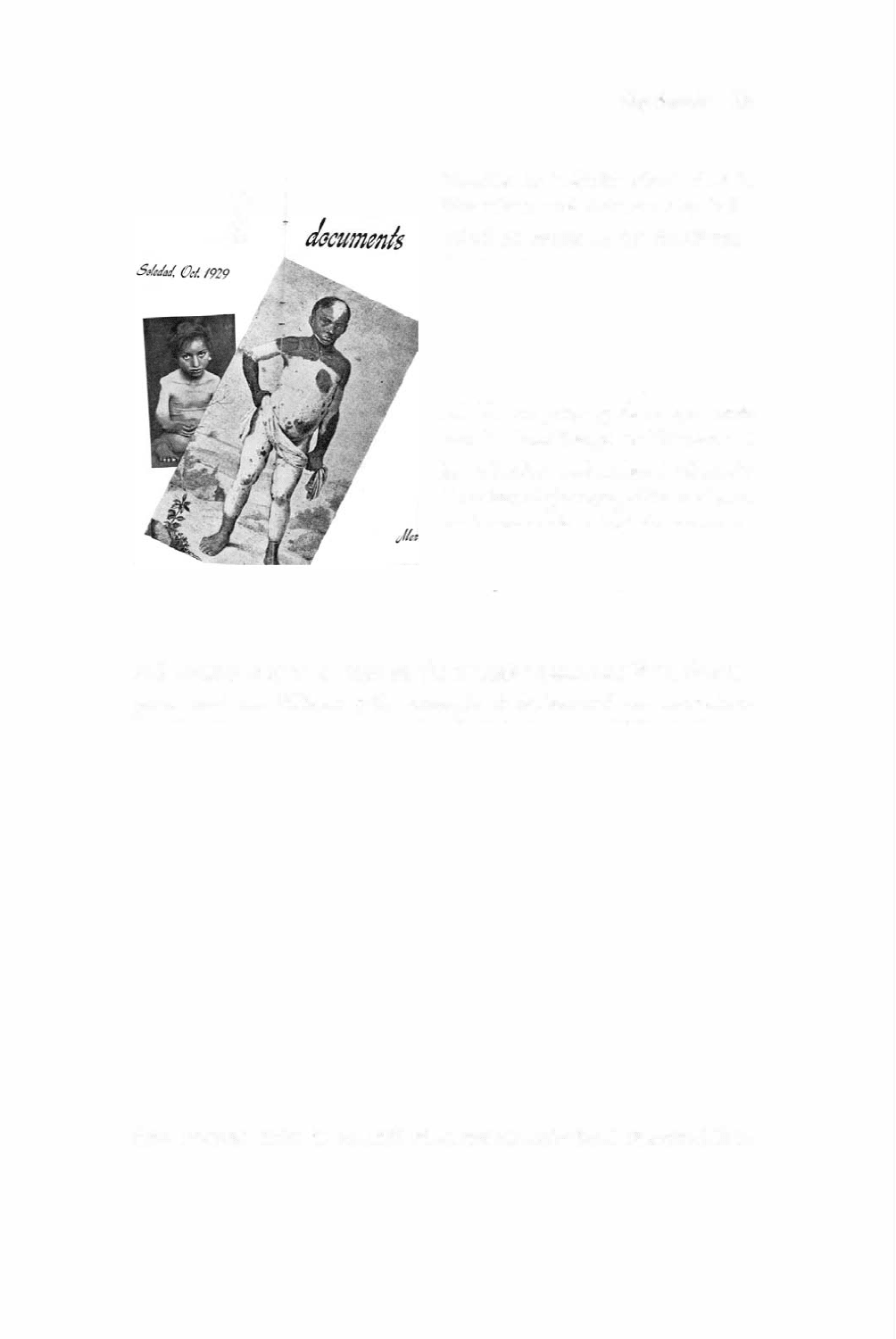
scribed the hungering desires of a bird hovering over a battleeld; the
story was sandwiched between Bataille-style "documents"-illustrated
by photos of physically deformed people-reporting on human cru
elties and abnormalities in Central America. Thus, "The Buzzard's"
politics
were aestheticized and subsumed within a nightmarish mix of
fa cts,
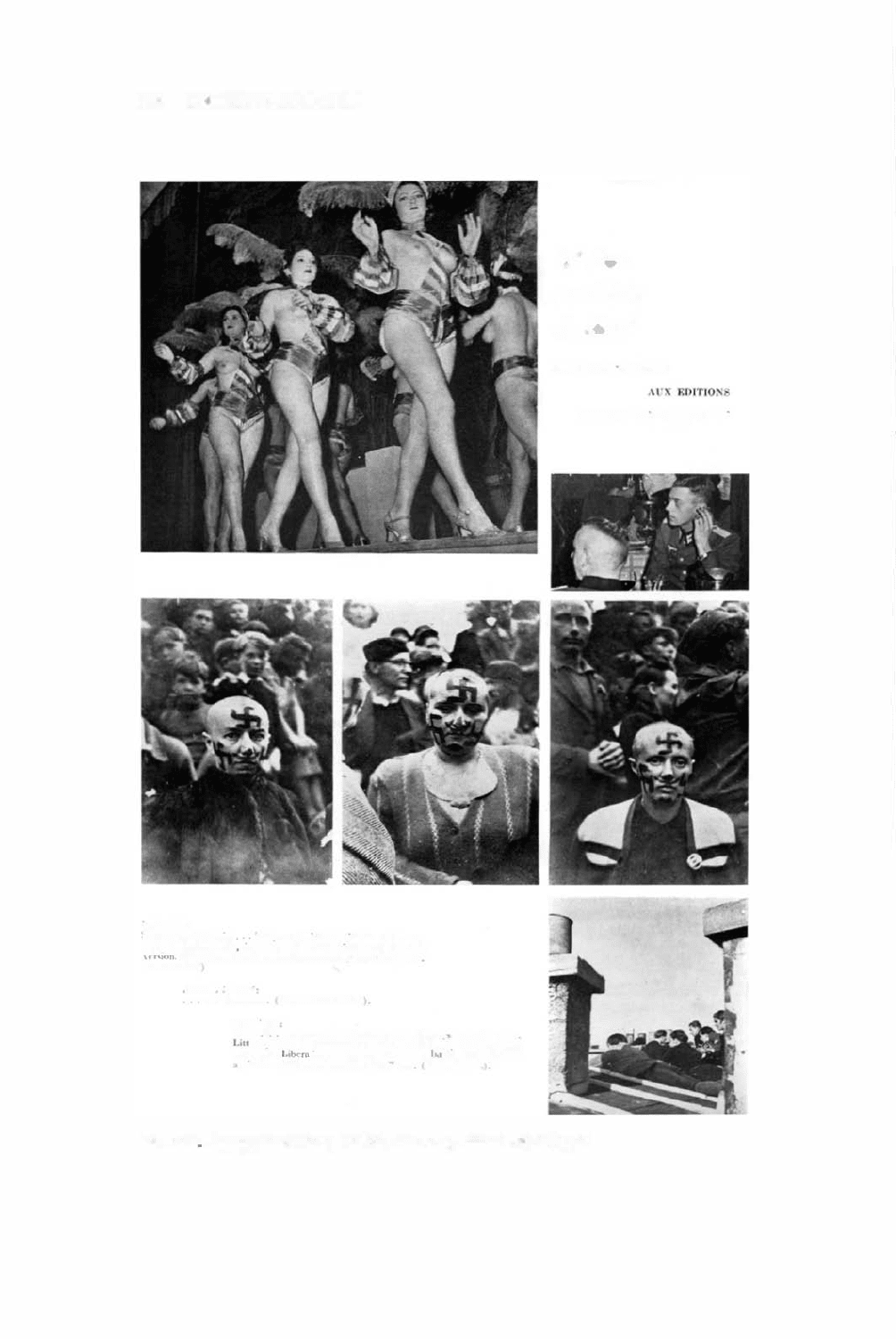
imagery, and ction. "In the world of Vi ew," Duncan observed,
"horror becomes an end in itself-not a rejection, but an acceptance,
more than that, a tremulous embrace of what was horrible, a sensation
which may be tasted by the reader for the vicarious thrill of it."'[ Sadly,
however, surrealism for consumers was doing very well on the maga
zine rack: "like The Buzzard,
it [
V
iew]
draws its profit and substance
from the battleelds, the misery and deformity of mode society;
and in contemporary America, where the populace at large relishes
the charnel havoc wrought upon the cities of Europe and Japan, View's
circulation booms."32
In sum, the magazine's success was symptomatic of a larger so
cial sickness, but it was also symptomatic of Ford's internalization of
the lies American society imposed on him. Accepting the belief in a
singular "normal human being" propagated by an establishment so
Antliff, Allan (Author). Anarchy and Art : From the Paris Commune to the Fall of the Berlin Wall.
Vancouver, BC, CAN: Arsenal Pulp Press, 2007. p cxxiii.
http://site.ebrary.com/lib/dominicanuc/Doc?id=10308829&ppg=123
2
"Two DOlfS," piT sprmd m
View, MaJ
1945.
GaJ A1IanbJ 123
"hostile to individuation" that it
"describes and debases any indi
vidual in terms of his deviation,"
Ford had embraced the identity
of the deviant homosexual "freak"
and was now "suing for little more
than that the world allow him his
'freakishness."'}} Tra gically, this
led him to prop up the very status
quo he should oppose: "He turned
to write for, and to live in the mi
lieu that might accept him and that
t the
SIII time h<lu the power
provide a protection of a kind; he
moved from th. O\ltst le
g
ions of
low Bohemia to high Bohemia on
the margins of that ever curious
and hungry section of society, the money-aristocracy."H In this re
gard, Ford was following the example of Breton and the surrealists
in
exile who, upon arriving in New York in the early 1940s, had been
"taken up and taken in by the culture collectors." "All the drama of the
real political world" was then "played in charade to give excitement to
the boredom of the rentiers" as Breton and company "capitalized upon
their revolutionary personalities."H Ford helped sell surrealism
this
clientele, and Breton valued him for it.16
To its credit,
Vi ew during these years was also "unremittingly hos
tile towa rd the State and its war." To this extent, it was "anarchis
tic-against the State."37 However, Ford's perpetual chewing on "the
cud of n-de-siecle diabolism" suggested he was "hostile not only to
the State, but the individual" as well.J8 "The real menace in the
shadow of which we all live-the twentieth-century State or what
is so aptly called the Permanent Wa r Economy," reasoned Duncan,
was out to crush authentic individuality.l')
View raised no resistance
this, because "if to be an individual means individual responsibility,
Antliff, Allan (Author). Anarchy and Art : From the Paris Commune to the Fall of the Berlin Wall.
Vancouver, BC, CAN: Arsenal Pulp Press, 2007. p cxxiv.
http://site.ebrary.com/lib/dominicanuc/Doc?id=10308829&ppg=124
114 ANARCH AND ART
Q0,
"-'<_. _
... ,. n,,,, I, •• � . .
.... "" �.,,,,- 10/" '" .. _"'_.,
,, ' . ,
, ••
•
_
., _ .... �� f ... . .. 'd
_",�.II
U/Oi/ Nflil
.. .1
.. ", • 1._
WTI<JJl
, fr
I
_
... � . ... a .. ,"-"" . c
I
..
.
.
. .... .. _
.
_ ...
.f ... ..
,
,_ . .. .. ' . .
I
.. " . . ' _
.... __ . _ . _. ..
"
p. "s
III
f Jl�S"
.'1( I.\ 1 •• ·.111.·:11
11.1
.... 01<1> HIMI.'. ,\ I'
.
,H,
"A Pnris .. � ' m Vicw, Vo VI, NM. z-;, Ih-ApriI 1946.

Antliff, Allan (Author). Anarchy and Art : From the Paris Commune to the Fall of the Berlin Wall.
Vancouver, BC, CAN: Arsenal Pulp Press, 2007. p cxxv.
http://site.ebrary.com/lib/dominicanuc/Doc?id=10308829&ppg=125
Gay Aarchy 125
Vi ew with its allegiance to the rentier-aristocracy is hostile to indi
vidualism.''4O Rather than caving in to this social strata's "lust for a
thrill" in light of its supposed "superiority to the mores of the modern
State," Duncan called on Ford to cultivate the "potential awakening
to productive and creative life" that anarchism sought.�l "Experience"
should be "something the artist struggles to transform into a eld for
achieving his or her desires.''4! Ford had lost sight of this, and with it,
art's insurrectionary dimension.
Contrast Ford's actions with Duncan's. The Libertarian Circle and
A1'k were communal endeavors free of capitalization whose purpose
was to enliven the creative lives of the participants at the same time
as they radicalized them. As such, they represented a step towards the
exemplary "m:w way of life uast:t! on a more e4uitaule set of valus"
that
Cantine had called for in
Retm·t. Both projects were destined to
wind
down in
194R, h\lt this did not dete.r n\mn. Tn 1949, he he.lped
start a third initiative, the Poetry Conference, where writers and art
ists gathered once a week for readings and discussions. Here, Duncan
met and fell in love with a young painter, Jess Collins; the twO fo rmed
an enduring relationship that lasted until Duncan's death in 1988Y
Born in California, Collins had been drafted into the atomic bomb
"Manhattan Project" while studying chemistry at the Californ ia
Institute of Te chnology. He was sent to the project's Oakridge,
Te nnessee fa cilities to work on enriching uranium, and on his twen
ty-second birthday-August 6, 1945-the United States dropped the
fruits of his labor on Hiroshima. Upon release from the military,
Collins returned to the California Institute and completed a Bachelor
of Science degree in radiochemistry, He rejoined the nuclear war in
dustry in 1948 as a technician, producing plutonium at the Hanford,
W
ashingron Atomic Energy Project, bur in 1949 he abruptly quit and
moved to San Francisco to study art. In a 1992 interview, Collins said
that the decision was inspired by
"a very strong and convincing dream
that the world was going to completely destruct by the year 1975."
"I'm sure," he continued, "the kind of work I was doing had some ef
fe ct on my state of mind at the time.'4�

Antliff, Allan (Author). Anarchy and Art : From the Paris Commune to the Fall of the Berlin Wall.
Vancouver, BC, CAN: Arsenal Pulp Press, 2007. p cxxvi.
http://site.ebrary.com/lib/dominicanuc/Doc?id=10308829&ppg=126
126 ANARCHY AND ART
He later commemorated this vISion during the Cuban missile
standoff of October 1962, when the United States and the Soviet
Union came within hours of starting a nuclear war. His painting
If
A tbe dd We re Pap e1- aud tbe Wa te1- Sink (1962) (see color plate
8), depicts him (or perhaps Duncan) in prole, looking upon a sun
lit
glen where children are dancing in a circle. An owl bearing a key
swoops down over what at rst looks like a bucolic scene until we gaze
into the distance, where a mushroom cloud is erupting skyward. For
Collins, the circle dance is an actofsun worship symbolic of children's
life-energy and their "wondrous ability to innitely connect images
and stories without having
segregate everything.'5 The destruc
tive power of the bomb, on the other hand, is the antithesis of nature's
spontam:ous, vcr conjoining lif-furcc: a wea
p
on of 111<1SS uestruction
deployed for divisive political ends by government bureaucrats_
n\lrin
g
his time lt Hnford, Collins hd b.g\lIl
p
intin
g
S "n
tidote to the science method.
,,
6
"I wanted to do something that was
truly meaningful
me," he recalled, and art "was far more mean
ingful than making plutonium."7 We get a sense of what the term
"meaningful" signies when he goes on to describe the impact of
his training under the anarchist abstract painter Clyfford Still at the
California School of Arts, whereJess enrolled as a student in 1949-5 1.
Still's lectures, Collins recalled, were "very moving in terms of my un
derstanding of the passion of the immediate image and the difculty
an
artist has in arousing a sense of spirit in a societal structure that
tends to suppress it." -18
Still was an accomplished gural painter who had tued to non
objectivity in the 1940s. He explained why in 1963 when he dismissed
the war and its aftermath as an era of "mechanism, power, and death,"
conduding "I
see no p
o
int in adding to its mammorh arrogance the
compliment of graphic homage.'9 Still's pessimistic outlook had led
him to retreat from social struggle; painting provided him with the
one "limited arena" where his "negative dialectic of creative freedom"
found resolution beyond the restrictions of the Cold War.'o
But freedom was tenuous once an artwork left the studio, and in this

Antliff, Allan (Author). Anarchy and Art : From the Paris Commune to the Fall of the Berlin Wall.
Vancouver, BC, CAN: Arsenal Pulp Press, 2007. p cxxvii.
http://site.ebrary.com/lib/dominicanuc/Doc?id=10308829&ppg=127
GayAan:hy 127
regard, Still was particularly hostile toward establishment art critics
and the cultural institutions they served. He saw them as operatives
in the "authoritarian devices for social control" that dampened the
spontaneous reaction of the public to art and the artist's capacity to
be innovative. In the post-war years, when his work began attracting
attention!
he strenuously ob
jected to mainstream art critics "shout
in
g
about individualism" in American art while they buried the dissident
politics of his work under the weight of formalist aesthetics ("super
cial value of material"). "Behind these reactions," he wrote, was "a body
of history matured into dogma, authority, tradition. The totalitarian
hegemony of this tradition
1 despise, its presumptions I reject."5l In an
attempt to deal with the situation, Still insisted that his work was not
to b shown to or
discussd by anybody who lat'k�u insight into the
aesthetic and moral values his paintings embodied. In particular, he
reh.l$e.d ('e.$$ to ]me Thr11 Sobe
y
(rt ('ritk), Clement Greenherg
(art critic), and Alfred Barr (director of the Museum of Mode Art):
all important players in the cultural marketing of non-objective paint
ing as a symbol of American freedom during the Cold WarY
At the California School of the Arts, Still urged his students to
adopt
the same strategy, but apart from that they were free to fo llow
their own path.H According to Collins, though personally committed
to abstraction, Still "never dictated an aesthetic" and encouraged his
students to reject any preconceptions regarding what was "good, right
or proper" in painting.H Consequently, when Collins began noticing
imaginative "scenes or fantasies" in his own non-objective paintings,
he
welcomed them as features worth exploring." Around 1951, just
after
moving in with Duncan, this led him to adopt collage "as
a way
... to construct imaginary scenarios in a more realistic rather than
a non-objective way."j6 His rst large-scale collage "paste up," The
Mo use's Tale (1951) (see color plate 9), was also a personal statement.
Collins conceived of this work as a self-conscious reclaiming of the
male body-the homosexual object of desire-from the domination
of heterosexual macho presentations. As he pur it, he was "showing
innocent beauty," albeit with a decidedly gay sensibility.
57

Antliff, Allan (Author). Anarchy and Art : From the Paris Commune to the Fall of the Berlin Wall.
Vancouver, BC, CAN: Arsenal Pulp Press, 2007. p cxxviii.
http://site.ebrary.com/lib/dominicanuc/Doc?id=10308829&ppg=128
128 ANARCHY AND ART
The gesture might not seem radical until put in context. Collins
created his collage at a time when being gay was something associated
with the criminal underworld, leftism, scandal, and mental illness.
People lost their jobs and went to jail for it.;8 Responding to this state
of affairs,
The Mo use's Ta le doesn't agitate, polemicise, protest, or pro
claim a positionj rather, by celebrating male beauty, Collins followed
Duncan's dictum in "The Homosexual in Society,
" to congure his
own creativity as a startin
g point for "devotion to human fr eedom,
toward the liberation of human love, human conicts, human aspi
rations
." ;9 This is the sense in which The NJollse's Ta le was radical
Collins' personal breakthrough into sexually-charged imagery and
his refusal to participate in the American war machine unfolded along
the same
p
ulitical cuntinuum.
And there were further developments. In 1952, Collins and
Duncan
tClllerl \lP with the rtist H
rr
y
JOh\lS to fO\l Tlrl n inrle.pe.nrlc
nt rt
ist-run gallery which they named after French satirist Alfred Jay's
(see Chapter Three) theatrical parody of a stupid, bumbling European
bourgeois imperialist, "King
Vbu.tt60 The agenda of King Ubu was
resolutely non-commercial and experimen
tal-to avoid any monetary
schemes arising from the venture, all three fo unders agreed to run
it for one year (December 1952-December 1953), and then close it
down.h
l
One could say that Collins, Duncan, and Jacobus were real
izing the anti-capitalist ethos pro
p
agated by Still by creating a non
commercial exhibition space where artists were subject only to the
judgement of their peers or those who expressed enough interest to
search out the gallery, which was located in a run
-down section of
the
city. Over the course of its existence, the King
Vbu hosted f
teen exhibitions, two plays staged
by Duncan, regular Sunday literary
meetings involving readings by former Libertarian Circle participants
(Rexroth, Lamantia, and others), two experimental lm screenings,
and musical performances.6!
A
p
art from the King Vbu experiment and a host of similar projects
that followed, the domestic sphere was also important. Here, through
the 1950s and 19605, Collins and Duncan hosted artistic events and

Antliff, Allan (Author). Anarchy and Art : From the Paris Commune to the Fall of the Berlin Wall.
Vancouver, BC, CAN: Arsenal Pulp Press, 2007. p cxxix.
http://site.ebrary.com/lib/dominicanuc/Doc?id=10308829&ppg=129
GJ Archy 129
circulated privately-produced publications free from the gaze of cen
sors and critics.63 In effect, Collins and Duncan transformed their
home into an community-building sphere for self-expression and ex
change between friends and acquaintances, which deepened mutual
understanding while enriching lives on a profound level. Collins and
Duncan enacted anarchism on an intimate scale, and their post-war
art
and activism were of a piece with this ethos: creating authentically,
they inspired others
do the same.