
API RP 2T-2010 Planning, Designing, and Constructing Tension Leg Platforms
Подождите немного. Документ загружается.


PLANNING, DESIGNING, AND CONSTRUCTING TENSION LEG PLATFORMS 131
For cases where the S-N curve selected does not already embody local stress concentration effects of
misalignment expected for the tendon welds, a stress concentration factor (SCF) should be applied to the
nominal pipe stress to account for local wall misalignment as the tubulars join at the girth weld. The SCF is an
exclusive function of the dimensional tolerances of the joining tubulars. The SCF can be estimated by
(Buitrago and Zettlemoyer, 1998
[108]
) by Equation (59):
1.4
thin
thick
thin
1
1.0 2.6
10.7
e
SCF
t
t
t
⎡⎤
⎢⎥
⎢⎥
=+
⎢⎥
⎛⎞
⎢⎥
+
⎜⎟
⎢⎥
⎝⎠
⎣⎦
(59)
The centerline offset (e) can be expressed as a function of the specified hi-lo mismatch (h) at the ID of the
weld as follows:
thick thin
2
tt
eh
−
=+
(60)
The specified hi-lo can be deduced as a function of the out-of-roundness (OOR) from pipe fabrication fit-up as
follows:
2
OOR
h =
(61)
A correction to the calculated SCF is necessary to account for the fact that tendon analyses use nominal pipe
sizes, whereas actual pipes are delivered within a range of dimensional tolerances. This correction factor,
which multiplies the calculated SCF, can be taken as the ratio of the analyzed thickness to t
thin
of the pipes
meeting at the weld.
As mentioned in 9.6.2.2, the presence of a conical transition in the tendon pipe generates an additional SCF
due to secondary bending induced by the section change. In this case, the total SCF at the cone-pipe junction
is the product of the SCF due to the local thickness misalignment given above and the SCF due to secondary
bending given in 9.6.2.3.4.
For the case of in-situ inspection, the inspection interval should be established via fracture mechanics based
on an initial crack size no smaller than that likely to be missed by the inspection method. In no case, however,
should the in-situ inspection interval be longer than one-fifth of the time necessary for the crack to grow
through thickness.
9.6.3.3 Girth Weld Fracture Mechanics Analysis
9.6.3.3.1 General
Fracture mechanics (FM) analyses are intended to establish the following:
a) fracture toughness level to be achieved through the weld qualification process to sustain the extreme
loads without fracture;
b) critical initial defect sizes at various locations through the weld thickness;
c) in-situ inspection intervals, if applicable.
One important input to the FM analysis is the crack-growth rate (CGR) of the material through which the crack
is assumed to propagate. In the absence of specific CGR data for the specific weld, general guidance may be
Copyright American Petroleum Institute
Provided by IHS under license with API
Licensee=Shell Global Solutions International B.V. Main/5924979112, User=Low, Ko
Not for Resale, 01/31/2011 00:10:44 MST
No reproduction or networking permitted without license from IHS
--``,`,```,,,``,`,``,,,,,,,,,,`-`-`,,`,,`,`,,`---

132 API RECOMMENDED PRACTICE 2T
used such as that given in BS 7910:1999. However, no advantage should be taken of crack threshold
behavior (see C.4.2).
For the case of no in-situ inspection, the critical initial defect size in the weld, as obtained via fracture
mechanics, should be reliably found during inspection after welding and should not propagate to its through-
thickness condition in a period shorter than five times the planned life of the facility. Subsurface defects
should also be considered in the analysis given the ease of access to the tendon weld surfaces and the high
reliability of the inspection methods used for the detection of surface-breaking defects during fabrication.
Care should be exercised in applying the leak-before-break (LBB) approach to tendon design, due to the
uncertainty in achieving the flooding rates upon which the design may be based (see C.4.2).
9.6.3.3.2 Girth Weld Fabrication
The manufacturing process of the basic pipe material restricts the tubular size, thickness, and dimensional
tolerances. Tolerances play an important role in the local SCF that may ultimately control the location of
fatigue failures. Tendons made with UOE pipe may be less oval than conventional rolled tubulars used in
offshore structures, thereby improving the fit-up and the SCF.
The welding process is crucial in establishing the fatigue design basis for the welds. The process determines
not only the type but also the size and frequency of occurrence of weld flaws. A reliable and consistent
welding method is recommended to improve the quality of the weld. The weld qualification process should
ensure that the mechanical properties required by the analyses are met, in particular fracture toughness.
The weld reinforcements at the ID and OD may be ground flush with the pipe walls to improve fatigue
performance by eliminating the weld toe defects and to facilitate inspection. Attainment of better fatigue
performance by grinding requires that the grinding procedure be qualified as to location and amount of
material to be removed, surface finish, inspection of the ground surfaces for surface-breaking defects, and
evaluation of the significance of the acceptable internal defects via fracture mechanics, as discussed at the
top of this section.
9.6.3.3.3 Girth Weld Inspection
In order to link the fracture mechanics analyses to fabrication and to ensure the expected S-N fatigue
performance, the inspection system should reliably detect, locate, and size the critical welding surface-
breaking and embedded defects during production. Given the uncertainties of the fracture mechanics
analyses and inspection process, care should be exercised when setting acceptable flaw size limits, taking
into consideration the maximum flaw size likely to be missed during inspection (see C.4.3).
The defect acceptance criteria to be enforced during inspection, in terms of maximum allowable defect
heights for given circumferential lengths, should take into account not only the inspection method’s sensitivity
and flaw sizing accuracy but also its probability of detection characteristics. In reducing the calculated critical
flaw size, account should be taken of the maximum undersizing accuracy error expected for the NDT method.
9.6.3.3.4 Girth Weld Testing
Full-scale girth weld testing may be required when essential welding parameters or tendon pipe material are
significantly different from those -with proven practice or when there are significant differences between the
welds to be used in practice and the manufacturing or inspection stipulations specified for the invoked S-N
fatigue curve. When necessary, the primary objective of testing is to confirm that, for the actual pipe size and
material, welding process, inspection method, and defect acceptance criteria employed during fabrication, the
girth welds can indeed achieve the required fatigue performance. Small-scale specimens, in the form of strips
taken from girth welds, may also be used. However, in selecting the size and number of strips to be tested
account should be taken of the potential variability of girth welds with respect to presence of acceptable flaws
around the circumference and the total length of sample weld to be tested as well as differences between
residual stresses in full-scale girth welds and removed strip specimens. The results of full-scale and/or strips
Copyright American Petroleum Institute
Provided by IHS under license with API
Licensee=Shell Global Solutions International B.V. Main/5924979112, User=Low, Ko
Not for Resale, 01/31/2011 00:10:44 MST
No reproduction or networking permitted without license from IHS
--``,`,```,,,``,`,``,,,,,,,,,,`-`-`,,`,,`,`,,`---

PLANNING, DESIGNING, AND CONSTRUCTING TENSION LEG PLATFORMS 133
can also provide a basis to upgrade the fatigue criteria and to confirm defect acceptance criteria for
inspection.
9.6.4 Tendon Connectors
9.6.4.1 General
Besides the pin-and-box type of connectors used to assemble tendon segments offshore, other types of
mechanical connections at the top and bottom of the tendon should also be considered in the tendon design
process. The guidance provided here applies to both end and intermediate mechanical connections in the
tendon string, except for the flex elements.
9.6.4.2 Connector Acting Stresses
9.6.4.2.1 General
The acting stresses in the tendon mechanical connections are those induced at the connection critical
sections or characteristic geometric features (e.g. notches) as a result of assembling the connector (i.e.
make-up stresses) and sustaining the tendon pipe nominal loads (i.e. without SCF) due to the extreme or
fatigue environments.
Connectors are acted upon by external pressure and axial loads and moments acting on the nominal pipe.
Each of these loads may act alone or in concert with others to result in stresses in the connector. Connectors
typically can be represented by an axi-symmetric model that facilitates application of axial and pressure loads,
but not bending moments. To obviate this problem the axial load (P) and the bending moment (M) can be
converted to an equivalent load (P
eqv
). The concept of the equivalent load is simple and slightly conservative
for relatively thin pipes (D/t > 20). The design load (P
design
) can be expressed as:
design eqv
P
PP
=+
(62)
()
()
2
eqv
4
4
32
2
tD t
Mc
AM
P
I
D
t
D
−
==
−−
(63)
where
c is the outside pipe radius, which equals
1
/2 D;
A is the pipe cross-sectional area;
I is the pipe cross section moment of inertia;
D is the pipe outside diameter;
t is the pipe wall thickness.
A simpler expression may be used for P
eqv
when D/t ≥ 20 :
P
eqv
= 2M/R (64)
where
R is the mid-radius at the section of interest;
M is the bending moment.
Copyright American Petroleum Institute
Provided by IHS under license with API
Licensee=Shell Global Solutions International B.V. Main/5924979112, User=Low, Ko
Not for Resale, 01/31/2011 00:10:44 MST
No reproduction or networking permitted without license from IHS
--``,`,```,,,``,`,``,,,,,,,,,,`-`-`,,`,,`,`,,`---

134 API RECOMMENDED PRACTICE 2T
9.6.4.2.2 Connector Acting Local Stresses
Connector stresses should be obtained via FEA that includes the effect of dimensional tolerances on local
stresses, as well as the pipe and pressure loads. Elastic FEA is typically sufficient and conservative. When
performing FEA to arrive at stresses to be used for fatigue analysis, consideration should be given to
performing mesh density studies in order to ensure peak stresses near structural discontinuities, e.g. notches,
thread roots, etc. have been accurately captured. As such, an increase in peak stress of less than 10 % when
going from one mesh density to a finer mesh density is typically desired as an indicator that further
refinements in mesh density are not required. Typically, there should be a minimum of seven to eight
elements in any 90° arc of a critical radius.
9.6.4.2.3 Connector Acting Section Stresses
Prior to conducting strength checks, each of the stress component distributions (axial, hoop, radial, and
shears) across the section of interest should be obtained via linear analysis (or measurements in the case of
surface values) and then linearized, as illustrated in Figure 12. Membrane stresses and bending stresses can
then be obtained from the linearized distributions. Alternatively, peak surface stress values may be used
directly to calculate the von Mises equivalent stress without linearization. For details on linearization of stress
components see C.5.
In general, the membrane and membrane plus bending von Mises equivalent stress can be calculated in polar
coordinates as follows with r, θ, and z being the radial, hoop, and longitudinal directions, respectively:
()()
22
ee
mem r θθz
mem ben
or .707
σσ σσ
+
⎡
=−+−+
σσ
⎢
⎣
()
()
rθ
1/2
2
2
22
zr
zr
θz
6
σσ
⎤
−+ ++τ
ττ
⎦
(65)
where
σ
e
mem
is the membrane von Mises equivalent stress;
σ
e
mem+ben
is the membrane plus bending von Mises equivalent stress;
σ
r
, σ
θ
, σ
z
are the membrane or membrane plus bending component of linearized normal stresses;
τ
rθ
, τ
zr
, τ
θz
are the average shear stresses.
9.6.4.3 Connector Strength Criteria
Connectors should be designed to sustain the stresses and deformations arising from assembly, external
loads applied to the pipe body, and pressure without exceeding the resistance of the connector. Criteria to
conduct strength checks are given below. See C.5.2 for additional information.
9.6.4.3.1 Primary Stress Criteria
9.6.4.3.2 General
Primary stresses are those that are induced by applied loads and are required to satisfy equilibrium. The
membrane (σ
e
mem
) and membrane plus bending (σ
e
mem+ben
) von Mises equivalent stresses resulting from
applied loads should satisfy the following conditions:
y
mem
mem
e
SF
σ
≤
σ
(66)
Copyright American Petroleum Institute
Provided by IHS under license with API
Licensee=Shell Global Solutions International B.V. Main/5924979112, User=Low, Ko
Not for Resale, 01/31/2011 00:10:44 MST
No reproduction or networking permitted without license from IHS
--``,`,```,,,``,`,``,,,,,,,,,,`-`-`,,`,,`,`,,`---

PLANNING, DESIGNING, AND CONSTRUCTING TENSION LEG PLATFORMS 135
y
mem+ben
mem+ben
e
SF
σ
≤
σ
(67)
where
σ
y
is the nominal yield strength of the material;
SF is the applicable safety factor according to criteria and stress type as identified in Table 11.
Table 11—Connector Strength Safety Factors
Safety Criteria
Safety Factors
Membrane
Membrane +
Bending
A (operating) 1.50 1.00
B (extreme) 1.25 0.83
S (survival) 1.00 0.83
Strains developed under primary stress conditions should also be limited such that the ability to seal,
disassemble and/or the function of the tubular string are not adversely affected.
9.6.4.3.3 Primary Plus Secondary Stress Criteria
Secondary stresses are those that are self-limiting and self-equilibrating, such as those induced by makeup.
The combined primary and secondary stresses, as calculated by linear analysis under preload and externally
applied loads, should also satisfy the following condition:
y
mem+ben
2
e
≤
σσ
(68)
9.6.4.3.4 Shear Stress Criteria
The average shear stress on the gross section, τ
av,
resulting from the applied loads should satisfy the
following condition:
y
av
2.5
σ
=
τ
(69)
9.6.4.3.5 Bearing Stress Criteria
The average bearing stress, σ
br
, resulting from the applied loads should satisfy the following condition:
y
br
1.0
σ
σ=
(70)
Connectors should also avoid modes of failure not related to material strength but to maintaining connector
engagement (e.g. “jump-out”). Sudden disengagement of a connector may take place due to excessive local
deformation at the points of load transfer. One example is the sudden disengagement of the mating surfaces
in threaded or grooved connectors.
Copyright American Petroleum Institute
Provided by IHS under license with API
Licensee=Shell Global Solutions International B.V. Main/5924979112, User=Low, Ko
Not for Resale, 01/31/2011 00:10:44 MST
No reproduction or networking permitted without license from IHS
--``,`,```,,,``,`,``,,,,,,,,,,`-`-`,,`,,`,`,,`---

136 API RECOMMENDED PRACTICE 2T
9.6.4.4 Connector Fatigue Design
9.6.4.4.1 General
Fatigue lives may be computed either by the conventional S-N stress life method, or by the strain life method.
Either method requires local elastic stresses at the fatigue critical location in the connector induced by the
nominal loads in the pipe body and material- or component-specific fatigue data.
9.6.4.4.2 Connector Fatigue S-N (Stress Life) Method
In the S-N method, fatigue damage is calculated based on an S-N curve qualified by relevant connector or
connector material fatigue test data and the nominal pipe stress history. The effect of local SCFs and mean
stresses should either be included in the qualified S-N curve or otherwise explicitly accounted for. Notch
alleviation, or notch sensitivity effects, on the elastic SCF should be taken into account (e.g. via the Peterson
fatigue notch factor). The stress history may be expressed as an occurrence stress range histogram in cycles
per year.
Using Miner's rule, the total damage may be calculated by summing, over all the stress ranges included in the
tendon response, the ratios of the number of cycles of the response to the number of cycles to failure from the
S-N curve for corresponding stress range values. For fracture-critical, uninspectable connectors in series with
the tendon pipe, a safety factor greater than 10 should be considered.
9.6.4.4.3 Connector Fatigue Strain Life Method
This method transforms the local cyclic elasto-plastic behavior stress at the critical notch of the connector into
equivalent strain amplitude vs reversals to failure curve, with failure defined as the development of an initial
crack. The procedure to calculate the strain life for a given stress range is given in C.6. Linear FEA of the
connector is needed to generate mean stress and SCFs at the notch, as well as relevant cyclic and
monotonic properties of the base material. Once the strain life curve has been generated, it can be converted
to a conventional S-N curve referenced to the nominal stress on the pipe, as illustrated in C.6. In this way, the
same methodology followed for damage accumulation and life criteria, as given in 9.6.4.4.2, can be used.
Typically, damage levels calculated by this method are much less conservative than those obtained via the S-
N stress life method. The crack propagation phase is conservatively neglected.
9.6.5 Tendon Flex Elements
9.6.5.1 General
Flexible elements typically are used at the top (hull) and bottom (foundation) ends of the tendon. They consist
of stacked laminates of steel and rubber or elastomer enclosed in a spherical steel housing that enables the
tendon to rotate while maintaining its axial stiffness. This rotation reduces the bending moment that otherwise
would have developed due to the abrupt change of stiffness between the tendon and its structural supporting
elements.
The strength and fatigue design of tendon flex elements requires a significant amount of analysis to evaluate
the acting stresses on both the rubber and the steel laminates; test data to establish basic static and time-
dependent material properties; and overall performance of the full-scale flex element. Experience with the
manufacturing process and quality control is also very important for achieving the required performance. For
these reasons, flex elements selected for tendon application shall either be of a design having a well
established track record of successful fabrication and performance, or having undergone rigorous
manufacturability qualification and performance verification (see C.7).
9.6.5.2 Flex Element Acting Stresses
The flex element should be designed to safely sustain short duration extreme stresses and long-term cyclic
stresses imparted by the tendons without impairing the rotational stiffness of the elements assumed in the
response analysis of the tendons. The design of the flex element should be based on analysis that includes
Copyright American Petroleum Institute
Provided by IHS under license with API
Licensee=Shell Global Solutions International B.V. Main/5924979112, User=Low, Ko
Not for Resale, 01/31/2011 00:10:44 MST
No reproduction or networking permitted without license from IHS
--``,`,```,,,``,`,``,,,,,,,,,,`-`-`,,`,,`,`,,`---

PLANNING, DESIGNING, AND CONSTRUCTING TENSION LEG PLATFORMS 137
the specific properties of the rubber material and the explicit modeling of the laminates. The model should
permit the application of axial force in conjunction with bending moment in one plane.
9.6.5.3 Flex Element Strength Design
The strength check should be performed for both the element laminates and the steel parts of the housing
and contact surfaces. The element should be originally designed to provide the rotational stiffness assumed in
the tendon response analysis. This stiffness should be confirmed by full-scale testing of a element prototype,
as part of the fabrication qualification of the element.
The steel strength criteria should be the same as those used for other tendon steel element design. The
rubber strength design should be based on the maximum allowable bulging during compression of the critical
rubber layer, maximum shear deformation during rotation and potential tension loading.
9.6.5.4 Flex Element Fatigue Design
The fatigue life of the flex element elastomer may be evaluated by using a cumulative damage approach
based on the Palmgren-Miners ratio and a strain-life curve. This curve should be based on data generated
using small-scale, strain-controlled tests of the elastomer in question under shear strain conditions. For
fatigue calculations using the cumulative damage method, the calculated fatigue life should exceed 10 times
the service life.
Alternatively, the fatigue life may be calculated using a tearing energy method in which the extent of crack
growth in the elastomer is calculated as a function of tearing energy (T) arising from the annual alternating
tension and rotation cycles (Stevenson and Harris, 1992
[228]
; Gunderson, et al. 1992
[151]
). For tearing energy
calculations, the growth of a crack equivalent to 50 % of the radial section of any elastomer layer should be
considered the point of functional failure. Calculations by either method should account for the changes in
mechanical properties of the elastomer over the service life. For fatigue calculations using the tearing energy
method, the calculated fatigue life should exceed five times the service life.
The flex element steel components should also be checked for fatigue damage using the fatigue procedure
given for other tendon components in 9.2.5. The required fatigue lives for flex element steel components
should be equal to or longer than the greater of the required lives of tendon connectors or the tendon itself.
Particular attention shall be given to the fatigue performance of the flex element shims, given their potential
increased vulnerability to fracture due to their generally higher strength, as well as their complete
inaccessibility.
See C.7 for additional guidance.
9.6.6 Tendon Bottom Receptacle
Tendons may be directly anchored to foundation piles or to a foundation template. In either case, the tendon
bottom termination connects, via a mechanical latch, to a receptacle on the template or pile. Receptacles may
have geometric features in the form of grooves or internally protruding elements to engage the tendon bottom
termination. These features may result in high local stresses that may lead to cracking.
The strength and fatigue design of the bottom receptacle and attachment girth weld should follow the
guidance provided in 9.6.3 and 9.6.4. For the case of tendons directly connected to piles, fatigue and damage
due to installation should also be accounted for as provided in 10.3.3.4.
9.7 Transportation, Handling and Installation Procedures
Transportation and handling of tendon systems is discussed in 14.5.4. Procedures for the installation of
tendon systems are discussed in 14.6.4.
Copyright American Petroleum Institute
Provided by IHS under license with API
Licensee=Shell Global Solutions International B.V. Main/5924979112, User=Low, Ko
Not for Resale, 01/31/2011 00:10:44 MST
No reproduction or networking permitted without license from IHS
--``,`,```,,,``,`,``,,,,,,,,,,`-`-`,,`,,`,`,,`---

138 API RECOMMENDED PRACTICE 2T
9.8 Operational Procedures
9.8.1 Load Monitoring
The tendon system should be suitably instrumented and monitored to aid in operations and to ensure that the
system is performing within design limitations.
Provision should be made to monitor tendon top tension. In addition, it may be desirable to monitor platform
mean offset position and tendon upper and/or lower flex joint angles.
9.8.2 Tendon Retrieval and Replacement
The need to retrieve a tendon could arise as part of a scheduled plan for inspection or replacement, in the
event of damage or suspected damage, or in removing the TLP from site. Regardless of the reason for
retrieval, the equipment, operations, and procedures involved should be carefully preplanned and personnel
trained to carry out the procedures.
9.9 Corrosion Protection
9.9.1 General
Steel materials should be protected from the effects of corrosion by the use of a corrosion protection system
that is in accordance with NACE SP0176 or DNV-RP-B401. The corrosion protection systems include
coatings, cathodic protection, corrosion allowance, and corrosion monitoring. Overprotection that may cause
hydrogen embrittlement should be avoided.
9.9.2 Antifouling
In areas where marine fouling is significant, organisms are active and the use of antifouling coatings may be
considered to reduce the effects of marine growth.
10 Foundation Analysis and Design
10.1 General
10.1.1 Purpose and Scope
This section addresses the analysis and design of TLP foundations. Discussions of fabrication, transportation,
installation, materials, monitoring, inspection, and maintenance as related to the foundation are also included.
10.1.2 Description of Foundation Systems
The term foundation system refers to the foundations used to anchor the tendon legs to the seafloor. A
foundation system can consist of structures such as independent leg templates and well templates or an
integrated single piece foundation supported or anchored by piles, suction anchors, gravity, mudmats, or
combinations of each.
10.1.2.1 Piled-template Foundations
Foundations comprised of piles and template structures (integrated or independent) are addressed. Well
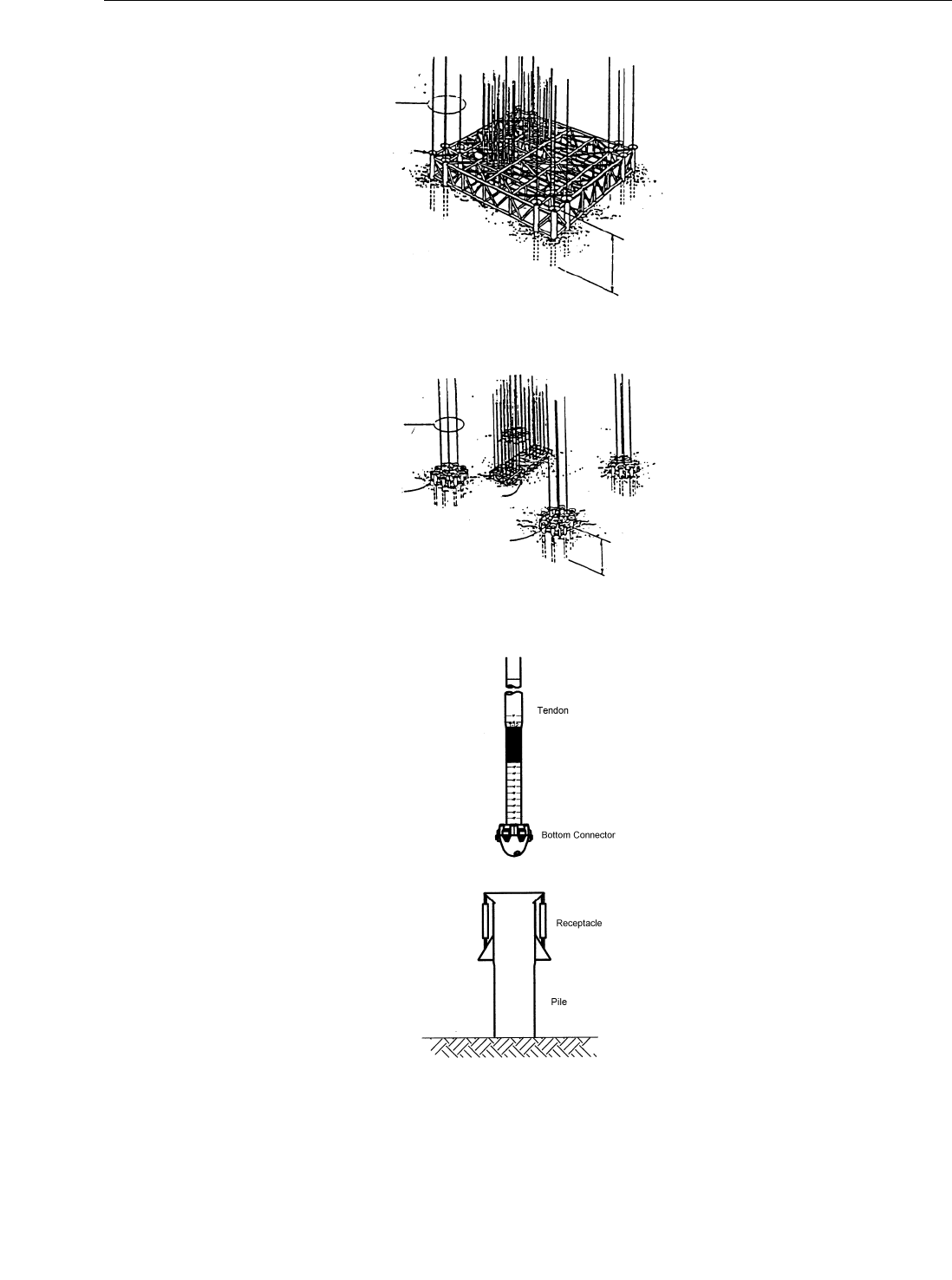
templates are also addressed since the well template may be integrated with the leg templates. Figure 14
illustrates an integrated foundation, Figure 15 shows components of an independent template foundation
system and Figure 16 shows the concept of a tendon directly connected to the pile.
Copyright American Petroleum Institute
Provided by IHS under license with API
Licensee=Shell Global Solutions International B.V. Main/5924979112, User=Low, Ko
Not for Resale, 01/31/2011 00:10:44 MST
No reproduction or networking permitted without license from IHS
--``,`,```,,,``,`,``,,,,,,,,,,`-`-`,,`,,`,`,,`---
P
LANNING
,
D
ESIGNING
,
AND
C
ONSTRUCTING
T
ENSION
L
EG
P
LATFORMS
139
Figure 14—Components of an Integrated Template Foundation System
Figure 15—Components of an Independent Template Foundation System
Figure 16—Components for Directly Connecting the Pile to a Tendon
Copyright American Petroleum Institute
Provided by IHS under license with API
Licensee=Shell Global Solutions International B.V. Main/5924979112, User=Low, Ko
Not for Resale, 01/31/2011 00:10:44 MST
No reproduction or networking permitted without license from IHS
--``,`,```,,,``,`,``,,,,,,,,,,`-`-`,,`,,`,`,,`---
140 API RECOMMENDED PRACTICE 2T
10.1.2.2 Shallow Foundations
Shallow foundations principally address gravity foundation systems but also include the piled template during
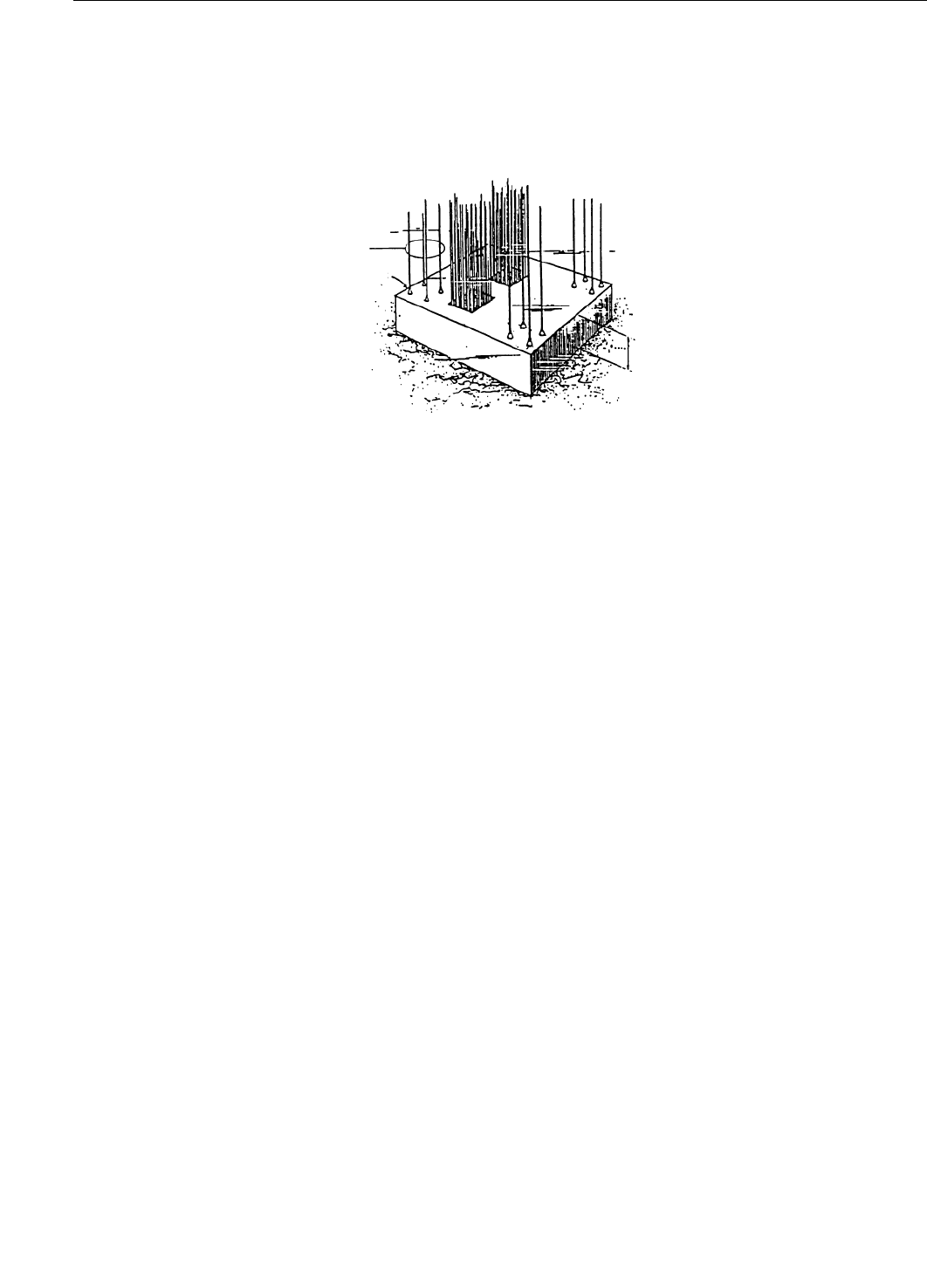
installation prior to pile placement. Figure 17 is an example of a shallow foundation system. Mudmat design
and analysis is covered in the shallow foundation subsection.
Figure 17—Components of a Shallow Foundation System
10.2 Foundation Requirements and Site Investigations
10.2.1 Foundation Requirements
The primary function of the foundation system is to anchor the tendons.
Load transfer to the soil can be accomplished in a number of ways. For example, through tendons directly
attached to piles or suction anchors, through templates, which distribute tendon forces to the soil via piles, or
through a gravity base.
The use of a template structure requires consideration of several factors including: template configuration,
structural strength, installation feasibility, required positional and alignment tolerances, connections with the
tendons, risers, and if applicable, connections between the template and piles.
The design of the foundation structure should ensure that permissible limits of stress, displacement, and
fatigue are not exceeded during and after installation. Particular attention should be given to loading
eccentricity arising from tendon/riser force variations within a group, tendon/riser installation sequences, and
possible tendon/riser retrieval and redeployment during the platform’s operational life. The permissible soil
stress and displacement should be established considering variations in soil properties resulting from cyclic
tensile and lateral loadings, and in the case of pile supported foundations, potential creep due to sustained
axial tension loadings. Consideration should also be given to the loss of foundation capacity due to scour or
other soil instabilities (e.g. mudslides and liquefaction).
The foundation system above the mud line should include provisions for inspection and maintenance. The
extent of inspection, timing of the inspection, and maintenance should be commensurate with the redundancy
relative to overall safety and performance.
10.2.2 Site Characterization
10.2.2.1 General
Primarily, the type and function of the platform to be installed, the availability and quality of data from prior site
surveys, and the consequences that would result from a partial or complete foundation failure should guide
requirements for site investigations. Special problems include deepwater sites and unusual loading
conditions. It is recommended that a high-quality, high-resolution geophysical survey, combined with a
Copyright American Petroleum Institute
Provided by IHS under license with API
Licensee=Shell Global Solutions International B.V. Main/5924979112, User=Low, Ko
Not for Resale, 01/31/2011 00:10:44 MST
No reproduction or networking permitted without license from IHS
--``,`,```,,,``,`,``,,,,,,,,,,`-`-`,,`,,`,`,,`---