
Bahm Karl. Berlin 1945: The Final Reckoning
Подождите немного. Документ загружается.


Antigonos the One-Eyed and the Creation of the
Hellenistic State
Richard A. Billows
UNIVERSITY OF CALIFORNIA PRESS
Berkeley · Los Angeles · Oxford
© 1997 The Regents of the University of California
PREFACE
This book, a revised and reorganized version of my Ph.D. dissertation, completed for
the University of California at Berkeley in 1985, is in large part a biography. In writing
it I have had to face the problem I imagine all biographers face: that they come to
like or dislike their subject, with consequent danger to objectivity. It will be obvious to
the reader that I rather like and admire my subject, Antigonos Monophthalmos, but I
hope that this has not colored my treatment of him here: I have certainly tried to
remain objective.
A feature of this book that the reader needs to be warned about in advance is
the spelling of Greek names. It used to be the custom to latinize the spelling of Greek
names in English—for example, Cassander for Kassandros, Antipater for Antipatros,
and so on—but I see no reason to perpetuate this curious habit. Instead, I adhere to
Greek spelling of Greek personal and geographic names, but not entirely consistently.
Some names of people and places are so familiar in their latinized form that it seems
to me excessively pedantic to change them back to Greek spelling. Thus I refer
throughout this work to Athens rather than Athenai, Thebes rather than Thebai,
Cyprus rather than Kypros, and so forth; likewise I retain the latinized spelling for
Alexander the Great, Philip of Macedon, and Ptolemy of Egypt. This has the added
advantage of distinguishing these three famous men from all other bearers of the
very common names Alexandros, Philippos, and Ptolemaios in my text. I should
further mention that, while I have tried to use all relevant scholarly literature up to
1985, works appearing after that date have necessarily been used only very
selectively.
― xviii ―
It is a pleasure here to acknowledge the help, advice, and support of many scholars
and friends who have been of incalculable aid in the production of this book. In the
first place there are my Ph.D. advisers, Raphael Sealey, Ronald Stroud, and Erich
Gruen, who with extraordinary patience read and gave their comments on the
inordinately long first version. Erich Gruen above all has been an indefatigable source
of scholarly criticism, useful advice, and friendly support, not only during the Ph.D.
phase of the work but during subsequent revisions with a view to publication.
Christian Habicht, while visiting Berkeley as a Sather Professor in 1982, was of
immense help in initiating me into the mysteries of Greek epigraphy, and
subsequently very kindly read and commented on large portions of the manuscript, to
my great advantage. I should also mention with gratitude the Regents of the
University of California for making available a travel fellowship which enabled me to
visit Turkey and Greece when I was doing research for this book in 1983; the staff of
the British School at Athens for their hospitality; and Mrs. Molizani of the Epigraphical
Museum at Athens for allowing me to examine several inscriptions there.
Furthermore, fellow students at Berkeley also contributed in numerous discussions of
early Hellenistic history both in and out of the classroom: in particular Joe Scholten,
Brady Kiesling, and my wife, Ann Kuttner.
Since moving to Columbia University I have received support and
encouragement from a variety of sources: the Center for Research in the Social
Sciences at Columbia provided a stipend enabling me to visit Greece again in 1986 to

clear up some loose ends of research; my colleague William Harris has been uniformly
helpful and supportive; and Roger Bagnall very kindly read through an earlier version
of this book and provided numerous helpful comments. Columbia University's
generosity in the matter of faculty research funds has greatly helped me to defray the
costs of preparing this work. For all of this I am deeply grateful.
In the process of consideration for publication by the University of California
Press, the book was read by Peter Green and August Frugé. Their criticisms were an
invaluable guide in the reorganization of what was in some respects a verbose and
diffuse dissertation into a much tighter and more carefully structured work. Finally,
the staff of the University of California Press, especially the acquisitions editor for
Classics, Doris Kretschmer, production editor Mary Lamprech, and copyeditor Peter
Dreyer, and the reader of the Press's Editorial Committee, Buchanan Sharp, have
been helpful in more ways than I can easily set out here.
― xix ―
Needless to say I have often disagreed with the various readers and other helpers
whom I have identified above, and stubbornly insisted on doing things my own way;
but I do thank all of them for their efforts and assure them that, however recalcitrant
I may have been at times, I am well aware that without the input of all of them, this
book, whatever its flaws and merits, would have been very much inferior to its
present state.
― 1 ―
INTRODUCTION
Antigonos Monophthalmos (the One-Eyed), the greatest of Alexander the Great's
successors (the Diadochoi), is not so well known a figure as to need no introduction—
certainly not as well known as he ought to be. In modern times, as in ancient, he has
been overshadowed by his contemporaries Philip II and Alexander the Great, whose
achievements have captured the imagination much more than have those of
Antigonos. The reason for this is not far to seek: Antigonos ended his life in defeat,
and so is regarded merely as an interesting failure. But he was responsible for
important and lasting achievements in spite of his final defeat, which entitle him to
more careful historical scrutiny than he has yet been accorded.
[1]
Antigonos was an exact contemporary of Philip II of Macedon, but outlived that
king by thirty-five years and enjoyed his greatest and most prominent period after the
death of Philip's son, Alexander, in 323. From 320, when he was sixty-two, until his
death aged eightyone at the battle of Ipsos in 301, Antigonos dominated the eastern
Mediterranean region and rose from private station to make himself and his
descendants kings. In so doing, he established an administrative system and
structure in western Asia that formed the basis for the
[1]
― 2 ―
later Seleukid Empire. There are therefore two themes to be covered in this book: the
life and activities of Antigonos Monophthalmos (part 1); and the creation, in large part
due to Antigonos's efforts, of a new state system from the wreck of the Persian
Empire conquered by Alexander—Hellenistic monarchy, the political milieu of
Hellenistic civilization (part 2).
Though the writing of history from a biographical viewpoint is nowadays rather
discredited in some circles, to ancient historiographers it seemed a self-evident truism
that great leaders were directly and personally responsible for the course of historical
events. Consequently our literary sources for the ancient world are written from the
viewpoint of what may be called the "great leader theory of history": we have a great
deal of information about the political, military, and cultural leaders of the ancient
world, but very little about social and economic conditions except what can be
gathered from incidental remarks in the sources and from non-literary evidence (that
is, archaeological, epigraphical, and numismatic evidence).

Antigonos dominates the literary sources for the period 323–301, towering like a
colossus in the narratives of this period: he is the central character in the narrative of
Diodoros of Sicily, our best and fullest surviving source, and he plays a major role
likewise in Plutarch's biographies of his enemy Eumenes and his son Demetrios, as
well as in book 4 of Polyainos's Strategemata .
[2]
To some extent this prominence is
no doubt due to the fact that the most important and influential primary historian of
the period was Antigonos's officer Hieronymos of Kardia, but it is clear that Antigonos
was in fact the leading figure of the period, who more than any other leader shaped
the course of events in the decades after Alexander's death.
[3]
Since the ancient historian must necessarily use ancient historiography as a
major source of information, it is inevitable that many works of ancient history should
be strongly oriented towards the leading men of antiquity; and since an exaggerated
respect for "great men" was an important feature of the ancient world, the
biographical tendency of much work on ancient history should not be considered
regrettable. Indeed, in the ancient world, with rather static social and
[2][3]
― 3 ―
economic conditions and societies dominated by small elites, great individuals did
have a more profound impact than in today's mass societies. The absence of an in-
depth treatment of Antigonos has long been noted as a major gap in scholarship on
the Diadoch period.
[4]
This absence is the more unfortunate in that it has allowed a
wrong perception of Antigonos and his role in the developments of the late fourth
century to be perpetuated, a perception based on hindsight value judgments in the
ancient sources rather than on the factual information they purvey. It is well known
that Hellenistic historiography was influenced by tragic drama, and Antigonos has
certainly suffered from this: "Pride goeth before a fall," and since Antigonos fell at the
end of his life, he must have been guilty of hubris.
The ancient sources mostly portray Antigonos as an arrogant man of
overweening ambition, driven by a fixed dream of ruling all of Alexander's empire,
and intolerant of any rivals or peers; and this is also the standard view of Antigonos
to be found in modern scholarship.
[5]
In fact, some scholars have even gone so far in
the notion of Antigonos as an emulator of Alexander as to describe him as being "of
the school of Alexander."
[6]
This is absurd. If Antigonos was of anyone's "school," it
was that of Philip, the great leader and reformer under whom he lived and served for
twenty-three years during his early manhood (from the ages of twenty-three to forty-
six), rising ultimately to an important position in the state. He was for a few years—
336-333—a senior adviser of Alexander, but was left behind by Alexander to govern
part of Asia Minor and so played no role in Alexander's romantic (but foolhardy)
exploits in the far east. Far from emulating Alexander, Antigonos never showed any
interest in the eastern regions of the Persian Empire that so fascinated Alexander, but
concentrated his ambitions instead on the eastern Mediterranean lands, on which
Philip's great general Parmenion is said to have advised Alexander to base his
empire.
[7]
In this Antigonos showed
[4][5][6][7]
― 4 ―
sound strategic sense, for under ancient conditions of communications, it was
obviously unrealistic for a power drawing its strength from the Balkans to attempt
long-term domination of regions as distant as Baktria and India, and the attempt to
do so was more likely to prove a drain on power and resources than a boost to them.
Instead of accepting the sources' judgments of Antigonos at face value, it is
necessary to scrutinize the evidence carefully and seek to understand the basis for
such judgments. Analysis of the course of events shows that Antigonos's aims and
ambitions changed and developed during the years 323–301;
[8]
that at least as late as
311 he was ready and willing to accept peers as independent rulers of parts of the
Macedonian Empire, confining his own interest to western Asia and Greece; and that
he never entertained serious ambitions to rule the far east. The charges in the
sources of Antigonos's arrogance and overweening ambition derive in large part from
the propaganda of his enemies and from retrojection from his last years, when he did,

in a burst of embittered aggressiveness, seek to eliminate his rivals.
[9]
It needs to be
recognized that the sources in fact have an obsession with the idea of the Diadoch
period as a scramble for supreme power over all of Alexander's empire, an aim
attributed to Kassandros and Ptolemy as well as Antigonos, and which is obviously a
product of hindsight review of the conflicts of the period.
[10]
A recently published
papyrus fragment indicates that this view of the period was already
[8][9][10]
― 5 ―
prevalent by the second century B.C., and that the attribution of excessive ambition
to Antigonos is probably at least in part due to inimical Rhodian evaluations influenced
by (and glorifying) Rhodes's successful war against Antigonos in 305/4.
[11]
Besides being the first comprehensive treatment of the leader who dominated
the last two decades of the fourth century, therefore, my work is a fundamental
reappraisal of the aims and significance of Antigonos's activities. In further pursuance
of this, part 2 of this book focuses for the first time on his contribution to the process
of state building which began to develop the procedures and institutions characteristic
of the Hellenistic monarchies, and of the Seleukid Empire especially.
[12]
Antigonos, as
the first of the Diadochoi to take the royal title, had a decisive impact on the form and
nature of Hellenistic kingship. He was also the leader who established respect for the
local autonomy of the Greek poleis as a guiding principle, and so determined the
outline of relations between the ruling powers of the Mediterranean world and the
Greek city-states throughout the Hellenistic period. Though the evidence is not as full
as one might wish, careful analysis shows beyond reasonable doubt that Antigonos
established a comprehensive administrative structure in west Asia (especially Asia
Minor and Syria/Palestine) which was taken over and completed by Seleukos and his
successors, and thus formed the basis of the Seleukid administration in Asia, a fact
largely ignored by modern scholarship on the administration of the Seleukid
Empire.
[13]
Again, an overestimation of the importance of Alexander lies behind the
underestination of Antigonos. Alexander's empire is seen as the direct forerunner of
the Seleukid Empire, and the intervening twenty-year rule of Antigonos is skipped
over except insofar as he is seen as a continuator of Alexander's aims. But Alexander,
for all his romantic career of conquest, was essentially a destroyer, not a crea-
[11][12][13]
― 6 ―
tor. The work of his great father, Philip, gave Alexander an opportunity that he seized
with both hands, namely to destroy the old politico-cultural balance of power between
the Hellenic world and the Persian Empire. By conquering the Persian Empire,
Alexander destroyed a balance that had existed for nearly two centuries and created
an opportunity to bring forth something new in its place. This he did not live to
exploit, and it may be doubted whether Alexander—the quintessential military man—
would have known how to exploit it.
[14]
It fell to the Diadochoi, especially Antigonos
and Seleukos, to try to make something of the opportunity won by Alexander, and
what emerged from their efforts is what we call the Hellenistic monarchy and
Hellenistic civilization. As to influences on Antigonos's administrative work, more to
the point than Alexander is Antigonos's service under his contemporary Philip, a great
reforming administrator, and his service for twelve years between 333 and 321 as a
satrap in Phrygia, functioning essentially under the Persian system of
administration.
[15]
In other words, the sources of ideas and inspiration for Antigonos's
work are more likely to have been the methods and practices of Philip, and of the
Persian Achaemenids, than of the brilliant, but unstable, Alexander.
Though centered on the career and work of one man, this book is only in part a
biography. Part 1 is a politico-military biography of Antigonos, but also an account of
the political and military events of the Diadoch period in general. Part 2, though still
focussed on Antigonos, is an account of the creation and running of an administrative
system. The appendices deal with the sources for the period generally (appendix 1)
and with the forces and aides who helped Antigonos achieve his aims (appendices 2
and 3). The reader will not find any attempt to delve into personality, psychological

motivations, and the like, which are normally features of biographies. There are good
reasons for this. In the first place it was not my aim to write a book of that sort, and
one may doubt generally the validity of any attempt by a twentieth-century historian
to reconstruct the personality and mindset of people who lived over two thousand
years ago.
[16]
[14][15][16]
― 7 ―
In the second place, the sort of evidence we have for Antigonos is not conducive to a
psychological approach: we have politico-military narrative and inscriptions; we do
not have a biography by Plutarch, which might have provided the sort of anecdotes
useful to a more conventional biographical venture (if Plutarch had written such a
work and it had survived).
Nevertheless, some brief remarks on Antigonos's appearance and character traits
as they emerge from the sources we do have are in order here to introduce the man
Antigonos, the more so in view of a recent attempt to explain Antigonos's ultimate
defeat and "failure" by psychological analysis which is one-sided and inappropriate.
[17]
Antigonos was an exceptionally large man. His son Demetrios is described as being of
"heroic stature" (Plut. Dem. 2,2; Diod. XIX 81,4; XX 92,2–3), meaning no doubt that
he was six feet or more tall, but Antigonos was taller even than Demetrios and was
big as well as tall–in extreme old age he became rather immobile because of his great
size and weight (Plut. Dem. 2, 2; 19, 3). This huge man was made even more
formidable in appearance by the fact that he was one-eyed, having lost an eye in
battle at some time, possibly at the siege of Perinthos in 340 (see pp. 27–29 below).
To his soldiers, the stature and scarred visage of Antigonos must have been
impressive, and he evidently understood the psychological benefits of this, for he was
in the habit while on campaign of striding about making jokes and laughing in a
booming voice to instill confidence in his men (Plut. Eum . 15,2; Dem. 28,4).
It is a pity that, though a considerable number of portraits and statues of
Antigonos are known to have been created during his lifetime, no securely attributable
likeness of him has survived.
[18]
There is, however, an ancient work of art which may
show us a
[17][18]
― 8 ―
contemporary portrait: it has been suggested that one of the Macedonian horsemen
depicted on the famous "Alexander Sarcophagus" in the Archaeological Museum at
Istanbul could be Antigonos. One of the long relief panels on this sarcophagus depicts
a battle between Macedonians and Persians, and at the right and left edges of the
scene are two Macedonian horsemen charging into the fray, each in the act of killing a
Persian cavalryman with his spear. The Macedonian horseman on the left is Alexander
the Great, in a depiction clearly drawing on the head of Herakles with a lion-scalp
helmet and Alexander's features shown on Alexander's coinage. The horseman on the
right, who is given equal billing (as it were) with Alexander, has been identified as
Antigonos Monophthalmos; and though this suggestion has met with a mixed
reception, I think it must be correct.
[19]
If so, we get a glimpse here of the face of
Antigonos. This horseman has a mature face, with prominent cheekbones and chin.
The nose is fairly long and fine, and the cheeks are slightly hollow, suggesting that a
portrait of some individual was aimed at.
[20]
Of course, even granted that this
horseman is intended to depict Antigonos, one cannot
[19][20]
― 9 ―
assume that the face is a true, realistic likeness. The sculptor has evidently been at
pains to present this horseman as one kind of archetype of a military man of fierce
energy and willpower. Nevertheless, it is reasonable to assume that in looking at this
Macedonian cavalryman, we got some idea of what Antigonos actually looked like (see
frontispiece).
[21]
An attractive feature of Antigonos's character is that he was very much a family
man. He married his wife, Stratonike, when he was in his early forties, and remained

married to her for the rest of his life, so far as we know never even having affairs with
other women, in sharp contradistinction to many contemporaries.
[22]
As dynast and
king he gave advancement to various nephews and to his half-brother Marsyas (see
app. 3, nos. 33, 67, 100, and 11). He brought up his younger son Philippos with care
and strictness (see app. 3, no. 92). In particular, there was a genuine devotion
between Antigonos and his son Demetrios, which seems to have served as a model in
his family in later generations (see Plut. Dem. 3,1–4). Plutarch reports that there was
such trust between father and son that Demetrios was allowed free access to
Antigonos even with weapons in his hand, and that Antigonos was so proud of this
trust (unusual among the powerful in his day) that he called it to the attention of
certain ambassadors from his rival dynasts, regarding it as one of the securest props
of his power. Elsewhere Plutarch records further anecdotes indicating the affection
between Antigonos and Demetrios. Though Antigonos himself disapproved of
indulgence in "wine, women and song," he was tolerant of Demetrios's weakness for
these pursuits: when Demetrios once greeted him with a particularly fond embrace,
Antigonos laughed and said, "One would think you were kissing Lamia"
[21][22]
― 10 ―
(Demetrios's mistress: Plut. Dem. 19,4); on another occasion when Demetrios had
been partying hard, he excused his absence from business affairs on grounds of an
illness, and Antigonos joked, "So I heard, but did you catch it from Thasos or Chios?"
(famous wineproducing islands: Plut. ibid.).
[23]
These anecdotes also illustrate another trait that must have helped Antigonos
win friends and inspire loyalty in his subordinates, namely his sense of humor.
Plutarch, especially, records a number of excellent witticisms of Antigonos's, which
besides a good sense of humor, display a good degree of learning and culture.
Antigonos was able to remember and adapt on the spur of the moment a line of
Euripides (Plut. Dem. 14,2–3), and could twit a young pupil of the
rhetorician/historian Anaximenes for his lack of knowledge of the subject on which he
had presumed to give a speech (Apophth. Ant. 13 at Plut. Mor. 182d–e).
[24]
He could
even joke about his deformity, remarking when he received a despatch written in
particularly large letters, "Even a blind man can read this" (Plut. Mor. 633c), though
he was otherwise rather sensitive about his scarred face and missing eye: the famous
artist Apelles for this reason painted him in profile so that only his good side was
visible in the portrait (Pliny NH XXXV 90).
The main impression we get of Antigonos during the years 323–310 (when he
was in his sixties and early seventies) is one of immense physical and mental vigor
and energy. The campaigns he undertook in these years would have taxed the energy
of most much younger men, and Antigonos did not spare himself during these
campaigns, taking a personal part in the battles and sharing in the work and
hardships of his soldiers (Diod. XIX 26,6–7; 30,7–10; 42,4–6; Seneca De ira III
22,3). This physical and mental energy may be considered his outstanding
characteristic, making him the successful general, statesman, and administrator that
he was. The ancients already recognized this: Diodoros called him the most active or
effective (praktikwtatoV ) of the Macedonian leaders, and described him as
outstanding in daring and intelligence (XVIII 23,3–4); Plu-
[23][24]
― 11 ―
tarch used him as a classic example of a robust and powerful old man (Mor. 791e).
But more even than his vigor or energy, the ancient sources characterize Antigonos
by the love of power (philarchia ) in the pursuit of which he displayed his energy and
daring. His pride and his love of power are repeatedly noted by the sources (e.g.,
Diod. XVIII 50,1; XXI 1,1; Plut. Dem. 28,2; Aelian VH XII 16), and the criticism is
expressed that this led him at times to be harsh and arrogant (Plut. Dem. 28,2).
Some modern scholars have seized on this aspect of Antigonos and made harshness
and arrogance his leading characteristics, blaming them for what they consider his
ultimate failure—though, to be sure, in this they are merely following Plutarch's
judgment at Dem. 28,2.
[25]
However, this is a simplistic and inaccurate view both of

Antigonos's character and of the sources: Antigonos was a complex man, and the
sources make a variety of pronouncements and judgments on his character and
disposition, depending on the occasion they comment on.
There is no doubt that Antigonos was at times ruthless and even harsh, but
being occasionally harsh and ruthless was inherent in the career of command he
followed and the times in which he lived, and mostly when Antigonos was ruthless it
was a matter of policy rather than of personal spite.
[26]
The other Diadochoi were no
better than Antigonos in this respect: it was not by being mild and tolerant that the
Macedonians had conquered a great empire, and it was not by mildness and tolerance
that the dynasts who succeeded Alexander secured parts of that empire as private
domains. At least Antigonos displayed no such horrific cruelty as Lysimachos.
[27]
The
fact is that
[25][26][27]
― 12 ―
Antigonos lived in a ruthless age, and actually had a reputation for being relatively
mild and forgiving, especially towards the end of his life: he behaved kindly
(filanqrwpwV ) to captured enemy soldiers (Diod. XVIII 45,4), and to his own men
(Diod. XIX 20, 1); when he captured a number of enemy leaders at the battle of
Kretopolis in 319, he merely imprisoned them (Diod. XVIII 45,3; XIX 16, 1–5) rather
than killing them, and he later took one of them—Dokimos—into his service (Diod.
XIX 75,3; XX 107,4); Seneca's pamphlet concerning the evil effects of anger cites
Antigonos as a shining example of a king who controlled his temper and refrained
from punishing insults (De ira III 22,2–3); and Plutarch reports that mildness and
gentleness characterized his rule towards the end of his life (Mor. 182b = Apophth.
Ant. 3). In general Antigonos's posthumous reputation, unlike those of Lysimachos
and Kassandros, was fairly good (see, for example, Plut. Phok. 29, 1), especially for
such a proud and ambitious man.
Basically, the picture of Antigonos in the sources is inconsistent: he was harsh
and kind, arrogant and mild, haughty yet just, grasping and generous. Nor is this in
my opinion in any way an unrealistic picture: the characteristics displayed by
Antigonos depend on the circumstances of any particular occasion, and the truth is
that he was neither especially harsh nor especially kind, but capable of displaying
either trait as the occasion arose; and so with the rest of these good and bad qualities
attributed to him. The keys to his personality are, I believe, ambition and intelligence.
Ambition caused him to seem harsh and arrogant to those who stood in his way, while
intelligence caused him to be just, and even at times kind and generous, to his friends
and subordinates, and mild towards defeated foes who were willing to give up
opposition and join him, since he understood that lasting power must be based upon
loyalty and good repute, which can only be won by showing justice and generosity.
This is really as much as can plausibly be said about Antigonos's character. Perhaps I
should emphasize that while I reject those interpretations which depict Antigonos as a
man fatally flawed and brought to ruin by excessive arrogance—a notion with obvious
roots in ancient tragedy—this in no way means that I wish to whitewash Antigonos.
To portray him as a bundle of virtues with scarcely a flaw or vice would be even more
unjustified than is the hubristic view of him. But the sources primarily concern
themselves with Antigonos's deeds, not his character; and his deeds likewise form the
main subject matter of this book.
PART I—
ANTIGONOS'S LIFE AND CAREER
― 15 ―
I —
The Early Years
Antigonos's Background and Youth (382–359 B.C.)
Antigonos Monophthalmos was born about 382 B.C. , as we know from his reported
age of eighty-one at his death in 301.
[1]
He was therefore an almost exact coeval of
King Philip II, also born in 383 or 382,
[2]
whom he outlived however by some thirty-
five years. Antigonos's father was named Philippos; his mother's name is unknown.
The family's social standing is disputed, some authorities claiming that Antigonos
came from peasant or yeoman stock, others that his family was linked to the
Macedonian royal house.
[3]
Neither of these claims can be proved, and both seem
unlikely. Since the few definite
[1][2][3]
― 16 ―
[Full Size]
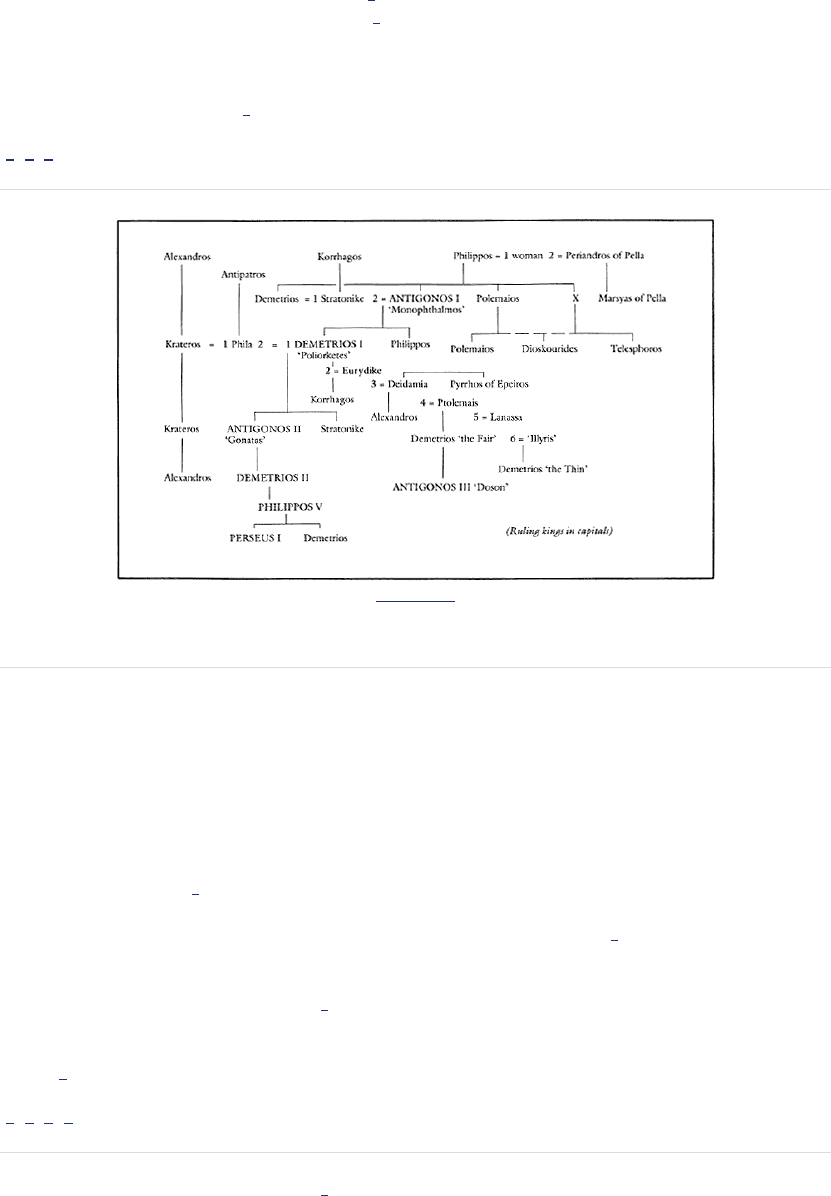
Figure 1.
The Family of Antigonos Monophthalmos
― 17 ―
statements about Antigonos's social background are unreliable, only indirect
arguments can be used to determine his family's social standing. Three facts lead to
the conclusion that in all probability the family was socially prominent and from the
Macedonian nobility.
In the first place, Antigonos's mother was widowed in early middle age and made
a second marriage to an important noble from Pella, the capital, showing that she
must have been of noble birth herself: only wealth, noble birth, and important
connections can have overcome the defect of middle age in persuading an important
noble to marry her.
[4]
Hence in all likelihood her first husband, Philippos, would have
come from the nobility too. Secondly, Antigonos's Wife, Stratonike, seems to have
belonged to a noble family, perhaps related to the royal house,
[5]
which suggests
again that Antigonos was a noble. Thirdly, Antigonos and at least one of his brothers
made successful careers as officers and administrators under Philip and Alexander,
again suggestive of noble status.
[6]
Antigonos had two brothers named Demetrios and Polemaios, the former
probably the oldest of the three, and at least one other sibling (see fig. 1 for a family
tree).
[7]
With his parents and three siblings, he grew up in a noble milieu, probably in
lowland Mace-
[4][5][6][7]
― 18 ―
donia around the capital of Pella.
[8]
Nothing specific is known of his youth, but what it
would have been like can be gathered from the nature of Macedonian society,
especially upper-class society, at the time.
Macedon was a region which had lagged behind the rest of the Greek world
socially, economically, and culturally, failing to develop the polis or city-state
institutions characteristic of the most advanced regions of Greece, but remaining

instead a tribal society ruled by kings and dominated by a land-owning aristocracy.
[9]
Indeed, there is some question as to whether Macedon should at this time be counted
as part of the Greek world at all, for it has been doubted whether the Macedonians
were a Greek-speaking people, on the basis of a few passages in ancient sources that
appear to speak of a Macedonian "language."
[10]
These passages can equally well be
understood to refer to a Macedonian "dialect," however, and though it cannot at
present be formally proved that the Macedonians were Hellenic in race and language,
I think it highly likely that they were, for three reasons: the overwhelming majority of
personal names known to have been used by Macedonians were good Greek names;
the names of the months in the Macedonian calendar were basically Greek in form;
and the religion of the Macedonians was largely the same as that of the Greeks, with
Zeus, Herakles, and Dionysos being particularly prominent.
[11]
[8][9][10][11]
― 19 ―
The Macedonians, then, were probably a Greek people (though certainly with an
admixture of Illyrians and Thracians) akin in language and culture to their neighbors
to the south and west, the Thessalians and Epeirots.
[12]
Like the Epeirots, they were
divided into several tribes and ruled over by a tribal monarchy. The main division in
Macedon was between the lowland Macedonians, living in the plains of Pieria, Bottiaia,
and the Amphaxitis, and the highland Macedonians, who were themselves divided into
a number of "cantons": from south to north, Tymphaia, Elimiotis, Orestis, Eordaia,
Lynkos, and Pelagonia (see map 1). The kings came from a royal family known as the
Argeadai, who claimed descent from Herakles, but the Argead house was rooted in
lower Macedon and the cantons of upper Macedon had dynastic families of their own
who frequently claimed to rule as independent kings over their own regions.
[13]
Like the Thessalians, the Macedonians never developed beyond the aristocratic
form of society typical of early Greece and probably depicted in Homer's epics.
[14]
The
Homeric appearance of certain elements of Macedonian society has been widely
noted; the chief of these elements is the so-called hetaireia, an institution which
bound together the king and the nobility: it was the privilege and duty of the nobles
to attend the king as his hetairoi (companions) both in war and peace, as cavalry
fighters and officers, or as councillors and boon companions.
[15]
That this institution
was deeply rooted in Macedon is shown by the existence of a religious festival named
the Hetairidia, and it is clear that the hetairoi formed a noble class of major
importance in the state. Although as chief priest, chief judge, commander in chief,
and political leader, the king embodied the state, he was constrained in practice to
function in consultation with his hetairoi . Thus the chief organ of state policy was the
synedrion or council of the
[12][13][14][15]
― 20 ―
king and his friends, in which the king took the lead and made the decisions, but
would find it hard to decide against a consensus of his nobles.
[16]
In particular, actions
against the lives of leading members of the hetairos class could normally be risked by
a king only with strong backing from his friends, and at times the king might prefer to
hand over the decision on a capital charge against a great noble to the synedrion of
his friends.
[17]
The basis of the social and economic standing of the hetairos class was clearly
landed wealth: Theopompos tells us that the 800 hetairoi of Philip II, for example,
owned as much land as the 10,000 wealthiest men of the rest of Greece put together
(FGrH, no. 115 F 225b). Being proprietors of great estates gave them an inherited
status within their regions, and hence in the kingdom as a whole. In particular, like
the Thessalian nobility, the Macedonian hetairoi raised horses on their estates, and
provided the cavalry forces of the Macedonian state, riding in to support the king in
time of war, each noble with a mounted following of his own.
[18]
Since Macedon before
the time of Philip II had no significant infantry force, but relied almost exclusively on
cavalry for its defense, their domination of the cavalry gave the Macedonian nobility
great political influence. This was especially true when a weak king was on the throne,

when factions of nobles often coalesced around other members of the royal house
claiming the throne and reduced the state to near anarchy.
[19]
It was as a member of this powerful and wealthy hetairos class that Antigonos
almost certainly grew up. He is specifically recorded to have been a hetairos of
Alexander, and the historian Justin makes Antigonos's son Demetrios claim in a
speech to a gathering of
[16][17][18][19]
― 21 ―
Macedonians that his father had been a socius (= hetairos ?) ofPhilip II throughout
that king's reign.
[20]
Though the sources here are unreliable, and though both Philip
and Alexander added men to their hetairoi from outside the old noble class, the facts I
have noted above about the status of Antigonos's mother and wife make it extremely
probable that Antigonos enjoyed hetairos status as a member of the nobility. Growing
up as a member of this class entailed in the first place wealth and privilege, and in the
second place an education in which the ability to ride, fight, and hunt played a major
role. For example, though the upper class in Macedon had adopted the Greek habit of
reclining at their meals, it was a rule that young men had to sit at the table until they
had achieved the feat of killing a wild boar without using a hunting net;
[21]
and
Aristotle (Pol. I324b) reports that a Macedonian who had never killed an enemy had
to wear a halter instead of a belt.
While retaining strong resemblances to the old Homeric warrior aristocracy,
however, the Macedonian nobility was nevertheless in touch with mainstream Greek
culture in Antigonos's day: under King Archelaos (regn. 4I3–399) some of the leading
men of Greek literature and arts had even spent considerable time in Macedon.
[22]
It is
certain that Antigonos received a thorough education in Greek culture. Later in life he
was able to rebuke a sophist giving a speech at his court with a line from Euripides
and to persuade his son to a useful marriage alliance by a punning adaptation of
another line from Euripides.
[23]
We can assume that a familiarity with Euripides' plays
was not the limit of Antigonos's literary education; Homer, at least, would have
formed part of his early reading, and in general it is probable that his education would
have encompassed the normal smattering of tragic and lyric poetry, rhetoric, and
philosophy that formed the basis of any upper-class Greek's education.
[20][21][22][23]
― 22 ―
Antigonos grew up, then, as a member of a wealthy and privileged class, trained in
Greek culture and in the martial pusuits of a warrior aristocracy. As a young man of
the hetairos class, he belonged to a powerful and wealthy caste, who consorted with
their king with a freedom of speech (parrhesia ) and access unthinkable in the rigidly
hierarchical Persian court or the sycophantic courts of the Greek tyrants. If one is
right in supposing that his family came from the region around Pella, there is even a
good chance that Antigonos would have been a playfellow when growing up of his
exact coeval Philip, who was at that time merely the third son of King Amyntas III,
with no particular prospect of coming to the throne.
Though Antigonos's youth was probably, then, marked by privilege and exalted
social and economic standing, it would not have been without anxieties and insecurity,
for the period of Antigonos's youth coincided with one of the most difficult phases in
Macedonian history. For though the fourteen-year reign of King Archelaos had brought
growth and stability to Macedon, his assassination in 399 ushered in a forty-year
period of strife, during which the kingship was disputed between a large number of
rival claimants, the highland cantons became more or less independent of the Argead
dynasty, and the country became a battlefield of foreign interests, with armed
interventions by Olynthos, Sparta, Thebes, Athens, and the Illyrians.
[24]
Philip's father,
Amyntas, came to the throne in 393 and ruled for twenty-four years, but his reign
was a troubled one, with several interruptions caused by an incursion of the Illyrians
just after he came to the throne, and his temporary ejection in favor of a rival—
Argaios—around 385–383 B.C.
[25]
In addition, Amyntas had trouble in the latter part
of his reign with the Chalkidian League of Olynthos, and with renewed pressure from