
Baker K.R. Optimization Modeling with Spreadsheets
Подождите немного. Документ загружается.

SUMPRODUCT formula that we saw throughout Chapter 2. Box 3.1 summarizes the
prominent features of special networks.
One interesting feature of special network models is that an optimal solution
always consists of an integer-valued set of decision variables whenever the constraint
parameters are integer valued. Recall that the linearity assumption in linear program-
ming allows for divisibility in the values of decision variables. As a result, some or all
of the decision variables in an optimal solution may be fractional, and this sometimes
makes the result difficult to implement or interpret. However, no such problem arises
with special networks; they will always lead to integer-valued solutions as long as the
constraint parameters are integers themselves.
Finally, the models of transportation, assignment, and transshipment problems
introduced thus far have featured LT constraints for capacities and GT constraints
for requirements, along with balance equations in the case of a transshipment
model. In the case of the assignment model, its special structure allowed us to use
equality constraints from the outset. However, as we shall discover next, it is possible
to formulate any of these problems as linear programs built exclusively on balance
equations. Although this approach may not seem as intuitive, it does link the flow dia-
gram and the spreadsheet model more closely, as suggested at the beginning of the
chapter.
3.5. BUILDING NETWORK MODELS WITH
BALANCE EQUATIONS
The transportation model is a special kind of network. As we can readily see in the
diagram of Figure 3.1, the nodes can be partitioned into a set of supply locations
and a set of demand locations. This partitioning allows us to build a From/To structure
suited to the row-and-column format of the spreadsheet. However, we sometimes
encounter other network structures that do not lend themselves quite as easily to
an array layout for decision variables. For these networks, it may be desirable to for-
mulate the model using the standard linear programming format, with decision
variables in a single row and with a SUMPRODUCT function in each of the con-
straints. In what follows, we provide a glimpse of how to approach network models
in such a manner. The distinguishing feature of this approach is the use of balance
equations, relying heavily on the information in a flow diagram. To illustrate how
this approach works, we return to examples we have already covered. As suggested
earlier, the balance equation approach is not the most intuitive way to handle transpor-
tation, assignment, and transshipment problems, but it will be useful background when
we analyze other network models. By revisiting the transportation, assignment, and
transshipment examples (Examples 3.1 –3.3) we can explore a new approach while
drawing on familiar problems.
The arcs of a network represent possible flow paths, and the quantities flowing
along each arc correspond to decision variables in the model. For diagramming pur-
poses, we also represent supply capacities and demand requirements as entering and
leaving arcs, respectively, just as in Figure 3.1 or 3.5. Now we take one additional
86
Chapter 3 Linear Programming: Network Models
step: we make sure that—for the entire network—the total supply quantity matches
the total demand quantity. This feature allows us to write a balance equation for
each node in the network.
Balanced totals for supply and demand occur in the assignment example of
Figure 3.5. Since the problem comes to us with that feature, we can move from the
diagram directly to the balance equations. For node A, the balance equation takes
the following form
ðFlow OutÞðFlow InÞ¼0
ðA1 þ A2 þ A3 þ A4 þ A5 þ A6Þ1 ¼ 0
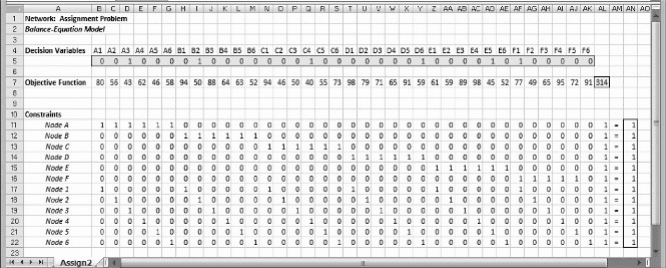
Similarly, there are 11 other balance equations. The full spreadsheet model, with 36
variables and 12 constraints, is shown in Figure 3.9. The optimal solution produced
by Solver achieves the minimum cost of $314 million, which we recognize from
Figure 3.6. The set of assignments matches the optimal solution in the earlier formu-
lation as well.
It is not hard to imagine a problem in which total supply and demand are unequal.
In fact, our transportation example in Figure 3.1 is just such a case. In this example,
total supply is 40,000, while total demand is 39,000. Thus, we might wonder
how to deal with problems that come to us with unbalanced totals for supply and
demand. Here is how we proceed. We alter the diagram by adding a “dummy” ware-
house to capture excess capacity. In our example, the requirement at this fictitious
warehouse is 1000, bringing demand and capacity into balance. We then add arcs link-
ing each of the plants to the dummy warehouse, and we assign zero costs to these arcs.
We can think of shipments to the dummy warehouse as shipments to Nowhere.
In other words, flows into the dummy warehouse are virtual flows that do not actually
occur, whereas flows into the first four warehouses correspond to physical flows.
The virtual flows correspond to unused capacity, which justifies using a cost of
zero on these arcs. The complete diagram is shown in Figure 3.10. We see that the
original diagram has been augmented so that there are now three capacities and five
Figure 3.9. Standard linear programming format for Example 3.2.
3.5. Building Network Models with Balance Equations 87
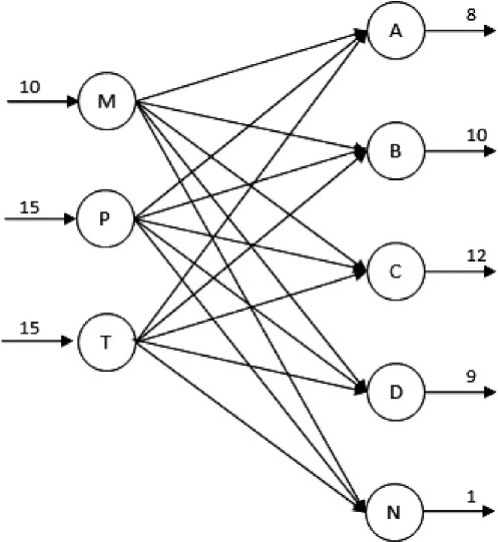
requirements, giving rise to eight nodes; and there are 15 routes, corresponding to
15 arcs. However, the net effect has been to recast the original network into an equiv-
alent one containing equal supply and demand quantities. This means that all of the
supply available at the plants must ultimately find its way through the network to
the warehouses. As a result, there must be a balance equation for every node.
The next step is to translate the diagram into a linear programming model. We
again set aside one variable for each arc; thus, we reserve 15 columns for decision vari-
ables. There are also eight constraints, one corresponding to each node. The essential
requirement for any node in the model is a balance equation, that is, an EQ constraint
ensuring that total flow into the node matches total flow out of the node, or
(Flow Out) (Flow In) ¼ 0
For example, at the Minneapolis node, the flow in corresponds to the capacity of
10,000, while the flows out correspond to the arcs (decision variables) MA, MB,
MC, MD, and MN. The balance equation becomes
MA þ MB þ MC þ MD þ MN 10,000 ¼ 0
or, in standard form, with variables on the left-hand side and constants on the right,
MA þ MB þ MC þ MD þ MN ¼ 10,000:
Figure 3.10. Flow diagram for the augmented version of Example 3.1.
88 Chapter 3 Linear Programming: Network Models
For the other two plants, we obtain
PA þ PB þ PC þ PD þ PN ¼ 15,000
TA þ TB þ TC þ TD þ TN ¼ 15,000
For the Atlanta node, the flow in corresponds to the arcs MA, PA, and TA, while
the flow out corresponds to the requirement of 8000. The balance equation becomes
8000 MA PA TA ¼ 0
which we choose to write as
MA PA TA ¼8000
For the other destination nodes, we obtain
MB PB TB ¼10,000
MC PC TC ¼12,000
MD PD TD ¼9000
MN PN TN ¼1000
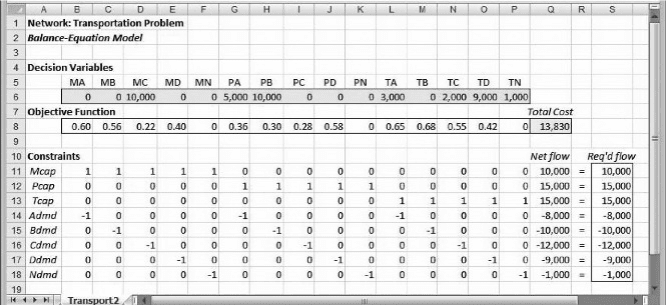
Figure 3.11 shows the complete spreadsheet model, in which all constraints are EQ
constraints, and the objective function is unchanged from before. Moreover, we can
distinguish flows into the network as positive right-hand sides (in the first three con-
straints) from flows out of the network, which are negative right-hand sides (in the last
five constraints). The model specification is as follows.
Objective: Q8 (minimize)
Variables: B6:P6
Constraints: Q11:Q18 ¼ S11:S18
Figure 3.11. Spreadsheet model for the augmented version of Example 3.1.
3.5. Building Network Models with Balance Equations 89
When we solve this optimization problem in the usual way, we obtain the same
minimum cost we saw previously, $13,830, as shown in Figure 3.11. In this case,
the decision variables also match those of Figure 3.2. The optimal solution also
contains the decision variable TN ¼ 1000, which we interpret as excess capacity of
1000 units at Tucson.
To summarize, we have followed a procedure for translating a network problem
into a linear program. This procedure requires a flow diagram, possibly including
a dummy node to capture unused capacity. Once we construct such a diagram, we
can build the model by following these simple steps.
†
Define a variable for each arc.
†
Define a constraint for each node.
†
Express the balance equation for each node.
In addition, a sign convention for right-hand side constants can provide improved
clarity. Under this convention, a balance equation has a positive right-hand side to
signal flow into the network and a negative right-hand side to signal flow out of the
network.
For distribution problems of this sort, the From/To structure of the situation
lends itself most readily to the special network layout shown in Figure 3.2, and that
would be the modeling approach of choice. The approach suggested here is more
general and would be valuable in situations that are more complicated than transpor-
tation, assignment, or transshipment problems. We examine some examples in the
next section. Before we proceed, however, here is a perspective on the balance
equation model.
The special network models all adhere to the conservation law and the use of
balance equations, although it may be necessary to add a dummy node to make
sure that all supply capacity is consumed. In the models we built at the outset, the
addition of a dummy node and corresponding dummy arcs would have seemed
unwieldy or unnecessary. Fortunately, we were able to avoid that step and proceed
directly to a convenient formulation that contains inequalities rather than equations.
In effect, we were dropping the dummy nodes and arcs from the network. By ignoring
those virtual flows, we could change the balance equation for each supply node to a LT
inequality. Similarly, we could also change the balance equation for each demand
node to a GT inequality, incorporating the additional flexibility suggested in
Chapter 2. These simplification steps left us with the network model we saw in
Figure 3.2, but with our new perspective, we can interpret it as an adaptation of the
balance equation model.
Special purpose solvers have been developed for use on large-scale network
problems in industry and academia. Typically, these solvers rely on balance equations
and therefore require that formulations contain equality constraints. However,
RSP does not presently have the facility to draw on these kinds of solvers. The
use of balance equations with Solver may help avoid formulation errors, but
it cannot exploit the algorithmic efficiencies that specialized network software
packages offer.
90
Chapter 3 Linear Programming: Network Models
3.6. GENERAL NETWORK MODELS WITH YIELDS
In network diagrams for the transportation, assignment, and transshipment models,
arcs carry flow from one node to another. Moreover, on every arc, the flow into the
destination node is implicitly required to exactly match the flow sent out from
the source node. However, we can relax that kind of conservation requirement
and extend network models to cases in which flows are subject to yield factors. The
yield factors may shrink the amount flowing on an arc, in which cases we speak of
a yield loss. Alternatively, yield factors may enhance the amount flowing, in which
case we speak of a yield gain. The next two subsections provide examples.
3.6.1. Models with Yield Losses
Yield loss occurs in manufacturing processes where materials are shaped and trimmed
to fit a target design, thus creating material waste. In other settings, quality inspections
screen out defective parts. Process yields of these types reduce the amount of material
in the main product. Similarly, yield loss may occur in distribution processes,
especially with perishable goods. Fluids may partially evaporate during a delivery
trip, or vegetables may spoil. The net effect of perishability, as with process yields,
is simply a reduction in the amount of a flow that reaches its destination.
EXAMPLE 3.4
The Goodwin Manufacturing Company Revisited
The Goodwin Manufacturing Company (of Example 3.1) finds that its product is subject
to evaporation in the tanker trucks used for distribution purposes. The average amount of evap-
oration depends the distance traveled and the average temperature. The following table shows
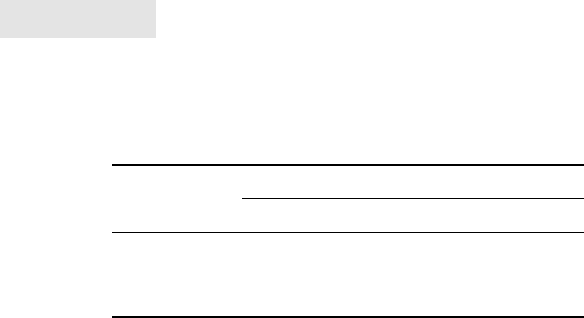
the corresponding yield loss as it has been observed to occur on each of its shipping routes.
(To) warehouse
(From) plant Atlanta Boston Chicago Denver
Minneapolis 0.24 0.19 0.07 0.11
Pittsburgh 0.10 0.05 0.04 0.15
Tucson 0.26 0.41 0.32 0.27
B
In this scenario, the yield factor tells us what proportion of the material sent along
an arc will reach its destination. For the purposes of decision making, we can still
measure the amounts sent out along each arc, but we have to adjust those figures to
determine how much demand is actually met at each destination. In addition, we
cannot know in advance how much material in the aggregate we will ship from the
three plants. We know that, after yield losses, we must ship more than the total
demand quantity (still 39,000), but we can’t tell how much more because we don’t
yet know which shipping routes we’ll use. Therefore, if we think of our model
3.6. General Network Models with Yields 91
containing a demand node for Nowhere, we must now treat the demand at that node as
a variable.
For the purposes of illustration, we assume that each plant has a standard capacity
of 16,000 units. Our supply constraints resemble those of the balance-equation model
of the previous section.
MA þ MB þ MC þ MD þ MN ¼ 10,000
PA þ PB þ PC þ PD þ PN ¼ 15,000
TA þ TB þ TC þ TD þ TN ¼ 15,000
For the Atlanta node, the flow in corresponds to the net amounts on arcs MA, PA, and
TA, while the flow out corresponds to the requirement of 8000. The balance equation
becomes
8000 0:76MA 0:90PA 0:74TA ¼ 0
which we choose to write as
0:76MA 0:90PA 0:74TA ¼8000
For the other destination nodes, we obtain
0:81MB 0:95PB 0:31TB ¼10,000
0:93MC 0:96PC 0:68TC ¼12,000
0:89MD 0:85PD 0:73TD ¼9000
MN PN TN NX ¼ 0
In this last constraint, NX measures the total quantity unshipped and does not appear in
the objective function. The objective function is the same as the one we used initially.
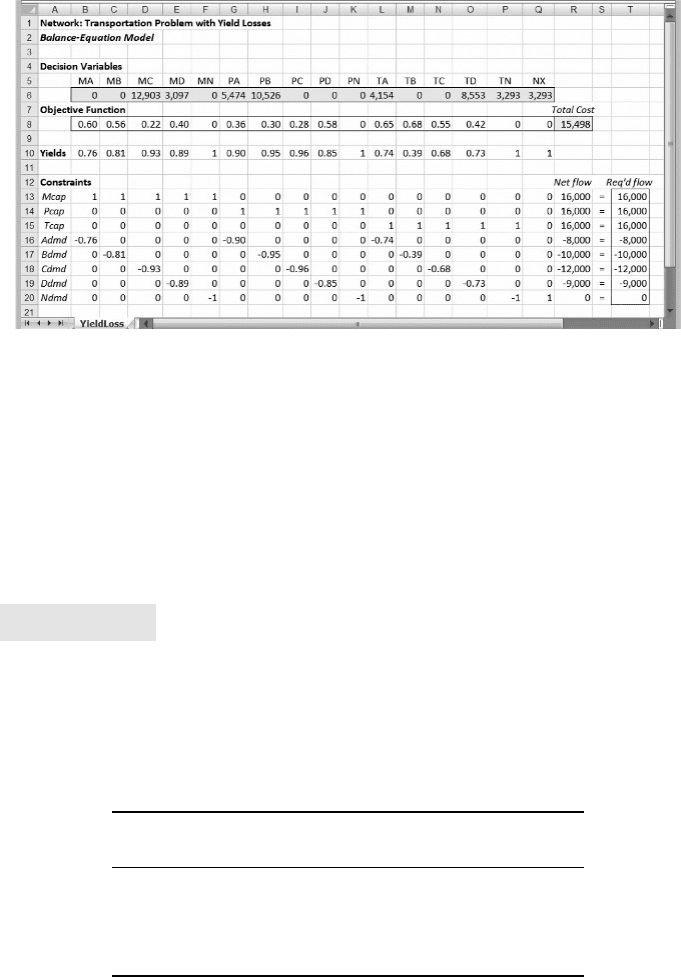
Figure 3.12 shows the complete spreadsheet model, in which all constraints are
EQ constraints, as in the previous section. In particular, the coefficients in rows
16–20 are yield factors, and these values are taken from the parameters in row 10.
The model specification is as follows.
Objective: R8 (minimize)
Variables: B6:Q6
Constraints: R13:R20 ¼ T13:T20
When we solve this optimization problem in the usual way, we obtain the mini-
mum cost of $15,498, as shown in Figure 3.12. To achieve this cost, the shipments out
of Minneapolis and Pittsburgh exhaust capacity, whereas some excess capacity
remains at Tucson. (The solution reflects this pattern because variables MN and PN
are zero, but TN is positive.) From the model, we can determine that the total quantity
shipped is 44,707, which provides the 39,000 units of demand after accounting
for yields.
With yields present in the model, the structure is not as simple as the transpor-
tation model, but we can exploit the conservation law to help us develop valid
constraints from balance equations.
92
Chapter 3 Linear Programming: Network Models
3.6.2. Models with Yield Gains
We look next at flows that expand. Although there are chemicals that exhibit this prop-
erty, a more familiar application involves money. As money flows through different
locations in time, it usually expands. This expansion results from drawing interest
or other kinds of investment returns. Consider the familiar problem of investing for
college expenses.
EXAMPLE 3.5
Planning for College
Two parents want to provide for their daughter’s college education with some money they
have recently inherited. They would like to set aside part of the inheritance in an account that
would cover the needs of their daughter’s college education, which begins four years from
now. They estimate that first-year college expenses will come to $24,000 and increase $2000
per year during each of the remaining three years of college. The following investments are
available.
Investment Available Matures
Return at
maturity
A Every year 1 year 6%
B 1, 3, 5, 7 2 years 14%
C 1, 4 3 years 18%
D 1 7 years 65%
The parents would like to determine an investment plan that provides the necessary funds to
cover college expenses with the smallest initial investment. B
Figure 3.12. Spreadsheet model for Example 3.4.
3.6. General Network Models with Yields 93
Investment and funds-flow problems of this sort lend themselves to network mod-
eling. In this type of problem, nodes represent points in time at which funds flow could
occur. We can imagine tracking the balance in a bank account, with funds flowing in
and out depending on our decisions. In Example 3.5, we include a node for now (time
zero), and nodes for the end of years 1 through 7. Tracking time for this purpose, the
end of year 3 and the start of year 4 are in effect the same point in time. To construct a
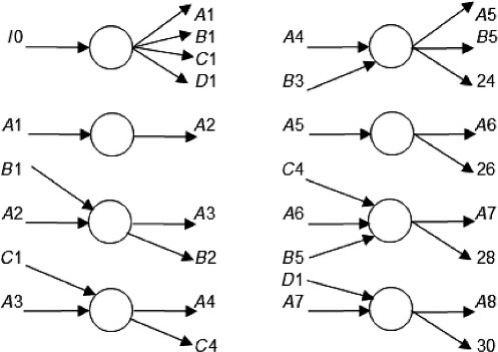
typical start-of-year node, we first list the potential inflows and outflows that can occur.
Inflows
Initial investment
Appreciation of investment A from 1 year ago
Appreciation of investment B from 2 years ago
Appreciation of investment C from 3 years ago
Appreciation of investment D from 7 years ago
Outflows
Expense payment for the coming year
Investment in A for the coming year
Investment in B for the coming 2 years
Investment in C for the coming 3 years
Investment in D for the coming 7 years
Not all of these inflows and outflows apply at every point in time, but if we sketch
the eight nodes and the flows that do apply, we come up with a diagram such as the
Figure 3.13. Flow diagrams for Example 3.5.
94 Chapter 3 Linear Programming: Network Models
one shown as Figure 3.13. In this diagram, A1 represents the amount allocated to
Investment A at time zero, A2 represents the amount allocated to Investment A at
the start of year 2, and so on. The initial investment in the account is shown as I0,
and the expense payments are labeled with their numerical values. The diagram
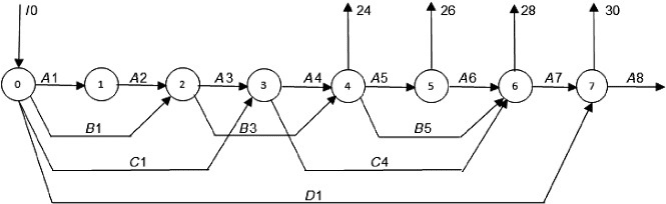
shows the different nodes as independent elements, which is all we really need; how-
ever, Figure 3.14 shows a tidier diagram in which the nodes are connected in a single
flow network.
We do not need the variable B7 in the model. A 2-year investment starting in
year 7 would extend beyond the 8-year horizon, so this option is omitted. However,
the variable A8 does appear in the model. We can think of A8 as representing the
final value in the account. Perhaps it is intuitive that, if we are trying to minimize
the initial investment, there is no reason to have money in the account in the end.
Still, to verify this intuition, we can include A8 in the model, anticipating that we
will find A8 ¼ 0 in the optimal solution.
The next step is to convert the diagram into a linear programming model. For this
purpose, the flows on the diagram become decision variables. Then, each node gives
rise to a balance equation, as listed below.
A1 þ B1 þ C1 þ D1 I0 ¼ 0 ðEnd of year 0Þ
A2 1:06A1 ¼ 0 ðEnd of year 1Þ
A3 þ B3 1:06A2 1:14B1 ¼ 0 ðEnd of year 2Þ
A4 þ C4 1:06A
3 1:18C1 ¼ 0 ðEnd of year 3Þ
A5 þ B5 þ 24,000 1:06A4 1:14B3 ¼ 0 ðEnd of year 4Þ
A6 þ 26,000 1:06A5 ¼ 0 ðEnd of year 5Þ
A7 þ 28,000 1:06A6 1:14B5 1: 18C4 ¼ 0 ðEnd of year 6Þ
A8 þ 30,000 1:06A7 1:65D1 ¼ 0 ðEnd of year 7Þ
Figure 3.15 shows these EQ constraints as part of the spreadsheet model. A
systematic pattern is formed by the coefficients in the columns of the constraint
equations. Each column has two nonzero coefficients: a positive coefficient (of 1),
corresponding to the time the investment is made, and a negative coefficient (reflecting
Figure 3.14. Unified flow diagram for Example 3.5.
3.6. General Network Models with Yields 95