
Bielajew A.F. Fundamentals of the Monte Carlo method for neutral and charged particle transport
Подождите немного. Документ загружается.

9.1. THE FORMAL SOLUTION 101
If one considers angular distributions only, then one may integrate over all ~x in Equation 9.7
giving:
"
∂
∂s
+ κ
l
#
ψ
l
(s)=0, (9.11)
resulting in the solution derived by Goudsmit and Saunderson [GS40a, GS40b]:
ψ(~µ, s)=
1
4π
X
l
(2l +1)P
l
(cos θ)k
l
(s) , (9.12)
where
k
l
(s)=exp
−
Z
s
0
ds
0
κ
l
(E)
. (9.13)
Equation 9.7 represents a complete formal solution of the linear Boltzmann transport equa-
tion but it has never been solved exactly in closed form. However, Equation 9.7 may be
employed to extract important information regarding the moments of the distributions.
A long and very boring proof should go here!
Lewis [Lew50] has shown the moments hzi, hz cos Θi,andhx
2
+ y
2
i to be:
hzi =
Z
s
0
ds
0
k
1
(s
0
) , (9.14)
hz cos θi =
k
1
(s)
3
Z
s
0
ds
0
1+2k
2
(s
0
)
k
1
(s
0
)
, (9.15)
and
hx
2
+ y
2
i =
4
3
Z
s
0
ds
0
k
1
(s
0
)
Z
s
0
0
ds
00
1 − k
2
(s
00
)
k
1
(s
00
)
. (9.16)
It can also be shown using Lewis’s methods that
hx sin θ cos φ + y sin θ sin φi =
2k
1
(s)
3
Z
s
0
ds
0
1 − k
2
(s
0
)
k
1
(s
0
)
, (9.17)
h~x · ~µi = k
1
(s)
Z
s
0
ds
0
1
k
1
(s
0
)
, (9.18)
hz
2
i =
2
3
Z
s
0
ds
0
k
1
(s
0
)
Z
s
0
0
ds
00
1+2k
2
(s
00
)
k
1
(s
00
)
, (9.19)
and
hx
2
+ y
2
+ z
2
i =2
Z
s
0
ds
0
k
1
(s
0
)
Z
s
0
0
ds
00
1
k
1
(s
00
)
, (9.20)
which gives the radial coordinate after the total transport distance, s. Note that there was
an error
2
in Lewis’s paper where the factor 1/3 was missing from his version of hz cos Θi.In
2
The correction of Lewis’s Equation 26 is:
H
l1
=
s
1
4π(2l +1)
k
l
(s)
Z
s
0
ds
0
lk
l−1
(s
0
)+(l +1)k
l+1
(s
0
)
k
1
(s
0
)

102 CHAPTER 9. LEWIS THEORY
the limit that s −→ 0, one recovers from Eqs. 9.15 and 9.19 the results lim
s−→ 0
hz cos Θi = s
and lim
s−→ 0
hz
2
i = s
2
which are not obtained without correcting the error as described in
the footnote.
It warrants repeating that these equations are all “exact” and are independent of the form
of the scattering cross section.
9.2 Isotropic scattering from uniform atomic targets
We assume that the cross section has the form:
σ(Θ, Φ)dΘ dΦ =
σ
0
4π
sin ΘdΘ dΦ . (9.21)
Using the results of the previous chapter,
Σ(Θ, Φ)dΘ dΦ = ρ
N
A
A
σ
0
4π
sin ΘdΘ dΦ =
Σ
0
4π
sin ΘdΘ dΦ . (9.22)
From Equation 9.8
κ
l
(E)=
Z
2π
0
dΦ
Z
π
0
dΘ sin Θ Σ(cos Θ,E)[1 − P
l
(cos Θ)] = Σ
0
(1 − δ
l0
) , (9.23)
and from Equation 9.13
k
l
(s)=exp
−
Z
s
0
ds
0
κ
l
(E)
= δ
l0
+(1− δ
l0
)e
−Σ
0
s
= δ
l0
+(1− δ
l0
)e
−λ
, (9.24)
where λ is a natural measure of distance in terms of the number of “mean-free-paths”
(MFP’s). If we substitute this into Equations 9.14–9.20, we obtain:
Σ
0
hzi =1− e
−λ
, (9.25)
Σ
0
hz cos θi =
1 − (1 −2λ)e
−λ
3
, (9.26)
Σ
0
hx sin θ cos φi =Σ
0
hy sin θ sin φi =
1 − (1 + λ)e
−λ
3
, (9.27)
Σ
0
h~x · ~µi =1− e
−λ
, (9.28)
Σ
2
0
hz
2
i =
2[1 + λ − (1 + 2λ)e
−λ
]
3
, (9.29)
Σ
2
0
hx
2
i =Σ
2
0
hy
2
i =
2[λ − 2 − (2 + λ)e
−λ
]
3
, (9.30)
The reader should consult Lewis’s paper [Lew50] for the definition of the H-functions.

9.2. ISOTROPIC SCATTERING FROM UNIFORM ATOMIC TARGETS 103
Σ
2
0
hx
2
+ y
2
+ z
2
i =2[λ − 1+e
−λ
] . (9.31)
The leading order small pathlength (λ −→ 0) behavior is:
Σ
0
hzi−→λ, (9.32)
Σ
0
hz cos θi−→λ, (9.33)
Σ
0
hx sin θ cos φi =Σ
0
hy sin θ sin φi−→λ
2
/6 , (9.34)
Σ
0
h~x · ~µi−→λ, (9.35)
Σ
2
0
hz
2
i−→λ
2
, (9.36)
Σ
2
0
hx
2
i =Σ
2
0
hy
2
i−→λ
3
/9 , (9.37)
Σ
2
0
hx
2
+ y
2
+ z
2
i−→λ
2
, (9.38)
which is to be expected since the particle has not had much chance to scatter away form the
z axis.
The large pathlength (λ −→ ∞)behavioris:
Σ
0
hzi−→1 , (9.39)
Σ
0
hz cos θi−→1/3 , (9.40)
Σ
0
hx sin θ cos φi =Σ
0
hy sin θ sin φi−→1/3 , (9.41)
Σ
0
h~x · ~µi−→1 , (9.42)
Σ
2
0
hz
2
i−→2(λ +1)/3 , (9.43)
Σ
2
0
hx
2
i =Σ
2
0
hy
2
i−→2(λ −2)/3 , (9.44)
Σ
2
0
hx
2
+ y
2
+ z
2
i−→2(λ − 1) , (9.45)
Several interesting properties may be derived. The variance associated with the distribution
in z is:
Σ
2
0
hz
2
i−(Σ
0
hzi)
2
=
2[1 + λ − (1 + 2λ)e
−λ
]
3
−(1 − e
−λ
)
2
(9.46)
The small pathlength limit is 4λ
3
/9 and the large pathlength limit is (2λ − 1)/3. Similarly,
the radial variance is:
Σ
2
0
h~x · ~xi−Σ
2
0
h~xi·h~xi =2[λ − 1+e
−λ
] − (1 − e
−λ
)
2
. (9.47)
The small pathlength limit is 2λ
3
/3 and the large pathlength limit is (2λ − 1).
These results and other similarly derived ones may be employed to verify, in a scattering-
model independent way, the operation of a Monte Carlo code.
104 CHAPTER 9. LEWIS THEORY

Bibliography
[GS40a] S. A. Goudsmit and J. L. Saunderson. Multiple scattering of electrons. Phys. Rev.,
57:24 – 29, 1940.
[GS40b] S. A. Goudsmit and J. L. Saunderson. Multiple scattering of electrons. II. Phys.
Rev., 58:36 – 42, 1940.
[Lew50] H. W. Lewis. Multiple scattering in an infinite medium. Phys. Rev., 78:526 – 529,
1950.
Problems
1. 10,000 particles start out in an infinite, unbounded medium with initial position vector
~x
0
= 0 and initial direction vector ~u
0
=ˆz. The interaction probability is:
p(s
i
)ds
i
=Σexp(−Σs
i
)ds
i
where s
i
is a measure of the pathlength of the particle along its current direction of mo-
tion starting from its current position to the i’th interaction point. Having interacted,
the particle scatters isotropically and can scatter again, repeatedly, according to the
same scattering law. This repeated scattering and transport results in a probability
distribution function of the form
F (~x, ~u, s)d~x d~u ds
which you will develop stochastically through a Monte Carlo program. The variable s
is a measure of total pathlength travelled, i.e. s =
P
N(s)
i
s
i
. Note that the number of
interactions N(s) is a probabilistic quantity.
(a) Consider the following moments:
•hxi±σ
hxi
(i.e. average x)
105
106 BIBLIOGRAPHY
•hyi±σ
hyi
(i.e. average y)
•hzi±σ
hzi
(i.e. average z)
•hx~u · ˆxi±σ
hx~u·ˆxi
(i.e. average correlation of x with the x-axis direction cosine)
•hy~u · ˆyi±σ
hy~u·ˆyi
(i.e. average correlation of y with the y-axis direction cosine)
•hz~u · ˆzi±σ
hz~u·ˆzi
(i.e. average correlation of z with the z-axis direction cosine)
•hxyi±σ
hxyi
(i.e. average correlation of x and y)
•hxzi±σ
hxzi
(i.e. average correlation of x and z)
•hyzi±σ
hyzi
(i.e. average correlation of y and z)
•hx
2
i±σ
hx
2
i
(i.e. average x
2
)
•hy
2
i±σ
hy
2
i
(i.e. average y
2
)
•hz
2
i±σ
hz
2
i
(i.e. average z
2
)
(b) Which moments would you expect to be zero? Why?
(c) Which moments would you expect to be equal to each other? Why?
(d) For Σ = 1 and s = 0.001, 0.002, 0.005 0.001, 0.02, 0.05, 0.1, 0.2, 0.5, 1, 2, 5, 10,
20, 50, 100, 200, 500, 1000, tally the above moments and their estimated errors:
Plot the results divided by s
n
as a function of log(s). n is some power of n
such that the correct small and large pathlength asymptotic forms (according
to Equations 9.32–9.45) divided by this s
n
is a constant. (e.g. hz
2
i/s
2
would be
expected to go to the constant 1 for small s and hz
2
i/s would be expected to go to
the constant 2/3 for large s.) If you expect the moment to be zero (on average),
set n = 0. Verify that both the s −→ 0andthes −→ ∞ limits discussed in this
chapter are reached.
Chapter 10
Geometry
In particle transport or ray tracing for applications such as the Monte Carlo simulation of
particles being transported through media or vacuum, the inclusion of boundaries permits
the development of applications of particle transport in geometrical objects. These objects
can be very simple, such as a planar interface between two semi-infinite media or a collection
of geometrical objects that define a nuclear power vessel or a complex radiation detector.
The technique to address both of these problems is essentially the same. When a particle
is about to be transported it knows that it is in a region of space identified by a region
number (or some other unique characteristic), its position, its direction and its proposed
flight distance (e.g. the distance to an interaction point). It also knows that its current
location in space is bounded by a finite set of surfaces. So, it interrogates the geometry code
associated with each of these to find out which surface it hits, if any, and the distance to
that surface.
For most Monte Carlo applications the essential questions to be answered by the geometry
modelling code are:
• If my particle starts off at position ~x
0
with direction vector µ, and it “flies” in a straight
line up to a maximum distance s, will it hit a given surface?
• If the answer to the above is “yes”, what is the distance to the intersection?
• And is the answer to the first question above is “yes”, what is the region number that
lies on the other side?
In this chapter the general problem of solving for the distance to the intersection point of a
directed straight line with an arbitrary plane or an arbitrary quadric surface is developed.
Quadric surfaces include, for example, spheres, cylinders and cones as well as a few less famil-
iar surfaces. A general strategy for boundary-crossing logic is presented which circumvents
ambiguities associated with numerical precision and end-of-step directional uncertainties.
107

108 CHAPTER 10. GEOMETRY
The specific examples of surfaces given are planes, circular cylinders, spheres and circular
cones with arbitrary orientation and position. Care is taken to develop the mathematical
equations so that they can be computed with numerical accuracy and a discussion on the
influence of machine precision on the accuracy of results is given.
This simple design allows the Monte Carlo transport routine to concern itself only with the
problem of transport of particles in infinite media and it only needs to know the composition
of the medium that particles are being transported in. Thus, when the new region number
is communicated to the Monte Carlo transport routine, it merely has to check in its look-up
tables to see whether or not the medium has changed and then take appropriate action.
This decoupling of transport physics and geometry is a very powerful generalizing feature
and permits arbitrary flexibility in specifying the geometry in such a way that the underlying
transport mechanisms are identical for all applications.
10.1 Boundary crossing
Let us imagine that a particle is being transported in vacuum, that its initial position is ~x
0
,
its region number is N
0
, it has direction ~µ and that there is only one surface bounding its
current region. The geometry code is then interrogated to see of the flight path will strike
the surface.
If the geometry modelling code replies:
• Yes, I will hit a certain surface along my flight path,
• The distance to the intersection is s,
• The region number that lies on the other side is N,
particle transport is effected using the equation:
~x = ~x
0
+ ~µs, (10.1)
and one assumes naturally that mathematically (or logically) that the new position is exactly
~x and that any test of where the particle is will yield the answer N for its region number.
However, numerics and mathematics often differ.
In an “ideal” computer where floating point numbers could be specified to absolute accuracy,
there would be no ambiguity. However, real computers represent real numbers to within a
finite, non-zero precision.
1
Is the particle on a surface or not? Is it exactly on the surface or
1
It is possible to recode geometry transport in integer arithmetic, thereby avoiding ambiguities. This
“quantisation” of space approach has its drawbacks and further discussion would take us out of the scope of
this discussion.
10.1. BOUNDARY CROSSING 109
has truncation caused an “undershoot” or round-up caused an overshoot? The problem of the
finite precision of floating point numbers in computers introduces three position-dependent
possibilities that one must consider:
undershoot The transport distance does not quite reach the surface,
exact Numerically, the particle is exactly on the surface,
overshoot The transport distance is slightly overestimated so that the surface is actually
crossed.
All of these possibilities occur with varying frequency during the course of a Monte Carlo
calculation. In fact, it is correct to say that if you run a geometry code through enough
examples with stochastic selection of input parameters, then everything that can happen
will happen. Therefore, it is necessary to write geometry coding that is robust enough
to handle all of these possibilities and also to be aware of the error handling that must
be introduced. It has been suggested that all geometry be coded in double or extended
precision to avoid these kinds of ambiguities. However, one must realise that double or
extended precision does not mean absolute precision. Higher precision reduces the size of
the undershoot or overshoot but does nothing to cure undershoot or overshoot ambiguities.
A geometry code that survives using single precision arithmetic will work at higher precision
providing that the coding does not make some intrinsic assumptions on precision or scale.
The converse is not true. The routines developed for this course will work for both single
and higher precision and the regions of validity for use with both single and double precision
is investigated.
There is yet another complicating factor. Transport to a surface can cause the direction
of a particle to change! If the boundary represents a reflecting surface, the direction will
change according to the law of reflection (discussed in a later chapter). Many charged
particle transport schemes apply multiple scattering angular deflection to electron/positron
trajectories in media when the flight path is interrupted by a boundary. (This point is
discussed further in a later chapter.) Or, with less probability is the possibility that an exact
boundary intersection corresponds with the exact numerical point of interaction causing a
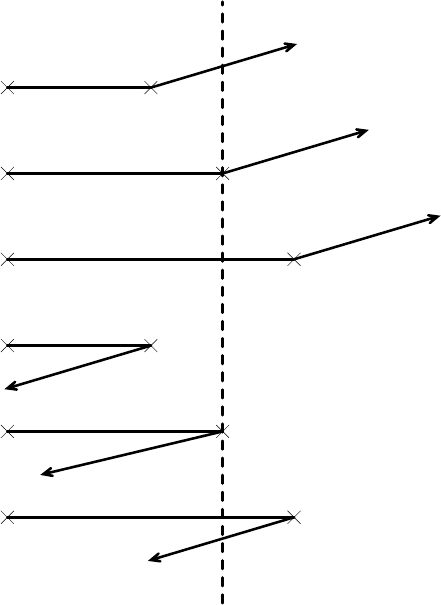
deflection. The various possibilities are depicted in Figure 10.1.
Fortunately there is a general error handling strategy that resolves these ambiguities:
• Do not calculate flight distances to boundaries that the particle is assumed to be headed
away from based on its known direction. The handles the undershoot and exact hit
problem in the case the particle assumes that it is still directed away from the surface
that it just crossed. However, the particle has to know in advance whether it is “inside”
or “outside” of a surface to start with.
• If the flight distance returned is less than or equal to zero, set the transport step to
zero and assume that the transport step causes a region change. This strategy resolves
110 CHAPTER 10. GEOMETRY
Region N
0
Region N
undershoot
exact
overshoot
undershoot
exact
overshoot
Figure 10.1: Boundary crossing of a particle across a boundary. There are six possibili-
ties corresponding to undershoot, exact surface position, and overshoot with either forward
scatter or backscatter.