
Bielajew A.F. Fundamentals of the Monte Carlo method for neutral and charged particle transport
Подождите немного. Документ загружается.

10.1. BOUNDARY CROSSING 111
ambiguities associated with undershoots and exact hits when the particle backscatters
form the surface.
Remarkably, this simple logic resolves all boundary transport ambiguities. Its calculational
efficiency is excellent, it is completely independent of the scale of the geometry with respect
to the transport pathlengths and it heals precision errors “on the spot” not allowing them
to accumulate.
Let us enumerate all the possibilities of boundary crossing and demonstrate how this boundary-
crossing logic resolves all problems.
undershoot, forward scatter The transport distance does not quite reach the surface,
but assumes logically that it is in the next region. The subsequent transport step
ignores the surface because it is assumed to be heading away from it. Note that the
positioning error is healed “on the spot” in the next transport step.
exact, forward scatter Numerically, the particle is exactly on the surface, but assumes
that it is in the next region. The subsequent transport step ignores the surface because
it is assumed to be heading away from it.
overshoot, forward scatter The transport distance is slightly overestimated so that the
surface is actually crossed. There is no ambiguity in this case since the numerical
position and the logical placement of the particle are in agreement.
undershoot, backscatter The transport distance does not quite reach the surface, but
assumes logically that it is in the next region. The subsequent transport step checks
this surface because it is assumed to be heading toward it. The calculation of the
transport distance to the surface yields a small, negative distance. Set the transport
distance to zero and let the next step transport the particle to this surface, doing
nothing more than resetting the region number to the original. Note that the error is
absorbed by the next transport step.
exact, backscatter The transport distance brings the particle exactly to the surface, and
the logic assumes that it is in the next region. The subsequent transport step checks
this surface because it is assumed to be heading toward it. The calculation of transport
distance to the surface yields an exact zero. Employ this zero transport distance and let
the next step transport the particle to this surface, doing nothing more than resetting
the region number to the original.
overshoot, backscatter The transport distance is slightly overestimated so that the sur-
face is actually crossed. There is no ambiguity in this case since the numerical position
and the logical placement of the particle are in agreement. The next transport will be
a small, positive step.
112 CHAPTER 10. GEOMETRY
It is clear that if there is an overshoot, there is no ambiguity. It is tempting to think that by
arranging for an overshoot (a small amount related to the relative or absolute floating point
precision) in every case will resolve all ambiguities and be efficient as well. The problem
with this approach is that is works well for normal incidence but not very well for grazing
incidence. Certain implementations of this strategy introduce a scale dependence into the
transport scheme, assume that errors in steps of a certain size can be ignored. Such strategies
will either be ineffective if the geometries are very large or introduce positioning errors if the
geometrical elements are very small.
10.2 Solutions for simple surfaces
10.2.1 Planes
The general equation for a plane of arbitrary orientation is:
~n · (~x −
~
P ) = 0 (10.2)
where ~n is the unit normal of the plane and
~
P is any point on the surface of the plane. Note
the use of the inner product, ~n · ~x ≡ n
x
x + n
y
y + n
z
z.
Intersection distance
Inserting Equation 10.1 into Equation 10.2 and solving for s gives:
s = −
~n · (~x
0
−
~
P )
~n · ~µ
(10.3)
We remark that there is no solution (s = ∞) when the particle direction is perpendicular
to the normal of the plan (~n · ~µ = 0). This is the solution of a particle travelling parallel to
a plane and never hitting it. Only positive solutions for s are acceptable and this depends
upon whether or not the particle is travelling towards the plane.
Adopting the convention that a particle is considered to be outside the plane of it is on the
side that the unit normal, ~n, is pointing, we enumerate the possibilities:
Case I ~n · ~µ =0
Trajectory is parallel to the plane, no solution
Case II ~n · (~x
0
−
~
P ) ≥ 0 and the particle is assumed to start from the outside
1. If ~n · ~µ<0, s = −~n ·(~x
0
−
~
P )/~n · ~µ
10.2. SOLUTIONS FOR SIMPLE SURFACES 113
2. Elseif ~n · ~µ>0, no solution
Case III ~n · (~x
0
−
~
P ) ≤ 0 and the particle is assumed to start from the inside
1. If ~n · ~µ>0, s = −~n ·(~x
0
−
~
P )/~n · ~µ
2. Elseif ~n · ~µ<0, no solution
Case IV ~n · (~x
0
−
~
P ) < 0 but the particle is assumed to start from the outside
1. If ~n · ~µ<0, s = 0 effecting a region change
2. Elseif ~n · ~µ>0, no solution
Case V ~n · (~x
0
−
~
P ) > 0 but the particle is assumed to start from the inside
1. If ~n · ~µ>0, s = 0 effecting a region change
2. Elseif ~n · ~µ<0, no solution
The case of a parallel trajectory is handled by Case I. The two “normal” conditions in
Case II and Case III handle the eventuality where the particle is exactly on the plane,
~n·(~x
0
−
~
P )=0.Case IV and Case V handle the anomalies. In the case of an undershoot and
backscatter out of the region where the particle thinks it is, then a zero distance is returned
so that the next transport step will switch to the correct region number. If the case of an
undershoot and forward scatter, no solution is given allowing other surfaces in the geometry
to determine the intersection. Note that no correction is made for the undershoot distance
and this will be included in the next transport step. Therefore, numerical inaccuracies are
not allowed to accumulate.
The FORTRAN codes which accomplishes this for a plane normal to the z axis is:
C23456789|123456789|123456789|123456789|123456789|123456789|123456789|12
subroutine zplane(p0,z0,w,s,inside,hit)
implicit none
C Calculates the distance of a particle to a planar surface normal to the
C z-axis
logical
* inside ! Input: inside = .true. => particle thinks it is inside
* , ! Input: inside = .false. => particle thinks it is outside
* hit ! Output: hit = .true. => particle would hit the surface
! Output: hit = .false. => particle would miss the surface

114 CHAPTER 10. GEOMETRY
real
* p0, ! Input: Point at which the plane cuts the z-axis
* z0, ! Input: z-coordinate of the particle
* w , ! Input: z-axis direction cosine of the particle
* s ! Output: Distance to the surface (if hit)
if (
* (inside.and.w.gt.0e0) !headed towards the surface
* .or.
* (.not.inside.and.w.lt.0e0) !headed towards the surface
*)
*then
hit = .true.
s = max(0e0,(p0-z0)/w)
return
else
hit = .false.
return
endif
end
10.3 General solution for an arbitrary quadric
Borrowing from the notation of Olmsted [Olm47], an arbitrary quadric surface in 3(x,y,z)-
space
2
can be represented by:
f(~x)=
3
X
i,j=0
a
ij
x
i
x
j
=0. (10.4)
The a
ij
’s are arbitrary constants and the 4-vector x
i
has components (1,x,y,z). The zeroth
component is unity by definition allowing a very compact representation and a
ij
is symmetric
with respect to the interchange of i and j,thatisa
ij
= a
ji
. Equation 10.4 is very general
and encompasses a wide variety of possibilities including solitary planes (e.g. only a
0i
non-
zero), intersecting planes (e.g. only a
11
and a
22
non-zero), cylinders (circular, elliptical,
parabolic and hyperbolic), spheres, spheroids and ellipsoids, cones (circular and elliptical),
hyperboloids of one and two sheets and elliptic and hyperbolic paraboloids. These surfaces
2
The only variance with Olmsted’s notation is that the 4
th
component is labelled as the 0
th
component
in this work.

10.3. GENERAL SOLUTION FOR AN ARBITRARY QUADRIC 115
can be combined to make geometrical objects of arbitrary complexity and are extremely
useful in Monte Carlo modeling of physical objects.
Despite having apparently 10 independent constants, Equation 10.4 represents only 10 inde-
pendent real surfaces (including the simple plane), unique after a translation and rotation
to standard position. The three cross terms (a
ij
for i 6= j and i, j ≥ 1) can be eliminated
by rotation. The resultant equation then only involves terms like x
2
i
and x
i
. In addition,
providing that a given variable’s quadratic constant is non-zero, the linear terms can be
eliminated by a translation. The result is that there are only two generic forms:
f(~x)=
3
X
i=1
a
i
x
2
i
+ c =0, (10.5)
and
f(~x)=
2
X
i=1
a
i
x
2
i
+ bx
3
=0. (10.6)
Equations 10.5 and 10.6 describe only 10 distinct possibilities with real solutions.
1. ellipsoids: a
2
1
x
2
1
+ a
2
2
x
2
2
+ a
2
3
x
2
3
− c
2
=0.
2. cones: a
2
1
x
2
1
+ a
2
2
x
2
2
− a
2
3
x
2
3
=0.
3. cylinders: a
2
1
x
2
1
+ a
2
2
x
2
2
−c
2
=0.
4. hyperboloids of one sheet: a
2
1
x
2
1
+ a
2
2
x
2
2
−a
2
3
x
2
3
− c
2
=0.
5. hyperboloids of two sheets: a
2
1
x
2
1
+ a
2
2
x
2
2
− a
2
3
x
2
3
+ c
2
=0.
6. elliptic paraboloids: a
2
1
x
2
1
+ a
2
2
x
2
2
+ a
3
x
3
=0.
7. hyperbolic paraboloids: a
2
1
x
2
1
−a
2
2
x
2
2
+ a
3
x
3
=0.
8. hyperbolic cylinders: a
2
1
x
2
1
− a
2
2
x
2
2
+ c
2
=0.
9. parabolic cylinders: a
2
1
x
2
1
+ a
3
x
3
=0.
10. simple planes: a
3
x
3
+ c =0.
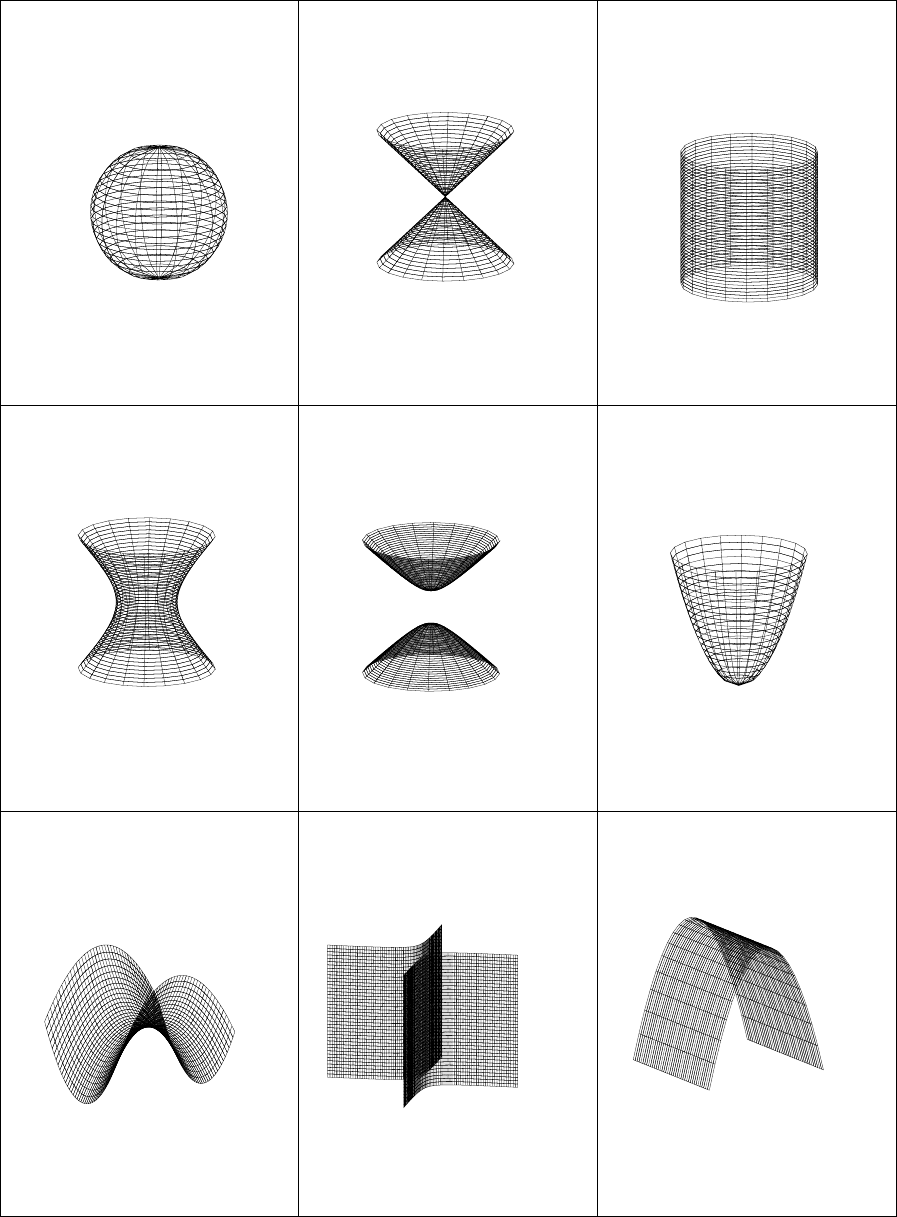
The first nine of these are shown
3
in Figure 10.2. (The magnitude of the above constants
were all chosen to be unity for the purposes of display. Consequently, the first six of these
surfaces shown exhibit at least one axis of rotational symmetry.)
There are other imaginary surfaces (e.g. imaginary ellipsoids a
2
1
x
2
1
+ a
2
2
x
2
2
+ a
2
3
x
2
3
+ c
2
=
0) that we will not consider nor will we consider quadrics that can be made up of two
3
Thanks to Keath Borg (wherever you are!) for generating the data for these figures.
116 CHAPTER 10. GEOMETRY
Sphere Circular Cone Circular Cylinder
Circular Hyperboloid of One Sheet Circular Hyperboloid of Two Sheets Circular Paraboloid
Hyperbolic Paraboloid Hyperbolic Cylinder Parabolic Cylinder
Figure 10.2: The nine real non-planar quadric surfaces.
10.3. GENERAL SOLUTION FOR AN ARBITRARY QUADRIC 117
independent planes in various orientations (e.g. intersection planes a
2
1
x
2
1
−a
2
2
x
2
2
= 0, parallel
planes a
2
1
x
2
1
− c
2
= 0, and coincident planes a
2
1
x
2
1
=0).
For more information on the reduction to canonical form, the reader is encouraged to read
Olmsted’s book [Olm47]. Olmsted also gives the classification of the surfaces and lists the
entire set of 17 canonical quadric forms.
10.3.1 Intercept to an arbitrary quadric surface?
We now change notation slightly and write the particle trajectory by the parametric equation:
~x = ~p + ~µs (10.7)
where the starting position of the particle is ~p =(p
x
,p
y
,p
z
). A positive value of s expresses
a distance along the direction that the particle is going (forward trajectory) and a negative
value is associated with a distance that the particle came from (backward trajectory). Thus,
negative solutions that are found for s below will be rejected.
In Monte Carlo particle transport calculations as well as ray-tracing algorithms a common
problem is to find the distance a particle has to travel in order to intersect a surface. This
is done by substituting for ~x from Equation 10.7 in Equation 10.4 to give:
s
2
3
X
i,j=0
a
ij
µ
i
µ
j
+2s
3
X
i,j=0
a
ij
p
i
µ
j
+
3
X
i,j=0
a
ij
p
i
p
j
=0, (10.8)
where we have adopted the convention that µ
0
= 0 and p
0
= 1. This is a quadratic equation
in s of the form A(~µ)s
2
+2B(~µ, ~p)s + C(~p)=0whereA(~µ)=
P
3
i,j=0
a
ij
µ
i
µ
j
, B(~µ, ~p)=
P
3
i,j=0
a
ij
p
i
µ
j
and C(~p)=
P
3
i,j=0
a
ij
p
i
p
j
.
Interpretation of the quadratic constants
The constant C(~p) is identically zero when ~p is on the surface. When ~p is not on the surface,
the sign of C(~p) can be interrogated to see if the particle is inside or outside. There is some
arbitrariness in the definition of what is “inside” or “outside”. A sphere with radius R,for
example, has the form ~p
2
− R
2
= 0 and in this case C(~p) > 0when|~p| >R. So, for this
example, C(~p) is positive when ~p is outside and negative when inside. However, the same
sphere is defined by R
2
− ~p
2
= 0 giving opposite interpretation for the signs of C(~p)for
points inside and outside. It is best to adopt a constant interpretation and be aware that
two points on opposite sides of the surface in the sense that a line joining them intersects
the surface only once, have different signs.
For planes and most of the other surfaces, “inside” and “outside” are arbitrary since multi-
plying Equation 10.5 or Equation 10.6 by a minus sign leaves the surface intact. However,

118 CHAPTER 10. GEOMETRY
there is one natural interpretation provided by the calculation of the normal to the surface,
∇f(~p), where ~p is a point on the surface, i.e. C(~p) = 0. In the way they were defined, ∇f(~p)
points to the “outside” region which can be defined as follows: If more than one line can
be drawn through a point such that the surface is not intersected in either the forward or
backward direction, then this point is on the outside. If at most only one such line exists,
then the point is on the “inside”. This defines the inside and outside in a unique and natural
way (inside a sphere, for example). There are three exceptions to this rule, the simple plane,
the hyperboloid of one sheet and the hyperbolic paraboloid. In their standard forms given
below Equation 10.6, the outside or inside of a plane is completely arbitrary, the outside of a
hyperbolic paraboloid contains the positive x
3
-axis and the inside of the hyperboloid of one
sheet contains the x
3
-axis which also seems to be a “natural” choice.
The constant B(~µ, ~p) is related to the inner product of the particle’s direction ~µ with
the normal to the surface at a point ~p when ~p is on the surface. Specifically, B(~µ, ~p)=
P
3
i,j=0
a
ij
p
i
µ
j
=
1
2
~µ ·∇f(~p). When ~p is on the surface ∇f(~p) is its normal there. This can be
exploited to decide to which side of a surface a particle is going if it happens to be on the sur-
face and is pointed in some direction. Imagine a particle on the surface at point ~p with some
direction ~µ and consider an infinitesimal step . The sign of C(~p + ~µ)=2B(~µ, ~p)+O(
2
)
will have the sign of B(~µ, ~p). If B(~µ, ~p)=0for~p on the surface, it means that the particle
is moving in the tangent plane to the surface at that point.
When a particle is on the surface, the constant A(~µ) can be related to the curvature of the
surface. It can be shown
4
that the radius of curvature at the point ~p on the surface in the
plane containing the normal to the surface there, ∇f(~p) and the direction of the particle on
the surface, ~µ,isgivenby|∇f(~p)|/|A(~µ)|. There is one case among the surfaces we consider
where both |∇f(~p)| and |A(~µ)| vanish simultaneously and that is of a point on the vertex of
a cone. In this anomalous case we can take the radius of curvature to be zero.
A(~µ) vanishes when the particle is travelling parallel to a “ruled line” of the surface, whether
on the surface or not. A ruled line is a line that lies entirely on the surface. Quadrics
with one or more vanishing quadratic constants (one of the a
i
’s in Equation 10.5 or 10.6)
always possess ruled lines, as do planes, cones, hyperboloids of one sheet and hyperbolic
paraboloids. The constant A(~µ) can also vanish for a particle having a trajectory that is
parallel to an asymptote of a hyperboloid, or pointed at the “nose” of a paraboloid or in the
plane perpendicular to it.
A(~µ) can be used to decide where a particle is in relation to a surface in the case that B(~µ, ~p)
and C(~p) vanish, that is when the particle is on the surface and in the plane tangent to it at
that point. In this case an infinitesimal transport C(~p + ~µ)=A(~µ)
2
will have the sign of
4
The way to do this is consider a particle at point ~p on the surface with an initial direction ~µ tangent to
the surface and moving in the plane defined by the normal orthogonal vectors ~µ and ∇f (~p)/|∇f(~p)|.The
trajectory of the particle is then described by f (~p + ~µs
u
+(∇f(~p)/|∇f (~p)|)s
n
)=0wheres
u
and s
n
are
projections of the particle’s position vector on the ~µ and ∇f(~p)/|∇f(~p)| axes, respectively. This yields the
equation of a conic. The radius of curvature is then obtained by the standard equation for motion in a plane,
R
c
= {[1 + (ds
n
/ds
u
)
2
]
3/2
}/|d
2
s
n
/ds
2
u
|.
10.3. GENERAL SOLUTION FOR AN ARBITRARY QUADRIC 119
A(~µ). So, if (A(~µ) > 0, B(~µ, ~p)=0,C(~p) = 0) the particle is headed outside, if (A(~µ) < 0,
B(~µ, ~p)=0,C(~p) = 0) the particle is headed inside, and if (A(~µ)=0,B(~µ, ~p)=0,C(~p)=0)
the particle is on the surface and directed along a ruling and there is no intercept in this
case.
For planar surfaces (A(~µ) = 0 always in this case) there is always a solution for s unless the
particle’s trajectory is exactly parallel to the plane. If the solution for s is negative, it is
rejected since it not a forward solution. If the solution for s is positive, then it represents a
solution along the forward trajectory of the particle.
For the non-planar surfaces, the equation for s is quadratic. In general, when B(~µ, ~p)
2
−
A(~µ)C(~p) < 0, there are no solutions to the quadratic equation, which means that the
particle’s trajectory misses the surface. If the surface in question is one of the seven with
the intuitive inside-outside interpretation, then one might guess that one does not have to
test for the positiveness of B(~µ, ~p)
2
− A(~µ)C(~p) when the particle is inside, thereby saving
computer time. However, there are conditions where the limited numerical precision causes
B(~µ, ~p)
2
− A(~µ)C(~p) to be negative even when the particle is inside one of the natural
surfaces. In this case it can be shown that the particle’s trajectory is very close to that of
being along a ruling and very close to the surface (A(~µ) ≈ 0, B(~µ, ~p) ≈ 0, C(~p) ≈ 0). It is
consistent, therefore, to assume that there is no solution in this case even if the trajectory
is not exactly on the surface or exactly tangent to it. In this case the particle is assumed to
travel along the ruling until it hits another surface in the problem or an interaction effects a
change of direction whereupon a decision can be made whether the particle is headed inside
or outside the surface.
Employing the error recovery strategy of the previous section, a general algorithm for an
arbitrary quadric surface may be sketched:
IF B
2
−AC < 0 Particle does not intersect the surface.
ELSEIF The particle thinks it is outside
IF B ≥ 0
IF A ≥ 0 No solution.
ELSE s = −(B +
√
B
2
−AC)/A.
ELSE s =max(0,C/[
√
B
2
− AC − B]).
ELSE The particle thinks it is inside
IF B ≤ 0
IF A>0 s =(
√
B
2
− AC − B)/A.
ELSE No solution.
ELSE s =max(0, −C/[
√
B
2
− AC + B]).
120 CHAPTER 10. GEOMETRY
All quadric surfaces are special cases that can be solved by this algorithm. Only the constants
A, B, C need to be specified for any case. Indeed, this algorithm will work for planes as well
but the simplicity of planes motivates the construction of a more efficient algorithm specific
to planes only.
The FORTRAN codes which solves the general solution of distance to intercept of a quadric
surface is:
C23456789|123456789|123456789|123456789|123456789|123456789|123456789|12
subroutine quadric(A,B,C,s,inside,hit)
implicit none
C Calculates the first positive distance to an arbitrary quadric surface
logical
* inside ! Input: inside = .true. => particle thinks it is inside
* , ! Input: inside = .false. => particle thinks it is outside
* hit ! Output: hit = .true. => particle would hit the surface
! Output: hit = .false. => particle would miss the surface
real
* A, ! Input: Quadratic coefficient A
* B, ! Input: Quadratic coefficient B
* C, ! Input: Quadratic coefficient C
* s ! Output: Distance to the surface (if hit)
real
* Q ! Internal: quadratic coefficient
Q = B**2 - A*C
if (Q .lt. 0e0) then
hit = .false.
return
end if
if (inside) then !inside the surface
if (B .le. 0e0) then !headed away from surface
if (A .gt. 0e0) then !but, surface curving up
hit = .true. !always a hit in this case
s = (sqrt(Q) - B)/A