
Bielajew A.F. Fundamentals of the Monte Carlo method for neutral and charged particle transport
Подождите немного. Документ загружается.


Chapter 1
What is the Monte Carlo method?
The Monte Carlo method is a numerical solution to a problem that models objects inter-
acting with other objects or their environment based upon simple object-object or object-
environment relationships
1
. It represents an attempt to model nature through direct sim-
ulation of the essential dynamics of the system in question. In this sense the Monte Carlo
method is essentially simple in its approach—a solution to a macroscopic system through
simulation of its microscopic interactions.
A solution is determined by random sampling of the relationships, or the microscopic in-
teractions, until the result converges. Thus, the mechanics of executing a solution involves
repetitive action or calculation. To the extent that many microscopic interactions can be
modelled mathematically, the repetitive solution can be executed on a computer. However,
the Monte Carlo method predates the computer (more on this later) and is not essential to
carry out a solution although in most cases computers make the determination of a solution
much faster.
There are many examples of the use of the Monte Carlo method that can be drawn from
social science, traffic flow, population growth, finance, genetics, quantum chemistry, radiation
sciences, radiotherapy, and radiation dosimetry but our discussion will concentrate on the
simulation of neutrons, photons and electrons being transported in condensed materials,
gases and vacuum. We will make brief excursions into other kinds of Monte Carlo methods
when they they serve to elucidate some point or when there may be a deeper connection to
particle-matter interactions or radiation transport in general.
In some cases, the microscopic interactions are not well known. For example, a Monte Carlo
calculation of the seating patterns of the members of an audience in an auditorium may
1
This presupposes that all uses of the Monte Carlo are for the purposes of understanding physical phe-
nomena. There are others uses of the Monte Carlo method for purely mathematical reasons, such as the
determination of multi-dimensional integrals, a topic that will be discussed later in Chapter 2. Often these
integrals are motivated by physical models. However, there are examples where the motivation is entirely
mathematical in which case our definition of the Monte Carlo method would have to be generalized somewhat.
1

2 CHAPTER 1. WHAT IS THE MONTE CARLO METHOD?
require that the researcher make assumptions about where an audience member would like
to sit and attempt to factor in other phenomena such as: a) for some type of performances,
people arrive predominantly in pairs, b) audience members prefer an unobstructed view of
the stage, c) audience members prefer to sit in the middle, close to the front, etc. Each
one of these assumptions could then be tested through measurement and then refined. The
Monte Carlo method in this case is an adjunct to the basic theory, providing a mechanism
to facilitate its development. An example is given in Figure 1.1.
Monte Carlo social study:
How is an auditorium filled by an audience?
Podium
Figure 1.1: Simulation of a seating arrangement in a partially filled small auditorium. An
occupied seat is represented by a solid circle and an empty seat by an open circle. The
audience members were given a preference to sit in the middle and towards the front with
the constraint that only one person could occupy a seat. (This constraint is what makes the
mathematical solution difficult but is easy to simulate using Monte Carlo methods.)
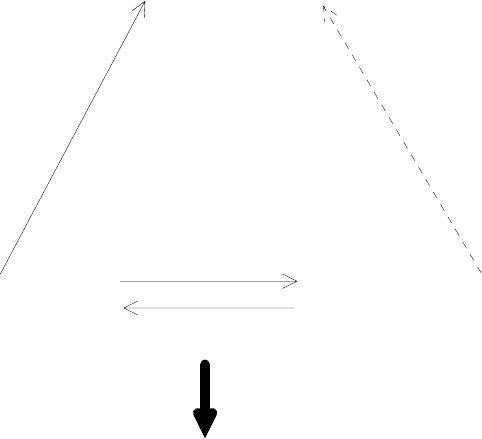
The important role that Monte Carlo methods have to play in this sort of study is illustrated
in Figure 1.2. Basic science attempts to understand the basic working mechanisms of a phe-
nomenon. The “theory” is a set of assumptions (with perhaps a mathematical formulation
of these assumptions) that can by a measured in an “experiment”. Ideally, the connection
between theory and experiment is direct so that the interpretation of the experiment in
unambiguous. This happens when the mathematical description of the microscopic interac-
tions and the macroscopic measurement involves no further approximation. When this is not
3
EXPERIMENT
THEORY
MONTE CARLO
Basic Science
Basic understanding
assumptions
verification
verification
small correction
assumptions
Figure 1.2: The role of Monte Carlo methods in basic science.
possible, as in the example of Figure 1.1 where two people can not occupy the same seat, a
Monte Carlo simulation enters the picture in a useful way and can serve a two-fold purpose.
It can either provide a small correction to an otherwise useful theory or it can be employed
directly to verify or disprove the theory of microscopic interactions.
In some cases, the microscopic interactions are well-known as in the electromagnetic in-
teractions of high-energy electrons and photons and verified by experiment. Monte Carlo
techniques in this field are useful for predicting the trajectories of high-energy particles
through detectors and other complex assemblies of materials. As an example, consider the
experiment by MacPherson, Ross and Rogers [MRR95, MRR96] to measure the stopping
power of electrons. The stopping power is the differential amount of energy, dE deposited
in a differential pathlength dx through some material. Stopping power is a function of the
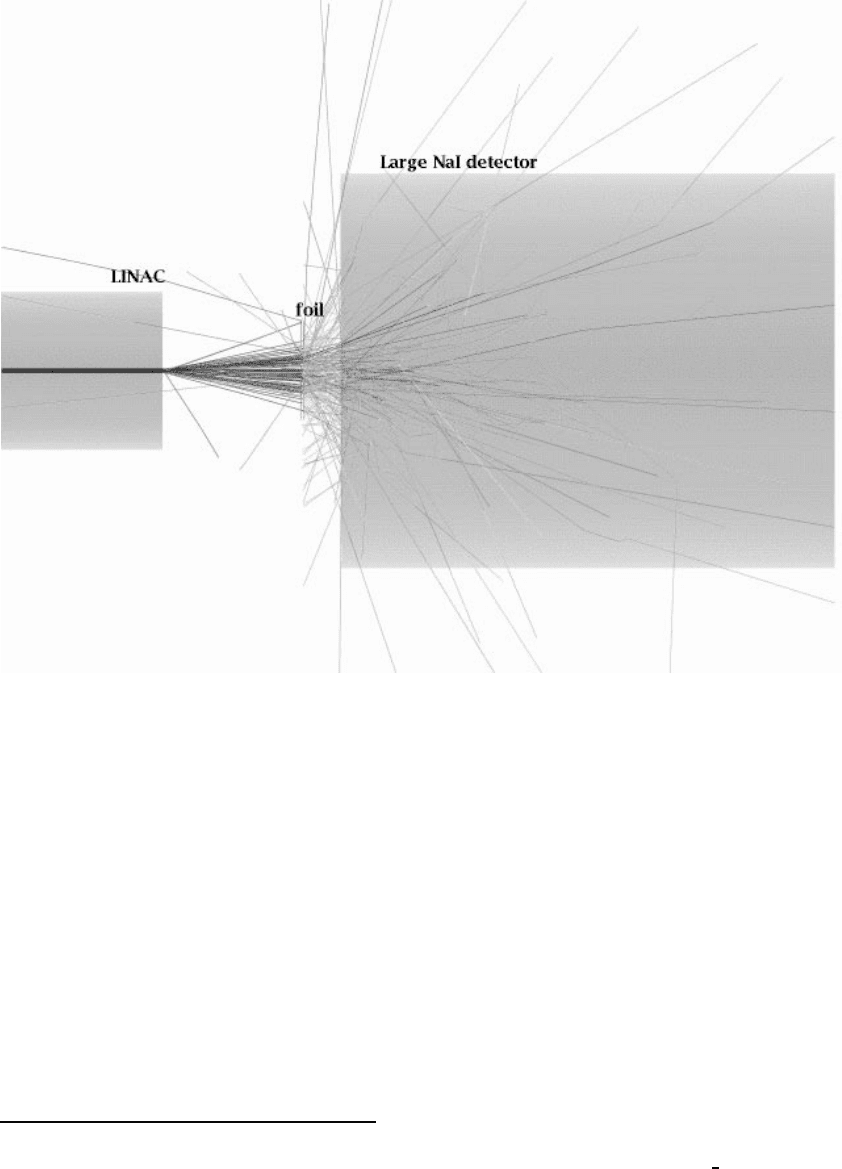
electron energy and the material. The experimental set-up is depicted in Figure 1.3.
Nearly-monoenergetic electrons from a linear accelerator (LINAC) are first scattered in the
forward direction by the thin exit window of the LINAC (this produces negligible energy
loss). The energy of the electrons are this point is known from a separate experiment.
The electron pass through a “thin” foil and are collected in a large NaI detector. The NaI
detector completely absorbs the electrons (except the occasional one that is backscattered)
although the bremsstrahlung photons produced in slowing down the electrons can escape.
4 CHAPTER 1. WHAT IS THE MONTE CARLO METHOD?
Figure 1.3: Experimental set-up of the MacPherson et al. stopping-power measurement.
The photon trajectories are represented by straight-line segments in the figure
2
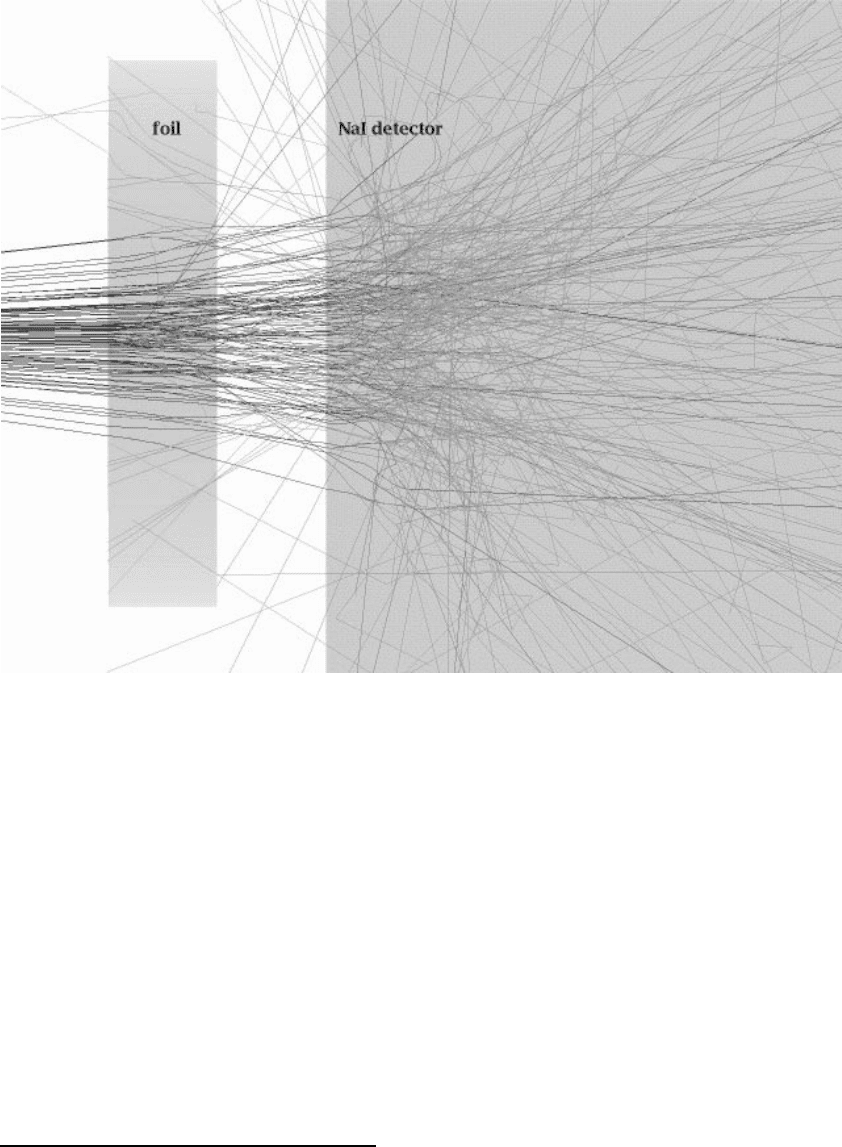
. A close-up
of the electron and photon trajectories in the foil is represented in Figure 1.4. In this case,
20 MeV electrons passed through a thin plastic foil.
We can note several features: 1) the electron trajectories through the foil are nearly straight
(there is little elastic scattering) although the angular distribution following the accelerator’s
exit window is evident, 2) some electrons backscatter from the foil and the NaI detector,
3) some bremsstrahlung, which is produced in either the foil or the NaI detector, escapes
detection, 4) some electrons scatter into large angles in the foil and escape detection. Since
the amount of energy lost in the foil is determined by how much energy is captured by the
NaI detector less the known input energy, items 2)–4) are corrections to the experiment that
can be determined by Monte Carlo methods and the skewness of the electron trajectories in
2
The trajectories depicted in Figure 1.3 and some subsequent ones were produced by the EGS4
code [NHR85, BHNR94] and the system for viewing the trajectories is called EGS Windows [BW91]. Color
renditions of this and subsequent figures make it easier to distinguish the particle species and color versions
maybeviewedonthewebathttp://www-ners.engin.umich.edu/info/bielajew/EWarchive.html.
5
Figure 1.4: A close up of the electron and photon trajectories in a thin foil in the MacPher-
son et al. stopping-power experiment.
the foil would have to be accounted for. However, these corrections are small in this case and
the Monte Carlo methods assist in the determination of the stopping power, a basic physics
parameter, and the scientific method outlined in Figure 1.2 still applies
3
.
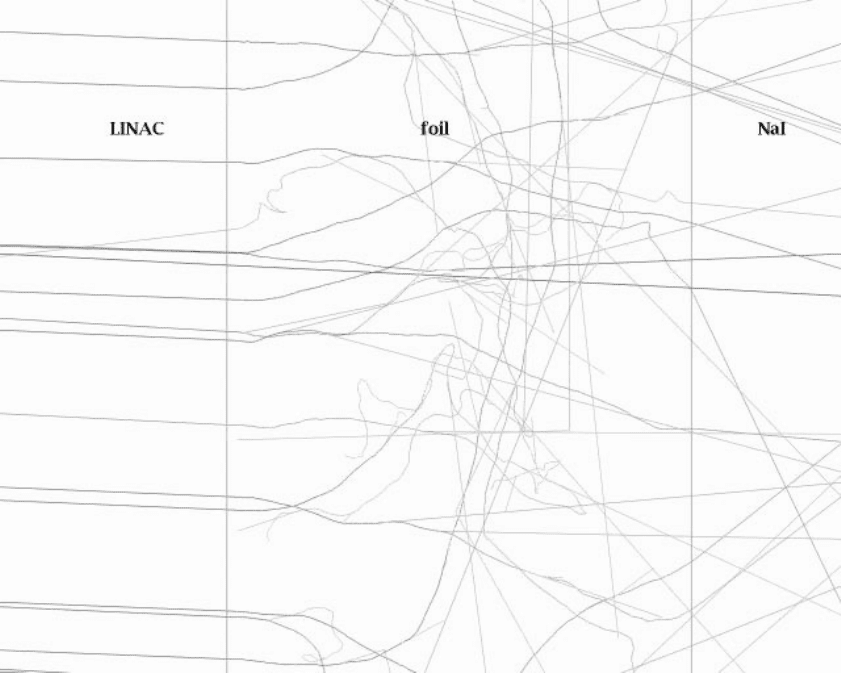
If one makes the foil thicker and/or reduces the energy, the electron trajectories become
considerably more complicated. A close up of a tungsten foil irradiated by 10 MeV elec-
trons in the same experiment is depicted in Figure 1.5. The electrons develop very curved
trajectories owing to multiple Coulomb elastic scattering. Indeed, some of them even stop
in the foil! Since the corrections in this case would be large (The dx in the stopping power
is a measure of the electron pathlength, not the thickness of the foil.) and to some extent
circular, this measurement is not useful as a determination of the stopping power. However,
this does not mean that the energy deposition in the thick foil is not accurate! Assuming
3
There is some circular logic in using Monte Carlo calculations to assist in the determination of stopping
power since the Monte Carlo calculations itself relies upon knowledge of the stopping power. However, if the
foil is thin enough, the sensitivity to the assumed stopping power in the Monte Carlo calculations is minimal.
6 CHAPTER 1. WHAT IS THE MONTE CARLO METHOD?
Figure 1.5: A close up of the electron and photon trajectories in a thick foil in the MacPher-
son et al. stopping-power experiment.
we believe the accepted value of the stopping power, the energy deposited in the foil may
be predicted with accuracy. However, the calculated result depends in a complicated and
coupled way on all the physics of electron and photon transport.
This use of the Monte Carlo method is depicted in Figure 1.6. In this case, theory can
not provide a sufficiently precise and entire mathematical description of the microscopic
and macroscopic physics. Theory can, however, provide intuition for the design of the
measurement. Monte Carlo methods are an adjunct to this process as well, serving in the
analysis of the experiment and verifying or invalidating the design.
1.1. WHY IS MONTE CARLO? 7
EXPERIMENT
THEORY
MONTE CARLO
Applied Science
Practical results
intuition
intuition
analysis
verification
Figure 1.6: The role of Monte Carlo methods in applied science.
1.1 Why is Monte Carlo?
If Monte Carlo did not exist there would be strong motivation to invent it! As argued
previously, the products of both basic and applied science are dependent upon the trinity
of measurement, theory and Monte Carlo. Monte Carlo is often seen as a “competitor” to
other methods of macroscopic calculation, which we will call deterministic and/or analytic
methods. Although the proponents of either method sometimes approach a level of fanaticism
in their debates, a practitioner of science should first ask, “What do I want to accomplish?”
followed by “What is the most efficient way to do it?” Sometimes the correct answer will be
“Deterministic” and other times it will be “Monte Carlo”. The most successful scientist will
avail himself or herself of more than one avenue attack on a problem.
There are, however, two inescapable realities. The first is that macroscopic theory, particu-
larly transport theory, provides deep insight and allows one to develop sophisticated intuition
as to how macroscopic particle fields can be expected to behave. Monte Carlo can not com-
pete very well with this. In discovering the properties of macroscopic field behaviour, Monte
8 CHAPTER 1. WHAT IS THE MONTE CARLO METHOD?
Carloists operate very much like experimentalists. Without theory to provide guidance the
process of discovery is trial and error, guided perhaps, by some brilliant intuition.
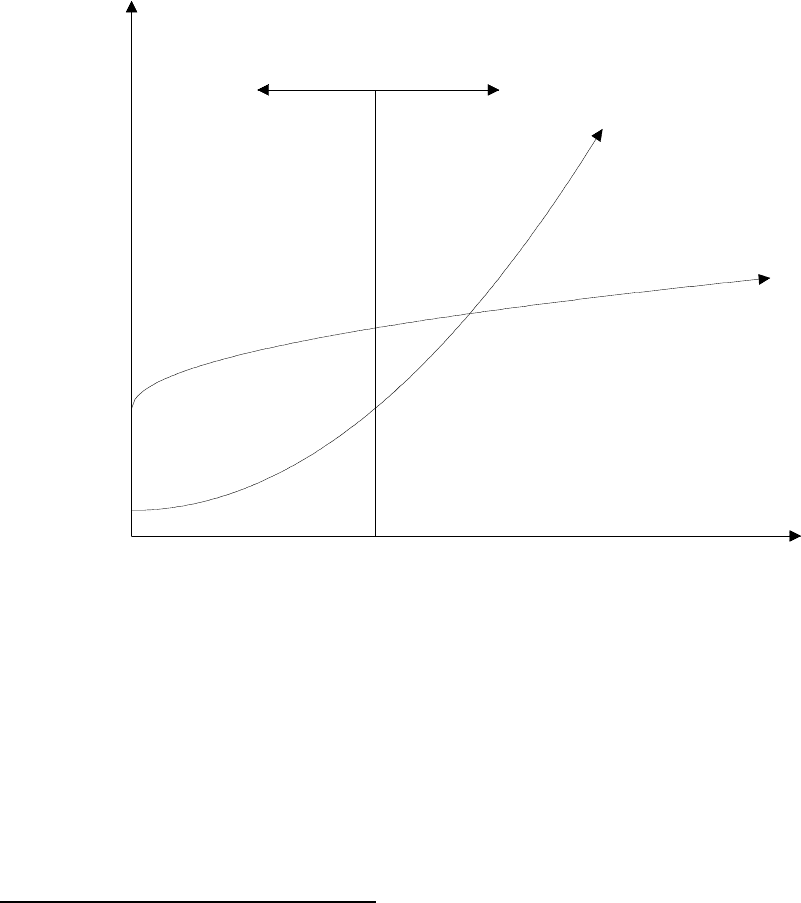
However, when it comes to complexity of a problem, however that is measured, Monte Carlo
techniques become advantageous as the complexity of a problem increases. Later in this
book, in section 11, a mathematical proof is given. This “idea” is expressed in Figure 1.7.
0.0 0.2 0.4 0.6 0.8
Complexity of problem (geometry)
0.0
0.2
0.4
0.6
0.8
1.0
1.2
1.4
1.6
1.8
2.0
2.2
2.4
2.6
2.8
3.0
3.2
3.4
3.6
3.8
Time to solution
Monte Carlo vs deterministic/analytic methods
Monte Carlo
Analytic/
Real life
Model problems
deterministic
Figure 1.7: Time to solution of Monte Carlo vs. deterministic/analytic approaches.
The other inescapable reality is that computers are getting faster and cheaper at an geometric
rate. This is known as Moore’s Law
4
.
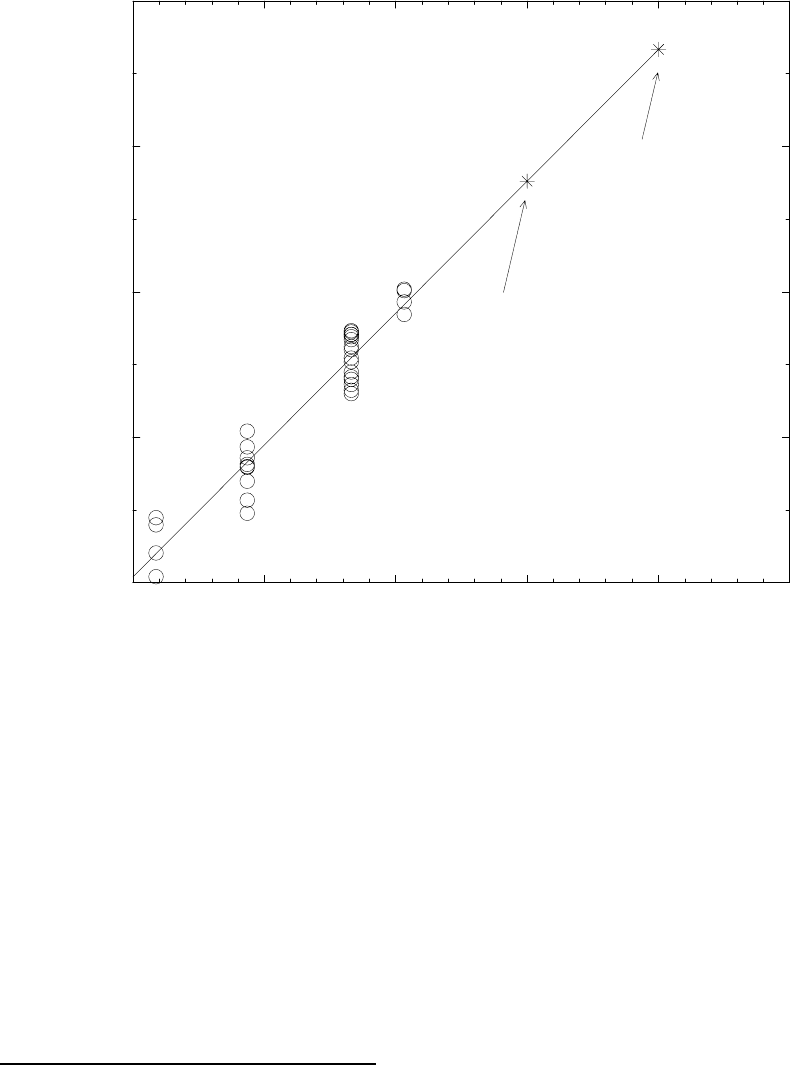
A demonstration of Moore’s Law for the radiotherapy application has been maintained for
about 10 years now, through a timing benchmark of the XYZDOS code [BR92, Bie95], a “user
4
Gordon E Moore (one of the co-founders of Intel) predicted in 1965 that the transistor density of semi-
conductor chips would double roughly every 12. This was based upon observation of silicon manufacturing
during the previous few years. Moore’s Law is not actually a law—it is a prediction based on the observation.
Computers doubled in speed/unit cost every 12 months from 1962–1970 and every 18 months thereafter.
1.1. WHY IS MONTE CARLO? 9
code” for the EGS4 Monte Carlo code system [NHR85, NBRH94, BHNR94]. The result for
Intel processors is shown in Figure 1.8.
1985 1990 1995 2000 2005 2010
year
0.0
1.0
2.0
3.0
4.0
log
10
speed
EGS4 radiotherapy benchmark results
Intel processors only
386
486
P5
P6
year 2000
speed = 580
year 2005
speed = 4600
Speed increase?
x 1.52 per year
P7?
P8?
Figure 1.8: An example of Moore’s “Law”.
The question as to when this geometric growth in computer speed will stop is a topic of some
hot debate. The increase in speed is achieved in two ways. As the technology advances,
computer circuits can be made smaller and smaller and it takes less time for signals to
move within a chip. Smaller size also allows chips to be placed closer together and interchip
communication times are proportionally less
5
. The problems associated with smaller size is
that heat becomes a problem. This is dealt with by driving these circuits at lower voltages
and by mounting these chips in elaborate heat-dissipating assemblies, sometimes with cooling
fans mounted directly on the assemblies. The other difficulty with small size is the “quantum
limit”. Circuit components can become so small that the state of a switch is no longer well-
defined (as in the classical case) and there is a probability that a switch, once thrown, could
5
There’s an old joke in computer circles that goes like this: ”Company XYZ’s computer manufacturing
business has become so successful that they are relocating into smaller premises!”
10 CHAPTER 1. WHAT IS THE MONTE CARLO METHOD?
spontaneously revert back causing undesirable effects. This is a more difficult problem that
we may see as soon as 2005 or earlier.
Another benefit of small size is that more circuitry can be packed into the same silicon real
estate and more sophisticated signal processing algorithms can be implemented. In addition,
the design of these algorithms is undergoing continuing research resulting in more efficient
processing per transistor. All these effects combine to give us the geometric growth we see
in computer speed per unit cost.
Other skeptics argue that market forces do not favor the development of faster, cheaper
computers. Historically, the development fast computing was based upon the need for it
from science, big industry and the military. The growth of the personal computer industry is
related to its appeal to the home market and its accessibility to small business. So successful
has the personal computer been that the mainframe computer industry has been squeezed
into niche markets. Some predict that eventually consumers, particularly the home markets,
will stop driving the demand so relentlessly. How fast does a home computer have to be? is
a typical statement heard from this perspective. However, applications usually grow to keep
up with new technologies, so perhaps this argument is not well-founded. “Keeping up with
the Joneses” is still a factor in the home market.
One trend that should not be ignored in this argument is the emergence of new tech-
nologies, like semi-optical (optical backplane computers) or completely optical computers.
The widespread introduction of this technology might cause computer speeds to exceed the
present-day geometric growth!
Another factor weighing in favor of Monte Carlo is that the Monte Carlo technique is one
based upon a minimum amount of data and a maximum amount of floating-point operation.
Deterministic calculations are often maximum data and minimal floating-point operation
procedures. Since impediments to data processing are often caused by communication bot-
tlenecks, either from the CPU to cache memory, cache memory to main memory or main
memory to large storage devices (typically disk), modern computer architecture favors the
Monte Carlo model which emphasizes iteration and minimizes data storage.
Although the concluding remarks of this section seem to favor the Monte Carlo approach, a
point made previously should be re-iterated. Analytic theory development and its realiza-
tions in terms of deterministic calculations are our only way of making theories regarding the
behaviour of macroscopic fields, and our only way of modelling particle fluences in a sym-
bolic way. Monte Carlo is simply another tool in the theoretician’s or the experimentalist’s
toolbox. The importance of analytic development must never be understated.