
Bielajew A.F. Fundamentals of the Monte Carlo method for neutral and charged particle transport
Подождите немного. Документ загружается.


Bibliography
[Chi78] A. B. Chilton. A note on the fluence concept. Health Physics, 34:715 – 716, 1978.
[Fel67] W. Feller. An introduction to probability theory and its applications, Volume I, 3rd
Edition. Wiley, New York, 1967.
[Khi29] A. Khintchine. In Comptes rendus de ’lAcad`e mie des Sciences, volume 189, pages
477 – 479. L’acad´emie des Sciences, Paris, 1929.
[KW86] M. H. Kalos and P. A. Whitlock. Monte Carlo methods, Volume I: Basics. John
Wiley and Sons, New York, 1986.
[Lin22] J. W. Lindeberg. Eine neue Herleitung des Exponentialgesetzes in der Wahrschein-
lichkeitrechnung. Mathematische Zeitschrift, 15:211 – 225, 1922.
Problems
Using a computer, operating system, computing language and compiler of your choice (tell
me what you used):
1. Write a code to sample the Cauchy probability distribution:
p(x)=
1
π
1
1+x
2
−∞<x<∞. (5.37)
As a function of the number of histories, N
h
, over the range 1 ≤ N
h
≤ 10, 000, plot x
and s
2
x
. Discuss.
2. Write a code to sample the small angle form of the Rutherfordian probability distri-
bution:
p(x)=
2x
(x
2
+1)
2
0 ≤ x<∞, (5.38)
As a function of the number of histories, N
h
, over the range 1 ≤ N
h
≤ 10, 000, plot x
and s
2
x
. Discuss.
61

62 BIBLIOGRAPHY
3. Write a code to sample the probability distribution:
p(x)=
4x
(x
2
+1)
3
0 ≤ x<∞, (5.39)
As a function of the number of histories, N
h
, over the range 1 ≤ N
h
≤ 10, 000, plot x
and s
2
x
. Discuss.
4. Write a code to sample the probability distribution:
p(x)=e
−x
0 ≤ x<∞, (5.40)
As a function of the number of histories, N
h
, over the range 1 ≤ N
h
≤ 10, 000, plot x
and s
2
x
. Discuss.
Chapter 6
Oddities: Random number and
precision problems
Now that we understand about random number generators, sampling and error estimation,
it is time for a brief respite to consider some of the oddities one might encounter during
Monte Carlo calculations. These oddities are related to artefacts associated with random
number generation and machine precision.
6.1 Random number artefacts
Consider the determination of the value of π one obtains by throwing random “darts” at a
circle inscribed within a square. This is depicted in Figure 6.1. The ratio of the number of
darts within the circle to the total number of darts within the square should be π/4.
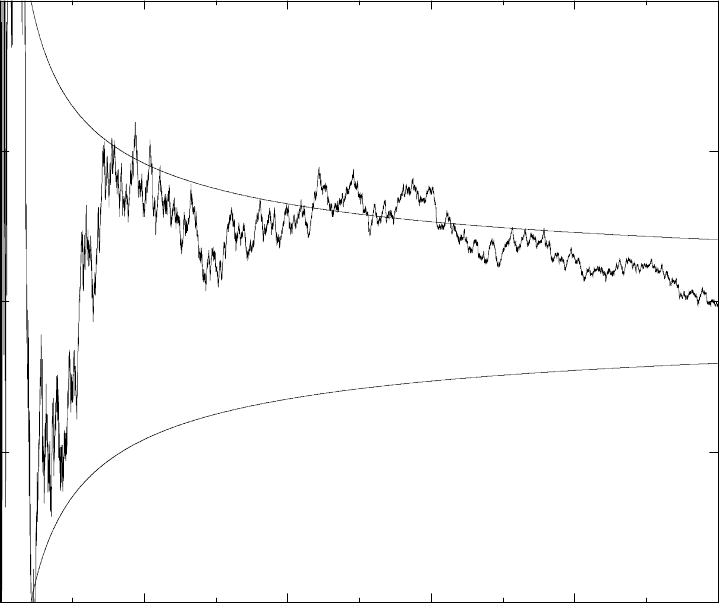
For a small number of iterations, the result converges as expected. This is shown in Figure 6.2
where the ratio 4N
in
/(Nπ) is plotted up to 10
4
cycles along with the 1-σ error bars predicted
by the “binary statistics” method. The estimated mean goes over and under the theoretical
prediction, takes an excursion in the overprediction direction and eventually begins to settle
down.
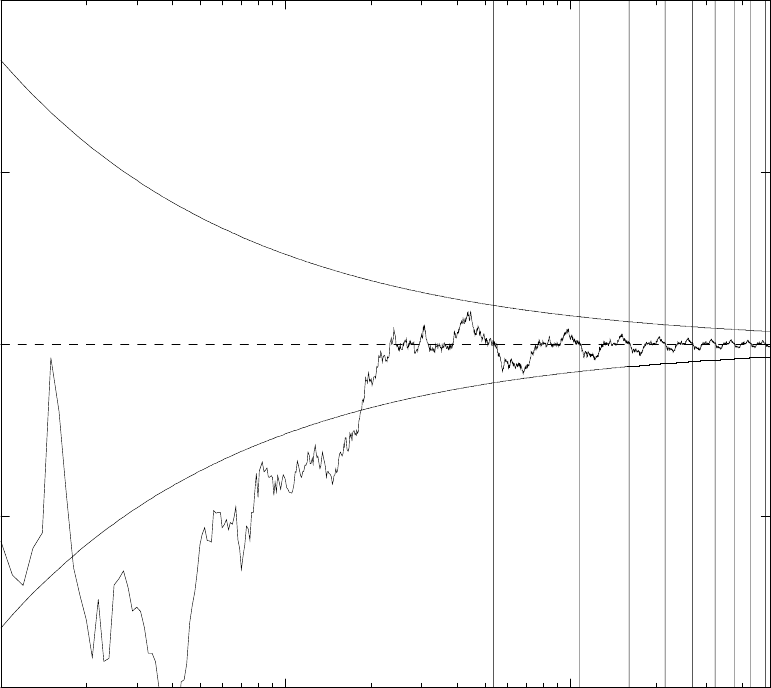
However, some difficulties are evident for large cycles as shown in Figures 6.3. and 6.4
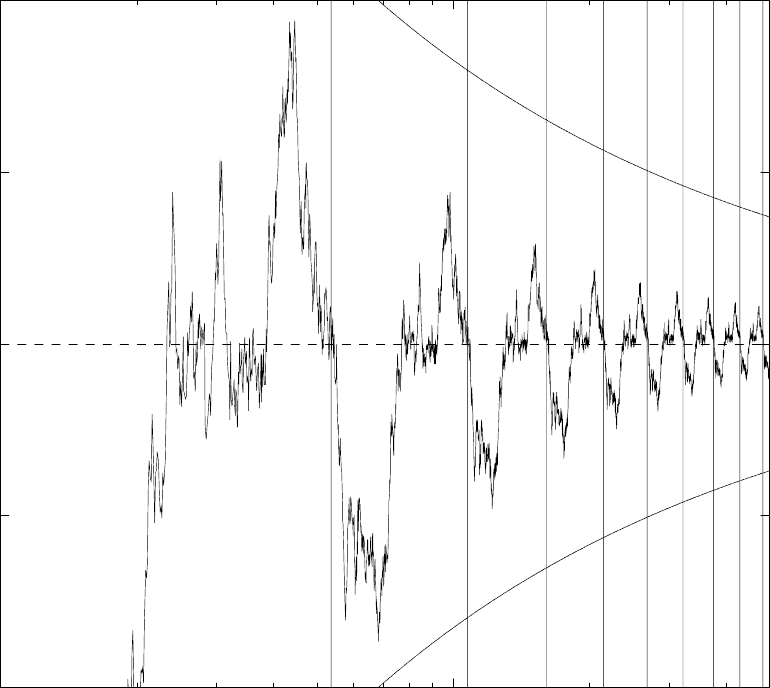
There are some classic signals indicated in Figure 6.3 that the random number generator
is cycling. The first piece of evidence is that the result exhibits a periodic structure. The
random number generator employed in this study is a multiplicative congruential random
number generator (MCRNG) with a sequence length of 2
30
=1, 073, 741, 824. Since two ran-
dom numbers are employed, the periodic structure occurs over a period of 2
29
= 536, 870, 912.
Another curious anomaly is that the result is close to unity (actually to within a few parts
63

64 CHAPTER 6. ODDITIES: RANDOM NUMBER AND PRECISION PROBLEMS
Determination of π
by throwing darts at an inscribed circle
Figure 6.1: Random darts are thrown at a square with an inscribed circle. The ratio of the
number of darts within the circle to the total number of darts within the square should be
π/4.
6.1. RANDOM NUMBER ARTEFACTS 65
0 2000 4000 6000 8000 10000
number of cycles
0.98
0.99
1.00
1.01
1.02
Monte Carlo/theory
Monte Carlo determination of π
Figure 6.2: Random darts are thrown at a square with an inscribed circle. The Monte Carlo
prediction divided by the theoretical prediction with the associated 1 ±σ prediction.
66 CHAPTER 6. ODDITIES: RANDOM NUMBER AND PRECISION PROBLEMS
10
7
10
8
10
9
number of cycles
0.99980
0.99990
1.00000
1.00010
1.00020
Mont Carlo/theory
Determination of π
trouble for large N
Figure 6.3: Random darts are thrown at a square with an inscribed circle. Large cycle
behaviour of the Monte Carlo π experiment. The vertical lines are drawn where the random
number generator begins a new cycle.
6.1. RANDOM NUMBER ARTEFACTS 67
10
8
10
9
number of cycles
0.99998
0.99999
1.00000
1.00001
1.00002
Mont Carlo/theory
Determination of π
trouble for large N
Figure 6.4: A zoom-in on the large cycle behaviour of previous figure.

68 CHAPTER 6. ODDITIES: RANDOM NUMBER AND PRECISION PROBLEMS
in 10
7
) at the point where the cycle restarts
1
. As a result, the calculated value appears to
be well below the 1σ bounds predicted by the Central Limit theorem in the range shown.
These are all strong signals that the random number has been “looped”. It is never wise
to use more than a fraction, say 1/10
th
of the sequence. Note that the latter half of the
sequence anti-correlates with the first half. This could lead to spurious results if a sequence
is exhausted.
It is also false to conclude: “Despite the periodic structure, the result converges to the correct
answer.” Wrong! We just happened to be lucky in this case! The result converged to about
1+5×10
−7
after one complete cycle, nearly the correct answer but not the correct answer.
The “error term” after one cycle just happens to be very small for this application. If we ran
this application for about 12 ×10
9
cycles, we would note a “false convergence” to 1+5×10
−7
whereas the 1σ bounds would be smaller and converging on unity.
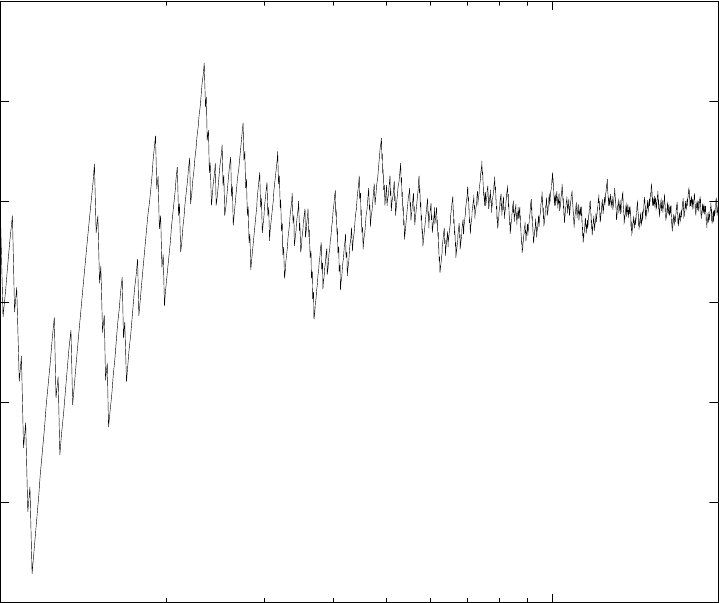
An example of “false convergence” is given in Figure 6.5 which is the same example except
that a large number of random numbers were thrown away after each sample of π,asif
to simulate many random numbers being employed in a different aspect of a calculation.
Although the example is somewhat extreme, it depicts clearly an anomalous result that will
never converge to the correct answer.
The object of this lesson is to warn against using random number generators beyond a
fraction of their sequence length.
The signals that you have cycled the random number generator are:
• The tally exhibits a period structure.
• The tally converges in a way that is contrary to Central Limit predictions, assuming
that the second moment of the tally exists.
• The presence of false convergence, which may be very difficult to detect.
1
This is due to 2D space being nearly uniformly filled by this MCRNG.
6.1. RANDOM NUMBER ARTEFACTS 69
100 1000
Number of Histories
0.98
0.99
1.00
1.01
1.02
1.03
1.04
Monte Carlo/Theory
Example of false convergence
Figure 6.5: An example of false convergence.
70 CHAPTER 6. ODDITIES: RANDOM NUMBER AND PRECISION PROBLEMS
6.2 Accumulation errors
Consider the summation:
s =
N
X
i=1
(1/N ) . (6.1)
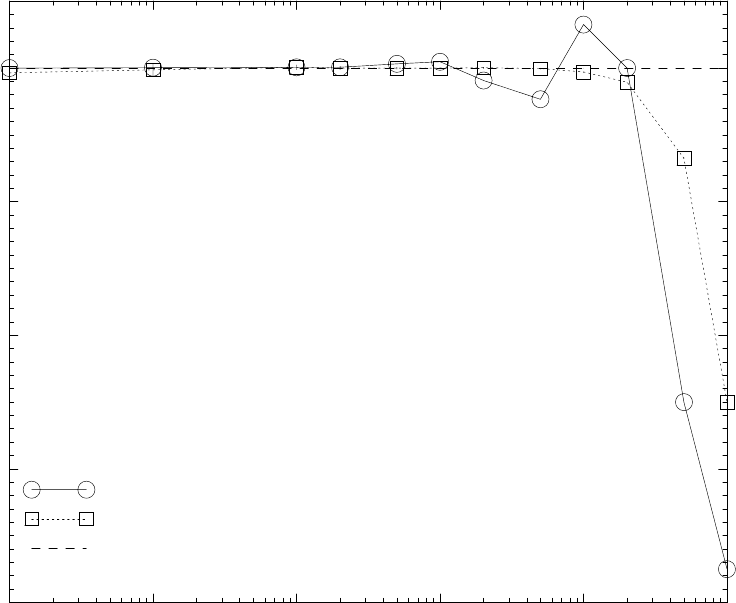
Of course, mathematically the result is s ≡ 1. Numerically, however, it is a different story.
The result of s vs. N is give in Figure 6.6.
10
3
10
4
10
5
10
6
10
7
10
8
N (number of iterations)
0.20
0.40
0.60
0.80
1.00
s (sum, should be 1)
single: s = s + Σ
i
(1/N)
single: s = s + Σ
i
ξ
i
(1/N) (ξ
i
is a random number 0<ξ<2 )
double: s = s + Σ
i
(1/N)
Figure 6.6: An example of constant and random accumulation errors in single-precision
arithmetic.
We note that an accumumulation error is seen starting from about 10
6
iterations when the