
Bielajew A.F. Fundamentals of the Monte Carlo method for neutral and charged particle transport
Подождите немного. Документ загружается.

4.2. REJECTION METHOD 41
−1.2
0.0
ab
0
p(x
max
)
p(x)
x
max
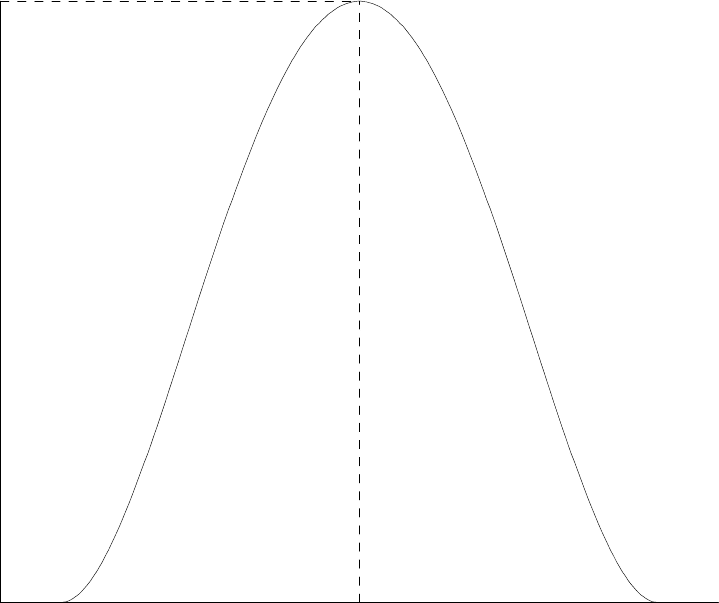
Figure 4.4: A typical probability distribution.
42 CHAPTER 4. SAMPLING THEORY
−1.2
0.0
a
b
0
1
f(x) = p(x)/p(x
max
)
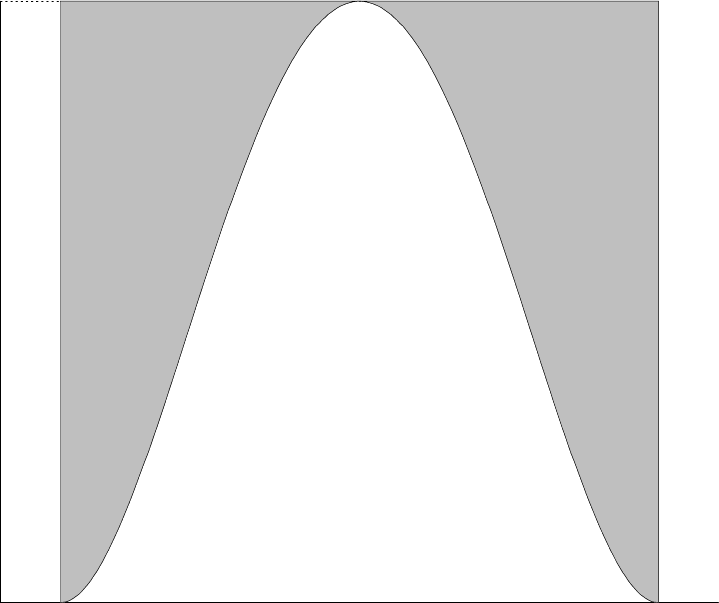
Figure 4.5: The probability distribution of Figure 4.4 scaled for the rejection technique.
4.3. MIXED METHODS 43
This method will result in x being selected according to the probability distribution func-
tion. Some consider this method “crude” because random numbers are “wasted” unlike the
invertible cumulative probability distribution function method. It is particularly wasteful for
“spiky” probability distribution functions. However, it can save computing time if the c()
−1
is very complicated. One has to “waste” many random numbers to use as much computing
time as in the evaluation of a transcendental function!
4.3 Mixed methods
As a final topic in elementary sampling theory we consider the “mixed method”, a combi-
nation of the previous two methods.
Imagine that the probability distribution function is too difficult to integrate and invert,
ruling out the direct approach without a great deal of numerical analysis, and that it is
“spiky”, rendering the rejection method inefficient. (Many probability distributions have
this objectionable character.) However, imagine that the probability distribution function
can be factored as follows:
p(x)=f(x)g(x) (4.9)
where f(x) is an invertible function that contains most of the “spikiness”, and g(x)isrela-
tively flat but contains most of the mathematical complexity. The recipe is as follows:
1. Normalise f(x) producing
˜
f(x) such that
R
b
a
dx
˜
f(x)=1.
2. Normalise g(x) producing ˜g(x) such that ˜g(x) ≤ 1 ∀ x ∈ [a, b].
3. Using the direct method described previously, choose an x using
˜
f(x) as the probability
distribution function.
4. Using this x, apply the rejection technique using ˜g(x). That is, choose a random
number, r, uniformly in the range [0, 1]. If ˜g(x) ≤ r, accept x, otherwise go back to
step 3.
Remarks:
With some effort, any mathematically complex, spiky function can be factored in this man-
ner. The art boils down to the appropriate choice of
˜
f(x)thatleavesa˜g(x)thatisnearly
flat. For two recent examples of this method as applied to a production-level code, see
References [BR86] and [BMC89].
The mixed method is also tantamount to a change in variables. Let
p(x)dx = f(x)g(x)dx =(
˜
f(x)dx)
Z
b
a
dxf(x)
!
g(x) , (4.10)

44 CHAPTER 4. SAMPLING THEORY
where
˜
f(x) is now a properly normalized probability distribution function. Employing
˜
f(x)
as the function for the direct part, we let
u = c(x)=
Z
x
a
˜
f(x
0
)dx
0
, (4.11)
be a transformation between x and u. Note the limits of u,0≤ u ≤
R
b
a
˜
f(x
0
)dx
0
=1. By
definition, the inverse exists so that x = c
−1
(u). As well du = f(x)dx. Thus, we can rewrite
Equation 4.10 as:
p(x)dx =
Z
b
a
dxf(x)
!
g(u)du, (4.12)
which eliminates f(x) through a change in variables. Thus, one can sample g(u)using
rejection (or some other technique) and relate the selected u to x through the inverse relation
x = c
−1
(u).
If the rejection technique is employed for g(x), then the efficiency of is calculated in the same
way as in Equation 4.8.
4.4 Examples of sampling techniques
4.4.1 Circularly collimated parallel beam
The normalised probability distribution in this case is:
p(ρ, φ)dρ dφ =
1
πρ
2
0
ρ dρ dφ 0 ≤ ρ ≤ ρ
0
0 ≤ φ ≤ 2π (4.13)
where ρ is the cylindrical radius, ρ
0
is the collimation radius and φ is the azimuthal an-
gle. ρdρdφ is a differential surface element in cylindrical coordinates. This is a separable
probability distribution of the form:
p(ρ, φ)dρ dφ =dp
1
(ρ)dp
2
(φ) (4.14)
where:
p
1
(ρ)dρ =
2
ρ
2
0
ρ dρ 0 ≤ ρ ≤ ρ
0
(4.15)
and
p
2
(φ)dφ =
1
2π
dφ 0 ≤ φ ≤ 2π (4.16)
4.4. EXAMPLES OF SAMPLING TECHNIQUES 45
Direct method
The cumulative probability distribution functions in this case are:
c
1
(ρ)=
2
ρ
2
0
Z
ρ
0
dρ
0
ρ
0
=
ρ
2
ρ
2
0
(4.17)
c
2
(φ)=c
2
(φ)=
1
2π
Z
φ
0
dφ
0
=
φ
2π
(4.18)
Inverting gives:
ρ = ρ
0
√
r
1
(4.19)
φ =2πr
2
(4.20)
where the r
i
are random numbers on the range [0, 1].
The code segment that would produce accomplish this looks like:
rho = rho_0 * sqrt(rng())
phi = 2e0 * pi * rng()
x = rho * cos(phi)
y = rho * sin(phi)
where rng() is a function that return a random number uniformly on the range [0, 1] [or
(0, 1] or [0, 1) or (0, 1)].
Rejection method
In this technique, a point is chosen randomly within the square −1 ≤ x ≤ 1; −1 ≤ y ≤ 1. If
this point lies within a circle with unit radius the point is accepted and the x and y values
scaled by the collimation radius, ρ
0
. The code segment that would accomplish this looks
like:
1 x = 2e0 * rng() - 1e0
y = 2e0 * rng() - 1e0
IF (x**2 + y**2 .gt. 1e0) goto 1
x = rho_0 * x
y = rho_0 * y

46 CHAPTER 4. SAMPLING THEORY
Which is better?
Actually, both methods are equivalent mathematically. However, one or the other may have
advantages in execution speed depending on other factors in the application. If the geometry
is not cylindrically symmetric or all the scoring that is done does not make use of the inherent
cylindrical symmetry, then the rejection method is about twice as fast as the direct method
because the trigonometric functions are not employed in the rejection method.
If the geometry is cylindrically symmetric and the scoring takes advantage of this symmetry,
then the direct method is about 2–3 times faster because symmetry reduces the calculation
to:
x = rho_0 * sqrt(rng())
y=0
Many computers now have hardware square root capabilities. With this capability the direct
method may be advantageous, whether or not one makes use of the cylindrical symmetry.
4.4.2 Point source collimated to a planar circle
The normalised probability distribution in this case is:
p(θ, φ)dθdφ =
dφ
2π
sin θ dθ
1 − cos θ
0
0 ≤ θ ≤ θ
0
0 ≤ φ ≤ 2π (4.21)
where θ is the polar angle and φ is the azimuthal angle. sin θ dθ dφ is a differential solid
angle element in spherical coordinates. θ
0
is the collimation angle. In terms of the distance
to the collimation plane z
0
and the diameter of the collimation circle on this plane ρ
0
,
cos θ
0
= z
0
/
q
z
2
0
+ ρ
2
0
.
This is a separable probability distribution of the form:
p(θ, φ)dθdφ = p
1
(θ)dθp
2
(φ)dφ (4.22)
where:
p
1
(θ)dθ =
sin θdθ
1 − cos θ
0
0 ≤ θ ≤ θ
0
(4.23)
and
p
2
(φ)dφ =
1
2π
dφ 0 ≤ φ ≤ 2π (4.24)
The cumulative probability distribution functions in this case are:
c
1
(θ)=
1
1 − cos θ
0
Z
θ
0
sin θ
0
dθ
0
=
1 − cos θ
1 − cos θ
0
(4.25)

4.4. EXAMPLES OF SAMPLING TECHNIQUES 47
c
2
(φ)=c
2
(φ)=
1
2π
Z
φ
0
dφ
0
=
φ
2π
(4.26)
Inverting gives:
cos θ =1−r
1
[1 − cos θ
0
] (4.27)
φ =2πr
2
(4.28)
where the r
i
are random numbers on the range [0, 1].
The code segment that would accomplish this looks like:
cos_theta = 1e0 - rng() * (1e0 - cos_theta_0)
theta = acos(theta)
sin_theta = sin(theta)
phi = 2e0 * pi * rng()
u = sin_theta * cos(phi) ! u is sin(theta)*cos(phi),
! the x-axis direction cosine
v = sin_theta * sin(phi) ! v is sin(theta)*sin(phi),
! the y-axis direction cosine
w = cos_theta ! w is cos(theta),
! the z-axis direction cosine
x = z_0 * u/w ! x = z_0 * tan(theta)*cos(phi)
y = z_0 * v/w ! y = z_0 * tan(theta)*sin(phi)
In terms of the cylindrical coordinates on the collimation plane, Equation 4.27 becomes:
z
0
q
ρ
2
+ z
2
0
=1− r
1
1 −
z
0
q
ρ
2
0
+ z
2
0
(4.29)
which yields a value for ρ on the collimation plane.
In the small angle limit, θ
0
−→ 0, the circularly collimated parallel beam result should be
recovered. If one employs the small angle approximation, ρ z
0
and ρ
0
z
0
, Equation 4.29
obtains the result of Equation 4.19, i.e. ρ = ρ
0
√
r
1
.
4.4.3 Mixed method example
Consider the probability function:
p(x)dx = Ne
−x
2
2xdx
(1 + x
2
)
2
0 ≤ x<∞ , (4.30)

48 CHAPTER 4. SAMPLING THEORY
where N is the normalization factor such that
R
∞
0
p(x)dx = 1. Although p(x)isintegrable
analytically
2
, it can not be inverted analytically. Therefore, we consider the ”spiky” part
that we can integrate analytically:
f(x)dx =
2xdx
(1 + x
2
)
2
dx 0 ≤ x<∞ , (4.32)
which can be integrated directly,
r = c(x)=1−
1
1+x
2
, (4.33)
and inverted,
x =
s
r
1 − r
. (4.34)
This is equivalent to a the change of variables,
u =1−
1
1+x
2
x =
s
u
1 − u
, (4.35)
and we must now sample,
g(x)dx =exp
−
u
1 − u
du 0 ≤ u ≤ 1 . (4.36)
If we apply rejection to g(x) directly, it can be shown that the “efficiency”, =0.404.
Interestingly enough, we can choose to do this example the other way! We can choose as our
direct function:
f(x)dx =2xe
−x
2
dx 0 ≤ x<∞ , (4.37)
which can be integrated directly,
r = c(x)=1− e
−x
2
, (4.38)
and inverted,
x =
q
−log(1 − r) . (4.39)
2
The cumulative probability function can be written
c(x)=1−
e
−x
2
+ e
1+x
2
Ei(−1 − x
2
)
(1 + x
2
)(1+eEi(−1))
(4.31)
where Ei(z) is the exponential integral [AS64].

4.4. EXAMPLES OF SAMPLING TECHNIQUES 49
This is equivalent to a the change of variables,
u =1− e
−x
2
x =
q
−log(1 − u) , (4.40)
and we must now sample,
g(x)dx =
1
[1 − log(1 − u)]
2
du
0 ≤ u ≤ 1 . (4.41)
This approach has the same efficiency as the previous approach. However, it is more costly
because is involves the use of more transcendental functions.
4.4.4 Multi-dimensional example
Consider the joint probability function:
p(x, y)dx dy =(x + y)dx dy 0 ≤ x, y ≤ 1 . (4.42)
The marginal probability in x is:
m(x)=
Z
1
0
dy (x + y)=x +
1
2
, (4.43)
the conditional probability of y given x is:
p(y|x)=
p(x, y)
m(x)
=
x + y
x +
1
2
, (4.44)
so that
p(x, y)=m(x)p(y|x) . (4.45)
First we sample the marginal probability distribution in x. The cumulative distribution
function and its associated random number map is:
r
1
= c(x)=
Z
x
0
dx
0
x
0
+
1
2
=
x
2
2
+
x
2
, (4.46)
which is a quadratic relation that can be inverted to give:
x =
−1+
√
1+8r
1
2
. (4.47)
The choice of the plus sign in the inversion of the quadratic relation was made based on the
having x =0whenr
1
= 0 and x =1whenr
1
=1.

50 CHAPTER 4. SAMPLING THEORY
Now that x is determined, we form the conditional cumulative probability distribution,
c(y|x), and its associated random number mapping:
r
2
= c(y|x)=
Z
y
0
dyp(y|x)=
y
2
+2xy
2x +1
, (4.48)
which itself can be inverted using quadratic inversion:
y = −x +
q
x
2
+ r
2
(2x +1), (4.49)
which again involved a choice of sign based upon the expected limits, y =0whenr
2
=0
and y =1whenr
2
= 1. For intermediate values of r
2
, y depends upon the choice of x.