
Bielajew A.F. Fundamentals of the Monte Carlo method for neutral and charged particle transport
Подождите немного. Документ загружается.

3.2. LONG SEQUENCE RANDOM NUMBER GENERATORS 31
C
C Declarations:
C =============
C These variables, 100 floating point numbers and 2 integers define the
C "state" of the RNG at any point
real u(97), c, cd, cm
integer ixx, jxx
C
C Initialisation:
C ===============
if((ixx.le.0).or.(ixx.gt.31328)) ixx = 1802 ! Sets Marsaglia default
if((jxx.le.0).or.(jxx.gt.30081)) jxx = 9373 ! Sets Marsaglia default
i = mod(ixx/177,177) + 2
j = mod(ixx, 177) + 2
k = mod(jxx/169,178) + 1
l = mod(jxx, 169)
do ii = 1,97
s = 0.0
t = 0.5
do jj = 1,24
m = mod(mod(i*j,179)*k,179)
i=j
j=k
k=m
l = mod(53*l + 1,169)
if(mod(l*m,64).ge.32) s = s + t
t = 0.5*t
end do
u(ii) = s
end do
c = 362436./16777216.
cd = 7654321./16777216.
cm = 16777213./16777216.
ixx = 97
jxx = 33
C
32 CHAPTER 3. RANDOM NUMBER GENERATION
C Iteration:
C ==========
rng = u(ixx) - u(jxx)
if (rng.lt.0.) rng = rng + 1.
u(ixx) = rng
ixx = ixx - 1
if(ixx.eq.0) ixx = 97
jxx = jxx - 1
if(jxx.eq.0) jxx = 97
c=c-cd
if (c.lt.0.) c = c + cm
rng = rng - c
if (rng.lt.0.) rng = rng + 1.
Although the initialization scheme is quite involved, it only has to be done once. The “state”
of the random number generator at any time is defined by the 100 floating point numbers,
u(97), c, cd, cm and the array indices ixx, jxx which are employed as pointers into the
u() array. ixx, jxx also serve a double role as initializing seeds. The sequence length is 2
144
(about 2 × 10
43
), long enough for any practical calculation. A few years ago the prevailing
opinion was that a a unique set of the two starting seeds such that 0 < ixx ≤ 31328 and
0 < jxx ≤ 30081 would produce an independent random sequence. In view of the work by
Tezuka, l’Ecuyer and Couture this information must be regarded with some suspicion. In
fact, now provides 100 seedings for their version of the “subtract-with-borrow” algorithm
with a guaranteed subsequence length of at least 2 × 10
9
(before running into the sequence
from another seeding).
At least for this course, existing RNG’s will suffice. For the purpose of large-scale, multi-
dimensional, massively parallel applications, it appears that there is still fundamental work
to be done.
Bibliography
[Bie86] A. F. Bielajew. RNG64 - A 64-bit random number generator for use on a VAX
computer. National Research Council of Canada Report PIRS-0049, 1986.
[Cl96] R. Couture and P. l’Ecuyer. Orbits and lattices for linear random number gener-
ators with composite moduli. Mathematics of Computation, 65:189 – 201, 1996.
[Ehr81] J. R. Ehrman. The care and feeding of random numbers. SLAC VM Notebook,
Module 18, SLAC Computing Services, 1981.
[Jam88] F. James. A review of pseudorandom number generators. CERN-Data Handling
Division, Report DD/88/22, 1988.
[Jam94] F. James. RANLUX: A FORTRAN implementation of the high-quality pseudo-
random number generator of L¨uscher. Computer Physics Communications, 79:111
– 114, 1994.
[Knu81] D. E. Knuth. Seminumerical algorithms, volume II of The art of computer pro-
gramming. Addison Wesley, Reading Mass., 1981.
[Knu97] D. E. Knuth. Seminumerical algorithms, volume II of The art of computer pro-
gramming. Addison Wesley, Reading Mass., 1997.
[L
¨
94] M. L¨uscher. A portable high-quality random number generator for lattice field
theory simulations. Computer Physics Communications, 79:100 – 110, 1994.
[Mar68] G. Marsaglia. Random numbers fall mainly in the planes. Nat. Acad. Sci., 61:25
– 28, 1968.
[MZ91] G. Marsaglia and A. Zaman. A new class of random number generators. Annals
of Applied Probability, 1:462 – 480, 1991.
[MZT90] G. Marsaglia, A. Zaman, and W. W. Tsang. Toward a universal random number
generator. Statistics and Probability Letters, 8:35 – 39, 1990.
[Tez94] S. Tezuka. A unified view of long-period random number generators. Journal of
the Operations Research Society of Japan, 37:211 – 227, 1994.
33
34 BIBLIOGRAPHY
[TlC93] S. Tezuka, P. l’Ecuyer, and R. Couture. On the lattice structure of the add-with-
carry and subtract-with-borrow random number generators. ACM Transactions
on Modeling and Computer Simulation, 3:315 – 331, 1993.
Problems
Using a computer, operating system, computing language and compiler of your choice (tell
me what you used), as long as it supports 32-bit 2’s complement integer arithmetic:
1. Assign or otherwise make an integer adopt the values 0, 1, 2, 2
31
− 2, 2
31
− 1, 2
31
,
-(2
31
− 2), -(2
31
− 1), -(2
31
) and have the computer output the integer values and the
floating-point representations after conversion r =0.5+i ∗ 0.23283064e − 09.
2. Write a computer code that simply performs the following:
:Initialisation: i = 987654321
:Iteration: i = i * 663608941
Verify that the sequence length is 2
30
by seeing that i returns to its original seed. How
much CPU time does it take to go through the whole sequence?

Chapter 4
Sampling Theory
Sir,
In your otherwise beautiful poem (The Vision of Sin) there is a verse which reads
“Every moment dies a man,
every moment one is born.”
Obviously, this cannot be true and I suggest that in the next edition you have
it read
“Every moment dies a man,
every moment 1
1
16
is born.”
Even this value is slightly in error but should be sufficiently accurate for poetry.
...Charles Babbage (in a letter to Lord Tennyson)
Now that we have tackled the essentials of elementary probability theory and random number
generation, it is now time to connect the two and demonstrate how random numbers may
be employed to sample from probability distributions.
We will consider three kinds of sampling techniques, the direct approach, the rejection tech-
nique and the mixed method that combines the two. Then, we we go through a small
catalogue of examples.
35
36 CHAPTER 4. SAMPLING THEORY
4.1 Invertible cumulative distribution functions (direct
method)
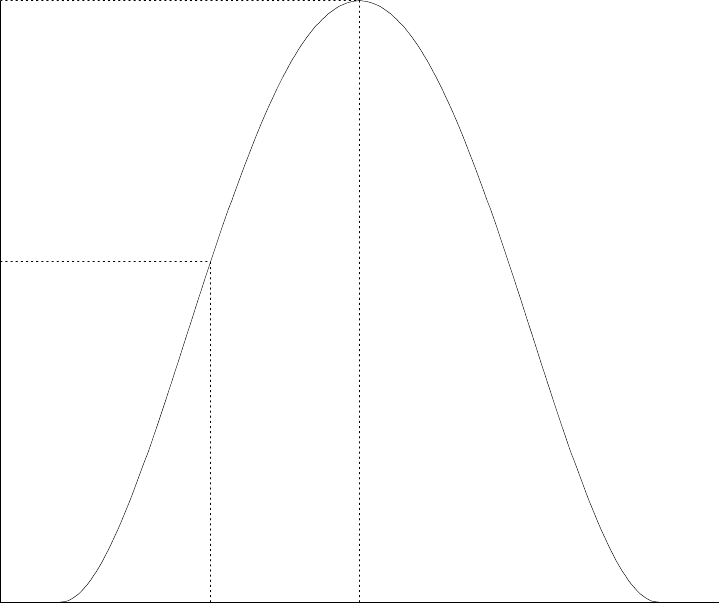
A typical probability distribution function is shown in Figure 4.1. It is defined over the range
−1.2
0.0
abx
1
x
2
0
p(x
2
)
p(x
1
)
p(x)
Figure 4.1: A typical probability distribution.
[a, b] where neither a nor b are necessarily finite. A probability distribution function must
have the properties that it is integrable (so that one can normalise it by integrating it over
its entire range) and that it is non-negative. (Negative probability distributions are difficult
to interpret.)
4.1. INVERTIBLE CUMULATIVE DISTRIBUTION FUNCTIONS (DIRECT METHOD)37
We now construct its cumulative probability distribution function:
c(x)=
Z
x
a
dx
0
p(x
0
) (4.1)
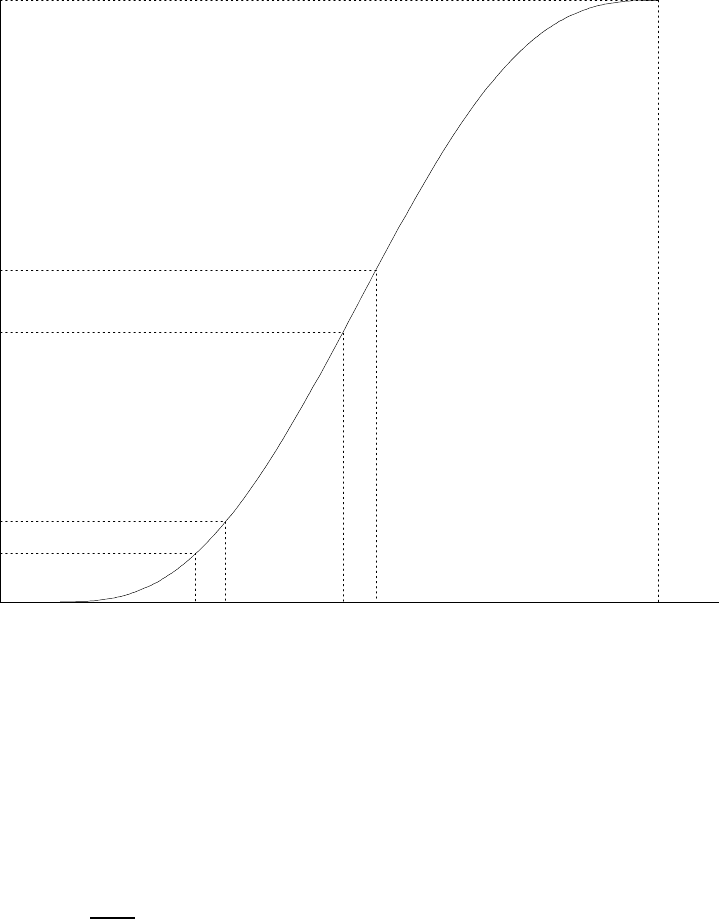
and assume that it is properly normalised, i.e. c(b) = 1. The corresponding cumulative
probability distribution function for our example is shown in Figure 4.2.
−1.2
0.0
ab
d
x
1
d
x
2
1
d
r
1
d
r
2
c(x)
Figure 4.2: The cumulative probability distribution obtained by integrating the probability
distribution function in Figure 4.1.
By its definition, we can map the cumulative probability distribution function onto the range
of random variables, r,where0≤ r ≤ 1andr is distributed uniformly. That is, r = c(x).

38 CHAPTER 4. SAMPLING THEORY
Now consider two equally spaced intervals dx
1
and dx
2
, differential elements in x in the
vicinity of x
1
and x
2
. Using some elementary calculus we see that:
dr
1
dr
2
=
(d/dx)c(x)|
x=x
1
(d/dx)c(x)|
x=x
2
=
p(x
1
)
p(x
2
)
. (4.2)
We can interpret this as meaning that, if we select many random variables in the range [0,1],
then the number that fall within dr
1
divided by the number that fall within dr
1
is equal
to the ratio of the probability distribution at x
1
to x
2
. (Recall the interpretation of the
probability distribution as given in Chapter 2.)
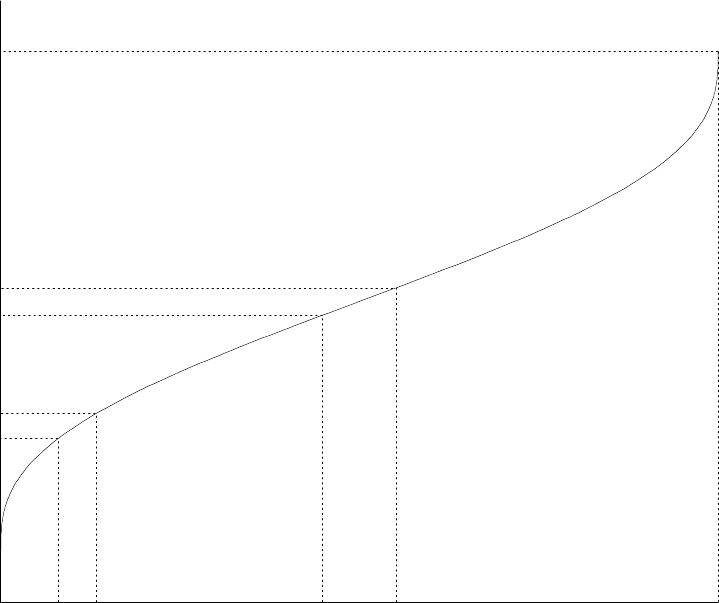
Having mapped the random numbers onto the cumulative probability distribution function,
we may invert the equation to give:
x = c
−1
(r) . (4.3)
All cumulative probability distribution functions that arise from properly defined probability
distribution functions are invertible, numerically if not analytically
1
.
Then, by choosing r’s randomly over a uniform distribution and substituting them in the
above equation, we generate x’s according to the proper probability distribution function.
Example:
As we will discuss in Chapter 8, the distance, z, to an interaction is governed by the well-
known probability distribution function:
p(z)dz = µe
−µz
dz, (4.4)
where µ is the interaction coefficient. The valid range of z is 0 ≤ z<∞ and this prob-
ability distribution function is already properly normalised. The corresponding cumulative
probability distribution function and its random number map is given by:
r = c(z)=1− e
−µz
. (4.5)
Inverting gives:
z = −
1
µ
log(1 − r) . (4.6)
If r is uniformly distributed over [0, 1] then so is 1 − r. An equivalent form of the above
equation (that saves one floating point operation) is:
z = −
1
µ
log(r) . (4.7)
1
However, there are subtleties. Sampling the probability distribution function is a differentiation process.
Thus, if a cumulative probability distribution function is constructed numerically, differentiation leads to
minor difficulties. For example, if a cumulative probability distribution function is represented by a set of
linear splines, differentiation will lead to a step-wise continuous probability distribution function.
4.1. INVERTIBLE CUMULATIVE DISTRIBUTION FUNCTIONS (DIRECT METHOD)39
0.0
−1.2
a
b
d
x
1
d
x
2
1
d
r
1
d
r
2
c
−1
(x)
Figure 4.3: The inverse cumulative probability distribution obtained by inverting the cumu-
lative probability distribution function in Figure 4.2.

40 CHAPTER 4. SAMPLING THEORY
This is exactly the form used to calculate a particle’s distance to an interaction in all Monte
Carlo codes. Recall, however, that if the random number generator provides an exact zero
as a possibility, the sampling implied by Equation 4.7 will cause a floating-point error. (It
is best to have a random number generator that does not provide exact zero’s unless you
really need them for something specific.)
4.2 Rejection method
While the invertible cumulative probability distribution function method is always possible,
at least in principle, it is often impractical to calculate c()
−1
because it may be exceedingly
complicated mathematically or contain mathematical structure that is difficult to control.
Another approach is to use the rejection method.
In recipe form, the procedure is this:
1. Scale the probability distribution function by its maximum value obtaining a new dis-
tribution function, f(x)=p(x)/p(x
max
), which has a maximum value of 1 which occurs
at x = x
max
(see Figures 4.4 and 4.5). Clearly, this method works only if the probabil-
ity distribution function is not infinite anywhere and if it is not prohibitively difficult
to determine the location of the maximum value. If it is not possible to determine the
maximum easily, then overestimating it will work as well, but less efficiently.
2. Choose a random number, r
1
, uniform in the range [0, 1] and use it to obtain an x
which is uniform in the probability distribution function’s range [a,b]. (To do this,
calculate x = a +(b − a)r
1
.) (Note: This method is restricted to finite values of a
and b. However, if either a or b are infinite a suitable transformation may be found to
allow one to work with a finite range. e.g. x ∈ [a, ∞)maybemappedintoy ∈ [0, 1)
via transformation x = a[1 − log(1 − y)].)
3. Choose a second random number r
2
.Ifr
2
<p(x)/p(x
max
) (region under p(x)/p(x
max
)
in Figure 4.5) then accept x, else, reject it (shaded region above p(x)/p(x
max
)inFig-
ure 4.5) and go back to step 2.
The efficiency of the rejection technique is defined as:
=
1
p(x
max
)
Z
b
a
dxp(x) . (4.8)
This is the ratio of the expected number of random numbers pairs that are accepted to the
total number of pairs employed.
Remarks: