
Coker A.K. Fortran Programs for Chemical Process Design, Analysis, and Simulation
Подождите немного. Документ загружается.

Mass Transfer 477
For binary mixtures of components 1 and 2, then
Yi -"
K l ( 1 - K 2 )
K~
- K 2
(7-31)
and
Y2 = 1.0- Yl (7-32)
These two equations can be used to calculate the composition of a binary
vapor that will begin to condense at a given temperature and pressure.
EQUILIBRIUM FLASH COMPUTATIONS
Flash vaporization calculations involving multicomponent mixtures
are essential to the design and successful operation of many processes.
These calculations are often required to determine the condition of the
feed to a fractionating column or to determine the flow of vapor from a
reboiler or condenser.
Flash calculations often involve trial-and-error solutions that are time
consuming, tedious, and subject to error if performed manually. Coker
[6] has developed an improved iterative convergence method first sug-
gested by Oliver [7] and later modified by Kostecke [8], for isothermal
equilibrium flash computations. Multicomponent flash (isothermal and
adiabatic) computations are incorporated as part of overall process simu-
lation and equipment design. However, single-stage flash fractionation
processes are also employed to obtain a separation of the light compo-
nents in a feed and as a preliminary step before a multicomponent frac-
tionation column, such as crude oil distillation. Table 7-1 lists ways of
producing two-phase mixtures from a single phase at appropriate con-
ditions. The last process in the table typifies the well head separation
that takes place in an oil field. It is known as a flash process because the
Table 7-1
Ways to Produce Two-Phase Mixture
Initial
Gas
Gas
Liquid
Liquid
Action to Produce Two-Phase Mixture
Cool, possibly after initial compression
Expand through a valve or an engine
Heat to achieve partial vaporization
Reduce pressure through a valve, if close to saturation
478
Fortran Programs for Chemical Process Design
vapor forms due to the rapid drop in the pressure.
Fundamentals
To carry out an appropriate flash calculation, the pressure, P, and the
temperature, T, must be known. If the values of P and T in the separat-
ing vessel are fixed, the value of P must not be so high that the two
phases cannot exist at any value of T. Nor must T lie outside the bubble
point and dew point range corresponding to R For a valid two-phase
equilibrium calculation, the following relationship must be satisfied:
Tbp <
T~
< Tdp
(7-33)
where
Tbp --
the bubble point temperature
T~ = the specified temperature
Tap- the dew point temperature
The existence of a valid two-phase flash can be verified with the design
equations for the bubble point, dew point, and equilibrium data calcu-
lated at the specified pressure and temperature. The design equations
for the bubble and dew points are:
Bubble point
fl
- ~
KiXi
(7-34)
i=l
Dew point
f2 - ~.,
Yi/Ki
(7-35)
i=l
Table 7-2 illustrates the phase condition using the liquid-vapor data
associated with the specified pressure and temperature.
From Table 7-2, the conditions for a valid two-phase equilibrium
flash are:
f~ -
,~ Kin i
> 1.0 (7-36)
i-I
and
f2 - ~_, n~/K
i
i--I
> 1.0 (7-37)
Table 7-2
Equilibrium Flash Criteria
Mass Transfer 479
f~ - s f2- s
i=1 i--1
Subcooled liquid <l > 1
Bubble point = 1 > 1
Two-phase condition > 1 > 1
Dew point > 1 = 1
Superheated vapor > 1 < 1
Feed analyses of component concentrations are normally not available
for complex hydrocarbon mixtures with a final boiling point of more
than about 38~ (e.g. n-pentane), unless such a feed is broken down
into pseudo-components (narrow boiling fractions). This enables the
mole fraction and equilibrium constant, K, to be estimated, and conse-
quently, flash calculation of the mixture can be carried out. A source of
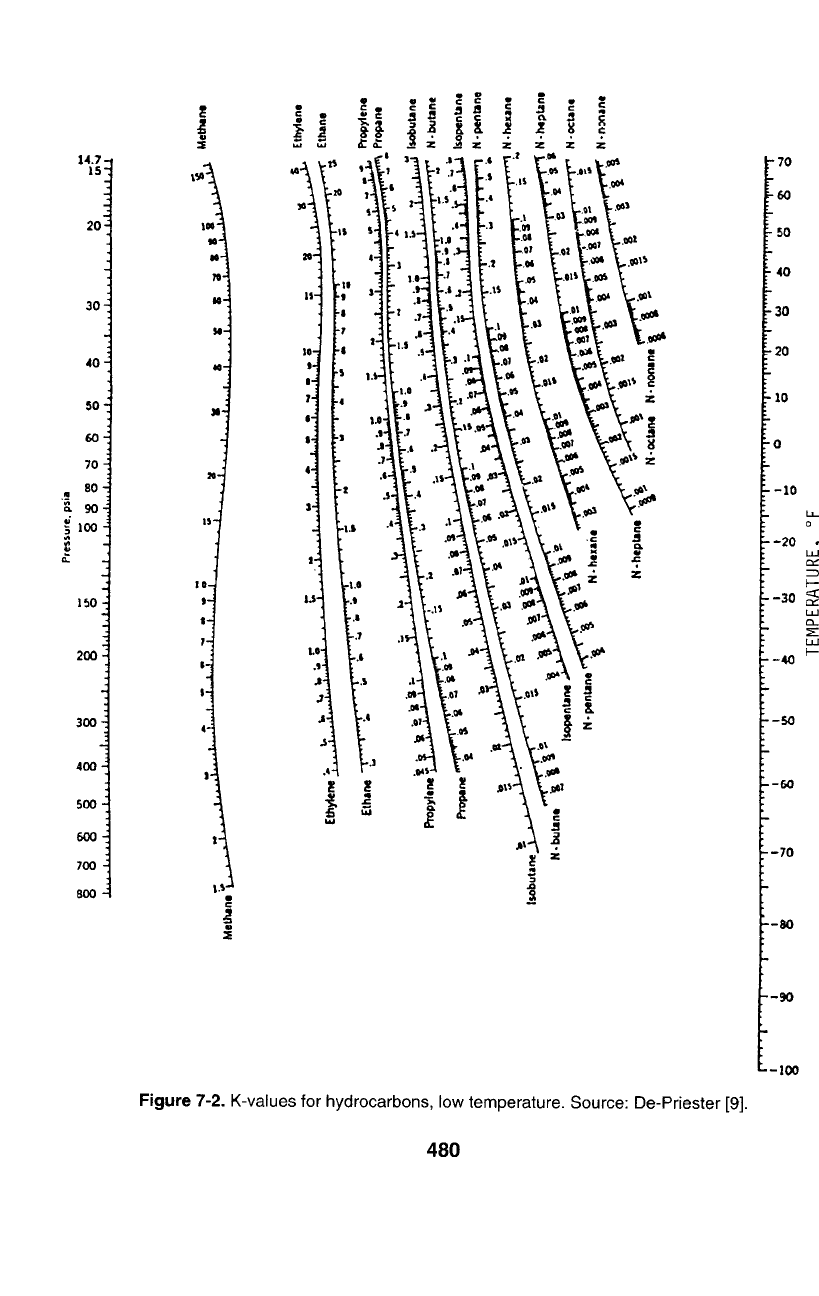
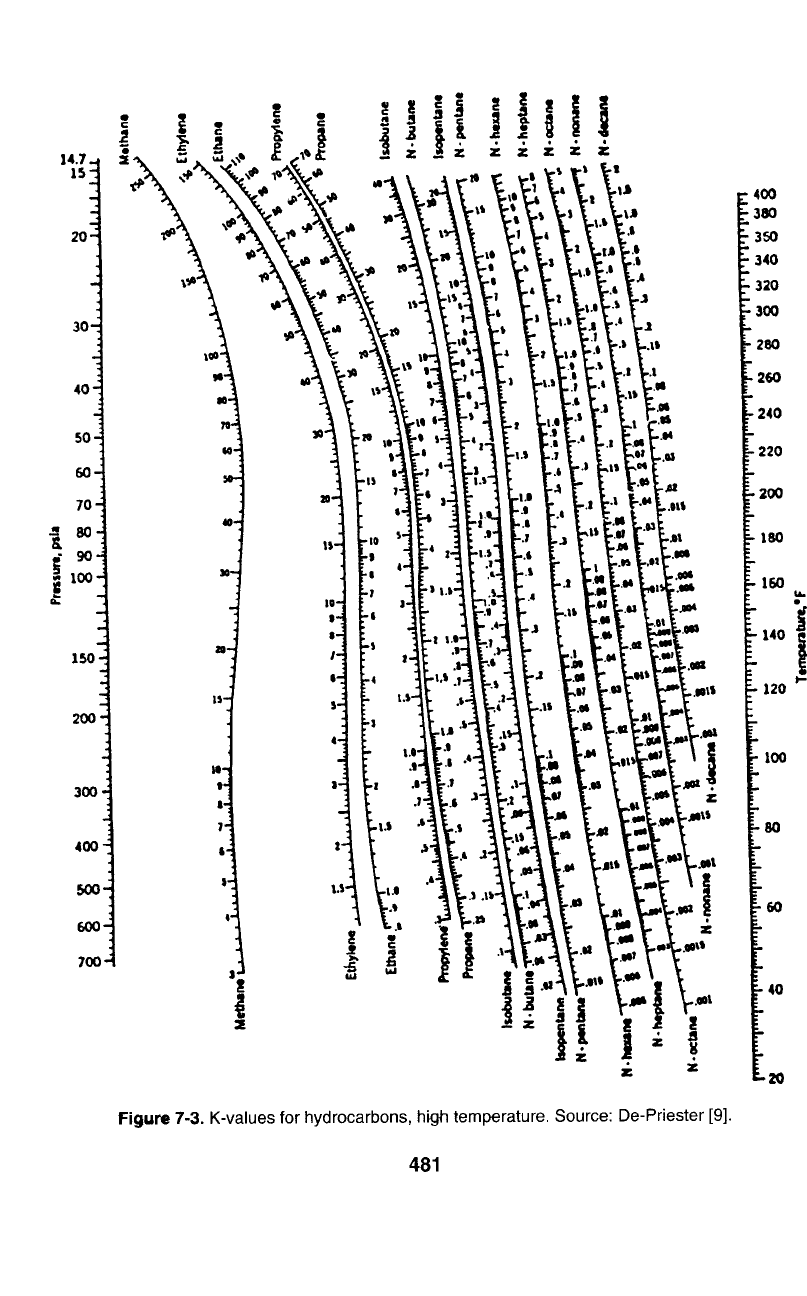
K values for light hydrocarbon systems is the De-Priester [9] charts,
which are shown in Figures 7-2 and 7-3. These charts give the K values
over a wide range of temperature and pressure. Because the charts are
nomographs, a straight edge connecting the temperature and pressure
for which K values are required will intersect curves for each compound
at its K value. These K values have been obtained by calculating fugaci-
ties from an equation of state. Use of these charts for exact determina-
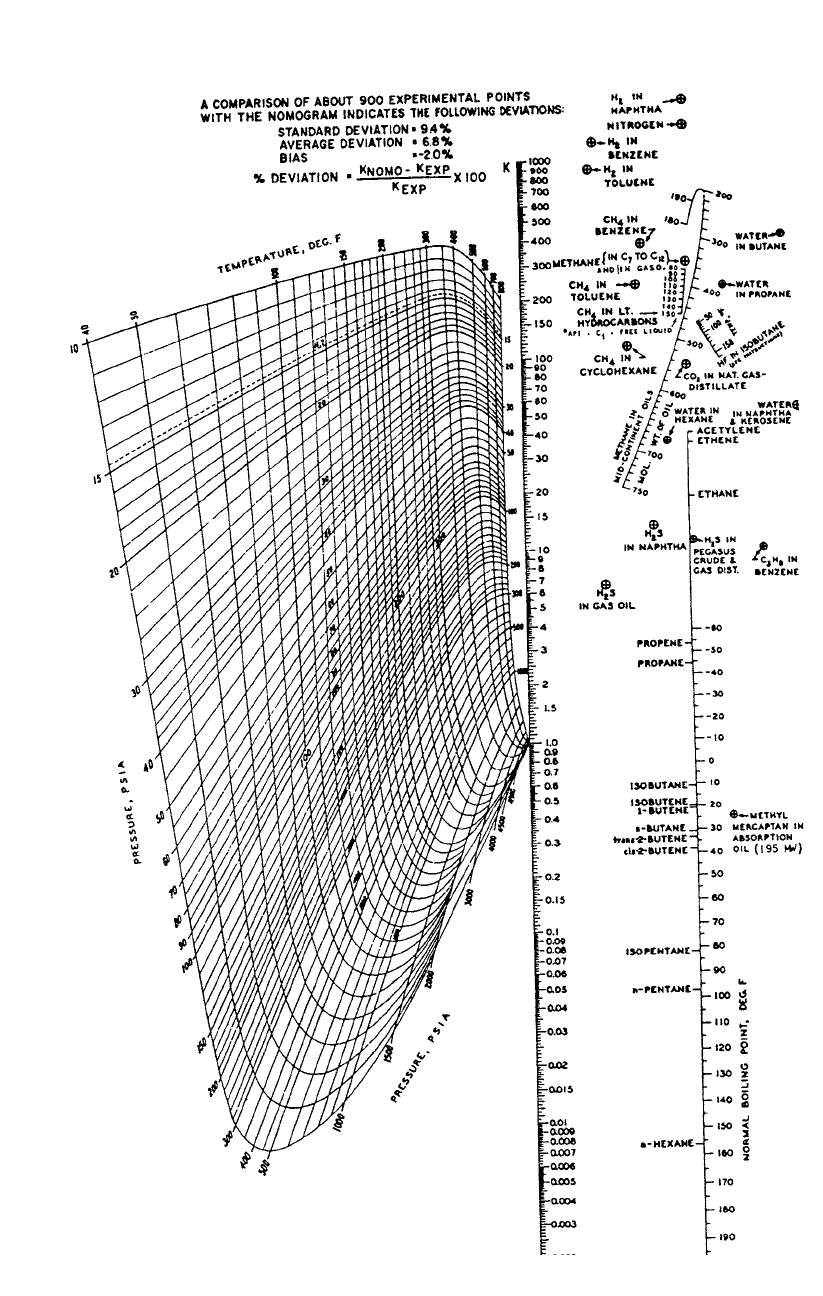
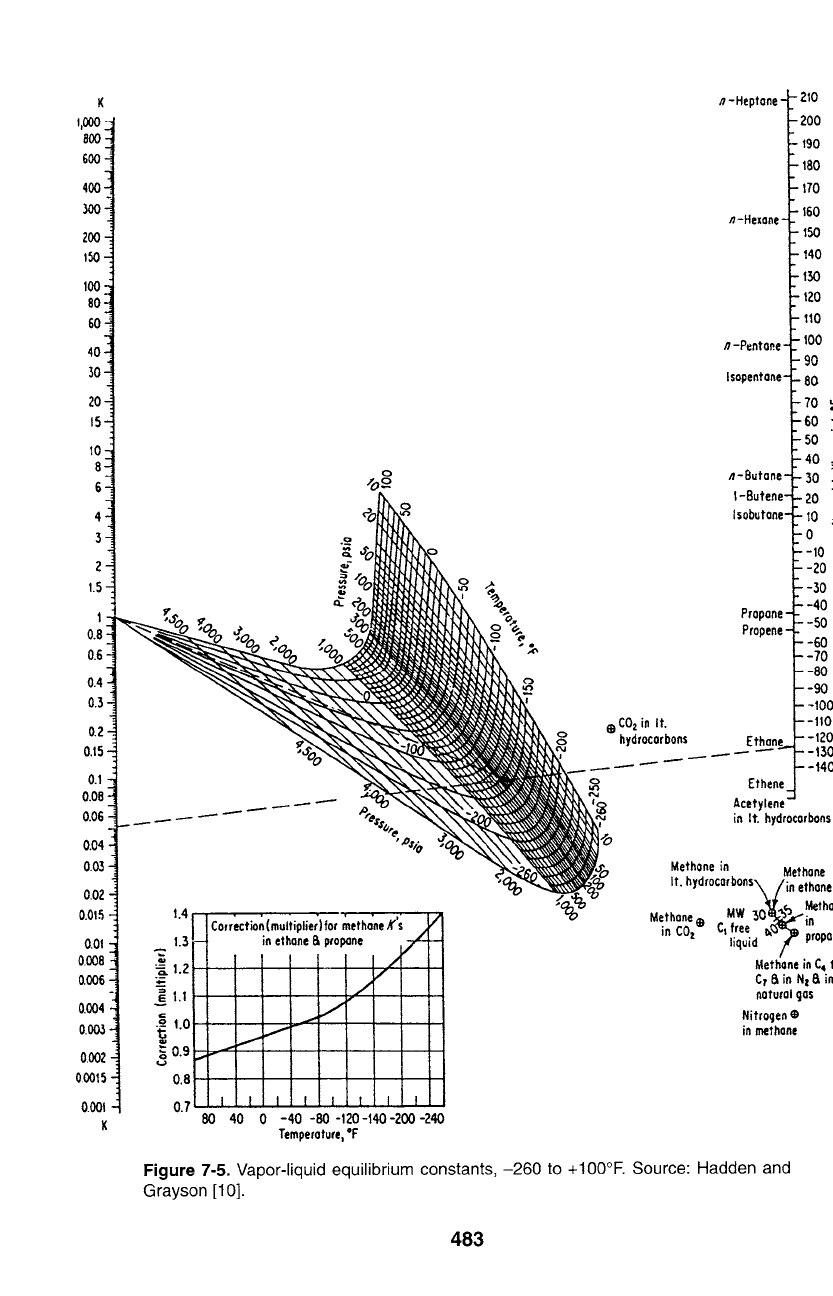
tion of K values requires trial-and-error calculations. Hadden and
Grayson [10] have presented correlations for hydrocarbon vapor-liquid
distribution ratios, and the charts from their work are shown in Figures
7-4 and 7-5. These charts can be readily used for determining the vapor-
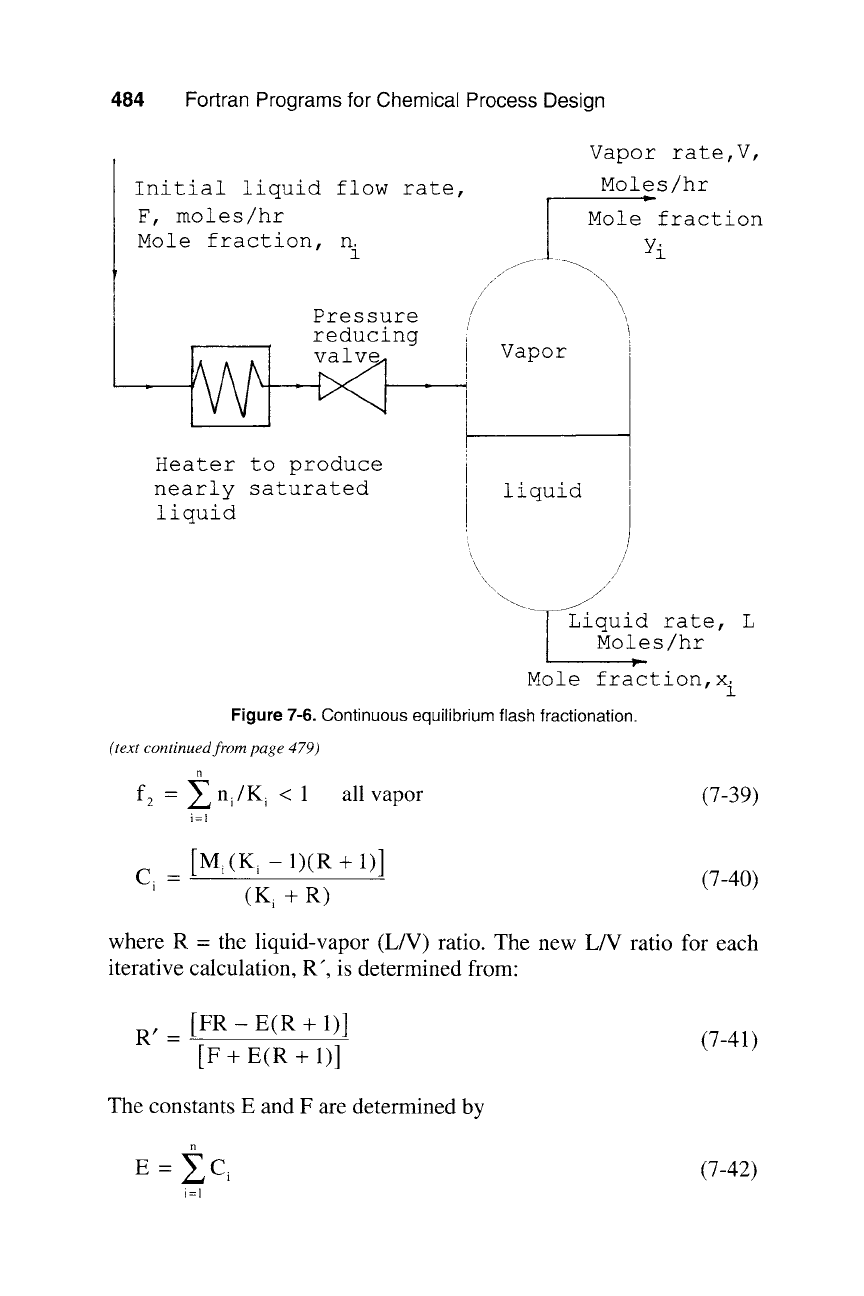
liquid distribution coefficients. Figure 7-6 shows a continuous equilib-
rium flash fractionation process.
The Equations
The following equations are used for the multicomponent equilib-
rium flash calculations.
f~ - ~
niK i <
1 all liquid (7-38)
i=l
(text continued on page 484)
14.7
-
IS-~
20 -~
30
40
5O
7o
.~
80
~. 9O
~ 9
~.
.
.2
150.2
.2
.2
2OO -:
300
400
500
700
800
:~ ,'.. ~ ~:~. _ " .
, 9 ol .~
~.~ ~ .;
_
M-
N~
lJ o
i
ZlD o
IS
I
c
J
4
, .~ " ,~
|.0 "!
.~"
,ID o
j;:
j2
e., Q.
J
m
,,.,,
J
Figure 7-2. K-values for hydrocarbons, low temperature. Source: De-Priester [9].
480
],4.7.
15-
2O 2
3O
4O
50
60
70-
II
9 , 100
g
150 -
2OO
31111
400"
7O0
!
o ~
~o
Z
,jz, jj
Figure 7-3. K-values for hydrocarbons, high temperature. Source: De-Priester [9].
481
o
,,=r
A COMPARISON OF ABOUT 900 EXPERIMENTAL POINTS
WITH THE NOMOGRAM INDICATES THE FOLLOWING DEVIATIONS:
STANDARD DEVIATION 9 9A%
AVERAGE DEVIATION 9 6.8%
BIAS ,-20%
9
KNOMO" KEX~Px I00 E
%
DEVIATION
KEXP
IL
, of.G. f
;=o
7OO
5OO
H L tN
-4)
NAPHTHA
N
iT ROO[N
O--t~
tN
t,[NZ[N[
(:l).,t. H 1 IN
TOLU[N[
I Io~J~ ~oo
c~ mN '*o.J t"
D[NZ[N[7 /" WATKff,a~)
~00 (~ j~300 IN I)UTAN[
.......
cf,N C, TO C,z~,~ L
|OO.L.,,,.. ANo II. aAso..o.~'/-
,OCUCNE
:;:~/. -oo ..,RO,A.E
ZOO T ,,o ://- ..
CH& IN
L 9
---* I so L ..~ ~ '
L IQuI~
100
~4~ CYCLOHrXAN[ [ JCO s NAT. GAS-
IN
70 ~ L 600 DISTILLATE
9 TER IN IN NAPHTHA
50 .".~ L ~ I,.- HEXANE 9 KEROSENE
=l~'W~ "G EL.O/ r" ACETYLENE
30
I
l
20 "~ ~'$0 ~- ETHAN[
/
9 S IN GAS OIL
PROPEN[
-5o
~J
o;
2
1.5
1.0
O.9
O.6
0.7
0~8 I~K) BUTANE-
0.5 I~I~BUTEN Ir
0.4
m -IMJTAN[.
0.3 WeH'ff"BUTIrN[ '
r N[
0.2
,0.15
-0.02
-30
-20
-10
0
10
ZO
~)~-,. M [.THYL
30 IdERCAPTAN IN
ABSORPTION
40 OiL. (195 H#)
50
6O
70
8O
,90
b.
,100
~
9 II0
~*
9 120
~
-13o ~
J
-14o ~
.J
-t~ ~
~e
-leo ~
170
190
K
1,000 --
800-
600
400
300
z00
150-
100-
80-
60
40
30
2o --='
15 "
8
6-
-i
4,
3-
4
2~
1.5-
1-
0.8 "~
0.6 -;
0.4
0.3 ~
0.2-.:"
0.15
0.I_
0.08 -
0.06
-
0.04 -I
0.03
0.02 -.::
0.015
O.Ol
0.0O8
0.006 -
0.004
0.003
0.002
0.0015 "
O.OOI
K
O
.o
Q.
o~
k, ".~
C
(
t I I Cmrection(mul;iplier)for methaneK's//
1 3 --
in ethane ~ propane IF"
z
I I I I. I I
/r
I
I
im
I
0
J
9
~
8
7 I
/
/
v
uB mmB Bnmn
80 40 0 -40-80-120-140-200-240
Temperature, "F
eCOz in It.
hydrocarbons
0
in It hydrocarbons
Methane in Methane
It. hydrocarbons,~/in ethane
,~ Metha
Methane,,, MW 30 %]~<~;,,
in COz ~ C! free lx~"~t) o'ro-at
liquid /# v v
f
Methane in C41
C? & in Nz8
in
natural gas
Nitrogen
9
in methane
Figure 7-5. Vapor-liquid equilibrium constants,-260 to +100~ Source" Hadden and
Grayson [10].
483
484
Fortran
Programs for Chemical Process
Design
Initial liquid flow rate,
F, moles/hr
Mole fraction, n.
1
Pressure
reducing
Heater to produce
nearly saturated
liquid
Vapor rate,V,
Moles/hr
Mole fraction
/// '~
, \\
\
/
Vapor
liquid
, /
\
"\
/
\'~~iquid rate, L
I
Moles/hr
Mole fraction,x i
Figure 7-6. Continuous equilibrium flash fractionation.
(text continued from page 479)
f2 - ~ n~/K~ < 1 all vapor (7-39)
i=l
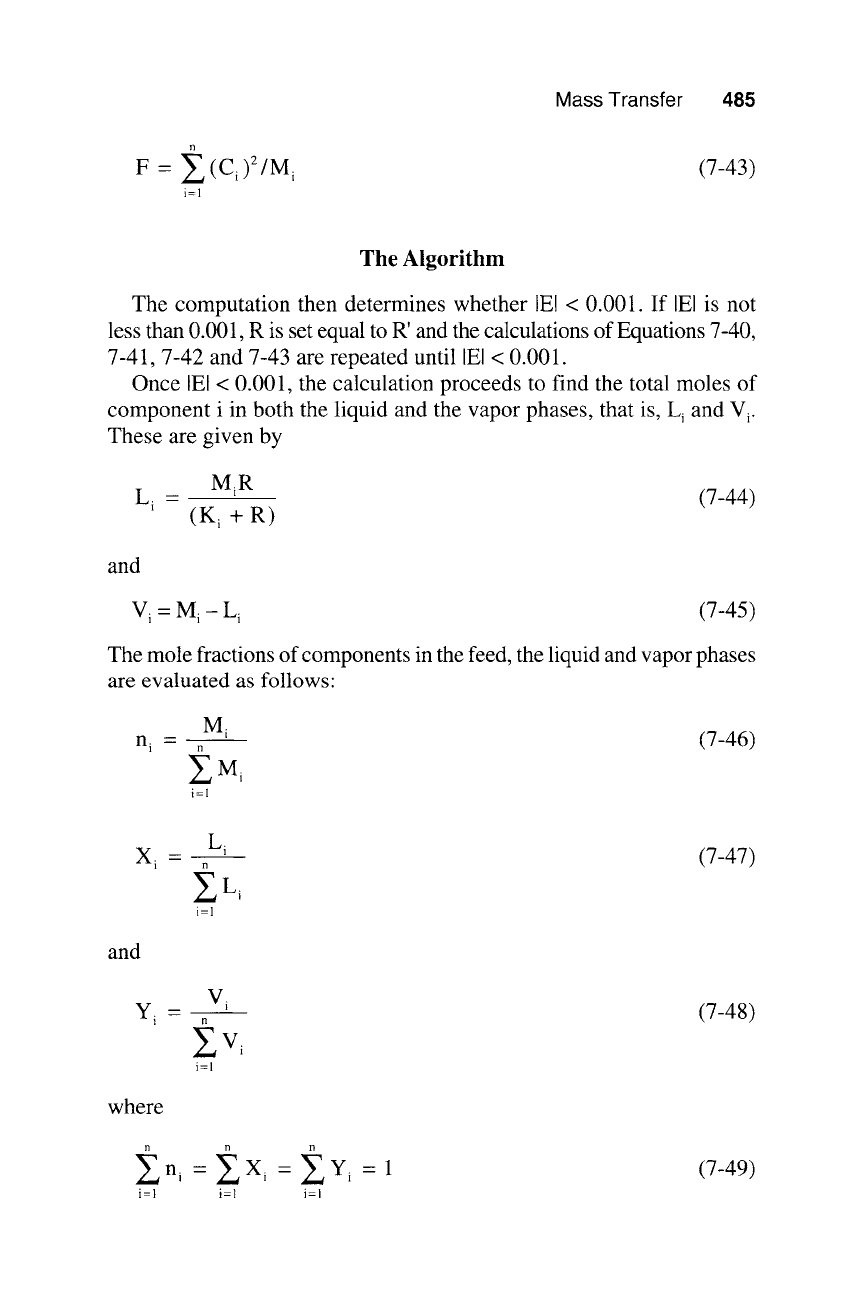
Ci
__ __
[M i (K~- 1)(R + 1)]
(K i + R)
(7-40)
where R- the liquid-vapor (L/V) ratio. The new L/V
ratio
for each
iterative calculation, R', is determined from:
R' = [FR- E(R + 1)]
[F+E(R+ 1)]
(7-41)
The constants E and F are determined by
E - ~_,
C i
(7-42)
i=l
Mass Transfer 485
F - ~
(C i )2/M~
(7-43)
i=l
The Algorithm
The computation then determines whether IEI < 0.001. If IEI is not
less than 0.001, R is set equal to R' and the calculations of Equations 7-40,
7-41, 7-42 and 7-43 are repeated until IEI < 0.001.
Once IEI < 0.001, the calculation proceeds to find the total moles of
component i in both the liquid and the vapor phases, that is, Li and V~.
These are given by
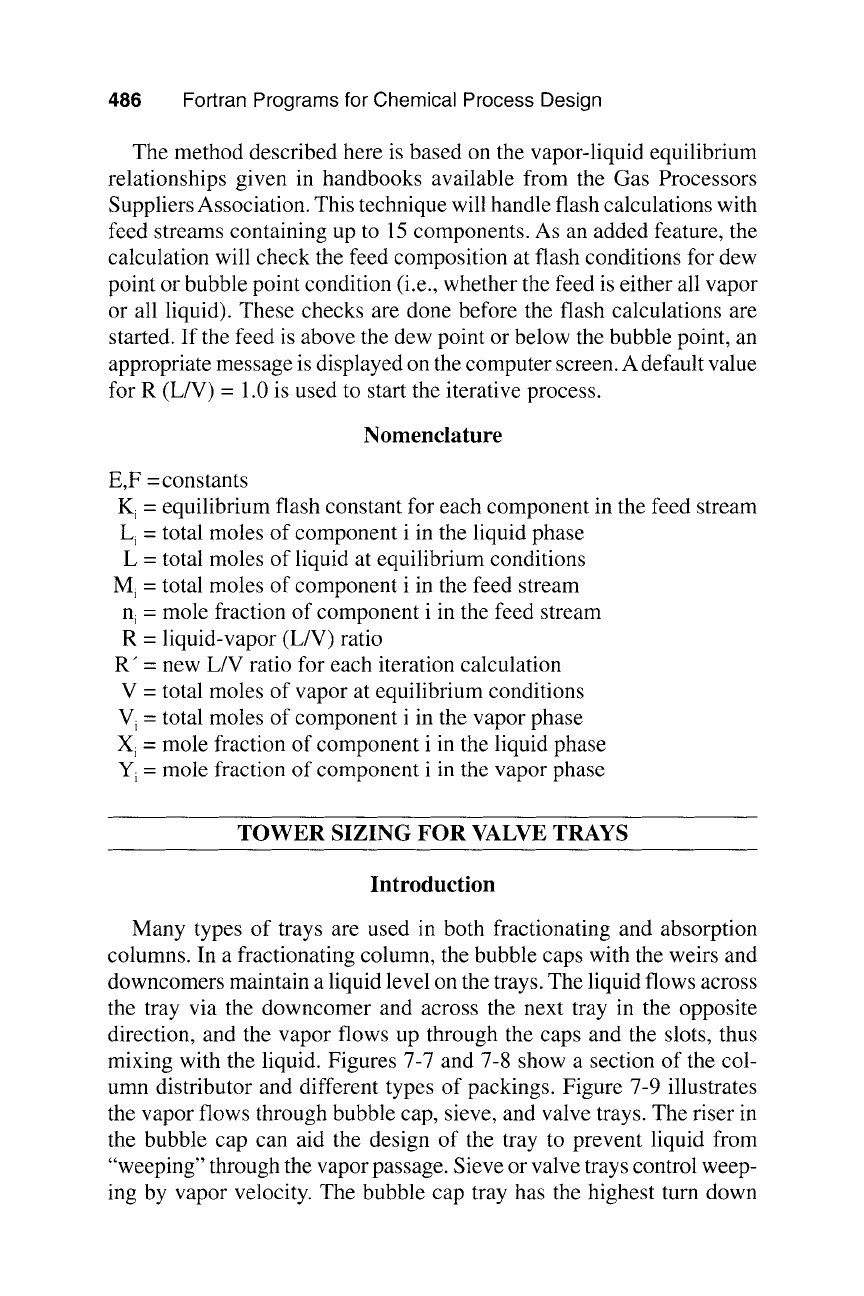
L i - MiR
(7-44)
(Ki + R)
and
V i - M i - L i (7-45)
The mole fractions of components in the feed, the liquid and vapor phases
are evaluated as follows"
Mi (7-46)
ni ,~M~
i=l
L i
X i - (7-47)
i=l
and
Yi --
where
Vi
~Vi
i=l
(7-48)
~n~-~X~-~Y~-1
i=l i=l i=!
(7-49)
486
Fortran Programs for Chemical Process Design
The method described here is based on the vapor-liquid equilibrium
relationships given in handbooks available from the Gas Processors
Suppliers Association. This technique will handle flash calculations with
feed streams containing up to 15 components. As an added feature, the
calculation will check the feed composition at flash conditions for dew
point or bubble point condition (i.e., whether the feed is either all vapor
or all liquid). These checks are done before the flash calculations are
started. If the feed is above the dew point or below the bubble point, an
appropriate message is displayed on the computer screen. A default value
for R (L/V) = 1.0 is used to start the iterative process.
Nomenclature
E,F = constants
K i =
equilibrium flash constant for each component in the feed stream
L~ = total moles of component i in the liquid phase
L = total moles of liquid at equilibrium conditions
M i = total moles of component i in the feed stream
n~ = mole fraction of component i in the feed stream
R = liquid-vapor (L/V) ratio
R'- new L/V ratio for each iteration calculation
V = total moles of vapor at equilibrium conditions
V i = total moles of component i in the vapor phase
X i = mole fraction of component i in the liquid phase
Y~ = mole fraction of component i in the vapor phase
TOWER SIZING FOR VALVE TRAYS
Introduction
Many types of trays are used in both fractionating and absorption
columns. In a fractionating column, the bubble caps with the weirs and
downcomers maintain a liquid level on the trays. The liquid flows across
the tray via the downcomer and across the next tray in the opposite
direction, and the vapor flows up through the caps and the slots, thus
mixing with the liquid. Figures 7-7 and 7-8 show a section of the col-
umn distributor and different types of packings. Figure 7-9 illustrates
the vapor flows through bubble cap, sieve, and valve trays. The riser in
the bubble cap can aid the design of the tray to prevent liquid from
"weeping" through the vapor passage. Sieve or valve trays control weep-
ing by vapor velocity. The bubble cap tray has the highest turn down