
Coker A.K. Fortran Programs for Chemical Process Design, Analysis, and Simulation
Подождите немного. Документ загружается.

Mass Transfer 527
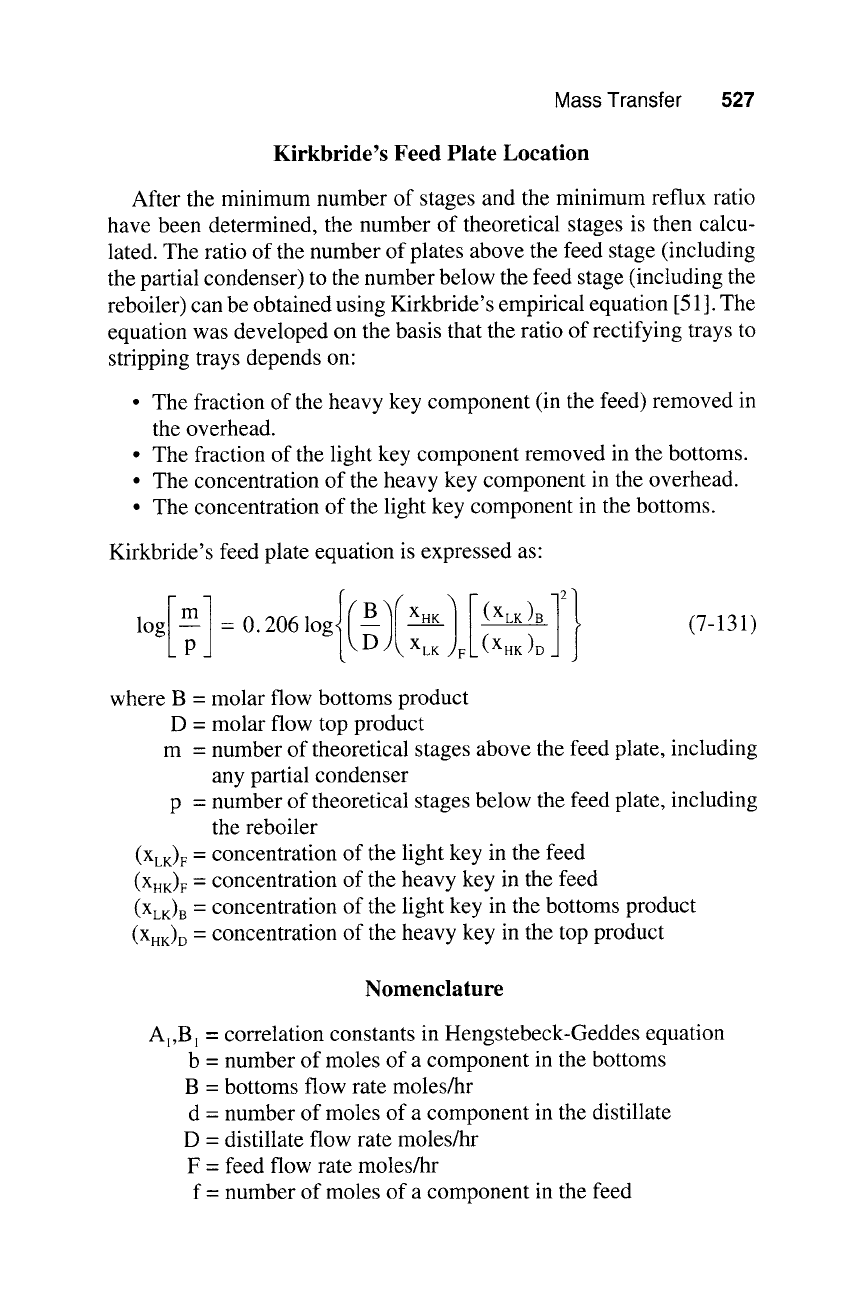
Kirkbride's Feed Plate Location
After the minimum number of stages and the minimum reflux ratio
have been determined, the number of theoretical stages is then calcu-
lated. The ratio of the number of plates above the feed stage (including
the partial condenser) to the number below the feed stage (including the
reboiler) can be obtained using Kirkbride's empirical equation [51 ]. The
equation was developed on the basis that the ratio of rectifying trays to
stripping trays depends on"
9 The fraction of the heavy key component (in the feed) removed in
the overhead.
9 The fraction of the light key component removed in the bottoms.
9 The concentration of the heavy key component in the overhead.
9 The concentration of the light key component in the bottoms.
Kirkbride's feed plate equation is expressed as:
( ( /[ ]2}
[el S )B
log -o.2o61og LK
XLK F (XHK)D
(7-131)
where B = molar flow bottoms product
D = molar flow top product
m = number of theoretical stages above the feed plate, including
any partial condenser
p = number of theoretical stages below the feed plate, including
the reboiler
(XLK)F = concentration of the light key in the feed
(XnK)F = concentration of the heavy key in the feed
(XLK)B = concentration of the light key in the bottoms product
(XnK)D = concentration of the heavy key in the top product
Nomenclature
A~,B~ = correlation constants in Hengstebeck-Geddes equation
b = number of moles of a component in the bottoms
B = bottoms flow rate moles/hr
d = number of moles of a component in the distillate
D = distillate flow rate moles/hr
F = feed flow rate moles/hr
f = number of moles of a component in the feed
528
Fortran Programs for Chemical Process Design
FACTOR - multiplier for the reflux ratio (that is, FACTOR
Rmin)
K = equilibrium constant for a component in the feed
n = number of components
N - number of theoretical plates
Nmi n :
minimum number of theoretical plates at total reflux
q = pseudo-ratio of liquid to vapor for the feed
R = reflux ratio
Umi n =
minimum reflux ratio
x = mole fraction of a component where x B, x D, x F = mole frac-
tions in the bottoms, distillate, and feed, respectively
Greek Letters
~z = relative volatility with respect to the heavy key
0 = Underwood's constant
= summation
HK, LK = heavy and the light key components
i = individual component identifier
PROBLEMS AND SOLUTIONS
Problem 7-1
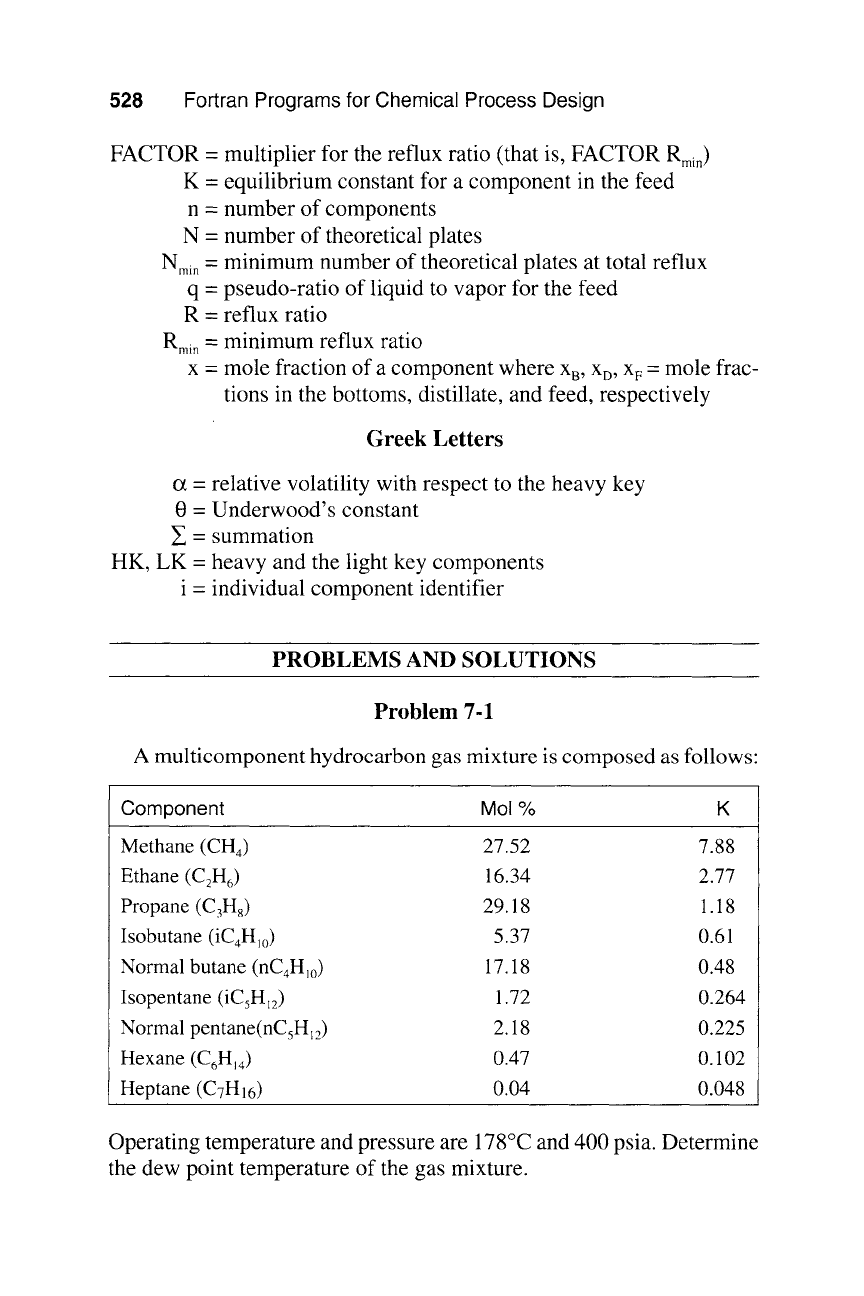
A multicomponent hydrocarbon gas mixture is composed as follows:
Component Mol % K
Methane
(CU4)
27.52 7.88
Ethane (C2H6) 16.34 2.77
Propane (C3H8) 29.18 1.18
Isobutane
(iC4Hl0)
5.37 0.61
Normal butane
(nC4Hl0)
17.18 0.48
Isopentane (iCsH12)
1.72 0.264
Normal pentane(nCsH~2) 2.18 0.225
Hexane
(C6Hl4)
0.47 0.102
Heptane (C7H16)
0.04 0.048
Operating temperature and pressure are 178~ and 400 psia. Determine
the dew point temperature of the gas mixture.
Mass Transfer 529
Solution
The computer program PROG71 calculates the dew and bubble points
of any multicomponent hydrocarbon mixture based on the user sup-
plied K-values. The program will handle feed streams containing up to
15 components. The feed entries may be moles, mole fraction, or mole
percent. The dew point (~X = ~Y/K) should be 1.0 or very close to 1.0,
depending on the tolerance the user will accept. If the sum printed is not
equal to 1.0 (within the user tolerance), a message is printed instructing
the user to assume a new temperature. The iteration is repeated using
the Ki's corresponding to the new temperature chosen. The temperature
supplied does not affect the computation, but is printed and stored as a
reminder to the user of which temperature (and corresponding K-values)
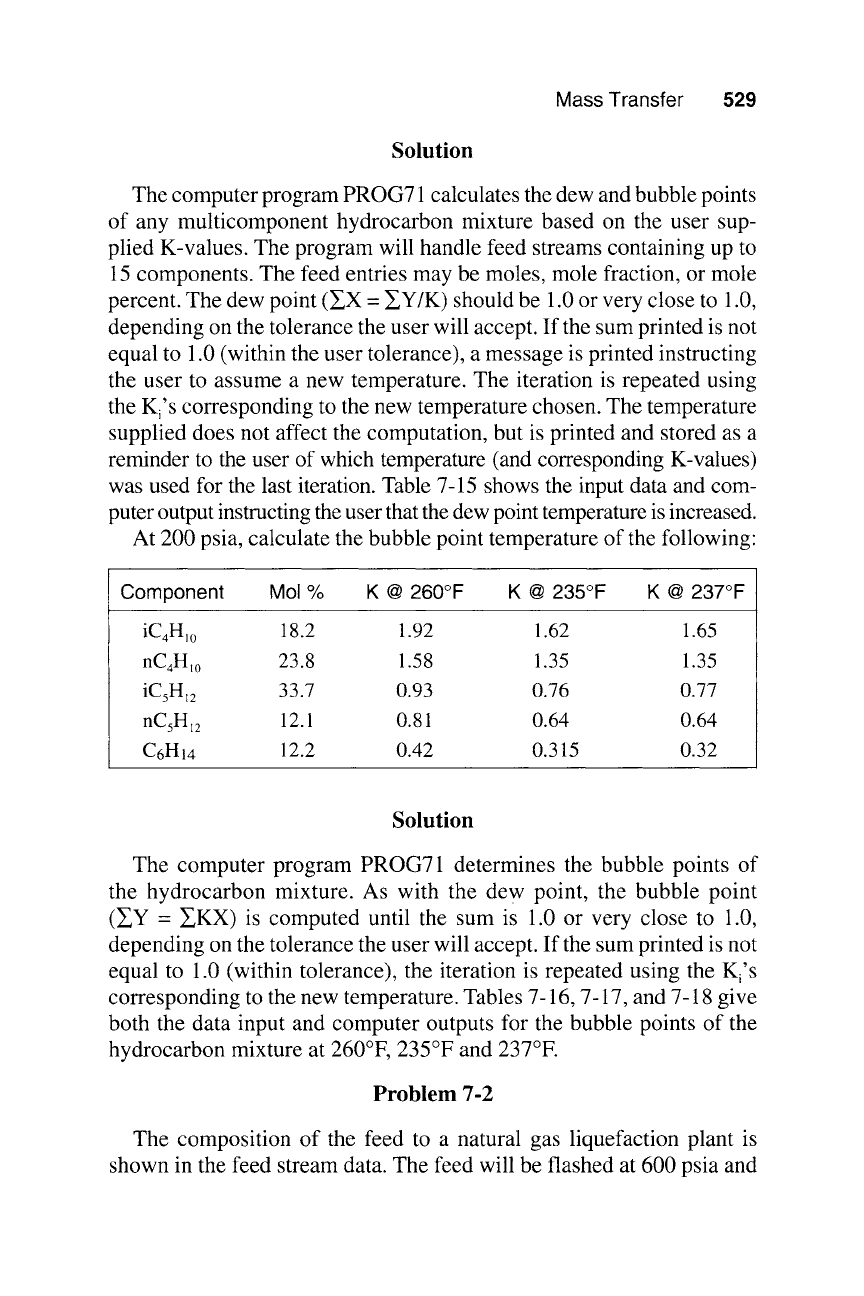
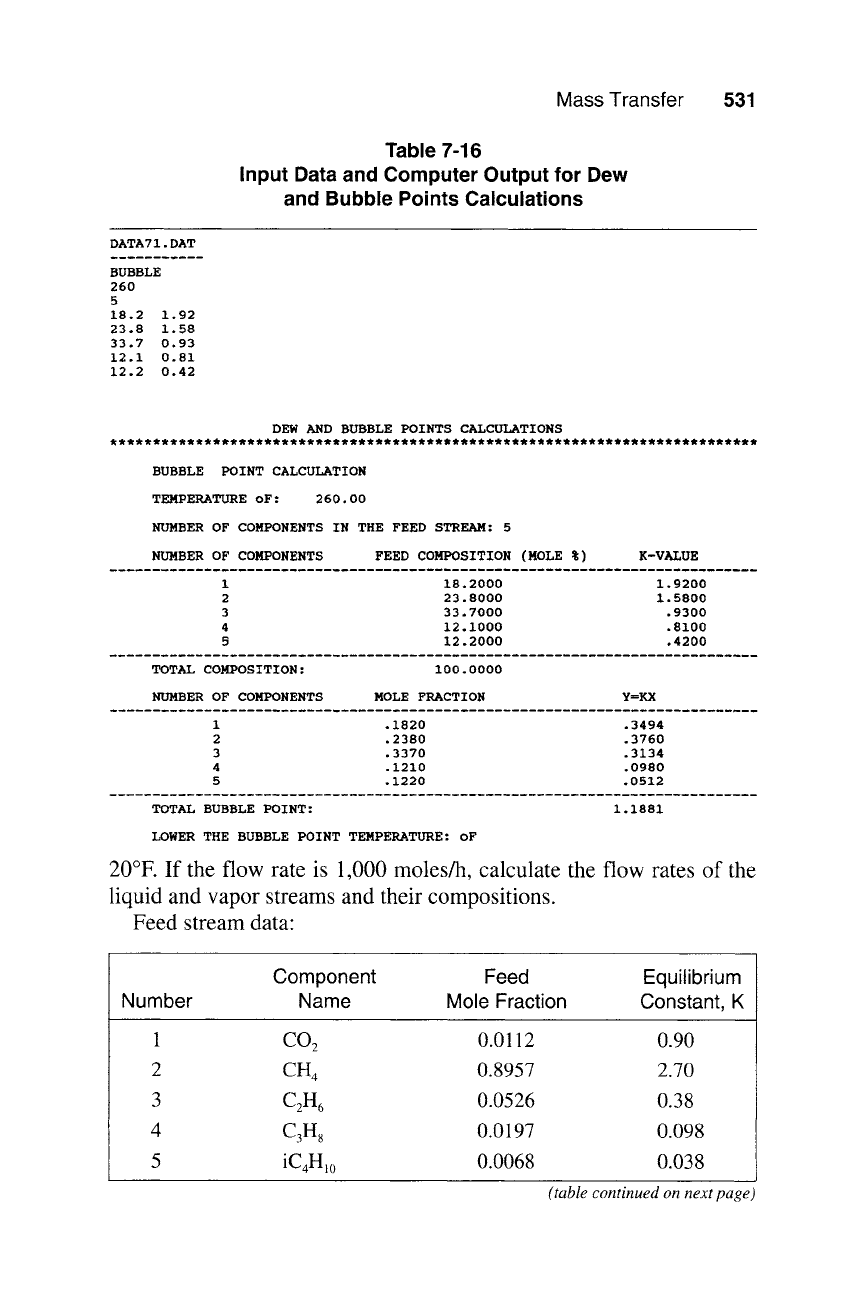
was used for the last iteration. Table 7-15 shows the input data and com-
puter output instructing the user that the dew point temperature is increased.
At 200 psia, calculate the bubble point temperature of the following:
Component Mol % K @ 260~ K @ 235~ K @ 237~
iC4Hl0
18.2 1.92 1.62 1.65
nCaH 10
23.8 1.58 1.35 1.35
iCsHl2
33.7 0.93 0.76 0.77
nCsHl2 12.1 0.81 0.64 0.64
C6H14
12.2 0.42 0.315 0.32
Solution
The computer program PROG71 determines the bubble points of
the hydrocarbon mixture. As with the dew point, the bubble point
(~Y = ~KX) is computed until the sum is 1.0 or very close to 1.0,
depending on the tolerance the user will accept. If the sum printed is not
equal to 1.0 (within tolerance), the iteration is repeated using the K~'s
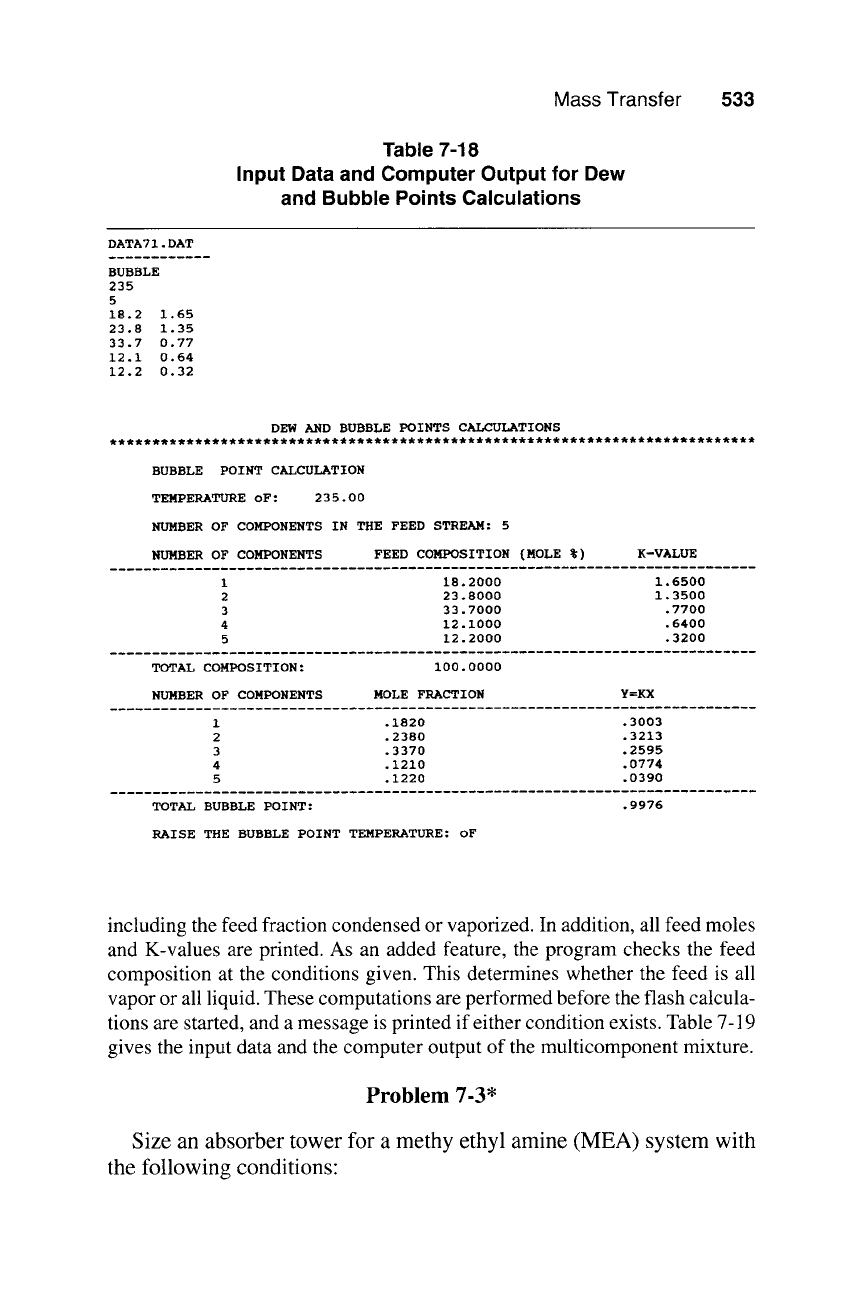
corresponding to the new temperature. Tables 7-16, 7-17, and 7-18 give
both the data input and computer outputs for the bubble points of the
hydrocarbon mixture at 260~ 235~ and 237~
Problem 7-2
The composition of the feed to a natural gas liquefaction plant is
shown in the feed stream data. The feed will be flashed at 600 psia and
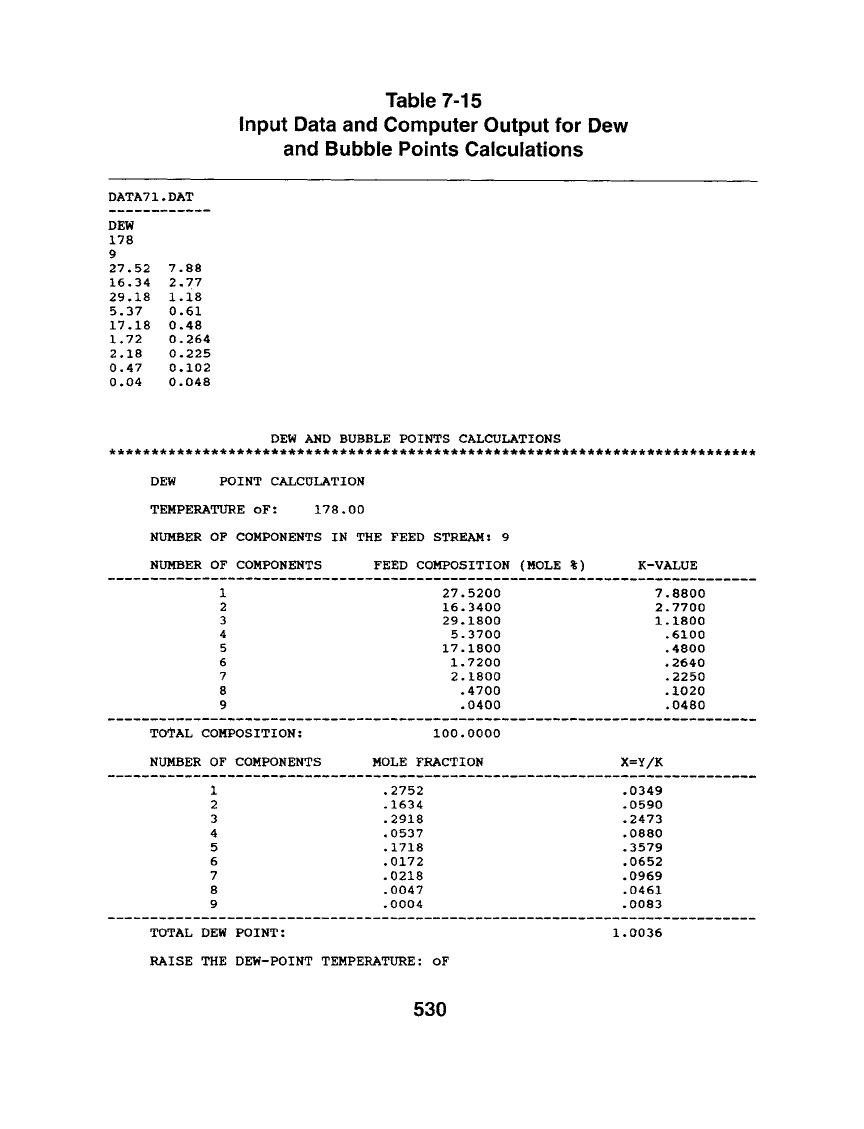
Table 7-15
Input Data and Computer Output for Dew
and Bubble Points Calculations
DATA71.DAT
DEW
178
9
27.52 7.88
16.34 2.77
29.18 1.18
5.37 0.61
17.18 0.48
1.72 0.264
2.18 0.225
0.47 0.102
0.04 0.048
DEW AND BUBBLE POINTS CALCULATIONS
****************************************************************************
DEW POINT CALCULATION
TEMPERATURE oF: 178.00
NUMBER OF COMPONENTS IN THE FEED STREAM: 9
NUMBER OF COMPONENTS FEED COMPOSITION (MOLE %) K-VALUE
1 27.5200 7.8800
2 16.3400 2.7700
3 29.1800 1.1800
4 5.3700 .6100
5 17.1800 .4800
6 1.7200 .2640
7 2.1800 .2250
8 .4700 .1020
9 .0400 .0480
TOTAL COMPOSITION:
NUMBER OF COMPONENTS
i00.0000
MOLE FRACTION
X=Y/K
1 .2752 .0349
2 .1634 .0590
3 .2918 .2473
4 .0537 .0880
5 .1718 .3579
6 .0172 .0652
7 .0218 .0969
8 .0047 .0461
9 .0004 .0083
TOTAL DEW POINT:
RAISE THE DEW-POINT TEMPERATURE: oF
1.0036
530
Mass Transfer 531
Table 7-16
Input Data and Computer Output for Dew
and Bubble Points Calculations
DATA71.DAT
BUBBLE
260
5
18.2 1.92
23.8 1.58
33.7 0.93
12.1 0.81
12.2 0.42
DEW AND BUBBLE POINTS CALCULATIONS
****************************************************************************
BUBBLE POINT CALCULATION
TEMPERATURE oF: 260.00
NUMBER OF COMPONENTS IN THE FEED STREAM: 5
NUMBER OF COMPONENTS FEED COMPOSITION (MOLE %) K-VALUE
1 18.2000 1.9200
2 23.8000 1.5800
3 33.7000 .9300
4 12.1000 .8100
5 12.2000 .4200
TOTAL COMPOSITION:
NUMBER OF COMPONENTS
I00.0000
MOLE FRACTION Y=KX
1 .1820 .3494
2 .2380 .3760
3 .3370 .3134
4 .1210 .0980
5 .1220 .0512
TOTAL BUBBLE POINT: 1 . 1881
LOWER THE BUBBLE POINT TEMPERATURE: oF
20~ If the flow rate is 1,000 moles/h, calculate the flow rates of the
liquid and vapor streams and their compositions.
Feed stream data"
Component Feed Equilibrium
Number Name Mole Fraction Constant, K
1 CO 2 0.0112 0.90
2 CH 4 0.8957 2.70
3 C2H 6 0.0526 0.38
4 C3H8 0.0197 0.098
5 iC4Hl0
0.0068 0.038
(table continued on next page)
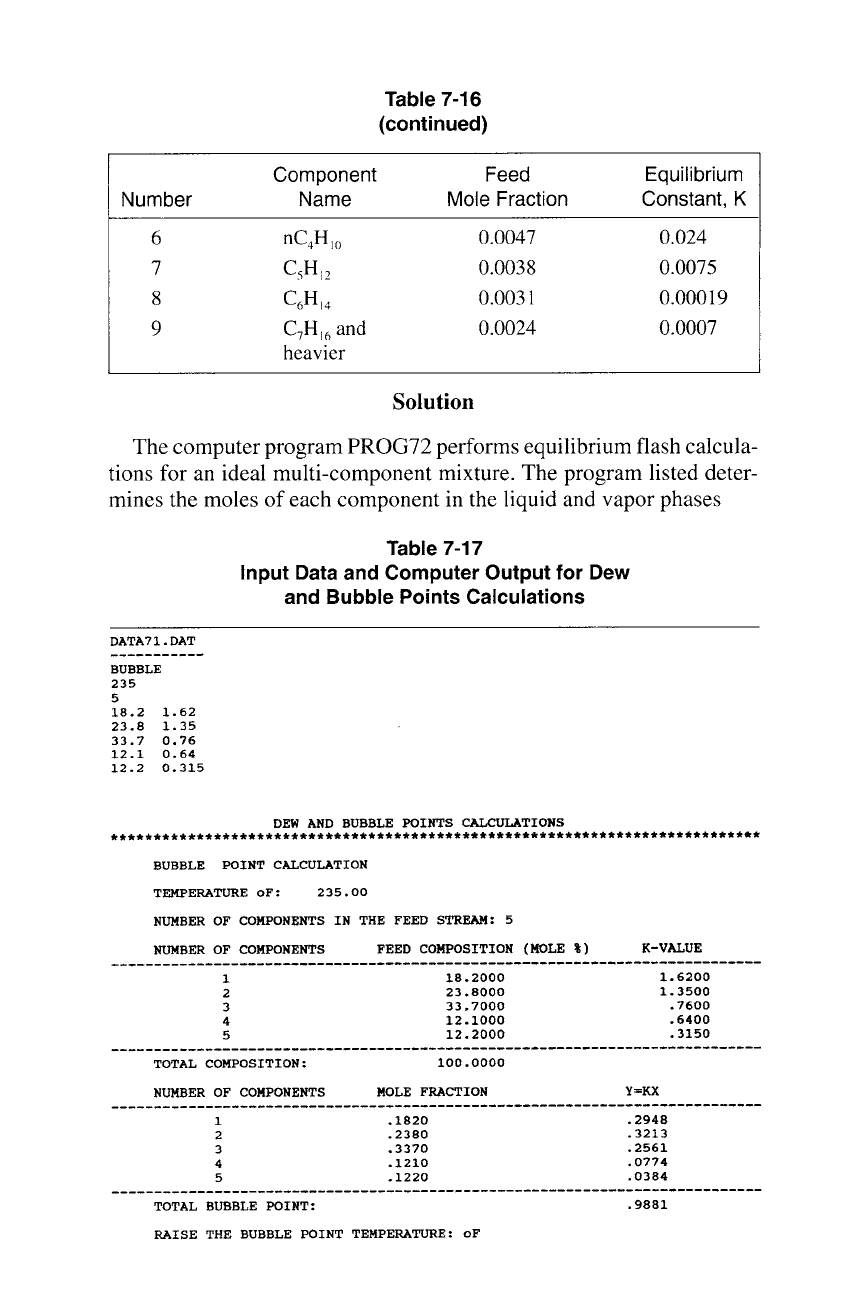
Table 7-16
(continued)
Component Feed Equilibrium
Number Name Mole Fraction Constant, K
6
nC4Hl0
0.0047 0.024
7
C5H12
0.0038 0.0075
8
C6HI4
0.0031 0.00019
9 C7H,6 and 0.0024 0.0007
heavier
Solution
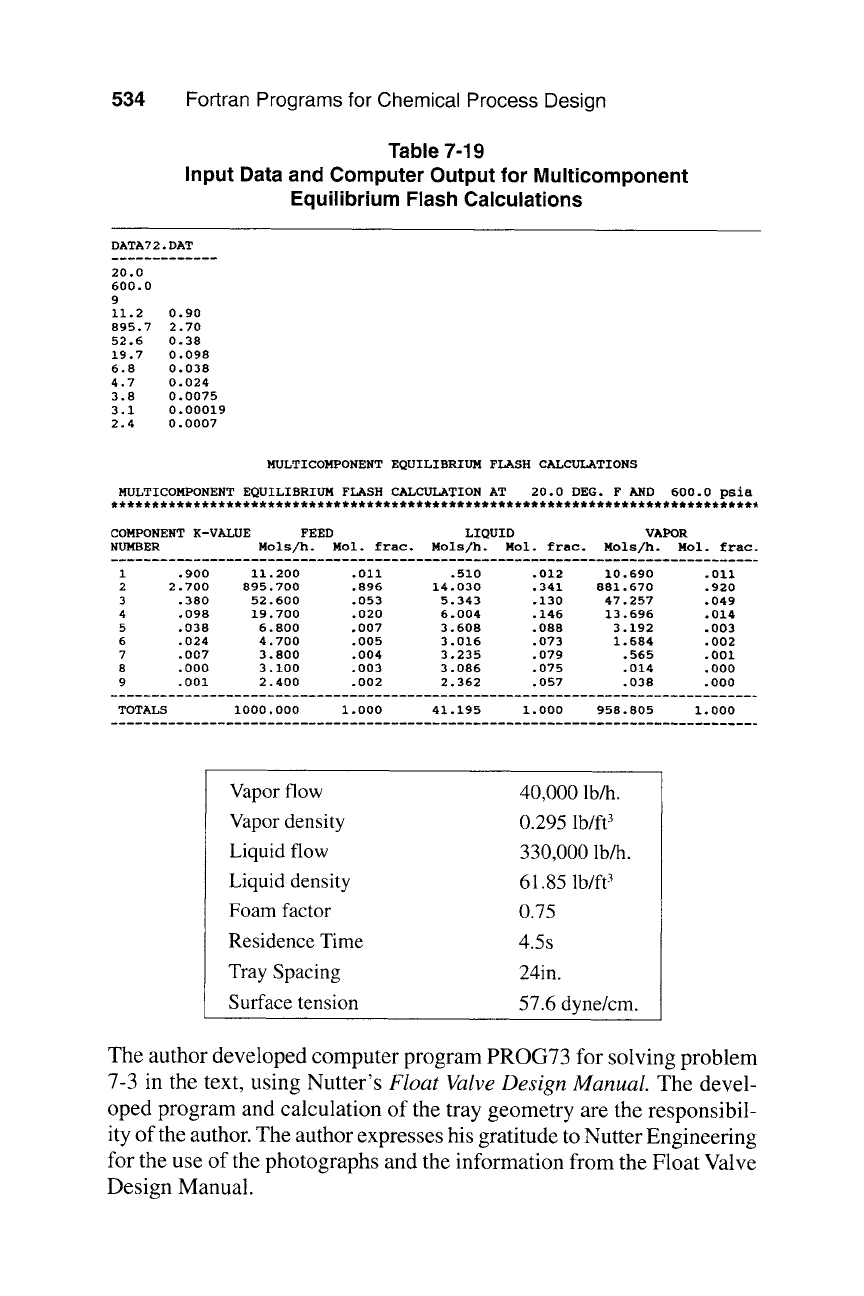
The computer program PROG72 performs equilibrium flash calcula-
tions for an ideal multi-component mixture. The program listed deter-
mines the moles of each component in the liquid and vapor phases
Table 7-17
Input Data and Computer Output for Dew
and Bubble Points Calculations
DATA71.DAT
BUBBLE
235
5
18.2 1.62
23.8 1.35
33.7 0.76
12.1 0.64
12.2 0.315
DEW AND BUBBLE POINTS CALCULATIONS
****************************************************************************
BUBBLE POINT CALCULATION
TEMPERATURE oF: 235.00
NUMBER OF COMPONENTS IN THE FEED STREAM: 5
NUMBER OF COMPONENTS FEED COMPOSITION (MOLE %) K-VALUE
1 18.2000 1.6200
2 23.8000 1.3500
3 33.7000 .7600
4 12.1000 .6400
5 12.2000 .3150
TOTAL COMPOSITION:
NUMBER OF COMPONENTS
i00.0000
MOLE FRACTION
u
1 .1820 .2948
2 .2380 .3213
3 .3370 .2561
4 .1210 .0774
5 .1220 .0384
TOTAL BUBBLE POINT:
RAISE THE BUBBLE POINT TEMPERATURE: oF
.9881
Mass Transfer 533
Table 7-18
Input Data and Computer Output for Dew
and Bubble Points Calculations
DATA71.DAT
BUBBLE
235
5
18.2 1.65
23.8 1.35
33.7 0.77
12.1 0.64
12.2 0.32
DEW AND BUBBLE POINTS CAiEUI~TIONS
****************************************************************************
BUBBLE POINT CALCULATION
TEMPERATURE oF: 235.00
NUMBER OF COMPONENTS IN THE FEED STREAM: 5
NUMBER OF COMPONENTS FEED COMPOSITION (MOLE %) K-VALUE
1 18.2000 1.6500
2 23.8000 1.3500
3 33.7000 .7700
4 12.1000 .6400
5 12.2000 .3200
TOTAL COMPOSITION:
NUMBER OF COMPONENTS
I00.0000
MOLE FRACTION
Y=KX
1 .1820 .3003
2 .2380 .3213
3 .3370 .2595
4 .1210 .0774
5 .1220 .0390
TOTAL BUBBLE POINT:
RAISE THE BUBBLE POINT TEMPERATURE: oF
.9976
including the feed fraction condensed or vaporized. In addition, all feed moles
and K-values are printed. As an added feature, the program checks the feed
composition at the conditions given. This determines whether the feed is all
vapor or all liquid. These computations are performed before the flash calcula-
tions are started, and a message is printed if either condition exists. Table 7-19
gives the input data and the computer output of the multicomponent mixture.
Problem 7-3"
Size an absorber tower for a methy ethyl amine (MEA) system with
the following conditions:
534
Fortran Programs for Chemical Process Design
Table 7-19
Input Data and Computer Output for Multicomponent
Equilibrium Flash Calculations
DATA72.DAT
20.0
600.0
9
11.2 0.90
895.7 2.70
52.6 0.38
19.7 0.098
6.8 0.038
4.7 0.024
3.8 0.0075
3.1 0.00019
2.4 0.0007
MULTICOMPONENT EQUILIBRIUM FLASH CALCULATIONS
MULTICOMPONENT EQUILIBRIUM FLASH CALCULATION AT 20.0 DEG. F AND 600.0
psia
*******************************************************************************
COMPONENT K-VALUE FEED LIQUID VAPOR
NUMBER Mols/h. Mol. frac. Mols/h. Mol. frac. Mols/h. Mol.
frac.
1 .900 11.200 .011 .510 .012 10.690 .011
2 2.700 895.700 .896 14.030 .341 881.670 .920
3 .380 52.600 .053 5.343 .130 47.257 .049
4 .098 19.700 .020 6.004 .146 13.696 .014
5 .038 6.800 .007 3.608 .088 3.192 .003
6 .024 4.700 .005 3.016 .073 1.684 .002
7 .007 3.800 .004 3.235 .079 .565 .001
8 .000 3.100 .003 3.086 .075 014 .000
9 .001 2.400 .002 2.362 .057 .038 .000
TOTALS 1000.000 1.000 41.195 1.000 958.805 1.000
Vapor
flow 40,000 lb/h.
Vapor density
0.295 lb/ft 3
Liquid
flow 330,000
lb/h.
Liquid density 61.85 lb/ft 3
Foam factor
0.75
Residence Time
4.5s
Tray Spacing
24in.
Surface tension 57.6 dyne/cm.
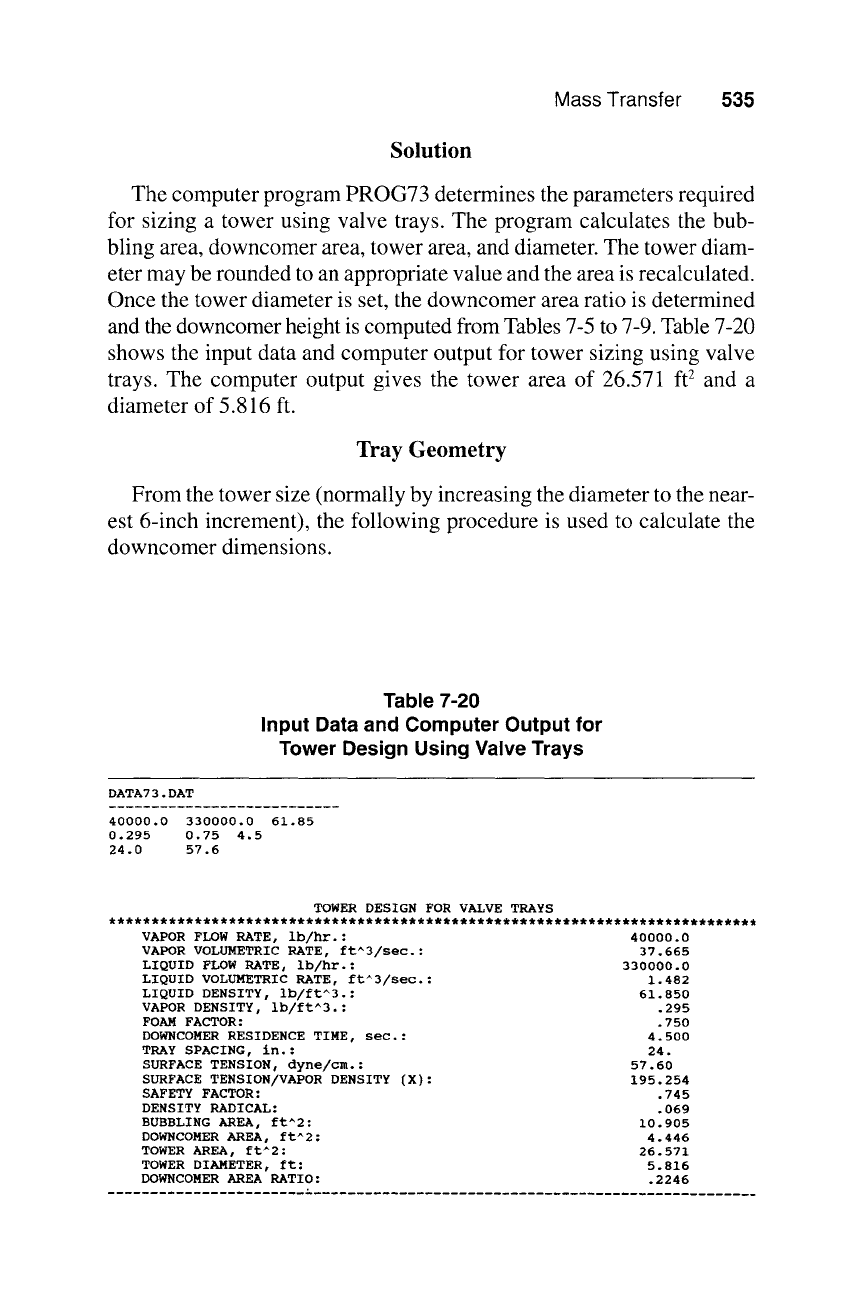
The author developed computer program PROG73 for solving problem
7-3 in the text, using Nutter's
Float Valve Design Manual.
The devel-
oped program and calculation of the tray geometry are the responsibil-
ity of the author. The author expresses his gratitude to Nutter Engineering
for the use of the photographs and the information from the Float Valve
Design Manual.
Mass Transfer 535
Solution
The computer program PROG73 determines the parameters required
for sizing a tower using valve trays. The program calculates the bub-
bling area, downcomer area, tower area, and diameter. The tower diam-
eter may be rounded to an appropriate value and the area is recalculated.
Once the tower diameter is set, the downcomer area ratio is determined
and the downcomer height is computed from Tables 7-5 to 7-9. Table 7-20
shows the input data and computer output for tower sizing using valve
trays. The computer output gives the tower area of 26.571 ft 2 and a
diameter of 5.816 ft.
Tray Geometry
From the tower size (normally by increasing the diameter to the near-
est 6-inch increment), the following procedure is used to calculate the
downcomer dimensions.
Table 7-20
Input Data and Computer Output for
Tower Design Using Valve Trays
DATA73.DAT
40000.0 330000.0 61.85
0.295 0.75 4.5
24.0 57.6
TOWER DESIGN FOR VALVE TRAYS
****************************************************************************
VAPOR FLOW RATE,
Ib/hr.:
VAPOR VOLUMETRIC RATE, ft^3/sec.:
LIQUID FLOW RATE,
Ib/hr.:
LIQUID VOLUMETRIC RATE, ft^3/sec.:
LIQUID DENSITY, ib/ft^3.:
VAPOR DENSITY, ib/ft^3.:
FOAM FACTOR:
DOWNCOMER RESIDENCE TIME,
sec.:
TRAY SPACING, in.:
SURFACE TENSION,
dyne/cm.:
SURFACE TENSION/VAPOR DENSITY (X):
SAFETY FACTOR:
DENSITY RADICAL:
BUBBLING AREA, ft^2:
DOWNCOMER AREA, ftA2:
TOWER AREA, ft^2:
TOWER DIAMETER,
ft:
DOWNCOMER AREA RATIO:
40000.0
37.665
330000.0
1.482
61.850
.295
.750
4.500
24.
57.60
195.254
.745
.069
10.905
4.446
26.571
5.816
.2246
536
Fortran Programs for Chemical Process Design
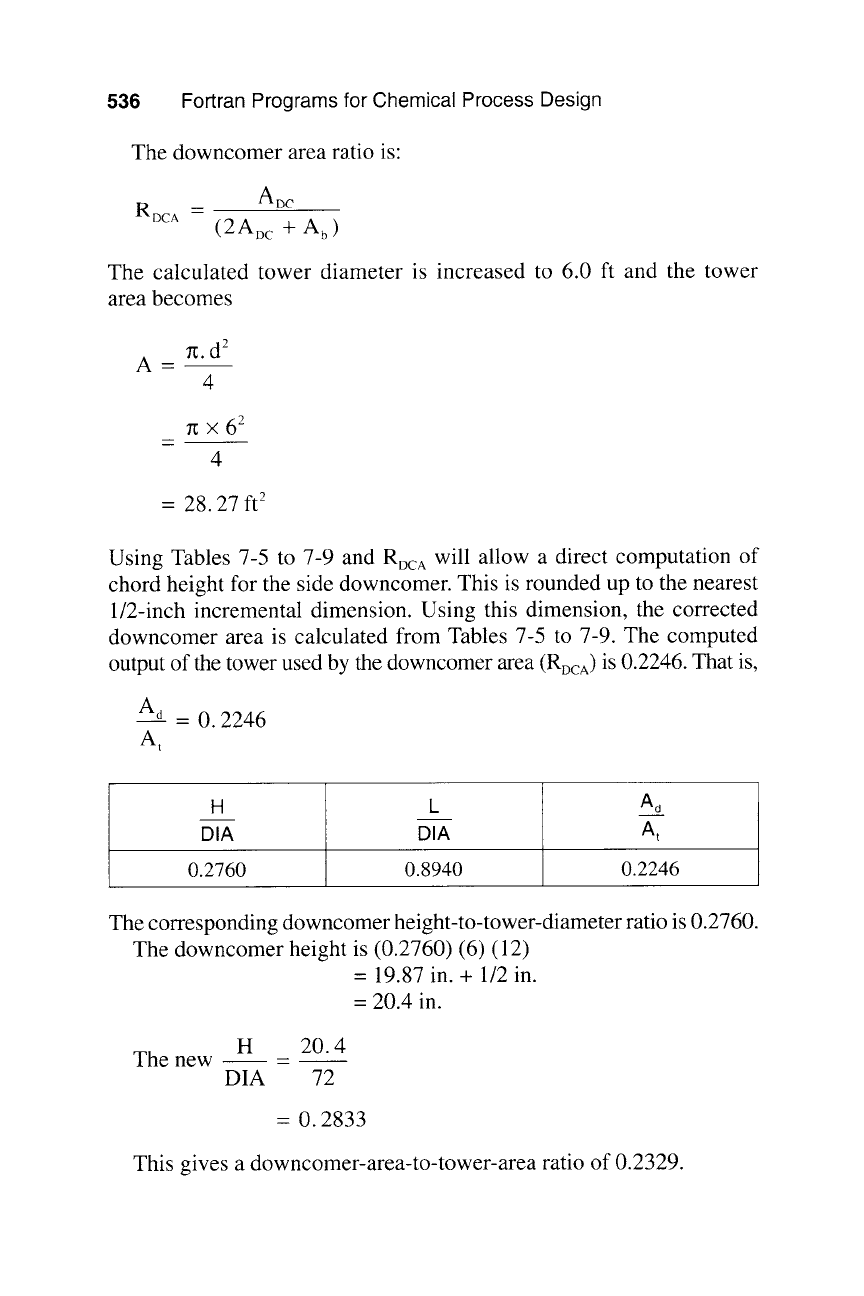
The downcomer area ratio is"
RDC A =
AD~
(2ADc
+ A b)
The calculated tower diameter is increased to 6.0 ft and the tower
area becomes
/17. d 2
A-
4
/rX6 2
4
= 28.27 ft 2
Using Tables 7-5 to 7-9 and
RDC A
will allow a direct computation of
chord height for the side downcomer. This is rounded up to the nearest
1/2-inch incremental dimension. Using this dimension, the corrected
downcomer area is calculated from Tables 7-5 to 7-9. The computed
output of the tower used by the downcomer
area (RDcA)
is 0.2246. That is,
Ad
= 0.2246
A~
DIA
0.2760
DIA
0.8940
A d
A,
0.2246
The corresponding downcomer height-to-tower-diameter ratio is 0.2760.
The downcomer height is (0.2760) (6) (12)
= 19.87 in. + 1/2 in.
= 20.4 in.
H 20.4
The new =
DIA 72
= 0.2833
This gives a downcomer-area-to-tower-area ratio of 0.2329.