
Coker A.K. Fortran Programs for Chemical Process Design, Analysis, and Simulation
Подождите немного. Документ загружается.

Engineering Economics 727
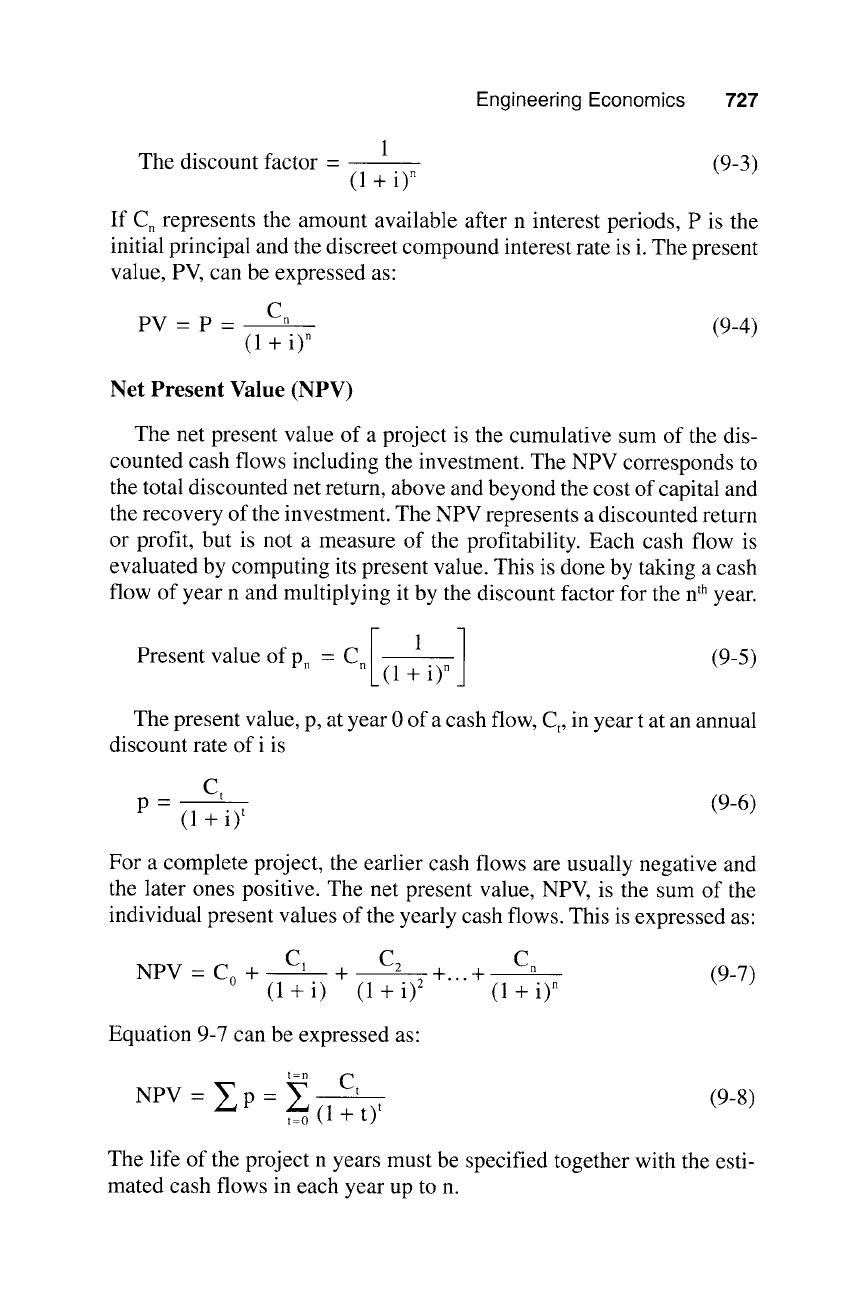
The discount factor =
(l+i) n
(9-3)
If C n represents the amount available after n interest periods, P is the
initial principal and the discreet compound interest rate is i. The present
value, PV, can be expressed as:
PV- P
= Cn
(9-4)
(l+i) n
Net Present Value (NPV)
The net present value of a project is the cumulative sum of the dis-
counted cash flows including the investment. The NPV corresponds to
the total discounted net return, above and beyond the cost of capital and
the recovery of the investment. The NPV represents a discounted return
or profit, but is not a measure of the profitability. Each cash flow is
evaluated by computing its present value. This is done by taking a cash
flow of year n and multiplying it by the discount factor for the n th year.
Presentvalue~ [ 1 In (l+i).
(9-5)
The present value, p, at year 0 of a cash flow,
Ct,
in year t at an annual
discount rate of i is
Ct
p = (9-6)
(l+i) t
For a complete project, the earlier cash flows are usually negative and
the later ones positive. The net present value, NPV, is the sum of the
individual present values of the yearly cash flows. This is expressed as:
C C 2 C n
NPV-C o+ ~ +~+...+~ (9-7)
(1 + i) (1
+ i) 2
(1 + i)"
Equation 9-7 can be expressed as:
Ct
NPV - ~p - )'
t=o (l+t
(9-8)
The life of the project n years must be specified together with the esti-
mated cash flows in each year up to n.
728 Fortran Programs for Chemical Process Design
NPV = net present value
C o = Initial investment
C n =
cash flow
n = year n
i = interest rate of return (ROI/100)
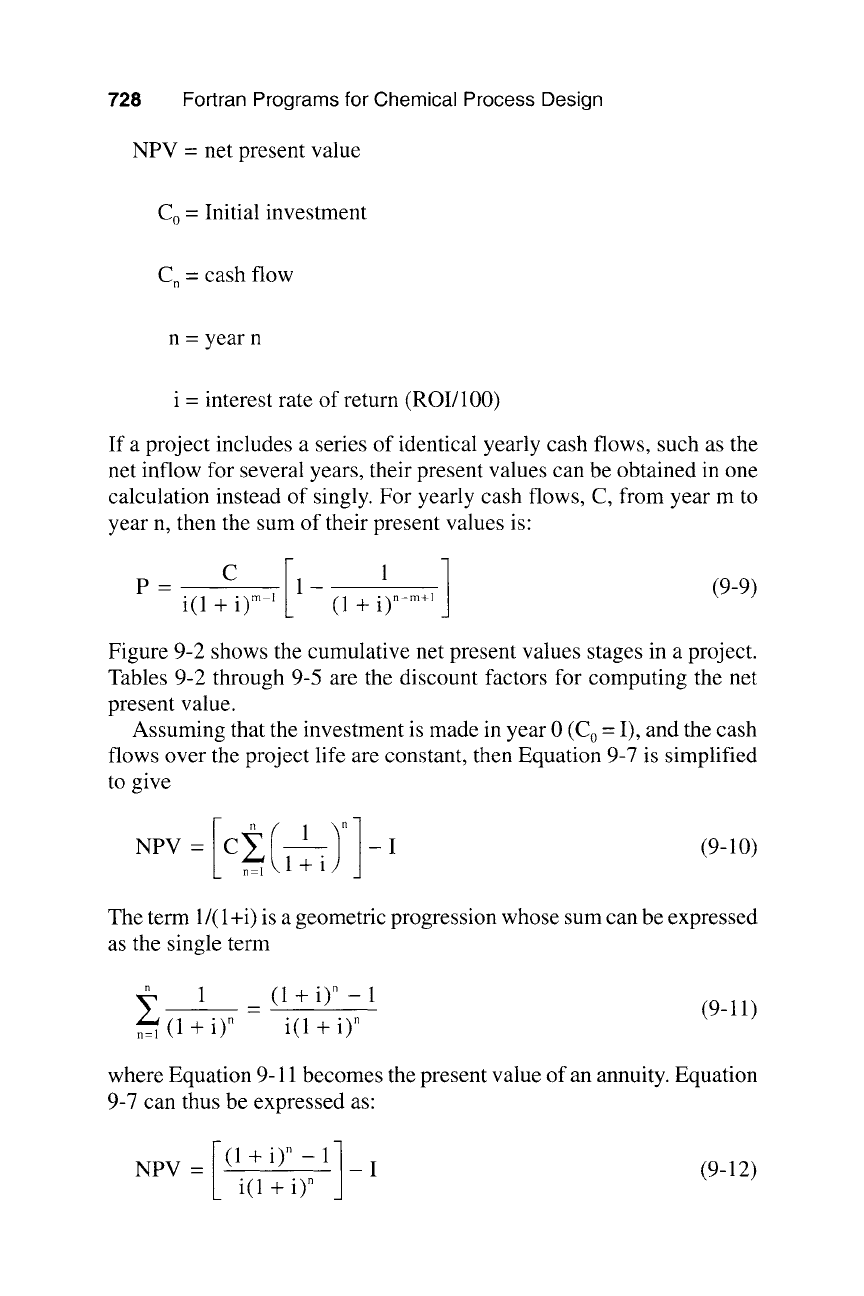
If a project includes a series of identical yearly cash flows, such as the
net inflow for several years, their present values can be obtained in one
calculation instead of singly. For yearly cash flows, C, from year m to
year n, then the sum of their present values is:
p= C 1
i(1
+ i) m-~
1 - (l+i)"-m+' (9-9)
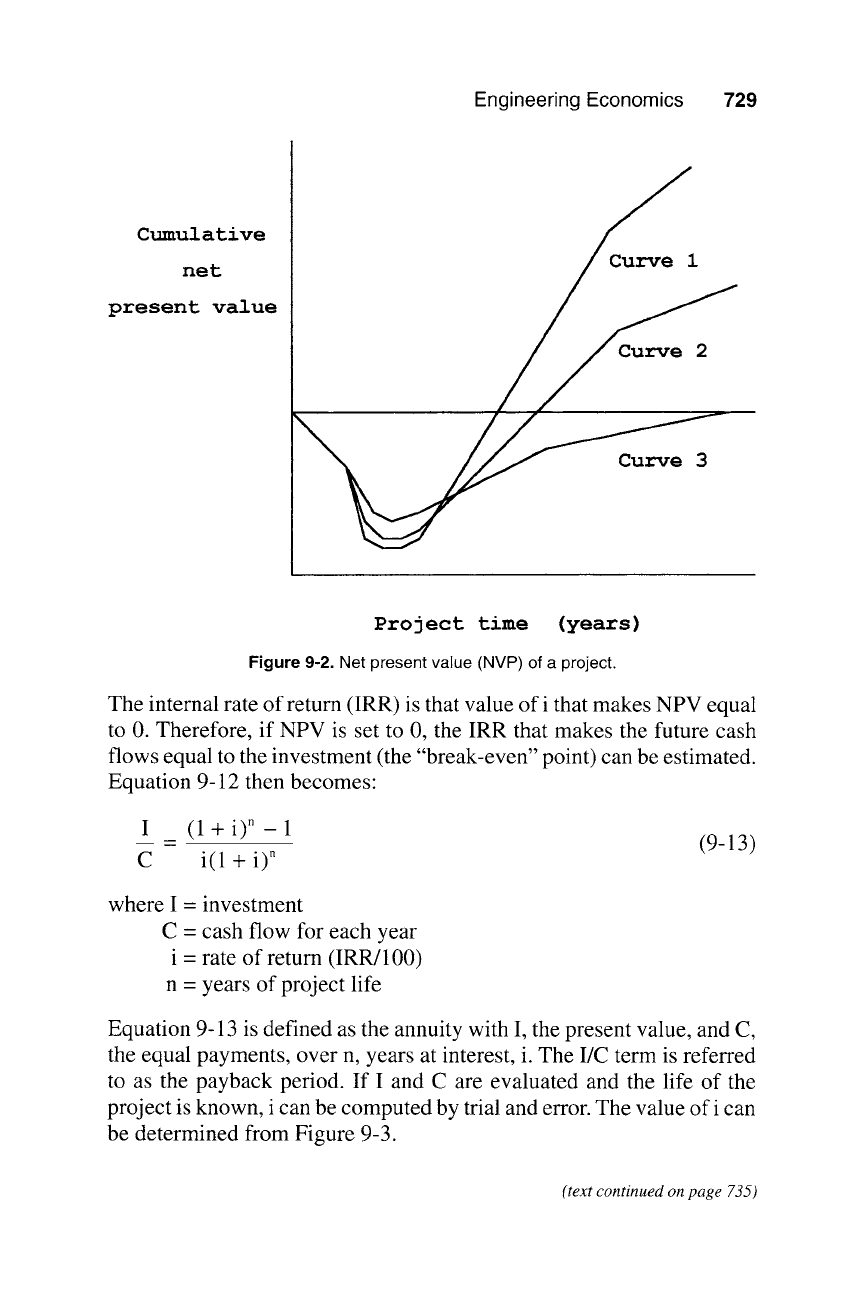
Figure 9-2 shows the cumulative net present values stages in a project.
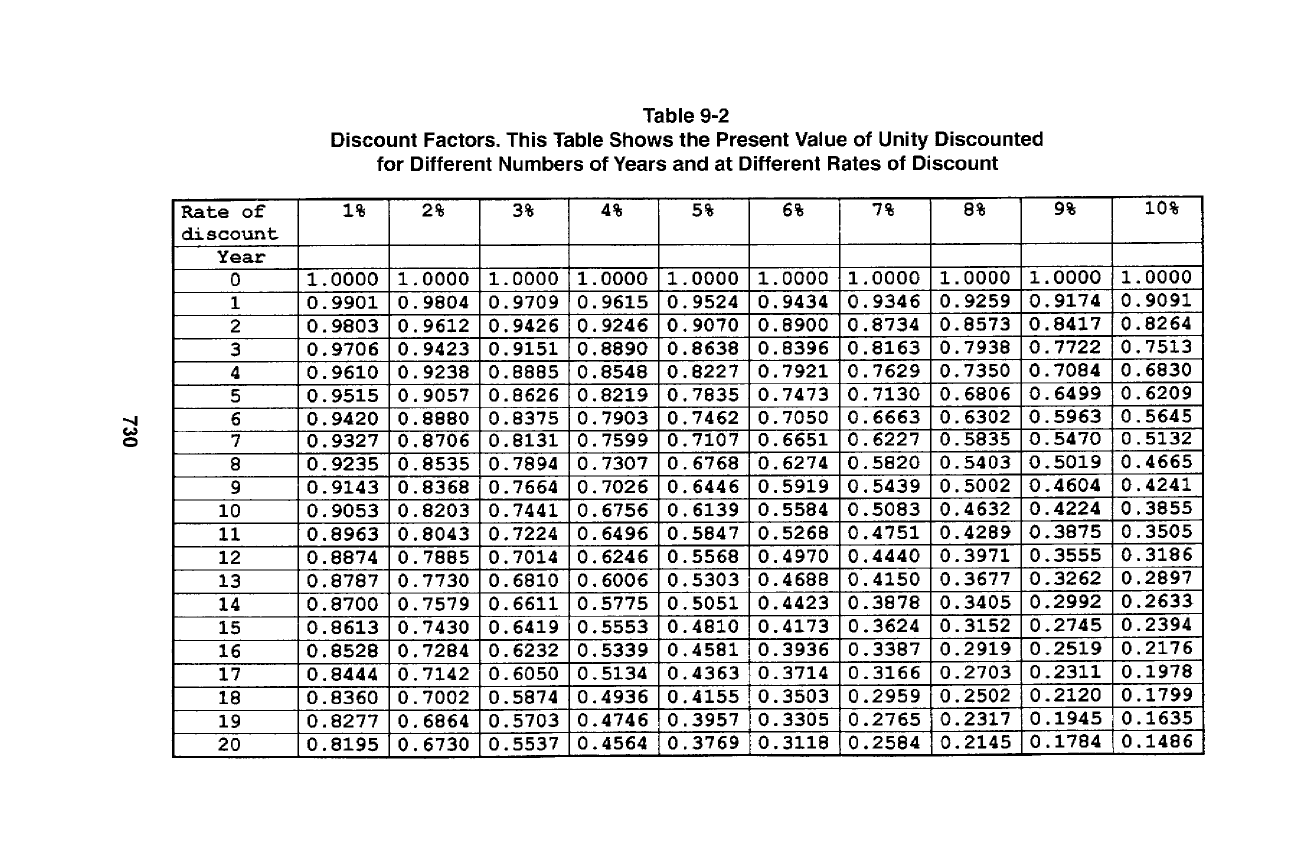
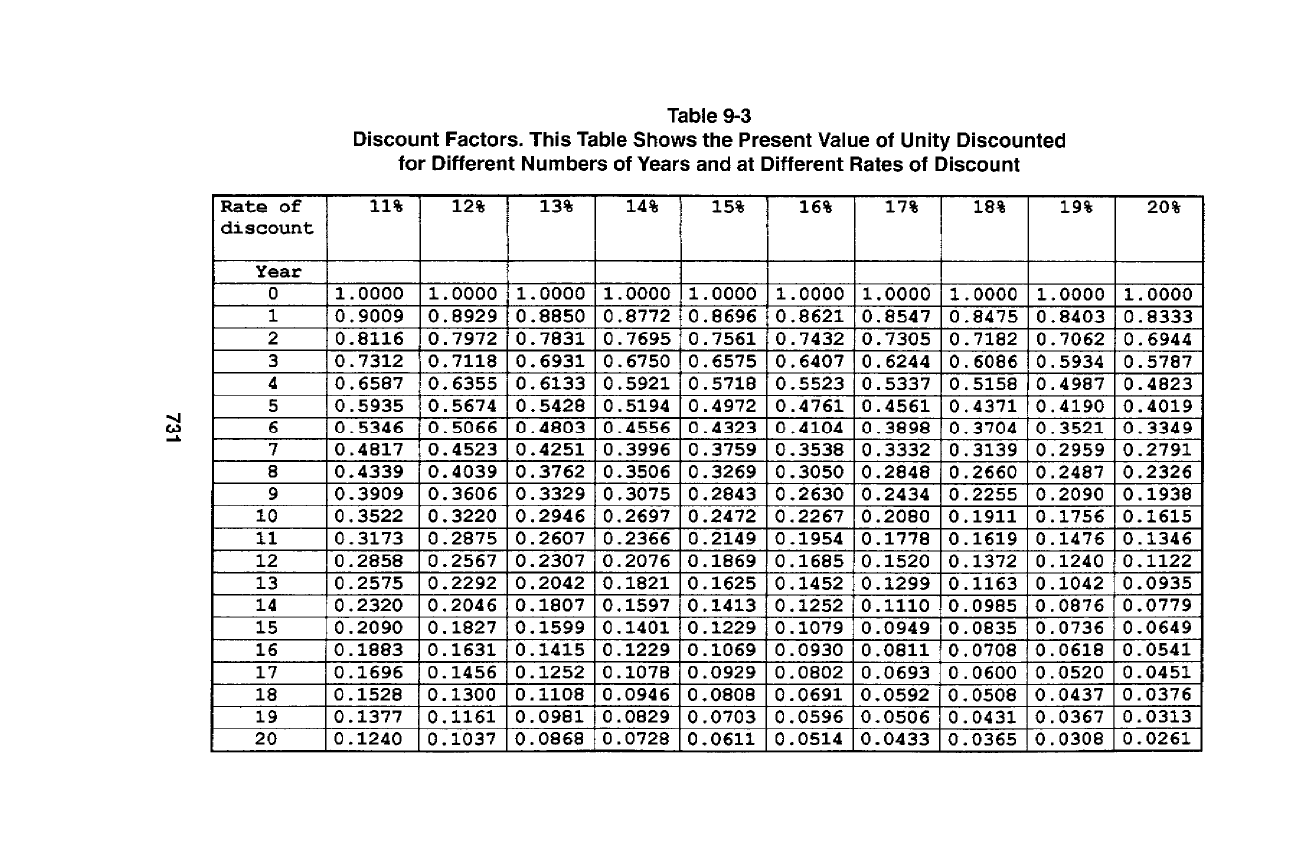
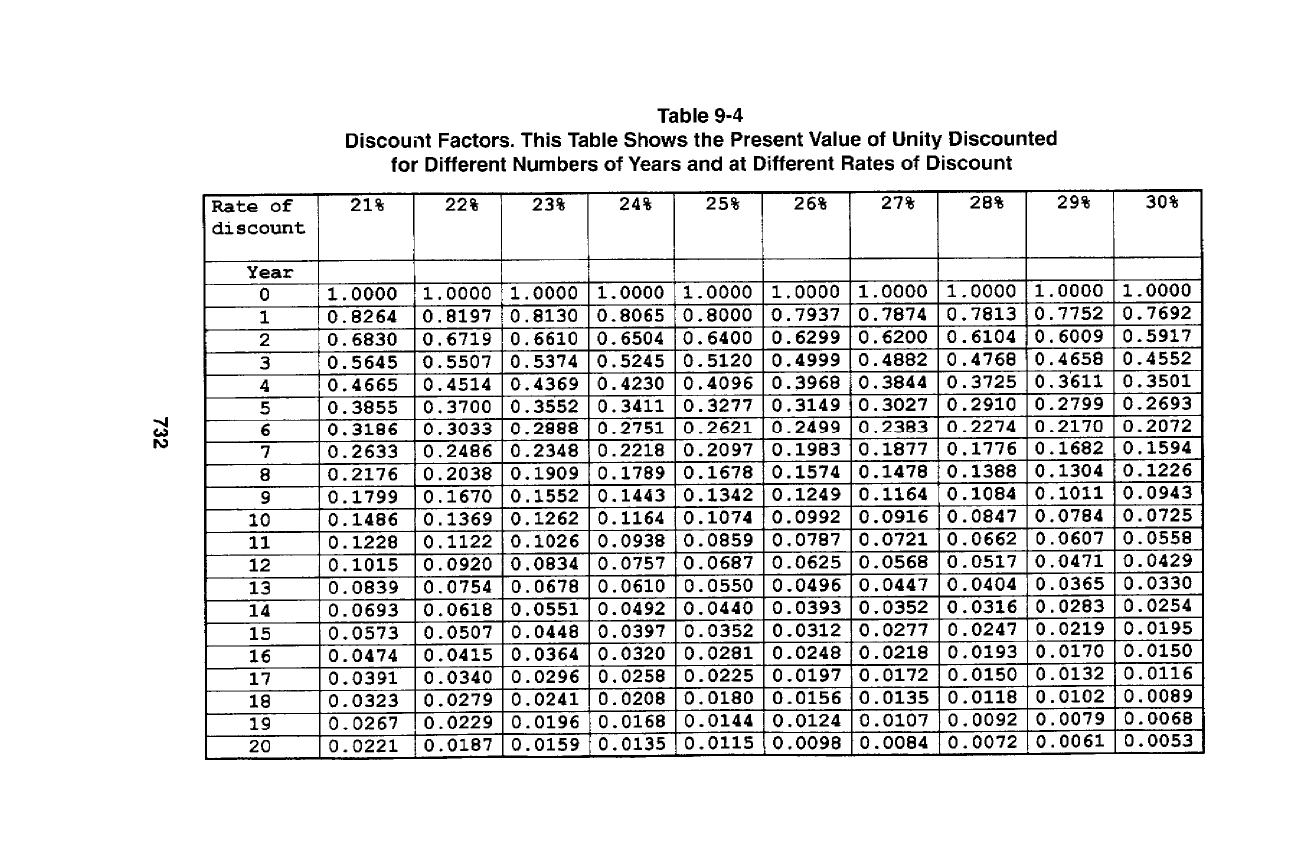
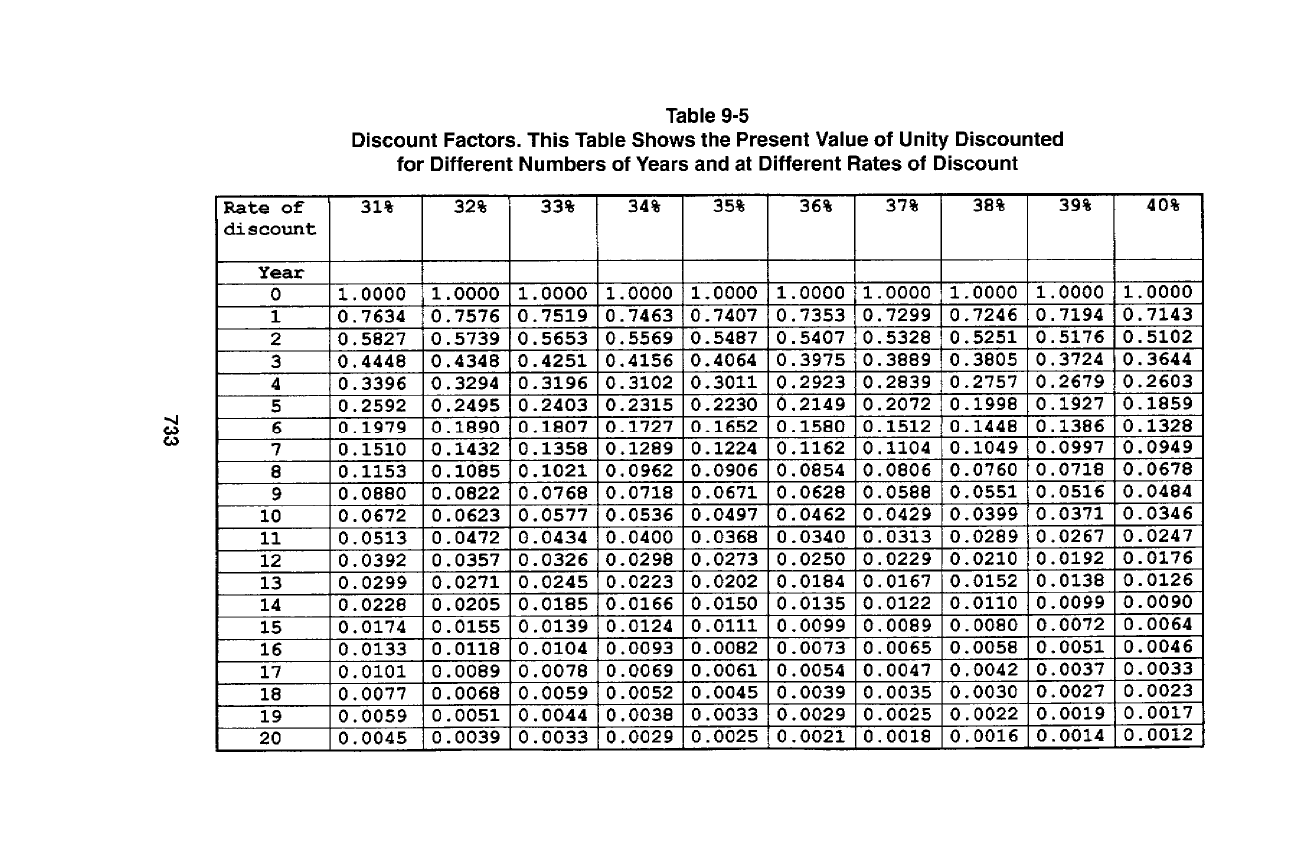
Tables 9-2 through 9-5 are the discount factors for computing the net
present value.
Assuming that the investment is made in year 0 (C o = I), and the cash
flows over the project life are constant, then Equation 9-7 is simplified
to give
NPV 1
n=l 1 +
i/n] I
(9-10)
The term 1/(1 +i) is a geometric progression whose sum can be expressed
as the single term
,•
1 (1 + i)" - 1
(9-11)
n=l (1 +
i)n i(1 + i) ~
where Equation 9-11 becomes the present value of an annuity. Equation
9-7 can thus be expressed as:
NPV-I(l+i)ni(l+i)n-ll-I
(9-12)
Engineering Economics 729
Cumulative
net
present value
Curve
3
Project time (years)
Figure 9-2. Net present value (NVP) of a project.
The internal rate of return (IRR) is that value of i that makes NPV equal
to 0. Therefore, if NPV is set to 0, the IRR that makes the future cash
flows equal to the investment (the "break-even" point) can be estimated.
Equation 9-12 then becomes:
I (1 + i)"-1
-- = (9-13)
C i(1 + i) ~
where I- investment
C - cash flow for each year
i- rate of return (IRR/100)
n- years of project life
Equation 9-13 is defined as the annuity with I, the present value, and C,
the equal payments, over n, years at interest, i. The I/C term is referred
to as the payback period. If I and C are evaluated and the life of the
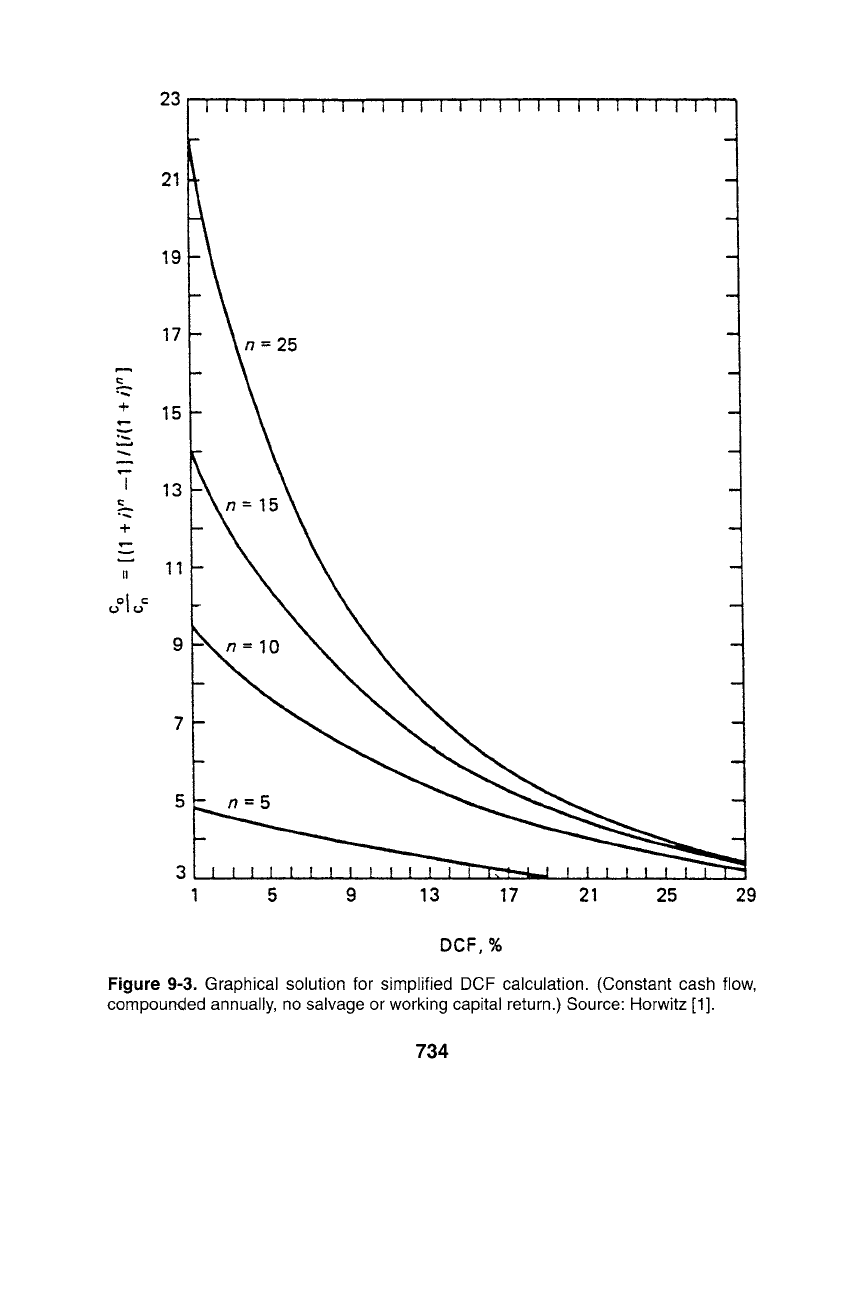
project is known, i can be computed by trial and error. The value of i can
be determined from Figure 9-3.
(text continued on page 735)
OP
0
"0
~ 0
'8
0 ~
U.
U
I3
.... I -"
0 0 041.0 IX) 0,1 '~0 rl ~00~1 IX) I-~ rl (X) %00") ,-I ¢~ ~'- ',.0 ',~
0 ~ (D t,. kO ,,,01.01.0 ~1, ,~1, 0") O") ('fl O~ 04 O~104 ,-I ,.4=~-.I ~-I
rl 0 0 0 0 0 0 0 0 0 0 0 0 0 0 0 0 0 0 0 0
.i ~i .1 ,1 .i ,i ,i ,i ,i $1 .i el ,I sl ~1 .i $1 ~1 ii .1 •
,,-I 0 0 0 0 0 0 0 0 0 0 0 0 0 0 0 0 0 0 0 0
0 lO ~- O~ I0000300 ~ ~D ~, 1"--, 0 IO ,,-,I 00 r-I ,~
00~ (X) ~'-. ~'- ,,.0 ,,.0 I.~ IX'I ~") ',~1, ',~1, O~ 0"1 ¢,%i030,104040.10~
"1
"1 '1
"1 ~1 "1 "I "1
"~ "~ "1 "1 "1
"1 "
~--I 0 0 0 0 0 0 0 0 0 010 0 0 0 0 0 0 0 0 0
,~ 0 0 0 0 0 0 0 00iO
0 '~ 0 %D ~1 {~ 0 r-I '~ O~ "~
0 ,~ O~ 03 (~ ,~ 0 kO Ol ~ U3
,-I 0 0 0 0 0 0 0~0 0 0
00~ ~ 03 Oq O~ ~OiO ~0 ,~ O~
0 ~ O~ ~0 ~0 ~it ~- "~ ~0 tO ~0
,-400001000000
0 r~ '~ O~ '~" 0 00~ u3
,-'400'010000000
0 ~ ~0 ,-III13 ~0 b3 ,-I ~ ,~p ,-I
.I
,-4000000000!0
0 0 ,-I O~ ~'I u'l ~0003 ~00
00~ ~o ,~ OI 0 (%) ~ LO 03 O~
00~ O~ O~ O~ O~ ~ O0 i~0 ~0 ~0
"I
,-40000000000
0 000 ,-I ,-,I ~ ~ ~T~,q~ b'3
010"1 ~0 ~ ~0 ~ '~" 0") 0~1 ~-~ 0
o~~~!o~,~
o o o o o o oioo o
~00~~~
0 0 0!0 0 0 0 0 0 0
~0~~~
~~ ~ ~00~
0 0~0 0 0 0 0 0 0 0
~~0~~
~0~~~
~0~~
0'0 0 0 0 0 0 0 0 0
~0
~ m~
0000000000
~ ~0~0~
~0~ ~0~ ~
0000000000
~0~0~~0
~~~0~
0~~0~ ~
0 0 0 0 0 0 0!0 0 0
~ ~ ~ 0 ~ ~ ~iO ~ ~
~0~ ~ ~
oooooooI~oo
O~ •
m
730
0
dO
0 ~
if)
Ii
,+- i
~ :el
l
4.1
!114
iO:3
0
!O 0"1 gl
!0 [i"1 i:~ 1,,.,. i~ 00rl I~ 03 O~ I~ i~ i-I!0,1 l'~ kO I.FI ,Ill, i',"1 0"1 (Xl
:00B '0 It) "~" 'I~ 0"101 Ol ,-I i-.I ,--I ,-I 0 0 O O 0 0 0 0
ie--I O O O O O O O O O O O O O O C) O O O O O
O tq Ol ,~P 1~ O r-I O~ !~ O ~O M) O O4 ~O ~O ~ OIl~ l~ OO
0
O GO ['~ IF) '~ ~1~ O~101 OI Ol rl e-4 e-4 e.-I O O O O C) O O
• -I 0 0 0 0 0 0 0 0 0 0 0 0 00iO 0 0 0 0 0
rt 0 O0 0 0 O0 0 0 0 0 O0 0 0 O0 0 0 0
0
o
0 000
,'-I 0 0 0 0!0 0 0 0 0:0 0 0 0 0 0 0 0 0 0 0
0 ~ [~ ~0 IO,~ ~ Or~ Or~ 04 Ol rl T.-.I r-I r,~ rl 0 0 0 0 0
r-40 O10 O O O O O O O O O O O O O O O O O
O i,O I1"11"~ O~ Cll 1~ Ol I~O ~@~ ~'10D ~ 04
O ~D l'~ t,O IO '~ "~ Orl:Orl O,101 CM r-I r.4 e-I ~,,-4 ~10 O O O
, ooloooooooooooooooooo
~oooooooooooooooooooo
, ooooooglooooooooooooo
00'l O~ ~1 (~ I0 0 1,1"1 i
'1
r-I O O O O O O O O O O O O O O O O O O O O
00~ i~ 1-'~- ~0 [0 i.~ ,,~I,,@ t~ o-i ('el Ol t-~ Ol Ol rl ,-.I ~1 ,....I ~
~-t 0 0 0 0 0 0 0 0 0 0 0 0 0 0 0 0 0!0 0 0
731
~o
0
O~
O~
"0
~o~
g
,,..o
o
0 O0
0
(~ 0
~J m
0 r'~ ~ 'q' ~ OI O~ ~'~ r'~ 000 00000000
,-4000o0o000o0o!oooo00010
0 0 . ~0
',..~ 0 0000 C) 0 000000000:0000
0 ~'~ ~0 ,~ ~'~ OI Ol!~-.; ,~ r~ 0 0000000000
r'~id 00000 O 0000000000000
00~ O~ ~0 ~000~ ~0 '~ ,~ O~ ~ ~0 '~" 0'~ O~ O~ ,"'~ ,"~ ,"~ 0
0 ~"~:~0 ,~ ~ I'~ OI ,r..~ r-~ ,r-I 00000000000
,~ c~o o o o o o o o o o o o o o o o oo o
0 ~'~ ~0 ,~ (~ ~q 04 ,-4 ,-.~ ,..~ 0 00 0000 00 00
r~O0 00000000 00000000 O0
0 O0 kO iO ,~ ¢~ O~ iN ,-~ ,-; ,-~ 0 0 0 0 0 0 0 0 0 0
,-~ 0 0 0 0 0 0 0 0 010 0 0 0 0 0 0 0 0 0 0
0 ~;'~0 ~0 ,~ fO (X; 0,1 ,-I ,-I ,-II0 0 0 0 0 0 0 0:0 0
,-.~ 00 00 00 0000 00000000 00
,---~ 000000000 00000000000
0 OD kO ~0 ,~ ("I ~ O~ O~ ~-~ ~-~ ,-~ 0 0 0 0:0 0 0 0 0
,--400000000000000000000
0 ~ ~ ~ ~ ~ ~ ~ ~ ~ ~ ~ 00 00 0000
"1
~ 000001000000000!00 0000
~0~~~0~~ ~~0
732
0
0 I~ I0 IT1 0,,I ~--I V-I 0 0 00iO 0 0 0 0 0 0 0 0 0
,'400000000000000000000
0~~~~~
O~~~~~~H
0 ~ ~ ~ ~ ~ ~i~ ~ ~ ~ ~ ~ ~ 000000~0
~ 0 ~i~ ~ ~ ~ ~!000iO 0000000000
~ o!o o o o o!o o o o o o o o o o o o o o
0o:
m
90-=
•
g
0~~0~0~00~0~
0 ~ ~ ~ ~ ~!~ 0 ~ ~ ~ ~ ~ ~ ~I000000
0 ~ ~ ~ ~ ~ ~ ~ 0000000:000000
~iO 0 0 0 0 0 0 0 0 0 0 0 0 0 0 0 0 0 0 0
0!~ ~ ~ ~ 0 ~ ~ ~ ~ ~ ~ ~ ~ ~ 000000
01~ ~ ~ ~ ~ ~ ~ 0000000000000
~00000000000000000000
0 ~ 0'~ ~ ~ ~ ~ ~ ~ ~ ~ ~ ~ ~ ~ ~ ~ ~
0~~~~000000
o~m~~ooooooooooooo
~ooooooooooioooooooooo
0 ~ ~l~ ~ 0 ~ ~ ~ ~ ~:~ ~ ~ 0 ~ ~ ~ ~ ~ ~
00~~0~~0~~~
0~00~~~~0~0000
O~ ~ ~ ~ ~ HO 0 O000000:00 O0
~ 0 O 0 0 0 00iO 0 0 0 0 0 0 0 0 g 0 old
O~ ~ ~ ~ ~ ~ ~0~ ~ ~ ~
0~0~~0~~~
0~~~~~00000
0 ~i~ ~ ~ ~ ~ ~ 0 0 0 0 0 0 0 0 0 0 0 0 0
~!oooo~!oooooooo~iooooo
0 ~!~ ~,~ ~ ~:~ ~ ~ ~ ~ ~ ~ ~ ~ ~ ~ ~ ~ ~
0 ~ ~ ~ 00~ ~ ~ ~ ~ ~0~ ~ ~ ~
0 ~ ~ ~ ~ O~ ~ ~ ~ ~ ~ 0000
0~~~000000000000
~ 000000000001000000000
0~~0~~~~
0~~~~0~~
0~~0~~~0000
0~~~000000000,000
~00000000000000000000
0~~~000000000000
I
~ 0 0 0 0 0 0 010 0 0 0 0 0:0 0 0 0 0 0 0
m
W
733
23Li ii
1 1 1 I I i I 1 i ..... I I I 1 'i' 1 I I' I I
I I I
21
19
17
A
+ 15
I
13
+
, 1 1
n= 25
n=lO
n-5
1 5 9 13 17 21 25 29
DCF, %
Figure 9-3. Graphical solution for simplified DCF calculation. (Constant cash flow,
compounded annually, no salvage or working capital return.) Source: Horwitz [1].
734
Engineering Economics 735
(text continued from page 729)
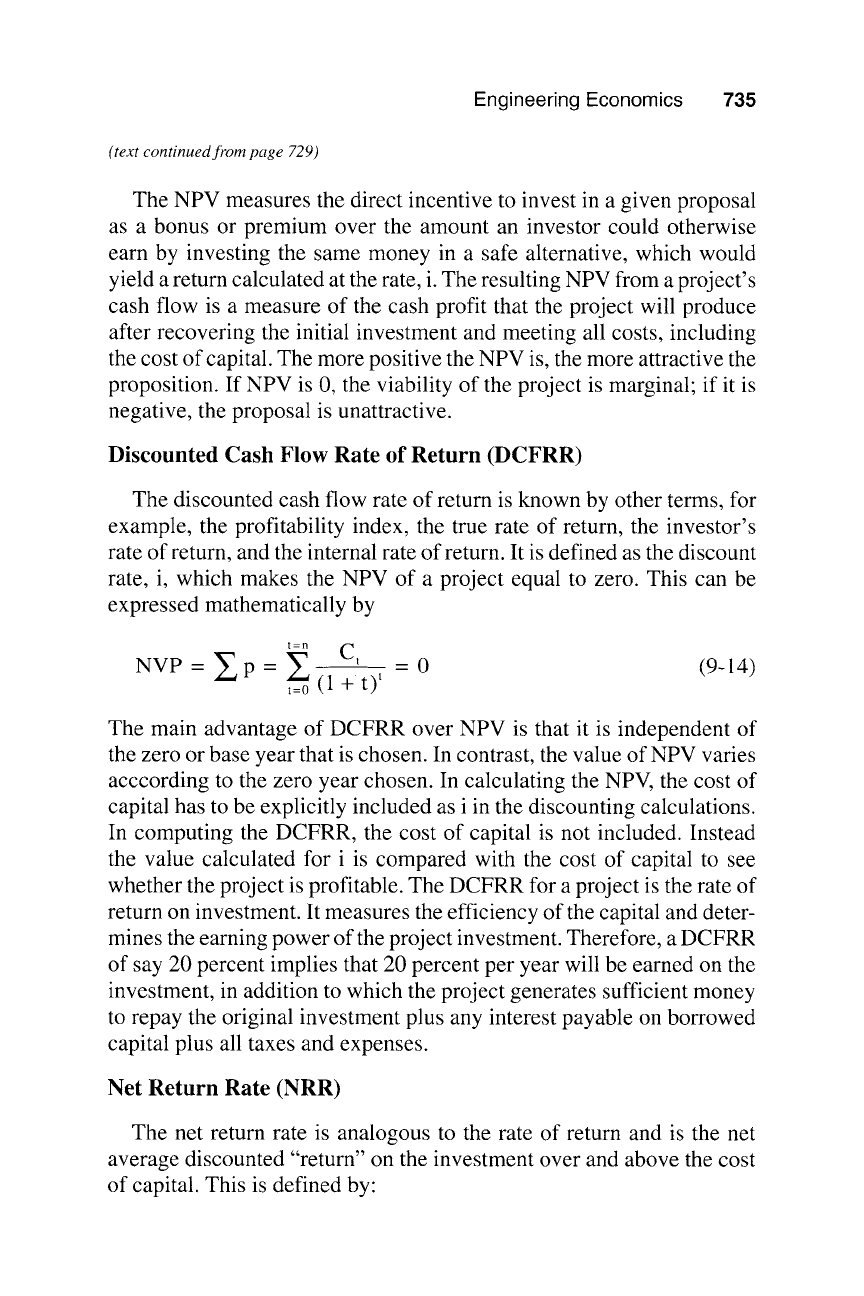
The NPV measures the direct incentive to invest in a given proposal
as a bonus or premium over the amount an investor could otherwise
earn by investing the same money in a safe alternative, which would
yield a return calculated at the rate, i. The resulting NPV from a project's
cash flow is a measure of the cash profit that the project will produce
after recovering the initial investment and meeting all costs, including
the cost of capital. The more positive the NPV is, the more attractive the
proposition. If NPV is 0, the viability of the project is marginal; if it is
negative, the proposal is unattractive.
Discounted Cash Flow Rate of Return (DCFRR)
The discounted cash flow rate of return is known by other terms, for
example, the profitability index, the true rate of return, the investor's
rate of return, and the internal rate of return. It is defined as the discount
rate, i, which makes the NPV of a project equal to zero. This can be
expressed mathematically by
Ct
NVP - Z p
- )t
t:O
(1
+:t
= 0 (9-14)
The main advantage of DCFRR over NPV is that it is independent of
the zero or base year that is chosen. In contrast, the value of NPV varies
acccording to the zero year chosen. In calculating the NPV, the cost of
capital has to be explicitly included as i in the discounting calculations.
In computing the DCFRR, the cost of capital is not included. Instead
the value calculated for i is compared with the cost of capital to see
whether the project is profitable. The DCFRR for a project is the rate of
return on investment. It measures the efficiency of the capital and deter-
mines the earning power of the project investment. Therefore, a DCFRR
of say 20 percent implies that 20 percent per year will be earned on the
investment, in addition to which the project generates sufficient money
to repay the original investment plus any interest payable on borrowed
capital plus all taxes and expenses.
Net Return Rate (NRR)
The net return rate is analogous to the rate of return and is the net
average discounted "return" on the investment over and above the cost
of capital. This is defined by:
736
Fortran Programs for Chemical Process Design
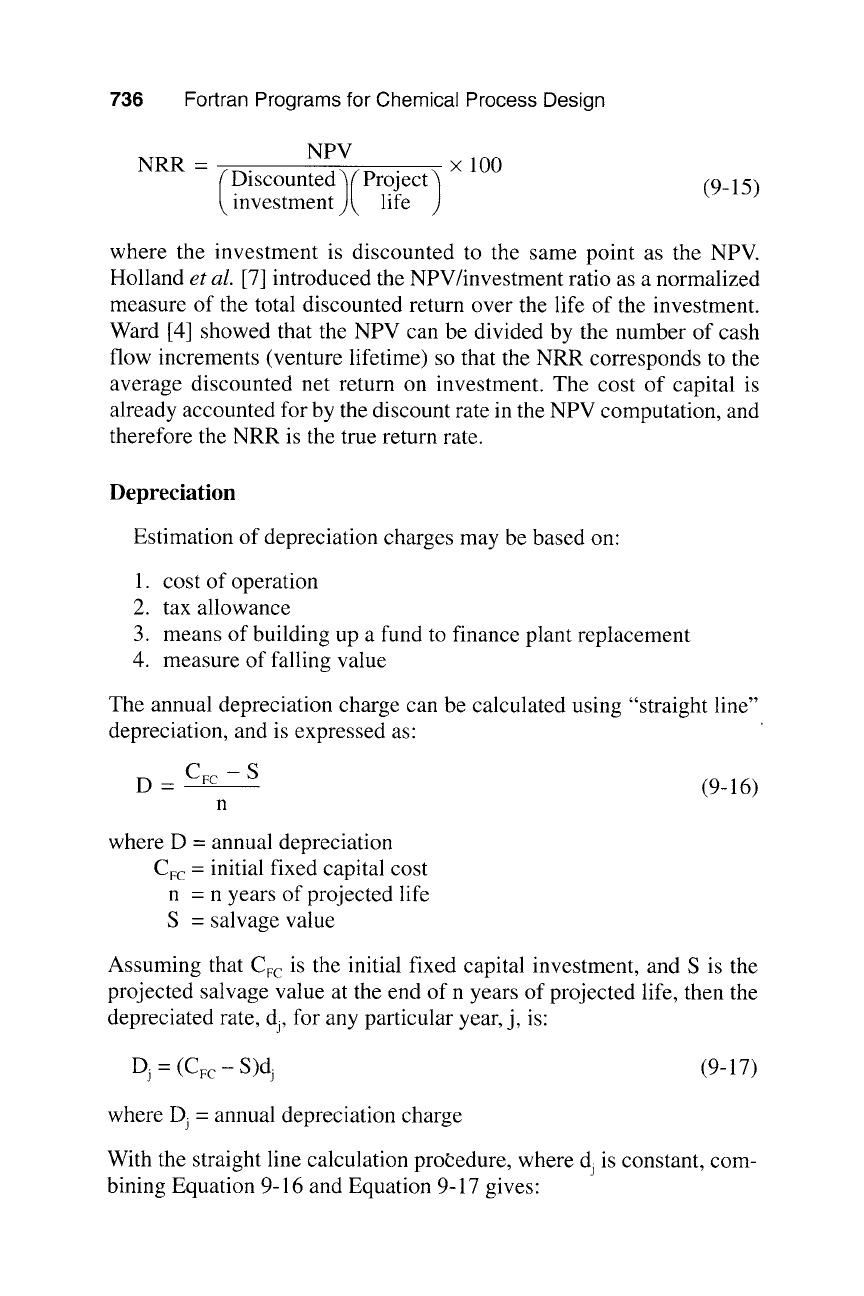
NPV
NRR
-
(Discounted
investment/( Pr~ /
x 100
(9-15)
where the investment is discounted to the same point as the NPV.
Holland
et al.
[7] introduced the NPV/investment ratio as a normalized
measure of the total discounted return over the life of the investment.
Ward [4] showed that the NPV can be divided by the number of cash
flow increments (venture lifetime) so that the NRR corresponds to the
average discounted net return on investment. The cost of capital is
already accounted for by the discount rate in the NPV computation, and
therefore the NRR is the true return rate.
Depreciation
Estimation of depreciation charges may be based on:
1. cost of operation
2. tax allowance
3. means of building up a fund to finance plant replacement
4. measure of falling value
The annual depreciation charge can be calculated using "straight line"
depreciation, and is expressed as:
D - CFc - S (9-16)
where D = annual depreciation
CFc = initial fixed capital cost
n = n years of projected life
S = salvage value
Assuming that CFc is the initial fixed capital investment, and S is the
projected salvage value at the end of n years of projected life, then the
depreciated rate, dj, for any particular year, j, is"
Dj - (CFc - S)dj (9-17)
where Dj = annual depreciation charge
With the straight line calculation proeedure, where dj is constant, com-
bining Equation 9-16 and Equation 9-17 gives: