
Darwin J. The Empire Project. The Rise and Fall of the British World-System, 1830-1970
Подождите немного. Документ загружается.

75 / The octopus power
meant to achieve a brisk reconstruction of Egyptian politics, locking
out ‘disruptive’ elements and allowing Tewfik to organise a govern-
ment committed to financial and political ‘reform’. Once a safe regime
was firmly installed in Cairo, repaying its debts under the eye of the
international Caisse de la Dette, the British could revert to their old
policy of influence and their old partnership with France. But nothing
went according to plan. It soon became clear that facile constitutional
schemes (like the Dufferin report of 1883) would collapse as soon as
the British garrison left Cairo. The internal crisis brought by economic
change and deepened by foreign interference, was much too severe to be
solved by a Whig formula. Amid all the promises of British withdrawal,
Egyptian politicians were understandably reluctant to ally themselves
to a transient force. Then, within a year of the British invasion, the
Mahdist revolt in Egypt’s vast southern colony of the Sudan – a posses-
sion which meant as much to Cairo as India to London – threatened to
destabilise Egypt’s politics still further and spread rebellion in its upper
provinces.
35
As these complications were rubbed in by Evelyn Baring,
the British Agent at Cairo, the date for withdrawal receded until, by
1889, the occupation, however ‘temporary’, had become indefinite.
36
The British now feared to leave because they were convinced
that a chaos worse than that of 1882 would follow. The logic of inter-
vention had become the logic of control. The strategic and diplomatic
cost of this discovery was bound to be high. Turning Egypt into a vir-
tual colony broke every rule of imperial expansion. Thus far, Britain’s
movement into the Outer World beyond Europe had served to insulate
her interests more and more from the play of intra-European rivalry.
Except in India (which had its own army and paid for British ‘help’),
access to Britain’s colonies and spheres was by the open sea, the element
where her strategic advantage was greatest. This pattern of maritime
expansion allowed the British to localise their conflicts and even to
choose between fighting limited or unlimited wars. But Egypt was an
exposed salient on the rim of Europe, a great hostage to diplomatic
fortune. As the Ottoman Empire sank towards collapse, the eastern
Mediterranean became the cockpit of European politics. It was one
thing to organise a diplomatic defence of Turkey in the style of Palmer-
ston, quite another to protect a territorial stake as large and important
as Egypt. The British dared not lower their guard lest a sudden crisis
bring on partition and wreck their status in Cairo. The price was relent-
less pressure on their naval power, already strained by technical change
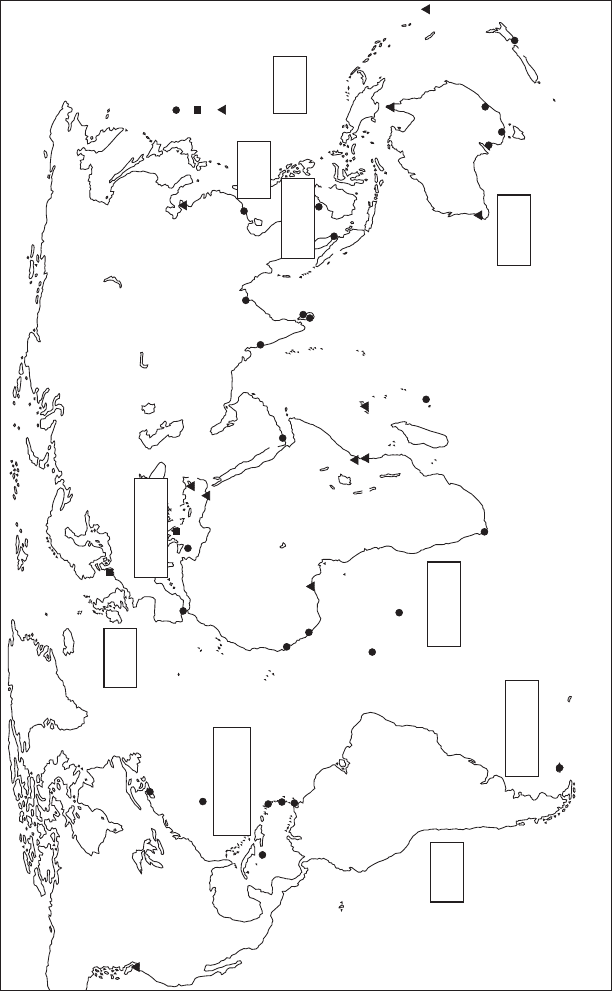
Pacific
North America
and West Indies
15
15
8
9
South America
5
4
Home
52
15
Mediterranean
18
38
Cape and
West Africa
11
20
Australia
11
16
East Indies
13
10
China
22
27
Home
52
15
1875
1898
Gambia
Sierra Leone
P. Burroughs
In 1875 the total number of ships in commission was 241, of which 20 were ships
of the line. Naval estimates amounted to about £9.5m and some 34,000 seamen,
boys, and marines were employed.
In 1898 the total number of ships in commission was 287, of which 52 were battleships.
Naval estimates amounted to about £23.8m and some 97,000 seamen, boys, and marines were employed.
Lagos
Ascension
St Helena
Cape Town
Falkland Islands
Trinidad
Jamaica
St Lucia
Antigua
Bermuda
Halifax
Esquimalt
Gibraltar
Heligoland
Ionian Islands
Malta
Alexandria
Cyprus
Mombasa
Aden
Zanzibar
Seychelles
Mauritius
Bombay
Calcutta
Colombo
Trincomalee
Singapore
Hong Kong
Weihaiwai
Labuan
Cape York
Fiji
Albany
Melbourne
Adelaide
Sydney
Wellington
Number of ships
based on station
Bases 1848 & 1898
Bases in 1848
relinquished by 1898
Additional bases
acquired by 1898
Source: A.N. Porter, Atlas of British Expansion
Map 4 The Royal Navy and its stations, 1875 and 1898
77 / The octopus power
and the building programme of France. Between 1885 and 1890,the
Royal Navy kept six first-class battleships in the Mediterranean. In
the fretful 1890s, the number rose to ten and, by 1902, to fourteen.
37
The naval ‘scare’ became endemic and drove spending higher and
higher: from £10.6 million in 1882 to £24 million by 1899. Even so,
after 1893, fear of naval inferiority in the Mediterranean Sea was a gov-
erning factor in British policy. The sense of being dragged willy-nilly
into a dangerous, expensive and inflexible commitment explains much
of the continuing anger of the Gladstonians (until the mid-1890s) at
what they regarded as the Egyptian folly.
Strategic insecurity placed a huge premium on diplomatic
finesse. From the beginning, the British found themselves paying a
diplomatic ransom for the occupation, and Egypt became, bizarrely,
the fulcrum of their world policy. Having claimed a European mandate
to reorganise Egypt’s finances, the British were pressed by France and
Germany (both with seats on the international Caisse which controlled
part of Egypt’s budget) to compensate the bondholders without delay.
They pressed for wider international supervision of Egyptian finances,
denounced the charge the British levied on Cairo for the cost of their
garrison and threatened an international enquiry into the fiasco of the
Sudan campaign. The British were to pay dearly for the privilege of
staying. The result of this pressure was soon visible. To appease the
Germans (who had less at stake financially), Gladstone referred a crop
of colonial disputes to a congress in Berlin in 1884. There Bismarck
wielded his baton Egyptien to good effect. To break the Franco-German
combination and escape the general displeasure of Europe, the British
abandoned a shoal of colonial claims. At a stroke, Bismarck gained an
embryo empire in West, East and Southwest Africa and in the Pacific.
To his lackey, the filibuster king of the Belgians, Leopold II, fell a
giant crumb from the diplomats’ table: the Congo basin. The British
took their reward in the easing of financial and diplomatic pressure on
Egypt.
38
This was just the first round, for the partition of Africa, like
the reform of Egypt, had hardly begun. The real task of managing
Britain’s ungainly new commitment fell to Lord Salisbury, the supremo
of foreign policy between 1886 and 1892 and from 1895 to 1900
when he was both Prime Minister and Foreign Secretary. (He remained
Prime Minister until 1902 but gave up the Foreign Office in 1900).
Salisbury was greatly helped by the ruthless skill with which Evelyn
78 / Towards ‘The Sceptre of the World’
Baring (later Lord Cromer) created a ‘veiled protectorate’ in Egypt
to minimise open dissent. Baring’s ‘system’ preserved the fiction of
Egyptian autonomy. But it rested on the tacit knowledge of the Egyptian
ruler that defiance would mean deposition; on the studied manipulation
of Egypt’s internal stresses; and on the systematic infiltration of the
government by British ‘advisers’ who were Baring’s eyes and ears. With
unrivalled political intelligence, a British garrison (of 6,000 men), a
reorganised local army under British officers, and an extraordinary hold
over his political masters in London (a measure of their trust), Baring
was able to restore Egypt’s solvency (by 1890) and ride out the crises
of his eccentric regime.
39
Salisbury’s other advantage lay in the chronic
mistrust between France and Germany and the gradual emergence of
two rival diplomatic groupings: Germany, Austria-Hungary and Italy
on one side; France and Russia (after 1892) on the other. But he faced
the constant risk that another crisis in the Near East might unite the
continental powers behind a scheme of partition whose victim (apart
from the Sultan) would be Britain’s strategic link with India.
By outlook and training, Salisbury was well suited to this game
of diplomatic poker. He took a disenchanted, ironic view of human
motive. He mistrusted enthusiasm and laughed at nationalism (‘the
philological law of nations’
40
). But he had thought deeply about state-
craft and saw the virtue of an active policy in Europe.
41
‘Sleepless
tact, immovable calmness and patience’
42
he deemed the secret of suc-
cess; the diplomat’s victories were ‘made up of a series of microscopic
advantages . . . .’ ‘Serene, impassive intelligence’ was the mark of the
statesman.
43
Salisbury regarded foreign policy as a realm of technical exper-
tise ill-suited to wayward cabinets let alone the rough and tumble of
electoral politics.
44
He preferred to work in secrecy with a small group
of aides. From his room in the Foreign Office or at Hatfield, his country
house near London, he kept a close, obsessive watch on the cauldron of
Near East diplomacy and the manoeuvres of his European counterparts.
He held the threads of policy tightly in his grasp. In the ‘inner zone’ of
British policy, the security corridor to India, his authority was not eas-
ily challenged. The ‘official’ interest in India and Egypt was under his
command; occupation had soothed the Egyptian bondholders. Public
hostility to Turkey aroused by new Armenian ‘Horrors’ was the main
constraint. But, in the ‘outer zone’ beyond, where diplomacy grappled
with unofficial colonialism, his grip was less sure.
79 / The octopus power
Yet Salisbury’s whole policy depended upon the careful bal-
ance between the needs of Egypt and the Near East, where Britain was
most vulnerable, and British interests in other regions of the Outer
World. In essence, his technique was to use the open spaces and ‘light
soil’ of tropical Africa to appease France and Germany, soften their
irritation at Britain’s unwarranted primacy in Cairo and stave off an
anti-British coalition among the continental powers. This was easier
said than done. By the 1880s, unofficial or commercial interest in
African hinterlands was growing rapidly. In Senegal and the Upper
Niger, the military sub-imperialism of the French colonial army was on
the march.
45
Rival groups of traders, missionaries and private imperial-
ists were soon jostling each other and scrambling for ‘treaties’ granting
commercial, mineral or religious rights. Worse still, they were remark-
ably deft at rallying public support at home for ventures easily repack-
aged as crusades against slavery or for the promotion of Christianity
through commerce.
To Salisbury, the result seemed a nightmare of misguided if
not fraudulent expansionism. At best it might be managed: it could
not be suppressed. Left untended, it threatened to wreck the finger-
tip delicacy with which he steered between the rival great power
combinations. It might drive him into unwelcome friendships and
towards unwanted confrontations. Many years before, ruminating
on the sources of friction in European politics, he had argued that,
when a state had become ‘permanently anarchical and defenceless’,
its neighbours for self-preservation must impose a ‘tutelage of ambas-
sadors . . . or . . . partition’.
46
This insight he now applied to anarchic,
defenceless Africa. The aim of policy must be to damp down the quar-
rels of Europe’s frontiersmen by an equitable partition of spheres before
they could inflame opinion and damage the interests that really mat-
tered. To this most detached observer of human foibles, with his gloomy
view of the burdens on British power, it seemed obvious that the diplo-
matic defence of Egypt depended upon a cartographic fantasy: the
parcelling-up of Africa.
Salisbury may have been the grand architect of African par-
tition, applying his diplomatic method to regions as remote and
unknown, he once said, as the ‘far side of the moon’. But he had
to tread carefully round vociferous ‘interests’ at home, and ruthless
empire-builders on the ground like Goldie and Rhodes. Without the
means (and perhaps the confidence) to counter their mastery of the
80 / Towards ‘The Sceptre of the World’
press, he took a fatalistic view of public opinion. ‘I once told Salis-
bury’, wrote the German ambassador, ‘that it seemed to be the Govern-
ment’s duty to lead public opinion. He replied that this was harder than
I appeared to realise.’
47
Whatever his reservations about the methods
and mentality of the private imperialists, he had little choice but to press
on behalf of their claims. He mixed the careful palliation of Germany
(exchanging Heligoland for Zanzibar) with the brutal coercion of Por-
tugal (both in 1890). Portugal’s claims in what is now Zimbabwe were
dismissed with a growl – in favour of Rhodes. The contest with France,
which had greater strength on the spot and, after 1892, an alliance with
Russia, required much more finesse. Salisbury could not afford to let the
French officiers soudanais and their ragtag black army hem in British
interests on the West African coast and deny them their hinterland;
or risk an armed struggle between them and Goldie’s pale imitation
of the East India Company (Salisbury was scornful of Goldie’s Clive-
like pretensions). Nor could he permit a French forward move into the
southern Sudan, in case their arrival coincided with the expected col-
lapse of the Mahdist regime in Khartoum. A French-ruled Sudan would
have wrecked Cromer in Egypt. In the West African case, despite much
bad-tempered diplomacy and some sabre-rattling in the bush, Salisbury
largely achieved the partition he wanted. In the Sudan, his victory was
much more complete. There Kitchener’s (Anglo-Egyptian) army, with
its light railways and steam launches, decisively smashed the Mahdist
regime and captured Khartoum (in September 1898). With Marchand’s
tiny force at Fashoda hugely outnumbered, and the Royal Navy assem-
bling in the English Channel, Paris abandoned its claim to the Upper
Nile Valley.
Salisbury’s triumph had been three-fold. He had secured
Britain’s position in Egypt, the strategic hinge of Anglo-Indian defence,
without drawing down on his head a continental coalition. The price
he had paid in African claims had been surprisingly light, guarding his
flank against an outcry at home. Above all, he had avoided the diplo-
matic and military setbacks that dogged Disraeli and Gladstone and
threatened electoral disaster. But, by the late 1890s, for all his success
at Fashoda, it was no longer so clear that his deft combination of British
strength on the ground, with an agile diplomacy and Britain’s naval
deterrent could protect British interests against the threat of attrition.
The main reason for this was the sudden emergence of a new
epicentre of extra-European upheaval. China’s shattering defeat by
Japan in 1895 signalled a political bankruptcy as complete as that of
81 / The octopus power
the Ottomans twenty years before. The break-up of the Ch’ing empire
seemed imminent. Even more alarming from the British point of view
was the formation of the ‘Far Eastern Triplice’ – a coalition of Ger-
many, France and Russia – to strip Japan of her spoils and impose their
own terms for China’s survival. Britain’s commercial interests were
centred on Shanghai and the Yangtse valley but spread out all over
China. Neither Kwangtung in the south (the hinterland behind Hong
Kong) nor North China and Peking could easily be given up. But with
France looking north from Indochina, Russia south from the Amur, and
German interest in Shantung, the British faced a squeeze and Salisbury
a dilemma. He could fall in with an agreed partition and make the
best terms he could. He could challenge the other powers to an open
competition for the spheres and concessions which the Chinese offered
in return for loans. Or he could hang back and wait, hoping the crisis
would pass.
Salisbury’s instinct was to wait. An early agreement with Britain
isolated and the Triplice in harmony would be expensive and perhaps
unacceptable to his colleagues and public opinion. An open competi-
tion risked extending the Triplice to the Near East, exposing the core of
his system to the danger he tried most to avoid, and at a moment when
the Armenian crisis and Anglo-French rivalry in Africa were coming
to a head. ‘In Asia there is room for us all’, he soothed in November
1896.
48
But delay was not an easy option. Salisbury’s caution was out
of tune with the mounting excitement among the British in China and
their sympathisers at home. The Asia-Pacific had replaced the Near
East and tropical Africa as the platform for imperial publicists and
commercial alarmists. The young George Curzon, patrician, politician,
scholar, traveller and ‘coming man’, proclaimed the Far East to be
the only region left where British manufacturers could find and keep
an open market.
49
In the Transformation of China (1898), Archibald
Colquhoun insisted that only in China could Britain hope to expand her
Asian commerce and strengthen her position. The Times correspondent
in China, George Morrison, regaled his foreign editor with dire warn-
ings of French and Russian advance, while Chirol raged back against
Salisbury’s ‘infirmities’ and the ‘blundering and lying in which Down-
ing Street excels’.
50
Inside the Cabinet, Joseph Chamberlain pressed
for a more forceful policy:
51
outside it he intrigued for an ill-fated
German alliance. Under this barrage, Salisbury moved crabwise. Peking
was asked to promise that no territorial rights would be granted away
in the Yangtse valley. Russian, French and German acquisitions were
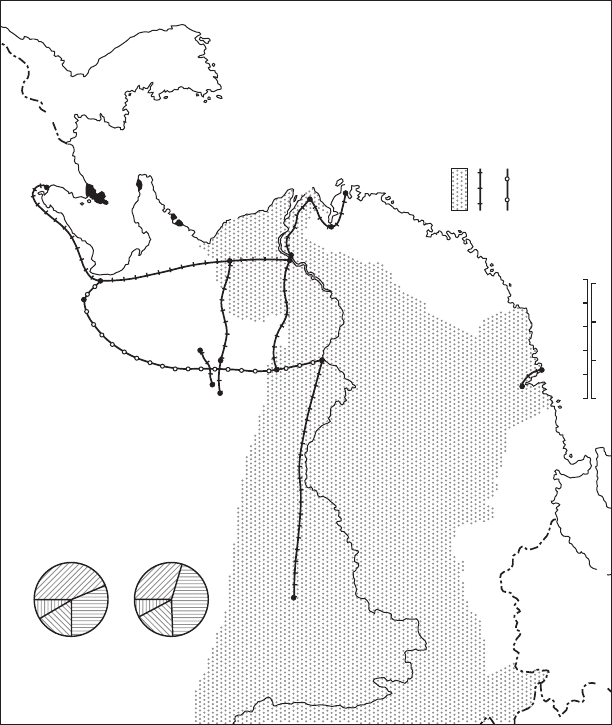
0
0
200 400
100 200 300 miles
500 km300100
FRENCH INDO-CHINA
Hong Kong
Canton
Ningpo
Shanghai
Hangchow
Nanking
Hankow
Sinyang
Chengtu
Y
a
n
g
t
z
e
R
i
v
e
r
Suchow
Kaifeng
Taokow
Tiensin
Peking
Newchwang
Tsechow
Honan
Pukou
1
2
3
4
K
O
R
E
A
ORIGINS OF IMPORTS INTO CHINA
1898
1913
Hong Kong
44%
India 9%
UK 16%
Others 31%
Hong Kong
29%
Others 46%
UK 17%
India 8%
TERRITORIES LEASED IN 1898
1. Port Arthur (to Russia)
2. Weihaiwei (to Britain)
3. Kiaochow (to Germany)
4. Kowloon New Territories (to Britain)
British sphere of influence
British railways and railway
concessions
Belgian railway concessions
Source: A.N. Porter, Atlas of British Expansion
Map 5 Britain’s position in China, 1900
83 / The octopus power
‘balanced’ by a British base at Wei-hai-wei in North China and the
extension of Hong Kong into the ‘New Territories’. But Salisbury
also tried to reduce the danger of friction with Russia (his main fear)
by acknowledging her claim to priority in Manchuria in the Scott-
Muraviev agreement in 1899. If Russia, as France’s ally, had nothing
to gain from quarrelling with Britain, so he reasoned, there was lit-
tle danger of Anglo-French antagonism in the Near East and Africa
spilling over into war. This was an approach already vindicated by the
French retreat in the Fashoda crisis and the successful resolution of
Anglo-French differences in West Africa. But, in the middle of 1900,as
Britain became ever more deeply embroiled in the South African War,
the Boxer Rising and its xenophobic challenge to all foreign interests in
China threatened to unite Britain’s rivals in a general partition of the
Ch’ing empire. ‘Her Majesty’s Government’, Salisbury told his min-
ister at Peking with gloomy understatement, ‘view with uneasiness a
“concert of Europe” in China.’
52
As it turned out, the Chinese were too resilient and the Euro-
peans too divided to permit a replay of the African partition. Japan’s
victory over Russia in 1905 removed a Chinese share-out from the
European diplomatic agenda. But the Boxer crisis in 1900 had brought
the new geopolitics of British power to a climax. It signalled the birth
of what became the grand dilemma of imperial strategy in the twentieth
century: how to safeguard British interests simultaneously in Europe,
the Middle East and East Asia. With the great enlargement of scale
brought by the new wave of rivalry and confrontation in Asia and the
Pacific, Salisbury’s delicate system of checks, balances, blandishments
and threats, with its pivot in Egypt, seemed to have reached its term.
In the world now imagined by Pearson, Kidd and Mackinder, and by
Chamberlain, Milner or Curzon, old diplomacy was not enough. The
tide of world politics, that had run so long in Britain’s favour, now
seemed to have turned against her.
Managing empire
Managing a worldwide empire under these new conditions threw a
heavy burden of political management onto administrative institutions
in London that had grown up haphazardly since the early part
of the century. ‘The external affairs of Great Britain’, remarked a
84 / Towards ‘The Sceptre of the World’
sarcastic observer, ‘are distributed without system between the For-
eign, Colonial and India Offices. Their provinces overlap and intersect
each other . . . like the divisions of some of the northern counties of
Scotland.’
53
In fact, responsibility for the faraway spheres of rule and
influence that made up the British system was scattered across half
a dozen departments. The shadow of the Treasury with its ‘Gladsto-
nian garrison’ of bureaucratic skinflints lay over them all. The Foreign
Office enjoyed primacy in external affairs as the guardian of Britain’s
stake in the cockpits of Europe – the centre of the world. It super-
vised relations in the ‘informal empire’ including Egypt (even after its
occupation in 1882), the Sudan (even after conquest in 1898), China
and the early protectorates in West and East Africa. The Colonial
Office ruled over a jumble of ‘crown colonies’ (where local represen-
tatives had an advisory role at best), dependencies and protectorates;
and reigned over the self-governing settler colonies, who resented this
m
´
esalliance. In the Mediterranean, parts of tropical Africa and even
in China (Hong Kong was a crown colony) it was the recalcitrant
junior partner of the Foreign Office, with its own view of priorities.
The India Office had been constructed in 1858 out of the East India
Company and the old Board of Control to preside over an Indian
‘empire’ enlarged by 1885 to include all of Burma as well western out-
posts in the Persian Gulf and at Aden. Control over imperial defence
lay with the Admiralty and the War Office. The former regarded itself
(like the Foreign Office) as the real guarantor of imperial safety and
despised the army as a motley of colonial garrisons without strategic
value.
Of course, the vast proportion of public business in the colonies
and India lay ‘below the line’ and never came to the attention of offi-
cials or ministers in London. The self-governing colonies were almost
entirely exempt from imperial scrutiny. In theory, the Colonial Office
could disallow their legislation if it was deemed to infringe the impe-
rial prerogative in external affairs, defence or constitutional change. In
practice, this power was rarely needed and hardly ever used. Crown
colony governors reported to the Office, but, even with the telegraph
(still very expensive) and more frequent mails, its officials were ill-
equipped to oversee their rule. Colonial governors were, by conven-
tion, masters in their own house. They could be rebuked or recalled for
misdemeanours or acting ultra vires, but, provided they stayed solvent,
kept order and avoided war, remote control from London was lax. The