
Darwin J. The Empire Project. The Rise and Fall of the British World-System, 1830-1970
Подождите немного. Документ загружается.

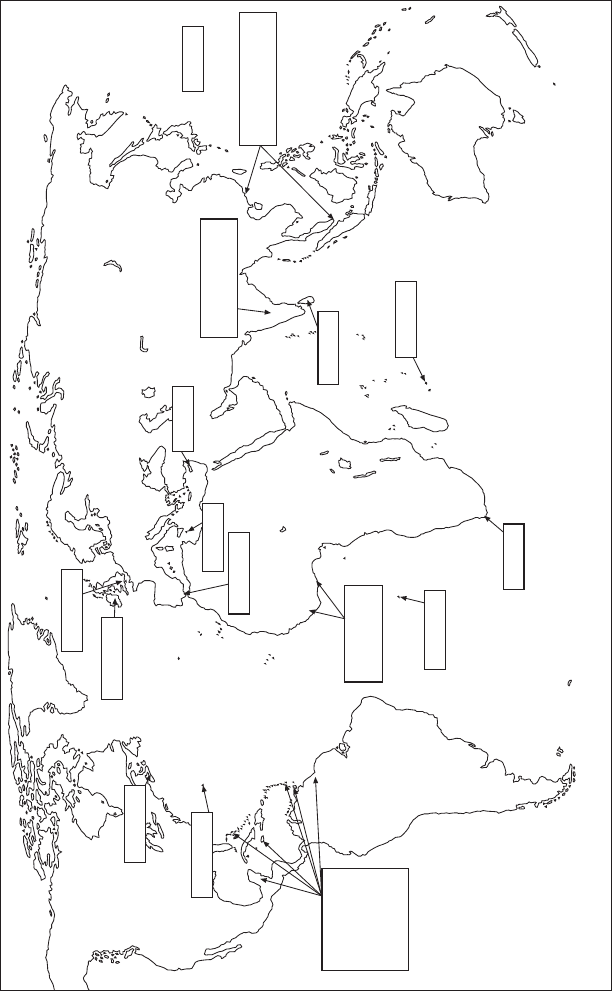
Bermuda 2,200
Canada 1,820
Ireland 25,353
Britain 65,809
Gibraltar 4,158
Malta 5,626
Cyprus 420
Ceylon 1,224
Mauritius 355
Cape 4,848
St Helena 210
Sierra Leone
Gold Coast
441
191
Bahamas
Jamaica
Honduras
Barbados
Trinidad
British Guiana
101
778
247
813
121
246
India
Native troops
69,647
125,000
Cape 4,848
Number of troops
based at garrison
Hong Kong
Straits Settlements
1,167
1,028
Source: A.N. Porter, Atlas of British Expansion
The total number of effectives of the British Army, officers and men,
all arms, on 1 January 1881, was 188,958. Of these 25,999 were
stationed in the colonies, excluding India.
P. Burroughs
Map 3 Distribution of British troops, 1881
66 / Towards ‘The Sceptre of the World’
and make the Ottoman Empire a client state of the Tsar. It was rapidly
followed by a general crisis in Egypt, and by a British invasion intended,
said London, to restore order in Cairo before an early withdrawal.
There was no withdrawal. Instead, within less than three years the
British became party to an extraordinary plan for the territorial parti-
tion of Africa. Under the rubric of ‘effective occupation’, a bundle of
treaties made with African rulers would justify a protectorate or even
a colony. Whether intended or not, the result was a ‘scramble’, and
the rush to partition was echoed in other parts of the world. But what
had led British governments to react in this fashion? What risks did
they run? How would opinion in Britain respond to the mass of new
liabilities that scrambling imposed? Would it relish the triumphs that
‘new imperialism’ brought home, or remain sourly indifferent to these
baubles of empire? Was this burst of expansion a sign of irrepressible
confidence in Britain’s ‘manifest destiny’ or the gloomy precaution of a
power in decline and its hag-ridden leaders? Had British greed wrecked
their diplomatic position in Europe and united their rivals in shared
animosity? Some people thought so. ‘We have not a friend in Europe’,
wrote a cabinet minister as Britain plunged into war in South Africa,
‘and . . . the main cause of the dislike is . . . that we are like an octopus
with gigantic feelers stretching out over the habitable world, constantly
interrupting and preventing foreign nations from doing that which we
in the past have done ourselves.’
2
The new geopolitics
Even in the 1870s, the alarm had been sounded about the speed with
which the world was ‘filling up’. ‘The world is growing so small that
every patch of territory begins to be looked upon as a stray farm is by a
County magnate’, wrote the editor of The Times in 1874, in language
he thought ministers might understand.
3
By the 1890s, the idea was
becoming a commonplace. Frederick Jackson Turner (in an American
context), and five widely influential writers, Charles Pearson (1893),
Benjamin Kidd (1894), Alfred Mahan (1900), James Bryce (1902)and
Halford Mackinder (1904) all regarded the closing of the settlement
frontier and the demarcation of the world’s land surface as the begin-
ning of a new epoch.
4
Coupled with the growth of almost instantaneous
communications, what the Canadian imperialist George Parkin called
‘a new nervous system’ of the cable and telegraph,
5
they had brought
67 / The octopus power
about a phase of unprecedented delicacy in great power diplomacy.
‘In the post-Columbian age’, declared Mackinder,
we shall again have to deal with a closed political system,
and none the less it will be of world-wide scope. Every
explosion of social forces, instead of being dissipated in a
surrounding circuit of unknown space and barbaric chaos,
will be sharply re-echoed from the far side of the globe and
weak elements in the political and economic organism of
the world will be shattered.
6
Mackinder’s suggestion that the end of the open frontier of territorial
expansion would have important effects upon domestic and interna-
tional politics had already been anticipated by Pearson and Kidd. Now
that the temperate lands had been filled up, argued Pearson, the pent-
up force of surplus population would force governments in Europe to
assume an ever larger role in social and economic life. Kidd believed that
the closing of the temperate frontier of settlement had coincided with
the arrival of a ‘new democracy’ in Europe, social as well as political,
whose economic demands could only be satisfied by the exploitation of
the tropics – ‘the richest region of the globe’.
7
Both writers assumed that
only large, well-organised states could survive in an age of increasing
competition for resources.
These large predictions also reflected powerful cultural and
racial assumptions. Pearson, whose views had been shaped by the
antipathy to Chinese immigration in the Australian colonies where
much of his career was spent, imagined a future in which the ‘higher
races’ would have been driven back upon ‘a portion of the temper-
ate zone’.
8
He prophesied the rise of Afro-Asian states ‘no longer too
weak for aggression’, with fleets in the European seas, attending inter-
national conferences and ‘welcomed as allies in the quarrels of the
civilised world’.
9
No doubt his readers could feel their flesh creep as
the ‘yellow peril’ grew closer. But to most writers it was the relentless
pressure of Europeans upon other peoples and civilisations that seemed
more obvious. The Anglo-Saxon, despite his humanitarian sentiments
‘has exterminated the less-developed peoples . . . even more effectively
than other races’, remarked Kidd sarcastically.
10
Tropical peoples could
offer no resistance to Europe’s ‘absolute ascendency’. ‘Europe has
annexed the rest of the earth’, remarked the historian-politician James
Bryce, ‘and European ideas would prevail everywhere except China.’
11
68 / Towards ‘The Sceptre of the World’
The close contact between advanced and backward peoples marked a
‘crisis in the history of the world’.
12
Isolation was no longer an option:
extinction or absorption was the fate of many tribes or peoples, and the
‘backward nations’ were condemned to be a proletariat. Nor was there
any way of preventing Europeans from annexing and settling ‘coun-
tries inhabited by the coloured races’: the best that could be hoped
for was to regulate relations between whites and blacks, Indians and
Chinese to minimise friction and keep ‘some races . . . at the highest level
of efficiency’.
13
To an acute observer of Indian civilisation, it seemed
certain that the old cultural realm of Hindu polytheism was under siege
from external forces, and that a ‘moral inter-regnum’ would intervene
before the Hindu reformation was complete.
14
Lord Salisbury referred
bluntly to ‘dying nations’.
It was hardly surprising that, among non-European writers,
the irresistible advance of the Europeans was regarded with a mix-
ture of awe at their technical prowess, and mistrust of their political
motives. The overweening racial arrogance of Europeans was widely
noted by Indian,
15
Chinese – ‘Westerners are very strict about races and
they look upon other races as enemies’, said the influential mandarin-
scholar K’ang Yu-Wei)
16
– and Afro-American observers. Europeans
would make little progress in spreading Christianity in Africa, thought
the highly educated black West Indian Edward Wilmot Blyden. They
were hindered by climate but also by their supercilious view of African
cultures.
17
Islamic intellectuals were divided between those who argued
against any compromise with the subversive teachings of the West and
those who insisted that a new synthesis could be found between its tech-
nical and scientific knowledge and a modernised Islam.
18
Underlying
much of this academic commentary was the sense of an impending cul-
tural struggle to reshape the non-European world. For the ruling elites
of Afro-Asia’s remaining independent states, international politics after
1880 were a race against time to achieve ‘self-strengthening’ before
the might of the European powers imposed ‘protection’, annexation or
partition upon them.
On all sides, world politics were coming to be seen as a vortex
in which only the strong would survive, and then at the price of a dis-
cipline and organisation at variance with older traditions of diversity
and individualism. Among Europeans, the sense of intensifying compe-
tition was sharpened by crucial changes on their own continent. After
the 1870s, the brief experiment of free trade was swept away and,
69 / The octopus power
in almost every large power except Britain, agriculture protected and
industry built up behind tariff walls. At the same time, the political
geography of the continent was reshaped by the emergence of Germany
and Italy as great powers and (after 1880) would-be colonial pow-
ers as well. The old triangular imperialism of Britain, France and
Russia had become hexagonal. Since the European ‘dwarfs’ (as the
Dutch described themselves) could not always be disregarded, impe-
rial diplomacy sometimes became octagonal – even before the rise of
American and Japanese power in the Pacific. Henceforward, it became
hard to resist the claim that the principle of equitable compensation
on which the peace of Europe was held to depend should be extended
to any region where a European power had enlarged its possessions.
For the British, the shock of change was particularly severe. British
opinion had blithely assumed that, in the new world economy of ris-
ing trade and rapid transport, international free trade would guarantee
their commercial ascendancy. Secondly, they had every reason to fear
that their large, loose, decentralised confederacy, with its wide zones of
informal influence and fluid primacy, would be especially vulnerable to
a new imperialism of partition.
The intensifying pressure to modernise in a world more and
more subject to a global economy and to a single system of international
politics thus threatened a double revolution in which old (Afro-Asian)
states would disappear and a new, more fiercely competitive group of
(European) empires would emerge. Its first epicentre was in the Near
East. The Ottoman Empire had been under siege since the 1770s but
it had shown a remarkable capacity for survival. In the Crimean War,
Russia, its main enemy, had been hurled out of the Black Sea. The
empire had been cautiously ‘reformed’ to strengthen its army and cen-
tralising bureaucracy. But, in such proximity to Europe and with large
Christian populations in its western provinces, this was bound to be dif-
ficult. Drawing closer to Europe through trade and technology risked
upsetting the delicate balance of its internal politics. Borrowing heavily
in the West to improve its rule was a gamble on economic forces over
which it had no control. In 1875, disaster came. The Ottoman gov-
ernment declared itself bankrupt, defaulting on large loans in London
and Paris. In the political turbulence that followed, reprisals against
its Christian subjects (the ‘Bulgarian Horrors’) became a cause c
´
el
`
ebre
in Europe. Amid a wave of passionate sympathy for ‘fellow Slavs’,
Russian intervention in 1877 led swiftly to full-scale invasion and the
70 / Towards ‘The Sceptre of the World’
imposition of a treaty (at San Stefano outside Constantinople) which
openly reduced Turkey to a client-state. With the loss of their Euro-
pean provinces (the richest part of their empire) and an indefensible
frontier in Thrace, the Ottomans had reached the brink of final col-
lapse. Russia’s control over the Straits and her predominance in the
Eastern Mediterranean – the nightmare of British diplomacy since the
1780s–wasonlyamatteroftime.
19
Disraeli’s government reacted angrily but indecisively. A fleet
was sent to lurk in the approaches to Constantinople and an Indian
army contingent sent to Malta. London grandly urged the Turks to
stand firm and embrace reform. But, with France still traumatised
by defeat in 1871 and no sign of animosity between the Russians,
Germans and Austrians, there was no chance of repeating the diplo-
matic triumph of 1856. After much huffing and puffing, the result was
a ‘strategic retreat’ in British policy, carefully disguised by Disraeli as
a diplomatic victory.
20
The British took Cyprus, theoretically to guard
Turkey’s Asian provinces against further Russian encroachment, and
staved off the ‘Big Bulgaria’ which might have brought Russian influ-
ence to the Aegean. But Salisbury (who became Foreign Secretary in
1878) was under no illusion that the ‘Eastern Question’ was settled.
21
Indeed, the wholesale confiscation of Ottoman Europe and Russia’s
advance in the Caucasus, acquiring Kars, Batum and Ardahan, sug-
gested that Turkey’s decay had entered the terminal phase. In every
court in Europe, Salisbury told his ambassador in Constantinople, ‘the
Empire is looked upon as doomed’.
22
This was the larger context in which the governments of both
Disraeli and Gladstone tried to exert political and financial discipline
on Egypt whose default had followed on the heels of Turkey’s in 1876.
Away from the Balkan cockpit, it was easier for Britain and France
(the main source of Egypt’s loans) to exert their joint influence through
the so-called ‘Dual Control’ over Cairo’s finances. The real difficulty
was that the drastic reduction of government spending to meet the
‘coupon’ owed to the bondholders was bound to offend the powerful
vested interests upon whom the Khedive’s regime depended: landown-
ers; the bureaucracy; above all, the army. It was hardly surprising
that, while Ismail had been anxious to restore his credit and regain
access to money-markets in the West, he also used every means to
loosen the foreign control at the heart of his government. But, when
France and Britain secured his deposition by the Ottoman Sultan (his
71 / The octopus power
formal overlord) in June 1879, in favour of the more pliant Tewfik, the
whole khedivial structure began to disintegrate. By September 1881,an
alliance of discontent had made Colonel Arabi, a senior army officer,
the dominant power.
23
The scale of Egyptian debt, Egypt’s importance as the closest
and most dynamic of Europe’s new Afro-Asian trading partners and her
strategic value as the ‘highway’ to the East (drastically increased with
the completion of the Suez Canal in 1869) all made an Anglo-French
accord with the ruling power in Cairo of the greatest urgency. But the
prospects of an agreement with Arabi were always bleak. The Anglo-
French officials of the ‘Dual Control’ regarded his movement as a road-
block in the path of financial reform. Without the wholehearted backing
of a ‘native’ government, they feared the shrivelling of their influence.
Their hostility was loudly echoed by the large European community
(nearly 100,000 strong) who lived under extra-territorial privilege and
largely exempt from taxation. They were regarded by Arabi’s following
as a parasitical class responsible for Egypt’s misfortunes.
24
The atmo-
sphere of mistrust was deepened by the efforts of Tewfik to restore his
authority, and by the natural suspicion on the Arabist side that sooner
or later the Western powers would act against him and (as in Cyprus
and Tunis) impose their rule. Under these conditions, reconciling auton-
omy, stability and financial reform would have needed a miracle.
For the British and French governments did not regard Egypt as
a sovereign state whose independence had to be respected at all costs.
Nor was this just a British view. ‘L’Egypte a une importance politique
qui lui interdit l’ind
´
ependance’ was the terse Russian summary.
25
Its
uncertain status as an autonomous part of the Ottoman Empire, its
protected European ‘settlers’, and the Khedive’s acceptance of the Dual
Control made it a region where international interests and influence
were already uniquely entrenched, and where local rights were closely
circumscribed. On this view, they were bound to regard Arabi’s demand
of ‘Egypt for the Egyptians’ as a dangerous and retrograde slogan. The
result was an escalating campaign of pressure and threat to deflate
his prestige and restore the Khedive as the prime mover in Egyptian
politics. In June 1882, the appearance of a French and British fleet at
Alexandria, Egypt’s premier port and its window on Europe, led to a
massacre of Europeans. In July, Admiral Seymour’s bombardment of
the city merely raised Arabi to the zenith of his fame as the champion
of Egyptian rights against the alien oppressor.
72 / Towards ‘The Sceptre of the World’
The Gladstone cabinet was now in a quandary. A change
of government in France had ruled out joint action. To do nothing
would be to acquiesce in Arabi’s supremacy. But did Britain’s interests
really justify a unilateral military intervention, courting international
resentment, and risking domestic outrage at the shameless reversal of
Gladstone’s Midlothian principles of 1879? Gladstone was in two
minds, if not more. But a strong ‘war party’ in the cabinet insisted
that Egypt was on the verge of anarchy, that Arabi was goading a
murderous xenophobia, and that only prompt action – an invasion –
could save Britain’s vital interest in the free passage of the Canal. With
his mind on Ireland, Gladstone accepted defeat, and the vote for war
credits passed triumphantly through the Commons. In September, an
expeditionary force of 31,000 British and Indian troops swept Arabi
aside at Tel el-Kebir and placed Egypt under a ‘temporary occupation’
that was to last for more than seventy years.
The real motives for this crucial decision, with its vast unfore-
seen consequences for Britain’s world position, have been fiercely
debated ever since. Was the Canal really in danger at the moment
in July when the cabinet authorised an invasion? Was there any risk
of France striking a separate bargain with Arabi and subverting British
influence? Was Arabi the monster of anarchy that he was painted?
Were British ministers as indifferent to the laments of the bondholders
as they claimed? Was strategy rather than economics the true com-
pelling force that drove the British into Egypt? Scepticism on all these
fronts has been vigorously expressed.
26
But the closest archival study
of the decision shows convincingly that even those who came to favour
invasion were extremely hesitant until the massacre at Alexandria, and
all hope of persuading the Turkish government to ‘restore order’ had
vanished. The bombardment of Alexandria was a ‘calculated risk’ to
frighten Arabi and his followers into retreat, taken in the knowledge
that he might then disrupt the Canal.
27
The invasion was prepared on
the assumption that this last effort to coerce the Arabists might make
the Canal, hitherto untouched by disorder, a scene of confrontation.
Disentangling the motives at work in a group of ministers strug-
gling to make sense of a faraway crisis and distracted by bitter simulta-
neous divisions over rural disorder in Ireland is a rough and ready task.
But several points stand out clearly. It is unlikely that those in favour of
military intervention drew a sharp distinction between Britain’s wider
interests in Egypt and her strategic interest in the Canal. It would have
73 / The octopus power
been quite illogical to do so. The Canal lay some distance from the Delta
towns, but its commercial centres at Port Said and Suez could not be
insulated from wider popular unrest.
28
Even Gladstone acknowledged
that ‘the safety of the Canal will not coexist with illegality and military
violence in Egypt’.
29
Nor, as Arabi’s own actions showed, would the
Canal be safe if the conflict between his regime and the Western powers
intensified. The Canal was much the largest tangible British interest in
Egypt, and its fate was bound up with the question of who ruled in
Cairo.
But, in that case, if the Canal was so critical, why not come to
terms with Arabi and ease the tension that endangered its use? Why
jeopardise a vital interest by the clumsy attempt to suppress a move-
ment whose capacity for harm was limited? Plausible or not, such an
argument would have made little impression on the group of minis-
ters for whom the Canal’s safety loomed so large. Their leader, Lord
Hartington, was Secretary of State for India; he would have liked to
have been Viceroy in 1880.
30
Lord Northbrook at the Admiralty was
a former Viceroy, deeply suspicious of the loyalty of India’s Muslims.
Charles Dilke, junior minister at the Foreign Office, a close friend of
Joseph Chamberlain and a key member of the ‘forward party’, shared
the widespread post-Mutiny view that British rule in India was inher-
ently fragile. For all these ministers, India was not only the second
centre of British power but the prism through which they surveyed
non-European politics. To have compromised with Arabi would have
threatened the prestige on which authority in India was held to depend.
To have done so after the Alexandria massacre, with its horrible evoca-
tion of the Mutiny, would have been inconceivable. Of all the ministers
in the Gladstone cabinet, those most alarmed about the Canal (because
of India) were those least disposed to treat with Arabi (because of India).
They were the most susceptible to alarmist reports about a coming anar-
chy and the least likely to see Arabi as a ‘national’ leader fighting fairly
for freedom.
But, in the end, what carried the Gladstone government over
the edge into invasion was the weakness of the arguments against it.
When Disraeli’s cabinet had debated how to check Russia’s advance
in 1877, the colossal risk of a war without allies was so divisive that
‘in a cabinet of twelve . . . there are seven parties’.
31
But, at the time
that military intervention was considered in July 1882, it was clear
that a brief occupation to ‘restore order on behalf of Europe’ would
74 / Towards ‘The Sceptre of the World’
present few diplomatic complications and had the approval of both the
Ottoman Sultan and the Khedive. The cost would be modest, and would
be met partly by India. There was little danger of defeat. Power would
revert to the Khedive, not pass to a British governor. On the other hand,
if the crisis worsened, the Canal were blocked and more Europeans
killed, the government’s credit would suffer badly and it would come
under irresistible pressure to invade in much less favourable conditions.
The ‘geopolitical calculus’ in short was overwhelmingly for intervention
and its champions too resolute to be outmanoeuvred by Gladstone.
The occupation was the single most important forward move-
ment made by Britain in the age of partition which set in after 1880.
There is no convincing evidence that it was undertaken primarily to
recoup the fortunes of British investors in Egyptian bonds. But, equally,
it is too schematic to argue that it was merely the culmination of a long-
standing interest in the safety of the route to India: a pure question of
strategy. The complex reaction to Egyptian politics in London did not
spring from the wish merely to conserve the existing strategic link with
India, still less to recover funds sunk before the crash of ’76. The leading
ministers, and the wider public who had celebrated Disraeli’s purchase
of Canal shares in 1875,
32
recognised that Britain’s stake in the Canal
(and therefore in Egypt) was growing rapidly. An entire shipping sys-
tem was being built around it,
33
and the commercial and military value
of India was rising steeply. The canal was not the symbol of a decaying
mid-Victorian pre-eminence, but of the dynamic expansion of late-
Victorian Britain. That, perhaps, was why its defence united Whigs and
Radicals (like Chamberlain and Dilke – who had urged annexation in
1878
34
) in Gladstone’s cabinet. In the same way, the hard line towards
Arabi reflected the late-century view that economic and social progress
was too urgent to be obstructed by Afro-Asian regimes whose capacity
for self-improvement was now regarded with ever heavier scepticism. In
the decade after 1882, Egypt became the test case for arguments about
‘progressive imperialism’ and the matrix of a new imperial consensus
on politics and strategy in the era of Weltpolitik.
The logic of partition
Whatever the logic behind occupation, the Liberal ministers soon found
that they had entered Egypt on a false prospectus. Intervention had been