
Darwin J. The Empire Project. The Rise and Fall of the British World-System, 1830-1970
Подождите немного. Документ загружается.

115 / The commercial republic
1860 to 465,000 in 1910 (and 674,000 in 1920).
5
Shipping tonnage
more than doubled in the same period (and travelled more rapidly).
Telegraph cables lengthened from approximately 8,000 miles in 1872
to reach 325,000 miles by 1922. British interests owned, managed or
controlled all these enterprises on a grand scale: the vast proportion of
railways outside the United States and Continental Europe and some
40% of registered shipping by the early twentieth century. By then,
40% of the world’s telegraph cables were in the hands of a single
British concern, the Eastern Telegraph Company and its associates.
6
Trade followed construction. Building railways overseas
required locomotives, rolling stock and iron rails. New customers
appeared as commercial production extended. The demand for British
exports rose on both accounts. It was true that, as new industrial com-
petitors arose in Germany and the United States, Britain’s share of
the world’s manufactured exports drifted down from 38%in1880
to 30%in1913.
7
More generally, Britain’s share of world trade fell
from 25%in1860 to 20%in1900 and 17%by1913.
8
But these
figures disguised a large absolute rise in the value of British exports
and a remarkable increase in the share of Britain’s total production
that they represented. In 1856, the ratio of exports to gross domestic
product had been 14.6%. By 1873, it had reached 18.3%. In 1913 it
was 25%.
9
British imports also grew rapidly as dependence upon for-
eign food supplies became greater and greater. Indeed, the imbalance
between exports and imports widened steadily after 1880 despite the
falling cost of food and many raw materials from an average of around
£97 million in 1880–9 to £160 million after 1900.
10
In production and
consumption Britain had become more dependent upon international
trade and more international in outlook than ever before. Free-trade
capitalism had reached its highest stage.
But the most spectacular change was the extent to which British-
based interests profited from the surging growth of international trade
and the scale on which they acquired assets abroad. A huge proportion
of the world’s trade passed through London by the early twentieth cen-
tury, not so much physically but rather in all the commercial and finan-
cial operations that international commerce required: ship-broking;
insurance; the grading of products; and sale. Sterling was the currency
of trade, and the ‘bill on London’ the usual (because most convenient)
form of payment. By 1913–14, 60 per cent of bills on London were
for transactions entirely between foreign buyers and sellers.
11
London
116 / Towards ‘The Sceptre of the World’
was the world centre for commercial information, the listening post
for commercial opportunities in every continent. London prices were,
for most goods, the world’s prices. Not surprisingly, British companies
took the lead in providing the information and services that world trade
needed, especially in shipping and insurance. Despite the huge fall in
the cost of seaborne freight (by some 50 per cent between 1870 and
1913
12
), the income from these ‘invisible’ exports rose steadily from
£80 million a year to nearly £170 million by 1913.
13
Large as this fig-
ure was, more than covering the trade gap, it was outstripped by the
income drawn from assets built up abroad.
A marked tendency to invest overseas was already visible before
1880. Partly it arose as British merchants mobilised capital at home to
create the kind of ‘fixed’ assets – like docks or warehouses – that would
expand their business on the spot. British lenders, who readily bought
government bonds (‘consols’) at home, also willingly placed money in
the bonds issued by foreign states. A disinclination to risk savings in
domestic commercial ventures, and the low level of government bor-
rowing at home after mid-century, drove the surplus incomes of the
wealthy abroad. The major impetus came from the construction of
railways overseas, which, unlike most commercial or industrial ven-
tures, required a very large immediate investment before any return
was forthcoming. British confidence in railway technology, the early
development in Britain of a market in railway shares and the promi-
nent role of British railway contractors overseas combined to make
this an especially attractive outlet for surplus British funds. As the
international railway boom developed in the 1870s, a huge stream of
British capital flowed abroad. Between 1870 and 1913, British invest-
ment in Indian, colonial and foreign railway companies rose fivefold to
£1.5 billion – around 40 per cent of all British overseas investment.
There was a similar rise in the sums invested in government bonds
(both inside and outside the Empire) – often to fund state railway con-
struction or other kinds of infrastructure. By 1913, a third category of
foreign investment was growing even faster: overseas companies con-
trolling utilities (like gas- or waterworks), banks, real estate, mines and
plantations, but rarely industry.
14
The result was an overall increase in
the value of Britain’s assets abroad from under £1,000 million in the
early 1870s to around £2,000 million by 1900,and£4,000 million by
1913.
15
Almost all of this was placed outside Europe and 44 per cent of
the world total of foreign investment was in British hands.
16
Altogether
117 / The commercial republic
these overseas assets produced an income worth more than one-fifth
of all Britain’s overseas earnings.
17
They made up some 34 per cent of
all British assets at home and abroad. A forward glance will reveal the
true scale of this astonishing mountain of wealth. By 1937, the effects
of war loss and depression had driven that proportion down to 18
per cent and by 1973 to 3 per cent.
18
In 1990, British overseas invest-
ment, having staged a major recovery, reached the impressive figure of
£100 billion. But, measured against the overall rise of Britain’s assets,
this was no more than one-seventh of its value in 1913.
19
The head and centre of this far-reaching financial and commer-
cial activity was the City of London. Essentially, the City was a cluster of
markets attracting buyers and sellers from all parts of the world. Some
of these markets were organised as ‘exchanges’ like the Wool Exchange
(established in 1875), the London Metal Exchange (1882), the Baltic
Exchange (dealing in grain) and the Coal Exchange. Mincing Lane was
the market for commodities like sugar, cocoa, coffee and spices, with
regular auctions at its sale rooms. A large number of City firms dealt in
the import or re-export of commodities, sometimes for immediate sale,
sometimes as options or ‘futures’. Many tended to specialise by country
or type of produce, and one entirely in the import of hair.
20
Because
the commodity trades usually required the advance of credit to faraway
producers, and because of the lapse of time before the harvest came
to market, the dealers in London were also lenders.
21
They, in turn,
required the services of specialised finance houses, ‘accepting houses’
or merchant banks, who could tap the reservoirs of short-term borrow-
ing drawn to the City from bank deposits throughout the country. The
merchant banks, headed by the great houses like Rothschilds, Barings
(the ‘sixth great power’ until its crash of 1890),
22
J. P. Morgan, Klein-
worts and Schroders, but including many that were far smaller and
more specialised, lent money on their own account but were usually the
agents through whom large loans or an issue of securities were nego-
tiated by public or private borrowers. Including the Bank of England
and the joint stock banks catering for the ordinary public, they made up
the ‘Inner City’ of high finance.
23
London was also the headquarters of
more than forty British-owned overseas banks like the Bank of London
and the River Plate or the Chartered Bank of India, Australia and China,
with branches in Bombay, Calcutta, Rangoon, Singapore, Hong Kong,
Shanghai, Manila and Batavia (modern Jakarta). By 1900, banking had
become increasingly cosmopolitan and British banks faced competition
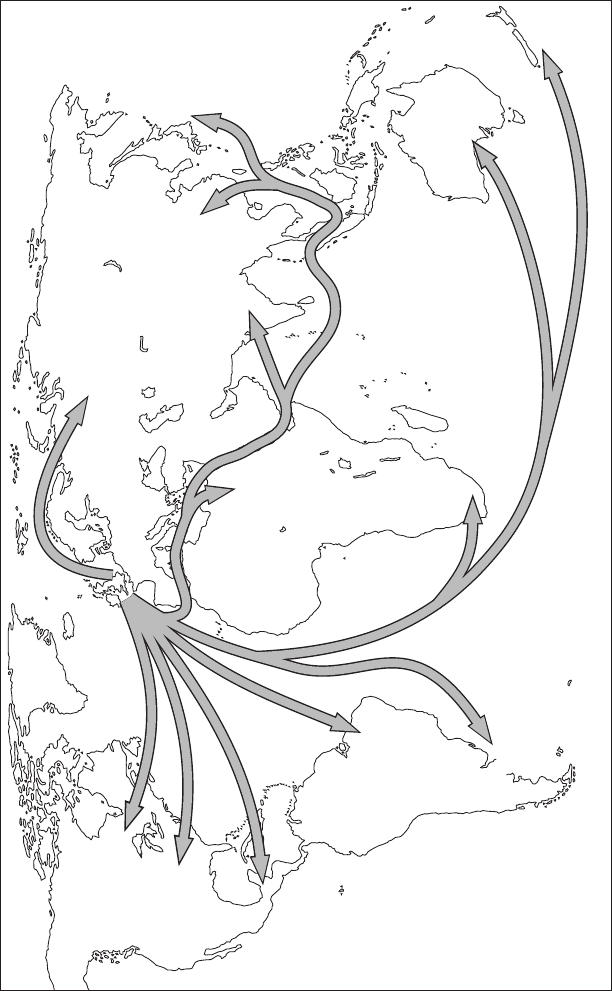
Canada
£412m
USA
£836m
Mexico
£81m
Brazil
£172m
Argentina
£349m
Egypt
£66m
South Africa
£262m
Russia
£139m
Australia
£339m
NZ
£84m
Japan
£78m
India
£317m
China
£73m
Source: A.N. Porter, Atlas of British Expansion and I. Stone, The Global Export of Capital
Map 6 British foreign investment to 1914
119 / The commercial republic
from foreign banks in London serving the commercial needs of their
own traders.
But the most dynamic element in the commercial life of the
late-Victorian City was the Stock Exchange.
24
Until mid-century it had
been largely concerned with the sale of government bonds. Thereafter,
railway shares and loans to foreign states rapidly widened its business.
In the 1880sand1890s, expansion was frantic. Membership (the enti-
tlement to deal) grew from 1,400 (1871) to over 5,500 by 1905.By
the early 1900s, one-third of all quoted securities around the world
were traded in London and around 60 per cent of the Stock Exchange’s
share listings were for overseas enterprises.
25
In the search for cap-
ital, most roads led to London. The Exchange itself was informally
divided into sections including Consols; the ‘Yankee’ market (Amer-
ican railways); Home rails; and, in the 1890s, the ‘Kaffir Circus’ for
South African gold shares. Stockbrokers developed specialist expertise
in lines of business or regions. In 1898,theStock Exchange Year Book
listed over 650 railway companies, a large proportion of them over-
seas; more than 1,000 firms engaged in mining or ‘exploration’; and
several thousand loosely described as ‘investment, trust and finance’ – a
category which included Cecil Rhodes’ ‘British South Africa Company’
with its private empire north of the Limpopo. As the communications
revolution seemed to throw open more and more commercial opportu-
nities in the non-European world, and distant prospects were gilded by
gold discoveries on the Rand, in Australia and at the Yukon, the Stock
Exchange became the great arena where private savings were mobilised
for investment overseas. Circling round it were the ubiquitous company
promoters, scrupulous or predatory, whose role was to convert a com-
mercial idea into a marketable security. Their skill in the ‘financial arts’,
remarked the radical economist J. A. Hobson, was often exercised to
‘scoop out’ the real assets of an enterprise while selling on its ‘shrivelled
carcase’ to a bamboozled public.
26
Proximity to the Stock Exchange and merchant banks, and
access to the flows of market information was the reason why many
British-owned overseas firms based themselves in the City. This was
especially true of overseas railway companies with their constant thirst
for new capital. Finsbury Circus was the favoured address of British-
owned Argentine rails like the Buenos Aires Great Southern or the
Oeste. Similar needs made the City the world headquarters for mining
enterprise.
27
Large shipowners like Cunard, British India, Peninsular

120 / Towards ‘The Sceptre of the World’
and Oriental and Shaw Savill (trading to Australasia) were drawn to
London by its ship-chartering market. London was the principal centre
for insurance. Railway, mining and shipping enterprise also required
the services of non-financial expertise: consulting engineers and other
technical specialists. In short, there was scarcely any large commercial
or financial venture linking Britain (and much of Continental Europe)
to the ‘new economies’ of the wider world that, in one aspect or many,
did not pass through a London agent. In a vast swathe of the world out-
side Europe and the United States, commercial development and even
financial solvency turned upon decisions made in the City. Here was a
plenitude of influence that matched that of Whitehall and Westminster,
the political capital of the British system.
Indeed, the great commercial and financial emporium centred on Lon-
don (with the lesser marts of Liverpool and Glasgow) was more than
just an adjunct to British world power. It was the great cosmopolitan
intermediary between the British domestic economy and the outside
world. It might almost be seen as an autonomous partner attached to
the British world-system by sentiment, self-interest and domicile, but
largely indifferent to the strategic or administrative preoccupations of
its political managers – except where they impinged directly on its eco-
nomic prospects. It had grown up willy-nilly over the remains of the old
mercantile system liquidated after 1846. Its well-being was acknowl-
edged as a vital national interest. Its leaders and spokesmen periodically
emphasised its contribution to British wealth. It shaped powerfully the
conception of the British interest in India. It massively – perhaps at times
decisively – reinforced the allegiance of the white dominions to their
faraway motherland. It was the conduit for the large British investment
in the United States, half-rival, half-associate in a world of voracious
imperialisms. But the commercial power it exerted was no mere exten-
sion of Britain’s imperial influence and authority. The managers of
the commercial empire, especially the City elite, had wide autonomy
and fiercely resisted outside regulation. Their priorities were rarely the
same as those of the political and official world at the far end of the
Strand. It was true that many bankers were drawn from the same class
as the political and administrative elite. But many other interests were
121 / The commercial republic
represented in the City, and in parts of it capitalism was anything but
gentlemanly.
28
Even in the most respectable quarters overseas busi-
ness was carried on with little regard to the ‘national interest’, partly
because, with so little inclination to think analytically, such a notion
existed only in the haziest form.
29
For their part, officials and politicians were inclined to treat the
commercial cosmopolis as an allied but not necessarily friendly power.
Its independence was warily recognised. But its political judgment was
laughed at;
30
and its morals widely distrusted. The sensational growth
in the wealth and social power concentrated in the City after 1890
aroused alarm as well as satisfaction. On both Left and Right, the
appearance of a new City-based ‘plutocracy’ was regarded with deep
suspicion.
31
On both political wings, the ‘cosmopolitan’ outlook of
the financial world was equated with rootlessness, restlessness and the
readiness to sacrifice public good for private gain. The cosmopolitan
financier, indifferent to any consideration but profit, was the villain in
J. A. Hobson’s radical unmasking of the hidden forces behind impe-
rial expansion and the South African War. His famous analysis of
the export of capital, on which the City prospered, insisted that its
social function was to perpetuate poverty and ‘under-consumption’ at
home by rewarding the ‘over-saving’ of the rich.
32
The Tariff Reformers
blamed cosmopolitan indifference to the domestic industrial economy
for the hostility of the financial world towards their programme of
imperial unity. In his ‘City’ speech in January 1904, Joseph Chamber-
lain warned his audience not to forget that ‘the future of this coun-
try and of the British race lay in our colonies and possessions . . . the
natural buttresses of our Imperial State’.
33
His economic expert,
W. J. Ashley, gloomily forecast Britain’s future as a declining rentier
state: ‘the history of Holland is to be repeated.’
34
There were other grounds for doubting the congruence of the
interests of the City with those of nation or empire. The Barings crisis
in 1890 and the American crash in 1907 showed that the City’s huge
exposure to overseas markets could destabilise the whole financial sys-
tem. Some observers warned that the speculative manias and fraudulent
promotions bred by the Stock Exchange could damage Britain’s real
interests overseas and unsettle her imperial ties.
35
But, down to 1914,
this criticism made little headway. Economic orthodoxy proclaimed the
unalloyed benefit of a large foreign portfolio and even Leftish opinion
came to concede that the City’s influence in world affairs was benignly
122 / Towards ‘The Sceptre of the World’
pacific.
36
Nor was there yet much sign of conflict between the City’s
cosmopolitan functions as the owner and manager of a vast property
empire outside British sovereignty and its role as the emporium for
‘Imperial’ trade between Britain, the dominions, India and the Crown
Colonies. Quite the contrary. London easily mobilised the vast stream
of capital that flowed to Canada after 1900. Its multilateral payments
system made it much easier for Britain to profit from India’s surplus
on foreign (i.e. non-Empire) trade, remitted to London as the ‘home
charges’.
37
Its foreign investments stimulated British production of cot-
ton, ships, locomotives and coal – for bunkering and as the outward
freight that made British shipping so widely profitable.
38
It made Britain
the ‘telegraph exchange of the world’,
39
and hence ‘British’ news the
most widely circulated. Its vast income stream lifted the social and
cultural prestige of the British metropolis to its zenith.
40
New frontiers of commerce
In all these ways, the City (with the smaller cosmopolises in Glasgow
and Liverpool) was the grand ally of the (formal) Empire. Its own sphere
of unofficial or ‘semi-colonial’ expansion was also growing rapidly after
1880. Here it was engaged in turning the sketchy ‘informal empire’ of
mid-Victorian times into prosperous new tributaries of its great com-
mercial republic. Four great zones lay at the edge of the ‘developed’
world but beyond the imperial frontier: tropical Africa, the Middle
East, China and Latin America.
None of these was wholly unfamiliar to British merchants and
lenders, but none had lived up to its early promise. By the 1860s
and 1870s they had become much more appealing. In part this was
a side-effect of accelerated commercial development elsewhere. As new
regions were ‘colonised’ by banks, railways, shippers and brokers, mer-
chant houses scoured remoter neighbourhoods for fresh trades where
competition was less harsh and windfall gains more likely.
41
Technol-
ogy was on their side. With the rising volume of long-distance trade,
seaborne travel became faster, cheaper and more regular, lowering
the start-up costs of merchant enterprise. After 1870, the Suez Canal
changed the geography of shipping in the Indian Ocean in Europe’s
favour. The expanding telegraph network carried the ‘information-
head’ of market intelligence into ever deeper hinterlands, reducing
123 / The commercial republic
business risk. With a weekly steamer service even the mystery and
horror of the West African coast was tamed.
42
Secondly, merchants
and lenders could hope to profit from the increasing readiness of previ-
ously conservative, secluded or simply disorganised states to embrace
financial and administrative modernisation – sometimes by ‘quick-fixes’
like the Reuter’s Concession in Iran where most of the modern com-
mercial sector was handed over (if only briefly) to a single foreign
entrepreneur.
43
Thirdly, British-based enterprises were well placed in
the later nineteenth century to piggy-back on older mercantile pio-
neers. It was usually local men who first opened the trade paths in
‘backward’ regions, plugging them into larger commercial circuits. But,
once their trade was worth the taking, they were often no match for
interlopers with cheaper credit, better shipping and vastly superior com-
mercial intelligence of markets and prices. Europeans were sometimes
‘trade-makers’, but they were just as likely to be ‘take-over’ merchants,
squeezing out or subordinating older practitioners – nowhere more so
than in Africa.
44
In principle, this extension of commercial activity ought to have
been self-reliant – much more so than in early Victorian times. In the
age of contract, the diplomatic glove, let alone the mailed imperial fist,
should have been redundant. The momentum of commercial change
was greater, its rewards more visible, its necessity more accepted. Busi-
nessmen had access to more capital and better information. In the era
of the limited company, it was easier to transfer capital to regions
promising quicker profits. And, as the tide of economic change lapped
higher in the non-Western world, finding local partners should have
been as straightforward as squaring ‘progress’-hungry rulers. And, up
to a point, it was.
In practice, it was much less clear that, even in its own semi-
colonial sphere, the City could dispense with political Empire. There
were three reasons for this. In some parts of the semi-colonial world,
the limited scope of political institutions threw upon the trader the
onus of defending his property and commercial rights by agreement if
possible, by force if necessary. Produce, markets and especially labour
were prizes for those with the strength to seize and hold them. But,
to enforce his ‘contractual’ claims in the face of other foreign inter-
lopers, the trader needed either the protection of his government or
a licence (like a charter) to make treaties, levy taxes and dispense
‘justice’. Secondly, there were parts of the extra-European world where
124 / Towards ‘The Sceptre of the World’
foreign trade or investment were concessions in the gift of patrimonial
or bureaucratic regimes. Here the merchant existed on sufferance or by
favour. His status and prospects depended upon the help of diplomatic
intermediaries without whose protection the privileges (freedom from
taxation, arrest and bureaucratic harassment) that made his business
profitable would lapse. Thirdly, there was the question of how the
merchant (or investor) could secure himself against default, when
the debtor was also the ruler. As trade and finance moved deeper into
the Outer World and their stakes grew higher, these ‘political’ risks
loomed large in their calculations.
For a late-Victorian government, however, smoothing the mer-
chant’s path and standing guard for the investor were not to be under-
taken lightly. Each threatened it with complications, embarrassment
and expense. Each laid it open to accusations of favouritism or worse.
But, where commercial interests could mobilise wider support or claim
some higher purpose, they were not so easily brushed aside. They might
even be useful to some diplomatic ploy. The result was a frontier of
commercial expansion in which the role of government varied between
a maximum (annexation) and a minimum (diplomatic inertia). It was a
revealing irony that annexation was most likely where local and inter-
national conditions made it easiest, not where its economic dividend
looked most promising.
British business in Africa
Tropical Africa represented the extreme case. Here was a vast region
between the Sahara and South Africa where British (and other Euro-
pean) traders had scarcely ventured beyond the West African coast.
Access to the hinterland was barred by physical obstacles or the obstruc-
tion of suspicious ‘middlemen’; there were no modern states to lend to
nor landed property to mortgage; and commercial information about
the interior was often, literally, at the exploratory stage. Even more
daunting, perhaps, was the fact that, in the 1880sand1890s, tropical
Africa’s commodities – such as they were – were of marginal interest
to industrialising Europe, and the principal commercial export, palm-
oil from West Africa, sank to its lowest price level in that period.
45
Indeed, tropical Africa had a declining share in the trade of an expand-
ing world economy. Yet none of this deterred British entrepreneurs
from striking into the interior to carve new business empires out of the
African bush.