
Darwin J. The Empire Project. The Rise and Fall of the British World-System, 1830-1970
Подождите немного. Документ загружается.

25 / Victorian origins
Singapore and Hong Kong. There was a mass of (mostly) small settle-
ments scattered across the enormous territories claimed or conquered
as British ‘possessions’ and annexed to the Crown: ‘British’ North
America (comprising the huge tracts ‘ruled’ by the Hudson’s Bay Com-
pany west of the Great Lakes as well as ‘the Canadas’ – modern Ontario
and Quebec – and the four maritime provinces); Australia (perhaps
one million immigrants along the ‘boomerang coast’ from Brisbane to
Adelaide); New Zealand (a dozen small colonies mainly linked by the
sea); and South Africa (where a handful of British in the Cape Colony
and Natal lived with the more numerous ‘Dutch’ in a tense and often
violent relation with the black communities within and beyond the
colonial frontier). There were the old plantation colonies of the British
West Indies, once the jewel in the imperial crown, but (with free trade
in sugar and the loss of slave labour) now falling behind their economic
competitors (Brazil and Cuba retained their slaves until late in the cen-
tury). And there was India, still ruled by the Company (until 1858)
with its huge ‘sepoy’ army, a great conquest state whose influence was
exerted spasmodically on the arc of territories from Aden (annexed to
Bombay in 1839) in the west to Singapore (ruled from Calcutta until
1867) in the east. In what sense, we might ask, was this disparate collec-
tion of ‘work camps in the wilderness’, mercantile agencies, mildewed
plantations, treaty-ports and port-cities, coaling stations and bases,
fractious semi-protectorates and one huge garrison state to be con-
sidered an ‘empire’? Yet, by the late nineteenth century, this ‘project
of an empire’ (in Adam Smith’s phrase) had become a world-system.
Its component parts assumed increasingly specialised roles. They fitted
together in ways that maximised Britain’s power in the world. How
had this happened?
Of the likeliest causes, perhaps three were decisive. The first
was the greater integration permitted by technical advance and institu-
tional change. The telegraph, steamship and railway speeded the flows
of goods, information and people (as well as military force) between the
imperial centre and its outlying parts. The rise of an international capital
market in London, and its vast ‘information exchange’ (of newspapers,
news agencies, specialised journals, commercial intelligence and promo-
tional literature) increased the dependence of colonial or semi-colonial
regions on this grand metropolis. When competing for markets, money
and (in the case of settler countries) men, or if claiming the support and
sympathy of the ‘imperial factor’ in their local affairs, they had to ‘sell’
26 / Towards ‘The Sceptre of the World’
themselves as net contributors to the larger ‘British world’, promising
profits, goods or services not on offer elsewhere. The second influence
at work was connected with this. The way that empire was imagined by
the 1870s revealed the drawing of ever sharper distinctions between the
economic trajectory, social development and political status to which
different regions could aspire. J. R. Seeley’s famous denial that the
‘kith and kin’ settlements of ‘Greater Britain’ (the phrase was coined by
Charles Dilke in 1869
1
) were an empire at all was one symptom of this.
Indian demands for an equal place in what Dadabhai Naoroji called
the ‘imperial firm’,
2
and the angry rejection of a constitutional status
below the internal self-government enjoyed by most settler societies,
showed how quickly the implications of this were detected elsewhere.
Thirdly, from the late 1860s onwards, the British began to think more
systematically about the defence of their widely scattered possessions.
One committee (in 1867) enquired into the prospects of organising a
‘Force of Asiatic Troops for General Service in Suitable Climates’ (to
replace British garrisons).
3
In the late 1870s, the Royal Commission on
Colonial Defence, spurred on by the fear of Russian advance, debated
what contribution the colonies should make to their own protection.
4
As the novel conception of ‘imperial defence’ began to take shape,
India’s role as the ‘imperial strategic reserve’ in the world east of Suez
became the dominant element in British plans for its future. The pres-
sures of world politics, like those of the new ‘world economy’ (whose
emergence may be dated from c.1870), pushed and prodded the mid-
Victorians’ forward rush into the late Victorians’ world-system
The geopolitics of expansion
Britain’s global position after 1815 has often been seen as almost prodi-
gally favourable in geopolitical terms: conferring free movement in
almost any direction. It was certainly true that the era of world war
between 1793 and 1815 had brought the British some remarkable win-
nings. They handed back Java and the other Dutch colonies in Southeast
Asia as a dowry for the new Netherlands kingdom (modern Belgium
and the Netherlands) that was meant to serve as the northern barrier to
renewed French expansion. But they kept Ceylon (Sri Lanka), Mauri-
tius and the Cape as a way of preventing the return of French sea-power
to the Indian Ocean in any foreseeable future. In the Mediterranean,
27 / Victorian origins
with their hands on the Ionian islands, and above all on Malta with
its Grand Harbour, they could keep their navy in the eastern part of
the sea astride the main maritime route to the Straits and Egypt. In
the North Atlantic, they already controlled (in Halifax and the British
Caribbean) the bases from which to watch the American seaboard. The
collapse of Spain, and the client status of Portugal, had now opened
the South Atlantic coast to British maritime influence in Brazil and
La Plata and (with the occupation of the Falkland Islands in 1833)
gave them a guard-post that commanded Cape Horn. In themselves,
the territories that the British acquired were not of great value and
had small or poor populations. But their geostrategic meaning was
huge. Their capture by Britain signalled the end of the mercantilist
order that had partitioned Europe’s seaborne trade with the Americas
and Asia between the closed economic empires of Spain, Portugal, the
Netherlands, France and Britain. The age of ‘free’ trade was about to
begin.
If the British had blasted open the path to unlimited commerce
with the world beyond Europe, it also looked by the 1820sand1830s
as if the regimes at the far end of their long-distance sea-lanes had
become more receptive, or at least more vulnerable, to their trade and
diplomacy. In those decades, it seemed as if vast new worlds were now
ready to be explored, exploited, colonised or converted. The successive
opening up to travel and trade of Central and South America, the
Niger, the South African interior, parts of the Middle East (especially
Egypt), the Persian Gulf, Central Asia, New Zealand, the North Pacific
and China promised a global revolution of which Britain was likely to
be the main beneficiary. ‘The situation of Great Britain’, remarked a
parliamentary committee in 1837, ‘brings her beyond any other power
into communication with the uncivilised nations of the earth.’
5
With
command of the sea, a lion’s share of inter-continental trade and a
long lead in the use of industrial techniques, the British had the means
(or so hindsight has often suggested) to make a universal empire along
the lines they chose. With little to fear from any European rival, and
the means to beat down any local resistance, they would become the
hegemon, the invincible power.
A closer inspection makes for a more sober assessment. It
was true that, since the naval triumph at Trafalgar, Britain’s maritime
strength made it hard for any other European state to attack its far-flung
possessions by sea. The diplomacy of George Canning (British foreign
28 / Towards ‘The Sceptre of the World’
minister, 1822–7) was intended to exploit this advantage and restrict
Britain’s European neighbours to the affairs of their continent. Britain
alone of the European powers would have position and influence in
the world beyond: this was why it was so urgent to establish friendly
relations with the newly independent states in Latin America.
6
But, if
Canning had hoped that Britain’s command of the New World would
allow it to cast off the burdens of the Old, his successors (Canning
died in 1827) learned a different lesson. His pupil, Lord Palmerston,
faced a series of crises in Europe that threatened most of the gains
of 1815. After 1830, the Belgian revolt tore in half the Netherlands
kingdom – the guard-dog created against French domination of the
Low Countries (and the invasion route to Britain). Spain and Portugal,
saved from Napoleon by Wellington’s army, seemed likely to fall under
conservative monarchs who would look to Austria, Russia or even to
France rather than to Britain. The Ottoman Empire seemed about to
break up, with Egypt and Syria falling to Mehemet Ali (suspected by
London to be a client of France) and the rest of the empire – including
the Straits – remaining under the sultan, now reduced by misfortune
to dependence on Russia. Britain lacked the means to act decisively,
however vital its interests in the Eastern Mediterranean. ‘It was not in
our power, already engaged in the affairs of Belgium and Portugal, to
enter into a third business of this kind’, the British prime minister told
Palmerston in April 1833. ‘We had no available force for such a [com-
mitment] and I am quite sure that Parliament would not have granted
us one.’
7
Instead, it was laborious diplomacy, the skilful exploitation of
Russo-French rivalry and the mutual exhaustion of the local protago-
nists that brought Palmerston his triumph in 1840–1. Ottoman revival
and Mehemet Ali’s defeat restored the regional balance and secured
the prime British interest in excluding any other great power from a
dominant influence in the Eastern Mediterranean or on the land-bridge
to India. In much the same way, Palmerston used the hostility of the
‘Eastern Powers’ (Prussia, Austria and Russia) towards France to
entrench the independence and neutrality of the new Belgian state in
the 1839 treaty.
The tense diplomacy of 1830–41 showed that British prestige
and security, and the safety of their lines of communication with the
outer world, depended upon an active diplomacy in Europe, not a pas-
sive enjoyment of Europe’s internal divisions, let alone the assertion
of London’s irresistible will. In the world beyond Europe, as much
29 / Victorian origins
as in Europe itself, British leaders had to reckon with the ambitions
of three large states as eager as they were to extend the sphere of
their influence. France, Russia and the United States, Palmerston told
the House of Commons in 1858, were ‘three great . . . powers . . . so
far independent of naval warfare that even a naval reverse does not
materially affect them’.
8
Each had the means to disrupt British influ-
ence or cut down its scope. Of the three, it was France that was
the most potentially dangerous, although hopes of a liberal alliance –
what Palmerston once called ‘a Western Confederacy of free states’
9
–
periodically lulled British suspicion that Napoleonic ambitions still lin-
gered in Paris. But French influence and interests in Belgium, Spain and
Italy, the occupation of Algiers (in 1830) and the special connection
with Egypt were a constant factor in British diplomacy. The reputa-
tion and size of France’s military machine, its volatile politics (with five
regime changes between 1815 and 1851), its revolutionary tradition,
and the influence derived from its enormous cultural prestige, made for
uneasy and often irritable relations. ‘Nothing can be settled in Europe or
the Levant without war’, the Duke of Wellington told Peel (then prime
minister) in 1845, ‘unless by good understanding with France; nor can
any question be settled in other parts of the world, excepting by the
good understanding between France and this country.’
10
French public
opinion was thought dangerously febrile: ‘a certain number of turbulent
men, without profession, occupation or principles, idle and thoroughly
demoralized, passing their time in reading newspapers and talking
politics . . . give a fictitious character to public opinion’, said Palmer-
ston, quoting Guizot.
11
The French government, said Peel, had ‘very
little control over the popular will, and equally little over its servants,
military, naval and diplomatic’.
12
That France was also a naval power,
active in the Pacific, Southeast Asia and the Indian Ocean, increased the
danger of collision and a storm in the press. A French squadron block-
aded the River Plate estuary in the late 1830s. In the second Western
war against China in 1856–60, the French presence in East Asia was
as large as the British. More serious was the risk that France would
exploit Anglo-American tensions. Most frightening of all, at least for
a time, was the fear that the application of steam power would allow
France to reverse Britain’s historic naval advantage and open the way
for a Blitzkrieg invasion.
Russia was not a colonial power in the maritime sense (except
in Alaska, sold in 1867 to the United States). Its naval power outside
30 / Towards ‘The Sceptre of the World’
Europe was negligible. Russia had been the great counterweight to
France in the struggle for Europe before 1815, to Britain’s great benefit.
By the 1820s, however, the renewal of Russia’s southward expansion
around the Black Sea, converging on the Straits, had become a major
British obsession. The uncertain mood of the Ottoman government
(often called ‘the Porte’ after the great gateway in Constantinople where
its main offices were), the restless atmosphere of its European provinces
and the open rebellion after 1830 of its over-mighty viceroy in Egypt,
Mehemet Ali, all raised the prospect of a sudden implosion of Ottoman
power. With the Tsar’s armies a few forced marches away, he was
likely to take a lion’s share of the assets. With control of the Straits,
the sympathy of Orthodox Greeks and Armenians (the main mercantile
classes across the Near East), and a military grip on Eastern Anatolia,
Russia would become the greatest power in the region, and the over-
lordship of Persia would follow in due course. ‘I take Nicholas to
be ambitious, bent upon great schemes, determined to make extensive
additions to his dominions and, animated by the same hatred to England
which was felt by Napoleon . . .’ was Palmerston’s verdict in 1835.
13
Whether Nicholas I and his ministers were really committed to the
grand geopolitical designs attributed to them now seems unlikely. As
an imperial power, Russia suffered from several obvious weaknesses,
not least a backward economy, appalling communications, undigested
minorities and a brittle and overstretched government.
14
Knowing these
defects, the Russians were afraid of encirclement and economic attrition
and tried to pre-empt them. But Palmerston was not alone in believing
that Russia had entered a critical phase in its pursuit of world power.
‘Sooner or later’, he told a cabinet colleague, ‘the Cossak and the Sepoy,
the man from the Baltic and he from the British islands will meet in the
centre of Asia. It should be our business to make sure that the meeting
is as far off from our Indian possessions as may be convenient.’
15
He
hoped to exploit Russia’s defeat in the Crimean War (achieved with
the help of French military power,
16
not just to drive it away from the
Straits but to expel it from the Caucasus, its gateway to Asia and the
scene of savage war against the Chechen population. But there and in
East Asia, where the Aigun treaty brought them closer to North China
in the late 1850s, the Russians were already too strong to be fenced in
in this way.
The threat posed by Russia in the Middle East, and, by exten-
sion, in Central Asia, acted as a magnet on British grand strategy,
31 / Victorian origins
sucking the British towards risky forward commitments where their
naval advantage was hard to deploy. In the western hemisphere they
faced a quite different rival. The American republic was a white set-
tler state, decentralised, populist and territorially avaricious on no less a
scale than Russia or Britain. Its leaders were deeply suspicious of Britain
and (in the South) fiercely resentful of the British attack on the slave
trade and slavery. Britain ‘is a great, opulent, and powerful nation’,
declared Henry Clay of Kentucky, ‘but haughty, arrogant and supercil-
ious. Not more separated from the rest of the world by the sea that girts
her island than she is separated in feeling, sympathy or friendly consid-
eration of their welfare.’
17
What the British called free trade ‘is a mere
revival of the British colonial system, forced upon us . . . during the exis-
tence of our colonial vassalage’.
18
American opinion regarded Britain’s
colonial presence on the North American continent as an archaic sur-
vival, futile and absurd: the 1812 war had been fought in part to expel it.
But the Americans’ restless expansion was bound to impinge on spheres
claimed or controlled by British-backed interests. In Oregon and on the
Maine–New Brunswick border, an agreement became urgent in the mid-
1840s. The Americans also suspected that the British meant to frustrate
the absorption of Texas and California, both of them wrenched from
Mexican hands, and had designs on Cuba, whose great harbour at
Havana guarded the exit from the Gulf of Mexico, and the maritime
highway between the Mississippi valley and Europe. ‘We must have
Cuba. We can’t do without Cuba, [and] above all we must not suf-
fer its transfer to Great Britain’, intoned James Buchanan, Secretary of
State in the late 1840s.
19
And, as Clay had implied, many Americans
resented their dependence upon British industrial goods and favoured
a protectionist tariff. Henry C. Carey, the most influential economist
in antebellum America, denounced free trade as a disastrous deflection
of progress, diverting labour and funds away from local development
into costly long-distance commerce.
20
The British were not helpless against American pressure. Their
main point of weakness was the threat of an invasion of Canada (mod-
ern Ontario and Quebec) which was weakly defended and almost
beyond the reach of reinforcements once winter set in and the St
Lawrence River was frozen. But they had a deterrent: the use of naval
power to bombard American sea-ports and blockade American trade.
In the disputed Oregon country, there were few American settlers,
while the Hudson’s Bay Company, with its forts and followers, had
32 / Towards ‘The Sceptre of the World’
a significant presence. Yet, although the threats flew and relations at
times seemed close to a rupture, three powerful constraints discour-
aged British aggression. The first was the fear that an American conflict
would encourage the other great powers – especially France – to join
in against Britain: this was exactly what had happened in the Revo-
lutionary War of 1775–83. Nervousness about France helped to push
the British into settling the Oregon question to American satisfaction
in 1846.
21
The second was the belief that (as Palmerston pointed out
in 1858) British sea-power would be of only limited value if it came
to a fight. The best the British could do in periods of tension was to
reinforce their Canadian garrison to show they meant business.
22
The
third was the sense that an American war, however successful, would
be self-defeating. It was no coincidence that the emissary sent to resolve
the boundary dispute over Maine was Lord Ashburton, a senior mem-
ber of the Baring family and a banker with wide American contacts
(he had helped to negotiate the Louisiana Purchase in 1803). Blockad-
ing American trade would inflict spectacular damage on the British
economy. Thus the balance of strength in North America, while far
from one-sided, decisively moulded the shape of British expansion. It
set strict limits to the territorial growth of British North America and
made its prosperity dependent in part on the economic goodwill of its
great southern neighbour. Secondly, it ruled out any chance of coercing
America into adopting free trade. The commercial and industrial power
of the ‘Old Northeast’, centred on New York, was already a rival to
that of Britain itself.
23
A high tariff barrier checked British exports and
steadily increased the imbalance of trade in America’s favour. And it
was from New York, not London or Liverpool, that the trade of the
‘Cotton Kingdom’ (Lancashire’s great partner) was managed.
24
In this
richest of continents, the ‘imperialism of free trade’ had been stopped
in its tracks.
Of course, there were places where the British had little to
fear from the interference of France, Russia or the United States,
although fewer perhaps than appeared at first sight. Palmerston ruled
out the invasion of Persia (to stop it seizing Afghan Herat) in 1838
on the ground that it would only drive the shah closer to Russia.
Instead, Afghanistan was to be ‘saved’ by an invasion from India –
a costly calamity. Once the Russians were entrenched to the north of
Manchuria, their reluctance to support the Anglo-French coercion of
Peking eased the pressure on the Manchu court.
25
Even where and when
33 / Victorian origins
the British were free to apply their military power, they had to weigh up
its costs against any possible gain. Their great asset was the Navy. Most
of its powerful units had to be kept at home or in the Mediterranean to
watch the French and the Russians. But, with nearly 200 ships, there
were plenty to spare. A squadron blockaded the River Plate estuary
between 1843 and 1846. Brazil was blockaded in the 1850s to enforce
a ban on the slave trade.
26
Twenty gunboats on average patrolled the
West African coast to stop the still-vigorous slave trade. The British
assembled a fleet of forty ships (including numerous steamers) to force
open China’s trade in the first opium war.
27
Yet naval power had its
limitations. It could bombard, blockade and police the sea-lanes. But
bombardment was risky and required heavy-weight firepower. A block-
ade was as likely to damage British trade as to check errant rulers.
28
The slave trade patrol produced embarrassingly feeble results: in the
four years after 1864, it caught a total of nine slaves. The most striking
success was perhaps against China in 1840–2. This was not because
naval force could be used directly against the Ch’ing government. But,
by entering the Yangtse and seizing its junction with the Grand Canal,
the British could paralyse China’s internal commerce and bring the
Emperor to terms.
Away from the sea, the spearhead of power, and its last resort,
was the British regular army. Its strength had drifted upwards from
109,000 in 1829 to 140,000 by 1847.
29
Between 25,000 and 33,000
men were usually stationed in India (the number rose sharply dur-
ing the Mutiny) as the praetorian guard of Company rule. A smaller
number, perhaps 18,000, were at home in Britain. Much of the rest
was scattered in packets across the colonies and Ireland (where around
18,000 men were normally kept
30
). This system depended, remarked
an experienced general, on ‘our naval superiority, and our means of
conveying troops with great rapidity from one part of the world to
another, which multiplies, as it were, the strength of our army’.
31
Even
so, it was thinly stretched. Between 5,000 and 6,000 men defended
Britain’s North American provinces. In the Cape Colony, the 400-mile
frontier, where raiding and reprisal were constant between whites and
blacks, was guarded by a single battalion of infantry too encumbered
with equipment to chase cross-border intruders.
32
Its reinforcement was
600 miles away in Cape Town and the whites in the region depended
instead on their local commandos (volunteer bands of notorious feroc-
ity) for defence and revenge. Twelve hundred men sent to New Zealand
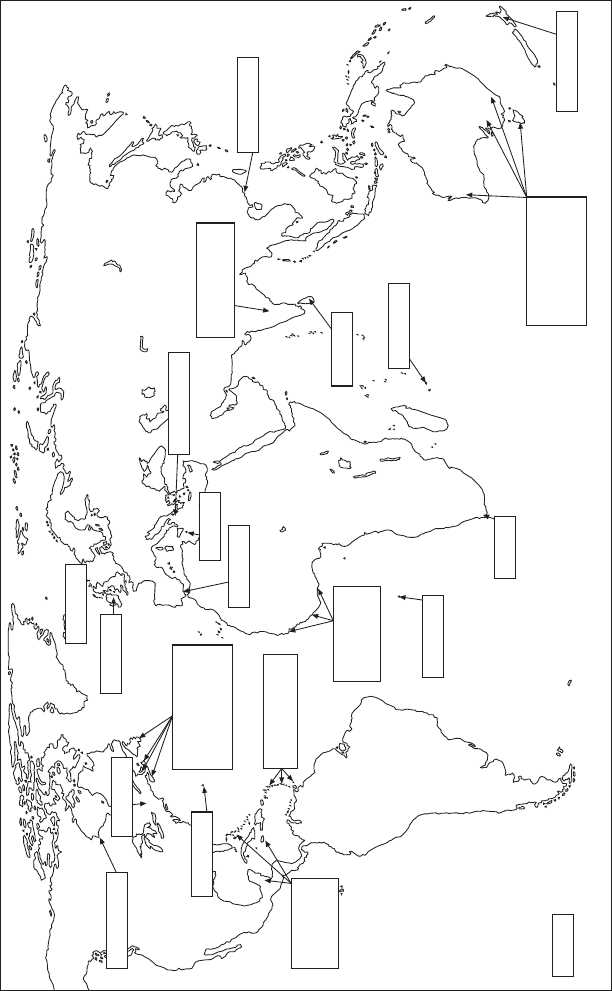
Hudson Bay 279
Bermuda 1,149
Canada 5,576
Ireland 28,566
Britain 33,057
Malta 2,285
Gibraltar 3,021
Windward and
Leeward Islands
3,186
Newfoundland
Prince Edward Island
New Brunswick
Nova Scotia
321
78
436
1,511
Gambia
Sierra Leone
Gold Coast
269
362
101
St Helena 394
Cape 5,601
Mauritius 1,611
Ceylon 2,954
Ionian Islands 2,343
India
Native troops
28,700
235,000
Hong Kong 1,095
Source: A.N. Porter, Atlas of British Expansion
Cape 5,601
Number of troops
based at garrison
Western Australia
South Australia
Van Dieman’s Land
New South Wales
111
79
1,678
967
New Zealand 1,995
P. Burroughs
The total number of effectives of the British Army, officers and men,
all arms, on 1 January 1848, was 129,726. Of these 39,403 were
stationed in the colonies, excluding India.
Bahamas
Honduras
Jamaica
477
146
1,378
Map 1 Distribution of British troops, 1848