
Darwin J. The Empire Project. The Rise and Fall of the British World-System, 1830-1970
Подождите немного. Документ загружается.

35 / Victorian origins
in 1845 fought a pitched battle with Maori at Ruapekapeka in the
North Island, but lacked the strength to compel their acceptance of
British authority.
33
In effect, the army was a collection of garrisons
whose main purpose was to protect the colonies from attack by an
imperial rival or a revolt from within (as in Ireland, French Canada and
British-ruled India). Fifty thousand men were scraped together in 1854
for the Anglo-French assault on Sebastopol, but, with that inglorious
exception, the offensive power of the British on land was really pivoted
on India, where the Company maintained an enormous army (until after
the Mutiny of 1857)ofsome200,000 men. The British regiments there
could be combined with sepoy battalions to form a respectable force.
Of the ten thousand men sent to China in 1842, the larger part were
Indians. In the second China war (just after the Mutiny), they made up
just under half of the British contingent. It was from India that expe-
ditions could also be mounted into Persia, Afghanistan, Burma and
Abyssinia. It was India that made the British a military and not just a
naval power – but a military power whose active sphere was almost
entirely confined to the world south and east of Suez.
In the 1830sand1840s, we can see that a certain geopolit-
ical ‘logic’ was imposing a shape on Britain’s place in the world. In
the official view from London, Europe bulked largest and posed the
most danger. No set of ministers was likely to forget the lesson of what
was still called the ‘Great War’. Their first priority was to preserve the
chief gain of 1815 – and prevent the rise of a European hegemon. For
all his bluster, Palmerston stood on the defensive in Europe, watching
apprehensively over the Low Countries, Portugal, Spain and the East-
ern Mediterranean. In North America, too, the British watchword was
caution, lest the populist anarchy of American politics unleash an inva-
sion which they would have to repel – perhaps at a difficult moment.
Naval power was deployed on the South American coast in the 1840s
and 1850s. But its utility in extending British influence there was open
to question. The blockade of Brazil forced a stop on the slave trade but
failed to induce a more liberal tariff.
34
There was little enthusiasm for
using military power to advance the colonial frontier. When the cost
of the South African garrison shot up to over £1 million in the late
1840s (as a result of its frontier wars), London quickly abandoned the
highveld interior to the Boer republics. When Whitehall gave way to the
urgent request from New Zealand in the mid-1860s, and sent 10,000
men to crush Maori resistance, it did so expecting the cost to be borne
36 / Towards ‘The Sceptre of the World’
by the settler government in Wellington and was enraged when it was
not.
35
Only in the sphere where Indian power (both naval and military
since the Persian Gulf was patrolled by the Bombay Marine and it was
Company steamers that were sent to China in 1842) was available to
them could British governments take the lead in advancing British influ-
ence. Even there (as we have seen) the limits of action were narrow.
Almost everywhere else, the task of building an empire, whether formal
or not, fell to private interests at home and to the ‘men on the spot’.
Making Empire at home: domestic sources of British expansion
Commerce
‘The great object of the Government in every quarter of the world was
to extend the commerce of the country’, Palmerston told Parliament in
1839.
36
This was not a new doctrine. The close inter-relation between
power and profit was proverbial wisdom. Few public men would have
denied the connection between overseas trade and Britain’s strength as
a state. The contribution of trade to taxable wealth, to Britain’s ability
to subsidise allies in wartime, and to the vital reserve of skilled naval
manpower, was well understood. Without overseas trade, empire was
redundant, a futile extravagance. Trade was the source of most colonies’
revenue and helped to defray the cost of their garrisons. It could also
be seen as a great arm of influence. ‘Not a bale of merchandise leaves
our shores’, Richard Cobden declared in 1836, ‘but it bears the seeds
of intelligence and fruitful thought to the members of some less enlight-
ened community . . . [O]ur steamboats and our miraculous railways are
the advertisements and vouchers of our enlightened institutions.’
37
In
the 1830sand1840s, the expansion of overseas trade took on a new
urgency. New markets were needed for the swiftly rising production of
textiles and ironware, to avert depression, unemployment and strife in
industrial districts. Britain’s domestic tranquillity required the growth
of its trade.
The leading role in promoting the expansion of trade was
played not by governments but by merchant houses, especially those
based in the largest ports: London, Liverpool and Glasgow. The sum
of their efforts might be likened to creating a vast commercial repub-
lic, embracing Britain’s empire but much else beyond. Its scale can be
seen in the statistics for exports whose nominal value had risen from
37 / Victorian origins
some £38 million in 1830 to £60 million in 1845 and £122 million
by 1857. They were matched by the fourfold increase between 1834
and 1860 in the tonnage of shipping that used British ports.
38
From
its old concentration in the Atlantic basin, British mercantile enterprise
had spread round the world by the mid-nineteenth century. In the late
1840s, a census revealed around 1,500 British ‘houses’ abroad, nearly
1,000 outside the European mainland, with 41 in Buenos Aires alone.
39
The most notable feature of this commercial expansion, apart from the
overall increase in volume, was the shift towards markets in Asia and
the Near East (up from 11 per cent of exports in 1825 to nearly 26 per
cent in 1860) and in Africa and Australasia (up from 2 per cent to over
11 per cent).
The speed with which British merchants moved out to search
for new business, their success in constructing new commercial connec-
tions and their dominant position in long-distance trade made Britain
the great economic power of the nineteenth-century world. This great
expansionist movement arose from the junction of favourable forces
already apparent by the mid-1830s. British merchants were the immedi-
ate gainers from the opening of the trade of Brazil and Spanish America
during the Napoleonic War: indeed, wartime Brazil had been virtually
a British protectorate. The release of British trade with India (1813),
the Near East (1825) and China (1833) from the regime of chartered
monopolies encouraged a flood of new enterprise. The rapid develop-
ment of the American economy after 1815 was another huge benefit.
With its favoured position at a maritime crossroads (where the shortest
transatlantic route crossed the seaway linking the north and south of
Europe), Britain became the main entrepot for the New World’s trade
with the Old – just as it was for the seaborne trade between Europe and
Asia until the cutting of the Suez Canal in 1869.By1815, London had
replaced Amsterdam as the financial centre of Europe, partly because
of the wartime blockade of the European mainland, partly because it
had been at the centre of a Europe-wide web of war loans and sub-
sidies. The supply of long credit on easy terms from London was the
key to business with regions where the local financing of long-distance
trade was underdeveloped or lacking. Above all, by the 1830s, with
the arrival of power-weaving, the British could undercut competition
across the whole range of cotton manufactures (the most widely traded
commodity), and break into new markets with products as much as
two hundred times cheaper than the local supply.
38 / Towards ‘The Sceptre of the World’
The main agent of commerce was the commission merchant,
usually in partnership. He took goods on consignment from manufac-
turers at home and a share of the sale price when a buyer was found. In
the 1830sand1840s, there were powerful incentives to search hard for
new outlets. Although Britain’s industrial output was growing, nearby
markets in Europe were either closed altogether against foreign indus-
trial goods, restricted by tariffs or comparatively stagnant. Some manu-
facturers gave merchants a free hand to sell at cost price or less – a form
of dumping.
40
Armed with cheap credit, equipped with cheap goods,
the merchants searched for customers wherever opportunity offered. Of
course, the conditions they found were bound to vary enormously, and
so did their methods. Henry Francis Fynn, a ship’s supercargo, went
ashore at Delagoa Bay in 1822 and paddled up-river, looking for ivory
to exchange with his trinkets and bolts of cloth.
41
Aslateasthe1880s,
some trade in West Africa was still conducted from ships sailing along
the coast, waiting for locals to venture out through the surf.
42
Few
British traders ventured far inland or were allowed to do so by African
middlemen resentful of interlopers. Much of Britain’s trade with the
United States was soon in the hands of American merchants: the role of
the British was to supply the finance, to become ‘merchant bankers’.
43
In Latin America, British merchants sometimes went into partnership
with local Creole merchants to widen their contacts and enlist local
finance. In Brazil, British merchants quickly established a dominant
position in the sugar and coffee trades, Brazil’s principal exports.
44
In
Canada, the fusion of the Hudson’s Bay Company and its Montreal
rival, the North West Company, in 1821 built a powerful nexus of
Anglo-Canadian businessmen including Edward ‘Bear’ Ellice (Palmer-
ston’s b
ˆ
ete noire), Andrew Colville, Sir George Simpson, Alexander
Wedderburn (brother-in-law of the Earl of Selkirk), Curtis Lampson
(a key figure in the laying of the Atlantic cable and grandfather of the
proconsul Miles Lampson, Lord Killearn) and Alexander Matheson,
nephew of the co-founder of Jardine Matheson, a Bank of England
director, and the biggest fish in the China trade. In India, British mer-
chants were usually partners in one of the ‘agency houses’ to be found
in Calcutta and Madras, whose original purpose had been to remit
home the earnings (one might almost say ‘winnings’) of the East India
Company’s ‘servants’. Agency houses dealt with imports and exports
but also acted as bankers to Europeans working in India and managed
plantations and processing plants (in jute or indigo) for their European
39 / Victorian origins
owners. Agency houses spread from India into Burma and other parts
of Southeast Asia in the first half of the century. When direct British
trade with China (and the right to buy tea) ceased to be an East India
Company monopoly after 1833, British houses (with Jardine Matheson
in the van) were quickly set up there.
45
This furious commercial activity had created by mid-century
a worldwide network of international business centred on Liverpool,
Glasgow and, above all, London. The extension of trade brought with it
shipping, insurance and banking, managed and financed by allied mer-
cantile interests or by the merchants themselves. It built up a huge fund
of ‘commercial intelligence’ – market information – and widened the
circuits along which it travelled: business letters, reports, local chambers
of commerce and globe-trotting businessmen. Since every market was
different, there was no single objective and no unified lobby. The main
merchant demands were protection from warfare or pirates – largely
secured by Britain’s command of the seas outside Europe; ‘free’ trade –
meaning the right to trade in overseas markets on the same terms as
locals; and ‘improvements’ – usually investment in canals, roads or rail-
ways. British exporters complained bitterly at the miserly spending of
the East India Company’s government on railways and roads, which
they blamed for the shortage of return cargoes from India and the slow
growth of their trade. The ‘Canadian’ interest grasped soon enough
that Montreal’s future depended on railways, if it was to survive the
end of imperial preference in the late 1840s.
46
The British government’s role in building the ‘commercial
republic’ was not insignificant, but it was bound to be limited. As
Palmerston claimed, it was keen to advance the sphere of free trade
abroad. Through treaties of commerce, it sought to protect British mer-
chants and their property from unfair or discriminatory treatment, and
to obtain ‘most favoured nation’ status – the right for British goods to
enter on terms at least as good as those enjoyed by the ‘most favoured’
foreign state. The treaty system and Britain’s naval presence (the world’s
seas were divided into eight overseas ‘stations’) gave British merchants
unprecedented freedom to trade, but no guarantee of success. ‘Free trade
imperialism’, in the sense of intervention by London, largely functioned
in this indirect mode. For five years in mid-century when a detailed
count was kept, gunboats were sent to protect commercial interests
outside the Empire in a bare handful of cases, usually against the threat
of violent disorder.
47
But there were three important exceptions to this
40 / Towards ‘The Sceptre of the World’
hands-off policy. First, government subsidy for the carriage of mail
encouraged the rapid expansion of scheduled steamship services across
the Atlantic, to South America and to India and the Far East. Secondly,
as we have noticed already, the Navy maintained a flotilla of some
twenty gunboats on the coast of West Africa. Palmerston declaimed on
the need to use force there in the interests of trade. ‘Cudgels & Sabres
& Carbines are necessary to keep quiet the ill-disposed People whose
violence would render Trade insecure’, ran a vehement minute.
48
But
of course the targets of Palmerston’s cudgel were the slave traders who
tried to drive out the ‘legitimate’ trade that threatened their own. The
gunboats were meant to keep them at bay until the trade in palm oil
and other commodities was strong enough to destroy them. Here was a
case where commerce sub-served the great moral obsession of Victorian
Britain. Thirdly, there was China.
China was much the most striking case where military power
was used in the interests of trade. Under heavy pressure from the mer-
chant lobby, and fearing a huge claim to compensate them for the opium
that the Chinese had seized, London despatched an expeditionary force
in 1840 to demand reparations and win commercial concessions. The
treaty of Nanking in 1842 opened half a dozen ‘treaty-ports’ where
British merchants were exempt from Chinese jurisdiction, laid down a
maximum tariff that the Chinese could levy on imports and transferred
the huge harbour at Hong Kong (then still a village) to the British. After
the second opium war (1856–60), the list of ports was extended and the
Chinese interior opened to foreign travel. To uphold these rights, the
British maintained a fleet of between thirty and forty ships, most of
them gunboats, to police the coasts and rivers against pirates, anti-
foreign disturbances and uncooperative officials.
49
The commitment
seems surprising since the volume of trade remained comparatively
modest even late in the century – far below the levels of Britain’s India
trade. The answer may lie in a curious set of coincidences. Intervention
took place at a moment of intense concern about British markets abroad
and when the commercial promise of China was wildly inflated (a recur-
rent phenomenon for more than a century). ‘The nation who, but for the
existence of certain restrictions on trade, would probably buy the great-
est amount of English manufactured goods are . . . the Chinese’, claimed
Edward Gibbon Wakefield in 1834.
50
Commercial access to China, as
it turned out, could only be gained through the consular enclaves and
extraterritorial rights to which Peking agreed, both of them subject to
41 / Victorian origins
constant local attrition. It was India that provided the available means
to secure British claims, and India that had a big interest in doing so.
British trade in China was largely an outgrowth of the India trade: ‘East
India’ merchants sent Indian opium and cotton to China to buy tea and
silk. But the opium itself was a government monopoly, and the revenue
from it made up nearly one-fifth of the Indian government’s income.
The amount exported to China rose astronomically in the 1840sand
1850s.
51
Here, profit and power were inextricably linked. Nor did it
seem that the periodic coercion of China would be costly or difficult.
When Lord Elgin was sent east in 1857 to demand a new treaty after
the breakdown of relations at Canton, he was initially given a mere
handful of troops and told to rely upon naval action (to cut the river
above Canton and block the Grand Canal) to force Peking to terms. ‘It
is not the intention of Her Majesty’s Government to undertake any land
operations in the interior of the country’, London grandly declared.
52
Migrants and missions
The search for new markets in the Outer World was the most obvious
expression of British expansion. But it was allied to two others. The first
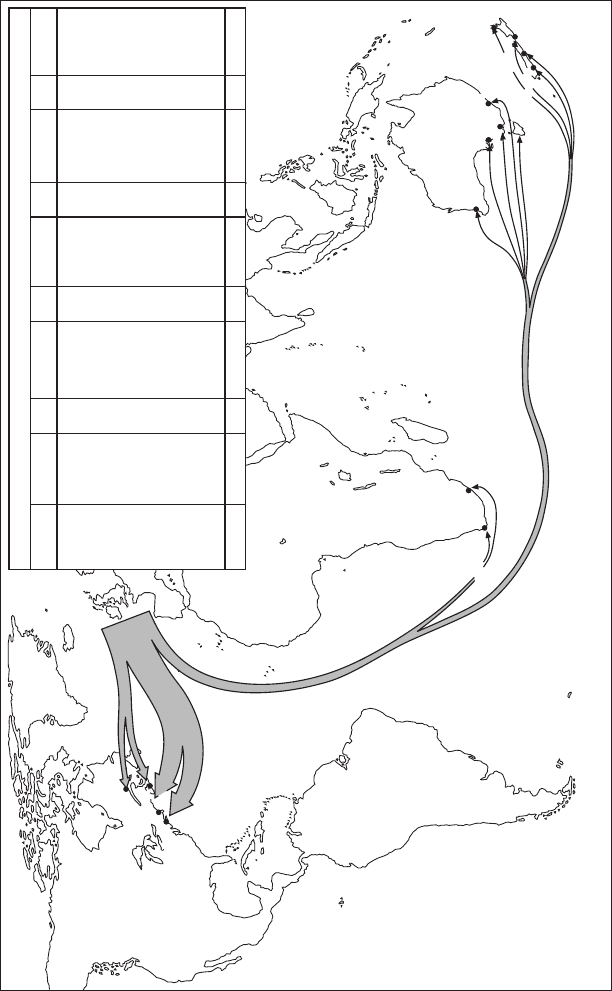
was migration. After 1830, the number of migrants from Britain rose
steadily: 1832 was the first year in which more than 100,000 departed
for destinations beyond Europe.
53
The United States was much the
most popular choice, especially for the huge outflow of Irish after the
Famine. But British North America, Australia and (after 1840)New
Zealand also attracted a significant number. Perhaps the commonest
method was through ‘chain migration’ when an ‘advance party’ cre-
ated the links (and perhaps remitted the means) to bring over friends
and family.
54
But migration was also a business, and perhaps even a
‘craze’. Migration societies spread propaganda and fired enthusiasm.
55
The ‘idea’ of migration as a road to self-betterment became increas-
ingly popular. There were also the land companies that sprang up in
the 1820sand1830s, to channel this movement and turn it into a
profit. Their aim was to buy land (cheaply) from its indigenous owners
(or a colonial government) and resell it (dearly) to settlers whom they
recruited in Britain. The Swan River Settlement (in which Robert Peel’s
brother had an interest), the Australian Agricultural Company, the
Van Diemen’s Land Company, the Western Australian Company, the
Canada Company and the British American Land Company were all of
this type. The interest in such ventures was fuelled in part by social
7
6
1
,
5
0
4
3
.
4
%
Quebec
Halifax
Boston
New York
Cape Town
Durban
Perth
Adelaide
Sydney
Melbourne
Tasmania
Dunedin
Christchurch
Wellington
Auckland
EMIGRATION FROM BRITAIN, 1815 – 1914
Sources: for 1815 – 76, PP 1877 (5) LXXXV, pp.628, 639:
for 1877 – 1914, W.A. Carrothers, Emigration from the British Isles (London, 1929), pp. 305 –6.
P. Burroughs
22,126,047
4
,
2
1
3
,
3
6
2
1
9
.
0
%
1
3
,
7
1
4
,
0
0
7
6
2
.
0
%
2
,
3
5
9
,
9
6
1
1
0
.
7
%
1815 – 30
1831 – 40
1841 – 50
1851 – 60
1861 – 70
1871 – 80
1881 – 90
1891 – 1900
1901 – 14
Total
150,160
308,247
1,094,556
1,495,243
1,424,466
1,531,851
2,446,018
1,814,293
3,449,173
13,714,007
40.2
43.8
65.0
65.4
72.4
68.7
70.8
68.2
51.0
62.0
209,707
322,485
429,044
235,285
195,250
232,213
395,160
328,411
1,865,807
4,213,362
56.0
45.8
25.5
10.3
9.9
10.4
11.4
12.3
27.6
19.0
8,935
67,882
127,124
506,802
280,198
313,105
383,729
131,629
540,557
2,359,961
2.3
9.5
7.5
22.1
14.2
14.0
11.1
4.9
8.0
10.7
–
–
–
–
–
9,803
88,991
215,590
447,120
761,504
–
–
–
–
–
–
2.5
8.1
6.6
3.4
373,338
703,150
1,684,892
2,287,205
1,967,570
2,228,395
3,455,655
2,661,532
6,764,310
22,126,047
United States %
British
North America
%
Australia &
New Zealand
% Cape & Natal % Total
Source: A.N. Porter, Atlas of British Expansion
Map 2 Migration from the British Isles, 1815–1914
43 / Victorian origins
anxiety. ‘Colonisation’ was a way of relieving economic distress,
directly by removing unneeded labour, indirectly (as Edward Gibbon
Wakefield argued) by creating new consumers abroad. It was no coin-
cidence that some of the most ardent free traders (like Sir William
Molesworth) were also drawn into the colonisation business. The South
Australian Association was a highly successful lobby that won govern-
ment support for a new settlement colony to which more than 10,000
migrants were sent in its first few years. Even more daring was Wake-
field’s New Zealand Association (1837), which successfully forced the
British government’s hand into annexing the islands.
56
Its patrons
included some of the greatest and best, among them Lord Durham,
cabinet minister, ambassador and the special commissioner into the
Canadian rebellions of 1837–8. It promised, among other things, to
save ‘the native inhabitants’ from the evils inflicted by the disrep-
utable Europeans already in the country.
57
Not all were convinced.
‘This beautiful compound of the mercantile and the merciful’, sneered
The Times, ‘will occasion a brisk demand for religious tracts and
ball-cartridges.’
58
The colonisation movement, unofficial and private as well as
organised and official (the Colonial Land and Emigration Commission
was set up in 1840 mainly to subsidise migration to Australia from
colonial land revenues), advanced in parallel with the great expan-
sion of trade. It threw out dozens of settlements, often small and iso-
lated, whose strongest links were with their parent communities in the
British Isles, the source of their manpower, exiguous capital and reli-
gious identity. Tiny outposts, like those of the Scots on Cape Breton,
lonely New Plymouth in New Zealand’s North Island,
59
the even more
lonely Kaipara,
60
as well as the larger and better known colonies in
Upper Canada, New South Wales, Victoria, Otago and Canterbury,
were all part of a web of human connections to which almost every
part of the British Isles was linked. If commercial expansion helped
breed a demand for ‘free’ trade, demographic expansion evoked a cry
for ‘free’ land. The right of the British to settle abroad became as much
part of their ‘birthright’ as the right to trade without let or hindrance.
In the twenty-one years after 1850, an annual average of more than
200,000 people migrated abroad.
61
By that time, the idea of overseas
settlement as amounting almost to a providential duty was becoming
deeply entrenched. ‘The great object and purpose of England in colonis-
ing was the multiplication of her race’, declaimed W. E. Gladstone in
44 / Towards ‘The Sceptre of the World’
1852. ‘Whatever course of legislation tended most to the rapid expan-
sion of population and power, in [Britain’s] colonies, necessarily tended
to enhance the reflected benefits that she was to derive from their
foundation.’
62
There was a wide consensus in Britain, claimed Edward
Cardwell thirteen years later, about ‘the great advantage of having
these free, industrious and enterprising communities sharing their own
blood, their own language, and their own laws, settled over the whole
world’.
63
Migrant and mercantile interests could mobilise a wide if
fragmented constituency to support the extension of British influ-
ence. So, for different reasons, could missionary societies. The most
important of these were the Baptist Missionary Society, founded in
1792, the inter-denominational London Missionary Society (1795), the
(Anglican) Church Missionary Society (1799), the British Foreign and
Bible Society (1804) and the Wesleyan Missionary Society (1813).
Launched on a wave of evangelical enthusiasm, the societies were car-
ried by the surge of popular religiosity and the patriotic feeling of
wartime. It was ‘artisans, petty shopkeepers and labourers who made
up the bulk of the missionary workforce’.
64
‘Is it presumptuous’, asked
the annual report of the Church Missionary Society in 1812, ‘to indulge
the humble and pious hope that to Great Britain may be entrusted the
high commission of making known the name of Jesus to the whole
world?’
65
In 1813, in a signal victory, the societies forced the East India
Company to fund a church establishment and admit missionaries freely
to its territories on the sub-continent. By 1821, the societies had a collec-
tive income of over £250,000 a year.
66
By 1824, the Church Missionary
Society alone had sent abroad more than 100 missionaries.
67
By 1848,
it had over 100 stations and had recruited some 350 missionaries.
68
Between the 1820s and the 1840s, the missionary frontier was
as dynamic as the mercantile. In South Africa, a survey between 1838
and 1840 counted eighty-five stations, most of them run by the London
Missionary Society or the Wesleyans.
69
In New Zealand, where Samuel
Marsden had arrived in 1814, well before annexation in 1840,more
than sixty stations were active by the 1840s.
70
In the same decade,
missionary enterprise in West Africa was carried along the coast from
its old bridgehead in Sierra Leone to Yorubaland in modern Nigeria,
where a station was founded at Abeokuta, and into the Niger delta at
Calabar.
71
Johan Krapf landed at Zanzibar in January 1844 to open
the campaign for souls in East Africa. By that time, the greatest prize