
Devore J.L., Berk K.N. Modern Mathematical Statistics with Applications
Подождите немного. Документ загружается.

Example 4.24 The amount of distilled water dispensed by a machine is normally distributed with
mean value 64 oz and standard deviation .78 oz. What container size c will ensure
that overflow occurs only .5% of the time? If X denotes the amount dispensed, the
desired condition is that P(X > c) ¼ .005, or, equivalently, that P(X c) ¼ .995.
Thus c is the 99.5th percentile of the normal distribution with m ¼ 64 and s ¼ .78.
The 99.5th percentile of the standard normal distribution is 2.58, so
c ¼ ð:995Þ¼64 þð2:58Þð:78Þ¼64 þ 2:0 ¼ 66 oz
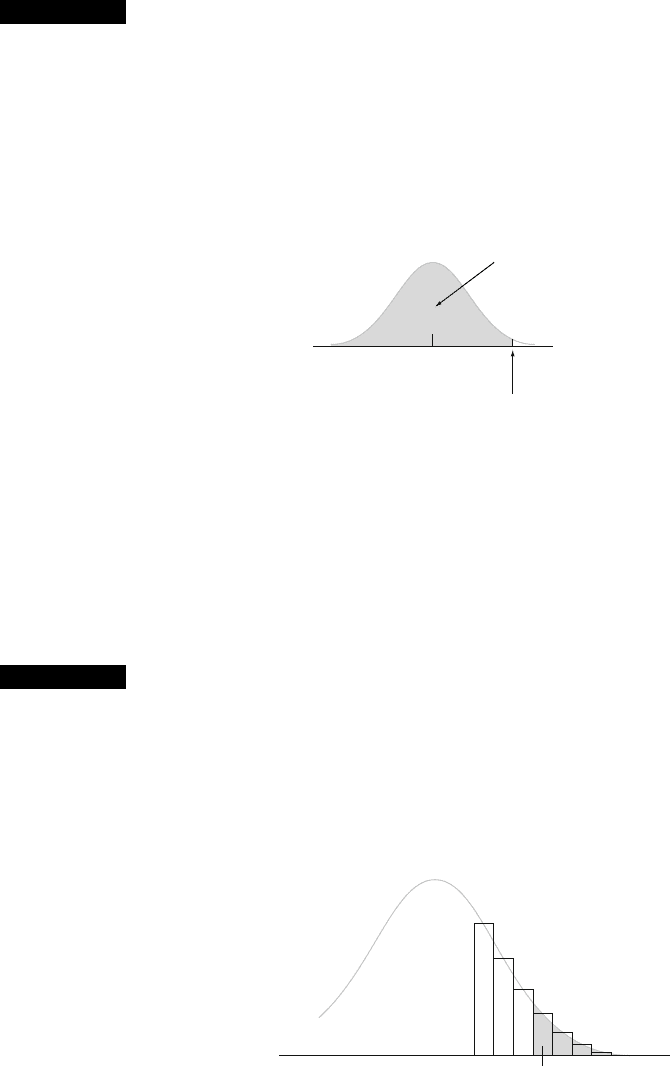
This is illustrated in Figure 4.23.
The Normal Distribution and Discrete Populations
The normal distribution is often used as an approximation to the distribution of
values in a discrete population. In such situations, extra care must be taken to
ensure that probabilities are computed in an accurate manner.
Example 4.25 IQ (as measured by a standard test) is known to be approximately normally distributed
with m ¼ 100 and s ¼ 15. What is the probability that a randomly selected individual
has an IQ of at least 125? Letting X ¼ the IQ of a randomly chosen person, we wish
P(X 125). The temptation here is to standardize X 125 immediately as in
previous examples. However, the IQ population is actually discrete, since IQs are
integer-valued, so the normal curve is an approximation to a discrete probability
histogram, as pictured in Figure 4.24.
c = 99.5th percentile = 66.0
Shaded area = .995
m = 64
Figure 4.23 Distribution of amount dispensed for Example 4.24 ■
125
Figure 4.24 A normal approximation to a discrete distribution
188
CHAPTER 4 Continuous Random Variables and Probability Distributions
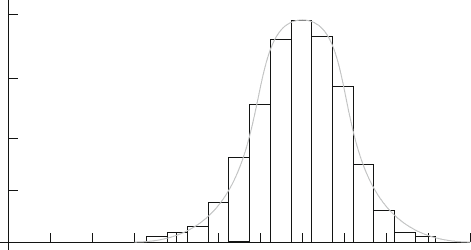
The rectangles of the histogram are centered at integers, so IQs of at least 125
correspond to rectang les beginning at 124.5, as shaded in Figure 4.24. Thus we
really want the area under the approximating normal curve to the right of 124.5.
Standardizing this value gives P(Z 1.63) ¼ .0516. If we had standardized
X 125, we would have obtained P(Z 1.67) ¼ .0475. The difference is not
great, but the answer .0516 is more accurate. Similarly, P(X ¼ 125) would be
approximated by the area between 124.5 and 125.5, since the area under the normal
curve above the single value 125 is zero. ■
The correction for discreteness of the underlying distribution in Example 4.25
is often called a continuity correction. It is useful in the following application of
the normal distribution to the computation of binomial probabilities. The normal
distribution was actually created as an approximation to the binomial distribution
(by Abraham De Moivre in the 1730s).
Approximating the Binomial Distribution
Recall that the mean value and standard deviation of a binomial random variable X
are m
X
¼ np and s
X
¼
ffiffiffiffiffiffiffiffi
npq
p
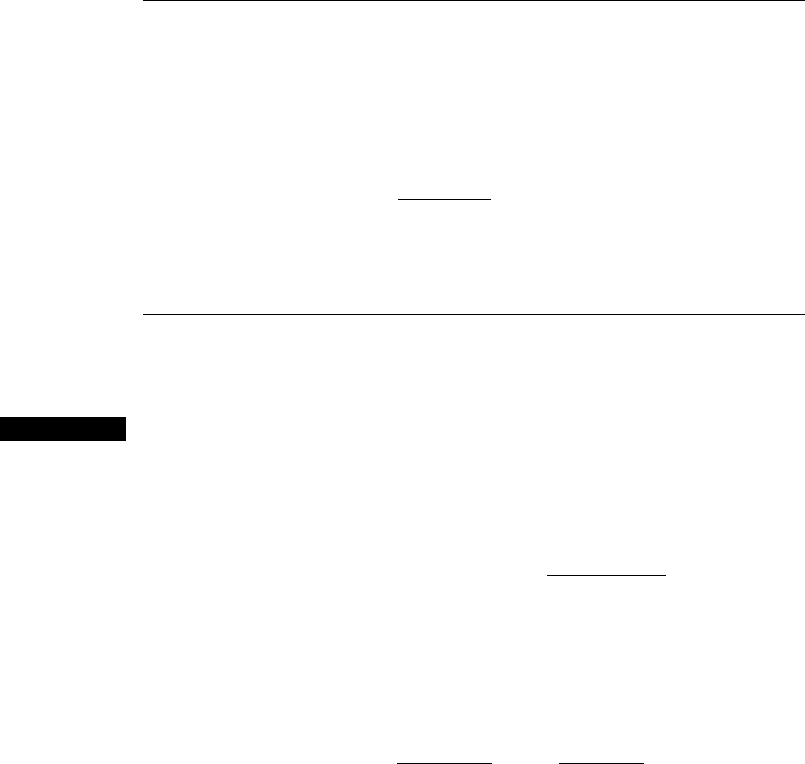
, respectively. Figure 4.25 display s a probability
histogram for the binomial distribution with n ¼ 20, p ¼ .6 [so m ¼ 20(.6) ¼ 12
and s ¼
ffiffiffiffiffiffiffiffiffiffiffiffiffiffiffiffiffiffiffiffi
20ð:6Þð:4Þ
p
¼ 2:19]. A normal curve with mean value and standard
deviation equal to the corresponding values for the binomial distribution has been
superimposed on the probability histogram. Although the probability histogram is a
bit skewed (because p 6¼ .5), the normal curve gives a very good approximation,
especially in the middle part of the picture. The area of any rectangle (probability of
any particular X value) except those in the extreme tails can be accurately approxi-
mated by the corresponding normal curve area. Thus P(X ¼ 10) ¼ B(10; 20, .6)
B(9; 20, .6) ¼ .117, whereas the area under the normal curve between 9.5 and
10.5 is P( 1.14 Z .68) ¼ .120.
More generally, as long as the binomial probability histogram is not too
skewed, binomial probabilities can be well approximated by normal curve areas.
It is then customary to say that X has approximately a normal distribution.
0 2 4 6 8 101214161820
Normal curve,
m = 12, s = 2.19
.20
.15
.10
.05
Figure 4.25 Binomial probability histogram for n ¼ 20, p ¼ .6 with normal approxi-
mation curve superimposed
4.3 The Normal Distribution 189
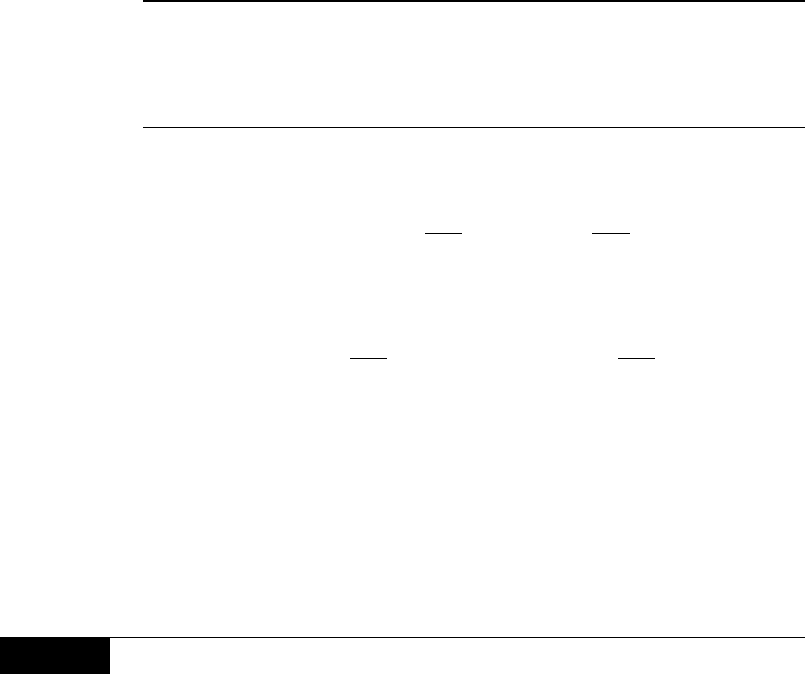
PROPOSITION
Let X be a binomial rv based on n trials with success probability p. Then if the
binomial probability histogram is not too skewed, X has approximately a
normal distribution with m ¼ np and s ¼
ffiffiffiffiffiffiffiffi
npq
p
. In particular, for x ¼ a
possible value of X,
PðX xÞ¼Bx; n; p
ðÞ
area under the normal curve to the left of x þ :5
ðÞ
¼ F
x þ :5 np
ffiffiffiffiffiffiffiffi
npq
p
In practice, the approximation is adequate provided that both np 10 and
nq 10.
If either np < 10 or nq < 10, the binomial distribution may be too skewed
for the (symmetric) normal curve to give accurate approximations.
Example 4.26 Suppose that 25% of all licensed drivers in a state do not have insurance. Let X be
the number of uninsured drivers in a random sample of size 50 (somewhat per-
versely, a success is an uninsured driver), so that p ¼ .25. Then m ¼ 12.5 and
s ¼ 3.062. Since np ¼ 50(.25) ¼ 12.5 10 and nq ¼ 37.5 10, the approxima-
tion can safely be applied:
PðX 10Þ¼Bð10 ; 50;:25ÞF
10 þ :5 12:5
3:062
¼ Fð:65Þ¼:2578
Similarly, the probability that between 5 and 15 (inclusive) of the selected drivers
are uninsured is
Pð5 X 15Þ¼Bð15; 50;:25ÞBð4; 50;:25Þ
F
15:5 12:5
3:062
F
4:5 12:5
3:062
¼ :8320
The exact probabilities are .2622 and .8348, respectively, so the approximations are
quite good. In the last calculation, the probability P(5 X 15) is being approxi-
mated by the area under the normal curve between 4.5 and 15.5—the continuity
correction is used for both the upper and lower limits.
■
When the objective of our investigation is to make an inference about a
population proportion p, interest will focus on the sample proportion of successes
X/n rather than on X itself. Because this proportion is just X multiplied by the
constant 1/n, it will also have approximately a normal distribution (with mean
m ¼ p and standard deviation s ¼
ffiffiffiffiffiffiffiffiffiffi
pq=n
p
) provided that both np 10 and
nq 10. This normal approximation is the basis for several inferential procedures
to be discussed in later chapters.
It is quite difficult to give a direct proof of the validity of this normal
approximation (the first one goes back about 270 years to de Moivre). In Chapter 6,
we’ll see that it is a consequence of an important general result called the Central
Limit Theorem.
190 CHAPTER 4 Continuous Random Variables and Probability Distributions
The Normal Moment Generating Function
The moment generating function provides a straightforward way to verify that the
parameters m and s
2
are indeed the mean and variance of X (Exercise 68).
PROPOSITION
The moment generating function of a normally distributed random variable X is
M
X
ðtÞ¼e
mtþs
2
t
2
=2
Proof Consider first the special case of a standard norm al rv Z.Then
M
Z
ðtÞ¼Eðe
tZ
Þ¼
ð
1
1
e
tz
1
ffiffiffiffiffiffi
2p
p
e
z
2
=2
dz ¼
ð
1
1
1
ffiffiffiffiffiffi
2p
p
e
ðz
2
2tzÞ=2
dz
Completing the square in the exponent, we have
M
Z
ðtÞ¼e
t
2
=2
ð
1
1
1
ffiffiffiffiffiffi
2p
p
e
ðz
2
2tzþt
2
Þ=2
dz ¼ e
t
2
=2
ð
1
1
1
ffiffiffiffiffiffi
2p
p
e
ðztÞ
2
=2
dz
The last integral is the area under a normal density with mean t and standard
deviation 1, so the value of the integral is 1. Therefore, M
z
ðtÞ¼e
t
2
2
=
.
Now let X be any normal rv with mean m and standard deviation s. Then, by
the first proposition in this section, (X m)/s ¼ Z, where Z is standard normal.
That is, X ¼ m + sZ. Now use the property M
aY+b
(t) ¼ e
bt
M
Y
(at):
M
X
ðtÞ¼M
mþsZ
ðtÞ¼e
mt
M
Z
ðstÞ¼e
mt
e
s
2
t
2
=2
¼ e
mtþs
2
t
2
=2
■
Exercises Section 4.3 (39–68)
39. Let Z be a standard normal random variable and
calculate the following probabilities, drawing pic-
tures wherever appropriate.
a. P(0 Z 2.17)
b. P(0 Z 1)
c. P(2.50 Z 0)
d. P(2.50 Z 2.50)
e. P(Z 1.37)
f. P(1.75 Z)
g. P(1.50 Z 2.00)
h. P(1.37 Z 2.50)
i. P(1.50 Z)
j. P(| Z | 2.50)
40. In each case, determine the value of the constant c
that makes the probability statement correct.
a. F(c) ¼ .9838
b. P(0 Z c) ¼ .291
c. P(c Z) ¼ .121
d. P(c Z c) ¼ .668
e. P(c | Z |) ¼ .016
41. Find the following percentiles for the standard nor-
mal distribution. Interpolate where appropriate.
a. 91st
b. 9th
c. 75th
d. 25th
e. 6th
42. Determine z
a
for the following:
a. a ¼ .0055
b. a ¼ .09
c. a ¼ .663
4.3 The Normal Distribution 191
43. If X is a normal rv with mean 80 and standard
deviation 10, compute the following probabilities
by standardizing:
a. P(X 100)
b. P(X 80)
c. P(65 X 100)
d. P(70 X)
e. P(85 X 95)
f. P(| X 80 | 10)
44. The plasma cholesterol level (mg/dL) for patients
with no prior evidence of heart disease who expe-
rience chest pain is normally distributed with
mean 200 and standard deviation 35. Consider
randomly selecting an individual of this type.
What is the probability that the plasma cholesterol
level
a. Is at most 250?
b. Is between 300 and 400?
c. Differs from the mean by at least 1.5 standard
deviations?
45. The article “Reliability of Domestic-Waste Bio-
film Reactors” (J. Envir. Engrg., 1995: 785–790)
suggests that substrate concentration (mg/cm
3
)of
influent to a reactor is normally distributed with
m ¼ .30 and s ¼ .06.
a. What is the probability that the concentration
exceeds .25?
b. What is the probability that the concentration
is at most .10?
c. How would you characterize the largest 5% of
all concentration values?
46. Suppose the diameter at breast height (in.) of trees
of a certain type is normally distributed with
m ¼ 8.8 and s ¼ 2.8, as suggested in the article
“Simulating a Harvester-Forwarder Softwood
Thinning” (Forest Products J., May 1997:
36–41).
a. What is the probability that the diameter of a
randomly selected tree will be at least 10 in.?
Will exceed 10 in.?
b. What is the probability that the diameter of a
randomly selected tree will exceed 20 in.?
c. What is the probability that the diameter of a
randomly selected tree will be between 5 and
10 in.?
d. What value c is such that the interval (8.8 c,
8.8 + c) includes 98% of all diameter
values?
e. If four trees are independently selected, what is
the probability that at least one has a diameter
exceeding 10 in.?
47. There are two machines available for cutting
corks intended for use in wine bottles. The first
produces corks with diameters that are normally
distributed with mean 3 cm and standard deviation
.1 cm. The second machine produces corks with
diameters that have a normal distribution with
mean 3.04 cm and standard deviation .02 cm.
Acceptable corks have diameters between 2.9 and
3.1 cm. Which machine is more likely to produce
an acceptable cork?
48. Human body temperatures for healthy individuals
have approximately a normal distribution with
mean 98.25
F and standard deviation .75
F. (The
past accepted value of 98.6
Fahrenheit was
obtained by converting the Celsius value of 37
,
which is correct to the nearest integer.)
a. Find the 90th percentile of the distribution.
b. Find the 5th percentile of the distribution.
c. What temperature separates the coolest 25%
from the others?
49. The article “Monte Carlo Simulation—Tool for
Better Understanding of LRFD” (J. Struct. Engrg.,
1993: 1586–1599) suggests that yield strength (ksi)
for A36 grade steel is normally distributed with
m ¼ 43 and s ¼ 4.5.
a. What is the probability that yield strength is at
most 40? Greater than 60?
b. What yield strength value separates the stron-
gest 75% from the others?
50. The automatic opening device of a military cargo
parachute has been designed to open when the para-
chute is 200 m above the ground. Suppose opening
altitude actually has a normal distribution with mean
value 200 m and standard deviation 30 m. Equip-
ment damage will occur if the parachute opens at an
altitude of less than 100 m. What is the probability
that there is equipment damage to the payload of at
least 1 of 5 independently dropped parachutes?
51. The temperature reading from a thermocouple
placed in a constant-temperature medium is nor-
mally distributed with mean m, the actual temper-
ature of the medium, and standard deviation s.
What would the value of s have to be to ensure
that 95% of all readings are within .1
of m?
52. The distribution of resistance for resistors of a
certain type is known to be normal, with 10%
of all resistors having a resistance exceeding
10.256 ohms and 5% having a resistance smaller
than 9.671 ohms. What are the mean value and
standard deviation of the resistance distribution?
192
CHAPTER 4 Continuous Random Variables and Probability Distributions
53. If adult female heights are normally distributed,
what is the probability that the height of a ran-
domly selected woman is
a. Within 1.5 SDs of its mean value?
b. Farther than 2.5 SDs from its mean value?
c. Between 1 and 2 SDs from its mean value?
54. A machine that produces ball bearings has initially
been set so that the true average diameter of
the bearings it produces is .500 in. A bearing is
acceptable if its diameter is within .004 in. of this
target value. Suppose, however, that the setting
has changed during the course of production, so
that the bearings have normally distributed dia-
meters with mean value .499 in. and standard
deviation .002 in. What percentage of the bearings
produced will not be acceptable?
55. The Rockwell hardness of a metal is determined
by impressing a hardened point into the surface
of the metal and then measuring the depth of
penetration of the point. Suppose the Rockwell
hardness of an alloy is normally distributed with
mean 70 and standard deviation 3. (Rockwell
hardness is measured on a continuous scale.)
a. If a specimen is acceptable only if its hardness
is between 67 and 75, what is the probability
that a randomly chosen specimen has an accep-
table hardness?
b. If the acceptable range of hardness is (70 c,
70 + c), for what value of c would 95% of all
specimens have acceptable hardness?
c. If the acceptable range is as in part (a) and the
hardness of each of ten randomly selected spe-
cimens is independently determined, what is
the expected number of acceptable specimens
among the ten?
d. What is the probability that at most 8 of 10
independently selected specimens have a hard-
ness of less than 73.84? [Hint: Y ¼ the number
among the ten specimens with hardness less
than 73.84 is a binomial variable; what is p?]
56. The weight distribution of parcels sent in a certain
manner is normal with mean value 12 lb and stan-
dard deviation 3.5 lb. The parcel service wishes to
establish a weight value c beyond which there will
be a surcharge. What value of c is such that 99% of
all parcels are at least 1 lb under the surcharge
weight?
57. Suppose Appendix Table A.3 contained F(z)
only for z 0. Explain how you could still
compute
a. P(1.72 Z .55)
b. P(1.72 Z .55)
Is it necessary to table F(z
) for z negative? What
property of the standard normal curve justifies
your answer?
58. Consider babies born in the “normal” range of
37–43 weeks of gestational age. Extensive data
supports the assumption that for such babies born
in the United States, birth weight is normally
distributed with mean 3432 g and standard devia-
tion 482 g. [The article “Are Babies Normal?”
(Amer. Statist., 1999: 298–302) analyzed data
from a particular year. A histogram with a sensible
choice of class intervals did not look at all normal,
but further investigation revealed this was because
some hospitals measured weight in grams and
others measured to the nearest ounce and then
converted to grams. Modifying the class intervals
to allow for this gave a histogram that was well
described by a normal distribution.]
a. What is the probability that the birth weight of
a randomly selected baby of this type exceeds
4000 g? Is between 3000 and 4000 g?
b. What is the probability that the birth weight of
a randomly selected baby of this type is either
less than 2000 g or greater than 5000 g?
c. What is the probability that the birth weight of
a randomly selected baby of this type exceeds
7 lb?
d. How would you characterize the most extreme
.1% of all birth weights?
e. If X is a random variable with a normal distri-
bution and a is a numerical constant (a 6¼ 0),
then Y ¼ aX also has a normal distribution.
Use this to determine the distribution of birth
weight expressed in pounds (shape, mean, and
standard deviation), and then recalculate the
probability from part (c). How does this com-
pare to your previous answer?
59. In response to concerns about nutritional contents
of fast foods, McDonald’s announced that it would
use a new cooking oil for its french fries that
would decrease substantially trans fatty acid levels
and increase the amount of more beneficial poly-
unsaturated fat. The company claimed that 97 out
of 100 people cannot detect a difference in taste
between the new and old oils. Assuming that this
figure is correct (as a long-run proportion), what is
the approximate probability that in a random sam-
ple of 1,000 individuals who have purchased fries
at McDonald’s,
a. At least 40 can taste the difference between the
two oils?
b. At most 5% can taste the difference between
the two oils?
4.3 The Normal Distribution 193

60. Chebyshev’s inequality, introduced in Exercise 43
(Chapter 3), is valid for continuous as well as
discrete distributions. It states that for any number
k satisfying k 1, PðjX mjksÞ1/k
2
. (see
Exercise 43 in Section 3.3 for an interpretation
and Exercise 135 in Chapter 3 Supplementary
Exercises for a proof). Obtain this probability in
the case of a normal distribution for k ¼ 1, 2, and
3, and compare to the upper bound.
61. Let X denote the number of flaws along a 100-m
reel of magnetic tape (an integer-valued variable).
Suppose X has approximately a normal distribu-
tion with m ¼ 25 and s ¼ 5. Use the continuity
correction to calculate the probability that the
number of flaws is
a. Between 20 and 30, inclusive.
b. At most 30. Less than 30.
62. Let X have a binomial distribution with parameters
n ¼ 25 and p. Calculate each of the following prob-
abilities using the normal approximation (with the
continuity correction) for the cases p ¼.5, .6, and .8
and compare to the exact probabilities calculated
from Appendix Table A.1.
a. P(15 X 20)
b. P(X 15)
c. P(20 X)
63. Suppose that 10% of all steel shafts produced by a
process are nonconforming but can be reworked
(rather than having to be scrapped). Consider
a random sample of 200 shafts, and let X denote
the number among these that are nonconforming
and can be reworked. What is the (approximate)
probability that X is
a. At most 30?
b. Less than 30?
c. Between 15 and 25 (inclusive)?
64. Suppose only 70% of all drivers in a state regu-
larly wear a seat belt. A random sample of 500
drivers is selected. What is the probability that
a. Between 320 and 370 (inclusive) of the drivers
in the sample regularly wear a seat belt?
b. Fewer than 325 of those in the sample regularly
wear a seat belt? Fewer than 315?
65. Show that the relationship between a general nor-
mal percentile and the corresponding z percentile
is as stated in this section.
66. a. Show that if
X has a normal distribution with
parameters m and s, then Y ¼ aX + b (a linear
function of X) also has a normal distribution.
What are the parameters of the distribution of Y
[i.e., E(Y) and V(Y)]? [Hint: Write the cdf of Y,
P(Y y), as an integral involving the pdf
of X, and then differentiate with respect to y
to get the pdf of Y.]
b. If when measured in
C, temperature is nor-
mally distributed with mean 115 and standard
deviation 2, what can be said about the distri-
bution of temperature measured in
F?
67. There is no nice formula for the standard normal
cdf F(z), but several good approximations have
been published in articles. The following is from
“Approximations for Hand Calculators Using
Small Integer Coefficients” (Math. Comput.,
1977: 214–222). For 0 < z 5.5,
PðZ zÞ¼1 FðzÞ
:5 exp
ð83z þ 351Þz þ 562
ð703=zÞþ165
The relative error of this approximation is less
than .042%. Use this to calculate approximations
to the following probabilities, and compare when-
ever possible to the probabilities obtained from
Appendix Table A.3.
a. P(Z 1)
b. P(Z < 3)
c. P(4 < Z < 4)
d. P(Z > 5)
68. The moment generating function can be used
to find the mean and variance of the normal distri-
bution.
a. Use derivatives of M
X
(t) to verify that E(X) ¼ m
and V(X) ¼ s
2
.
b. Repeat (a) using R
X
(t) ¼ ln[M
X
(t)], and com-
pare with part (a) in terms of effort.
4.4
The Gamma Distribution and Its Relatives
The graph of any normal pdf is bell-shaped and thus symmetric. In many practical
situations, the variable of int erest to the experimenter might have a skewed distri-
bution. A family of pdf’s that yields a wide variety of skewed distributional shapes is
the gamma family. To define the family of gamma distributions, we first need to
introduce a function that plays an important role in many branches of mathematics.
194 CHAPTER 4 Continuous Random Variables and Probability Distributions
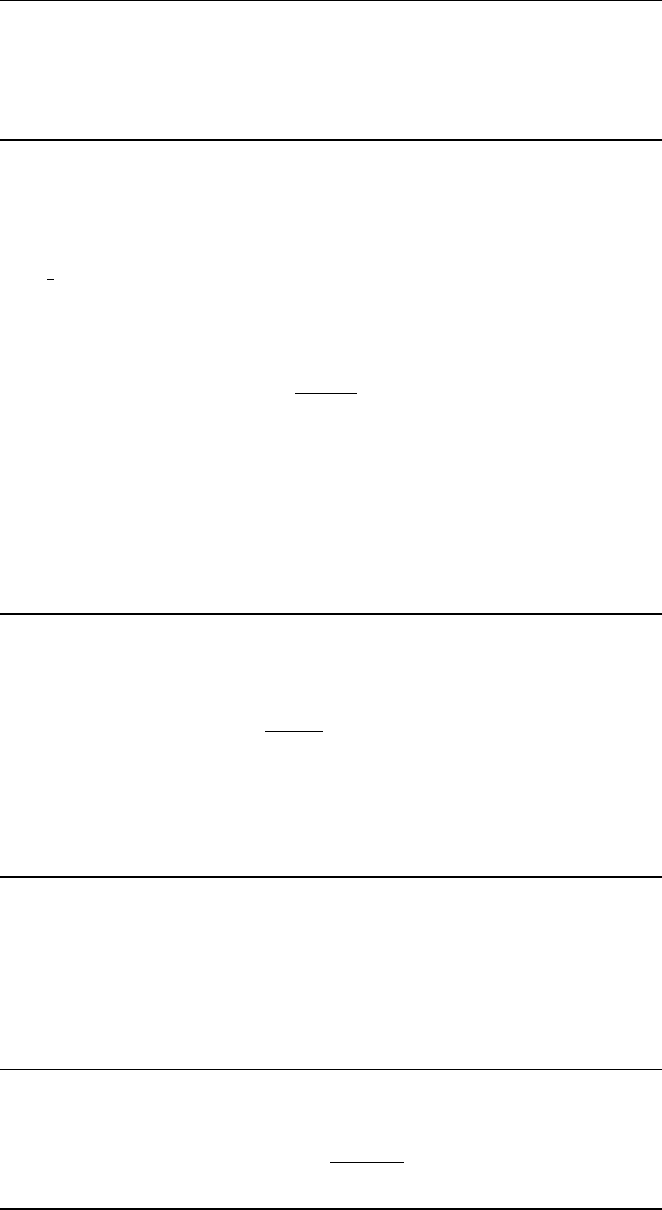
DEFINITION
For a > 0, the gamma function G(a) is defined by
GðaÞ¼
ð
1
0
x
a1
e
x
dx ð4:5Þ
The most important properties of the gamma function are the following:
1. For any a > 1, G(a) ¼ (a 1) · G(a 1) (via integration by parts)
2. For any positive integer, n , G(n) ¼ (n 1)!
3. G
1
2
¼
ffiffiffi
p
p
By Expression (4.5), if we let
f ð x; aÞ¼
x
a1
e
x
GðaÞ
x>0
0 otherwise
8
>
<
>
:
ð4:6Þ
then f(x; a ) 0 and
Ð
1
0
f ð x; aÞdx ¼ GðaÞ=GðaÞ¼1, so f(x; a) satisfies the two
basic properties of a pdf.
The Family of Gamma Distributions
DEFINITION
A continuous random variable X is said to have a gamma distribution if the
pdf of X is
f ð x; a; bÞ¼
1
b
a
GðaÞ
x
a1
e
x=b
x > 0
0 otherwise
8
<
:
ð4:7Þ
where the parameters a and b satisfy a > 0, b > 0. The standard gamma
distribution has b ¼ 1, so the pdf of a standard gamma rv is given by (4.6).
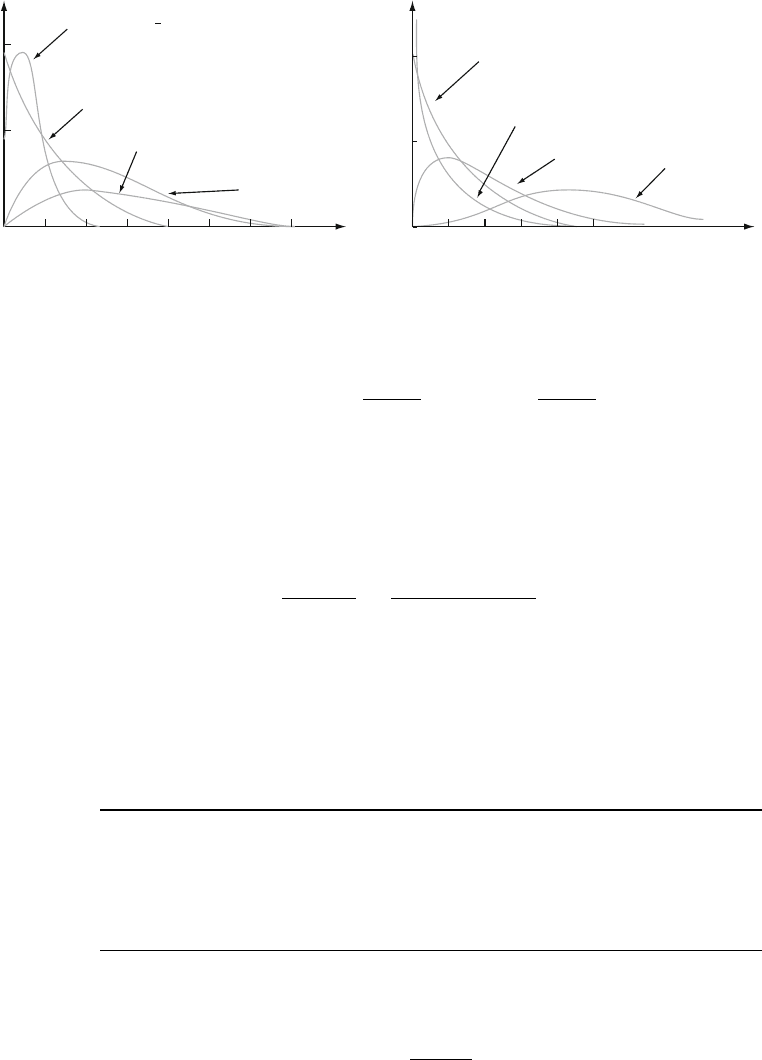
Figure 4.26(a) illustrates the graphs of the gamma pdf for several (a, b)pairs,whereas
Figure 4.26(b) presents graphs of the standard gamma pdf. For the standard pdf,
when a 1, f(x; a) is strictly decreasing as x increases; when a > 1, f(x; a) rises to a
maximum and then decreases. The parameter b in (4.7)iscalledthescale parameter
because values other than 1 either stretch or compress the pdf in the x direction.
PROPOSITION
The moment generating function of a gamma random variable is
M
X
ðtÞ¼
1
ð1 btÞ
a
4.4 The Gamma Distribution and Its Relatives 195
Proof By definition, the mgf is
M
X
ðtÞ¼Eðe
tX
Þ¼
ð
1
0
e
tx
x
a1
GðaÞb
a
e
x=b
dx ¼
ð
1
0
x
a1
GðaÞb
a
e
xðtþ1=bÞ
dx
One way to evaluate the integral is to express the integrand in terms of a gamma
density. This means writing the exponent in the form x/b and having b take the
place of b. We have x(t +1/b) ¼x[(bt + 1)/b] ¼x/[b/(1 bt)]. Now
multiplying and at the same time dividing the integrand by 1/(1bt)
a
gives
M
X
ðtÞ¼
1
ð1 btÞ
a
ð
1
0
x
a1
GðaÞ½b=ð1 btÞ
a
e
x=½b=ð1btÞ
dx
But now the integrand is a gamma pdf, so it integrates to 1. This establishes the
result. ■
The mean and variance can be obtained from the moment generating func-
tion (Exercise 80), but they can also be obtained directly through integration
(Exercise 81).
PROPOSITION
The mean and variance of a random variable X having the gamma distribution
f(x; a, b) are
EðX Þ¼m ¼ ab VðXÞ¼s
2
¼ ab
2
When X is a standard gamma rv, the cdf of X, which is
Fðx; aÞ¼
ð
x
0
y
a1
e
y
GðaÞ
dy x > 0 ð4:8Þ
is called the incomplete gamma function [sometimes the incomplete gamma
function refers to Expres sion (4.8) without the denominator G(a) in the integrand].
1
12345
234567
0
0.5
1.0
1
3
ab
x
0
0.5
1.0
x
f (x; a, b)
f
(x; a)
a = 1
a = 2, b =
a = 1, b = 1
a = 2, b = 2
a = 2, b = 1
a = .6
a = 2
a = 5
Figure 4.26 (a) Gamma density curves; (b) standard gamma density curves
196
CHAPTER 4 Continuous Random Variables and Probability Distributions
There are extensive tables of F(x; a) available; in Appendix Table A.4, we present a
small tabulation for a ¼ 1, 2, ... , 10 and x ¼ 1, 2, ... , 15.
Example 4.27 Suppose the reaction time X of a rando mly selected individual to a certain stimulus
has a standard gamma distribution with a ¼ 2. Since
Pða X bÞ¼FðbÞFðaÞ
when X is continuous,
Pð3 X 5Þ¼Fð5; 2ÞFð3; 2Þ¼:960 :801 ¼ :159
The probability that the reaction time is more than 4 s is
PðX > 4Þ¼1 PðX 4Þ¼1 Fð4; 2Þ¼1 :908 ¼ :092
■
The incomplete gamma functi on can also be used to compute probabilities
involving nonstandard gamma distributions.
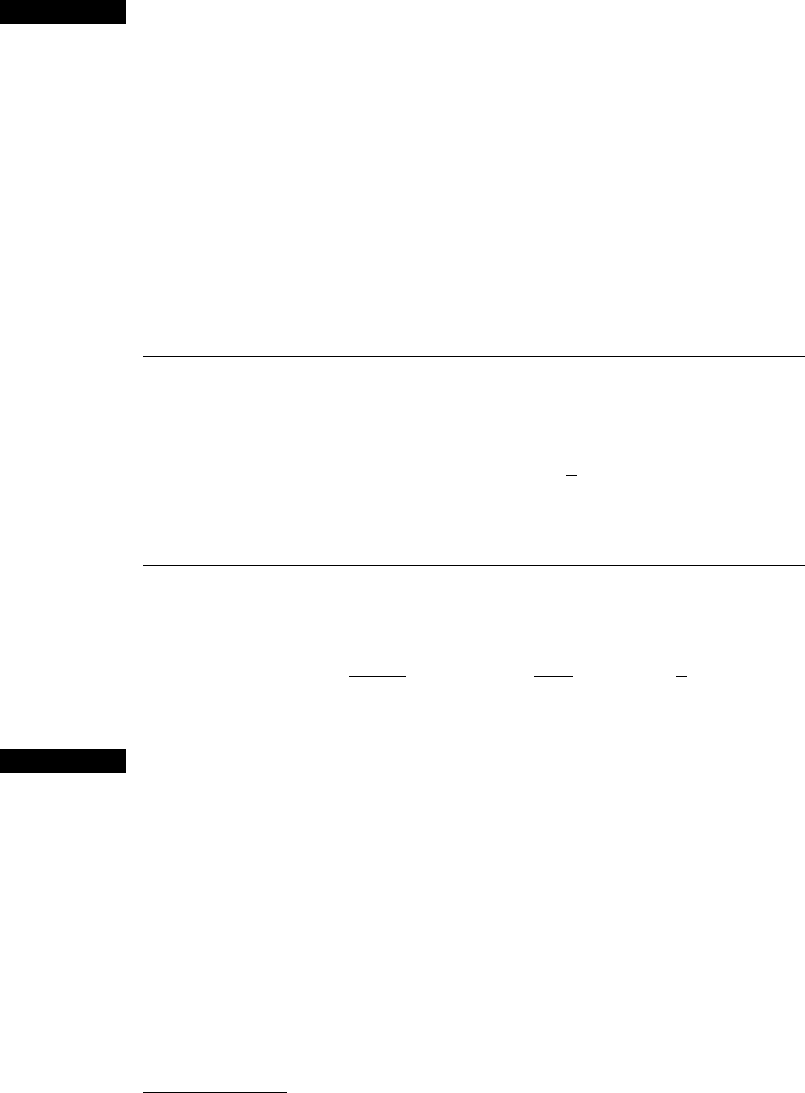
PROPOSITION
Let X have a gamma distributio n with parameters a and b. Then for any
x > 0, the cdf of X is given by
PðX xÞ¼Fðx; a; bÞ¼F
x
b
; a
the incomplete gamma function evaluated at x/b.
1
Proof Calculate, with the help of the substitution y ¼ u/b,
PðX xÞ¼
ð
x
0
u
a1
GðaÞb
a
e
u b=
du ¼
ð
x b
=
0
y
a1
GðaÞ
e
y
dy ¼ F
x
b
; a
■
Example 4.28 Suppose the survival time X in weeks of a randomly selected male mouse exposed
to 240 rads of gamma radiation has a gamma distribution with a ¼ 8 and b ¼ 15.
(Data in Survival Distributions: Reliability Applications in the Biomedical Services,
by A. J. Gross and V. Clark, suggests a 8.5 and b 13.3.) The expected survival
time is E(X) ¼ (8)(15) ¼ 120 weeks, whereas V(X) ¼ (8)(15)
2
¼ 1,800 and s
X
¼
ffiffiffiffiffiffiffiffiffiffi
1800
p
¼ 42:43 weeks. The probability that a mouse survives between 60 and
120 weeks is
Pð60 X 120Þ¼PðX 120ÞPðX 60Þ
¼ F 120=15; 8ðÞ60=5; 8ðÞ
¼ F 8; 8ðÞF 4; 8ðÞ¼:547:051 ¼ :496
1
MINITAB, R and other statistical packages calculate F(x; a, b) once values of x, a, and b are specified.
4.4 The Gamma Distribution and Its Relatives
197