
Devore J.L., Berk K.N. Modern Mathematical Statistics with Applications
Подождите немного. Документ загружается.

The probability that a mouse survives at least 30 weeks is
PðX 30Þ¼1 PðX < 30Þ¼1 PðX 30Þ
¼ 1 Fð30 15
=
; 8Þ¼:999
■
The Exponential Distribution
The family of exponential distributions provides probability models that are widely
used in engineering and science disciplines.
DEFINITION
X is said to have an exponential distribution with parameter l (l > 0) if the
pdf of X is
f ð x; lÞ¼
le
lx
x 0
0 otherwise:
(
ð4:9Þ
The exponential pdf is a special case of the general gamma pdf (4.7) in which a ¼ 1
and b has been replaced by 1/l [some authors use the form (1/b)e
x/b
]. The mean
and variance of X are then
m ¼ ab ¼
1
l
s
2
¼ ab
2
¼
1
l
2
Both the mean and standard deviation of the exponential distribution equal 1/l.
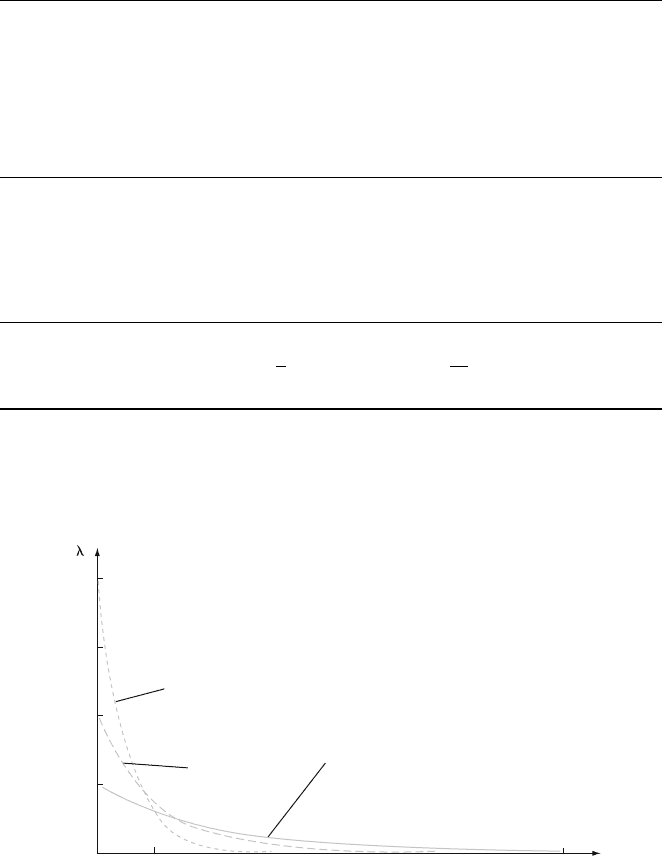
Graphs of several expone ntial pdf’s appear in Figure 4.27.
012345678
f
(x;
)
2
1.5
1
.5
0
x
λ = 2
λ = 1
λ
= .5
Figure 4.27 Exponential density curves
198
CHAPTER 4 Continuous Random Variables and Probability Distributions

Unlike the general gamma pdf, the exponential pdf can be easily integrated.
In particular, the cdf of X is
Fðx; lÞ¼
0 x < 0
1 e
lx
x 0
Example 4.29 The response time X at an on-line computer terminal (the elapsed time between the
end of a user’s inquiry and the beginning of the system’s response to that inquiry)
has an exponential distribution with expected response time equal to 5 s. Then E(X) ¼
1/l ¼ 5, so l ¼ .2. The probability that the response time is at most 10 s is
PðX 10Þ¼Fð10; :2Þ¼1 e
ð:2Þð10Þ
¼ 1 e
2
¼ 1 :135 ¼ :865
The probability that response time is between 5 and 10 s is
Pð5 X 10Þ¼Fð10; :2ÞFð5; :2Þ¼ 1 e
2
1 e
1
¼ :233
■
The exponential distribution is frequently used as a model for the distribution of
times between the occurrence of successive events, such as customers arriving at a
service facility or calls coming in to a switchboard. The reason for this is that the
exponential distribution is closely related to the Poisson process discussed in Chapter 3.
PROPOSITION
Suppose that the number of events occurring in any time interval of length t
has a Poisson distribution with parameter at (where a, the rate of the event
process, is the expected number of events occurring in 1 unit of time) and that
numbers of occurrences in nonoverlapping intervals are independent of one
another. Then the distribution of elapsed time betwee n the occurrence of
two successive events is exponential with parameter l ¼ a.
Although a complete proof is beyond the scope of the text, the result is easily
verified for the time X
1
until the first event occurs:
PðX
1
tÞ¼1 PðX
1
> tÞ¼1 P½no events in (0, tÞ
¼ 1
e
at
ðatÞ
0
0!
¼ 1 e
at
which is exactly the cdf of the exponential distribution.
Example 4.30 Calls are received at a 24-h “suicide hotline” according to a Poisson process with
rate a ¼ .5 call per day. Then the number of days X between successive calls has an
exponential distribution with parame ter value .5, so the probability that more than
2 days elapse between calls is
PðX > 2Þ¼1 PðX 2Þ¼1 Fð2; :5Þ¼e
ð:5Þð2Þ
¼ :368
The expected time between successive calls is 1/.5 ¼ 2 days.
■
4.4 The Gamma Distribution and Its Relatives 199

Another important application of the exponential distribution is to model
the distribution of component lifetime. A partial reason for the popularity of such
applications is the “memoryless” property of the exponential distribution.
Suppose component lifetime is expone ntially distributed with parameter l. After
putting the component into service, we leave for a period of t
0
h and then return to
find the comp onent still working; what now is the probability that it lasts at least an
additional t hours? In symbols, we wish P(X t + t
0
| X t
0
). By the definition
of conditional probability,
PðX t þ t
0
jX t
0
Þ¼
P½ðX t þ t
0
Þ\ðX t
0
Þ
PðX t
0
Þ
But the event X t
0
in the numerator is redundant, since both events can occur if
and only if X t + t
0
. Therefore,
PðX t þ t
0
jX t
0
Þ¼
PðX t þ t
0
Þ
PðX t
0
Þ
¼
1 Fðt þ t
0
; lÞ
1 Fðt
0
; lÞ
¼
e
lðtþt
0
Þ
e
lt
0
¼ e
lt
This conditional probability is identical to the original probability P (X t) that the
component lasted t hours. Thus the distribution of additional lifetime is exactly the
same as the original distribution of life time, so at each point in time the component
shows no effect of wear. In other words, the distribution of remaining lifetime is
independent of current age.
Although the memoryless property can be justified at least approximately in
many applied problems, in other situations components deteriorate with age or
occasionally improve with age (at least up to a certain point). More general lifetime
models are then furnished by the gamma, Weibull, and lognormal distributions
(the latter two are discussed in the next section).
The Chi-Squared Distribution
DEFINITION
Let n be a positive integer. Then a random variable X is said to have a chi-
squared distribution with parameter n if the pdf of X is the gamma density
with a ¼ n/2 and b ¼ 2. The pdf of a chi-squared rv is thus
f ð x; nÞ¼
1
2
n=2
Gðn=2Þ
x
ðn=2Þ1
e
x=2
x 0
0 x < 0
8
<
:
ð4:10Þ
The parameter n is called the number of degrees of freedom (df) of X.
The symbol w
2
is often used in place of “chi-squared.”
The chi-squared distribution is important because it is the basis for a number
of procedures in statistical inference. The reason for this is that chi-squared
distributions are intimately related to normal distributions (see Exercise 79).
We will discuss the chi-squared distribution in more detail in Section 6.4 and the
chapters on inference.
200 CHAPTER 4 Continuous Random Variables and Probability Distributions

Exercises Section 4.4 (69–81)
69. Evaluate the following:
a. G(6)
b. G(5/2)
c. F(4; 5) (the incomplete gamma function)
d. F(5; 4)
e. F(0; 4)
70. Let X have a standard gamma distribution with
a ¼ 7. Evaluate the following:
a. P(X 5)
b. P(X < 5)
c. P(X > 8)
d. P(3 X 8)
e. P(3 < X < 8)
f. P(X < 4orX > 6)
71. Suppose the time spent by a randomly selected stu-
dent at a campus computer lab has a gamma distri-
bution with mean 20 min and variance 80 min
2
.
a. What are the values of a and b?
b. What is the probability that a student uses the
lab for at most 24 min?
c. What is the probability that a student spends
between 20 and 40 min at the lab?
72. Suppose that when a type of transistor is subjected
to an accelerated life test, the lifetime X (in weeks)
has a gamma distribution with mean 24 weeks and
standard deviation 12 weeks.
a. What is the probability that a transistor will last
between 12 and 24 weeks?
b. What is the probability that a transistor will
last at most 24 weeks? Is the median of the
lifetime distribution less than 24? Why or why
not?
c. What is the 99th percentile of the lifetime
distribution?
d. Suppose the test will actually be terminated
after t weeks. What value of t is such that
only .5% of all transistors would still be
operating at termination?
73. Let X ¼ the time between two successive arrivals
at the drive-up window of a local bank. If X has an
exponential distribution with l ¼ 1 (which is
identical to a standard gamma distribution with
a ¼ 1), compute the following:
a. The expected time between two successive
arrivals
b. The standard deviation of the time between
successive arrivals
c. P(X 4)
d. P(2 X 5)
74. Let X denote the distance (m) that an animal
moves from its birth site to the first territorial
vacancy it encounters. Suppose that for banner-
tailed kangaroo rats, X has an exponential distri-
bution with parameter l ¼ .01386 (as suggested
in the article “Competition and Dispersal from
Multiple Nests,” Ecology, 1997: 873–883).
a. What is the probability that the distance is
at most 100 m? At most 200 m? Between 100
and 200 m?
b. What is the probability that distance exceeds
the mean distance by more than 2 standard
deviations?
c. What is the value of the median distance?
75. In studies of anticancer drugs it was found that if
mice are injected with cancer cells, the survival
time can be modeled with the exponential distri-
bution. Without treatment the expected survival
time was 10 h. What is the probability that
a. A randomly selected mouse will survive at
least 8 h? At most 12 h? Between 8 and 12 h?
b. The survival time of a mouse exceeds the mean
value by more than 2 standard deviations?
More than 3 standard deviations?
76. The special case of the gamma distribution in
which a is a positive integer n is called an Erlang
distribution. If we replace b by 1/l in Expression
(4.7), the Erlang pdf is
f ðx; l; nÞ¼
lðlxÞ
n1
e
lx
ðn 1Þ!
x 0
0 x < 0
8
<
:
It can be shown that if the times between succes-
sive events are independent, each with an expo-
nential distribution with parameter l, then the
total time X that elapses before all of the next n
events occur has pdf f(x ; l, n).
a. What is the expected value of X? If the time (in
minutes) between arrivals of successive custo-
mers is exponentially distributed with l ¼ .5,
how much time can be expected to elapse
before the tenth customer arrives?
b. If customer interarrival time is exponentially
distributed with l ¼ .5, what is the probability
that the tenth customer (after the one who has
just arrived) will arrive w ithin the nex t
30 min?
c. The event {X t} occurs if and only if at least n
events occur in the next t units of time. Use the
4.4 The Gamma Distribution and Its Relatives 201

fact that the number of events occurring in an
interval of length t has a Poisson distribution
with parameter lt to write an expression (involv-
ing Poisson probabilities) for the Erlang
cumulative distribution function F(t; l, n) ¼
P(X t).
77. A system consists of five identical components
connected in series as shown:
12345
As soon as one component fails, the entire system
will fail. Suppose each component has a lifetime
that is exponentially distributed with l ¼ .01 and
that components fail independently of one
another. Define events A
i
¼ {ith component lasts
at least t hours}, i ¼ 1, . . . , 5, so that the A
i
’s are
independent events. Let X ¼ the time at which the
system fails— that is, the shortest (minimum)
lifetime among the five components.
a. The event {X t} is equivalent to what event
involving A
1
,...,A
5
?
b. Using the independence of the five A
i
’s, com-
pute P(X t). Then obtain F(t) ¼ P (X t)
and the pdf of X. What type of distribution
does X have?
c. Suppose there are n components, each having
exponential lifetime with parameter l. What
type of distribution does X have?
78. If X has an exponential distribution with parameter l,
derive a general expression for the (100p)th per-
centile of the distribution. Then specialize to
obtain the median.
79. a. The event { X
2
y} is equivalent to what event
involving X itself?
b. If X has a standard normal distribution, use part
(a) to write the integral that equals P(X
2
y).
Then differentiate this with respect to y to obtain
the pdf of X
2
[the square of a N(0, 1) variable].
Finally, show that X
2
has a chi-squared distribu-
tion with n ¼ 1 df [see Expression (4.10)].
[Hint: Use the following identity.]
d
dy
ð
bðyÞ
aðyÞ
f ðxÞdx
()
¼ f ½bðyÞ b
0
ðyÞf ½aðyÞ a
0
ðyÞ
80. a. Find the mean and variance of the gamma
distribution by differentiating the moment gen-
erating function M
X
(t).
b. Find the mean and variance of the gamma dis-
tribution by differentiating R
X
(t) ¼ ln[M
X
(t)].
81. Find the mean and variance of the gamma distri-
bution using integration to obtain E(X) and E(X
2
).
[Hint: Express the integrand in terms of a gamma
density.]
4.5
Other Continuous Distributions
The normal, gamma (including exponential), and uniform families of distributions
provide a wide variety of probability models for continuous variables, but there are
many practical situations in which no member of these families fits a set of
observed data very well. Statisticians and other investigators have developed
other families of distributions that are often appropriate in practice.
The Weibull Distribution
The family of Weibull distributions was introduced by the Swedish physicist Waloddi
Weibull in 1939; his 1951 article “A Statistical Distribution Function of Wide
Applicability” (J. Appl. Mech., 18: 293–297) discusses a number of applications.
DEFINITION
A random variable X is said to have a Weibull distribution with parameters
a and b (a > 0, b > 0) if the pdf of X is
f ð x; a; bÞ¼
a
b
a
x
a1
e
ðx=bÞ
a
x 0
0 x < 0
8
<
:
ð4:11Þ
202 CHAPTER 4 Continuous Random Variables and Probability Distributions
In some situations there are theoretical justifications for the appropriateness
of the Weibull distribution, but in many applications f(x; a, b) simply provides a
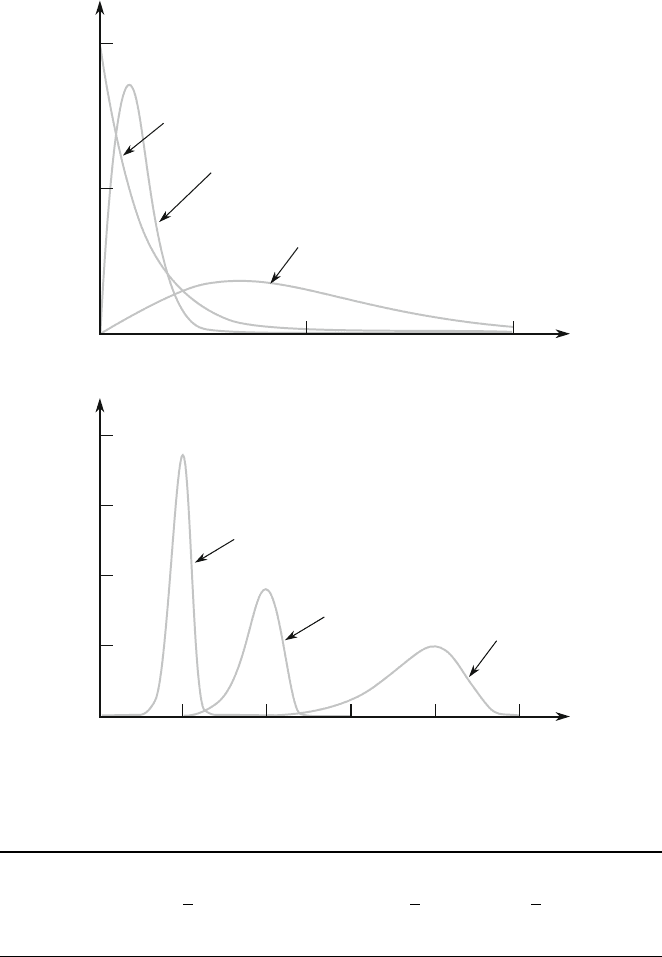
good fit to observed data for particular values of a and b. When a ¼ 1, the pdf
reduces to the exponential distribution (with l ¼ 1/b), so the exponential distribu-
tion is a special case of both the gamma and Weibull distributions. However, there
are gamma distributions that are not Weibull distributions and vice versa, so one
family is not a subset of the other. Both a and b can be varied to obtain a number of
different distributional shapes, as illustrated in Figure 4.28 . Note that b is a scale
parameter, so different values stretch or compress the graph in the x-direction.
Integrating to obtain E(X) and E(X
2
) yields
m ¼ bG 1 þ
1
a
s
2
¼ b
2
G 1 þ
2
a
G 1 þ
1
a
2
()
.5
1
0
5 10
2
0
4
6
8
.50 1.0 1.5 2.0 2.5
x
x
f (x)
f
(x)
a = 10, b = .5
a = 1, b = 1 (exponential)
a = 2, b = 1
a = 2, b = .5
a = 10, b = 1
a = 10, b = 2
Figure 4.28 Weibull density curves
4.5 Other Continuous Distributions 203

The computation of m and s
2
thus necessitates using the gamma function.
The integration
Ð
x
0
f ð y; a; bÞdy is easily carried out to obtain the cdf of X.
The cdf of a Weibull rv having parameters a and b is
Fðx; a; bÞ¼
0 x < 0
1 e
ðx=bÞ
a
x 0
(
ð4:12Þ
Example 4.31 In recent years the Weibull distribution has been used to model engine emissions
of various pollutants. Let X denote the amount of NO
x
emission (g/gal) from a
randomly selected four-stroke engine of a certain type, and suppose that X has
a Weibull distribution with a ¼ 2 and b ¼ 10 (suggested by information in the
article “Quantification of Variability and Uncertainty in Lawn and Garden
Equipment NO
x
and Total Hydrocarbon Emission Factors,” J. Air Waste Manag.
Assoc., 2002: 435–448). The corresponding density curve looks exactly like the one
in Figure 4.28 for a ¼ 2, b ¼ 1 except that now the values 50 and 100 replace 5 and
10 on the horizontal axis (because b is a “scale parameter”). Then
PðX 10Þ¼Fð10; 2; 10Þ¼1 e
ð10=10Þ
2
¼ 1 e
1
¼ :632
Similarly, P(X 25) ¼ .998, so the distribution is almost entirely concentrated on
values between 0 and 25. The value c, which separates the 5% of all engines having
the largest amounts of NO
x
emissions from the remaining 95%, satisfies
:95 ¼ 1 e
ðc=10Þ
2
Isolating the exponential term on one side, taking logarithms, and solving the resulting
equation gives c 17.3 as the 95th percentile of the emission distribution.
■
Frequently, in practical situations, a Weibull model may be reasonable except
that the smallest possible X value may be some value g n ot assumed to be zero (this
would also apply to a gamma model). The quantity g can then be regarded as a third
parameter of the distribution, which is what Weibull did in his original work. For,
say, g ¼ 3, all curves in Figure 4.28 would be shifted 3 units to the right. This is
equivalent to saying that X g has the pdf (4.11), so that the cdf of X is obtained by
replacing x in (4.12)byx g.
Example 4.32 An understanding of the volumetric properties of asphalt is important in designing
mixtures that will result in high-d urability pavement. The article “Is a Normal
Distribution the Most Appropriate Statistical Distribution for Volumetric Proper-
ties in Asphalt Mixtures” J. of Testing and Evaluation, Sept. 2009: 1–11 used the
analysis of some sample data to recommend that for a particular mixture, X ¼ air
void volume (%) be modeled with a three-parameter Weibull distribution. Suppose
the values of the parameters are g ¼ 4, a ¼ 1.3, and b ¼ .8 (quite close to
estimates given in the article).
For x 4, the cumulative distribution function is
Fðx; a; b; gÞ¼Fðx; 1:3;:8; 4Þ¼1 e
½ðx4Þ=:8
1:3
204 CHAPTER 4 Continuous Random Variables and Probability Distributions
The probability that the air void volume of a specimen is between 5% and 6% is
Pð5 X 6Þ¼Fð6; 1:3;:8; 4ÞFð5; 1:3;:8; 4Þ¼e
½ð54Þ=:8
1:3
e
½ð64Þ=:8
1:3
¼ :263 :037 ¼ :226
■
The Lognormal Distribution
Lognormal distributions have been used extensively in engineering, medicine, and
more recently, finance.
DEFINITION
AnonnegativervX is said to have a lognormal distribution if the rv Y ¼ ln(X)
has a normal distribution. The resulting pdf of a lognormal rv when ln(X)is
normally distributed with parameters m and s is
f ð x; m; sÞ¼
1
ffiffiffiffiffiffi
2p
p
sx
e
½lnðxÞm
2
=ð2s
2
Þ
x 0
0 x < 0
8
<
:
Be careful here; the parameters m and s are not the mean and standard deviation
of X but of ln(X). The mean and variance of X can be shown to be
EðX Þ¼e
mþs
2
=2
VðXÞ¼e
2mþs
2
ðe
s
2
1Þ
In Chapter 6, we will present a theoretical justification for this distribution
in connection with the Central Limit Theorem, but as with other distributions, the
lognormal can be used as a model even in the absence of such justification.
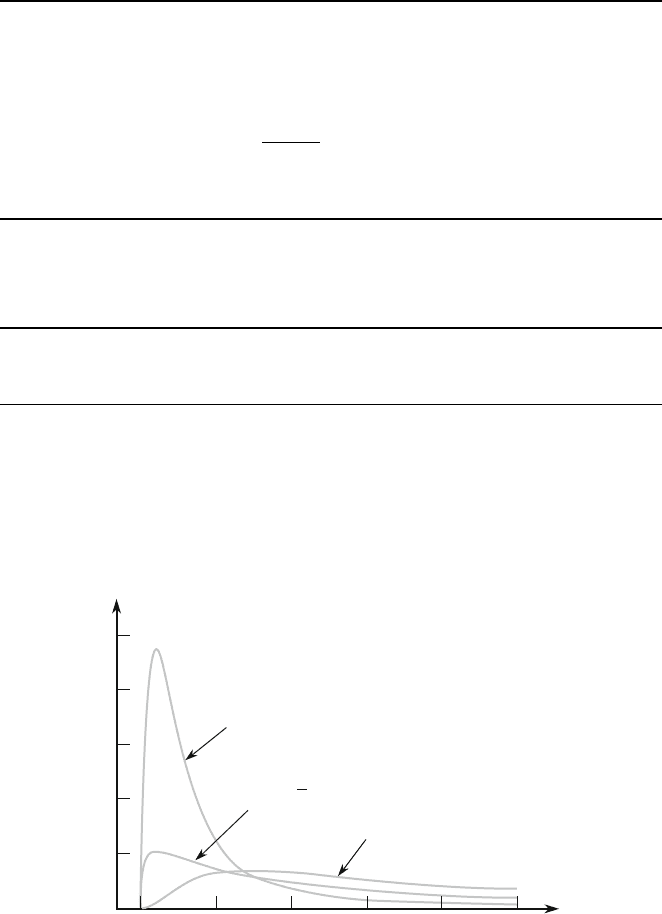
Figure 4.29 illustrates graphs of the lognormal pdf; although a normal curve is
symmetric, a lognormal curve has a positive skew.
.05
0
.10
.15
.20
.25
0 5 10 15 20 25
x
√3
f (x)
m = 1, s = 1
m = 3, s = 1
m = 3, s =
Figure 4.29 Lognormal density curves
4.5 Other Continuous Distributions 205
Because ln(X) has a normal distribution, the cdf of X can be expressed in
terms of the cdf F(z) of a standard normal rv Z. For x 0,
Fðx; m; sÞ¼PðX xÞ¼P½lnðXÞlnðxÞ ¼ P
lnðXÞm
s
lnðxÞm
s
¼ PZ
lnðxÞm
s
¼ F
lnðxÞm
s
ð4:13Þ
Example 4.33 According to the article “Predictive Model for Pitting Corrosion in Buried Oil and
Gas Pipelines” (Corrosion, 2009: 332–34 2), the lognormal distribution has been
reported as the best option for describing the distribution of maximum pit depth
data from cast iron pipes in soil. The authors suggest that a lognormal distribution
with m ¼ .353 and s ¼ .754 is appropriate for maximum pit depth (mm) of buried
pipelines. For this distribution, the mean value and variance of pit depth are
EðXÞ¼e
:353þð:754Þ
2
=2
¼ e
:6383
¼ 1:893
VðXÞ¼e
2ð:353Þþð:754Þ
2
ðe
ð:754Þ
2
1Þ¼ð3:57697Þð:765645Þ¼2:7387
The probability that maximum pit depth is between 1 and 2 mm is
Pð1 X 2Þ¼Pðlnð1ÞlnðXÞlnð2ÞÞ
¼ Pð0 lnðXÞ:693Þ
¼ P
0 :353
:754
Z
:693 :353
:754
¼ Fð:45ÞFð:47Þ¼:354
What value c is such that only 1% of all specimens have a maximum pit depth
exceeding c? The desired value satisfies
:99 ¼ Pð X cÞ¼PZ
lnðcÞ:353
:754
The z critical value 2.33 captures an upper-tail area of .01 (z
.01
¼ 2.33), and thus
a cumulative area of .99. This implies that
lnðcÞ:353
:754
¼ 2:33
from which ln(c) ¼ 2.1098 and c ¼ 8.247. Thus 8.247 is the 99th percentile of the
maximum pit depth distribution.
■
The Beta Distribution
All families of continuous distributions discussed so far except for the unif orm
distribution have positive density over an infinite interval (although typically the
density function decreases rapidly to zero beyond a few standard deviations from
the mean). The beta distribution provides positive density only for X in an interval
of finite length.
206 CHAPTER 4 Continuous Random Variables and Probability Distributions
DEFINITION
A random variable X is said to have a beta distribution with parameters a, b
(both positive), A, and B if the pdf of X is
f ð x; a; b; A; BÞ¼
1
B A
Gða þ bÞ
GðaÞGðbÞ
x A
B A
a1
B x
B A
b1
A x B
0 otherwise
8
<
:
The case A ¼ 0, B ¼ 1 gives the standard beta distrib ution .
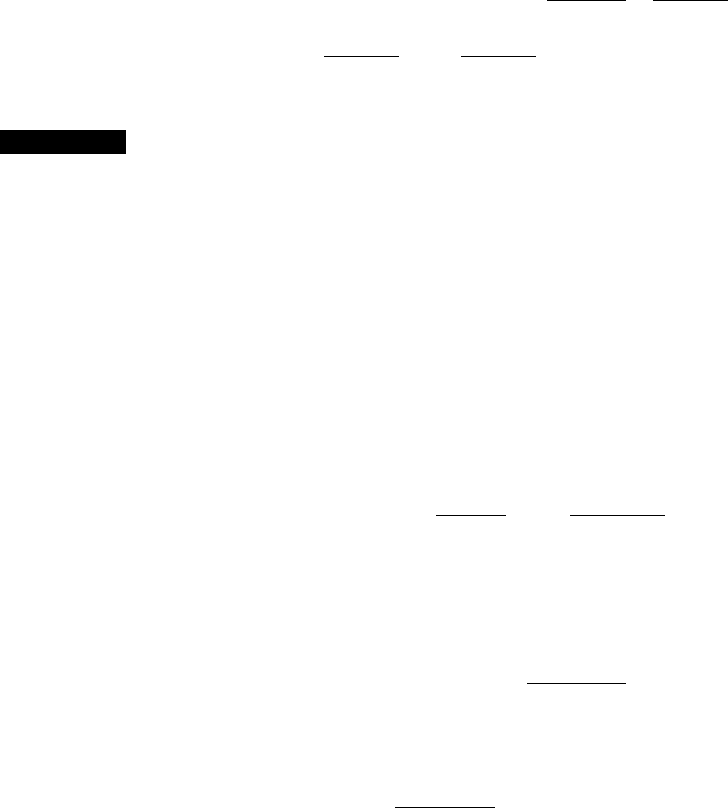
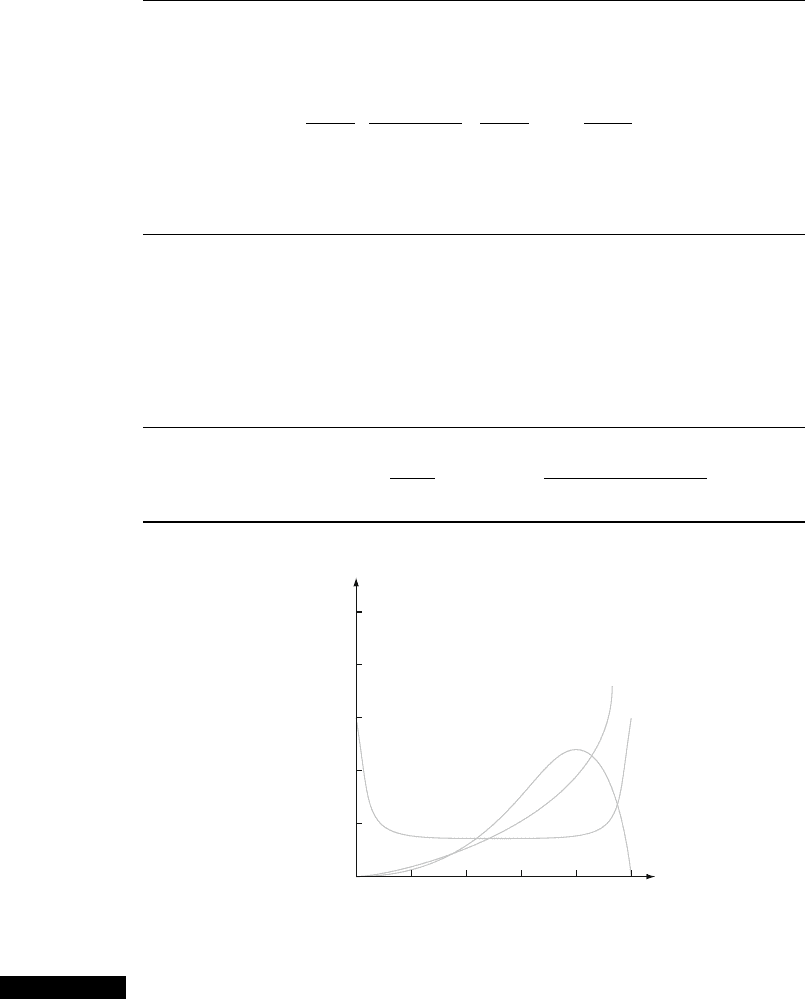
Figure 4.30 illustrates several standard beta pdf’s. Graphs of the general pdf are
similar, except they are shifted and then stretched or compressed to fit over [A, B].
Unless a and b are integers, integration of the pdf to calculate probabilities is difficult,
so either a table of the incomplete beta function or software is generally used.
The mean and variance of X are
m ¼ A þðB AÞ
a
a þ b
s
2
¼
ðB AÞ
2
ab
ða þ bÞ
2
ða þ b þ 1Þ
Example 4.34 Project managers often use a method labeled PERT— for program evaluation and
review technique—to coord inate the various activities making up a large project.
(One successful application was in the construction of the Apollo spacecraft.)
A standard assumpt ion in PERT analysis is that the time necessary to complete
any particular activity once it has been started has a beta distribution with A ¼ the
optimistic time (if everything goes well) and B ¼ the pessimistic time (if every-
thing goes badly). Suppose that in constructing a single-family house, the time X
(in days) necessary for laying the foundation has a beta distribution with A ¼ 2,
B ¼ 5, a ¼ 2, and b ¼ 3. Then a/(a + b) ¼ .4, so E (X) ¼ 2 + (3)(.4) ¼ 3.2.
.8.6.4.2 1
1
2
3
4
5
0
a = b = .5
a = 2
b = .5
a = 5
b = 2
x
f
(x; α, β)
Figure 4.30 Standard beta density curves
4.5 Other Continuous Distributions 207