
Devore J.L., Berk K.N. Modern Mathematical Statistics with Applications
Подождите немного. Документ загружается.


135. The reaction time (in seconds) to a stimulus is a
continuous random variable with pdf
f ðxÞ¼
3
2x
2
1 x 3
0 otherwise
(
a. Obtain the cdf.
b. What is the probability that reaction time is at
most 2.5 s? Between 1.5 and 2.5 s?
c. Compute the expected reaction time.
d. Compute the standard deviation of reaction
time.
e. If an individual takes more than 1.5 s to react,
a light comes on and stays on either until one
further second has elapsed or until the person
reacts (whichever happens first). Determine
the expected amount of time that the light
remains lit. [Hint: Let h( X) ¼ the time that
the light is on as a function of reaction time
X.]
136. Let X denote the temperature at which a certain
chemical reaction takes place. Suppose that X
has pdf
f ðxÞ¼
1
9
ð4 x
2
Þ1 x 2
0 otherwise
a. Sketch the graph of f(x).
b. Determine the cdf and sketch it.
c. Is 0 the median temperature at which the
reaction takes place? If not, is the median
temperature smaller or larger than 0?
d. Suppose this reaction is independently carried
out once in each of ten different labs and that
the pdf of reaction time in each lab is as given.
Let Y ¼ the number among the ten labs at
which the temperature exceeds 1. What kind
of distribution does Y have? (Give the name
and values of any parameters.)
137. The article “Determination of the MTF of Posi-
tive Photoresists Using the Monte Carlo Method”
(Photographic Sci. Engrg., 1983: 254–260) pro-
poses the exponential distribution with parameter
l ¼ .93 as a model for the distribution of a
photon’s free path length (mm) under certain
circumstances. Suppose this is the correct model.
a. What is the expected path length, and what is
the standard deviation of path length?
b. What is the probability that path length
exceeds 3.0? What is the probability that
path length is between 1.0 and 3.0?
c. What value is exceeded by only 10% of all
path lengths?
138. The article “The Prediction of Corrosion by
Statistical Analysis of Corrosion Profiles” (Cor-
rosion Sci., 1985: 305–315) suggests the follow-
ing cdf for the depth X of the deepest pit in an
experiment involving the exposure of carbon
manganese steel to acidified seawater.
Fðx; a; bÞ¼e
e
ðxaÞ=b
1< x < 1
The authors propose the values a ¼ 150 and
b ¼ 90. Assume this to be the correct model.
a. What is the probability that the depth of the
deepest pit is at most 150? At most 300?
Between 150 and 300?
b. Below what value will the depth of the maxi-
mum pit be observed in 90% of all such
experiments?
c. What is the density function of X?
d. The density function can be shown to be
unimodal (a single peak). Above what value
on the measurement axis does this peak
occur? (This value is the mode.)
e. It can be shown that E(X) .5772b + a.
What is the mean for the given values of a
and b, and how does it compare to the median
and mode? Sketch the graph of the density
function. [Note: This is called the largest
extreme value distribution.]
139. Let t ¼ the amount of sales tax a retailer owes the
government for a certain period. The article “Sta-
tistical Sampling in Tax Audits” (Statistics and
the Law, 2008: 320–343) proposes modeling the
uncertainty in t by regarding it as a normally
distributed random variable with mean value m
and standard deviation s (in the article, these
two parameters are estimated from the results of
a tax audit involving n sampled transactions). If a
represents the amount the retailer is assessed, then
an underassessment results if t > a and an over-
assessment if a > t. We can express this in terms
of a loss function, a function that shows zero loss
if t ¼ a but increases as the gap between t and a
increases. The proposed loss function is L(a,t) ¼
t a
if t > a and ¼ k(a t)ift a (k > 1is
suggested to incorporate the idea that overassess-
ment is more serious than underassessment).
a. Show that a
¼ m þ sF
1
1=ðk þ 1ÞðÞis the
value of a that minimizes the expected loss,
where F
1
is the inverse function of the stan-
dard normal cdf.
b. If k ¼ 2 (suggested in the article),
m ¼ $100,000, and s ¼ $10,000, what is the
optimal value of a, and what is the resulting
probability of overassessment?
228
CHAPTER 4 Continuous Random Variables and Probability Distributions
140. A mode of a continuous distribution is a value x*
that maximizes f(x).
a. What is the mode of a normal distribution
with parameters m and s?
b. Does the uniform distribution with para-
meters A and B have a single mode? Why or
why not?
c. What is the mode of an exponential distribu-
tion with parameter l? (Draw a picture.)
d. If X has a gamma distribution with parameters
a and b, and a > 1, find the mode. [Hint:
ln[f(x)] will be maximized if and only if f(x)
is, and it may be simpler to take the derivative
of ln[f(x)].]
e. What is the mode of a chi-squared distribution
having n degrees of freedom?
141. The article “Error Distribution in Navigation”
(J. Institut. Navigation, 1971: 429–442) suggests
that the frequency distribution of positive errors
(magnitudes of errors) is well approximated by
an exponential distribution. Let X ¼ the lateral
position error (nautical miles), which can be
either negative or positive. Suppose the pdf of
X is
f ðxÞ¼ð:1Þe
:2jxj
1< x < 1
a. Sketch a graph of f(x) and verify that f(x)isa
legitimate pdf (show that it integrates to 1).
b. Obtain the cdf of X and sketch it.
c. Compute P(X 0), P(X 2), P(1 X
2), and the probability that an error of
more than 2 miles is made.
142. In some systems, a customer is allocated to one
of two service facilities. If the service time for a
customer served by facility i has an exponential
distribution with parameter l
i
(i ¼ 1, 2) and p is
the proportion of all customers served by facility 1,
then the pdf of X ¼ the service time of a randomly
selected customer is
f ðx; l
1
; l
2
; pÞ
¼
pl
1
e
l
1
x
þð1 pÞl
2
e
l
2
x
x 0
0 otherwise
(
This is often called the hyperexponential or
mixed exponential distribution. This distribution
is also proposed as a model for rainfall amount in
“Modeling Monsoon Affected Rainfall of Paki-
stan by Point Processes” (J. Water Resources
Planning Manag., 1992: 671–688).
a. Verify that f(x; l
1
, l
2
, p) is indeed a pdf.
b. What is the cdf F(x; l
1
, l
2
, p)?
c. If X has f(x; l
1
, l
2
, p) as its pdf, what is E(X)?
d. Using the fact that E(X
2
) ¼ 2/l
2
when X has
an exponential distribution with parameter l,
compute E(X
2
) when X has pdf f(x; l
1
, l
2
, p).
Then compute V(X).
e. The coefficient of variation of a random vari-
able (or distribution) is CV ¼ s/m. What is the
CV for an exponential rv? What can you say
about the value of CV when X has a hyper-
exponential distribution?
f. What is the CV for an Erlang distribution with
parameters l and n as defined in Exercise 76?
[Note: In applied work, the sample CV is used
to decide which of the three distributions
might be appropriate.]
143. Suppose a state allows individuals filing tax
returns to itemize deductions only if the total of
all itemized deductions is at least $5,000. Let X
(in 1,000’s of dollars) be the total of itemized
deductions on a randomly chosen form. Assume
that X has the pdf
f ðx; aÞ¼
k=x
a
0
x 5
otherwise
a. Find the value of k. What restriction on a is
necessary?
b. What is the cdf of X?
c. What is the expected total deduction on a
randomly chosen form? What restriction on
a is necessary for E(X) to be finite?
d. Show that ln(X/5) has an exponential distri-
bution with parameter a 1.
144. Let I
i
be the input current to a transistor and I
o
be
the output current. Then the current gain is pro-
portional to ln(I
o
/I
i
). Suppose the constant of
proportionality is 1 (which amounts to choosing
a particular unit of measurement), so that current
gain ¼ X ¼ ln(I
o
/I
i
). Assume X is normally
distributed with m ¼ 1 and s ¼ .05.
a. What type of distribution does the ratio I
o
/I
i
have?
b. What is the probability that the output current
is more than twice the input current?
c. What are the expected value and variance of
the ratio of output to input current?
145. The article “Response of SiC
f
/Si
3
N
4
Composites
Under Static and Cyclic Loading—An Experi-
mental and Statistical Analysis” (J. Engrg. Mate-
rials Tech., 1997: 186–193) suggests that tensile
strength (MPa) of composites under specified
conditions can be modeled by a Weibull distri-
bution with a ¼ 9 and b ¼ 180.
Supplementary Exercises 229

a. Sketch a graph of the density function.
b. What is the probability that the strength of a
randomly selected specimen will exceed 175?
Will be between 150 and 175?
c. If two randomly selected specimens are cho-
sen and their strengths are independent of
each other, what is the probability that at
least one has strength between 150 and 175?
d. What strength value separates the weakest
10% of all specimens from the remaining
90%?
146. a. Suppose the lifetime X of a component, when
measured in hours, has a gamma distribution
with parameters a and b. Let Y ¼ lifetime
measured in minutes. Derive the pdf of Y.
b. If X has a gamma distribution with parameters
a and b, what is the probability distribution of
Y ¼ cX?
147. Based on data from a dart-throwing experiment,
the article “Shooting Darts” (Chance, Summer
1997: 16–19) proposed that the horizontal and
vertical errors from aiming at a point target
should be independent of each other, each with
a normal distribution having mean 0 and vari-
ance s
2
. It can then be shown that the pdf of the
distance V from the target to the landing point is
f ðnÞ¼
n
s
2
e
n
2
=ð2s
2
Þ
n > 0
a. This pdf is a member of what family intro-
duced in this chapter?
b. If s ¼ 20 mm (close to the value suggested in
the paper), what is the probability that a dart
will land within 25 mm (roughly 1 in.) of the
target?
148. The article “Three Sisters Give Birth on the
Same Day”(Chance, Spring 2001: 23–25) used
the fact that three Utah sisters had all given
birth on March 11, 1998, as a basis for posing
some interesting questions regarding birth coin-
cidences.
a. Disregarding leap year and assuming that the
other 365 days are equally likely, what is the
probability that three randomly selected births
all occur on March 11? Be sure to indicate
what, if any, extra assumptions you are
making.
b. With the assumptions used in part (a), what is
the probability that three randomly selected
births all occur on the same day?
c. The author suggested that, based on extensive
data, the length of gestation (time between
conception and birth) could be modeled as
having a normal distribution with mean
value 280 days and standard deviation 19.88
days. The due dates for the three Utah sisters
were March 15, April 1, and April 4, respec-
tively. Assuming that all three due dates are at
the mean of the distribution, what is the prob-
ability that all births occurred on March 11?
[Hint: The deviation of birth date from due
date is normally distributed with mean 0.]
d. Explain how you would use the information
in part (c) to calculate the probability of a
common birth date.
149. Let X denote the lifetime of a component, with
f(x) and F(x) the pdf and cdf of X. The proba-
bility that the component fails in the interval
(x, x + Dx) is approximately f(x)·Dx. The condi-
tional probability that it fails in (x, x + Dx) given
that it has lasted at least x is f(x)·D x/[1 F(x)].
Dividing this by
Dx produces the failure rate
function:
rðxÞ¼
f ðxÞ
1 FðxÞ
An increasing failure rate function indicates
that older components are increasingly likely to
wear out, whereas a decreasing failure rate is
evidence of increasing reliability with age. In
practice, a “bathtub-shaped” failure is often
assumed.
a. If X is exponentially distributed, what is r(x)?
b. If X has a Weibull distribution with para-
meters a and b, what is r(x)? For what param-
eter values will r(x) be increasing? For what
parameter values will r(x) decrease with x?
c. Since r(x) ¼(d/dx)ln[1 F(x)],
ln[1 F(x)] ¼
R
r(x) dx. Suppose
rðxÞ¼
a 1
x
b
0 x b
0 otherwise
(
so that if a component lasts b hours, it will last
forever (while seemingly unreasonable, this
model can be used to study just “initial wear-
out”). What are the cdf and pdf of X?
150. Let U have a uniform distribution on the interval
[0, 1]. Then observed values having this distribu-
tion can be obtained from a computer’s random
number generator. Let X ¼(1/l)ln(1 U).
a. Show that X has an exponential distribution
with parameter l.
b. How would you use part (a) and a random
number generator to obtain observed values
230
CHAPTER 4 Continuous Random Variables and Probability Distributions
from an exponential distribution with param-
eter l ¼ 10?
151. If the voltage v across a medium is fixed but
current I is random, then resistance will also be
a random variable related to I by R ¼ v/I.If
m
I
¼ 20 and s
I
¼ .5, calculate approximations
to m
R
and s
R
.
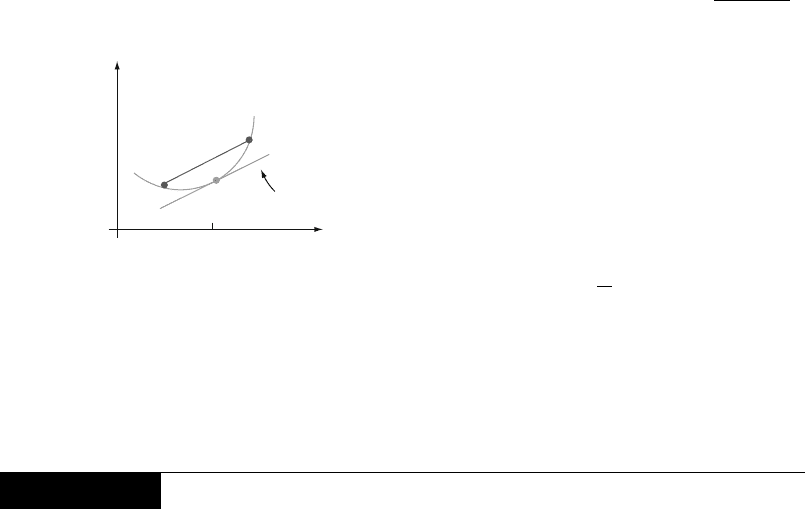
152. A function g(x)isconvex if the chord connecting
any two points on the function’s graph lies above
the graph. When g(x) is differentiable, an equiv-
alent condition is that for every x, the tangent line
at x lies entirely on or below the graph. (See the
figure below.) How does g(m) ¼ g[E(X)] com-
pare to E[g(X)]? [Hint: The equation of the tan-
gent line at x ¼ m is y ¼ g(m)+g
0
(m)·(x m).
Use the condition of convexity, substitute X
for x, and take expected values. Note: Unless
g(x) is linear, the resulting inequality (usually
called Jensen’s inequality) is strict (< rather
than ); it is valid for both continuous and dis-
crete rv’s.]
x
Tangent
line
153. Let X have a Weibull distribution with parameters
a ¼ 2andb. Show that Y ¼ 2X
2
/b
2
has a chi-
squared distribution with n ¼ 2.
154. Let X have the pdf f(x) ¼ 1/[p(1 + x
2
)] for 1
< x < 1 (a central Cauchy distribution), and
show that Y ¼ 1/X has the same distribution.
[Hint: Consider P(|Y| y), the cdf of |Y|, then
obtain its pdf and show it is identical to the pdf
of |X|.]
155. A store will order q gallons of a liquid product to
meet demand during a particular time period.
This product can be dispensed to customers in
any amount desired, so demand during the period
is a continuous random variable X with cdf F(x).
There is a fixed cost c
0
for ordering the product
plus a cost of c
1
per gallon purchased. The per-
gallon sale price of the product is d. Liquid left
unsold at the end of the time period has a salvage
value of e per gallon. Finally, if demand exceeds
q, there will be a shortage cost for loss of good-
will and future business; this cost is f per gallon
of unfulfilled demand. Show that the value of q
that maximizes expected profit, denoted by q*,
satisfies
Pðsatisfying demand) ¼ FðqÞ ¼
d c
1
þ f
d e þ f
Then determine the value of F(q*) if d ¼ $35,
c
0
¼ $25, c
1
¼ $15, e ¼ $5, and f ¼ $25. [Hint:
Let x denote a particular value of X. Develop an
expression for profit when x q and another
expression for profit when x > q. Now write an
integral expression for expected profit (as a func-
tion of q) and differentiate.]
156. An insurance company issues a policy covering
losses up to 5 (in thousands of dollars). The loss,
X, follows a distribution with density function:
f ðxÞ¼
3
x
4
x 1
0 x < 1
8
<
:
What is the expected value of the amount paid
under the policy?
Bibliography
Bury, Karl, Statistical Distributions in Engineering,
Cambridge University Press, Cambridge, England,
1999. A readable and informative survey of distri-
butions and their properties.
Johnson, Norman, Samuel Kotz, and N. Balakrishnan,
Continuous Univariate Distributions, vols. 1–2,
Wiley, New York, 1994. These two volumes
together present an exhaustive survey of various
continuous distributions.
Nelson, Wayne, Applied Life Data Analysis, Wiley,
New York, 1982. Gives a comprehensive discus-
sion of distributions and methods that are used in
the analysis of lifetime data.
Olkin, Ingram, Cyrus Derman, and Leon Gleser,
Probability Models and Applications (2nd ed.),
Macmillan, New York, 1994. Good coverage of
general properties and specific distributions.
Bibliography 231

CHAPTER FIVE
Joint Probability
Distributions
Introduction
In Chapters 3 and 4, we studied probability models for a single random variable.
Many problems in probability and statistics lead to models involving several
random variables simultaneously. In this chapter, we first discuss pro bability
models for the joint behavior of several random variables, putting special emphasis
on the case in which the variables are independent of each other. We then
study expected values of functions of several random variables, including covari-
ance and correlation as measures of the degree of association between two
variables.
The third section considers conditional distributions, the distributions of
random variables given the values of other random variables. The next section is
about transformations of two or more random variables, generalizing the results of
Section 4.7. In the last section of this chap ter we discuss the distribution of order
statistics: the minimum, maximum, median, and other statistics that can be found
by arranging the observations in order.
J.L. Devore and K.N. Berk, Modern Mathematical Statistics with Applications, Springer Texts in Statistics,
DOI 10.1007/978-1-4614-0391-3_5,
#
Springer Science+Business Media, LLC 2012
232
5.1
Jointly Distributed Random Variables
There are many experimental situations in which more than one random variable
(rv) will be of interest to an investigator. We shall first consider joi nt probability
distributions for two discrete rv’s, then for two continuous variables, and finally for
more than two variables.
The Joint Probability Mass Function
for Two Discrete Random Variables
The probability mass function (pmf) of a single discrete rv X specifies how much
probability mass is placed on each possible X value. The joint pmf of two discrete
rv’s X and Y describes how much probability mass is placed on each possible pair
of values (x, y).
DEFINITION
Let X and Y be two discrete rv’s defined on the sample space S of an
experiment. The joint probability mass function p(x, y) is defined for each
pair of numbers (x, y )by
px; yðÞ¼PðX ¼ x and Y ¼ yÞ
Let A be any set consisting of pairs of (x, y) values. Then the probability that
the random pair (X, Y) lies in A is obtained by summing the joint pmf over
pairs in A:
P½ðX; YÞ2A¼
X
ðx;yÞ
X
2A
pðx; yÞ
Example 5.1 A large insurance agency services a number of customers who have purchased both
a homeowner’s policy and an automobile policy from the agency. For each type of
policy, a deductible amount must be specified. For an automobile policy, the
choices are $100 and $250, whereas for a homeowner’s policy, the choices are 0,
$100, and $200. Suppose an individual with both types of policy is selected at
random from the agency’s files. Let X ¼ the deductible amount on the auto policy
and Y ¼ the deductible amount on the homeowner’s policy. Possible (X, Y) pairs are
then (100, 0), (100, 100), (100, 200), (250, 0), (250, 100), and (250, 200); the joint
pmf specifies the probability associated with each one of these pairs, with any other
pair having probability zero. Suppose the joint pmf is given in the accompanying
joint probability table:
y
p(x, y) 0 100 200
x
100 .20 .10 .20
250 .05 .15 .30
5.1 Jointly Distributed Random Variables 233
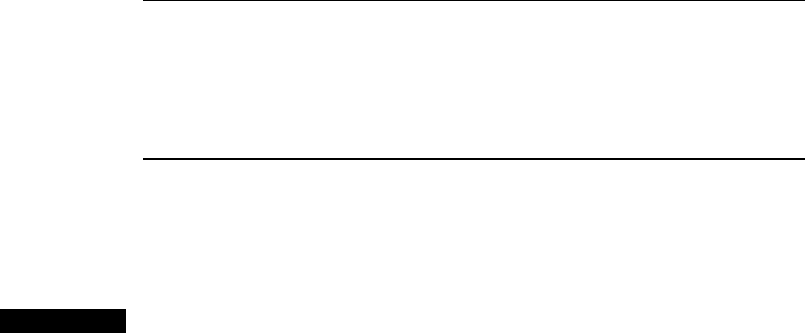
Then p(100, 100) ¼ P(X ¼ 100 and Y ¼100) ¼ P($100 deductible on both policies)
¼ .10. The probability P(Y 100) is computed by summing probabilities of all
(x, y) pairs for which y 100:
PðY 100Þ¼p 100;100ðÞþp 250;100ðÞþp 100;200ðÞþp 250;200ðÞ¼:75
■
A function p(x, y) can be used as a joint pmf provided that p( x, y) 0 for all x
and y and
P
x
P
y
pðx; yÞ¼1 :
The pmf of one of the variables alon e is obtained by summing p(x, y)
over values of the other variable. The result is called a marginal pmf because
when the p(x, y) values appear in a rectangular table, the sums are just marginal
(row or column) totals
DEFINITION
The marginal probability mass functions of X and of Y, denoted by p
X
(x)
and p
Y
(y), respectively, are given by
p
X
ðxÞ¼
X
y
pðx; yÞ p
Y
ðyÞ¼
X
x
pðx; yÞ
Thus to obtain the marginal pmf of X evaluated at, say, x ¼ 100, the probabilities
p(100, y) are added over all possible y values. Doing this for each possible X value
gives the marginal pmf of X alone (without reference to Y). From the marginal pmf’s,
probabilities of events involving only X or only Y can be computed.
Example 5.2
(Example 5.1
continued)
The possible X v alues are x ¼ 100 and x ¼ 250, so computing row totals in the joint
probability table yields
p
X
100ðÞ¼p 100; 0ðÞþp 100; 100ðÞþp 100; 200ðÞ¼:50
And
p
X
250ðÞ¼p 250; 0ðÞþp 250; 100ðÞþp 250; 200ðÞ¼:50
The marginal pmf of X is then
p
X
ðxÞ¼
:5
0
x ¼ 100; 250
otherwise
Similarly, the marginal pmf of Y is obtained from column totals as
p
Y
ðyÞ¼
:25
:50
0
8
<
:
y ¼ 0; 100
y ¼ 20
otherwise
so PðY 100Þ¼p
Y
100ðÞþp
Y
200ðÞ¼:75 as before. ■
234 CHAPTER 5 Joint Probability Distributions
The Joint Probability Density Function for Two
Continuous Random Variables
The probability that the observed value of a continuous rv X lies in a one-
dimensional set A (such as an interval) is obtained by integrating the pdf f(x) over
the set A. Similarly, the probability that the pair (X, Y) of continuous rv’s falls in a
two-dimensional set A (such as a rectangle) is obtained by integrating a function
called the joint density function.
DEFINITION
Let X and Y be continuous rv’s. Then f(x, y) is the joint probability density
function for X and Y if for any two-dimensional set A
P½ðX; YÞ2A¼
ð
A
ð
f ð x; yÞdx dy
In particular, if A is the two-dimensional rectangle fðx; yÞ :
a x b; c y dg; then
P½ðX; YÞ2A¼Pða X b; c Y dÞ¼
ð
b
a
ð
d
c
f ð x; yÞdy dx
For f(x, y) to be a candidate for a joint pdf, it must satisfy f(x, y) 0
and
Ð
1
1
Ð
1
1
f ðx; yÞdx dy ¼ 1: We can think of f(x, y) as specifying a surface at
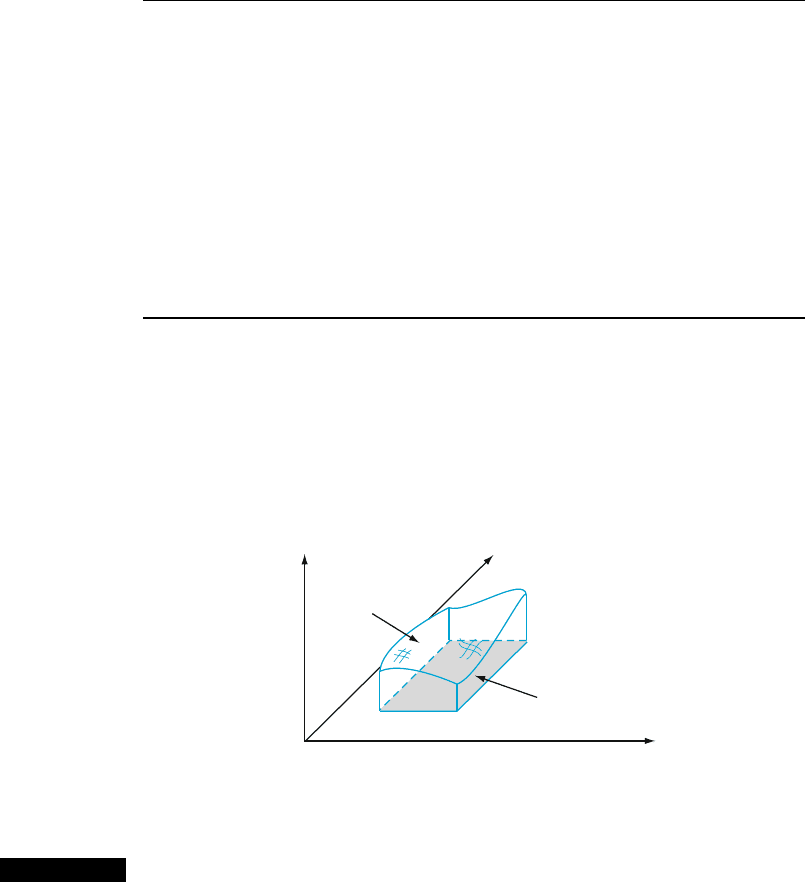
height f(x, y) above the point (x, y ) in a three-dimensional coordinate system. Then
P[(X, Y) 2 A] is the volume underneath this surface and above the region A,
analogous to the area under a curve in the one-dimensional case. This is illustrated
in Figure 5.1.
Example 5.3 A bank operates both a drive-up facility and a walk-up window. On a randomly
selected day, let X ¼ the proportion of time that the drive-up facility is in use (at
least one customer is being served or waiting to be served) and Y ¼ the proportion
of time that the walk-up window is in use. Then the set of possible values for (X, Y)
y
x
f (x, y)
Surface f (x, y)
A = Shaded
rectangle
Figure 5.1
P
[(
X
,
Y
) 2
A
] ¼ volume under density surface above
A
5.1 Jointly Distributed Random Variables 235
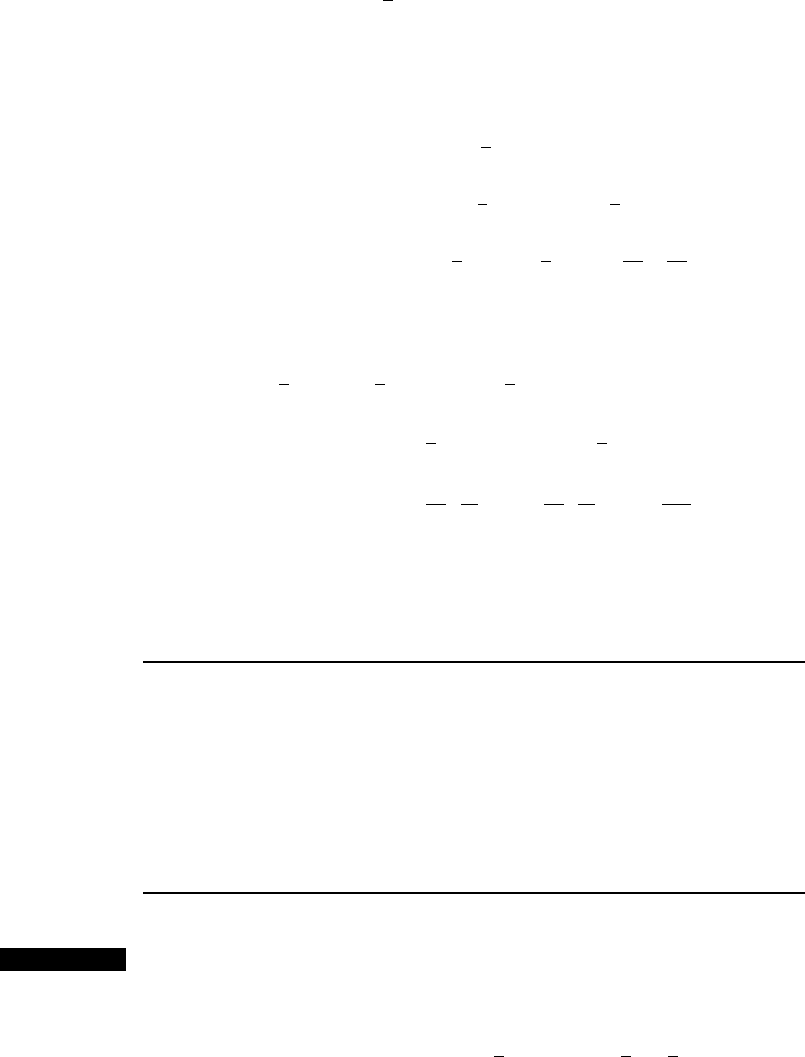
is the rectangle D ¼fðx; yÞ : 0 x 1; 0 y 1g: Suppose the joint pdf of
(X, Y) is given by
f ð x; yÞ¼
6
5
ðx þ y
2
Þ 0 x 1; 0 y 1
0 otherwise
8
<
:
To verify that this is a legitimate pdf, note that f (x, y) 0 and
ð
1
1
ð
1
1
f ð x; yÞdx dy ¼
ð
1
0
ð
1
0
6
5
ðx þ y
2
Þdx dy
¼
ð
1
0
ð
1
0
6
5
xdx dyþ
ð
1
0
ð
1
0
6
5
y
2
dx dy
¼
ð
1
0
6
5
xdxþ
ð
1
0
6
5
y
2
dy ¼
6
10
þ
6
15
¼ 1
The probability that neither facility is busy more than one-quarter of the time is
P 0 X
1
4
; 0 Y
1
4
¼
ð
1=4
0
ð
1=4
0
6
5
ðx þ y
2
Þdx dy
¼
6
5
ð
1=4
0
ð
1=4
0
xdxdyþ
6
5
ð
1=4
0
ð
1=4
0
y
2
dx dy
¼
6
20
x
2
2
x¼1=4
x¼0
þ
6
20
y
3
3
y¼1=4
y¼0
¼
7
640
¼ :0109
■
As with joint pmf’s, from the joint pdf of X and Y, each of the two marginal
density functions can be computed.
DEFINITION
The marginal probability density functions of X and Y, denoted by f
X
(x)
and f
Y
(y), respectively, are given by
f
X
ðxÞ¼
ð
1
1
f ð x; yÞdy for 1< x < 1
f
Y
ðyÞ¼
ð
1
1
f ð x; yÞdx for 1< y < 1
Example 5.4
(Example 5.3
continued)
The marginal pdf of X, which gives the probability distribution of busy time for the
drive-up facil ity without reference to the walk-up window, is
f
X
ðxÞ¼
ð
1
1
f ð x; yÞdy ¼
ð
1
0
6
5
ðx þ y
2
Þdy ¼
6
5
x þ
2
5
236 CHAPTER 5 Joint Probability Distributions
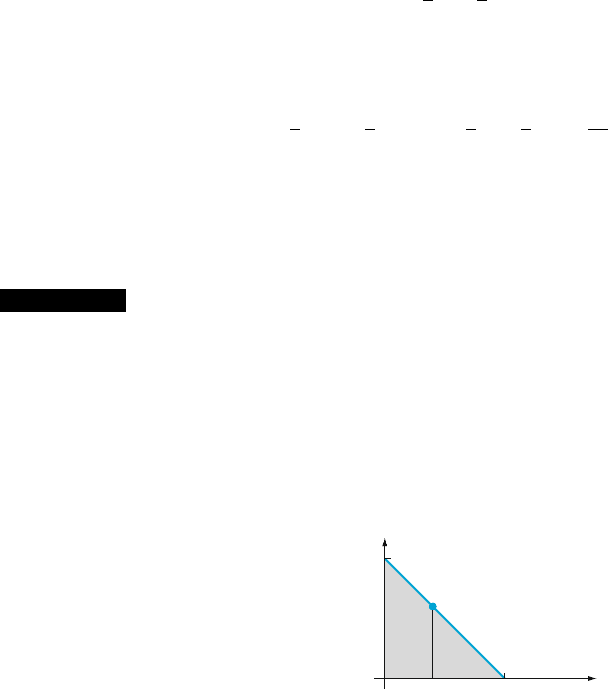
for 0 x 1 and 0 otherwise. The marginal pdf of Y is
f
Y
ðyÞ¼
6
5
y
2
þ
3
5
0 y 1
0 otherwise
8
<
:
Then
P
1
4
Y
3
4
¼
ð
3=4
1=4
6
5
y
2
þ
3
5
dy ¼
37
80
¼ :4625:
■
In Example 5.3, the region of positive joint density was a rectangle, which
made computation of the marginal pdf’s relatively easy. Consider now an example
in which the region of positive density is a more complicated figure.
Example 5.5 A nut company markets cans of deluxe mixed nuts containing almonds, cashews, and
peanuts. Suppose the net weight of each can is exactly 1 lb, but the weight contribution
of each type of nut is random. Because the three weights sum to 1, a joint probability
model for any two gives all necessary information about the weight of the third
type. Let X ¼ the weight of almonds in a selected can and Y ¼ the weight of cashews.
Then the region of positive density is D ¼fðx; yÞ : 0 x 1; 0 y 1;
x þ y 1 g, the shaded region pictured in Figure 5.2.
Now let the joint pdf for (X, Y)be
f ð x; yÞ¼
24xy 0 x 1; 0 y 1; x þ y 1
0 otherwise
(
For any fixed x, f(x, y) increases with y; for fixed y, f(x, y) increases with x. This is
appropriate because the word deluxe implies that most of the can should consist of
almonds and cashews rather than peanuts, so that the density function should be
large near the upper boundary and small near the origin. The surface determined by
f(x, y) slopes upward from zero as (x
, y) moves away from either axis.
Clearly, f(x, y) 0. To verify the second condition on a joint pdf, recall that a
double integral is computed as an iterated integral by holding one variable fixed
(such as x as in Figure 5.2), integrating over values of the other variable lying along
x
(0, 1)
x
(1, 0)
y
(x, 1−x)
Figure 5.2 Region of positive density for Example 5.5
5.1 Jointly Distributed Random Variables 237