
Dignas B., Winter E. Rome and Persia in late Antiquity. Neighbours and Rivals
Подождите немного. Документ загружается.

17 The peace treaty of 298 123
for each other’s destruction.
20
For this is not held as a virtue but rather levity or
weakness. As they believe that later generations will not be able to help them they
make an effort to destroy their opponents.’ He continued by saying that it was not
necessary to think that Nars
¯
e was weaker than the other kings but rather to see
Galerius as that much superior to the other kings so that Nars
¯
e himself was inferior
to him alone, and rightly so, without, however, proving to be lower in dignity than
his ancestors. Apharb
¯
an added that Nars
¯
e had given him instructions to entrust,
as they were fair, the right of his empire to the kindness of the Romans; that this
was why he was not bringing the oaths by which the peace had to be concluded
but was handing everything over to the judgement of the emperor, asking only
that his children and wives were returned to him, and he claimed that for their
return he would owe the emperor more for his benefactions than if spared by
his arms. He was not able to thank him appropriately for the fact that those in
captivity had not experienced any cruelty but had been treated as if soon to be
returned to their own high status at home. In this context he also reminded the
emperor of the changeable character of human affairs. But Galerius seemed to be
angry about this remark and, with his body beginning to shake, responded that
it was not quite appropriate for the Persians to remind others of the changes in
human affairs because they themselves did not cease to use every opportunity to
add to human misfortune.
21
‘For you guarded the rule of victory well in Valerian’s
case, when you deceived him with tricks, took him captive and did not release
him until old age and his shameful death, when you, after his death, conserved
his skin with some disgusting method and thereby afflicted the mortal body with
immortal offence.’
22
The emperor
23
went through all this and added that his mind
was not changed by what the Persian embassy tried to convey, namely that he
should respect human fate (because one should rather be enraged by this if one
considered what the Persians had done), but that he would follow the footsteps of
his own ancestors, whose custom it had been to spare their subjects but to fight
the ones who opposed them;
24
he told the ambassador to inform his king of the
20
It is striking how much these words resemble those of Xusr
¯
oII(590–628) at the end of the sixth
century when he approached the Byzantine emperor Maurice in order to win him as an ally against
his internal rival Bahr
¯
am
ˇ
C
¯
ob
¯
ın; Theoph. Simoc. iv.11.1–2 must have based his wording on the chro-
nicle of Peter the Patrician; see also the way
ˇ
S
¯
ap
¯
ur II addresses Constantius II in Amm. xvii.5.3 (34).
21
According to Sprengling 1953: 111 Galerius’ words are too immediate and lively for an account that
was composed 250 years after the events and cannot have been the product of the historian’s own
imagination.
22
At this point Galerius recalls the fate of the Roman emperor Valerian, who had been captured by
the Persians during the reign of
ˇ
S
¯
ap
¯
urI(240–72)(5).
23
In the Greek text the author uses the title basileus, as it was indeed used for a Roman emperor;
Galerius, however, had been acclaimed ‘Caesar’ on 21 May (?) 293; he was acclaimed ‘Augustus’ in
Nicomedia not before 1 May 305; on the title of basileus in the early Byzantine period see in general
Chrysos 1978: 29–75.
24
Galerius alludes to Vergil’s famous words parcere subiectis et debellare superbos (Aen. vi.853), which
describe a principle of Rome’s attitude towards defeated enemies; ironically, the attribute superbus
describes the Persian ambassador rather well so that Rome’s generosity appears even more noteworthy;
the reader is also reminded of Festus’ statement (25), Persae non modo armis sed etiam moribus Romanos
superiores esse confessi sunt; see Eadie 1967a: 148.
124 4 The diplomatic solutions
generosity of the Romans, whose kindness he had challenged, and to hope that
soon they [the captives] would return to him by judgement of the emperor.
(14) When Galerius and Diocletian had come together in Nisibis, they took
counsel there and agreed to send an ambassador to Persia, Sicorius Probus, an
archivist. Nars
¯
e received him in a friendly way expecting to hear what had been
reported to him. But Nars
¯
e also made use of delaying tactics. For as if he wanted the
ambassadors who had come with Sicorius to recover (since they were exhausted),
he took Sicorius, who knew well what was going on, as far as the Asproudis, a
river in Media, until the units who had been scattered here and there because of
the war had gathered. And then, in the inner room of the palace, having sent
away all others and allowing only the presence of Apharb
¯
an and of the archapet
¯
es
Barsaborsos,
25
the one of whom was the praetorian prefect and the other held the
rule over Syme,
26
he asked Probus to deliver his message. The main points of the
ambassador’s message were the following: that in the eastern region the Romans
should receive Ingil
¯
en
¯
e together with S
¯
oph
¯
en
¯
e, Arzan
¯
en
¯
e together with Kardu
¯
en
¯
e
and Zabdik
¯
en
¯
e and that the river Tigris should be the boundary line between the
two states,
27
that the fortress of Zintha, which was located on the border of Media,
should mark the border of Armenia, that the king of Ib
¯
eria should owe his royal
status to the Romans, and that the city of Nisibis, which lies on the Tigris, should
be the place of trade. Nars
¯
e listened to these points and – as his present situation
did not allow him to refuse any of this – agreed to all of them; with the exception,
so that he would not seem to be forced to comply with everything, that he rejected
the condition that Nisibis should be the only place for exchange. Sicorius, however,
responded, ‘This point is a requirement because the embassy does not have full
power and no instructions for this have been given by the emperors.’ When these
matters had thus been settled, Nars
¯
e was given back his wives and children, whose
pure reputation had been respected thanks to the emperors’ love of honour.
Already shortly after the decisive defeat in Armenia, which did not leave the
Sasanians any prospects for a military success (6), the Persian ruler Nars
¯
e
sent an ambassador to Galerius. The main objective of this embassy was
to achieve the release of the royal family whose captivity would represent
an asset for the Romans during the negotiations and at least a significant
psychological advantage. The man sent to Galerius by Nars
¯
e was Apharb
¯
an,
25
On the title archapet
¯
es, which is attested for the Parthian and early Sasanian period, see Chaumont
1986a: 400–1; on Barsaborsos see Chaumont 1969: 120; Felix 1985: 124.
26
Peeters 1931: 27–8 conjectures t
¯
en tou Symiou eichen arch
¯
en into t
¯
en tou s
¯
emeiou arch
¯
en; in this case
Barsaborsos, who was able to read, would have acted as secretary to the Great king, which would
suggest that there was a written agreement.
27
Chrysos 1976: 12–14 points to the significance of the term politeia, i.e. the ‘state’ as a construct
organised in a specific way in contrast to the royal power (basileia). Chrysos argues that the term
politeia indicates an autonomous state acting in a politically sovereign manner and that in the
sixth and seventh centuries Byzantine authors such as Peter the Patrician, Menander Protector and
Theophylact Simocatta reserved this term for Rome and the Sasanian Empire whereas other empires
and nations were labelled as ethn
¯
e and gen
¯
e; see also Schreiner 1983: 305–6.
17 The peace treaty of 298 125
who was the commander of the royal guard and thus a high Persian dig-
nitary and intimate friend of the Sasanian king. On the Roman side the
negotiations were led by the magister memoriae Sicorius Probus, who was
likewise a high official. The Persian ambassador argued that the Roman and
Persian Empires were like two lights, two eyes, whose sparkle made each
other shine, and they should therefore refrain from destroying each other.
28
Although Apharb
¯
an used this metaphor in order to emphasise the equal
rank of both empires his words cannot be dismissed as a feeble attempt
to show the Sasanian Empire in a better light. The expressive image must
reflect his actual view of the relationship between the two states.
29
Apharb
¯
an then went on to appeal to the Romans’ sense of humanity
and justice. However, when he asked for the Persian captives to be treated
well and assured the Roman emperor that this would oblige the great king
more than a military victory could, Galerius became very angry and inter-
rupted him. The memory of the death of the Roman emperor Valerian
in Persian captivity just a few decades before (5) and the circumstances of
his death must have been alive among Romans and Persians alike. Nev-
ertheless, Galerius dismissed the Persian ambassador by promising Nars
¯
e
that the captives would return soon. The emperor’s decision was probably
motivated by his respect both for Diocletian’s moderate policy and for the
Sasanian Empire. The negotiations between Galerius and Apharb
¯
an were
a prerequisite for the conclusion of a formal peace treaty.
When his negotiations with Apharb
¯
an had come to an end, Galerius
rushed to Nisibis where he and Diocletian jointly decided on the terms
for a formal peace.
30
Afterwards Sicorius Probus went to meet Nars
¯
eon
Persian territory in order to inform him of these terms. It seems certain that
Sicorius Probus and Nars
¯
e met in M
¯
edia but we do not know where exactly
on the river Asproudis.
31
The region had been conquered by Galerius after
Satala but officially it was still part of the Sasanian Empire. Diocletian’s
decision to send a middle man to the Persian ruler is surprising; even more
surprising, however, is the fact that in spite of the Persian defeat the Roman
ambassador crossed the official border and went to meet Nars
¯
e in order
28
Cf. also the words placed into the mouth of the Sasanian king Kav
¯
adh I by the Byzantine author
Ioannes Malalas (18.44 [p. 449]), namely that according to a divine plan Byzantium and the Sasanian
Empire were the two centres of civilisation, ‘the moon of the West and the sun of the East’; according
to Theophylact Simocatta (iv.13.7) Xusr
¯
o II wrote to his benefactor Maurice that ‘one power alone
was not able to shoulder the immense burden of taking care of the organisation of the universe
and one man’s pulse was not able to steer everything created under the sun’; see also Shahbazi 1990:
591.
29
For an analysis of this text see Winter 1988: 163–8.
30
Eutr. ix.25.1; Zon. xii.31.
31
Enßlin 1942: 42.
126 4 The diplomatic solutions
to conclude the treaty.
32
In Iranian–Roman relations the venue for peace
negotiations was a formal element as important as the accurate diplomatic
ceremonial and was also seen to reflect the political balance of power.
Diocletian’s policy in the East was shaped by an attempt not to overexert
the capacities of the empire, to refrain from expansion and to be content
with a restoration of the borders that had been fixed by the Eastern policy
of the Severi. In spite of Diocletian’s strong position in 298 Rome did not
show any aggressive or universal aspirations; instead, Diocletian intended
to acknowledge the sovereignty of the defeated Sasanian king. This is illus-
trated by the place where the foedus of 298 was concluded and which was
accepted, perhaps even chosen by Rome, together with the moderate terms
of the agreement. According to Peter the Patrician Nars
¯
e had to give his
consent to three important Roman conditions. The first of these concerned
territory and a clarification of the situation along the Sasanian–Roman and
Sasanian–Armenian borders.
33
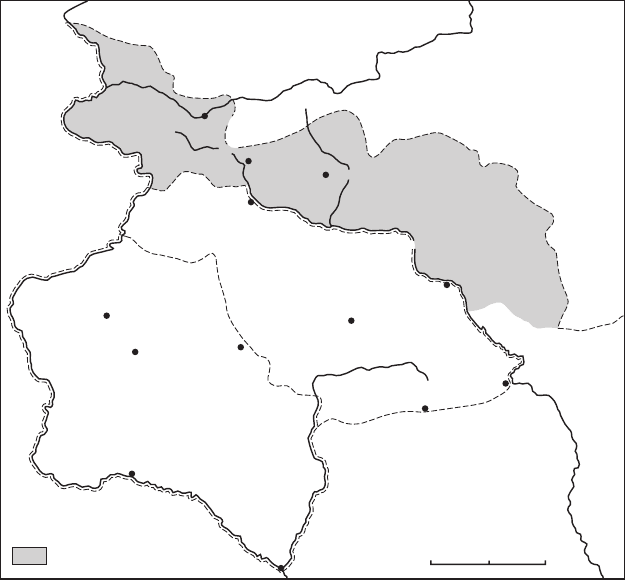
Locating the so called ‘provinces beyond the
Tigris’, which had to be ceded to Rome, poses problems (map 8).
34
Peter the Patrician singles out five regions: Ingil
¯
en
¯
e and S
¯
oph
¯
en
¯
e geo-
graphically comprise the area between the Tigris and the Nymphios. The
third province, Arzan
¯
en
¯
e, borders these in a south-eastern direction, also
situated along the upper Tigris and starting from the eastern banks of
the Nymphios.
35
Adjacent to this province are the regions Kardu
¯
en
¯
e and
Zabdik
¯
en
¯
e. A comparison with other sources
36
fleshes out our map of the
area. The area between the Euphrates and the Nymphios and further east
into Kardu
¯
en
¯
e actually included nine and not five regions.
Moreover, our author’s statement that the Tigris was supposed to be the
new borderline between the two powers seems to contradict the fact that
most areas ceded to Rome were located beyond the Tigris. This is con-
firmed by the ancient author Festus, who wrote in the fourth century and
was thus much closer to the events of 298 than Peter the Patrician. Festus
claims that the Romans gained power over five peoples across the Tigris.
37
Ammianus Marcellinus also mentions the regiones Transtigritanae.
38
Differ-
entiating between a situation de-iure and one de-facto may help to explain
the diverging accounts of Peter the Patrician and Festus. Whereas the latter
describes the official situation which assigns the so called ‘provinces beyond
the Tigris’ to Rome, the Byzantine historian describes the real situation that
was created by an administrative practice in these provinces soon after 298.
39
32
Winter 1994: 603–5.
33
Winter 1989b: 555–71.
34
Adontz 1970: 25–37.
35
On this province see also Whitby 1983: 205–18.
36
Amm. xxv.7.9.
37
Fest. 14.25.
38
Amm. xxv.7.9.
39
Dillemann 1962: 217–18; see also Felix 1985: 125–6.
17 The peace treaty of 298 127
Callinicum
Trans-Tigritanian regions/nations
Carrhae
Edessa
Rhesaina
Nisibis
Singara
Mosul
Bezabde
Ziata
Amida
Martyropolis
Arsamosata
Sophe
-
ne
-
Anzite
-
ne
-
Ingile
-
ne
-
Sophane
-
ne
-
Asthiane
-
ne
-
Balabite
-
ne
-
Arzan
e
-
ne
-
Kard
ue
-
ne
-
Zabdike
-
ne
-
Rehime
-
ne
-
M
o
x
o
e
-
n
e
-
Armenia
M
e
s
o
p
o
t
a
m
i
a
O
s
r
h
o
e
n
e
Circesium
E
u
p
h
r
a
t
e
s
C
h
a
b
o
-
r
a
s
T
i
g
r
i
s
N
y
m
c
h
i
o
s
A
r
s
a
n
i
a
s
0 50 100 km
Map 8: The ‘Trans-Tigritania’
Ancient authors of the fourth century, who talk about contemporary affairs
along the border, refer to the Tigris as the actual borderline.
40
The Romans
withdrew to the western banks of the Tigris; in 298 they refrained from con-
structing a ‘proper limes’ beyond the Tigris but were content with securing
strategically important passes.
41
Accordingly, the regions beyond the Tigris which were ceded to Rome
in 298 did not become new provinces of the Roman Empire but continued
to be administered and ruled by Armenian noble families, who, however,
were responsible to Rome.
42
Diocletian would not have envisaged a perma-
nent territorial gain for the Roman Empire and left things as they were in
40
Amm. xviii.5.3 and 6.9; Iul. Or. 1.22 b–c.
41
Honigmann 1935: 6–16.
42
On the administrative structures and the legal status of these Roman–Armenian satrapies and on
the special role of the Armenian satraps see Enßlin 1942: 80–3.
128 4 The diplomatic solutions
Trans-Tigritania. He must have hoped that such a policy of integration
would secure the loyalty of the Armenians.
43
In this way, Rome pushed
forward the line of defence for the province of Mesopotamia. During the
following years, however, we observe new Roman activities with an eye to
securing the border region, which illustrate the strategic importance of the
area for the West.
44
Another territorial clause poses problems.
45
According
to Peter the Patrician the fortress of Zintha, which was supposed to mark the
boundary of Armenia, was situated along the border to M
¯
edia. If we trust
the words of the Byzantine historian, the borders of Armenia would have
been shifted considerably eastward. In this case, Armenia would have been
compensated for the loss of the ‘provinces beyond the Tigris’ in the area of
the Media Atropat
¯
en
¯
e (Azerbaijan) at Sasanian expense. It is also possible,
however, that the fortress was situated within the border region Ingil
¯
en
¯
e,
which, as already mentioned, was ceded to Rome and was explicitly named
in the treaty because of its strategic importance.
Moreover, any compensation for Armenia by way of a south-eastern
extension of its borders is problematic.
46
The overall policy of the Roman
emperor speaks against an eastward extension of the borders all the way into
the area of the Media Atropat
¯
en
¯
e. Diocletian’s conservative policy rather
aimed at securing the status quo. It is noteworthy that Tiridates III was
excluded from the peace negotiations of the year 298 although Galerius
owed his military success against Nars
¯
e above all to the help of the Arme-
nian king. Diocletian acted in the name of Tiridates III, who apparently
did not have any choice but to acknowledge his dependence on Rome. It
does not look, therefore, as if Diocletian felt obliged to compensate Tiri-
dates for anything. The latter must have been well aware that his existence
depended on the great powers, and this was once more revealed by the treaty
of 298.
47
According to Peter the Patrician the peace treaty also demanded that in
the future the king of Ib
¯
eria would receive the symbols of his rule from
Rome. Nars
¯
e thus had to acknowledge a Roman protectorate of Ib
¯
eria,
which was situated south of the middle Caucasus and north of Armenia.
43
Barcel
´
o 1981: 159 assumes that the long existing amicitia between Rome and Armenia was confirmed
and that this friendship extended to a wide range of scenarios, such as Rome asking the Arsacid
nobility ruling Armenia to protect Roman interests in the East.
44
Honigmann 1935: 4–5; Enßlin 1942: 54–70 and Lightfoot 1986: 509–29.
45
Winter 1988: 180–6.
46
Kettenhofen 1995c: 69–73.
47
Against this background we have to understand Tiridates III’s decision to make Christianity the
state religion in Armenia soon after 298. The war against Armenia that began in 312 was the answer
to this move, which had such wide-reaching consequences for Armenia’s future; on the war against
Armenia by Maximinus Daia see Castritius 1968/9: 94–103; on Tiridates and the Christianisation of
Armenia see Chaumont 1969: 131–46 and Kettenhofen 1995c: 48–135.
17 The peace treaty of 298 129
Rome thereby ruled over Kolchis and Ib
¯
eria, which together make up the
territory of modern Georgia.
48
By placing Ib
¯
eria under their supremacy the
Romans gained crucial strategic advantages over the Sasanian Empire.
The last paragraph of the treaty of 298 concerned primarily economic
questions (see also 28).
49
The city of Nisibis, which was situated on the
Tigris, was named as the only place of trade between the two empires.
Peter the Patrician mentions that Nars
¯
e complained about this condition
whereas he seems not to have shown any reaction against the other terms for
peace proclaimed by Sicorius Probus. The king’s protest as well as Rome’s
firm attitude reveal how much importance both sides attributed to this
matter. Nars
¯
e rejected the clause for good reasons because it entailed that
the exchange of goods within Mesopotamia, in particular the local
trade along the borders, would be impeded. Correctly, W. Seston inter-
prets this ‘economic clause’ of the peace treaty as complementing the Roman
defence system.
50
The many caravan routes in upper Mesopotamia and in
particular the main waterway, the Euphrates, represented natural conditions
for intensive trade and also for close contacts between the neighbouring
regions of both states. The official frontier between the Roman and the
Persian Empires was therefore somewhat artificial. From a Roman point of
view, trying to declare Nisibis as the only place for an exchange of goods
between the two empires makes sense, also with regard to the safety of the
empire (28).
51
After Nars
¯
e had agreed to Rome’s terms his relatives were
returned to him.
52
Festus tells us that the king’s family had been treated
very mercifully and that this impressed the Persians so much that they
admitted to being inferior to the Romans not only in arms but also with
regard to common decency.
53
It is certainly possible that the return of the
captives had been part of the official peace treaty.
54
Apparently the treaty
was concluded in the autumn of 298 and was ratified by the signatures of
Nars
¯
e and Sicorius Probus. It was a foedus that fulfilled the technical and
legal conditions for an agreement that would bind both parties.
48
Braund 1994: 245–6; on the history of this region in general see Lang 1983: 505–36 and Lordkipanidse
and Brakmann 1994: 12–106.
49
Winter 1987: 47–58 and 1988: 192–9.
50
Seston 1946: 176–7.
51
According to Andreotti 1969: 217–18 the strict supervision of trade was not crucial for military
considerations; cf. ibid. 215–57 for a detailed discussion of the relationship between national safety
and the control of trade.
52
Malal. 12.39 (p. 308); Zon. xii.31.
53
Fest. 25; Eutr. ix.27.2 and Zon. xii.32 claim that Diocletian paraded Nars
¯
e’s family in his triumph
but these statements must be seen as part of a literary embellishment surrounding the great triumph
that Diocletian celebrated in 303.
54
Cf. Schenk Graf von Stauffenberg 1931: 400.
130 4 The diplomatic solutions
Most modern scholars interpret the foedus of 298 as a great political and
diplomatic Roman triumph. In contrast, P. Barcel
´
o and R. Klein argue
that the final treaty of the year 298 created a situation that was genuinely
unacceptable for the Sasanians and hence dangerous. The two scholars
talk about a delayed war rather than a real peace, which only lasted as
long as it did because for a while the Sasanian king
ˇ
S
¯
ap
¯
ur II was preoccu-
pied with domestic and other foreign affairs. They claim that Diocletian’s
wish to fortify the border revealed how much the emperor was aware of
the danger.
55
According to G. Wirth Rome dictated peace conditions that
the Sasanian Empire perceived as threatening its very existence.
56
How-
ever, such interpretations fail to see the defensive character of Diocletian’s
policy.
Moreover, we have to look at Sasanian interests from the perspective of
the year 298 and not in light of the following events. Considering Nars
¯
e’s
military defeat, what could he have expected from a peace treaty with Rome,
in particular given the fact that his family was held captive by the enemy? His
goal for the negotiations was the release of the royal prisoners, and in return
he seems to have been prepared to accept any reasonable terms. Diocletian’s
demands must therefore be regarded as moderate and restrained. Only if
the emperor had acted differently by claiming more Persian territory or had
even refused to release the prisoners – which, considering Valerian’s death in
Sasanian captivity not long before, might have been considered an option –
could one indeed talk of repressions and a treaty that bore the seeds for a new
war. As it was, Nars
¯
e achieved his main goal in the negotiations, the return
of the captives, and from a Sasanian perspective this was a success as much
as the fact that Rome waived territorial claims. Nars
¯
e certainly accepted
terms that entailed significant strategic and economic disadvantages for the
Sasanian Empire but in view of the situation in the year 298 this had been
inevitable.
An analysis of the peace treaty of 298
57
should also point to the fact that in
spite of the military and diplomatic defeat the dignified role of the Persian
king and the equality between the ‘King of kings’ and the emperor were
respected. Rome acknowledged the sovereignty of the defeated Sasanian
ruler.
58
Likewise, in light of his defeat Nars
¯
e gave up Sasanian plans for a
world empire. Towards the end of the third century each of the two powers
therefore respected the might of the opponent both on a military and a
diplomatic level.
55
Klein 1977: 185 and Barcel
´
o 1981: 74.
56
Wirth 1980/1: 336–7.
57
Winter 1988: 208–15.
58
Ziegler 1964: 145 and Chrysos 1976: 1–60.
18 The peace treaty of 363 131
18: The peace treaty of 363 between Jovian and
ˇ
S¯ap ¯ur II
For the most part, Rome’s territorial gains and corresponding strategic and
economic advantages that resulted from the foedus of 298 were lost when
ˇ
S
¯
ap
¯
ur II and Jovian concluded a new peace in 363.
59
This time it was the
Roman emperor who – in light of his crushing military defeat – had to
agree to more or less all conditions for peace named by
ˇ
S
¯
ap
¯
ur II. For Rome,
losing important strategic positions and cities meant considerable loss of
prestige. Many and varied sources ranging from chroniclers and historians
to poets, orators and theologians reveal how Rome struggled with this
situation, both historically and ideologically.
60
We owe the most elaborate
account to the eyewitness Ammianus Marcellinus, who was an officer in
the Roman army at the time and participated in a number of wars during
his lifetime.
Ammianus Marcellinus
xxv
.7.9–14
(9) But the king insisted on demanding what, as he called it, was his and what
had been taken away a long time ago by Maximianus
61
but really, as the situation
required, for our release
62
five regions beyond the Tigris: Arzan
¯
en
¯
e, Moxo
¯
en
¯
e, Zab-
dik
¯
en
¯
e and also Rehim
¯
en
¯
e and Kardu
¯
en
¯
e together with fifteen fortresses, Nisibis
as well as Singara and the Castra Maurorum,
63
a very convenient fortification. (10)
And although it would have been ten times better to fight than to hand over any
of these, the many flatterers put the timid emperor under pressure by bringing
up the dreaded name of Procopius
64
and predicting that if he, after learning of
Julian’s death, returned with a fresh army, which he commanded, he would easily
and without opposition overthrow the government. (11) Without hesitation the
emperor, greatly inflamed by these persistent and dangerous remarks, handed over
everything they asked for
65
and he barely made sure that Nisibis and Singara came
under Persian control without their inhabitants and that the Romans from the
fortresses that were to be handed over were allowed to return to our protection.
59
For an analysis of this foedus of 363 see ibid.: 25–60; Blockley 1984: 34–7 and Chrysos 1993: 165–202.
60
See Chrysos 1993: 166–7; Chrysos lists the testimonies related to the peace treaty.
61
ˇ
S
¯
ap
¯
ur II has Nars
¯
e’s defeat against Gaius Galerius Valerius Maximianus in 298 in mind (6), which
resulted in the peace concluded at Nisibis (17).
62
With these words Ammianus Marcellinus refers to the difficult situation of the Roman army, which
was still situated in the enemy’s territory when Julian died and exposed to the continuing Sasanian
attacks.
63
This important Roman fortification in Mesopotamia, a two days’ march away from D
¯
ar
¯
a, is men-
tioned by the author elsewhere (xviii.6.9) and also by Procopius (Aed. ii.4); see Ball 1989: 7–18 and
2003: 80–1.
64
This is the usurper Procopius, a relative of the emperor Julian, who had been a general in his Persian
campaign and on whom Julian was said to have conferred the imperial title; on 28 September 365
he had himself proclaimed emperor in Constantinople but in May of the following year he was
defeated by the emperor Valens.
65
Eutropius (x.17.3) and Festus (29) also claim that Jovian showed more concern for the preservation
of his rule than for the interests of the empire.
132 4 The diplomatic solutions
(12) In addition there was another dreadful and shameful condition, namely that
after the conclusion of these negotiations, our longstanding and faithful friend
Arsaces, if he asked for it, should not be given help against the Persians. This was
designed with a double purpose, so that a man who with the emperor’s instruction
had devastated Chiliocomum
66
would be punished and that there would be the
opportunity immediately after to invade Armenia without opposition. This is why
later the same Arsaces was captured alive and the Parthians under dissensions and
turmoils seized the longest stretch of Armenia,
67
which borders Media, as well as
Artaxata.
68
(13) After this shameful peace had been sealed distinguished men were
given as hostages on both sides so that nothing was done contrary to the agreement
during the truce . . .
(14) Thus a peace of thirty years was concluded and sealed by sacred oaths . . .
The majority of ancient authors judge the treaty of 363 as one of the most
unfortunate treaties that Rome ever concluded with a foreign power.
69
Although Ammianus Marcellinus tends to be critical of the emperor Jovian,
his account reveals a balanced view. We learn that the agreement of 363
cancelled important stipulations of the foedus of 298, which had been dis-
advantageous for the Sasanians. From a Roman perspective there was a clear
loss of territories that had formed an integral part of the empire. Losing
much of north-eastern Mesopotamia, in particular the cities Nisibis and
Singara, had an immediate effect on Rome’s prestige. Ammianus Marcelli-
nus describes in detail the exodus of the inhabitants of Nisibis and the
take-over by the Persians.
70
The urgency of his account reveals how much
significance contemporaries attributed to the event and how important the
city was for Roman security and trade.
71
According to the wording of the treaty Nisibis and Singara had to be
handed over ‘without their inhabitants’ (sine incolis), which means the cities
were taken over ‘naked’ by their new rulers.
72
Apparently the inhabitants
of the two cities were to be spared captivity and deportation.
73
Eutropius
and Festus, who composed their breviaria ab urbe condita shortly after the
events, describe the surrender of Nisibis as a unique event in all of Rome’s
history.
74
66
Chiliocomum was a fertile region north of Kardu
¯
en
¯
e; cf. also Amm. xxiii.3.5 and xxiv.8.4.
67
On Armenia’s and Arsaces’ fate during the reign of
ˇ
S
¯
ap
¯
ur II see 26.
68
This is the capital of Armenia, situated in the left banks of the Araxes river, and the modern Artashat
southeast of Yerevan; Diod. xxxi.17a states that Artaxios I built the city in 188 bc; cf. also Plut. Luc.
31; Strabo xi.14.6 claims that Hannibal was involved in the foundation of the city.
69
Fest. 29; Lib. Or. 1.134; 18.277–8; Agath. iv.26.6–7; as can be expected, the Christian authors are
polemical against the pagan emperor Julianand hold him responsible for the loss of Roman territories.
70
Amm. xxv.9.1–12; see also Teixidor 1995: 499–510.
71
Turcan 1966: 875–90.
72
Malal. 13.27 (p. 336).
73
On the deportations of Roman prisoners to the Sasanian Empire see 36.
74
Eutr. x.17; Fest. 29; in this context see also Bird 1986: 11–22.