
Dignas B., Winter E. Rome and Persia in late Antiquity. Neighbours and Rivals
Подождите немного. Документ загружается.

22 Hatra 153
and via Singara and Edessa to Zeugma and the river Euphrates, became
exceptionally popular. This route was controlled by the desert stronghold of
Hatra, which flourished especially during the course of the second century.
3
Although Cassius Dio claims that Hatra was still insignificant during the
reign of Trajan, neither large nor prosperous, a city in the middle of the
desert and with little and bad water,
4
his statements somewhat disagree with
Hatra’s impressive temples that were built in the early imperial period.
5
The idea that Hatra did not participate in any significant long-distance
trade but owed its wealth to its role as a religious centre within the region
is not supported by our evidence.
6
Hatra certainly lay on and profited
from the trade route – already described by Strabo – that crossed the
Euphrates at Zeugma and went from Mesopotamia to Babylon.
7
Not least
the unsuccessful attacks against the city by Trajan and Septimius Severus in
the years 117 and 198/9 illustrate the powerful position Hatra had acquired
by this time.
8
The economic and political rise of Hatra
9
is also closely linked to the
administrative structures of the Parthian kingdom.
10
As early as in the first
century Western observers viewed the Arsacid Empire as joint regna rather
than a unified state.
11
Especially in the course of the second century Hatra
became less dependent from Parthia and instead a loose client relationship
with the Arsacid dynasty developed.
12
The increased autonomy is illustrated
by the fact that the lords of Hatra, who previously had called themselves
‘Sir’ (m
¯
ary
¯
a), now adopted the royal title (malk
¯
a).
13
Until the beginning
of Sasanian rule in the year 224 Hatra was able to preserve this degree
of autonomy and also functioned as a buffer state between the Roman
and the Arsacid empires. Both in 117 and 198/99 Roman soldiers failed at
3
In general on Hatra see Drijvers 1977: 803–37; Hauser 1998: 493–528; Sommer 2003a: 44–6 and
2003b: 384–98.
4
Cass. Dio lxviii.31.1.
5
Sommer 2003a: 47–80.
6
Correctly, Sommer 2003a: 44–6 rejects Young 2001: 192–3.
7
Strabo xvi.1.27; see also Stein 1941: 299–316.
8
Cass. Dio lxviii.31 (Trajan); Herod. iii.9 and Cass. Dio lxxvi.12.2 (Septimius Severus); on the
two campaigns see Debevoise 1938: 213–39 and 256–62; Birley 1999: 129–45; Rubin 1975: 419–41;
Campbell 1986: 51–8; on the fortification of Hatra see al-Salihi 1991: 187–94 and Gawlikowski 1994:
47–56.
9
For bibliographic references see Hauser 1998: 493–528; Sommer 2003a and b; Kaizer 2000: 229–52;
Dijkstra 1990: 81–98.
10
For an overview see Wieseh
¨
ofer 2001: 144–9 and 281–2 with further references.
11
Wieseh
¨
ofer 2001: 144–5 on Plin. HN vi.112; Metzler 1991: 22 (now Wagner 2000: 51); on the
relationship between local functionaries and the Arsacid lords see also Schuol 2000.
12
Wieseh
¨
ofer 1982: 440; Winter 1988: 34; Hauser 1998: 515–16.
13
On the controversial chronology and the titles of the rulers of Hatra see Maricq 1955: 273–88; Drijvers
1977: 820–7 and Hauser 1998: 499–503.
154 5 Arabia between the great powers
conquering the city.
14
Dio’s account reveals that Hatra’s political situation
changed as soon as the first Sasanian king Arda
ˇ
s
¯
ır I (224–40) had defeated
the last Parthian ruler.
Cassius Dio
lxxx
.3.1–2
(1) The situation in Mesopotamia was even more alarming and caused deep anxiety
among everybody, not only among people in Rome but also everywhere else.
15
(2)
For an Artaxerxes (= Arda
ˇ
s
¯
ır I), a Persian, defeated the Parthians in three battles,
even killed their king Artabanos
16
and then marched against Hatra in order to
establish a base from which he could attack the Romans. And indeed, he took the
wall but lost many of his soldiers during the siege and therefore turned against
Media.
The third-century historian, who was from Nicaea in Bithynia and com-
posed a Roman history from the beginnings of the city to the year 229,
informs us about Arda
ˇ
s
¯
ır I’s attack of Hatra shortly after the change of
power in Iran in 224.
17
This campaign against ‘pre-Arsacid’ Hatra around
226/7, that is, before the beginning of the first Roman–Sasanian confronta-
tions in the years 230–3, was part of the Sasanian conquest of previously
Parthian territories after the foundation of the empire in 224
18
and an
expression of Arda
ˇ
s
¯
ır I’s efforts to secure his own power. Cassius Dio also
emphasises Hatra’s strategic importance in northern Mesopotamia as a base
for further military campaigns to the West.
Apparently Hatra was not willing to acknowledge Arda
ˇ
s
¯
ır’s sovereignty
when he tried to integrate the city into the Sasanian Empire. There must
have been two reasons for this; first, although Arda
ˇ
s
¯
ır had been able to
conquer all of Media he had not succeeded in doing the same to Armenia
where some Medes had fled.
19
From Hatra’s perspective, Parthian rule had
not entirely been broken. Secondly, Hatra saw its political and economic
autonomy, which the city had gained in the course of the second century,
threatened by Arda
ˇ
s
¯
ır’s desire to consolidate and centralise his rule within
the Empire and to remove the power of the vassal kings.
In 226/7 Arda
ˇ
s
¯
ır suffered a defeat outside Hatra and had to withdraw.
However, his attack had long-lasting consequences because thereafter the
14
Cass. Dio lxviii.31.1–4 and lxxvi.10.1; Herod. iii.9.3–4; on these two campaigns see also Debevoise
1938: 213–39 and 256–62.
15
Cf. the commentary on 1.
16
On the decisive battle between Arda
ˇ
s
¯
ır and the last Arsacid ruler Artabanos IV, which took place on
28 April 224 in the plain of Hormizdag
¯
an, see Schippmann 1990: 15.
17
We also read about Arda
ˇ
s
¯
ır’s activities against the caravan city in Tabar
¯
ı, tr. N
¨
oldeke 18–19; Bosworth
15–16 (820).
18
Wieseh
¨
ofer 1982: 445–6.
19
Cass. Dio lxxx.3.3.
23 Palmyra 155
Hatraensians, who had been Rome’s enemies during the Arsacid period,
now sought cooperation with Rome against the common opponent, the
Sasanians. Rome and Hatra allied themselves in the following years
20
and the city became part of the Roman defence strategy along the East-
ern frontier, developments which enhanced Rome’s strategic position in
northern Mesopotamia considerably. Latin inscriptions that have been
found in Hatra attest the presence of Roman soldiers in the city dur-
ing the reigns of Severus Alexander (222–35) and Gordian III (238–44).
21
Roman activities after 230 such as the building and repair of streets and
fortresses in the vicinity of Hatra further reveal Roman interest in using
the city as an outpost against the Persian enemy and as part of its defence
system.
The military alliance between Rome and Hatra weakened the Sasanian
position in a region that was strategically important as well as from the point
of view of trade. This situation inevitably provoked a reaction from the ris-
ing Eastern power and eventually Hatra was not able to withstand the
Sasanian expansion of power. When the Persians conquered Hatra in the
year 240
22
the political balance of power in this region was affected sig-
nificantly and this entailed new military confrontations. In the Roman–
Sasanian peace treaty of 244 (16) the Roman emperor Philip the Arab
(244–9) presumably gave up the Roman protectorate of the territory of
Hatra and, urged to do so by
ˇ
S
¯
ap
¯
ur I, recalled his troops from there.
23
Ammianus Marcellinus describes the Hatra of the year 363 as an old city in
the middle of the desert, which had been deserted a long time ago.
24
The
example of Hatra was not unique. J. Wieseh
¨
ofer explains that Hatra’s fate
was typical for that of buffer states between the great powers. They often
rose as a result of the strategic and political interests of their patrons but
as often were crushed between them.
25
Not quite identical but compara-
ble was the situation of Palmyra, which played an important role in the
Iranian–Roman confrontations.
23: Palmyra
Pliny, Naturalis Historia
v
.88
26
Palmyra, a city that is privileged by its location, the high quality of its soil and
its pleasant waters, is encircled on all sides by wide sandy deserts and lies – as if
separated from other countries in a natural way – on its own between the two
20
On this alliance see Hauser 1998: 516–19.
21
Oates 1955: 39–43 (nos. 79–81).
22
Cf. the references on pp. 19–22, nn. 9-12.
23
Winter 1988: 103–4.
24
Amm. xxv.8.5.
25
Wieseh
¨
ofer 1982: 447.
26
On this passage see Kaizer 2002: 36.
156 5 Arabia between the great powers
greatest empires of the Romans and the Parthians, thus in a conflict always the
first point of interest on both sides. The distance between Palmyra and Parthian
Seleucia, which is called ‘(Seleucia) on the Tigris’,
27
is 337 miles, between Palmyra
and the nearest Syrian coast 203 miles and between Palmyra and Damascus 27 miles
less than that.
28
Pliny the Elder wrote a comprehensive natural history, which was an ency-
clopaedic work comprising several hundred Roman and Greek technical
authors and composed according to subject groups. We learn from his
passage on Palmyra that the city, just like Hatra, owed its wealth and signif-
icance to its geographical situation. Its prominent location between Rome
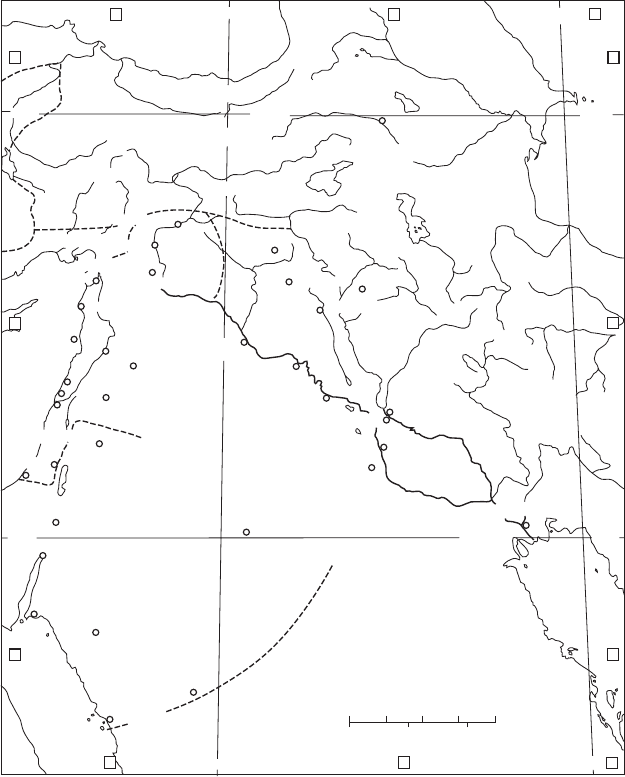
and Iran (map 9) attracted the attention of both powers, in particular during
military confrontations.
29
As contacts between Rome and the Parthian kingdom developed,
Palmyra, which had always played a key role with regard to the trade in
the Near and Middle East, gained more and more importance. Especially
during periods of peace Palmyra thrived and developed into a flourishing
trading metropolis in the East of the ancient world. Modern travellers are
still impressed by its numerous magnificent monuments, among these the
famous temple of Bel, the main Palmyran deity,
30
which reveal not only a
rich religious life but also the prosperity of the city.
31
Undoubtedly, the city
was a crucial mediator for the trade between the great powers Rome and
Iran
32
because the Roman East was the main recipient of the goods traded
in Palmyra, above all the luxury goods that came from China and Arabia
and travelled along the Silk Road, but also goods from India (28).
33
From a Roman perspective Palmyra was also attractive because of the
strategic role it could play. The city was supposed to represent an outpost
27
Around 300 bc Seleucus I founded the city to become the capital of the Seleucid Empire. Although
the city, which is located 40 miles north-east of Babylon on the right bank of the Tigris, had to cede
this privileged status to Antioch on the Orontes in 293 bc, it developed and flourished as an Asian
trade centre. In 165 Seleucia was burnt down during the Parthian War of Lucius Verus. Kt
¯
esiph
¯
on,
which was situated across the river and is mentioned by Polybius (v.45.4) for 221 bc for the first
time, was heavily fortified after the Parthian War of Septimius Severus and became the new capital
of the Sasanians.
28
These distances are somewhat exaggerated; the units are stadia that have been converted into miles.
29
On the significance and history of Palmyra see F
´
evrier 1931; Michalowski and Gawlikowski 1966–85;
Fr
´
ezouls 1976; Drijvers 1977: 837–63; Browning 1979; Teixidor 1984; Bounni and Al-Asad 1988;
Laurenti 1995; for further references see Kaizer 2002.
30
On the religious life of Palmyra see Drijvers 1976; Teixidor 1979; Gawlikowski 1990: 2605–58 and
Kaizer 2002.
31
On the topography and architecture of Palmyra see Schlumberger 1935; Gawlikowski 1973; Will
1983: 69–81.
32
On Palmyra’s role as a trading centre in general see Drijvers 1977: 837–63; Drexhage 1982: 17–34;
Teixidor 1984; Gawlikowski 1994: 27–33 and 1996: 139–45; Young 2001: 136–86; Luther 2004: 327–51.
33
Cf. App. Civ. v.9.
23 Palmyra 157
A
B
C
a
b
c
C
B
A
c
b
a
40°E
50°E
40°N
30°N
50°E
40°E
30°N
40°N
P
o
l
e
m
o
n
i
a
c
B
r
i
d
g
e
A
R
M
E
N
I
A
M
I
N
O
R
Galatian
Bridge
Mediterranean
Bridge
CAPPADOCIA
CILICIA
Samosata
Zeugma
Hierapolis
Antioch
Laodicea
Arados
Bertytos
Sidon
Ty r e
PALESTINE
Bostra
Doumata
(Djawf)
Vologesias
Babylon
Seleucia
Ctesiphon
Hit
Anat
Dj
é
zireh
Nisbis
Hatra
Singara Arbela
Artaxata
L. Van
ASSYRIA
ADIABENE
ARMENIA
SOPHENE
Dura-
Europos
Osrho
ëne
Dj.
Sindjar
Spasinou
Charax
Damascus
Jerusalem
Gaza
Petra
Alia
Leuk
è Kômè?
Ruwwafa
Red
Sea
Leuk
è Kômè?
H
ègra
SCALE
0 100 200 300 400 km
0 100 100 miles
HEDJAZ
ARABIA
NABATAEI
SINAI
JUDEA
Palmyra
Emesa
SYRIA
CYPRUS
E
u
p
h
r
a
t
e
s
M
E
S
E
N
E
Tigris
K
h
a
b
o
u
r
M
e
s
o
p
o
t
a
m
i
a
Map 9: Palmyra and the Roman East in the second century
against both the Parthian kingdom and the many Arab tribes in Syria.
34
Because of its mediating role in the world of trade Palmyra was interested
in maintaining good relations with Parthia but the city preferred to attach
itself to Rome, the most powerful military power in the area. Palmyra’s
34
Shah
ˆ
ıd 1984a: 22–4.
158 5 Arabia between the great powers
special status is expressed in the city’s title Hadriana, which it received
after Hadrian’s visit in 129.
35
Citizens of Palmyra could be granted Roman
citizenship.
36
In 212 the Roman emperor Caracalla raised Palmyra’s status
to that of a colony and granted the city the ius Italicum. Further privi-
leges linked to this new status included the right to raise and dispose of
taxes.
37
The defeat of the Parthian kingdom at the hands of the rising Sasanian
dynasty represented a threat not only for Rome. Similar to Hatra, Palmyra
feared that its position could be jeopardised by the new power in the East.
Above all, the fact that the founder of the new empire, Arda
ˇ
s
¯
ır I (224–
40) was expanding into the north-eastern areas of the Arabian Peninsula
affected Palmyran interests. When the king occupied Spasinu Charax on the
ˇ
Satt al-‘Arab the city lost immediate access to the Persian Gulf and thus its
lucrative trade with India, one of its most important sources of income.
38
In general, Palmyra therefore developed a hostile attitude to Persia and
simultaneously formed a bond with Rome. Because of its crucial role in the
military confrontations between the two great powers from the middle of
the third century onwards the city gained tremendous power and eventually
became an empire in its own right.
During this period the history of the city was directly linked to the
ruling family in Palmyra, the Iulii Aurelii Septimii. It was mainly Septimius
Odaenathus who laid the foundations for Palmyra’s expansion of power in
the 260s and 270s. In an inscription dated to April 252 he is described
as vir clarissimus, which was the title typically used during the imperial
period for members of the senatorial order. Moreover, he was called the
‘Lord of Palmyra’ (exarchos).
39
Considering Palmyra’s municipal order that
assigned supreme administrative power to the strategoi, this title reflects
a remarkable concentration of power in the hands of one individual. In
several inscriptions from 257/8 Odaenathus was addressed not only as vir
clarissimus but also as vir consularis.
40
Odaenathus’ rise is closely linked to Palmyra’s intervention in the
Roman–Sasanian confrontations during the reign of
ˇ
S
¯
ap
¯
ur I (240–72).
41
In 253 Odaenathus inflicted a first defeat on a Sasanian unit. It looks, how-
ever, as if
ˇ
S
¯
ap
¯
ur had dismissed Odaenathus’ attempts to form an alliance
35
Schlumberger 1939: 63–4 (no. 3).
36
Strobel 1989: 74.
37
In general on the economic and political structures of Palmyra see Zahrnt 1986: 279–93; Brodersen
1987: 153–61 and Matthews 1984: 157–80.
38
Cf. the references on p. 19, with n. 8.
39
Gawlikowski 1985: 257,no.13.
40
Ibid. 254–5, nos. 5–8; on these ranks and Odaenathus’ membership in the Roman Senate see Strobel
1989: 74–5.
41
On Odaenathus’ activities, which are difficult to trace, see Kettenhofen 1982: 122–6.
23 Palmyra 159
with Persia before the Palmyrene lord was granted the position of vir con-
sularis.
42
In light of the ‘crisis’ of the Roman Empire, which reached its
peak around the middle of the third century, this development turned out
to be extremely advantageous for Rome. Concerted actions of Palmyra and
Persia would have entailed severe consequences for Rome.
43
Because of the
growing tensions between the great powers it was impossible for Palmyra
to adopt a neutral position. This is why Odaenathus once more tried to get
closer to Rome. The anonymous author of the Historia Augusta (c. 400)
reveals how significant the military activities of Odaenathus were for Rome’s
policy in the East.
Scriptores Historiae Augustae, Tyranni triginta 15. 1–4
(1) If Odaenathus, the Palmyrene prince, had not seized power after the capture of
Valerian when the resources of the Roman state were exhausted, the East would
have been lost. (2) As it was, after having assumed for the first time the title ‘King’
he gathered an army and then set out against the Persians together with his wife
Zenobia, with his oldest son, whose name was Herodes, and with the younger
sons Herennianos and Timolaos.
44
(3) First, he brought under his power Nisibis
and most of the East together with all of Mesopotamia, after that he forced the
defeated king himself to flee. (4) Finally, he pursued
ˇ
S
¯
ap
¯
ur (I) and his children all
the way to Kt
¯
esiph
¯
on, captured his concubines and also made a great amount of
booty.
Although this chronique scandaleuse of Roman emperors is a problematic
historical source (4), we cannot but agree with the ancient author that
Rome was only able to retain its Eastern provinces because of the help of
the Palmyrene lord Odaenathus. We learn that after Valerian (253–60) had
been captured by
ˇ
S
¯
ap
¯
ur in the year 260 (5) Odaenathus gathered an army
and advanced against the Persians. In the second half of the year 260 he
started a first counter-attack.
45
The military successes in Mesopotamia men-
tioned in the Historia Augusta were part of another Persian campaign (262–
4), upon which Odaenathus embarked at the instigation of the emperor
Gallienus (260–8), using Palmyrene as well as Roman troops. In particu-
lar Odaenathus’ previous involvement in suppressing the attacks (260–1)
against Gallienus’ reign
46
persuaded the emperor to give him full powers
with regard to the war in the East.
42
Petr. Patr., frg. 10; cf. on this source Kettenhofen 1982: 72–3 and 124.
43
Thus Alf
¨
oldi 1939: 178.
44
On the question whether these names are fictive see Hohl 1976–1985: 365 n. 1 on SHA Tyr. Trig. 27.1.
45
On Odaenathus’ Persian campaigns see De Blois 1975: 7–23; Kettenhofen 1982: 122–6 and Bleckmann
1992: 122–9.
46
On these events see Strobel 1993: 246–56.
160 5 Arabia between the great powers
In the year 262 Odaenathus succeeded in reclaiming the territories in
Mesopotamia previously gained by the Sasanians. In particular the loss
of Nisibis and Carrhae amounted to a serious defeat. Moreover, twice
Odaenathus’ troops advanced all the way to Kt
¯
esiphon (262; 264?) and
devastated large parts of Mesopotamia.
47
However, they did not manage to
capture the Sasanian capital, contrary to what the Historia Augusta might
indicate. Apparently only the area surrounding the capital, which was suc-
cessfully defended by the Persians, was raided. Nor is the capture of the
royal harem confirmed by other sources. Be this as it may, there is no doubt
that Odaenathus’ advance enabled Rome to restore the status quo ante bel-
lum. Gallienus granted Odaenathus the title of imperator for his successes.
The emperor also appointed him commander over the entire East and he
became corrector totius Orientis.
48
In Gallienus’ name Odaenathus now governed the territories that he had
reconquered from
ˇ
S
¯
ap
¯
ur. He probably held his imperium maius over the
Eastern Roman provinces from the Pontic coast all the way to Palestine.
49
He became indispensable to the Roman emperor and to the defence of the
Roman Eastern frontier.
50
With regard to Palmyrene trade interests it was
above all important to restore direct access to the Persian Gulf.
Odaenathus’ death in the spring of 267 not only freed
ˇ
S
¯
ap
¯
urIfroma
powerful opponent but was also a benchmark in the history of Palmyra.
Up to this point the city had sided with and been loyal to Rome, and its
power had increased steadily. Odaenathus’ official successor was his ten
year-old son Vahball
¯
athus on whose behalf his mother Zenobia (267–72)
ruled the city. Within a short period of time she became the actual ruler
of Palmyra and ‘governed almost the entire East like a man’.
51
Gallienus
must have taken advantage of Palmyra’s unstable situation entailed in the
change of rule but the threat from the Goths in the West prevented the
emperor from pursuing an active policy in the East.
52
Apparently Rome
and Palmyra found some sort of modus vivendi also during the reign of
Claudius II (268–70). Coins issued by both the Roman emperor and the
Palmyrene ruler indicate a policy of rapprochement.
53
Palmyra retained its
significance for the protection of the Roman Eastern frontier against the
Sasanian Empire.
47
Cf. Strobel 1993: 249–50.
48
SHA Gall. 10.1–2; on Odaenathus’ titles see Chrysos 1978: 51–2; Swain 1993: 157–64; Potter 1996a:
271–85.
49
Strobel 1993: 249.
50
On Palmyra’s role as the most important Roman outpost against the Sasanians see Funke 1996:
226–7.
51
SHA Gall. 13.5.
52
Alf
¨
oldi 1939: 177–8.
53
Mattingly 1936: 95, 102 and 109.
23 Palmyra 161
However, when in 270 Palmyra sent troops to Egypt, embarked on a cam-
paign into Asia Minor advancing to Ankyra and Chalcedon and conquered
the Roman province of Arabia the break with Rome was final.
54
When the
emperor Aurelian (270–5) began his reign Palmyra’s sphere of influence was
at its peak, reaching from Alexandria in Egypt to the Hellespont.
55
Officially, Zenobia also broke with Rome; in 271/2 the joint mints with
Aurelian ceased.
56
By issuing coins with the title ‘Augusta’ or ‘Augustus’
for herself and her son, without including Aurelian, Zenobia postulated
her own imperial rule and proclaimed Palmyra’s independence from the
Roman Empire.
57
Her aggressive policy did not remain without a response.
In the year 271 Aurelian, whose hands had been tied by revolts in the empire
and barbarian invasions, turned against Palmyra. At Antioch and at Emesa
he scored a decisive victory against the Palmyrene army and in 272 he
forced Palmyra to surrender.
58
Whereas Zenobia herself was captured the
city was spared by Aurelian. However, shortly after he had left the area the
emperor was informed of an uprising in Palmyra, which made him return
and besiege the city once more.
59
The title Palmyrenicus maximus, which
is exclusively attested for Aurelian, celebrated the victory.
60
The emperor
had managed to restore his rule in this region.
With regard to Zenobia’s fate the sources are not unanimous. Whereas
the Greek historian of the fifth century, Zosimus, claims that Zenobia died
on the journey to Rome,
61
the majority of our sources tell us that she
was paraded through Rome during Aurelian’s triumph and that she lived
in the vicinity of Rome for some time after.
62
Once more the Historia
Augusta deserves special attention in this context. The Lives of the Thirty
Tyrants include a letter attributed to Aurelian and addressed to the Roman
Senate in which the emperor defends himself against accusations that he
had celebrated his victory over a woman like a victory over a military leader.
Scriptores Historiae Augustae, Tyranni triginta 30.4–11; 24–6
(4) A letter by Aurelian survives which bears testimony regarding the captured
woman. For when he was criticised by certain people because he, the strongest
54
Zos. i.50; for the difficult chronology of the events see Strobel 1993: 256–60.
55
Millar 1971: 1–17; Equini Schneider 1993 and Stoneman 1992.
56
On these mints see the references in Strobel 1993: 265.
57
On the legends S ZENOBIA AUG and IMP C VAHBALLATHUS AUG see RIC v2: 584, nos. 1–2
and 585, nos. 1–8; see also Drijvers 1977: 851–2 and Strobel 1993: 265–6.
58
Downey 1950: 57–68.
59
Zos. i.61; see Bowersock 1983: 130–7 and Shah
ˆ
ıd 1984a: 22–5, 151–2.
60
CIL v 4319 (= ILS 579); cf. also Kettenhofen 1986: 143–4.
61
Zos. i.59.4.
62
SHA Tyr. Trig. 24.4; Aur. 33.1–2; Eutr. ix.13; Fest. 24.
162 5 Arabia between the great powers
man, had paraded a woman in his triumph like some general,
63
he defended
himself in letters to the Senate and the Roman people by giving the following
explanation, (5) ‘I hear, Senators, that I am being accused of having performed
an unmanly act by parading Zenobia in triumph. Those who are criticising me
would praise me to the sky if they knew what kind of woman she is, how prudent
in her way of thinking, how consistent in her actions, how firm with the soldiers,
how generous when the situation requires it, how harsh when discipline is called
for. (6) I may well say that she was even responsible for Odaenathus’ victory over
the Persians and for the fact that he advanced all the way to Kt
¯
esiph
¯
on after he
had put
ˇ
S
¯
ap
¯
ur (I) to flight. (7) I may add that the woman spread such fear among
the peoples of the East and of Egypt that neither the Arabs nor the Saracens or
Armenians dared to move against her. (8) And I would not have spared her life,
had I not known that she did the Roman Empire a great service by preserving her
rule in the East for herself or for her children.
64
(9) May those who are not pleased
by anything, therefore, hold their nasty tongues. (10) For if it is not appropriate to
defeat a woman and to lead her in triumph what do they say about Gallienus, on
whom she placed shame by ruling her empire as well as she did? (11) What about
the deified Claudius, this revered and honoured leader, who, as they say, allowed
her to enjoy her rule while he himself was busy with his campaigns against the
Goths? And he was well advised and clever to do so in order that he could achieve
more securely what he had set out to do while she guarded the borders of the
empire in the East.’
65
(24) And so she was led in triumph displaying a splendour
that the Roman people had never seen before. She was adorned with gems so huge
that she suffered from the weight of her jewelry. (25) For it is said that the woman,
although she was very strong, stopped very often, saying that she was not able to
bear the weight of her gems. (26) Moreover, her feet were bound with gold and
also her hands bound by golden chains, even around her neck she wore a golden
chain, by which a Persian buffoon
66
led her.
Although the author credits Zenobia with Odaenathus’ military successes
against the Persians, he is justified in pointing to her advances into Asia
Minor, Arabia and Egypt. There is no doubt that the passage reflects
Zenobia’s actual position of power as it was widely acknowledged in
antiquity.
The description of the triumph is certainly exaggerated and embellished
with novelistic elements. E. Merten points out that the motif of the oriental
queen who can barely carry the weight of her gemstones was a familiar topos
in contemporary novels and rhetoric.
67
However, there is no reason to reject
the idea that Zenobia was indeed paraded in Aurelian’s triumph. Although
63
SHA Aur. 26.3 and 5; Zos. i.55.3.
64
Gaudemet 1970: 94 and n. 47.
65
The author of the Historia Augusta clearly tries to ignore Zenobia’s ambitious claims for power; she
appears only twice in the Life of Claudius (4.4 and 7.5).
66
On this scurra Persicus, who was Zenobia’s own servant, see Straub 1980: 243–4.
67
Merten 1968: 134; cf. ibid. 132–40 for detailed comments on this passage.