
Dignas B., Winter E. Rome and Persia in late Antiquity. Neighbours and Rivals
Подождите немного. Документ загружается.

27 Protection of the frontier 193
the fact that the Romans had failed to comply with the Persian request to
contribute to the protection of the Caucasus.
92
An account given by Priscus from Thracian Panion (c. 420 to after 474)
regarding a Persian embassy to the Byzantine emperor Leo I (457–74) nicely
illustrates the concerns. Priscus is the author of a lost Byzantine history,
which covered the events between 434 and 474; the work primarily yields
information on the confrontations between Byzantium and the Huns but
also gives us insight into the balance of power between Romans, Persians,
Huns, Hephthalites and the Lazes. The surviving fragments are assembled
in the Excerpta de legationibus by Constantinus Porphyrogenitus (905–59).
93
Priscus himself participated in two embassies sent to Attila, the king of the
Huns, in 449 and to Rome in 450 by Theodosius II (408–50) and therefore
must have known the contemporary diplomatic events quite well.
Priscus frg. 41.1 (= FHG
iv
, frg. 31)
There was also an embassy from the Persian king complaining that some of their
people were seeking refuge with the Romans . . . They also requested that the
Romans contributed money for maintaining the fortress Iuroeipaach, which is
situated by the Caspian Gates,
94
or at least commanded soldiers to its protection
because they would no longer bear the costs and protection of the place by them-
selves. For if they withdrew the attacks of the tribes in the area would bear an
impact not only on the Persians but also on the Romans. They added that it was
also necessary that these supported them with money for the war against the so
called Kidarite Huns; for it would be to their own advantage if they defeated this
people and did not let them enter the Roman Empire. The Romans responded that
they would send someone
95
who would discuss all these matters with the Parthian
king.
96
For neither were they receiving refugees nor did they keep the Magians from
practising their religion. With regard to the protection of the fortress Iuroeipaach
and the war against the Huns, they claimed that the Persians had taken these on
in their own accord and did not have a right to request money from the Romans.
The ambassadors referred to the Kidarite Huns, who during the reign of
King P
¯
er
¯
oz (459–84) represented a serious threat primarily to the Sasani-
ans.
97
Leo therefore tried to delay the negotiations. According to another
passage in Priscus, in 467 the emperor rejected a new Persian request to
92
Luther 1997: 106.
93
Doblhofer 1955: 11–82 and Blockley 1983: 222–377.
94
Priscus confuses the Caspian Gates at Derbend with the portae Caucasiae.
95
The Romans sent the patricius Constantius to enter negotiations with P
¯
er
¯
oz (459–84), which ended
without any actual results; cf. Priscus frg. 41.3 (= FHG iv 106).
96
Priscus refers to the Sasanian ruler P
¯
er
¯
oz.
97
Blockley 1985a: 66 and Luther 1997: 112–16; see also Blockley 1981: 121.
194 6 Shared interests: Continuing conflicts
support the fortress Iuroeipaach by sending either money or troops, say-
ing that each side should defend their own country and maintain their
own fortresses.
98
In contrast, during the first half of his reign the Byzan-
tine emperor Zeno (474–5/476–91) did make subsidiary payments to P
¯
er
¯
oz,
although these should probably not be labelled ‘tribute’, as the Syrian chron-
icler Joshua the Stylite clarifies in his detailed account.
99
Immediately after the death of the Sasanian king (484) the payments
for the fortification of the Caucasian passes ceased.
100
This led to new
tensions. When in the year 502 Kav
¯
adh I (488–97/499–531) asked the
emperor Anastasius (491–518) to send him money for his battle against
the Hephthalites,
101
the emperor’s rejection led to the outbreak of the first
Byzantine–Sasanian War in the sixth century.
102
Apparently, the Persian
ruler had offered Anastasius one of the Caucasian fortresses in turn; during
the peace negotiations in the spring of 531 Kav
¯
adh I accused Anastasius of
having been the aggressor by saying, among other things, that the emperor
had not been willing to ‘acquire’ the Caspian Gates. If he had done so, he
would have had to maintain an army there for all times and bear a great
financial burden in order to fend off the barbarians.
103
Both the question of how the costs for maintaining the Caucasian
fortresses would be met and the cessation of the annual payments triggered
many new conflicts way into the sixth century.
104
It is thus not surpris-
ing that when Justinian I (527–79) and Xusr
¯
oI(531–79) tried to put an
end to the second Roman–Persian War in the sixth century in 562 (20)
the diplomatic efforts towards a comprehensive agreement also focused on
the protection of the shared border and its defence against the bellicose
nomadic peoples attacking from the north. According to Menander the
Guardsman the Persians agreed to march against invasions of the Huns,
the Alans and other barbarians in the Caucasus region whereas the Romans
promised not to send troops into the area and thus to give up any influence
in the region.
105
This means that the Persians, who had firmly established
their military presence in the Caucasus by the sixth century,
106
were now
willing to defend this insecure border by themselves without insisting on
98
Priscus frg. 47 (= FHG iv 107).
99
Ios. Styl. 8; see the detailed commentary in Luther 1997: 101–8; also Blockley 1985a: 66–7, ‘The
insistence of Joshua that the payments made by Zeno were no tribute suggests that some thought
they were, perhaps because the Persians had attempted to convert an occasional payment into a
regular.’
100
Ios. Styl. 18.
101
Proc. BP i.7.1–4 and Ios. Styl. 20 and 23;onKav
¯
adh’s requests see Blockley 1985a: 68.
102
Greatrex 1998: 73–119.
103
Proc. BP i.16.4.
104
Blockley 1985a: 68–74.
105
Menander Protector, frg. 11.
106
Kramers 1935–7: 613–18.
28 Economy and trade 195
compensation from Byzantium. This agreement stayed in place until the
end of the relations.
107
28: Economy and trade
Although the numerous military conflicts between Rome and the Sasanian
Empire impeded uninterrupted trade, both sides showed a strong interest
in close economic relations. Primarily in order to secure the revenues from
customs duties they designed a diplomatic framework which established
the conditions for a regulated exchange of goods. Numerous treaties that
were concluded between the empires and their details on economic and
trade related issues attest to this.
When relations between Rome and the Parthian kingdom intensified it
was above all luxury goods from the Far East, in particular silk and silk
products, which were traded at great profit and therefore important goods
of trade in East and West.
108
The ancient sources reveal the wide range of
goods that were imported from the East and had to be declared, for example
spices, incense, gems or even wild beasts and enslaved Indian eunuchs.
109
They also attest to the wider circulation of these goods.
110
The fourth-century Latin work of an anonymous author, the so called
Expositio totius mundi et gentium, gives a description of all territories of the
ancient world and their populations, including trade and its products.
111
Expositio totius mundi et gentium 19 (pp. 153–4, ed. Roug
´
e)
After these there are the Persians, who are the neighbours of the Romans. The
history books say that they are particularly bad and brave in war. . . in all other
respects, however, they are said to have everything in abundance; for the nations
neighbouring their territory are given the opportunity to engage in trade and
therefore they themselves also seem to have plenty of everything.
In this passage the anonymous author, who draws on an unknown Greek
source,
112
emphasises the Sasanian trade policy. For rather selfish reasons
they permitted the neighbouring peoples to engage in trade as they pleased.
The Sasanians made good profit from the exchange of luxury goods, not
only silk but also precious stones, spices, incense and ivory. The traditional
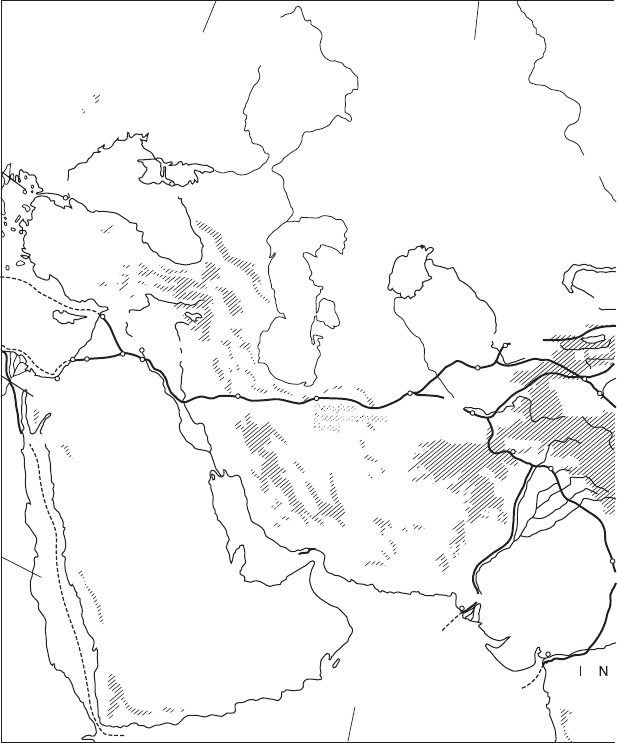
trade route was the famous Silk Road (map 13),
113
which went from China
107
Blockley 1985a: 72.
108
Cf. Young 2001.
109
Dig. xxxix.4.16 (7); cf. also Pigulevskaja 1969: 78–9.
110
On the wide range of goods that entered the Roman Empire see Miller 1969: 34–109; in general on
the Roman eastern trade see Raschke 1978: 604–1378; Loewe 1971: 166–79.
111
Roug
´
e 1966 and Drexhage 1983.
112
On the author see Pigulevskaja 1969: 46–50.
113
Haussig 1983 and Klimkeit 1990.
196 6 Shared interests: Continuing conflicts
via Central Asia, Hor
¯
as
¯
an and Northern Persia to Mesopotamia from where
the goods could then be shipped to the Black Sea and the Mediterranean.
114
Trade relations between the Graeco-Roman world and the Far East and
India existed already during the early Principate. In late antiquity these
contacts intensified.
Until late in the third century the most important trade route from the
Persian Gulf to the centres of the Roman province of Syria and the Mediter-
ranean ports followed the river Euphrates.
115
There are early attestations to
the transport of goods to Nik
¯
ephorion-Kallinikos via the Euphrates, and
from there to the markets in Edessa, Batnai or Harran, from where the
merchants transported their merchandise to the Mediterranean centres.
116
Isidorus of Charax, who was a geographer of the Augustan period, gives
us a detailed description of the major trade routes and bases for supplies.
According to the author the traffic of goods went from the Parthian capital
Seleucia on the Tigris/Kt
¯
esiph
¯
on to the Roman Empire via the trading
centres along the Euphrates, namely Neapolis, Anath,
117
B
¯
elesi Biblada,
118
Phaliga, Nik
¯
ephorion, to Zeugma.
119
The intense trade between the Far East, India and the Persian Gulf did
not cease after the fall of Hatra (22) and Palmyra (23); Persian traders
themselves participated in the lucrative trade with India.
120
After 273 at the
latest, possibly already after the fall of Hatra, the traffic of goods may have
shifted towards the Tigris river, and as a result this waterway, which so far
had been rather insignificant for trade purposes, became much more attrac-
tive.
121
This view is supported by the decision of 298 to make Nisibis the
only centre for an exchange of goods.
122
Because of a lack of archaeological
investigation along the Tigris we do not have any immediate testimonies
for such a ‘shift’ of trade but new studies show that there were significant
demographic movements from the Hatrene towards the Tigris.
123
Inten-
sified settlement patterns throughout late antiquity can be observed also
114
Bivar 1970: 1–11.
115
See Young 2001: 188–90.
116
Chaumont 1984: 63–107.
117
Kennedy 1986: 103–4 and Kennedy and Northedge 1988: 6–8.
118
Kennedy and Riley 1990: 224–5.
119
Isid. of Charax Mansiones Parthicae 1; on this source see Chaumont 1984: 63–107 and Luther 1997:
237–42.
120
Williams 1972: 97–109; Whitehouse and Williamson 1973: 29–49; Whitehouse 1996: 339–49 and
Morony 2004: 184–8.
121
This development also affected strategic considerations; according to Amm. xxiii.3.1 before embark-
ing on his Persian campaign Julian had to decide at Carrhae whether to take the route along the
Tigris or along the Euphrates.
122
See Millar 1996: 483–4, who argues that the peace of 298 indicates a possible shift of trade from the
Euphrates to the Tigris.
123
Hauser 2000: 187–201.
28 Economy and trade 197
for the parts of the Tigris that were under Roman control,
124
and these
must have been a consequence of the increased significance of the Tigris
for trade. However, as the ravines created by the course of the river become
very narrow, hardly any transport of goods would have been possible above
the Roman camps Castra Maurorum
125
and Bezabde.
126
Moreover, along
this part of the Tigris the extremely barren mountain ridge of the T
¯
ur
‘Ab d
¯
ın (Mons Masius) to the West must have impeded regular trade so
that goods going upstream must have been taken no further than Bezabde,
most likely only to Castra Maurorum, from where they would have been
transported along the southern edges of the T
¯
ur ëAbd
¯
ın to Nisibis.
In light of these topographical premises Nisibis, which was located
in the northern Mesopotamian plain on the upper reaches of the
Chab
¯
oras/Chab
¯
ur,
127
almost inevitably became the new centre for long
distance trade.
128
There were then several routes on which goods could be
transported from Nisibis to Syria, via Edessa and Zeugma for example.
In contrast to the ‘caravan cities’ Hatra and Palmyra the Roman colonia
Nisibis, which was also the seat of the Roman governor of the province
of Mesopotamia, was no longer the guarantor for an extended network
of traffic but a huge trans-shipment centre. The Expositio totius mundi et
gentium confirms the city’s exceptional role.
Expositio totius mundi et gentium 22 (p. 156, ed. Roug
´
e)
Mesopotamia, however, has many different cities of which I shall name but the
most exceptional ones. There are, then, Nisibis and Edessa, which possess the best
men in every respect, both clever merchants and good hunters. Above all they are
wealthy as well as equipped with all sorts of goods. For they acquire their goods
directly from the Persians, sell them throughout the entire Roman Empire and then
engage in trade with the goods they purchase there, except for bronze and iron
because it is not permitted to sell bronze and iron to enemies.
129
These cities, which
will always remain standing through the wisdom of the gods and the emperor and
124
On the location of Castra Maurorum see Ball 1989: 7–18 and 2003: 18–19.
125
Ball 2003: 80–1.
126
For a long time it has been suggested that Bezabde was located in the Turkish–Syrian border area
close to Cizre; see Lightfoot 1983: 189–204; for new surveys locating Bezabde 13km further north
see Algaze 1989: 248–52 and 1991: 191–2.
127
On the course and navigability of the Chab
¯
oras/Chab
¯
ur see Tardieu 1990: 103–35.
128
Also important because of its geographic location was Singara, a point of intersection between the
course of the upper Chab
¯
oras/Chab
¯
ur towards the Tigris and along the route from Hatra to Nisibis;
on Singara see Oates 1968: 97–106 and Kessler 1980.
129
For the export embargo on aeramentum et ferrum see also Herodian iv.18; Dig. xxxix.4.11; Cod. Iust.
iv.53.1 (4); on further export embargos ibid. iv.41.1–2 and iv.63.2.
198 6 Shared interests: Continuing conflicts
BASTARNAE
AO
R
SI
ALANI
Caspian Sea
Byzantium
S
Y
R
IA
Alexandria
Gaza
Antakya (Antioch)
Palm
yra
Halebie-Ze
nobia
Dura-Europa
Hamadan
(Ecoatana
Aman)
Damghan
(Hacatomphylos)
Ho-tu)
Damghan
(Hacatomphylos)
Ho-tu)
Sama
rkand
(Maracanda)
(Pei-t'ien )
Balkh
(Bactra)
(Pu-tiao)
BACTIRIA
(TA HSIA)
Begram
Ta xila
Mathura
?
(T'IEN
Barygaza
Barbaric
um
Indus
FARGHANA
(IAYUAN)
KUSHAN
ITAYUEH CHIH
Tigris
Damascus
PART H
IA
(A
NHS
I)
Myos-Hormos
EGYPT
Red Sea
ARABIA
Arabian
Sea
(Ethryaean Sea)
E
u
p
h
r
a
te
s
Ty re
(TACHIN)
Mediterianean
Sea
Panticapaeum
Aral
Sea
L. Balkhash
Issyk-kul
WU-SUN
Tashkent
SOGDIANA
(K'ANG CHU)
Oxus
Jax
arles
R. Iii
SYEBI
(CHIEN-K'UN)
ALANORSI
(TING-LING)
Black Sea
60 °E30 °E
60 °E
20°
N
10°N
A
B
Z
O
A
E
(
Y
E
N
-
T
S
'
A
I
)
Marv
(Antiokia Margiana)
(Mu-lu)
P
e
r
s
i
a
n
G
u
l
f
Kashgar
(Su-to)
Yarkand
(Su-chil)
T Ten
¯
¯
¯
¯
¯
Map 13: The Silk Road from China to the Roman Orient
which have famous walls,
130
in war always thwart the bravery of the Persians;
131
they are enthusiastic about their business and well engaged in trade with the entire
province.
130
In late antiquity city walls were considered as sanctum and could not be mended or changed without
explicit permission by the emperor; cf. Dig. i.8.9.4, i.8.8.2 and i.8.11; on this issue see Winter 1996:
205–6.
131
The Sasanians had attacked Nisibis repeatedly during the reign of Constantius II (7).
28 Economy and trade 199
Sayan
Yablonoy
Noin-Ula
L. Balkal
Urga
Lop Nor
Karashar (Yen-chi)
Edsin Gol
Peking
YUEH
TUNG HAI
MIN YUEH
NAN YUEH
T'IEN
Canton
Sites where Han Chinese
silks and/or lacquers
have been found
Land over 2000 m
0
0
500
miles
500 km
Yangtze
CHINA
Lo-yang
Ch'ang-an
Lan-chou
Lo-lang
CH'AO HSIEN
MANCHURIA
Chu-yen
An-hsi
Tun-huang
Hami
Lou-tan
Ying-pan
Aksu
(wen-su)
Khotah
Niya
Keriya
G
a
n
g
e
s
Kitai
Urumchi
D
'zungaria
Shan
Altai
Tu rfari
ANAREI
( HU-CHIEH
)
K
h
a
n
g
a
i
H
S
I
U
N
G
-
N
U
Y
e
l
l
o
w
R
i
v
e
r
Lhasa
DIA
CHU)
Bay of
Bengal
TIBET
Koko Nor
90 °E 120 °E
40°E
30°N
20°N
90 °E
MONGOLIA
S
h
a
n
Y
E
H
L
A
N
G
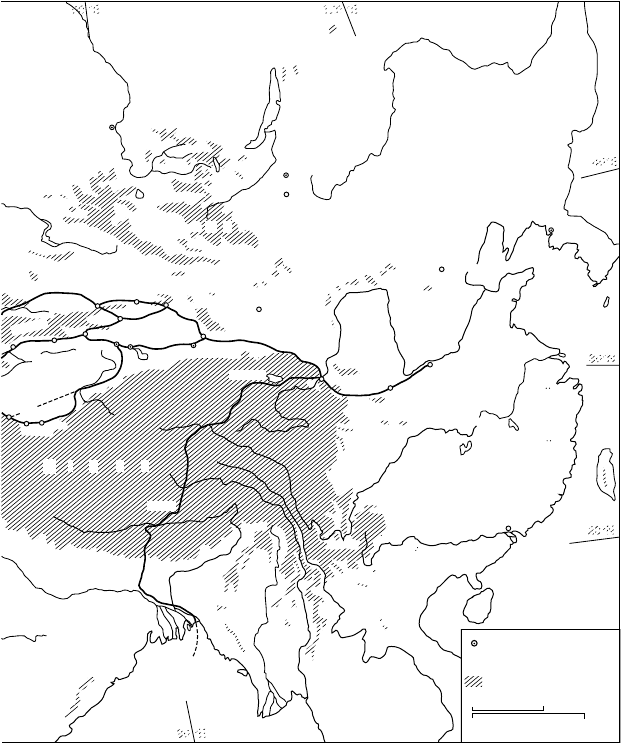
Map 13:(cont.)
By the fourth century Nisibis was thus a crucial centre of trade and also
played a great strategic role. As the passage suggests, for the purpose of
defending the Roman Eastern frontier the city served as an essential fortress.
Ammianus Marcellinus speculates that had it not been for Nisibis – orientis
firmissimum claustrum – at this point the Roman East would have been
under Sasanian rule for some time.
132
Quite consistently, the same author
132
Amm. xxv.8.14.
200 6 Shared interests: Continuing conflicts
labels the foedus of 363 (18) and the cessation of Nisibis to the Persians as
‘humiliating agreements’ accepted by Jovian.
133
But why did Rome insist in 298 (17) to make it the only place for the
exchange of goods between West and East? There may have been several
reasons. The fact that the treaty of 298 made Nisibis the only place of
trade – in an area where numerous caravan routes and traffic routes existed –
inevitably channelled the Sasanian trade. However, the changes initiated
by Rome with an eye to centralisation did not bear that much impact
on the trade of the sought after luxury goods from the Far East because
these had always been exchanged in the great centres of trade such as
Nisibis. The changes affected above all the local trade in the border areas
and the exchange of goods within Mesopotamia. The individual tradesman,
merchant or peasant who had offered his ware at the nearest market now had
to decide whether to expose himself to the risks of the long and exhausting
journey or not. According to the treaty of 298 merchants had to take their
goods, sometimes covering long distances, all the way to Nisibis where
Roman merchants received them.
When Roman merchants received goods from the Far East and from
India that had travelled through Persian territories into the border regions
along the Euphrates and Tigris,
134
they had to pay customs duties fixed by
the Eastern power. Some scholars believe that the revenues accumulated in
this way allowed the Sasanians to build up their army, to conscribe Arab
mercenaries and finally to expand westwards.
135
For the Romans the fact
that their only overland trade with China and India was via the Sasanians
entailed high costs in peace time and a cessation of the eastern trade in times
of war.
136
In order to secure its eastern trade the Romans therefore were
primarily interested in breaking the Sasanian monopoly as mediators for
the exchange of goods along the Roman Eastern frontier and in acquiring
trade centres outside the Persian Empire.
Accordingly, the Romans intended to limit the activities of Persian mer-
chants and to control these. Moreover, they were interested in fixed prices
as well as their own revenues from customs duties, which were normally
133
Ibid. xxv.7.13.
134
For some time Sasanian merchants monopolised the trade in the Persian Gulf and the Indian
Ocean so that the Sasanians were able to control the trade with India; cf. Williams 1972: 97–109;
Whitehouse and Williamson 1973: 29–49; Whitehouse 1996: 339–49.
135
Haussig 1959: 138.
136
In late antiquity Roman maritime trade between the Red Sea and India therefore became more and
more important; cf. Sidebotham 1986a: 16–36.
28 Economy and trade 201
raised by cities that had customs offices.
137
It is thus not surprising that
in 298 the Roman ambassador Sicorius Probus insisted on Nisibis as the
only place of trade in Mesopotamia. Fiscal considerations must have been
responsible for including this clause in the treaty because in consequence
every Sasanian merchant had to pay customs duties if he wanted to sell
his goods in Nisibis, which at the end of the third century was part of the
Roman sphere of influence.
138
We cannot say with certainty how high these
customs duties were. It is possible that the Sasanians now had to submit
25 per cent instead of the customary 12.5 per cent of the selling price.
139
By imposing high customs duties Diocletian intended to break the Persian
monopoly on the silk trade and to add a counter weight to the prices
dictated by the Persians.
While the Roman line of reasoning seems clear and financial advantages
on the Roman side possible, it is difficult to estimate how far the decision
of 298 had an overall effect on the Sasanian state budget.
140
It looks as if
the clause did not diminish the revenues of the Sasanian state because it
did not lose its freedom to impose customs duties from traders either when
they entered the Sasanian Empire or when they sold their goods within
Persian territory.
141
Nisibis was vehemently contested during the fourth century
142
but still
retained its role as a trans-shipment centre after 363 when the city fell
into Sasanian hands.
143
Ammianus Marcellinus’ elaborate description of
the exodus of its inhabitants and the take over by the Persians illustrates
how much the loss of this city shocked contemporaries.
144
Not surprisingly,
when relations once more deteriorated during the sixth century, the Romans
built the city of D
¯
ar
¯
a-Anastasiopolis facing Nisibis and transformed it into
a massive bulwark during the reign of Justinian. This was meant to be the
Western counterpart to Nisibis.
145
137
Manandian 1965: 77; in general on trade related aspects in the diplomatic relations between West
and East see Winter 1987: 46–74.
138
Andreotti 1969: 215–57.
139
Cf. DNP s.v. Zoll: 830 for further references; on late antique taxation in Syria and Mesopotamia
see Pollard 2000: 213–18 and Jones 1964: 824–7.
140
Blockley 1984: 33 emphasises the financial advantages for Rome, ‘The result of this was that the
Romans would garner all the income from taxes of the lucrative eastern trade.’
141
In Winter and Dignas 2001: 210 the authors emphasised the financial losses for the Sasanians but
have changed their view since; on the Sasanian economy in general see Morony 2004: 166–94.
142
Festus 27.2; on the confrontations during the reign of
ˇ
S
¯
ap
¯
ur II see Mar
´
oth 1979: 239–43 and
Lightfoot 1988: 105–25.
143
Amm. xxv.7.19–14 (18); see also Chrysos 1993: 165–202.
144
Amm. xxv.9.1–12; for context and interpretation see 18.
145
For details, references and a photograph of the modern – still impressive – ruins of D
¯
ar
¯
a see
figs. 13–14.
202 6 Shared interests: Continuing conflicts
The foedus of 298 also forced Nars
¯
e to acknowledge the Roman protec-
torate of Ib
¯
eria (17), an area south of the central Caucasus and north of
Armenia through which the upper and middle Kyros was flowing. Diocle-
tian intended to expand the Roman sphere of influence to the north-east
in order to create new routes for the Eastern trade which would circum-
vent Sasanian territory in the north. The emperor’s ambition to regain
power over Ib
¯
eria was closely linked to the role of this area as a transit area.
Repeatedly the Romans had become painfully aware that the most impor-
tant overland trade routes in the East of the ancient world, by which the
sought after luxury goods from the Far East reached the large Roman cen-
tres along the eastern coast of the Mediterranean, went through Sasanian
territory. The Persian supremacy by sea, in particular in the Persian Gulf,
which was the starting point for the lucrative trade with India,
146
must have
further strengthened the key role the Sasanians played with regard to the
Roman eastern trade. The Romans therefore tried to establish firm bases
along the Black Sea and in the Caucasus in order to create new land routes
for an extended eastern trade, primarily with China.
147
To some extent their
attempts to maintain diplomatic relations with Armenia and the Caucasus
had to do with the hope that the peoples in this region would help them
to obtain important luxury goods, above all silk and silk products. The
significance of the areas in the Caucasus and around the Caspian Sea with
regard to trade has been suggested as a motive for the expansion of a Roman
Eastern policy during the Parthian period
148
and has been acknowledged
for some time as a cause for confrontations between Byzantium and the
Sasanian Empire during the fifth and sixth centuries.
149
This significance
very much also applies to the situation at the end of the third century.
Until the treaty of 363 (18) when
ˇ
S
¯
ap
¯
ur II (309–79) made the emperor
Jovian (363–4) revise the central aspects of the foedus of 298 (17) the agree-
ments of this treaty continued to be legally valid. Ammianus Marcellinus
states, however, that during the reign of Constantius II an annual market
existed in Batnai where Indian and goods from Seran were offered and
the author also praises the magnificent goods of the city of Kallinikos.
150
146
On the Sasanian contacts with India, specifically by sea via the Persian Gulf see also Wieseh
¨
ofer
1998a: 19–20 and Daryaee 2003: 1–6.
147
On possible trade routes to China which went through the Caucasus and bypassed Sasanian territory
in the north see Herrmann 1966: 18–19 and 26–7; cf. also Thorley 1969: 215 and Wissemann 1984:
166–73; on the Sasanian attempts to stop trade along the northern route of the Silk Road see Haussig
1983: 161–82.
148
Wissemann 1984: 166–73.
149
Pigulevskaja 1969: 155–8; Harmatta 2000: 249–52.
150
Amm. xiv.3.3 and xxiii.3.7; cf. also Kirsten 1959: 558 and Synelli 1986: 89; on Batnai as a centre of
trade see Kissel 1998: 171–2 and De Ligt 1993: 74.