
Dignas B., Winter E. Rome and Persia in late Antiquity. Neighbours and Rivals
Подождите немного. Документ загружается.

chapter 6
Shared interests: Continuing conflicts
Although Roman–Persian relations were dominated by military conflicts
or diplomatic activities concerning these conflicts, there were a number
of issues that showed points of contact between the two powers, which,
however, could themselves become the starting point for further tensions.
These are above all economic and trade related issues, the protection of
the frontier and the integration of territories that had been contested for
centuries. It is noteworthy that the contemporary authors always give their
accounts on the basis of an ‘imaginary opposition’ between Occident and
Orient, which creates a typical ‘perspective of confrontation’. One cannot
fail to notice the prejudices the Roman historians held against the ‘oriental
barbarians’. Such commonplaces, which found their way into Western lit-
erature many centuries ago, and which were embellished in numerous sub-
sequent accounts given by those travelling between the cultures – soldiers
or diplomats, scholars or philosophers, artists or missionaries – have had
a tremendous impact on modern views until the present day. The second
part of this book thus emphasises the contrary, namely the efforts to recon-
cile differences, the openness for cooperation between the powers and the
solutions that were found in the process and thereby to gain a deeper under-
standing of Roman–Sasanian relations.
1
Given how the rivalries between
Rome and Persia persisted and how difficult in particular the geographical
conditions in the border regions were, these solutions can indeed be called
innovative and forward-looking. At times, they certainly helped to stabilise
the difficult political situation in the contested border territories along the
Euphrates and Tigris.
26 Armenia
It is not easy to say what exactly ‘Armenia’ was in (late) antiquity, let alone
to pinpoint the origins of those settling in the territorial entity between
1
In this context see also chapter 9 ‘Exchange of information’, below.
173
174 6 Shared interests: Continuing conflicts
the Black and the Caspian Seas that may be referred to as ‘Armenia’ by
contemporary or modern authors.
2
The meaning of ‘Armenia’ varies, and
this not only according to date and context but also according to perspective,
which means that at any given point the Armenians themselves would have
had a very different view from those adopted by the Romans and Persians.
3
From the beginning of Roman–Iranian relations, however, Armenia was an
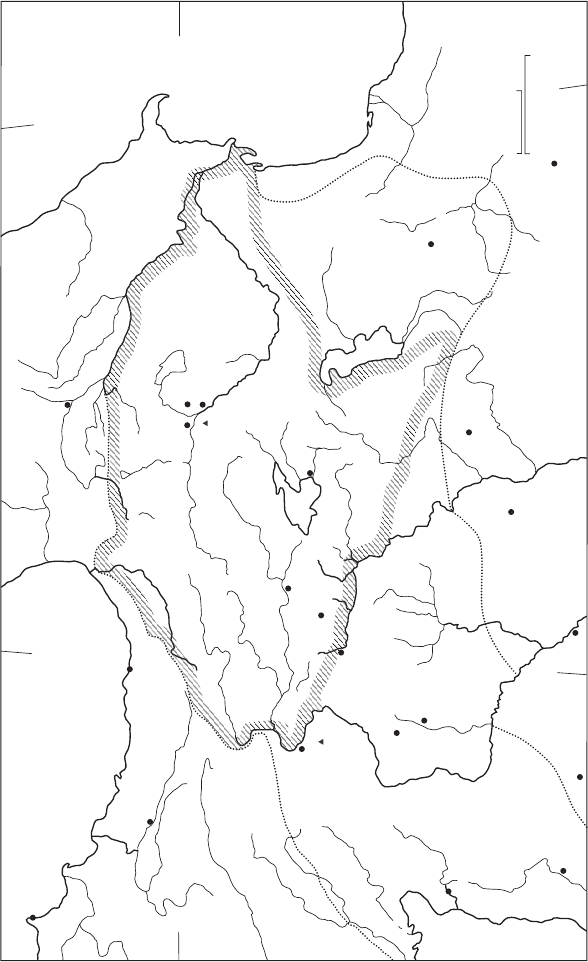
object of rivalry between both powers, and for good reasons (map 11).
Because of its geographical location, the highland of Armenia to the south
and south-west of the Caucasus was a focal point throughout antiquity: it
was the area through which the majority of traffic from the Near East to Asia
Minor passed and it was close to the strategically important Caucasus passes
(27). Apart from being a transit area, Armenia had remarkable economic
resources.
4
Among others, there were the gold mines of Pharangion,
5
men-
tioned by both Procopius and Malalas and famous already during Strabo’s
lifetime.
6
Accordingly, during the peace negotiations for the so-called ‘eter-
nal peace’ in 530/31 Kav
¯
adh I insisted on these mines being returned by the
Romans.
7
Armenia benefited not only from its ‘natural’ resources but also from its
important role in trade. Among those who travelled to Greater Armenia –
the larger part of the country, which, as we shall see, came to be controlled
by the Sasanians – in order to engage in trade were merchants from Persia as
well as from Syria and Palestine.
8
Procopius provides us with a description
of the most important Armenian city in the sixth century, Dv
¯
ın.
9
The
Byzantine historian mentions a densely populated landscape surrounding
the new capital, which was also the economic centre of Armenia. He also
refers to fertile plains used for breeding horses. According to the author,
merchants came from neighbouring Ib
¯
eria, from almost anywhere in Persia
and even from faraway India.
10
Armenia’s human resources were equally significant and resulted from
the idiosyncratic structure of Armenian society. Considering the sporadic
2
For an excellent summary of early Armenian history see Garso
¨
ıan 1997a: 63–94 and 1997b: 95–116;
for a sequence of maps see Hewsen 2001.
3
For a cautious assessment with an emphasis on the ‘diversity and incongruity’ of anything ‘Armenian’
see the forthcoming article by Greenwood.
4
On the economic resources of Armenia see Redgate 1998 (repr. 1999): 83–7.
5
Proc. BP i.15.26–9; Malal. 18.50–1 (pp. 455-6).
6
Strabo xi.14.9.
7
Chaumont 1987a: 433 correctly interprets this as an indication ‘that their exploitation yielded large
profits for the Sasanian government’.
8
Malal. 18.63 (p. 469). Armenia’s intensive trade with the neighbouring regions during late antiquity
may be confirmed by the large variety of coins found in the area; for references see Chaumont 1987a:
433.
9
Manandian 1965: 81–2.
10
Proc. BP ii.25.1–3.
40 °E
50 °E
40°N
50 °E
40 °E
40°N
Sinope
Trebizond
Mush
Amida
Antioch
Emesa
Palmyra
Dura Europos
SYRIA
CILICIA
GORDUENE
Tıgranocerta
Melitene
Edessa
Carrhae
Nimrud
Dagh
Echmıadzın
ARMENIA
MAJOR
Dvin
Artaxata
Gazaca
Ecbatana
0 100 km
0 100 miles
PARTHIA
Arbela
Hatra
Van
L.Thospitis
(L.Van)
Mt Ararat
L. Sevan
R. Araxes
L. Urmıya
Cabeira
R. Halys
R. Iris
MOSKHOI
Mtskheta
CASPIAN
SEA
R. Cyrus
TAOKHOI
COLCHI S
BLACK SEA
C
H
A
L
Y
B
E
S
P
O
N
T
U
S
S
A
S
P
E
R
O
I
B
E
R
I
A
A
L
B
A
N
I
A
A
R
M
E
N
I
A
M
I
N
O
R
O
S
R
O
E
N
E
M
E
S
O
P
O
T
A
M
I
A
R
.
T
i
g
r
i
s
A
D
I
A
B
E
N
E
M
E
D
I
A
A
T
R
O
P
A
T
E
N
E
R
.
E
u
p
h
r
a
t
e
s
C
A
P
P
A
D
O
C
I
A
C
O
M
M
A
G
E
N
E
¯
¯
¯
A
R
Z
A
N
E
N
E
I
Map 11: Armenia at the time of the Parthian Empire
176 6 Shared interests: Continuing conflicts
character of our evidence, it is problematic to use the term ‘feudal system’.
11
However, the relationship between the king, who had his own resources, and
the hereditary Armenian nobility, the naxarars, was characterised by obliga-
tion as well as independence. There was also intense competition between
and within the princely families, whose prestige and landed property varied
but was often immense.
12
Below the nobility, the rest of the population was
primarily made up of peasants who owed military and labour service to
the respective families and ultimately to the crown. The contingents at the
king’s disposal were impressive and enhanced by monetary contributions
owed by the princes.
13
To the west of the river Euphrates, Lesser Armenia (Armenia Minor),
belonged to the Roman Empire from early on. Since Diocletian and Con-
stantine this part of Armenia formed the provinces Armenia i and ii.In
contrast, Greater Armenia (Armenia Maior), was often the reason for mil-
itary conflicts between Rome and Iran. Although both sides showed the
desire to resolve tensions peacefully, both also wanted to gain power in
this strategically important region. The following account by Suetonius
goes back to an earlier period of Roman–Parthian relations,
14
but it illus-
trates Armenia’s delicate situation between East and West – a situation that
remained difficult throughout late antiquity.
Suetonius, Nero 13
(1) Among the spectacles that he staged I may well also report on the entrance of
Tiridates into the city. As foggy weather had prevented him from showing the man
to the people on the day determined by the edict, he produced this man, the
king of Armenia, who had been persuaded to come by great promises, when the
next possible opportunity arose; cohorts in full armour were displayed around
the temples in the Forum, he sat in a curule chair by the rostra in the attire of a
triumphant general and surrounded by military symbols and standards. (2) And
at first he let the king, who was approaching via a sloping platform, go down on
his knees, then he kissed him after he had raised him with his right hand, and
finally he took his tiara away, as the king had asked him to, and replaced it with
the diadem,
15
while a man of praetorian rank translated the words of the suppliant
and announced them to the crowd. Then he led him to the theatre and placed
11
Redgate 1998: 97–8 on Toumanoff 1963: 34–144 and Adontz 1970: 343–61.
12
See Thomson 1999: xiii–xiv; Garso
¨
ıan 1997a: 76–9; somewhat speculative Chaumont 1987a: 433.
13
Cf. Redgate 1998: 99 with further references.
14
On the history of Armenia during the Parthian period see Bedoukian 1980; Chaumont 1987a: 420–6;
1990: 19–31; Kettenhofen 1998: 325–52; see also Schottky 1989.
15
The tiara is a Persian headgear. Among the Parthians, it was the prerogative of the kings, who alone
were allowed to wear the battlemented tiara, often decorated with stars; the diadem was the royal
symbol granted and acknowledged by the Romans.
26 Armenia 177
him, who once more adopted the demeanor of a suppliant, on his right. Because
of this he was hailed as imperator, and after laying a laurel wreath in the Capitol
he closed the double doors of the temple of Janus, indicating that no war was left
anywhere.
16
In the year 54 the Parthian king Vologaeses I (51–76/80) had appointed his
brother Tiridates (52/54–60 and 61/66–72) as king of Armenia. This move
had threatened Roman interests and triggered war with Rome. Although
the Romans mobilised a large army in order to deal with the ‘Armenian
conflict’, a solution was reached only through a mutual agreement that
led to the events described by Suetonius. Right after the last battle in
Armenia, which had taken place at Rhandeia, Tiridates had paid tribute
to Nero before the emperor’s image and taken off his diadem, which Nero
himself returned to him three years later as part of a solemn ceremony.
Suetonius depicts the events as a spectacle that illustrated Rome’s greatness
and superiority, a representation that matches his efforts to praise Nero as
a triumphant victor. What we do not immediately see, however, is that
after a series of unsuccessful military activities the Romans had to waive
their claims for direct rule in Armenia; this was compensated for by the
willingness of the king to acknowledge that henceforth any Armenian king
would be an official dependant of Rome. At least in the year 66 the solution
proved to be a successful reconciliation of interests, which had a stabilising
effect. By agreeing on such a partition of sovereignty over Armenia both
sides came to terms with the fact that neither could rule in Armenia without
respecting the interests of the other. Ultimately, however, Armenia remained
a Parthian vassal state because the Parthian kings did not allow the Romans
to prescribe who would be the Arsacid on the Armenian throne. While the
investiture of the Armenian king was reserved to the Roman emperors, the
actual choice lay with the Parthian king.
17
Armenian history after Tiridates I is not well documented. We can say,
however, that for the next 150 years the situation was more or less peace-
ful and closely linked to the state of Roman–Parthian relations.
18
When
tensions between the great powers increased, this entailed turbulence for
Armenia. The following passage reveals how much the foundation of the
Sasanian Empire in the year 224 affected affairs within Armenia itself as
well as its role as a cause for conflict between West and East.
16
This was the customary symbolic act that indicated the end of war.
17
Chaumont 1987a: 424.
18
On the episodic character of Armenian history and the difficulties of ‘reconstructions’ see Garso
¨
ıan
1997a and 2004; see also Redgate 1998: 88–94.
178 6 Shared interests: Continuing conflicts
Agathangelos, History (ed. Thomson) §§ 18–20
19
(§ 18) At the eclipse of the era of the Parthian kingdom, when sovereign rule was
taken from Artabanos son of Valar
ˇ
s at his murder by Arda
ˇ
s
¯
ır son of Sasan – who was
a noble from the province of Stahr, who had come and united the Persian forces,
20
who then scorned and rejected the sovereign rule of the Parthians and were pleased
to choose the lordship of Arda
ˇ
s
¯
ır son of Sasan – when the sad news of his death had
reached Xusr
¯
o, the king of Armenia – who was second in the sovereign rule of the
Persians, because whoever was the king of Armenia was second in the sovereignty
of the Persians
21
– although he soon heard the sorrowful news, he had no time at
all to complete preparations for warfare. After this, he returned in great sadness
at the course of events, because he had not been able to accomplish anything; in
great distress and at the completion of these matters, he turned and went to his
own country.
(§ 19) Now at the start of the next year, Xusr
¯
o, the king of Armenia, began to
organise his army and to collect a force,
22
gathering the forces of the Albanians and
the Georgians, opening the gate of the Alans
23
and the pass of
ˇ
Cor,
24
bringing the
forces of the Honkë ,
25
in order to campaign in Persian regions and attack the regions
of Asorestan,
26
as far as the gates of Kt
¯
esiph
¯
on. Having ravaged the whole land,
he brought populous cities and prosperous towns to ruin and left all the inhabited
land empty and devastated. He was attempting to eradicate and destroy utterly, to
overthrow the foundation; he was aiming to expunge the traditional institutions of
Persian sovereignty. He made an oath at the same time to seek revenge with great
resentment for their [i.e. the Parthian] loss of sovereignty . . .
(§ 20) For because of his close kinship to that house, he himself was also greatly
dejected, that they had submitted and entered into service, acknowledging the
kingdom of the Stahrac ë i,
27
and had joined with him. And although Xusr
¯
o arranged
19
On this passage see also the references in Thomson 1976: 454–6; for a brief survey of Armenian
historiography see Thomson 2001: 106.
20
On Arda
ˇ
s
¯
ır and his career see Wieseh
¨
ofer 1986a: 371–6.
21
On the close relations between the Armenian Arsacids and the Parthians see Chaumont 1969: 25–47;
on the representation of the Arsacids in the Armenian sources see Kettenhofen 1998: 325–53.
22
Cf. the account of Moses of Chorene ii.71–9, who describes Xusr
¯
o’s support for the last Parthian
king Artabanos against Arda
ˇ
s
¯
ır; for discussion of this extremely problematic source see Chaumont
1969: ch. 2 and Toumanoff 1969: 251.
23
This refers to the Dariel pass, the main route through the Caucasus; cf. the commentary on 27, esp.
p. 188 n. 70.
24
This is the Derbend pass by the Caspian Sea (= Caspian Gates).
25
The Honkë are the Huns, which is an anachronistic term at this point and reflects the fifth-century
perspective of the author; he has the K
¯
u
ˇ
s
¯
an in mind, who at the beginning of the third century were
active along the North-eastern frontier of the Parthian Empire.
26
This is a frequently used geographical name for Sasanian Mesopotamia.
27
Istakhr is the main religious centre of the Sasanians in the Persis, a region in south-eastern Iran;
although there are no archaeological remains, the sources agree that from the late Parthian period
onwards it was home to a fire sanctuary of the goddess Anahita. According to tradition, the ancestral
founder of the Sasanian dynasty, Sasan, presided over this sanctuary, which therefore was directly
linked to the rise of the Sasanians; see Wieseh
¨
ofer 2001: index s.v. (Istakhr) and the glossary in this
volume.
26 Armenia 179
an embassy, [urging] that his relatives should come in support and should stand
against them with his kingdom, and that help would be given to him from the
regions of the K
¯
u
ˇ
s
¯
an and from that border and from their own country, by brave
peoples and military forces, that they would come in support, the houses, the chiefs
and nobles and family-heads of the Parthians, did not pay heed because they had
accepted and submitted to the sovereign rule of Arda
ˇ
s
¯
ır rather than the sovereignty
of their own relative and brother.
During the Parthian and Sasanian eras the history of Armenia was closely
linked to that of Iran.
28
Accordingly, the testimonies of Armenian histo-
riography are very valuable for us, not least because they yield numerous
details regarding the history and culture of the Sasanian Empire. How-
ever, frequently these sources show a pro-Armenian or rather anti-Iranian
bias and – as they were composed during a later period – also confront us
with problems of chronology.
29
This applies above all to the early phases
of Sasanian history. The passage above is an excerpt from an Armenian
history, several revised editions of which have survived under the author’s
name ‘Agathangelos’. Although the author claims to have been an eye-
witness during the reign of Tiridates the Great (who ruled until c. 330),
his work is most likely a compilation of the fifth century. Agathangelos
describes the reaction in Armenia immediately after the Arsacids had been
overthrown by the Sasanians.
30
Xusr
¯
o, the king of Armenia and brother
of the last Parthian king, feared that the events would jeopardise his own
position. Being of Arsacid offspring himself, he did not want to acknowl-
edge the Sasanian dynasty and sought allies in order to continue the fight
against the Sasanians.
31
Agathangelos’ list of Xusr
¯
o’s various initiatives in the
Caucasian region once more points to Armenia’s geo-strategic significance,
which steered the activities of the great powers in the region. However,
Xusr
¯
o’s efforts were unsuccessful. In the face of the resolute actions of the
first Sasanian king the initial resistance against Arda
ˇ
s
¯
ır within the Sasanian
Empire broke down quickly.
28
For a historical survey see Chaumont 1987a: 423–38.
29
As the Armenian script was invented between 410 and 420 and did initially not have any biblical
focus the work cannot predate c. 450; see also Wieseh
¨
ofer 2001: 156.
30
On the conflicting accounts of Western and Armenian historiography and the resulting difficulties
in establishing a chronology of the events in Armenia see especially Schottky 1994: 226–31; cf. also
Toumanoff 1969: 233–81.
31
Cf. Chaumont 1987a: 426, ‘The dynastic upheaval in Iran transformed the political scene in Armenia.
The Armenian sources state that the country’s king at the time was Khosrov “the Great”. He was
probably a close relative of the last Parthian monarchs, and he evidently wanted to make his realm
an Arsacid bastion against the Sasanians. Since his own forces were too weak, he needed Roman
support and remained resolutely pro-Roman.’
180 6 Shared interests: Continuing conflicts
Ultimately, Armenia could not escape the ambitions of the early Sasanian
rulers. Xusr
¯
o’s successor on the Armenian throne, his son Tiridates, had to
flee and seek refuge in the Roman Empire. After Arda
ˇ
s
¯
ır had tried already in
227 to take possession of Greater Armenia,
32
from 252/53 onwards the coun-
try became part of the sphere of influence of the Sasanians, who followed
the Parthian tradition of appointing a member of their own dynasty as king
of Armenia. Hormizd-Arda
ˇ
s
¯
ır, the oldest son of the second Sasanian king
ˇ
S
¯
ap
¯
ur I became the ‘Great king of Armenia’.
33
He was the only member of
ˇ
S
¯
ap
¯
ur’s family who was allowed to use the title of ‘Great king’, a circum-
stance which reveals the important role Armenia played for the Sasanian
dynasty. During the reign of
ˇ
S
¯
ap
¯
ur I’s successor, Hormizd I, Armenia con-
tinued to be ruled by a Sasanian satellite king, probably the youngest son
of
ˇ
S
¯
ap
¯
ur I, Nars
¯
e.
34
It looks as if this phase of Sasanian rule introduced
some internal stability in Armenia, which among other aspects involved an
assimilation of local religion and orthodox Mazdaism.
35
However, in the face of the changing balance of power towards the end
of the third century we observe renewed Roman attempts to increase their
influence in Armenia. Bahr
¯
am II (276–93) had to accept that Diocletian
invested Tiridates III and thereby once more a descendant of the Arsacid
dynasty as Armenian king, whose rule, however, was at first limited to Lesser
Armenia.
36
As a consequence of Nars
¯
e’s catastrophic defeat by Galerius
in the year 298 (6) and the resulting peace treaty of Nisibis strategically
important regions in southern Armenia became part of the Roman sphere
of influence (17); moreover, with Roman support Tiridates extended his
rule to all of Armenia. As Tiridates ‘the Great’, he captured a very special
place in Armenian history because during his reign the country turned
to Christianity.
37
Although the historical circumstances are complex and
the reconstruction of the ‘story’ subject to speculation,
38
one may say that
‘Armenia’ became the first ever Christian state, not long before a similar
change took place in the West. Against the opposition of the Armenian
nobility, who largely followed Iranian traditions, the country increasingly
opened up to Western influence. The Armenian churches and monasteries
32
Widengren 1971: 758.
33
Cf.
ˇ
SKZ, Greek text, ll. 40–1.
34
Cf. Humbach and Skjaervo 1983: iii 1, 28, 32 and 45; iii 2, 10–11, 36 and 72.
35
Chaumont 1987a: 426, with reference to Moses of Chorene ii.77.
36
For details cf. Winter 1988: 145–51.
37
Soz. ii.8.1; on the controversial dating of this crucial event within Armenian history – often the years
313 or 314 are given as the date but many Armenians prefer the year 301 – see Ananian 1961: 43–73
and 317–60.
38
There was already a Syrian current of Christianity that had percolated into southern districts; see
Garso
¨
ıan 1997: 81–3.
26 Armenia 181
built during late antiquity and in particular the early Middle Ages can still be
admired today, which has led to the assumption that Armenia contributed
to the development of Christian religious architecture in general.
39
The
following passage attests to the consequences of Tiridates’ decision for
Armenia’s position between Rome and the Sasanian Empire.
Moses of Chorene (ed. Thomson)
iii
.5
40
Copy of the letter of the Armenians
‘Head-bishop Vrt ëan
¯
es and those bishops under him and all the nobles of Greater
Armenia, to our lord Constantius, emperor, autocrator, Greeting.
Remember the sworn agreement
41
of your father Constantine, which was [made]
to our king Tiridates; and do not give this country of yours to the godless Persians,
but assist us with forces, in order to create as king the son of Tiridates, Xusr
¯
o.
For God has made you lord not only of Europe but also all the Middle-lands, and
respect for your power has reached the ends of the earth. And we ask that your
rule may expand more and more. Be well.’
On hearing this, Constantius sent Antiochus, the overseer of his palace,
42
with a
substantial force and purple robes with a crown and a letter which had this original:
Letter of Constantius
‘Augustus, autocrator, emperor Constantius, to you the great Vrt‘an
¯
es and all
your countrymen, greetings.
I have sent to you a force in assistance and the order to make as king for you
Xusr
¯
o, son of your king Tiridates, so that, having been established in good order,
you may serve us faithfully. Be well.’
As is the case with the history of Agathangelos, the work of Moses of
Chorene confronts us with serious chronological difficulties, and this with
regard to its date of composition as well as the sequence of the narrative.
Moses himself claims to have composed his work in the fifth century and
to have been a contemporary of St Ma
ˇ
stocë . The debate over the date is
ongoing but recent scholarship has forcefully argued in favour of a date of
composition in the eighth or ninth century.
43
As far as the narrative itself
is concerned, in many places the work contradicts the information given
by other authors. Nevertheless, the text throws much light on the situation
of Armenia during the first half of the fourth century. After the victory of
39
See Redgate 1998: 113–39.
40
On this passage see also Thomson 1980: 257–8.
41
Such an ‘agreement’ is also referred to by Agathangelos 877, ‘Similarly with great happiness he showed
love for king Tiridates as a dear brother especially because of his knowledge of God; furthermore he
made a treaty with him, holding the faith which was in Christ the lord as the common denominator,
so that they might preserve assuredly and for ever a steadfast friendship between the kingdoms’ (tr.
T. Greenwood); see also Epic Histories iii.21.
42
Cf. Thomson 1980: 258 with n. 3.
43
See Thomson 1980: 1–61;Mah
´
e and Mah
´
e 1993.
182 6 Shared interests: Continuing conflicts
Galerius over the Sasanians in the year 298 Tiridates had been placed on the
Armenian throne as a Roman client king. Presumably he had supported
Rome’s anti-Christian policy during the reign of Diocletian, and when
he decided to convert to Christianity and the Christian religion became
the official, publicly promoted religion also in the Roman Empire, this
brought the two states even closer.
44
In contrast, the relationship with the
Zoroastrian Sasanian Empire was bound to deteriorate dramatically.
45
The
persecutions of the Christians in the Sasanian Empire that began during
the reign of
ˇ
S
¯
ap
¯
ur II clearly reveal that the relationship between West
and East was changing for the worse after the Constantinian revolution.
Accordingly, Moses of Chorene’s letter of the Armenians to the Roman
emperor Constantius stems from the fear that the Sasanians would renew
their attempts to take possession of the country. The petition for military
support against the claims of the ‘godless Persians’ is now accompanied by
a reference to the emperor’s duty to act as the patron of Christianity as a
whole.
Elsewhere we also hear about the emperor’s all-embracing care for the
Christians, which applied also to the Christians in the Sasanian Empire
and inevitably irritated the Persian king (31). Numerous sources attest to
the continuing confrontations between the followers of the Christian faith
and those of the Zoroastrian fire cult, which provoked intervention by the
great powers in Armenia. The changes with regard to the religious affairs
in Armenia meant that the already explosive situation in this region was
aggravated. It is thus not surprising that
ˇ
S
¯
ap
¯
ur II’s far reaching political
ambitions also took aim at Armenia.
Ammianus Marcellinus
xxvii
.12.1–4
46
(1) The Persian king, the now aged
ˇ
S
¯
ap
¯
ur (II),
47
who from the very beginning of
his reign had always been tempted by raids, seemed well disposed to us with his
people for a short while after the death of the emperor Julian and after the shameful
peace
48
was struck; but then he spurned the promise of the agreements made under
Jovian and laid his hand on Armenia in order to bring it under his rule as if the
validity of the agreements had been erased. (2) At first he used various tricks and
inflicted fairly light harm on this densely populated country by soliciting some of
44
Again, scholars do not accept this reconstruction of events unanimously; see above, p. 128 with n. 47.
45
According to Chaumont 1987a: 427, ‘Christianization tended to strengthen Armenia’s link with the
Roman Empire and to set back the Iranian cultural influence.’
46
For another English translation that includes the following paragraphs see Greatrex and Lieu 2002:
21–2.
47
The author describes events of the last years of
ˇ
S
¯
ap
¯
ur II’s long reign, the years after 367.
48
This is the peace treaty of 363 which was concluded between Jovian and
ˇ
S
¯
ap
¯
ur II (18).