
Dignas B., Winter E. Rome and Persia in late Antiquity. Neighbours and Rivals
Подождите немного. Документ загружается.

26 Armenia 183
the influential men and satraps or by surprising others with unexpected raids. (3)
Then he used a carefully calculated mix of flattery and perjury in order to get at
King Arsaces himself. He gave instructions to take the king, who had been invited
to a banquet, to a secret door, to tear his eyes out and to bind him in silver chains,
which among this people is held as a consolation in the punishment of men of
rank, if only a small one;
49
then he had him banished to a fortress called Agabana,
50
where he was tortured and then punished with death by the sword. (4) After that,
so that his perjury would not leave anything undefiled, he expelled Sauromaces,
who ruled over Ib
¯
eria by Roman authority, and handed over the rule over the same
people to a certain Aspacures; he even crowned the man in order to show how
much he disrespected our authority.
51
In February of 364 Jovian died unexpectedly and
ˇ
S
¯
ap
¯
ur II embarked on an
offensive against Armenia.
52
In the above passage, Ammianus Marcellinus
criticises the Persian advance sharply. The author emphasises
ˇ
S
¯
ap
¯
ur II’s
aggressive policy and his intention to conquer the areas that his ancestors
had controlled. It is noteworthy that Ammianus’ words contradict his own
account of the peace of 363 (xxv.7.12; 18) according to which the Romans
broke the treaty when they refused to support Armenia in the event of a
Persian invasion. Be that as it may, the Persian king met with strong oppo-
sition in Armenia. Whereas the Armenian Christians tended to support the
West and the still numerous Zoroastrians sided with the Persians, the inter-
ests of the almost independent ‘feudal’ nobles were not as clear cut because
the latter above all wanted to retain their autonomy. Ammianus mentions
that it took
ˇ
S
¯
ap
¯
ur II until 367 to capture and execute the Armenian king
Arsaces, and this only by resorting to a ruse. Arsaces’ son and successor to
the throne, Pap
¯
as, fled and sought protection from the Roman emperor
Valens.
ˇ
S
¯
ap
¯
ur II mustered a large force and took possession of large parts
of Armenia. He also tried to expand Sasanian influence to the north, into
Ib
¯
eria, by deposing Sauromaces, whom Rome had invested with power in
Ib
¯
eria, and to install a man of his own choice, a certain Aspacures, as the
new ruler.
Rome reacted to this development without delay. Shortly after the peace
agreement of 363 both powers were at war again. In 371 the armies of
ˇ
S
¯
ap
¯
ur II and of the Roman emperor Valens confronted each other in open
49
Cf. Hdt. iii.130 and Curt. v.12.20.
50
Proc. BP i.3.7 mentions this fortress and calls it the ‘place of oblivion’.
51
When Ib
¯
eria was to be divided between Sauromaces and Aspacures in 370 (Amm. xxvii.12.16–17)
ˇ
S
¯
ap
¯
ur II objected vehemently (Amm. xxx.2.2). The Sasanian king used the war against the Goths
fought by the emperor Valens in order to expel Sauromaces once more from Ib
¯
eria in 378 (Amm.
xxx.2.4 and 7).
52
Gutmann 1991: 162–91.
184 6 Shared interests: Continuing conflicts
battle. The outcome was not decisive but the armies withdrew to Kt
¯
esiph
¯
on
and Antioch respectively. When
ˇ
S
¯
ap
¯
ur II was informed that the claimant
to the Armenian throne Pap
¯
as, on whom he had hoped to exercise great
influence, had been assassinated (374),
53
he tried to approach Valens in
order to find a common solution to the Armenia problem. The following
passage tells us about the agreement that was reached by the great powers. Its
anonymous author wrote his work, which has mistakenly been attributed
to P‘awstos Buzand/Faustus of Byzantium, in the 470s in the Armenian
language. Going back to local oral traditions, in an epic style, the source
describes the history of the late Arsacid dynasty in Armenia.
Epic Histories
vi
.1
After the death of the commander of Armenia Manu
¯
el, no one could confirm the
reign of Ar
ˇ
sak (Arsaces) over the country; instead many of the Armenian nobles
left the court and went to the king of Persia and surrendered to him the country
of Armenia. And they requested from him a king [who was] an Arsacid. And he
consented with great joy on his part to give by his word (a king) from the same line,
from the Armenian Arsacid royal house, and through him to seize for himself the
country of Armenia. Therefore he found a youth from that house named Xusr
¯
o
and he placed a crown on his head and gave him as his wife his sister Zruanduxt and
placed at his disposal all the forces of his authority. And he gave his deputy Zich as
a tutor for king Xusr
¯
o. And they went and reached the country of Armenia. When
king Arsaces saw them, he left the place and travelled and went to the borders of
the Greeks. And the king of the Greeks was assisting Arsaces and the king of the
Persians was assisting Xusr
¯
o.
Then the forces of the king of the Greeks came in support. And king Arsaces was
around the district of Ekeleacë and the Persian forces and king Xusr
¯
owereinthe
district of Ayrayrat. Then envoys and messengers of the two kings, of the Greeks
and of the Persians, shuttled back and forth between them. And as a result the
king of the Greeks and the king of the Persians decided to make a joint agreement
with one another, and they resolved that it would be better to divide the country
of Armenia between themselves; for they said, ‘Since this powerful and wealthy
country is situated between us, it would be better if we were able to disorder and
ruin this kingdom. First let us divide it into two through these two Arsacid kings,
whom we have installed; then let us try to nibble away at them, to impoverish
them, to intervene and reduce to submission so that they shall not be able to raise
their heads between us.’
And they approved this plan and they divided the country into two. The portion
on the Persian side belonged to king Xusr
¯
o and the portion on the Greek side
belonged to king Arsaces. But many districts, being eaten away from these, were
53
Amm. xxx.1.1–23.
26 Armenia 185
cut off on this side and that side and only a small part from both countries was
left to the two kings.
54
However the two kings of Armenia, Arsaces and Xusr
¯
o, who was Suren, the
districts of the kingdom of Armenia remained on both sides between them. And
the two Arsacid kings, having introduced boundaries between the two parts, were
established in peace, and the land of Armenia was in two parts, with two kings;
they submitted in each portion to their respective king. But the portion of Xusr
¯
o
was larger than that of Arsaces. And many districts were separated from both of
them. And the kingdom of Armenia was diminished, divided and scattered. And
from that time on, it declined in importance.
As we do not have any contemporary sources on the so called partition
of Armenia, this late source is our most important testimony. The text
confirms on the one hand the already existing division of Armenia into
two parts, one within the Roman, the other within the Persian sphere of
influence, on the other hand the desire of the great powers to dissolve the
Armenian monarchy and to divide up the country between the Roman
and the Sasanian Empires. Both sides had learnt that tensions repeatedly
flared up because Armenian issues had not been resolved and wanted to
find a mutually acceptable and permanent solution. The contemporary
historian Ammianus Marcellinus confirms this assessment of the situa-
tion by describing how the Sasanian king urged the emperor Valens to
get rid of the notorious trouble spot, Armenia.
55
Initially Valens refused
but eventually gave in to
ˇ
S
¯
ap
¯
ur’s urging. The fact that the Goths were
about to invade Roman territory along the Danube forced the emperor to
retreat from the Eastern theatre of war. In 363 Armenia, which had been
the reason for numerous conflicts between West and East since the begin-
ning of Roman–Iranian relations, was factually divided into two spheres
of influence: the Sasanians took possession of Greater Armenia, and Rome
was assigned Lesser Armenia, which comprised only a fifth of the size of
Greater Armenia. Soon after, this partition of Armenia was officially con-
firmed during the reign of
ˇ
S
¯
ap
¯
ur III (383–8).
56
During the following years
the situation stabilised. Whereas in c. 390 the Romans replaced Arsaces with
a comes in charge of the administration of the areas under Roman rule while
preserving a considerable degree of autonomy for this part of Armenia, the
Sasanians left the monarchy intact and as a subject of the Sasanian king
54
This alludes to the Armenian territorial losses in the South and East, where land was ceded to the
Albanians and Sasanians; cf. Toumanoff 1963: 132.
55
Amm. iii.2.2.
56
About this treaty on the partition of Armenia see Doise 1945: 274–7; Stock 1978a: 165–82;
Blockley 1987: 222–34; Gutmann 1991: 230–2 and 260 with further references; Greatrex 2000:
35–48.
186 6 Shared interests: Continuing conflicts
a descendant of the Arsacid dynasty continued to rule the Persian sector
of the country. In 428, however, the situation changed when Bahr
¯
am V.
G
¯
or (420–39) decided to depose king Artashes (Arda
ˇ
s
¯
ır) as well as the head
of the Armenian Church, the catholicos Sahak, and to appoint a Persian
governor who would henceforth administer Armenian affairs.
57
Sahak was
replaced initially by an Armenian Surmak, and then by two Syrians. This
final loss of independence and an anti-Christian policy pursued by the
Sasanian rulers in the following period led to a split within the ranks of the
Armenian nobility into pro- and anti-Sasanian factions; moreover, during
the course of the fifth century numerous military conflicts arose between
the Armenians and the Sasanians.
58
Two Armenian authors, Lazarus of
Pharp, whose history was composed around 500, taking up where the Epic
Histories end and continuing to 485, and Eli
ˇ
s
¯
e, who wrote his History of
Vardan and the Armenian War around 570, describe the last unsuccessful
revolt of the Armenians against the Sasanian overlordship in 450/51 and
the ensuing fate of the Armenian captives in the Sasanian Empire.
59
The
following passage by the Syrian chronicler Joshua the Stylite shows that the
tense situation in Armenia continued to bear an impact on the relations
between Byzantium and Persia.
Joshua Stylites 21 (249.15–23)
Now, when the Armenians who were under the rule of Kav
¯
adh heard that the
Romans had not replied to him with a truce, they took heart and were encouraged,
and they uprooted the fire shrines that had been built in their country by the
Persians, and they killed the Magians in their midst. And Kav
¯
adh sent against
them a certain marzban,
60
with an army, that he might punish them and again
force them to worship fire; but they fought with him and destroyed both him and
his army. They sent envoys to the emperor in order to submit to him, but he was
not willing to receive them, so that it might not be supposed that he was provoking
the war with the Persians.
The author of these lines wrote a very detailed and informative description
of Roman–Sasanian conflicts, and in particular those of the fifth century.
His work is one of the oldest examples of Syriac historiography and also
yields much information regarding the social and economic climate in
57
Cf. Chaumont 1987a: 429, ‘Thereafter the government of Armenia was conducted by marzbans,
who were sometimes picked from the Armenian nobility. The first marzban appointed by Vahram
was Veh-Mihr-Sapur.’
58
On a detailed analysis of the military as well as diplomatic activities see Yuzbashyan 1986: 51–5 (in
Russian with an English summary) and Luther 1997: 141–4.
59
Cf. Thomson 1982 and 1991.
60
Title of the governor of a border province and military commander of the Sasanian border troops.
26 Armenia 187
Edessa and the surrounding area at the beginning of the sixth century
as well as the history of the Sasanian Empire during the reigns of P
¯
er
¯
oz,
Bal
¯
a
ˇ
s, Kav
¯
adh I and
ˇ
G
¯
am
¯
asp.
61
The passage throws light on the inner
affairs of Greater Armenia,
62
which were closely linked to the increasingly
complex and difficult foreign policy of the Sasanian Empire. Here, the
growing threat in the East by the Hephthalites affected internal affairs. The
‘crisis’ reached a first peak when in the summer of 484 the Hephthalites
defeated the Persians and killed King P
¯
er
¯
oz (459–84). The situation was
exacerbated by severe financial problems. According to Joshua the Stylite
the two successors of P
¯
er
¯
oz, Bal
¯
a
ˇ
s(484–8) and Kav
¯
adh I (488–97/499–
531) were forced to approach the Western opponent and ask for gold from
the imperial treasury. Kav
¯
adh’s aggressive tone was unmistakable – the
king threatened Byzantium with war should his request be turned down.
63
Nevertheless, both Zeno and his successor Anastasius refused the desired
financial support.
Unrest in Armenia was thus also an expression of the internal problems
of the Sasanian Empire at the beginning of the rule of Kav
¯
adh I, which led
to confrontations with various peoples along the borders of the empire.
64
Joshua the Stylite specifically points to the Armenian unwillingness to
accept Persian attempts to convert them to the Zoroastrian faith.
65
The
destructions of the fire temples – symbols of Persian rule – and the assassi-
nation of numerous Magians by Armenians triggered war. Initial Sasanian
attempts to consolidate their rule by military action were unsuccessful.
It is not a coincidence that the upheavals in Armenia were accompanied
by the Armenians’ desire to establish diplomatic contacts with Byzantium
and to procure Roman protection, a scenario that once more illustrates
Armenia’s delicate role between the two great powers. Ultimately, if there
was such ‘conscious’ reasoning, Armenia could only ‘survive’ through an
alliance with either of the two opponents. Anastasius, however, refused any
help for Armenia because from a Persian perspective this could have been
viewed as an intervention in Sasanian affairs and thus a valid reason for war.
The emperor’s decision reflects an attitude that applies to the fifth century
as a whole, namely for Byzantium to hold back along the Eastern fron-
tier of the empire rather than to risk any aggressive behaviour towards the
Eastern opponent. Armenia was thus left to its own devices. The Armenians’
attempt to ally themselves with Rome had also been motivated by religion
61
Cf. Luther 1997: 1–4.
62
For the general background see Thomson 2000: 662–77.
63
Ios. Styl. 18 and 19.
64
Luther 1997: 145.
65
On the rigorous Sasanian religious policy in Armenia under Yazdgard II and P
¯
er
¯
oz see Chaumont
1987a: 429–30.
188 6 Shared interests: Continuing conflicts
as well as a desire for more autonomy. The plan failed but the unrest in
Armenia further weakened the monarchy of Kav
¯
adh I. Conflicts broke out
within the Sasanian Empire, and eventually Kav
¯
adh I was deposed.
66
Only
with the help of the Hephthalites did he manage to return to the throne
in 498/99. Shortly after, Anastasius once more refused to grant financial
support to the king, which triggered the outbreak of the first Byzantine–
Sasanian War in the sixth century (12). Apparently Kav
¯
adh remembered
well that the Armenians had revolted against Sasanian rule a decade ear-
lier – the first Persian attack in August 502 targeted the capital of Lesser
Armenia, Theodosio(u)polis.
67
Once more Armenia was the setting for a
war between Byzantium and the Sasanian Empire.
68
27: Protection of the frontier
The following comments focus on an area that was of exceptional strategic
importance in antiquity and played a crucial role in relations between
Rome and its Eastern neighbours: the Caucasus (map 12).
69
Only very few
routes existed by which this region between the Black and the Caspian
Seas, characterised by its huge mountain ranges, could be crossed. Apart
from the coastal routes along the Black Sea and along the Caspian Sea
the most important pass was the so-called Caucasian Gates.
70
These portae
Caucasiae are different from the portae Caspiae, which are situated south of
the Caspian Sea and often confused with the former in the ancient sources.
The portae Caucasiae, however, a narrow passage through the Caucasus, are
the only route to Ib
¯
eria and this is why they are sometimes also called portae
Hiberiae. Procopius describes how the Huns settling in the Transcaucasus
and as far as the Maeotic Lake (Sea of Asov) invaded Persian as well as
Roman territories through this pass, which was set there by nature just as
if made by the hand of man. The author explains that their horses did
not come to any harm nor did they have to take detours or overcome
66
On the so-called Mazdakite revolt and its consequences for inner affairs in Persia see 11.
67
Ios. Styl. 48; Malal. 16.9 (p. 398); Zach. HE vii.3 (22.15–22); cf. also Luther 1997: 178–9 and Greatrex
1998: 79–80.
68
On the political and religious situation in Armenia during the reign of Kav
¯
adh I see Chaumont
1987a: 430–2; on the general history and culture of Armenia in late antiquity see Redgate 1998 (repr.
1999): esp. 140–64 and Thomson 1999: xi–xxx.
69
Toumanoff 1954: 109–90; Lang 1962: 25–8; Braund 1986: 31–49 and 1989: 31–43; Dabrowa 1989:
77–111; Dreher 1996: 188–207.
70
Luther 1997: 105 n. 29 locates two strategically important passes through the Caucasus, namely the
so-called Alans’ Gate or Dariel pass, situated to the north of Tiflis (= portae Caucasiae), and the
Derbend pass, the Caspian Gates, to the Persian Atropat
¯
en
¯
e.
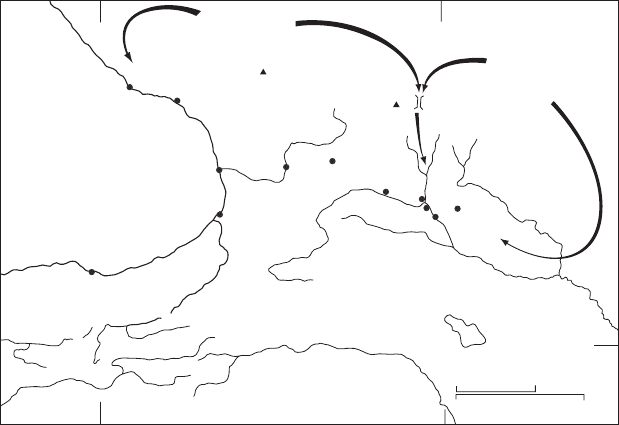
27 Protection of the frontier 189
40 °E
45 °E
40°N
0 100 km
0 miles 100
C
I
M
M
E
R
I
A
N
S
S
A
R
M
A
T
I
A
N
S
S
C
Y
T
H
I
A
N
S
Daryal Pass
Mt Elbruz
Pitiunt
Dioscurias
(Sukhumi)
Phasis
TAO KHO
I
SASPEROI
Aea
(Kutaisi)
Armazi
Sachkhere
R. Aragvi
R Rioni
Trapezus
R. Halys
R
. Euphrates
Bathys
(Batum
ı)
ARMENIA
(URARTU)
L.Sevan
TRIALETI
Black Sea
(
LAZ
)
Mt Kazbek
Mtskheta
SVANS
Caucasus
Range
C
O
L
C
H
I
S
H
E
N
I
O
C
H
I
M
A
C
R
O
N
E
S
M
O
S
S
Y
N
O
E
C
I
C
H
A
L
Y
B
E
S
T
I
B
A
R
E
N
I
R
.
A
r
a
x
e
s
M
O
S
K
H
O
I
(
M
E
S
H
E
C
H
)
A
L
B
A
N
I
A
R
.
M
t
k
v
a
r
i
(
K
u
r
a
)
R. Alazani
Ujarma
INN
ER
KAR
TLI
U
plistsikhe
Tbilisi
(Tiflis)
I
B
E
R
I
A
R
.
M
t
k
v
a
r
i
R
.
C
h
o
r
o
k
h
i
Map 12: The Caucasus
precipitations; that when they went through other passes they did so with
great difficulty, had to change their horses and were forced to make great
detours through steep territory.
71
The great powers showed great interest in the Caucasian countries
because they were hoping to engage in trade in the area
72
while stay-
ing off the enemy’s territory and also because of the necessity to protect
the frontier against attacks from the north. Already during the Arsacid
period the Transcaucasian peoples had represented a lingering force that
was easily mobilised and intervened in the rivalries of the areas in the
Caucasus and along the Caspian Sea and seriously affected the balance of
power.
73
Ib
¯
eria was a small but because of its location an important country,
which represented a bulwark against the peoples attacking from the north
(map 12).
74
The fact that they controlled the portae Caucasiae enabled
71
Proc. BP i.10.3–8; in this passage Procopius also confuses the Caspian with the Iberian Gates; Veh
1970: 465–6 and Standish 1970: 17–24.
72
Cf. the references on p. 202 with n. 147.
73
Halfmann 1986: 43; Toumanoff 1971: 111–58.
74
On the trade related aspects of controlling Ib
¯
eria see Magie 1919: 302–3 and Charlesworth 1970: 106;
on the geographical situation of Ib
¯
eria see Hewsen 1992: 128–41; Kettenhofen 1995c: 22–3.
190 6 Shared interests: Continuing conflicts
the Romans to intervene before the Persians could form political alliances
with northern nomadic peoples. During the first and second centuries
cooperation between Rome and Ib
¯
eria proved advantageous for both states,
and this at a time when the Romans were confronted by the Parthian
expansion westwards and their political interests in Armenia were at stake.
The peoples in the mountainous regions south of the Caucasus also feared
the Parthians, who were thus the common enemies of Rome and Ib
¯
eria.
While the Ib
¯
erians hoped that close contacts between the two would secure
their own freedom, the Romans saw these contacts as a means to stop the
Eastern power from invading this strategically important region.
The end of Parthian rule did not change the situation. Common interests
in the Caucasus intensified the relations between Rome and the Sasanian
Empire.
75
As part of the foedus of 244 between Philip the Arab and
ˇ
S
¯
ap
¯
ur
I the Roman emperor was obliged to make annual subsidiary payments
to the Sasanian king (16), money which had previously been used for
the protection of the fortresses in the Caucasus. This meant that
ˇ
S
¯
ap
¯
ur
I was henceforth responsible for maintaining the Caucasian passes. The
regulations of 244 also entailed that the Roman emperor had to withdraw
from this strategically important region where the Sasanians now gained
much influence. In the military confrontations of the following period
the Ib
¯
erian king may have fought on the Persian side; in the great
ˇ
S
¯
ap
¯
ur
Inscription the Ib
¯
erian king is listed among the subjects of the Persian
king
76
and in the Inscription of Paikuli he is still among those who show
reverence to Nars
¯
e at the beginning of his reign.
77
Only when Nars
¯
e was defeated and the two powers concluded the treaty
of 298 (6 and 17) did Rome regain hegemony over the important coun-
tries Kolchis and Ib
¯
eria, which form modern Georgia. The sixth-century
Byzantine historian Peter the Patrician states that the rulers of Ib
¯
eria had
to receive the symbols of their power from Rome.
78
The territories which
ˇ
S
¯
ap
¯
ur I had conquered in this part of the Caucasus had therefore been
lost by the end of the third century. In 298 Diocletian achieved obvious
strategic advantages and thereby continued the existing policy of protect-
ing Roman interests around the Black Sea and of securing the Caucasian
passes. It is doubtful whether the Caucasus region was also an issue in the
agreements of the year 363 (18). However, John the Lydian, who wrote his
75
On the Sasanian interests see Yuzbashian 1996: 143–64.
76
ˇ
SKZ § 44 (p. 355 ed. Back); on the successes of
ˇ
S
¯
ap
¯
ur I in the Caucasus see Kettenhofen 1982c: 42–3.
77
Inscription of Paikuli § 92 (p. 71, ed. Skjaervo).
78
Petr. Patr. frg. 14 (FHG iv 189).
27 Protection of the frontier 191
work De magistratibus during the first half of the sixth century, conveys this
impression.
79
John Lydus, De magistratibus
iii
.52
As the ankles of the Caucasus are split by nature – towards the sun when it
rises under the constellation of the Lion at the narrow beginning of the Caucasus,
towards the north wind by the Caspian Sea, an entrance was created for a barbarian
people settling around Hyrkania but unknown both to us and the Persians.
80
Through this entrance they attack Persian territory in the East, Roman territory
in the North. And as long as the Romans were in control of Artaxata and also of
further territories they were present there and thus used to go against them. But
when during the reign of Jovian they had given up this and many other territories
81
the Persians were not strong enough to protect their own and the previously Roman
territory and therefore on both sides Armenia was constantly afflicted by unbearable
unrest.
82
In consequence then after the luckless reign of Jovian talks took place
between our hyparch Salutius
83
and the most eminent Persians, and later with
Yazdgard,
84
to the effect that both states would share the costs and establish a
fortress at the described entrance and set up a garrison in these places in order to
stop the barbarians from pouring through. However, as the Romans were occupied
by their wars in the West and North the Persians – being closer to the attacks of
the barbarians – were forced to erect a fortress there, which they call Biraparach in
their language,
85
and stationed troops there. And no enemy managed to come in.
John the Lydian, who was born in Philadelphia (Lydia) and became a
teacher of rhetoric in Constantinople, is the author of several works; to
some extent his accounts are confused and often superficial but they nev-
ertheless provide important information on cultural and administrative
aspects of the Roman Empire. In particular the author’s knowledge of the
situation in the eastern Roman Empire seems excellent. The above passage
comes from a work that not only informs us about Roman officials during
the republic and the imperial period into late antiquity but also frequently
refers to geography and natural history. In spite of evident chronological
inconsistencies
86
Lydus’ narrative throws light on the special geographical
79
On the author and his work see Carney 1971; for text and English translation see Bandy 1983a and b.
80
John Lydus must be referring to the portae Caucasiae.
81
On the foedus concluded between Jovian and
ˇ
S
¯
ap
¯
ur in the year 363 see 18.
82
On the ‘partition’ of Armenia between the great powers see above, pp. 184–6 with n. 56.
83
As praefectus praetorio Orientis Salutius played a major role in the successful conclusion of the peace
treaty of 363.
84
Luther 1997: 105 n. 28 suggests that this man is neither Yazdgard I (399–421) nor Yazdgard II
(439–57) but an otherwise unknown Persian diplomat who led the negotiations with Salutius; such
negotiations would then have taken place before Salutius left office, that is before 366–8.
85
This fortress must be identical with the Iuroeipaach mentioned by Priscus, frg. 41.1 (= FHG iv 105).
86
For a detailed analysis see Blockley 1985a: 63–74 and Luther 1997: 104–8.
192 6 Shared interests: Continuing conflicts
and political role the Caucasus region played between the two great pow-
ers. Three aspects are crucial: first the dangers posed by invasions of the
‘barbarians’, secondly the fact that by themselves neither Rome nor the
Persian Empire were able to guard the Caucasus region and thus to protect
their own territory and, thirdly, the necessity to make arrangements for the
protection of the frontier together, to guarantee this by official agreements
and in particular to assign and agree on the financial contributions of each
side.
In this context the ancient author also refers to the peace treaty of the year
363 (18). He confirms once more the loss of important strategic positions
that Jovian had to accept after Julian’s catastrophic defeat in his Persian
War (8). As after 363
87
the Romans withdrew from the Caucasus extremely
slowly, the Persians thought that they had to increase their efforts to protect
the region. John the Lydian seems to indicate that the Romans henceforth
no longer met their financial obligations with regard to the Caucasus.
88
In
the end the Persians could not accept the fact that the Roman payments
had ceased and they decided to invade Syria and Cappadocia.
89
It is also
significant that the author refers to negotiations regarding the costs for
building a fortress in order to protect the portae Caucasiae and for setting
up a garrison. However, it would appear that it did not come to an official
agreement.
In spite of the hostile atmosphere between Rome and Persia, both shared
an interest in fending off bellicose nomadic tribes. However, an agreement
to that effect would have had to be based on an alliance that most probably
did not form until the beginning of the fifth century, and not, as John the
Lydian claims, as early as 363.
90
Certainly from the end of the fourth century
and with the increasing frequency of the attacks by the Huns, which posed
a serious threat to the West and the East, the protection of the Caucasian
passes became a crucial issue for both great powers.
91
This was still the
case when in the following period Rome had to turn to the more and more
pressing problems along the frontiers along the Rhine and the Danube and
the Sasanians alone often had to bear the financial burden of protecting
the Caucasus region. As a consequence the relations tended to deteriorate
and the outbreak of the wars of 421–2 and 441 (19) was directly linked to
87
The confrontations between Valens and
ˇ
S
¯
ap
¯
ur II in Ib
¯
eria between 362 and 378 (Amm. xxvii.12.1–2
and xxvii.30.2–3) reveal that the great powers continued to fight over the country; cf. also Chrysos
1993: 183.
88
Luther 1997: 105–6.
89
Lyd. Mag. iii.53.
90
Synelli 1986: 106–20.
91
Chrysos 1993: 183.