
Dinc Ibrahim. Refrigeration systems and applications 2th edition
Подождите немного. Документ загружается.


Refrigerants 71
2.5 Refrigerant–Absorbent Combinations
The refrigerant–absorbent combinations (so-called working fluids) are basically used in absorp-
tion refrigeration and heat pump systems. Inorganic and organic groups are major sources of the
refrigerants and absorbents. Some organic groups for refrigerants are amines, alcohols, halogens, and
HCs, and for absorbents, alcohols, ethers, alcohol-ethers, amides, amines, amine-alcohols, esters,
ketones, acids, or aldehydes can be used.
Two well-known examples are ammonia–water and water–lithium bromide. In some literature,
the absorbent is also called the solvent. The absorbent should have a greater chemical affinity
for the refrigerant than that indicated by the ordinary law of solubility. Very little heat is released
when the freons, nitrogens, or certain other gases are dissolved in water. However, water has a high
chemical affinity for ammonia, and considerable heat is evolved during absorption. For example,
at 15
◦
C one unit of water can absorb approximately 800 units of ammonia. Thus the quantity of
heat released in absorption is a crude measure of the chemical affinity.
In practical absorption–refrigeration applications, besides ammonia–water and water–lithium bro-
mide combinations, various refrigerant–absorbent combinations have been considered such as:
• ammonia/calcium chloride,
• ammonia/strontium chloride,
• ammonia/heptanoyl,
• ammonia/triethanolamine,
• ammonia/glycerin,
• ammonia/silicon oil,
• ammonia/lithium nitrate,
• ammonia/lithium bromide,
• ammonia/zinc bromide,
• ammonia/dimethyl ether tetraethylene glycol (DMETEG),
• ammonia/dimethyl formamide (DMF),
• methyl amine/water,
• methyl chloride/tetraethylene glycol,
• R12/dimethyl acid amide,
• R12/cyclohexanone,
• R21/dimethyl ester,
• R22/DMETEG,
• R22/DMF, and
• R22/dimethyl acid amide.
The interest in finding new refrigerants and working fluids brought R134a as an alternative
refrigerant with DMETEG and DMF forefront for absorption refrigeration and heat pump
systems.
A desirable refrigerant–absorbent combination should have the property of high solubility at
conditions in the absorber but should have low solubility at conditions in the generator. In absorp-
tion refrigeration and heat pump systems, the following summarizes the desirable properties and
influences of the absorbents (Dincer, 1997):
• negligible vapor pressure at the generator, compared to the vapor pressure of the refrigerant at
37.5
◦
C, influencing rectifier losses and operating cost;
• good temperature, pressure, and concentration relations (absorbent should remain liquid through-
out the cycle, and the relations must be in conformity with practical condenser, absorber, and
generator temperatures and pressures);

72 Refrigeration Systems and Applications
• high stability, influencing the ability to withstand the heating operation at the maximum temper-
atures encountered in the generator;
• low specific heat, influencing heat-transfer requirements;
• low surface tension, influencing heat transfer and absorption; and
• low viscosity, influencing heat transfer and power for pumping.
Also, refrigerant–absorbent combinations are expected to meet the following requirements:
• solubility (high solubility of the refrigerant at the temperatures of the cooling medium, e.g., air
or water, and at a pressure corresponding to the vapor pressure of the refrigerant at 5
◦
C, plus
low solubility of the refrigerant in the absorbent at generator temperatures and at a pressure
corresponding to the vapor pressure of the refrigerant at the temperature of the cooling medium);
• stability (refrigerant and absorbent must be incapable of any nonreversible chemical action with
each other within a practical temperature range, for example, from −5 to 120
◦
C); and
• superheating and supercooling (influencing operation).
The properties of the combinations relate to the liquid and/or vapor state, as encountered in normal
operation of absorption systems using such combinations, and to the crystallization boundary of
the liquid phase, where applicable. The property data can be classified as follows:
• vapor–liquid equilibria,
• crystallization temperature,
• corrosion characteristics,
• heat of mixing,
• liquid-phase densities,
• vapor–liquid-phase densities,
• specific heat,
• thermal conductivity,
• viscosity,
• stability,
• heat mass transfer rates,
• entropy,
• refractive index,
• surface tension,
• toxicity, and
• flammability.
2.6 Stratospheric Ozone Layer
Here, we explain some very important definitions and names before going into details.
UV radiation is a portion of the electromagnetic spectrum with wavelengths shorter than visible
light. The sun produces UV, which is commonly split into three bands known as UVA, UVB, and
UVC.
• UVA. This is a band of UV radiation with wavelengths from 320–400 nm produced by the sun
and is not absorbed by ozone. This band of radiation has wavelengths just shorter than visible
violet light.
• UVB. This is a band of UV radiation with wavelengths from 280–320 nm produced by the
sun. UVB is a kind of UV light from the sun (and sun lamps) that has several harmful effects,
particularly effective at damaging DNA. It is a cause of melanoma and other types of skin cancer.
It has also been linked to damage to some materials, crops, and marine organisms. The ozone
layer protects the earth against most UVB coming from the sun. It is always important to protect

Refrigerants 73
oneself against UVB, even in the absence of ozone depletion, by wearing hats, sunglasses, and
sunscreen. However, these precautions will become more important as ozone depletion worsens.
• UVC. This is a band of UV radiation with wavelengths shorter than 280 nm. Despite being
extremely dangerous, it is completely absorbed by ozone and normal oxygen (O
2
).
Stratosphere is a region of the atmosphere above the troposphere and extends from about
15 to 50 km in altitude. As a matter of fact, in the stratosphere, temperature increases with altitude
because of the absorption of UV light by oxygen and ozone. This creates a global inversion layer
which impedes vertical motion into and within the stratosphere – since warmer air lies above colder
air in the upper stratosphere, convection is inhibited. The word stratosphere is related to the word
stratification or layering.
Troposphere is a region of the atmosphere closest to the earth and extends from the surface up
to about 10 km in altitude, although this height varies with latitude. Almost all weather takes place
in the troposphere. Mt Everest, the highest mountain on earth, is only 8.8 km high. Temperatures
decrease with altitude in the troposphere. As warm air rises up, it gets cooled, falling back to
the earth. This process, known as convection, means that there are huge air movements that mix the
troposphere very efficiently.
Ozone is a gas composed of three atoms of oxygen, known as a bluish gas, that is harmful
to breathe. Nearly 90% of the earth’s ozone is situated in the stratosphere and is referred to
as the ozone layer . Ozone absorbs a band of UVB that is particularly harmful to living organisms.
The ozone layer prevents most UVB from reaching the ground.
Ozone layer is a region of the stratosphere containing the bulk of atmospheric ozone. The ozone
layer lies approximately 15–40 km above the earth’s surface, in the stratosphere. The ozone layer is
between 2 and 5 mm thick in the stratosphere under normal temperature and pressure conditions and
its concentration varies depending on the season, hour of the day, and location. The concentration
is greatest at an altitude of about 25 km near the equator and at about an altitude of 16 km near the
poles. The ozone comes mostly from the photodisassociation of oxygen by UV radiation of very
short wavelength (i.e., 200 µm).
Column ozone is the ozone between the earth’s surface and outer space. Ozone levels can be
described in several ways. One of the most common measures is the amount of ozone in a vertical
column of air. The Dobson unit (DU) is a measure of column ozone, which is described in the next
paragraph. Other measures include partial pressure, number density, and concentration of ozone,
and can represent either column ozone or the amount of ozone at a particular altitude.
Dobson unit (DU) is a measure of column ozone levels. If 100 DU of ozone were brought to the
earth’s surface, it would form a layer of 1 mm thickness. In the tropics, ozone levels are typically
between 250 and 300 DU year-round. In temperate regions, seasonal variations can produce large
swings in ozone levels. For instance, measurements in St Petersburg have recorded ozone levels
as high as 475 DU and as low as 300 DU (Wayne, 1991). These variations occur even in the
absence of ozone depletion. Ozone depletion refers to reductions in ozone below normal levels
after accounting for seasonal cycles and other natural effects. A DU is convenient for measuring
the total amount of ozone occupying a column overhead. If the ozone layer over the United States
were compressed to 0
◦
C and 1 atm pressure, it would be about 3 mm thick. So, 0.01 mm thickness
at 0
◦
C and 1 atm is defined to be 1 DU; this makes the ozone layer over the United States measures
∼300 DU. In absolute terms, 1 DU is about 2.7 × 10
16
mol/cm
2
(Wayne, 1991). In total, there are
about 3 billion metric tons, or 3 × 10
15
g, of ozone in the earth’s atmosphere; about 90% of this is
in the stratosphere. In absolute terms, ozone is distributed at about 10
12
mol/cm
3
at 15 km, rising
to nearly 10
13
at 25 km, then falling to 10
11
at 45 km; and in relative terms, ozone is distributed at
about 0.5 parts per million by volume (ppmv) at 15 km, rising to ∼8 ppmv at ∼35 km and falling
to ∼3 ppmv at 45 km (Wayne, 1991).
In the past, ozone measurements were made from the ground utilizing an accurately cali-
brated Dobson instrument and, more recently, other types. The fluctuation in the concentration
74 Refrigeration Systems and Applications
was extremely large depending on the season and the seasonal activities of weather due to varying
solar activity, some of which was of an apparently stochastic nature with the reason yet unexplained.
2.6.1 Stratospheric Ozone Layer Depletion
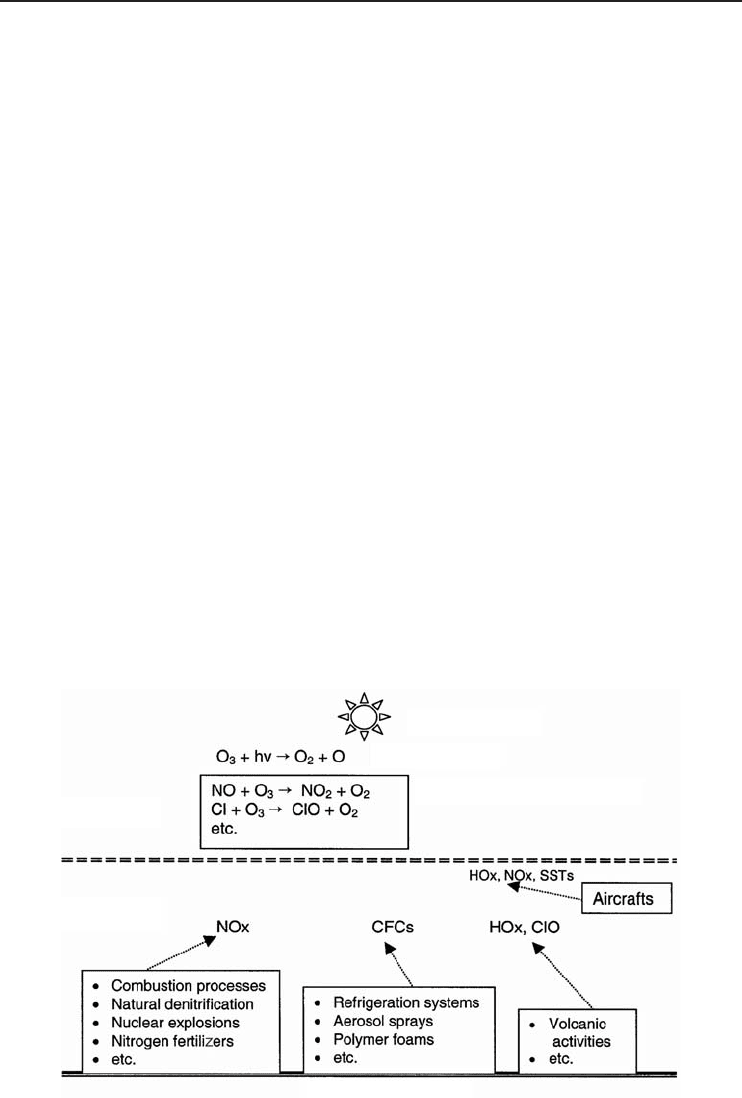
The stratospheric ozone layer depletion is a chemical destruction beyond natural reactions and is
known as one of the global environmental problems (Figure 2.1). It has been shown that this issue
is mainly caused by the ozone depletion substances (ODSs). Stratospheric ozone is constantly being
created and destroyed through natural cycles. Various ODSs, however, accelerate the destruction
processes, resulting in less than normal ozone levels. Depletion of this layer by ODS will lead
to higher UVB levels, which in turn will cause increased skin cancers and cataracts and potential
damage to some marine organisms, plants, and plastics.
The ozone-depleting substances are the compounds that contribute to stratospheric ozone
depletion. ODSs include CFCs, HCFCs, halons, methyl bromide, carbon tetrachloride, and methyl
chloroform. ODSs are generally very stable in the troposphere and only degrade under intense UV
light in the stratosphere. When they break down, they release chlorine or bromine atoms, which
then deplete ozone.
Three decades ago, Rowland and Molina first launched a theory that CFCs and some other
anthropogenic trace gases in the atmosphere may act to deplete the stratospheric ozone layer by
catalytic action of free chlorine. They predicted very rapid reduction of ozone concentration despite
having ozone measurements almost steady for nearly 50 years, without any serious consideration.
This theory brought in a new phase in the modeling of stratospheric chemistry and gave rise
to renewed activities in the field. In fact, the most significant point that makes the conditions
quite complicated is the natural air movement in all directions, air having nearly 40 different
compounds giving several hundred possible reactions. That is why the models were extremely
complex. The reduction in mean ozone level was estimated in the range between 0 and 10%,
depending on the assumptions.
Stratosphere
Troposphere
Ozone depletion reactions
Earth's surface
Cosmic radiation
Photodissociation
Figure 2.1 A schematic representation of stratospheric ozone depletion.

Refrigerants 75
In the 1930s, Chapman described the following reactions: ozone is created in the upper strato-
sphere by short-wavelength UV radiation (less than ∼240 nm) when it is absorbed by oxygen
molecules (O
2
), which dissociate to give oxygen (O) atoms. These atoms combine with other
oxygen molecules and make ozone as follows (Rowland, 1991; Dincer, 1997):
O
2
+ UV → 2O and O + O
2
→ O
3
Sunlight with wavelengths ranging between 240 and 320 nm is absorbed by ozone, which then
falls apart to give an O atom and an O
2
molecule. Ozone is transformed back into oxygen if an O
atom comes together with an O
3
as follows:
O
3
+ sunlight → O + O
2
and O + O
3
→ 2O
2
This cycle seems to combine with many actions, particularly catalytic destructive actions. An
example of ozone depletion is as follows:
R + O
3
→ RO + O
2
and RO + O → R + O
2
where R may be nitrogen or hydroxide or chlorine radicals.
CFCs are compounds with at least one chlorine, one fluorine, and one carbon atom in their
molecule. Chlorine from the CFCs has been understood to lead to the depletion of ozone in the
stratosphere. It is the chlorine that makes a substance ozone depleting; CFCs and HCFCs are a
threat to the ozone layer but HFCs are not.
If the ozone depletion continues, it is likely to have effects on the following:
• human skin, with the development of skin tumors and more rapid aging of the skin,
• human eyes, with an increase in cataracts,
• human immunological system, and
• land and sea biomass, with a reduction in crop yields and in the quantity of phytoplankton.
2.6.2 Ozone Depletion Potential
The ODP is a number that refers to the amount of stratospheric ozone depletion caused by a sub-
stance. The ODP is the ratio of the impact on ozone of a chemical compared to the impact of
a similar mass of R-11. Thus, the ODP of R-11 is defined to be 1.0. Other CFCs and HCFCs
have ODPs that range from 0.01 to 1.0. The halons have ODPs ranging up to 10. Carbon tetra-
chloride has an ODP of 1.2 and methyl chloroform’s ODP is 0.11. HFCs have zero ODP because
they do not contain chlorine. The ODP data of all ozone-depleting substances are tabulated in
Table 2.2.
As an example, a compound with an ODP of 0.2 is roughly about one-fifth as harmful as R-11.
The ODP of any refrigerant (i.e., R-X) is defined as the ratio of the total amount of ozone destroyed
by a fixed amount of R-X to the amount of ozone destroyed by the same mass of R-11, as follows:
ODP (R-X) = (Ozone loss because of R-X)/(Ozone loss because of R-11)
CFCs are considered to be fully halogenated. This means that there are no hydrogen atoms, only
halogens (chlorine, fluorine, bromine, etc.). As mentioned earlier, the refrigerants with hydrogen
atoms are known as HCFCs (e.g., R-22, R-123, R-124, R-141b, and R-142b); they are not fully
halogenated and are less stable than CFCs. The computed ODP values for HCFC refrigerants are
very low (on the order of 0.01 to 0.08) compared to the values estimated for CFCs (on the order
of 0.7 to 1, for R-11, R-12, R-113, and R-114 and about 0.4 for R-115). It is for this reason that
the Montreal Protocol had a main goal of phasing out CFC-type refrigerants. There is a family of
refrigerants with an estimated ODP value of zero and without any chlorine, called HFCs.Some

76 Refrigeration Systems and Applications
Table 2. 2 ODPs, GWPs, and CAS numbers of Class I and II ODSs.
Chemical Name ODP GWP CAS Number
Class I
Group I
CFC-11 Trichlorofluoromethane 1.0 4,000 75-69-4
CFC-12 Dichlorodifluoromethane 1.0 8,500 75-71-8
CFC-113 1,1,2-Trichlorotrifluoroethane 0.8 5,000 76-13-1
CFC-114 Dichlorotetrafluoroethane 1.0 9,300 76-14-2
CFC-115 Monochloropentafluoroethane 0.6 9,300 76-15-3
Group II
Halon 1211 Bromochlorodifluoromethane 3.0 1,300 353-59-3
Halon 1301 Bromotrifluoromethane 10.0 5,600 75-63-8
Halon 2402 Dibromotetrafluoroethane 6.0 – 124-73-2
Group III
CFC-13 Chlorotrifluoromethane 1.0 11,700 75-72-9
CFC-111 Pentachlorofluoroethane 1.0 – 354-56-3
CFC-112 Tetrachlorodifluoroethane 1.0 – 76-12-0
CFC-211 Heptachlorofluoropropane 1.0 – 422-78-6
CFC-212 Hexachlorodifluoropropane 1.0 – 3182-26-1
CFC-213 Pentachlorotrifluoropropane 1.0 – 2354-06-5
CFC-214 Tetrachlorotetrafluoropropane 1.0 – 29255-31-0
CFC-215 Trichloropentafluoropropane 1.0 – 1599-41-3
CFC-216 Dichlorohexafluoropropane 1.0 – 661-97-2
CFC-217 Chloroheptafluoropropane 1.0 – 422-86-6
Group IV
CC1
4
Carbon tetrachloride 1.1 1,400 56-23-5
Group V
Methyl chloroform 1,1,1-trichloroethane 0.1 110 71-55-6
Group VI
CH
3
Br Methyl bromide 0.7 5 7-55-6
Group VII ––
CHFBr
2
1.0 – –
CHF
2
Br (HBFC-12B1) 0.74 – –

Refrigerants 77
Table 2. 2 (continued)
Chemical Name ODP GWP CAS Number
CH
2
FBr 0.73 – –
C
2
HFBr
4
0.3–0.8 – –
C
2
HF
2
Br
3
0.5–1.8 – –
C
2
HF
3
Br
2
0.4–1.6 – –
C
2
HF
4
Br 0.7–1.2 – –
C
2
H
2
FBr
3
0.1–1.1 – –
C
2
H
2
F
2
Br
2
0.2–1.5 – –
C
2
H
2
F
3
Br 0.7–1.6 – –
C
2
H
3
FBr
2
0.1–1.7 – –
C
2
H
3
F
2
Br 0.2–1.1 – –
C2H
4
FBr 0.07–0.1 – –
C
3
HFBr
6
0.3–1.5 – –
C
3
HF
2
Br
5
0.2–1.9 – –
C
3
HF
3
Br
4
0.3–1.8 – –
C
3
HF
4
Br
3
0.5–2.2 – –
C
3
HF
5
Br
2
0.9–2.0 – –
C
3
HF
6
Br 0.7–3.3 – –
C
3
H
2
FBr
5
0.1–1.9 – –
C
3
H
2
F
3
Br
4
0.2–2.1 – –
C
3
H
2
F
3
Br
3
0.2–5.6 – –
C
3
H
2
F
4
Br
2
0.3–7.5 – –
C
3
H
2
F
5
Br 0.9–1.4 – –
C
3
H
3
FBr
4
0.08–1.9 – –
C
3
H
3
F
2
Br
3
0.1–3.1 – –
C
3
H
3
F
3
Br
2
0.1–2.5 – –
C
3
H
3
F
4
Br 0.3–4.4 – –
C
3
H
4
FBr
3
0.03–0.3 – –
C
3
H
4
F
2
Br
2
0.1–1.0 – –
C
3
H
4
F
3
Br 0.07–0.8 – –
C
3
H
5
FBr
2
0.04–0.4 – –
C
3
H
5
F
2
Br 0.07–0.8 – –
C
3
H
6
FBr 0.02–0.7 – –
(continued overleaf )

78 Refrigeration Systems and Applications
Table 2. 2 (continued)
Chemical Name ODP GWP CAS Number
Class II
HCFC-21 dichlorofluoromethane 0.04 210 75-43-4
HCFC-22 monochlorodifluoromethane 0.055 1,700 75-45-6
HCFC-31 monochlorofluoromethane 0.02 – 593-70-4
HCFC-121 tetrachlorofluoroethane 0.01–0.04 – 354-14-3
HCFC-122 trichlorodifluoroethane 0.02–0.08 – 354-21-2
HCFC-123 dichlorotrifluoroethane 0.02 93 306-83-2
HCFC-124 monochlorotetrafluoroethane 0.022 480 2837-89-0
HCFC-131 trichlorofluoroethane 0.01–0.05 – 359-28-4
HCFC-132b dichlorodifluoroethane 0.01–0.05 – 1649-08-7
HCFC-133a monochlorotrifluoroethane 0.02–0.06 – 75-88-7
HCFC-141b dichlorofluoroethane 0.11 630 1717-00-6
HCFC-142b monochlorodifluoroethane 0.065 2,000 75-68-3
HCFC-221 hexachlorofluoropropane 0.01–0.07 – 422-26-4
HCFC-222 pentachlorodifluoropropane 0.01–0.09 – 422-49-1
HCFC-223 tetrachlorotrifluoropropane 0.01–0.08 – 422-52-6
HCFC-224 trichlorotetrafluoropropane 0.01–0.09 – 422-54-8
HCFC-225ca dichloropentafluoropropane 0.025 180 422-56-0
HCFC-225cb dichloropentafluoropropane 0.033 620 507-55-1
HCFC-226 monochlorohexafluoropropane 0.02–0.1 – 431-87-8
HCFC-231 pentachlorofluoropropane 0.05–0.09 – 421-94-3
HCFC-232 tetrachlorodifluoropropane 0.008–0.1 – 460-89-9
HCFC-233 trichlorotrifluoropropane 0.007–0.2 – 7125-84-0
HCFC-234 dichlorotetrafluoropropane 0.01–0.28 – 425-94-5
HCFC-235 monochloropentafluoropropane 0.03–0.52 – 460-92-4
HCFC-241 tetrachlorofluoropropane 0.004–0.09 – 666-27-3
HCFC-242 trichlorodifluoropropane 0.005–0.13 – 460-63-9
HCFC-243 dichlorotrifluoropropane 0.007–0.12 – 460-69-5
HCFC-244 monochlorotetrafluoropropane 0.009–0.14 – –
HCFC-251 trichlorofluoropropane 0.001–0.01 – 421-41-0
HCFC-252 dichlorodifluoropropane 0.005–0.04 – 819-00-1
HCFC-253 monochlorotrifluoropropane 0.003–0.03 – 460-35-5
HCFC-261 dichlorofluoropropane 0.002–0.02 – 420-97-3
HCFC-262 monochlorodifluoropropane 0.002–0.02 – 421-02-03
HCFC-271 monochlorofluoropropane 0.001–0.03 – 430-55-7
Source: U.S. Environmental Protection Agency, EPA (2009).

Refrigerants 79
examples of HFCs mentioned above are R-125, R-134a, R-143a, and R-152a. Research and devel-
opment activities have focused on the use of these ozone- and environment-friendly refrigerants.
2.6.3 Montreal Protocol
The world’s leading ecologists and their counterparts in industry and commerce all agree that
CFCs are the primary cause of ozone-layer depletion in the atmosphere. Ozone layer depletion
and the greenhouse effect (direct or indirect) are the first environmental problems that have arisen
from the use of CFCs. In 1974, Molina and Rowland observed a hole in the ozone layer over
Antarctica, which they thought to be abnormal. There seemed to be a direct connection with CFCs.
In 1977, 3 years after Molina and Rowland presented their hypothesis of ozone destruction by
CFCs, the United Nations Environment Program organized a crucial conference to initiate action.
Since then, this situation has been discussed at several meetings and symposia. On September 19,
1987, 24 countries meeting in Montreal signed the Protocol on Substances Depleting the Ozone
Layer. The Montreal Protocol was the international treaty governing the protection of stratospheric
ozone. The Montreal Protocol and its amendments control the phaseout of ODS production and
use. Under the Protocol, several international organizations report on the science of ozone depletion,
implement projects to help move away from ODS, and provide a forum for policy discussions. In
addition, the Multilateral Fund provides resources to developing nations to promote the transition
to ozone-safe technologies.
This protocol provided for a reduction in consumption (of 20% of the 1986 consumption by
July 1, 1993 and of 50% by July 1, 1998), with later deadlines for developing countries. In addition,
many countries (over 70) signed the Protocol and accepted the regulations in the following Helsinki
Conference (May 1989) and London Conference (June 1990) and so on. Later, many countries have
adopted regulations stricter than those of the Montreal Protocol.
After the Montreal Protocol, there was a tremendous effort within the refrigeration and air-
conditioning industry to find proper replacements for CFCs now under phaseout. In this respect,
the thermodynamic aspects of replacement refrigerants, in particular, the consequences for system
operating efficiencies and the desired operating temperatures and pressures for conventional refrig-
eration equipment, are being investigated. Recently, there has been increasing interest in research
and development in many areas, for example, ecological phenomena, fluid toxicology, thermody-
namic and technological properties of the alternative refrigerants and equipment, and use of the
new cycles and systems.
2.7 Greenhouse Effect (Global Warming)
Although, the term greenhouse effect has generally been used for the role of the whole atmosphere
(mainly water vapor and clouds) in keeping the surface of the earth warm, it has been increasingly
associated with the contribution of CO
2
(currently, it is estimated that CO
2
contributes about 50%
to the anthropogenic greenhouse effect). However, several other gases such as CH
4
, CFCs, halons,
N
2
O, ozone, and peroxyacetylnitrate (so-called greenhouse gases) produced by the industrial and
domestic activities can also contribute to this effect, resulting in a rise in the earth’s temperature.
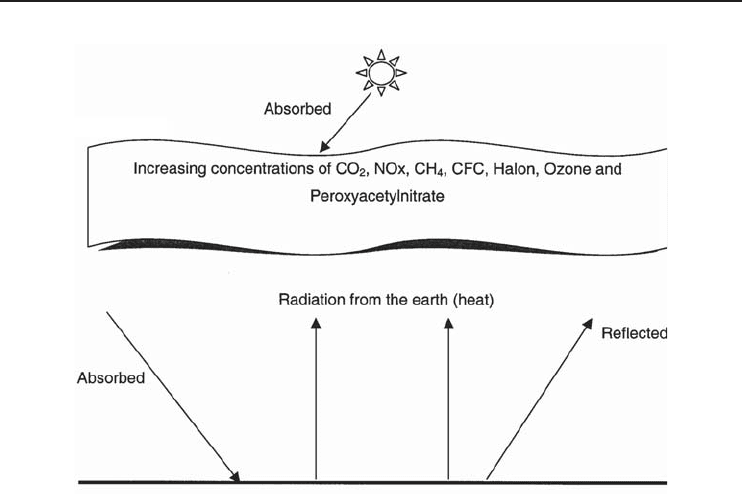
A schematic representation of this global problem is illustrated in Figure 2.2.
In the greenhouse effect phenomenon, the rays of the sun reach the earth and maintain an average
temperature level of around +15
◦
C. A large part of the infrared rays reflected off the earth are
caught by CO
2
,H
2
O, and other substances (including CFCs) present in the atmosphere and kept
from going back into space. The increase in the greenhouse effect would result in a sudden rise
in temperature and it is very likely linked with human activity, in particular, the emissions from
fossil fuel consumption.
80 Refrigeration Systems and Applications
Earth‘s surface
Trap heat and raise the earth's surface temperature
Greenhouse effect
Atmosphere
Figure 2.2 A schematic representation of the greenhouse effect.
Also, increasing the greenhouse effect may result in the following (Dincer, 2003):
• an intermediate warming of the atmosphere (estimated as 3 to 5
◦
C by 2050),
• a rise in the level of the oceans (estimated as 20 cm by 2050), and
• climatic effects (increases in drought, rain, snow, warming, and cooling).
Increasing atmospheric concentrations of CFCs have accounted for about 24% of the direct
increase in the radiative heating from greenhouse gases over the last decade. However, an observed
decrease in stratospheric ozone, thought to be connected to increasing stratospheric chlorine from
CFCs, suggests a negative radiative heating or cooling tendency over the last decade.
The release of CFCs into the atmosphere affects climate in two different ways (Badr et al., 1990):
• CFCs are highly harmful greenhouse gases (relative to CO
2
) because of their stronger IR band
intensities, stronger absorption features, and longer atmospheric lifetimes.
• CFCs deplete the stratospheric ozone layer that affects earth’s surface temperature in two
ways: more solar radiation reaching the surface–lower troposphere system, resulting in a
warmer climate and leading to lower stratospheric temperatures and, therefore, less IR radiation
being passed to the earth’s surface–lower troposphere system, resulting in lower ground-level
temperatures.
Therefore, the net effect is dependent on the altitudes where the ozone change takes place.
2.7.1 Global Warming Potential
GWP is a number that refers to the amount of global warming caused by a substance. GWP
is the ratio of the warming caused by a substance to the warming caused by a similar mass of