
Engelbrecht Andries P. Computational Intelligence: An Introduction
Подождите немного. Документ загружается.


268 14. Cultural Algorithms
process, assume that an EP is used as the search algorithm in the population space.
The resulting algorithm is referred to as a CAEP.
The belief space is used to determine the mutational step sizes, and the direction
of changes (i.e. whether step sizes are added or subtracted). Reynolds and Chung
[720] proposed four ways in which the knowledge components can be used within the
influence function:
• Only the normative component is used to determine step sizes during offspring
generation:
x
ij
(t)=x
ij
(t) + size(I
j
(t))N
ij
(0, 1) (14.12)
where
size(I
j
(t)) = x
max,j
(t) − x
min,j
(t) (14.13)
is the size of the belief interval for component j.
• Only the situational component is used for determining change direction:
x
ij
(t)=
x
ij
(t)+|σ
ij
(t)N
ij
(0, 1)| if x
ij
(t) < ˆy
j
(t) ∈S(t)
x
ij
(t) −|σ
ij
(t)N
ij
(0, 1)| if x
ij
(t) > ˆy
j
(t) ∈S(t)
x
ij
(t)+σ
ij
(t)N
ij
(0, 1) otherwise
(14.14)
where σ
ij
is the strategy parameter associated with component j of individual
i.
• The normative component is used to determine change directions, and the situ-
ational component is used to determine step sizes. Equation (14.14) is used, but
with
σ
ij
(t) = size(I(t)) (14.15)
• The normative component is used for both the search directions and step sizes:
x
ij
(t)=
x
ij
(t)+|size(I
j
(t))N
ij
(0, 1)| if x
ij
(t) <x
min,j
(t)
x
ij
(t) −|size(I
j
(t))N
ij
(0, 1)| if x
ij
(t) >x
max,j
(t)
x
ij
(t)+βsize(I
j
(t))N
ij
(0, 1) otherwise
(14.16)
where β>0 is a scaling coefficient.
14.4 Fuzzy Cultural Algorithm
Section 14.3.2 discussed a fuzzy acceptance function, which initially allows many in-
dividuals to adjust the belief space, and less individuals as the generation number
increases. This section discusses a completely fuzzy CA approach, where an alter-
native fuzzy acceptance function is used and both belief space and population space
adaptations are based on fuzzy logic. This fuzzy CA was shown to improve accuracy
and convergence speed [725].

14.4 Fuzzy Cultural Algorithm 269
14.4.1 Fuzzy Acceptance Function
Reynolds and Zhu [725] proposed an acceptance function that selects few individuals
in the early steps of the search, but more as the generation number increases. The
motivation for this approach stems from the fact that the initial population usually
has only a few fit individuals that can sensibly contribute to the belief space.
As the first step, a fuzzy similarity matrix (or fuzzy equivalence relation), R,iscon-
structed for the population space where
r
ij
=1−
|f(x
i
) − f(x
j
)|
n
s
l=1
|f(x
l
)|
(14.17)
for i, j =1,...,n
s
,withn
s
the size of the population, and R =[r
ij
]. Before calculation
of R, the individuals are sorted from best to worst according to fitness. The equivalence
relation is then used to calculate the α-cuts matrix (refer to Section 20.4), R
α
as
follows:
α
ij
=
1ifr
ij
>α(t)
0ifr
ij
≤ α(t)
(14.18)
where α(t) is referred to as the refinement value, and R
α
=[α
ij
]fori, j =1,...,n
s
.
A value of α
ij
= 1 indicates an elite individual that will be used to update the belief
space, while a value of α
ij
= 0 indicates a non-elite individual. Because elements are
sorted according to fitness, the elite elements will occupy the first elements of R
α
.
The refinement value is initialized to a large value, but bounded by the interval [0, 1],
which will ensure a small number of elite individuals. After each generation, the value
of α is changed according to
α(t +1)=
γ
1
if t ≥
1 − γ
2
(t − )/n
t
if t ∈ [0,)
(14.19)
where γ
1
and γ
2
are positive constants (suggested to be γ
1
=0.2andγ
2
=2.66 [725]),
and is set such that /t
max
=0.3.
14.4.2 Fuzzified Belief Space
Only two knowledge components are considered. The situational component is crisp
and stores the best individual. The normative component is fuzzified.
The fuzzy interval update rule occurs in the following steps for each x
l
(t),l =
1,...,n
B
(t):
1. Initialization: Upper and lower bounds are initialized to the domain, as follows:
x
min,lj
(0) = x
min,j
(14.20)
x
max,lj
(0) = x
max,j
(14.21)
where x
minj
and x
max,j
are the domain bounds for component j.

270 14. Cultural Algorithms
2. Calculate the center of the interval for each individual as
c
ij
(t)=
1
2
(x
min,lj
(t)+x
max,lj
(t)) (14.22)
Interval bounds are adjusted until x
min,lj
(t),x
max,lj
(t) ∈ [0.9c
lj
(t), 1.1c
lj
(t)].
3. Compute the fuzzy membership functions, f
L
(x
j
)andf
U
(x
j
) for each individual
for the lower and upper bounds respectively:
f
L
(x
j
)=
1
1+x
α
j
(14.23)
f
U
(x
j
)=
1
1+x
α
j
(14.24)
for α ≥ 0.
4. Update the lower boundary of each component of individual l:
x
min,lj
(t +1)=
x
min,lj
(t)+µ(x
lj
(t))(x
lj
(t) − x
min,lj
(t))
if x
min,lj
(t) ≤ x
lj
(t) < 0.9c
lj
(t)
x
min,lj
(t)
if 0.9c
lj
(t) ≤ x
lj
(t) < 1.1c
lj
(t)
(14.25)
where µ(x
lj
(t)) = f
L
(x
lj
(t)).
5. Update the upper boundary of each component of individual l:
x
max,lj
(t +1)=
x
max,lj
(t)+µ(x
lj
(t))(x
lj
(t) − x
max,lj
(t))
if 1.1c
lj
(t) <x
lj
(t) ≤ x
max,lj
(t)
x
max,lj
(t)
if 0.9c
lj
(t) ≤ x
lj
(t) ≤ 1.1c
lj
(t)
(14.26)
where µ(x
lj
(t)) = f
U
(x
lj
(t)).
14.4.3 Fuzzy Influence Function
The fuzzified normative knowledge is used to determine both the step size and the
direction of change. Mutational step sizes are based on the age, a
i
(t), of individuals
as defined in equation (11.68). For each generation that a parent performs better than
its offspring, the parent’s age is incremented. When the offpsring replaces the parent,
the corresponding age is set to 1. The influence function will effect larger mutations to
individuals with a lower age value, as such individuals are still in a strong exploration
phase. Assuming an EP for the population space, offspring are generated as follows
for each parent, x
i
(t):
x
ij
(t)=
x
ij
(t)+σ
ij
(t)|size(I
j
(t))N
ij
(0, 1)| if x
ij
(t) <x
min,ij
(t)
x
ij
(t) − σ
ij
(t)|size(I
j
(t))N
ij
(0, 1)| if x
ij
(t) >x
max,ij
(t)
x
ij
(t)+σ
ij
(t)size(I
j
(t))N
ij
(0, 1) otherwise
(14.27)
where σ
ij
(t) is computed as
σ
ij
(t)=µ(a
i
(t)) =
1 −
1
a
i
(t)
if a
i
(t) <α
0ifa
i
(t) ≥ α
(14.28)

14.5 Advanced Topics 271
where α is a positive constant. If a parent performs better than its offspring for more
than α generations, then that individual will not be mutated.
14.5 Advanced Topics
This section discusses specific CA implementations for solving constrained optimiza-
tion problems (Section 14.5.1), multi-objective optimization problems (Section 14.5.2),
and dynamic environments (Section 14.5.3).
14.5.1 Constraint Handling
Reynolds and Peng [721], and Dos Santos Coelho and Mariani [219] used a penalty
approach (refer to Section A.6.2) to solve constrained problems. The approach fol-
lowed by Reynolds [721] is to simply set the fitness of any individual that violates a
constraint, to an infeasible value. These penalty methods do not make use of the belief
space to guide individuals to move towards feasible space. Chung and Reynolds [128]
represented constraints as interval-constraint networks. These networks are then used
to determine if an individual violates any of the constraints. In the case of constraint
violations, information from the belief space is used to repair that individual.
Jin and Reynolds [419] expanded the interval representation of the normative knowl-
edge component to also represent constraints. The approach fits a grid structure over
the search space, where the cells are referred to as belief cells. Belief cells are then
classified into one of four categories (as illustrated in Figure 14.2):
• feasible, which represents a part of the search space where no constraint is
violated;
• infeasible, where at least one constraint is violated;
• semi-feasible, in which case the cell contains both feasible parts of the search
space; and
• unknown
The intervals as given in the normative knowledge component are used to divide the
search space as represented by these intervals into hypercubes or belief cells. The type
of belief cell is determined based on the number of individuals that fall in that cell.
For each cell,
• if there are no feasible or infeasible individuals, the cell is classified as unknown;
• if there are no infeasible individuals, but at least one feasible individual, the cell
is classified as feasible;
• if there are no feasible individuals, but at least one infeasible individual, the cell
is classified as infeasible; or
• if there are both feasible and infeasible individuals, the cell is classified as semi-
feasible.
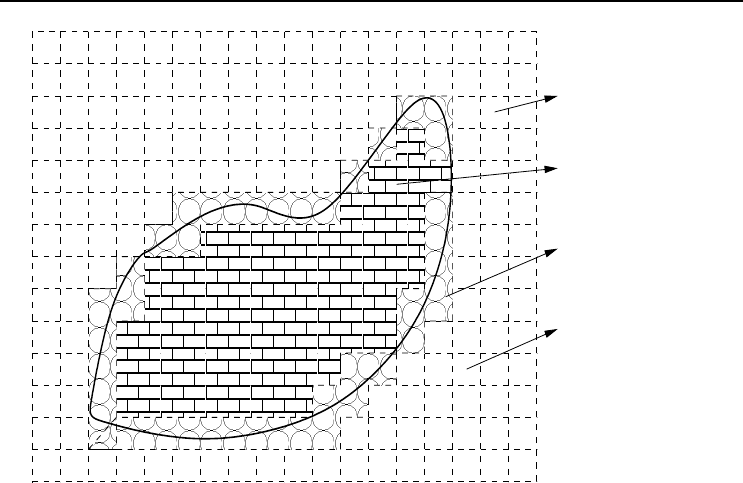
272 14. Cultural Algorithms
Search cells
Feasible cells
Semi-feasible cell
s
Infeasible cells
Figure 14.2 Illustration of Belief Cells
Initially, all cells are classified as unknown.
The update of the belief space requires the counters of feasible and infeasible individ-
uals per belief cell to be updated. At regular intervals, the normative component is
updated by redefining the hypercubes based on the most recent intervals as contained
in this knowledge component. After recalculation of hypercubes, all the feasible and
infeasible counters have to be updated. Coello and Becerra [145] proposed that the
acceptance function be adapted to use fitness as a secondary criterion in selecting in-
dividuals. Instead, feasible individuals should be given preference to update the belief
space.
The influence function is changed to promote creation of feasible offspring. If x
ij
(t)is
within a feasible, semi-feasible, or unknown hypercube, mutation is applied such that
the individual remains in the same hypercube, or stays very close to it. If x
ij
(t)isin
an infeasible cell, the direction of mutation is such that the individual moves closer
to a semi-infeasible cell. If there is no semi-feasible cell in the vicinity of x
ij
(t), the
move is made towards an unknown cell. Failing this, x
ij
(t) is initialized to a random
position within the interval defined by the normative component.
14.5.2 Multi-Objective Optimization
Coello and Becerra [146] developed the first CA for solving multi-objective optimiza-
tion problems (MOP). The belief space is constructed to consist of a normative compo-
nent (representing intervals) and a grid. The grid is constructed over objective space,

14.5 Advanced Topics 273
and for each cell the number of nondominated solutions that lie within that cell is
recorded. This information is then used to ensure that nondominated solutions are
uniformly distributed along the Pareto front.
The normative knowledge component is updated at regular intervals, while the grid
is updated at each generation. Updating the grid simply involves recalculating the
number of nondominated solutions per cell. An update to the normative component
triggers a recalculation of the grid over objective space.
Within the population space, selection of the new population is adapted to make use
of the grid information contained in the belief space. Tournament selection is used,
and applied to the parents and offspring. The rules of tournament selection is updated
as follows:
• If an individual dominates its competitor, then the dominating individual wins.
• If none of the two competing individuals are dominating, or if their objective
values are the same, then
– if one of the individuals lies outside of the grid, then that individual is
selected.
– if both lie in the grid, the one in the less populated cell is selected.
• If none of the cases above are satisfied, the more fit individual is selected.
This MOO approach using CAs maintains an archive of nondominated solutions [146].
14.5.3 Dynamic Environments
Saleem and Reynolds [752] showed that the self-adaptability of CAs, due to the dynam-
ically changing belief space, makes CAs suitable for tracking optima in dynamically
changing environments. The belief space is extended to store information from pre-
vious and current environmental states. Environmental history is stored in a table,
containing the following information for each environment: the location of the best
solution (i.e. the current item stored in the situational knowledge component), the
fitness value of that solution, the change magnitude in each dimension, and the con-
sequent change in fitness value. This information is then used in a dynamic influence
function to introduce diversity into the population, proportional to the magnitude of
change.
The step size is calculated as
∆x
ij
(t)=
2|f(x
i
(t)) −
˜
f(x
i
(t))|
ˆ
f(t)
U
ij
(0, 1) (14.29)
where f represents the landscape before change, and
˜
f represents the changed land-
scape;
ˆ
f(t) is the fitness value of the best solution as stored in the history table. This
results in large step sizes for large environmental changes; thereby increasing diversity.

274 14. Cultural Algorithms
14.6 Applications
Cultural algorithms have been applied to solve a number of problems, with one of
the first applications modeling the evolution of agriculture in the Valley of Oaxaca
(Mexico) [715, 721]. Other applications of CAs include concept learning [826], induc-
ing decision trees [718], real-valued function optimization [720], optimizing semantic
networks [747], software testing [647], assessing the quality of GP [163], data mining
[420], image segmentation [723], and robotics [287].
14.7 Assignments
1. Discuss how a CA can be used to train a FFNN.
2. What are the similarities and differences between CAs and ES?
3. Discuss the validity of the following statement: The belief space can be likened
to a blackboard system used in multi-agent systems.
4. With reference to [24], show how CAs address the three levels of adaptation:
population, individual, and component.
5. Investigate the performance of different selection operators, as discussed in Sec-
tion 8.5, as acceptance function.
6. Propose membership functions for the fuzzy sets used to implement the rules
as given in Algorithm 14.2 for the fuzzy acceptance function discussed in Sec-
tion 14.3.2.
7. Discuss the merits of the fuzzy acceptance function of Section 14.3.2 with refer-
ence to the fuzzy rules summarized in Algorithm 14.2.
8. Implement a DE for the population space of a CA, and compare its performance
with CAEP.

Chapter 15
Coevolution
Coevolution is the complementary evolution of closely associated species. Coevolution
between two species is nicely illustrated using Holland’s example of the competitive
interaction between a plant and insects [377]. Consider a certain species of plant living
in an environment containing insects that eat the plant. The survival “game” consists
of two parts: (1) to survive, the plant needs to evolve mechanisms to defend itself from
the insects, and (2) the insects need the plant as food source to survive. Both the
plant and the insects evolve in complexity to obtain characteristics that will enable
them to survive. For example, the plant may evolve a tough exterior, but then the
insects evolve stronger jaws. Next the plant may evolve a poison to kill the insects.
Next generations of the insect evolve an enzyme to digest the poison. The effect
of this coevolutionary process is that, with each generation, both the plant and the
insects become better at their defensive and offensive roles. In the next generation,
each species change in response to the actions of the other species during the previous
generation.
The biological example described above is an example of predator-prey competitive
coevolution, ‘where there is an inverse fitness interaction between the two species. A
win for the one species means a failure for the other. To survive, the “losing” species
adapts to counter the “winning” species in order to become the new winner. During
this process the complexity of both the predator and the prey increases.
An alternative coevolutionary process is symbiosis, where the different species coop-
erate instead of compete. In this case a success in one species improves the survival
strength of the other species. Symbiotic coevolution is thus achieved through a positive
fitness feedback among the species that take part in this cooperating process.
In standard EAs, evolution is usually viewed as if the population attempts to adapt in
a fixed physical environment. In contrast, coevolutionary (CoE) algorithms (CoEA)
realize that in natural evolution the physical environment is influenced by other
independently-acting biological populations. Evolution is therefore not just locally
within each population, but also in response to environmental changes as caused by
other populations. Another difference between standard EAs and CoEAs is that EAs
define the meaning of optimality through an absolute fitness function. This fitness
function then drives the evolutionary process. On the other hand, CoEAs do not
define optimality using a fitness function, but attempt to evolve an optimal species
where optimality is defined as defeating opponents (in the case of predator-prey CoE).
Computational Intelligence: An Introduction, Second Edition A.P. Engelbrecht
c
2007 John Wiley & Sons, Ltd
275

276 15. Coevolution
Section 15.1 provides a summary of different types of coevolution. Competitive coevo-
lution is discussed in Section 15.2, while some cooperative coevolution approaches are
summarized in Section 15.3.
15.1 Coevolution Types
As indicated in the introduction of this chapter, two main classes of coevolutionary
approaches can be identified, namely competitive coevolution and cooperative coevo-
lution. For each of these classes, Fukuda and Kubota [293] identified a number of
subclasses. For competitive coevolution, the following subclasses can be found:
• Competition, where both species are inhibited. Due to the inverse fitness
interaction between the two species, success in one of the species is felt as failure
by the other species.
• Amensalism, where one species is inhibited, and the other is not affected.
In the case of cooperative (or symbiotic) coevolution, the following subclasses can be
identified:
• Mutualism, where both species benefit. The positive fitness interaction leads
to an improvement in one species whenever the other species improves.
• Commensalism, where only one of the species benefits, while the other is not
affected.
• Parasitism, where one of the species (the parasite) benefits, while the other
species (the host) is harmed.
The focus of this chapter will be on competitive (predator-prey) coevolution and mu-
tualism.
15.2 Competitive Coevolution
Competitive coevolution (CCE) works to produce optimal competing species through
a pure bootstrapping process. Solutions to problems are found without any prior
knowledge from human experts, or any other information on how to solve the problem.
A CCE algorithm usually evolves two populations simultaneously. Individuals in one
population represent solutions to a problem, while individuals in the other population
represent test cases. Individuals in the solution population evolve to solve as many
test cases as possible, while individuals in the test population evolve to present an
incrementally increasing level of difficulty to the solution individuals. The fitness
of individuals in the solution population is proportional to the number of test cases
solved by the solution. The fitness of individuals in the test population is inversely
proportional to the number of strategies that solve it.
This is the CCE approach popularized by Hillis [365]. However, Hillis was not the first

15.2 Competitive Coevolution 277
to consider CCE. Miller [594, 595] and Axelrod [33] used CCE to evolve strategies
for the iterated prisoner’s dilemma (IPD). Holland [377] incorporated coevolution in
a single population GA, where individuals compete against other individuals of the
same population.
Section 15.2.1 discusses competitive fitness. The hall of fame concept is discussed in
Section 15.2.1. A generic CCE algorithm is given in Section 15.2.2. Some applications
of CCE are given in Section 15.2.3.
15.2.1 Competitive Fitness
Standard EAs use a user-defined, absolute fitness function to quantify the quality of
solutions. This absolute fitness function directly represents the optimization problem.
The fitness of each individual is evaluated independently from any other population,
or individual, using this fitness function. In CCE, the driving force of the evolution-
ary process is via a relative fitness function that only expresses the performance of
individuals in one population in comparison with individuals in another population.
Usually, the relative fitness computes a score of how many opponents are beaten by
an individual. It should be clear that the only quantification of optimality is which
population’s individuals perform better. No fitness function that describes the optimal
point is used.
In order to calculate the relative fitness of an individual, two aspects are of importance:
(1) Which individuals from the competing population are used, and (2) exactly how
these competing individuals are used to compute the relative fitness. The first aspect
refers to fitness sampling, and is discussed in Section 15.2.1. Relative fitness evaluation
approaches are summarized in Section 15.2.1.
Fitness Sampling
The relative fitness of individuals is evaluated against a sample of individuals from the
competing population. The following sampling schemes have been developed:
• All versus all sampling [33], where each individual is tested against all the
individuals of the other population.
• Random sampling [711], where the fitness of each individual is tested against
a randomly selected group (consisting of one or more) individuals from the other
population. The random sampling approach is computationally less complex
than all versus all sampling.
• Tournament sampling [27], which uses relative fitness measures to select the
best opponent individual.
• All versus best sampling [793], where all the individuals are tested against
the fittest individual of the other population.
• Shared sampling [738, 739, 740], where the sample is selected as those opponent
individuals with maximum competitive shared fitness. Shared sampling tends